Research Methods in
Management
Module IV : Analysis of Data
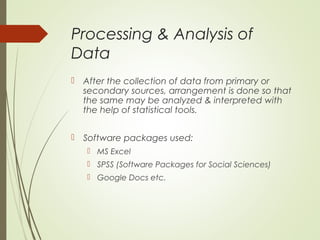
Processing & Analysis of
Data
 After the collection of data from primary or
secondary sources, arrangement is done so that
the same may be analyzed & interpreted with
the help of statistical tools.
 Software packages used:
 MS Excel
 SPSS (Software Packages for Social Sciences)
 Google Docs etc.
Processing the data
Editing
Field Editing Central Editing
Coding
Classification
Tabulation
Graphing
Data editing
 Data editing is a process by which
collected data is examined to detect
any errors or omissions and further these
are corrected as much as possible
before proceeding further.
 Editing is of two types:
1. Field Editing
2. Central Editing.
Data editing
FIELD EDITING:
 This is a type of editing that relates to abbreviated
or illegible written form of gathered data. Such
editing is more effective when done on same day
or the very next day after the interview. The
investigator must not jump to conclusion while
doing field editing.
CENTRAL EDITING:
 Such type of editing relates to the time when all
data collection process has been completed. Here
a single or common editor corrects the errors like
entry in the wrong place, entry in wrong unit etc. As
a rule all the wrong answers should be dropped
from the final results.
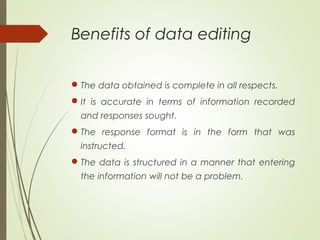
Benefits of data editing
The data obtained is complete in all respects.
It is accurate in terms of information recorded
and responses sought.
The response format is in the form that was
instructed.
The data is structured in a manner that entering
the information will not be a problem.
Data coding
 The process of identifying and denoting a numeral to
the responses given by the respondent is called
coding
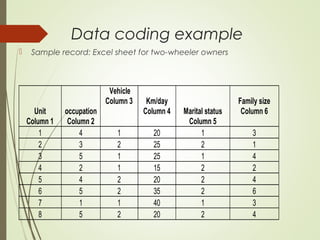
Data coding example
 Sample record: Excel sheet for two-wheeler owners
Unit
Column 1
occupation
Column 2
Vehicle
Column 3 Km/day
Column 4 Marital status
Column 5
Family size
Column 6
1 4 1 20 1 3
2 3 2 25 2 1
3 5 1 25 1 4
4 2 1 15 2 2
5 4 2 20 2 4
6 5 2 35 2 6
7 1 1 40 1 3
8 5 2 20 2 4
Classification of data
 Classification of the data implies that the
collected raw data is categorized into common
group having common feature.
 Data having common characteristics are
placed in a common group.
 The entire data collected is categorized into
various groups or classes, which convey a
meaning to the researcher.
 Classification is done in two ways:
1. Classification according to attributes.
2. Classification according to the class intervals.
CLASSIFICATION
ACCORDING THE ATTRIBUTES
 Here the data is classified on the basis of common
characteristics that can be descriptive like literacy,
sex, honesty, marital status etc.
 Descriptive features are qualitative in nature and
cannot be measured quantitatively but are kindly
considered while making an analysis.
CLASSIFICATION ON THE BASIS OF
INTERVAL
 The numerical feature of data can be measured
quantitatively and analyzed with the help of
some statistical unit like the data relating to
income, production, age, weight etc. come
under this category. This type of data is known as
statistics of variables and the data is classified by
way of intervals.
TABULATION of data
 Tabulation is an orderly arrangement of data in
rows and columns.
 Tabulation summarizes the raw data and
displays data in form of some statistical tables.
Types of tables
 Vertical Tables
 Horizontal Tables
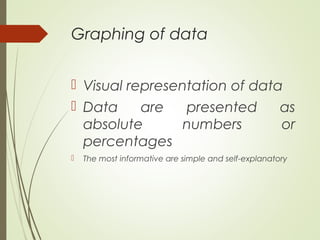
Graphing of data
 Visual representation of data
 Data are presented as
absolute numbers or
percentages
 The most informative are simple and self-explanatory
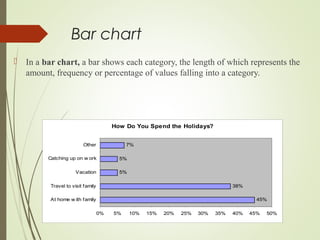
Bar chart
 In a bar chart, a bar shows each category, the length of which represents the
amount, frequency or percentage of values falling into a category.
How Do You Spend the Holidays?
45%
38%
5%
5%
7%
0% 5% 10% 15% 20% 25% 30% 35% 40% 45% 50%
At home w ith family
Travel to visit family
Vacation
Catching up on w ork
Other
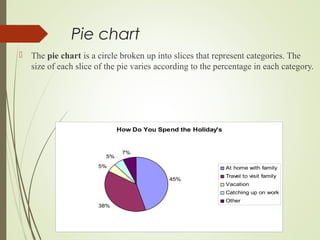
Pie chart
 The pie chart is a circle broken up into slices that represent categories. The
size of each slice of the pie varies according to the percentage in each category.
How Do You Spend the Holiday's
45%
38%
5%
5%
7%
At home with family
Travel to visit family
Vacation
Catching up on work
Other
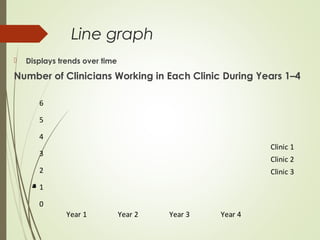
Line graph
 Displays trends over time
Number of Clinicians Working in Each Clinic During Years 1–4
0
1
2
3
4
5
6
Year 1 Year 2 Year 3 Year 4
Numberofclinicians
Clinic 1
Clinic 2
Clinic 3
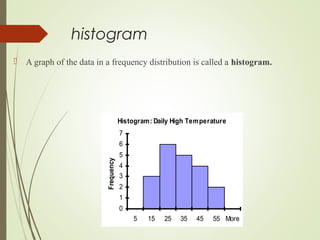
histogram
 A graph of the data in a frequency distribution is called a histogram.
Histogram: Daily High Temperature
0
1
2
3
4
5
6
7
5 15 25 35 45 55 More
Frequency
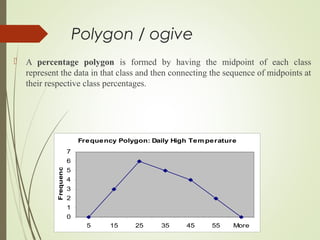
Polygon / ogive
 A percentage polygon is formed by having the midpoint of each class
represent the data in that class and then connecting the sequence of midpoints at
their respective class percentages.
Frequency Polygon: Daily High Temperature
0
1
2
3
4
5
6
7
5 15 25 35 45 55 More
Frequency
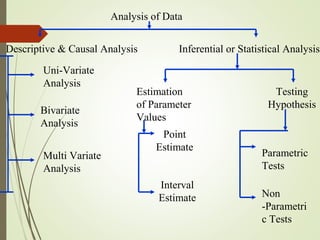
Analysis of Data
 Analysis means computation of certain indices
or measures along with searching for patterns of
relationships that exists among the data groups.
Analysis of Data
Descriptive & Causal Analysis Inferential or Statistical Analysis
Uni-Variate
Analysis
Bivariate
Analysis
Multi Variate
Analysis
Estimation
of Parameter
Values
Testing
Hypothesis
Point
Estimate
Interval
Estimate
Parametric
Tests
Non
-Parametri
c Tests
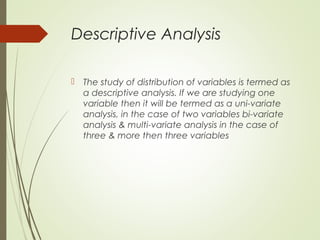
Descriptive Analysis
 The study of distribution of variables is termed as
a descriptive analysis. If we are studying one
variable then it will be termed as a uni-variate
analysis, in the case of two variables bi-variate
analysis & multi-variate analysis in the case of
three & more then three variables
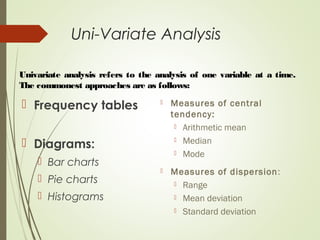
Uni-Variate Analysis
 Frequency tables
 Diagrams:
 Bar charts
 Pie charts
 Histograms
 Measures of central
tendency:
 Arithmetic mean
 Median
 Mode
 Measures of dispersion:
 Range
 Mean deviation
 Standard deviation
Univariate analysis refers to the analysis of one variable at a time.
The commonest approaches are as follows:
Bivariate Analysis
 Bivariate analysis is concerned with the analysis of two
variables at a time in order to uncover whether the two
variables are related
 Main types:
1. Simple Correlation
2. Simple Regression
3. Two-Way ANOVA
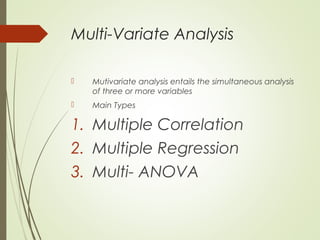
Multi-Variate Analysis
 Mutivariate analysis entails the simultaneous analysis
of three or more variables
 Main Types
1. Multiple Correlation
2. Multiple Regression
3. Multi- ANOVA
Causal Analysis
 Causal analysis is concerned with the study of
how one or more variables affect changes in
another variables
Inferential Analysis
 Inferential analysis is concerned with the testing
the hypothesis and estimating the population
values based on the sample values.
PARAMETRIC TESTS
 These tests depends upon assumptions typically
that the population(s) from which data are
randomly sampled have a normal distribution.
Types of parametric tests are:
1. t- test
2. z- test
3. F- test
4. χ2- test
Non parametric Test
Do Not Involve Population Parameters
Example: Probability Distributions,
Independence
Data Measured on Any Scale
(Ratio or Interval, Ordinal or Nominal)
presented by
Dr. Dharmesh Motwani.
Visit us online at
www.TheStockker.com