Marketing Management
Module I
What is Marketing?
Marketing is a human activity directed at satisfying needs & wants
through exchange process.
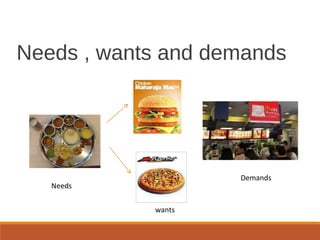
Needs , wants and demands
Needs
wants
Demands
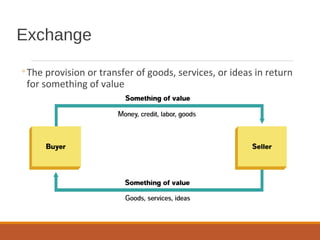
Exchange
◦The provision or transfer of goods, services, or ideas in return
for something of value
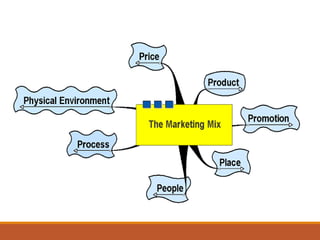
Marketing Mix
The tools available to a business to gain the reaction it is
seeking from its target market in relation to its marketing
objectives.
Traditional 4 P’s v/s Modern 7 P’s
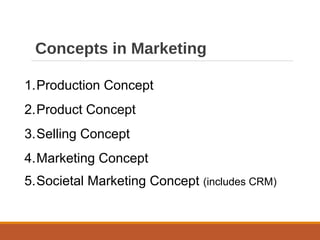
Concepts in Marketing
1.Production Concept
2.Product Concept
3.Selling Concept
4.Marketing Concept
5.Societal Marketing Concept (includes CRM)
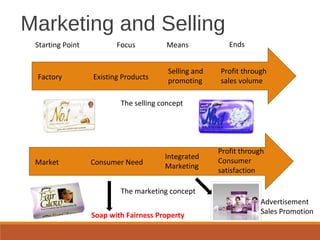
Starting Point Focus Means Ends
Factory Existing Products
Selling and
promoting
Profit through
sales volume
Market Consumer Need
Integrated
Marketing
Profit through
Consumer
satisfaction
The selling concept
The marketing concept
Marketing and Selling
Soap with Fairness Property
Advertisement
Sales Promotion
Importance of Marketing
Developing the products or services that customers want.
Pricing the products or services correctly
Making the products or services readily available to the
customers
Promoting the product or service
Delivers Profitable Growth
Scope of Marketing
What is Marketing?
What is Marketed?
Who Markets?
How Business & Marketing are changing?
Strategic Planning
Strategic planning is defined as:
◦“The process of developing and maintaining a strategic fit between the
organization’s goals and capabilities and its changing marketing
opportunities.”
Strategic Planning
Defining the purpose & mission
Setting Objectives & Goals
Designing the business portfolio
Developing detailed marketing plans
Strategic Planning
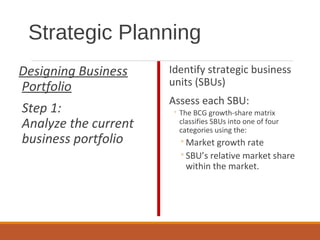
Designing Business
Portfolio
Step 1:
Analyze the current
business portfolio
Identify strategic business
units (SBUs)
Assess each SBU:
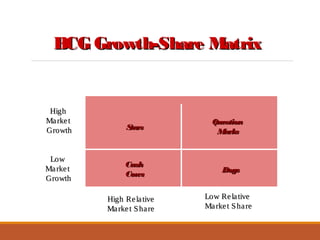
◦ The BCG growth-share matrix
classifies SBUs into one of four
categories using the:
◦Market growth rate
◦SBU’s relative market share
within the market.
BCG Growth-Share MatrixBCG Growth-Share Matrix
High RelativeHigh Relative
Market ShareMarket Share
HighHigh
MarketMarket
GrowthGrowth
LowLow
MarketMarket
GrowthGrowth
StarsStars
CashCash
CowsCows
QuestionQuestion
MarksMarks
DogsDogs
Low RelativeLow Relative
Market ShareMarket Share
Strategic Planning
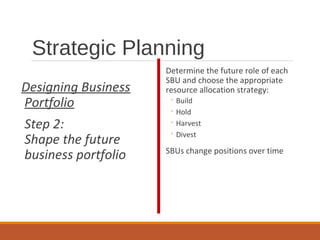
Designing Business
Portfolio
Step 2:
Shape the future
business portfolio
Determine the future role of each
SBU and choose the appropriate
resource allocation strategy:
◦ Build
◦ Hold
◦ Harvest
◦ Divest
SBUs change positions over time
Strategic Planning
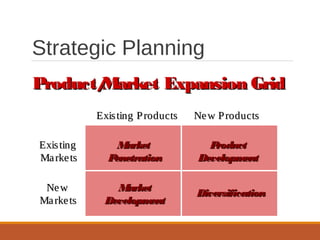
Product/Market Expansion GridProduct/Market Expansion Grid
Existing ProductsExisting Products New ProductsNew Products
ExistingExisting
MarketsMarkets
NewNew
MarketsMarkets
MarketMarket
PenetrationPenetration
MarketMarket
DevelopmentDevelopment
ProductProduct
DevelopmentDevelopment
DiversificationDiversification
Marketing Planning
Process
Assessing opportunities & Threats
Establishing Marketing Objectives
Framing Marketing Strategies
Programming of Operations
Developing Marketing Mix
Designing resource-mobilization plan
Monitoring the operations
Customer Value
From customer point of view
◦How a customer perceive any product profitable for him/her on
different grounds
From firm point of view
◦Profitability of any customer
Customer Value Model
◦Conventional firm centric
◦Contemporary customer centric
Measuring the Customer
Value
Customer Satisfaction
Customer Loyalty
Marketing Environment
It consists of the actors & forces to the marketing that
affect marketing management's ability to develop and
maintain successful exchanges with its customers"
Components of Marketing
Environment
Internal Environment
External Environment
◦Micro
◦Macro
Components of Marketing
Environment
Micro Environment
◦Customers
◦Suppliers
◦Intermediaries
◦Employees
◦Competitors
◦Shareholders
Components of Marketing
Environment
Macro Environment
◦Economic Environment
◦Political Environment
◦Social & Cultural Environment
◦Demographic Environment
◦Technological Environment
Environmental Scanning
Gathering information & analyzing it
Forecasting the Impact
Techniques
◦Marketing Information system
◦Marketing Research
◦Sales force opinion
◦Delphi Technique
◦Quantitative Techniques
Rural Marketing
Rural Marketing is defined as any marketing activity in
which one dominant participant is from a rural area. This
implies that rural marketing consists of marketing of inputs
(products or services) to the rural as well as marketing of
outputs from the rural markets to other geographical areas.
Profile of Rural Market in
India
Due to near saturation of urban markets, companies are
looking at rural markets for further expansion & growth.
There are 742 million rural consumers.
Good growth of agriculture during 1990s – as a result of
13 consecutive good monsoons (barring 2002 & 2003).
From 8th
to 10th
Plan, there has been 600% increase in 5-
Year Plan outlay.
Profile of Rural Market in
India
Between 1997-98 and 2004-05, there has been 230% increase in
flow of institutional credit for agriculture.
Since 1998, 41 million Kisan Credit Cards (KCC) have been issued
and Rs.97,700 crore worth of credit has been sanctioned.
Growth of agriculture has resulted in rapid rise of rural incomes.
Profile of Rural Market in
India
Census of India – any habitation with population density of
less than 400 per sq. km., where at least 75% of male
working population is engaged in agriculture & where
there exists no municipality or board.
Of the nearly 6.4 lakh villages in India, only 20,000 villages
have populations of more than 5000.
Most companies in FMCG sector would define rural as any
place with a population upto 20000.
Durable & agri-input companies would consider any town
with a population below 50000 as rural
Sales increased as Compare to
2010 in 2011
Milk & allied products 41%, while it was only 8% in 2010
Shampoo & Toilet soap 10 to 25%, demand of “Dove” &
“Pears” is increased drastically.
Toothpaste 47%, which was 31% in 2010
Rural Pharma market alone grew by 18.8%
Some facts
As per NSSO in 2010-11 per capita expenditure is now
Rs.953 per month, which is 70% more than the year 2004-
05
MGNAREGA has increased the income of rural women
Branded commodities are preferred because of increased
awareness
Rural population has grown by 12% in last decade
Few myths about rural
sector
Rural people do not buy brands – in fact, branded
consumption, both national & regional, accounts for
80% of sales of FMCGs.
Rural consumers buy cheap products – in reality, they
seek value for money.
Rural market is homogeneous mass – in fact it is
fascinatingly heterogeneous – a farmer in Punjab is
more progressive than his counterpart in Bihar. A
farmer in Karnataka is far more educated than one in
Rajasthan, and so on.
Problems of Rural
Marketing
Physical Distribution
Channels of Distribution
Sales Force Problems
Marketing Communication
Duplicated Products
Customers’ Profile
Channel Management in Rural
Markets
 Local Retailers & Dealers
 Co-operative Societies
 Public Distribution System
 Multipurpose distribution centers by petroleum
and oil companies
 Feeder Markets
 Hats & Melas
 Agricultural Dealers
Challenges of Rural
Communication
Widespread geographical dispersion (6,38,000
villages) – many beyond reach of conventional
media.
Vast variations in literacy (90% in Kerala, 44%
in Bihar)
Heterogeneous nature of consumers (16
scheduled languages, 114 local vernaculars)
Variations in reach of TV ( Kerala 63%, Bihar
17%) and print media (Kerala 65%, Bihar 9%).
Marketing Communication
in Rural Markets
Mass Media
◦ Electronic Media:- TV, Radio & Cinema
◦ Print Media
◦ Wall Painting & Hoardings
Market Media
◦ Haat or Mandi or Mela
◦ Video Van
◦ Point of Purchase display
Folk Media
◦ Puppet Show
◦ Music Show
Market Segmentation in
Rural Markets
Geographic- Region, village size, density, climate, culture etc.
Demographic: Age, family structure, income, education, house
type, occupation, religion, caste etc.
Psychographic: Social class, lifestyle, personality etc.
Behavioral: Occasion, benefits sought, user status, usage rate,
loyalty status, place of purchase etc.
Presented by
Dr. Dharmesh Motwani.
Visit us online at
www.TheStockker.com

Marketing Management - Module I

  • 1.
  • 2.
    What is Marketing? Marketingis a human activity directed at satisfying needs & wants through exchange process.
  • 3.
    Needs , wantsand demands Needs wants Demands
  • 4.
    Exchange ◦The provision ortransfer of goods, services, or ideas in return for something of value
  • 5.
    Marketing Mix The toolsavailable to a business to gain the reaction it is seeking from its target market in relation to its marketing objectives. Traditional 4 P’s v/s Modern 7 P’s
  • 7.
    Concepts in Marketing 1.ProductionConcept 2.Product Concept 3.Selling Concept 4.Marketing Concept 5.Societal Marketing Concept (includes CRM)
  • 8.
    Starting Point FocusMeans Ends Factory Existing Products Selling and promoting Profit through sales volume Market Consumer Need Integrated Marketing Profit through Consumer satisfaction The selling concept The marketing concept Marketing and Selling Soap with Fairness Property Advertisement Sales Promotion
  • 9.
    Importance of Marketing Developingthe products or services that customers want. Pricing the products or services correctly Making the products or services readily available to the customers Promoting the product or service Delivers Profitable Growth
  • 10.
    Scope of Marketing Whatis Marketing? What is Marketed? Who Markets? How Business & Marketing are changing?
  • 11.
    Strategic Planning Strategic planningis defined as: ◦“The process of developing and maintaining a strategic fit between the organization’s goals and capabilities and its changing marketing opportunities.”
  • 12.
    Strategic Planning Defining thepurpose & mission Setting Objectives & Goals Designing the business portfolio Developing detailed marketing plans
  • 13.
    Strategic Planning Designing Business Portfolio Step1: Analyze the current business portfolio Identify strategic business units (SBUs) Assess each SBU: ◦ The BCG growth-share matrix classifies SBUs into one of four categories using the: ◦Market growth rate ◦SBU’s relative market share within the market.
  • 14.
    BCG Growth-Share MatrixBCGGrowth-Share Matrix High RelativeHigh Relative Market ShareMarket Share HighHigh MarketMarket GrowthGrowth LowLow MarketMarket GrowthGrowth StarsStars CashCash CowsCows QuestionQuestion MarksMarks DogsDogs Low RelativeLow Relative Market ShareMarket Share
  • 15.
    Strategic Planning Designing Business Portfolio Step2: Shape the future business portfolio Determine the future role of each SBU and choose the appropriate resource allocation strategy: ◦ Build ◦ Hold ◦ Harvest ◦ Divest SBUs change positions over time
  • 16.
    Strategic Planning Product/Market ExpansionGridProduct/Market Expansion Grid Existing ProductsExisting Products New ProductsNew Products ExistingExisting MarketsMarkets NewNew MarketsMarkets MarketMarket PenetrationPenetration MarketMarket DevelopmentDevelopment ProductProduct DevelopmentDevelopment DiversificationDiversification
  • 17.
    Marketing Planning Process Assessing opportunities& Threats Establishing Marketing Objectives Framing Marketing Strategies Programming of Operations Developing Marketing Mix Designing resource-mobilization plan Monitoring the operations
  • 18.
    Customer Value From customerpoint of view ◦How a customer perceive any product profitable for him/her on different grounds From firm point of view ◦Profitability of any customer Customer Value Model ◦Conventional firm centric ◦Contemporary customer centric
  • 19.
    Measuring the Customer Value CustomerSatisfaction Customer Loyalty
  • 20.
    Marketing Environment It consistsof the actors & forces to the marketing that affect marketing management's ability to develop and maintain successful exchanges with its customers"
  • 21.
    Components of Marketing Environment InternalEnvironment External Environment ◦Micro ◦Macro
  • 22.
    Components of Marketing Environment MicroEnvironment ◦Customers ◦Suppliers ◦Intermediaries ◦Employees ◦Competitors ◦Shareholders
  • 23.
    Components of Marketing Environment MacroEnvironment ◦Economic Environment ◦Political Environment ◦Social & Cultural Environment ◦Demographic Environment ◦Technological Environment
  • 24.
    Environmental Scanning Gathering information& analyzing it Forecasting the Impact Techniques ◦Marketing Information system ◦Marketing Research ◦Sales force opinion ◦Delphi Technique ◦Quantitative Techniques
  • 25.
    Rural Marketing Rural Marketingis defined as any marketing activity in which one dominant participant is from a rural area. This implies that rural marketing consists of marketing of inputs (products or services) to the rural as well as marketing of outputs from the rural markets to other geographical areas.
  • 26.
    Profile of RuralMarket in India Due to near saturation of urban markets, companies are looking at rural markets for further expansion & growth. There are 742 million rural consumers. Good growth of agriculture during 1990s – as a result of 13 consecutive good monsoons (barring 2002 & 2003). From 8th to 10th Plan, there has been 600% increase in 5- Year Plan outlay.
  • 27.
    Profile of RuralMarket in India Between 1997-98 and 2004-05, there has been 230% increase in flow of institutional credit for agriculture. Since 1998, 41 million Kisan Credit Cards (KCC) have been issued and Rs.97,700 crore worth of credit has been sanctioned. Growth of agriculture has resulted in rapid rise of rural incomes.
  • 28.
    Profile of RuralMarket in India Census of India – any habitation with population density of less than 400 per sq. km., where at least 75% of male working population is engaged in agriculture & where there exists no municipality or board. Of the nearly 6.4 lakh villages in India, only 20,000 villages have populations of more than 5000. Most companies in FMCG sector would define rural as any place with a population upto 20000. Durable & agri-input companies would consider any town with a population below 50000 as rural
  • 29.
    Sales increased asCompare to 2010 in 2011 Milk & allied products 41%, while it was only 8% in 2010 Shampoo & Toilet soap 10 to 25%, demand of “Dove” & “Pears” is increased drastically. Toothpaste 47%, which was 31% in 2010 Rural Pharma market alone grew by 18.8%
  • 30.
    Some facts As perNSSO in 2010-11 per capita expenditure is now Rs.953 per month, which is 70% more than the year 2004- 05 MGNAREGA has increased the income of rural women Branded commodities are preferred because of increased awareness Rural population has grown by 12% in last decade
  • 31.
    Few myths aboutrural sector Rural people do not buy brands – in fact, branded consumption, both national & regional, accounts for 80% of sales of FMCGs. Rural consumers buy cheap products – in reality, they seek value for money. Rural market is homogeneous mass – in fact it is fascinatingly heterogeneous – a farmer in Punjab is more progressive than his counterpart in Bihar. A farmer in Karnataka is far more educated than one in Rajasthan, and so on.
  • 32.
    Problems of Rural Marketing PhysicalDistribution Channels of Distribution Sales Force Problems Marketing Communication Duplicated Products Customers’ Profile
  • 33.
    Channel Management inRural Markets  Local Retailers & Dealers  Co-operative Societies  Public Distribution System  Multipurpose distribution centers by petroleum and oil companies  Feeder Markets  Hats & Melas  Agricultural Dealers
  • 34.
    Challenges of Rural Communication Widespreadgeographical dispersion (6,38,000 villages) – many beyond reach of conventional media. Vast variations in literacy (90% in Kerala, 44% in Bihar) Heterogeneous nature of consumers (16 scheduled languages, 114 local vernaculars) Variations in reach of TV ( Kerala 63%, Bihar 17%) and print media (Kerala 65%, Bihar 9%).
  • 35.
    Marketing Communication in RuralMarkets Mass Media ◦ Electronic Media:- TV, Radio & Cinema ◦ Print Media ◦ Wall Painting & Hoardings Market Media ◦ Haat or Mandi or Mela ◦ Video Van ◦ Point of Purchase display Folk Media ◦ Puppet Show ◦ Music Show
  • 36.
    Market Segmentation in RuralMarkets Geographic- Region, village size, density, climate, culture etc. Demographic: Age, family structure, income, education, house type, occupation, religion, caste etc. Psychographic: Social class, lifestyle, personality etc. Behavioral: Occasion, benefits sought, user status, usage rate, loyalty status, place of purchase etc.
  • 37.
    Presented by Dr. DharmeshMotwani. Visit us online at www.TheStockker.com