Marketing Management
Module IV
Marketing (Distribution)
Channel
Marketing channels are the distribution networks through
which producer’s product flow to the market.
A distribution channel is a system of relationships existing
among businesses that participate in the process of buying
& selling the products
Nature & Roles of Marketing
Channels
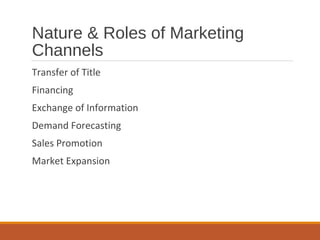
Transfer of Title
Financing
Exchange of Information
Demand Forecasting
Sales Promotion
Market Expansion
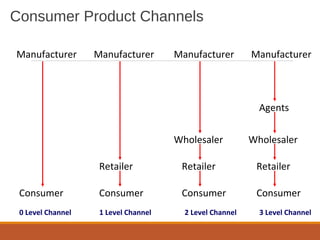
Consumer Product Channels
Manufacturer Manufacturer Manufacturer Manufacturer
Consumer Consumer Consumer Consumer
Retailer Retailer Retailer
Wholesaler Wholesaler
Agents
0 Level Channel 1 Level Channel 2 Level Channel 3 Level Channel
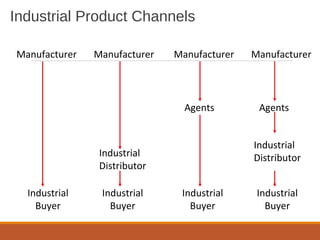
Industrial Product Channels
Manufacturer Manufacturer Manufacturer Manufacturer
Industrial
Buyer
Industrial
Buyer
Industrial
Buyer
Industrial
Buyer
Industrial
Distributor
Industrial
Distributor
AgentsAgents
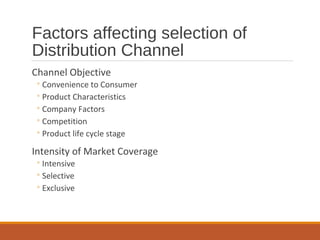
Factors affecting selection of
Distribution Channel
Channel Objective
◦Convenience to Consumer
◦Product Characteristics
◦Company Factors
◦Competition
◦Product life cycle stage
Intensity of Market Coverage
◦Intensive
◦Selective
◦Exclusive
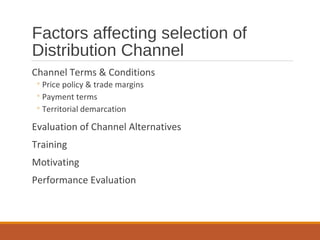
Factors affecting selection of
Distribution Channel
Channel Terms & Conditions
◦Price policy & trade margins
◦Payment terms
◦Territorial demarcation
Evaluation of Channel Alternatives
Training
Motivating
Performance Evaluation
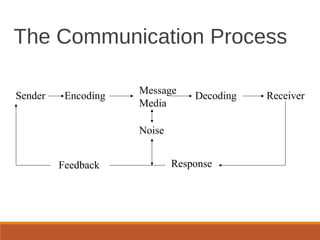
The Communication Process
Sender Encoding
Message
Media
Decoding Receiver
ResponseFeedback
Noise
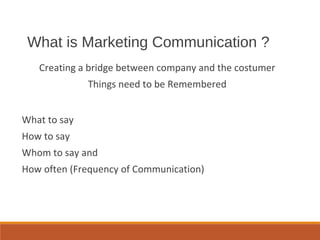
What is Marketing Communication ?
Creating a bridge between company and the costumer
Things need to be Remembered
What to say
How to say
Whom to say and
How often (Frequency of Communication)
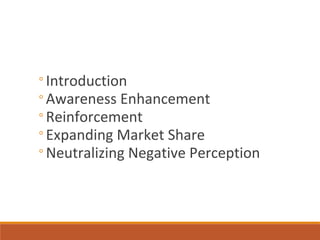
Promotional Objective
◦Introduction
◦Awareness Enhancement
◦Reinforcement
◦Expanding Market Share
◦Neutralizing Negative Perception
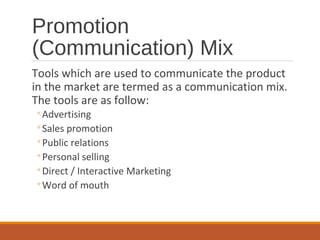
Promotion
(Communication) Mix
Tools which are used to communicate the product
in the market are termed as a communication mix.
The tools are as follow:
◦Advertising
◦Sales promotion
◦Public relations
◦Personal selling
◦Direct / Interactive Marketing
◦Word of mouth
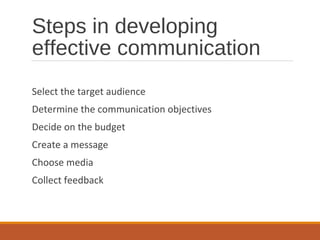
Steps in developing
effective communication
Select the target audience
Determine the communication objectives
Decide on the budget
Create a message
Choose media
Collect feedback
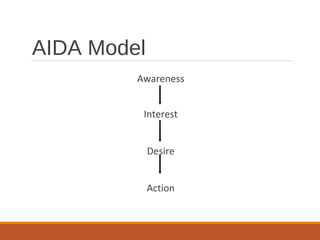
AIDA Model
Awareness
Interest
Desire
Action
Advertising
It is any paid form of non – personal presentation and
promotion of ideas, goods, services by an identified
sponsor.
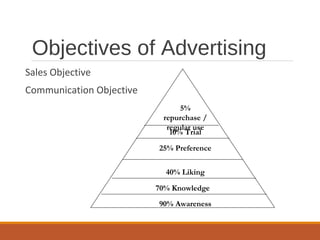
Objectives of Advertising
Sales Objective
Communication Objective
90% Awareness
70% Knowledge
10% Trial
25% Preference
40% Liking
5%
repurchase /
regular use
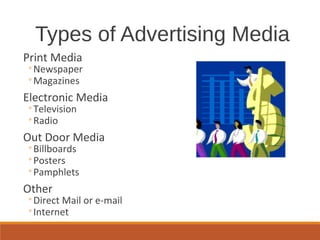
Types of Advertising Media
Print Media
◦Newspaper
◦Magazines
Electronic Media
◦Television
◦Radio
Out Door Media
◦Billboards
◦Posters
◦Pamphlets
Other
◦Direct Mail or e-mail
◦Internet
Selection of Media
Geographical coverage
Type & quantity of audience reach
Frequency with which it can touch the target audience
Comparative cost
Possibilities of using sound, color & movement
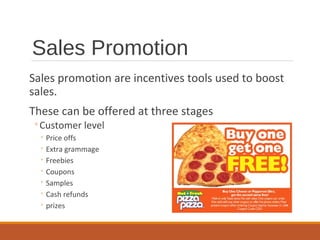
Sales Promotion
Sales promotion are incentives tools used to boost
sales.
These can be offered at three stages
◦Customer level
◦ Price offs
◦ Extra grammage
◦ Freebies
◦ Coupons
◦ Samples
◦ Cash refunds
◦ prizes
Intermediaries level
◦Margins
◦Credits
◦Discounts
◦Free goods
◦Shelf space display incentives
◦Promotion allowances
◦Distribution of awards
Internal Customers (sales force)
◦Bonuses
◦Contests
◦Awards & Prizes
Sales Promotion
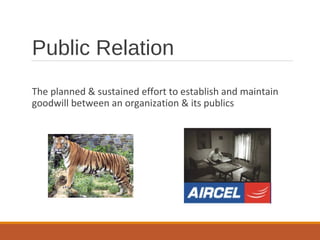
Public Relation
The planned & sustained effort to establish and maintain
goodwill between an organization & its publics
Tools of PR
Publication in the form of press release, journals, brochures
etc.
Holding events like AGM, seminars, convocation etc.
Conduct of trade shows, exhibitions.
Sponsoring of social events, charities & community
projects.
Personal Selling
A personal presentation by a company’s
representative to one or more than one prospect
costumer in order to make sales and developing
relationship with the customer.
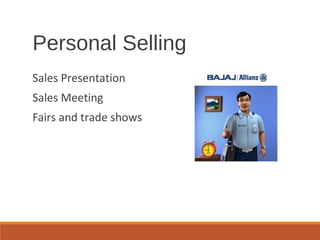
Personal Selling
Sales Presentation
Sales Meeting
Fairs and trade shows
Direct Marketing
Direct communication to very specific individual /
costumers in order to generate immediate result.
Features
Direct Communication
Very specific Individual / Costumers
To obtain immediate result
Direct Marketing
Telemarketing
Fax
E-mailing
Selective catalog
distribution
Voice Mail
Marketing Information System
Consists of people, equipment, and procedures that gather,
sort, analyze, evaluate, and distribute needed, timely, and
accurate information to marketing decision makers
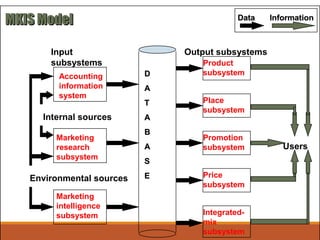
Input
subsystems
Output subsystems
DD
AA
TT
AA
BB
AA
SS
EE
Accounting
information
system
Marketing
research
subsystem
Marketing
intelligence
subsystem
Internal sources
Environmental sources
Product
subsystem
Place
subsystem
Promotion
subsystem
Price
subsystem
Integrated-
mix
subsystem
Users
DataData InformationInformation
MKIS ModelMKIS Model
Marketing Research
A systematic & objective process of collecting, recording
and analyzing data to facilitate marketing decisions.
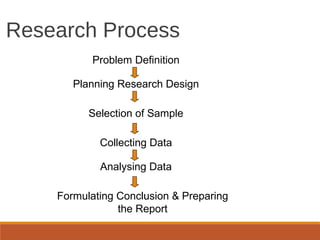
Research Process
Problem Definition
Planning Research Design
Selection of Sample
Collecting Data
Analysing Data
Formulating Conclusion & Preparing
the Report
Presented by
Dr. Dharmesh Motwani.
Visit us online at
www.TheStockker.com

Marketing Management – Module IV