Business Law
Module 1: Indian Contract Act, 1872
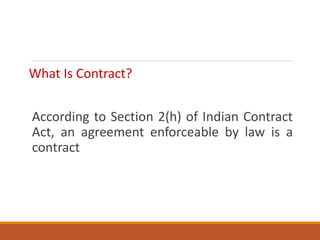
What Is Contract?
According to Section 2(h) of Indian Contract
Act, an agreement enforceable by law is a
contract
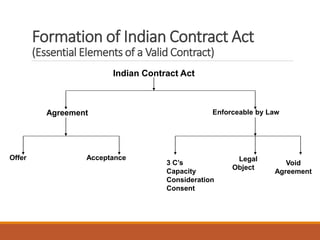
Formation of Indian Contract Act
(Essential Elements of a Valid Contract)
Indian Contract Act
Agreement Enforceable by Law
Offer Acceptance
3 C’s
Capacity
Consideration
Consent
Legal
Object
Void
Agreement
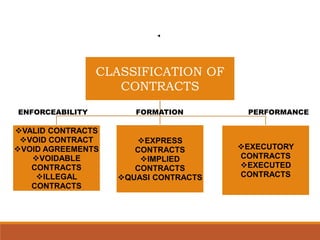
CLASSIFICATION OF
CONTRACTS
VALID CONTRACTS
VOID CONTRACT
VOID AGREEMENTS
VOIDABLE
CONTRACTS
ILLEGAL
CONTRACTS
EXPRESS
CONTRACTS
IMPLIED
CONTRACTS
QUASI CONTRACTS
EXECUTORY
CONTRACTS
EXECUTED
CONTRACTS
ENFORCEABILITY PERFORMANCEFORMATION
Agreement
Every promise and every set of promises,
forming the consideration for each other, is an
agreement.
An Agreement has two Basic Elements
◦ Offer or Proposal
◦ Acceptance
Offer or Proposal
When one person signifies to another his
willingness to do or to abstain from doing anything,
with a view to obtaining the assent of that other to
such act or abstinence, he is said to make a
proposal
Promisor & Promise
Offer
A valid offer must be in conformity with the following rules:
It must be precise; capable of being understood
and communicated.
It must not contain a clause that does away with
acceptance.
The offer must be communicated to the person to
whom it is made.
It need not be in writing though in immoveable
property contracts it must be in writing.
Offer
A valid offer must be in conformity
with the following rules:
Offer may be express or implied
An offer can be revoked before it is accepted.
An offer may be conditional but the conditions must be
clearly communicated
TYPES OF OFFER
Express offer
Implied offer
Specific offer
General offer
Cross offer
Counter offer
Standing offer
Acceptance
According to section 2(b) a proposal or offer is said to have
been accepted when the person to whom the proposal is
made, signifies his assent to the proposal.
Acceptance
A valid Acceptance must be in conformity with the following rules:
An acceptance must be in response to an offer
It must be in the mode prescribed.
It must be made by the person to whom the
offer has been made.
It must be absolute (unqualified) and
unconditional.
Acceptance
A valid Acceptance must be in
conformity with the following rules:
Acceptance must be communicated.
Acceptance must be made within the time provided or reasonable time.
Acceptance must be made before offer
is revoked.
Capacity
Parties making an contract must have contractual capacity.
According to law the contracts with following parties will be
invalid
1 With Minors
2 With Unsound Mind
3 With Insolvents
Minors (18 & 21)
Agreement with minor is void – ab – initio.
An agreement with a minor cannot be ratified
on his becoming a major.
Guardians of a minor are not liable on contracts
with a minor.
A minor if provided with necessaries of life then
it can be reimbursed from the minor’s estate.
A minor can be a beneficiary.
A minor can become a partner though he would
not be liable.
Unsound Mind
A person is said to be of sound mind for the
purpose of making a contract if, at the time when
he makes it, he is capable of understanding it and
of forming a rational judgment as to its effect upon
his interests.
A person, who is usually of unsound mind,
but occasionally of sound mind, may make a
contract when he is of sound mind.
A person, who is usually of sound mind, but
occasionally of unsound mind, may not make a
contract when he is of unsound mind.
Consideration
In a Contract every party gets something in return of his
promise from another party, whatever he gets will
constitute consideration for his promise
Example: A promises not to file legal proceedings against B,
if B promises him to pay Rs.500 in satisfaction of the
promissory note.
Consent
Two or more persons are said to consent when
they agree upon the same thing in the same
sense.
Consent is said to be free when it is not caused
by:
1. Coercion : application of physical force
2. Undue Influence : use of mental pressure
3. Misrepresentation : innocent false representation
4. Fraud : Cheating or deceiving
5. Mistake
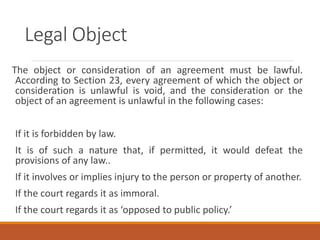
Legal Object
The object or consideration of an agreement must be lawful.
According to Section 23, every agreement of which the object or
consideration is unlawful is void, and the consideration or the
object of an agreement is unlawful in the following cases:
If it is forbidden by law.
It is of such a nature that, if permitted, it would defeat the
provisions of any law..
If it involves or implies injury to the person or property of another.
If the court regards it as immoral.
If the court regards it as ‘opposed to public policy.’
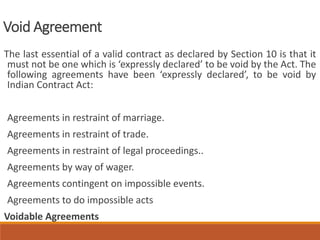
Void Agreement
The last essential of a valid contract as declared by Section 10 is that it
must not be one which is ‘expressly declared’ to be void by the Act. The
following agreements have been ‘expressly declared’, to be void by
Indian Contract Act:
Agreements in restraint of marriage.
Agreements in restraint of trade.
Agreements in restraint of legal proceedings..
Agreements by way of wager.
Agreements contingent on impossible events.
Agreements to do impossible acts
Voidable Agreements
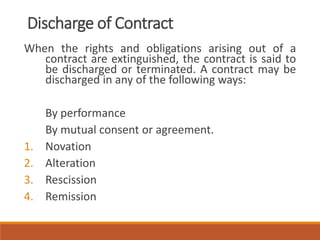
Discharge of Contract
When the rights and obligations arising out of a
contract are extinguished, the contract is said to
be discharged or terminated. A contract may be
discharged in any of the following ways:
By performance
By mutual consent or agreement.
1. Novation
2. Alteration
3. Rescission
4. Remission
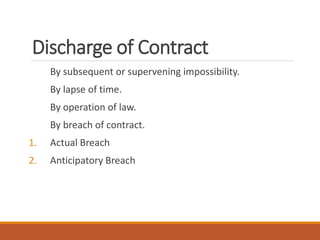
Discharge of Contract
By subsequent or supervening impossibility.
By lapse of time.
By operation of law.
By breach of contract.
1. Actual Breach
2. Anticipatory Breach
Remedies for breach of
contracts
Suit for Specific Performance
Suit for Damages
Suit for Injunction
Suit for Quantum meruit
Contingent Contract
A contingent contract is one in which a promise is
conditional and the contract shall be performed only on the
happening of some future uncertain event.
Example: A agrees to sell some goods to B, which are being
brought by ship coming to Mumbai.
Contract of Indemnity
A contract is called as a ‘contract of indemnity’ if –
One party promises to save the other from loss caused to
him by the conduct of the promisor himself, or by the
conduct of any other person.
Two Parties – Indemnity Holder & Indemnifier
Essential elements of a contract
of indemnity
All the elements of a valid contract
Loss to one party
Indemnity by the promisor
Reason for loss
RIGHTS OF INDEMNITY HOLDER
Right to recover damages
Right to recover costs
Right to recover sums paid
Contract of Guarantee
A ‘contract of guarantee’ is a contract to –
Perform the promise; or
Discharge the liability, of a third person in case of
his default.
Three Parties – Creditor, Principal Debtor, Surety
Essential elements of a contract
of Guarantee
All the elements of a valid contract
Primary liability of some person
The contract must be conditional
No misrepresentation
CONTRACT OF BAILMENT
A ‘bailment’ is the delivery of goods by one person
to another for some purpose, upon a contract that
they shall, when the purpose is accomplished, be
returned or otherwise disposed of according to the
directions of the person delivering them.
Two Parties – Bailor & Bailee
Essential elements of a contract
of Bailment
All the elements of a valid contract
Goods
Delivery
Purpose of delivery
Return or disposal of goods
MODES OF DELIVERY
Actual delivery
Symbolic delivery
Constructive delivery
PLEDGE
The bailment of goods as security for payment of a
debt or performance of promise is called ‘pledge’.
Two Parties – Pawnor & Pawnee
Agency
An ‘agent’ is a person employed to –
Do any act for another; or
Represent another in dealings with third persons.
‘Principal’ is the person –
For whom an act is done by the agent; or
Who is represented by the agent in respect of dealing with
third persons.
Test of agency
Where a person has the capacity to –
Create contractual relations between the principal
and a third party;
Bind the principal by his own acts, there exists a
relationship of agency.
presented by
Dr. Dharmesh Motwani.Visit us online at
www.TheStockker.com

Business law module 1

  • 1.
    Business Law Module 1:Indian Contract Act, 1872
  • 2.
    What Is Contract? Accordingto Section 2(h) of Indian Contract Act, an agreement enforceable by law is a contract
  • 3.
    Formation of IndianContract Act (Essential Elements of a Valid Contract) Indian Contract Act Agreement Enforceable by Law Offer Acceptance 3 C’s Capacity Consideration Consent Legal Object Void Agreement
  • 4.
    CLASSIFICATION OF CONTRACTS VALID CONTRACTS VOIDCONTRACT VOID AGREEMENTS VOIDABLE CONTRACTS ILLEGAL CONTRACTS EXPRESS CONTRACTS IMPLIED CONTRACTS QUASI CONTRACTS EXECUTORY CONTRACTS EXECUTED CONTRACTS ENFORCEABILITY PERFORMANCEFORMATION
  • 5.
    Agreement Every promise andevery set of promises, forming the consideration for each other, is an agreement. An Agreement has two Basic Elements ◦ Offer or Proposal ◦ Acceptance
  • 6.
    Offer or Proposal Whenone person signifies to another his willingness to do or to abstain from doing anything, with a view to obtaining the assent of that other to such act or abstinence, he is said to make a proposal Promisor & Promise
  • 7.
    Offer A valid offermust be in conformity with the following rules: It must be precise; capable of being understood and communicated. It must not contain a clause that does away with acceptance. The offer must be communicated to the person to whom it is made. It need not be in writing though in immoveable property contracts it must be in writing.
  • 8.
    Offer A valid offermust be in conformity with the following rules: Offer may be express or implied An offer can be revoked before it is accepted. An offer may be conditional but the conditions must be clearly communicated
  • 9.
    TYPES OF OFFER Expressoffer Implied offer Specific offer General offer Cross offer Counter offer Standing offer
  • 10.
    Acceptance According to section2(b) a proposal or offer is said to have been accepted when the person to whom the proposal is made, signifies his assent to the proposal.
  • 11.
    Acceptance A valid Acceptancemust be in conformity with the following rules: An acceptance must be in response to an offer It must be in the mode prescribed. It must be made by the person to whom the offer has been made. It must be absolute (unqualified) and unconditional.
  • 12.
    Acceptance A valid Acceptancemust be in conformity with the following rules: Acceptance must be communicated. Acceptance must be made within the time provided or reasonable time. Acceptance must be made before offer is revoked.
  • 13.
    Capacity Parties making ancontract must have contractual capacity. According to law the contracts with following parties will be invalid 1 With Minors 2 With Unsound Mind 3 With Insolvents
  • 14.
    Minors (18 &21) Agreement with minor is void – ab – initio. An agreement with a minor cannot be ratified on his becoming a major. Guardians of a minor are not liable on contracts with a minor. A minor if provided with necessaries of life then it can be reimbursed from the minor’s estate. A minor can be a beneficiary. A minor can become a partner though he would not be liable.
  • 15.
    Unsound Mind A personis said to be of sound mind for the purpose of making a contract if, at the time when he makes it, he is capable of understanding it and of forming a rational judgment as to its effect upon his interests. A person, who is usually of unsound mind, but occasionally of sound mind, may make a contract when he is of sound mind. A person, who is usually of sound mind, but occasionally of unsound mind, may not make a contract when he is of unsound mind.
  • 16.
    Consideration In a Contractevery party gets something in return of his promise from another party, whatever he gets will constitute consideration for his promise Example: A promises not to file legal proceedings against B, if B promises him to pay Rs.500 in satisfaction of the promissory note.
  • 17.
    Consent Two or morepersons are said to consent when they agree upon the same thing in the same sense. Consent is said to be free when it is not caused by: 1. Coercion : application of physical force 2. Undue Influence : use of mental pressure 3. Misrepresentation : innocent false representation 4. Fraud : Cheating or deceiving 5. Mistake
  • 18.
    Legal Object The objector consideration of an agreement must be lawful. According to Section 23, every agreement of which the object or consideration is unlawful is void, and the consideration or the object of an agreement is unlawful in the following cases: If it is forbidden by law. It is of such a nature that, if permitted, it would defeat the provisions of any law.. If it involves or implies injury to the person or property of another. If the court regards it as immoral. If the court regards it as ‘opposed to public policy.’
  • 19.
    Void Agreement The lastessential of a valid contract as declared by Section 10 is that it must not be one which is ‘expressly declared’ to be void by the Act. The following agreements have been ‘expressly declared’, to be void by Indian Contract Act: Agreements in restraint of marriage. Agreements in restraint of trade. Agreements in restraint of legal proceedings.. Agreements by way of wager. Agreements contingent on impossible events. Agreements to do impossible acts Voidable Agreements
  • 20.
    Discharge of Contract Whenthe rights and obligations arising out of a contract are extinguished, the contract is said to be discharged or terminated. A contract may be discharged in any of the following ways: By performance By mutual consent or agreement. 1. Novation 2. Alteration 3. Rescission 4. Remission
  • 21.
    Discharge of Contract Bysubsequent or supervening impossibility. By lapse of time. By operation of law. By breach of contract. 1. Actual Breach 2. Anticipatory Breach
  • 22.
    Remedies for breachof contracts Suit for Specific Performance Suit for Damages Suit for Injunction Suit for Quantum meruit
  • 23.
    Contingent Contract A contingentcontract is one in which a promise is conditional and the contract shall be performed only on the happening of some future uncertain event. Example: A agrees to sell some goods to B, which are being brought by ship coming to Mumbai.
  • 24.
    Contract of Indemnity Acontract is called as a ‘contract of indemnity’ if – One party promises to save the other from loss caused to him by the conduct of the promisor himself, or by the conduct of any other person. Two Parties – Indemnity Holder & Indemnifier
  • 25.
    Essential elements ofa contract of indemnity All the elements of a valid contract Loss to one party Indemnity by the promisor Reason for loss
  • 26.
    RIGHTS OF INDEMNITYHOLDER Right to recover damages Right to recover costs Right to recover sums paid
  • 27.
    Contract of Guarantee A‘contract of guarantee’ is a contract to – Perform the promise; or Discharge the liability, of a third person in case of his default. Three Parties – Creditor, Principal Debtor, Surety
  • 28.
    Essential elements ofa contract of Guarantee All the elements of a valid contract Primary liability of some person The contract must be conditional No misrepresentation
  • 29.
    CONTRACT OF BAILMENT A‘bailment’ is the delivery of goods by one person to another for some purpose, upon a contract that they shall, when the purpose is accomplished, be returned or otherwise disposed of according to the directions of the person delivering them. Two Parties – Bailor & Bailee
  • 30.
    Essential elements ofa contract of Bailment All the elements of a valid contract Goods Delivery Purpose of delivery Return or disposal of goods
  • 31.
    MODES OF DELIVERY Actualdelivery Symbolic delivery Constructive delivery
  • 32.
    PLEDGE The bailment ofgoods as security for payment of a debt or performance of promise is called ‘pledge’. Two Parties – Pawnor & Pawnee
  • 33.
    Agency An ‘agent’ isa person employed to – Do any act for another; or Represent another in dealings with third persons. ‘Principal’ is the person – For whom an act is done by the agent; or Who is represented by the agent in respect of dealing with third persons.
  • 34.
    Test of agency Wherea person has the capacity to – Create contractual relations between the principal and a third party; Bind the principal by his own acts, there exists a relationship of agency.
  • 35.
    presented by Dr. DharmeshMotwani.Visit us online at www.TheStockker.com