PRIMARY & SECONDARY
SOURCE OF DATA
COLLECTION
RESEARCH METHOD FOR MANAGERS
PRESENTED BY :
GOKUL P G & AJAY ANOJ KUMAR MBA – TKM COE
Primary & Secondary sources of Data: By Ajay Anoj & Gokul
Objective : To understand “Primary
& Secondary Data collection”
 Introduction
 Need for Data Collection
 Factors to be considered for data collection
 Sources of Data
 Primary Data and Collection Methods
 Traditional and New Aged Means of data
Collection
 Questionnaires with examples
 Secondary Sources & Collection Methods
 Differences between Primary & Secondary
sources
 Selection of Appropriate data collection
&Triangulation of Data
Primary & Secondary sources of Data: By Ajay Anoj & Gokul
Need of Data Collection
 Why is Data Collection Needed ?
 •To get information for analysis.
 •To get idea about real time situation.
 •For comparison between two situation.
Primary & Secondary sources of Data: By Ajay Anoj & Gokul
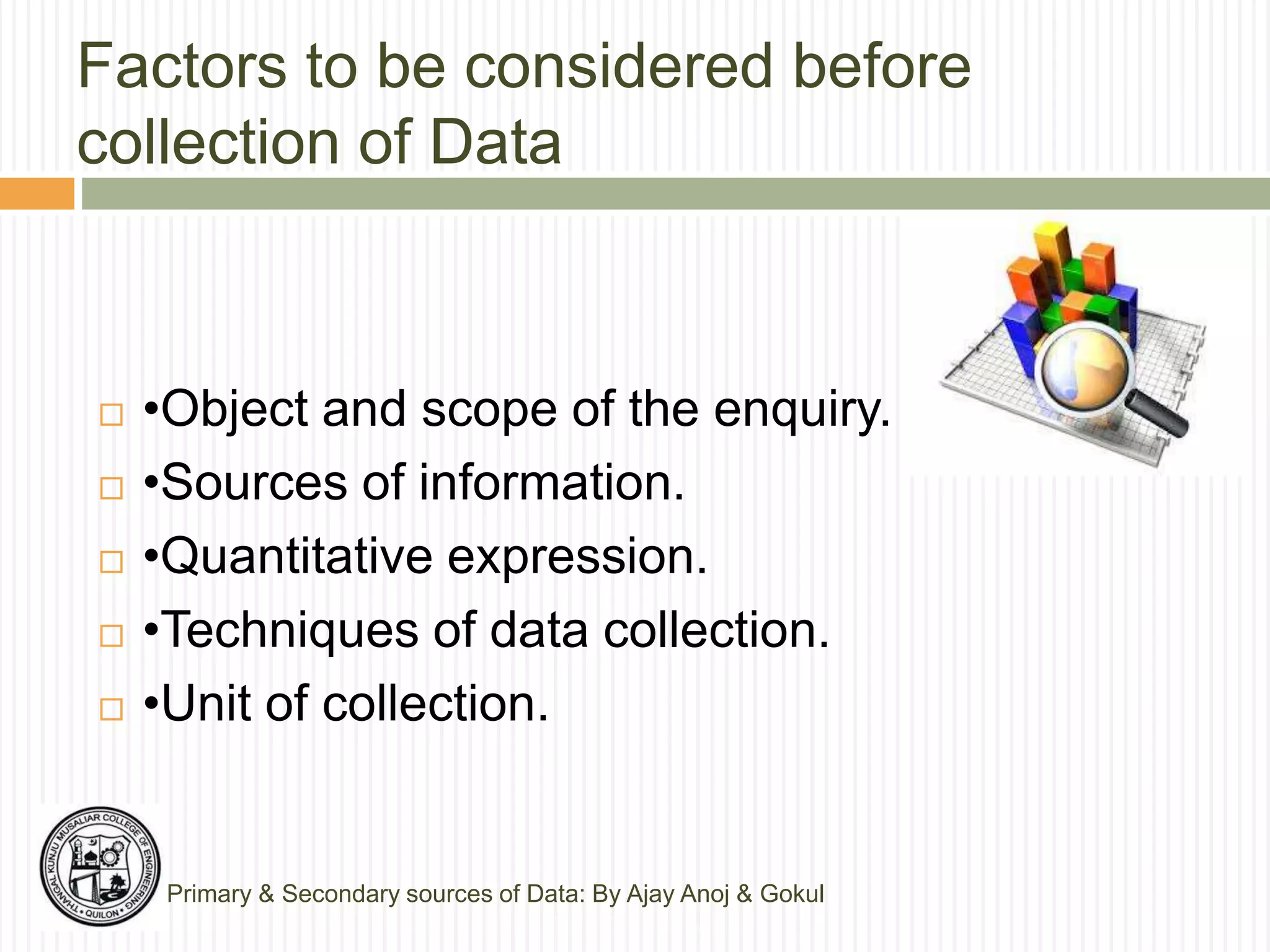
Factors to be considered before
collection of Data
Primary & Secondary sources of Data: By Ajay Anoj & Gokul
 •Object and scope of the enquiry.
 •Sources of information.
 •Quantitative expression.
 •Techniques of data collection.
 •Unit of collection.
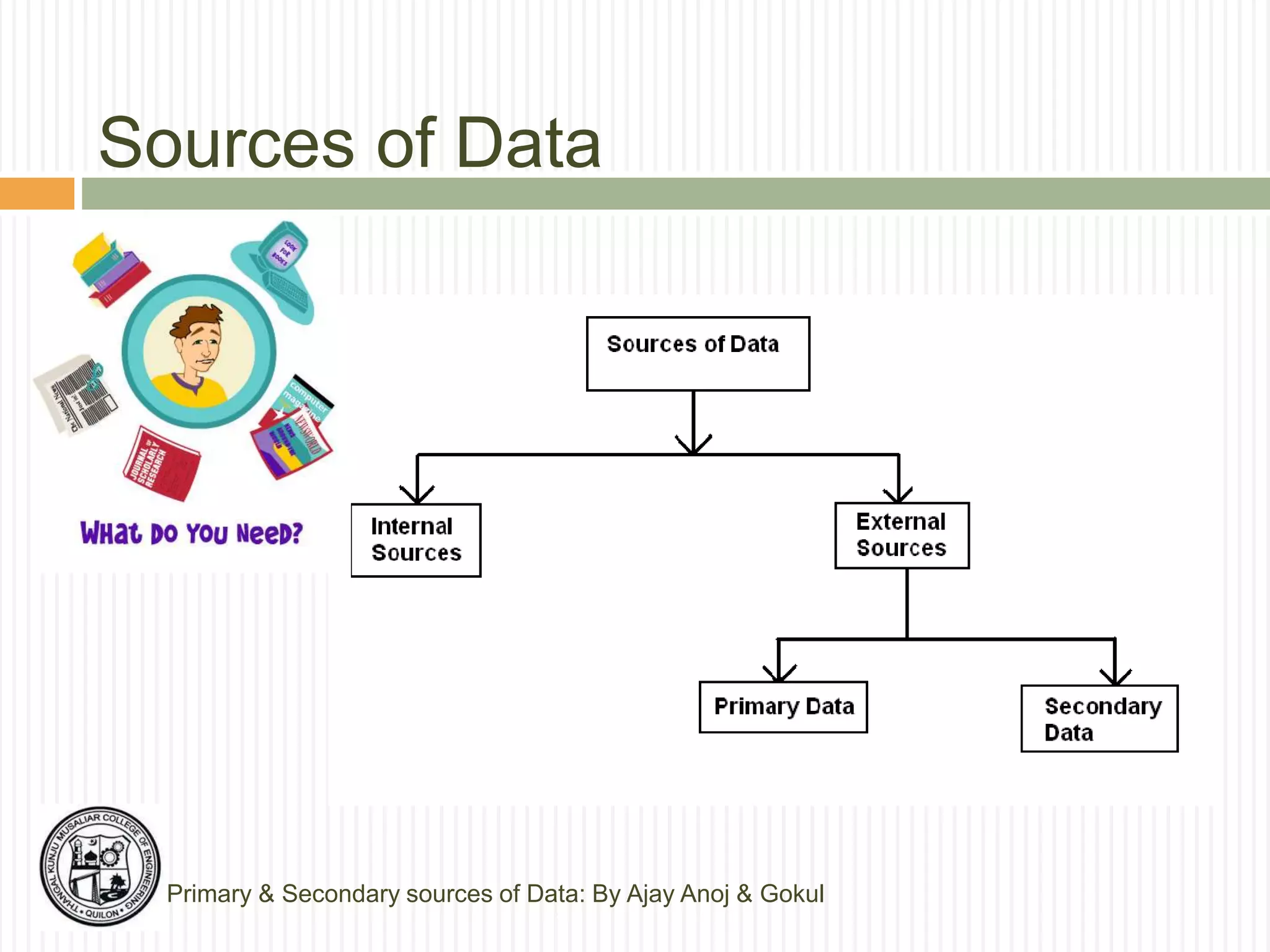
Sources of Data
Primary & Secondary sources of Data: By Ajay Anoj & Gokul
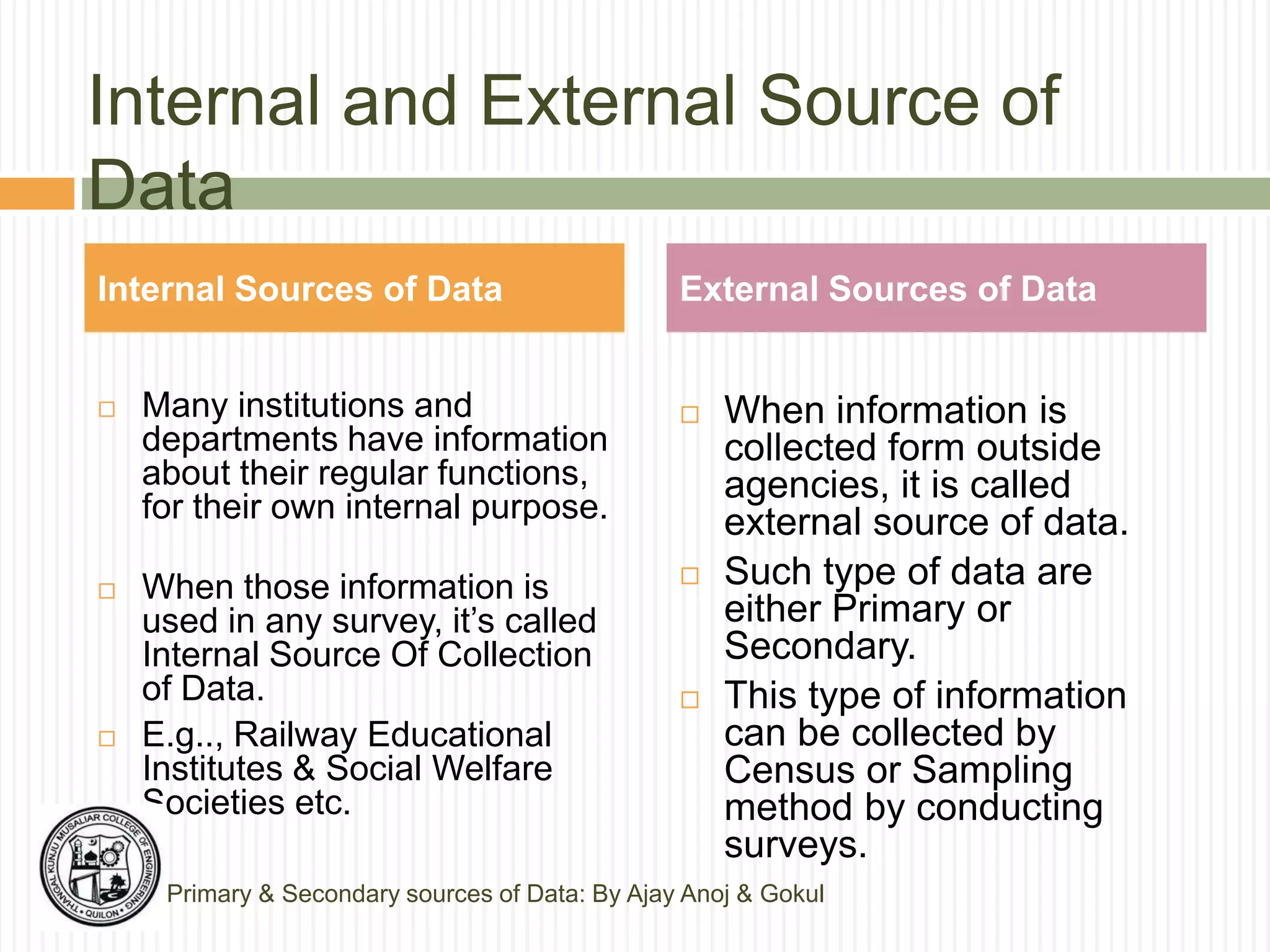
Internal and External Source of
Data
 Many institutions and
departments have information
about their regular functions,
for their own internal purpose.
 When those information is
used in any survey, it’s called
Internal Source Of Collection
of Data.
 E.g.., Railway Educational
Institutes & Social Welfare
Societies etc.
 When information is
collected form outside
agencies, it is called
external source of data.
 Such type of data are
either Primary or
Secondary.
 This type of information
can be collected by
Census or Sampling
method by conducting
surveys.
Primary & Secondary sources of Data: By Ajay Anoj & Gokul
Internal Sources of Data External Sources of Data
Primary Data
Primary & Secondary sources of Data: By Ajay Anoj & Gokul
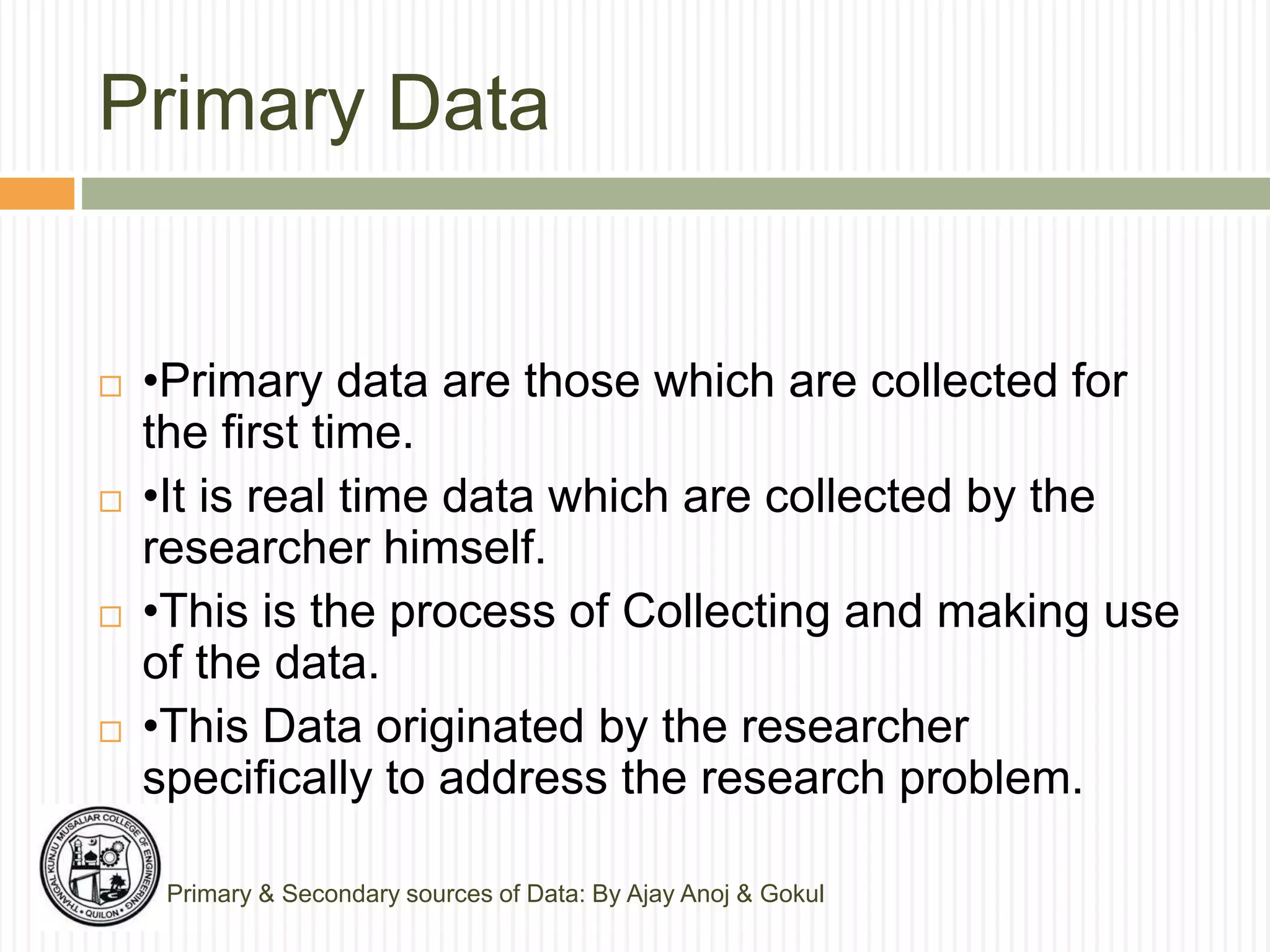
 •Primary data are those which are collected for
the first time.
 •It is real time data which are collected by the
researcher himself.
 •This is the process of Collecting and making use
of the data.
 •This Data originated by the researcher
specifically to address the research problem.
Primary Research methods
Primary & Secondary sources of Data: By Ajay Anoj & Gokul
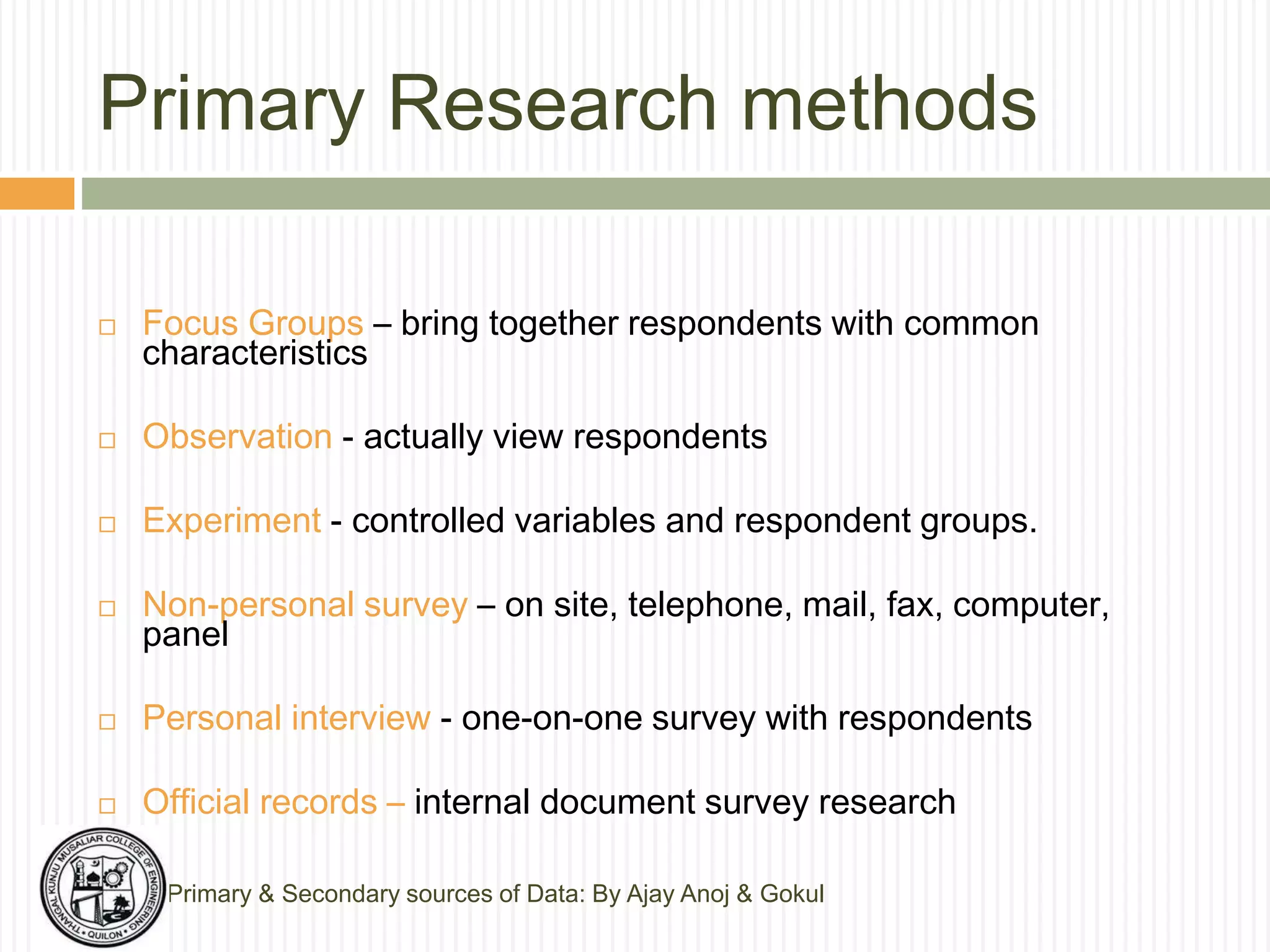
 Focus Groups – bring together respondents with common
characteristics
 Observation - actually view respondents
 Experiment - controlled variables and respondent groups.
 Non-personal survey – on site, telephone, mail, fax, computer,
panel
 Personal interview - one-on-one survey with respondents
 Official records – internal document survey research
Method of Collecting Primary Data
Primary & Secondary sources of Data: By Ajay Anoj & Gokul
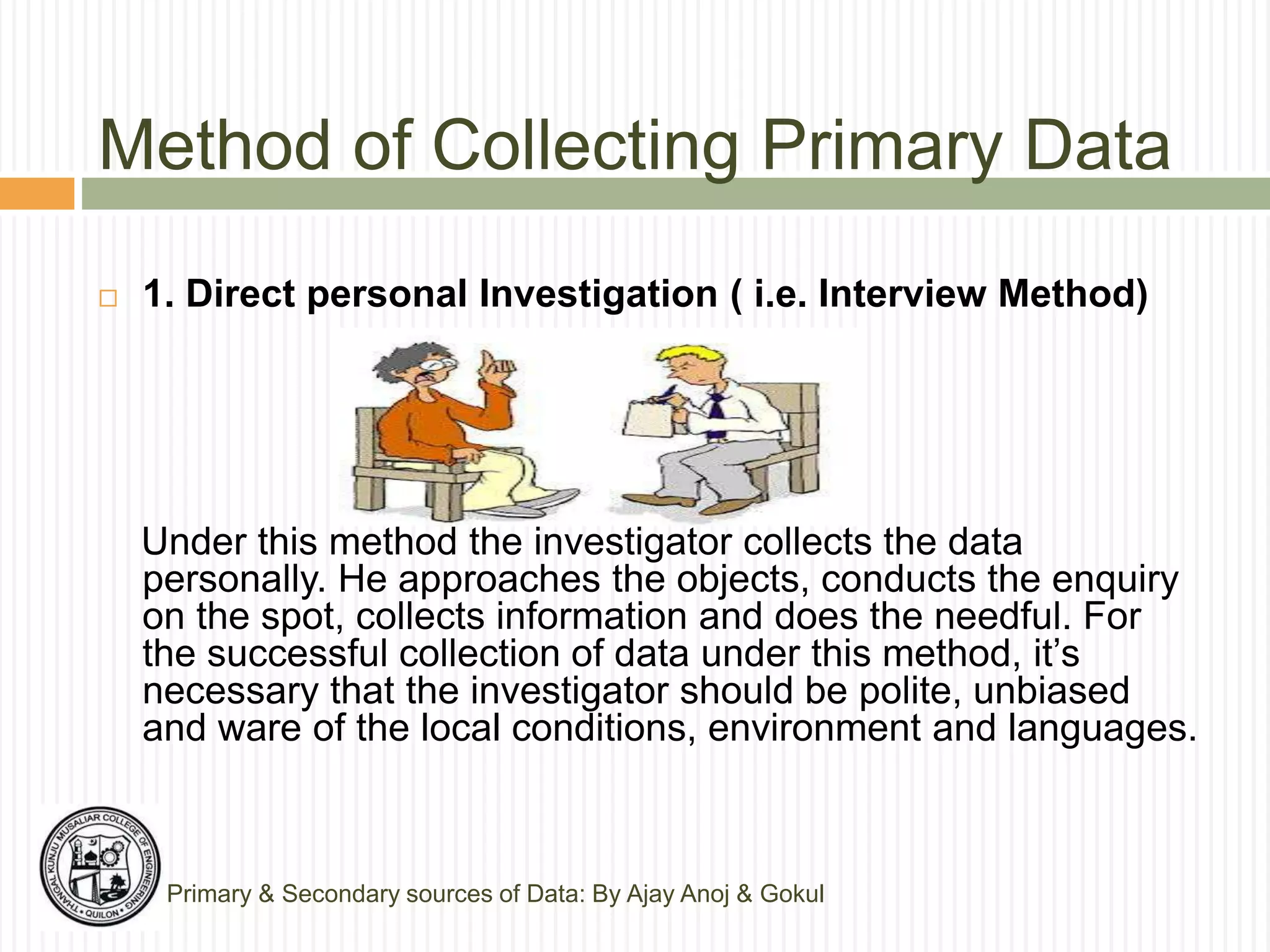
 1. Direct personal Investigation ( i.e. Interview Method)
Under this method the investigator collects the data
personally. He approaches the objects, conducts the enquiry
on the spot, collects information and does the needful. For
the successful collection of data under this method, it’s
necessary that the investigator should be polite, unbiased
and ware of the local conditions, environment and languages.
Method of Collecting Primary
Data
Primary & Secondary sources of Data: By Ajay Anoj & Gokul
 2. Indirect oral investigation ( i.e. through enumerators)
Under this the investigator doesn’t collects the information
directly, instead he gets them indirectly through those
persons who know the information and who are ready to part
away with the information they posses. This method is used
in case where direct contact is not possible.
 3. Investigation through Local reporters Questionnaire
In this method data are not collected through specially
appointed agents/ correspondents/investigators/enumerators
but local agents or correspondents are requested to collect
the information. They collect the information in their own
fashion and according to their liking’s and disliking.
Method of Collecting Primary
Data
Primary & Secondary sources of Data: By Ajay Anoj & Gokul
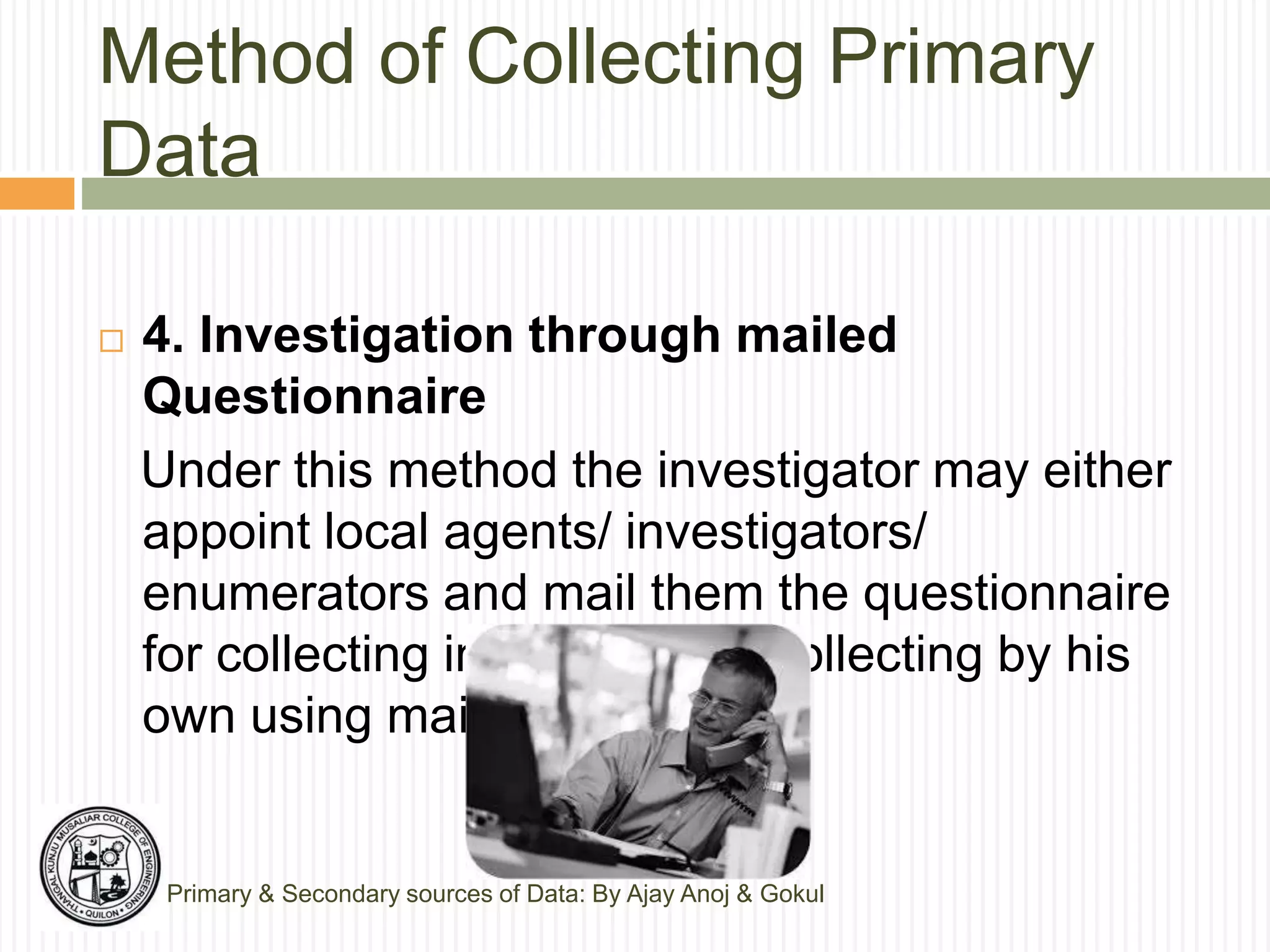
 4. Investigation through mailed
Questionnaire
Under this method the investigator may either
appoint local agents/ investigators/
enumerators and mail them the questionnaire
for collecting information or collecting by his
own using mail or telephone.
Method of Collecting Primary
Data
Primary & Secondary sources of Data: By Ajay Anoj & Gokul
5. Investigation through Observation
 In this watching behavior of object and most commonly used
method in behavior science. One major problem in this
method is that Natural response is not obtained when
respondent know he is observed.
 Type of Observation-
1)Participant Observation
2)Non-Participant Observation
3)Disguised Observation
4)Controlled Observation
5)Uncontrolled Observation
Traditional data collection
methods
Primary & Secondary sources of Data: By Ajay Anoj & Gokul
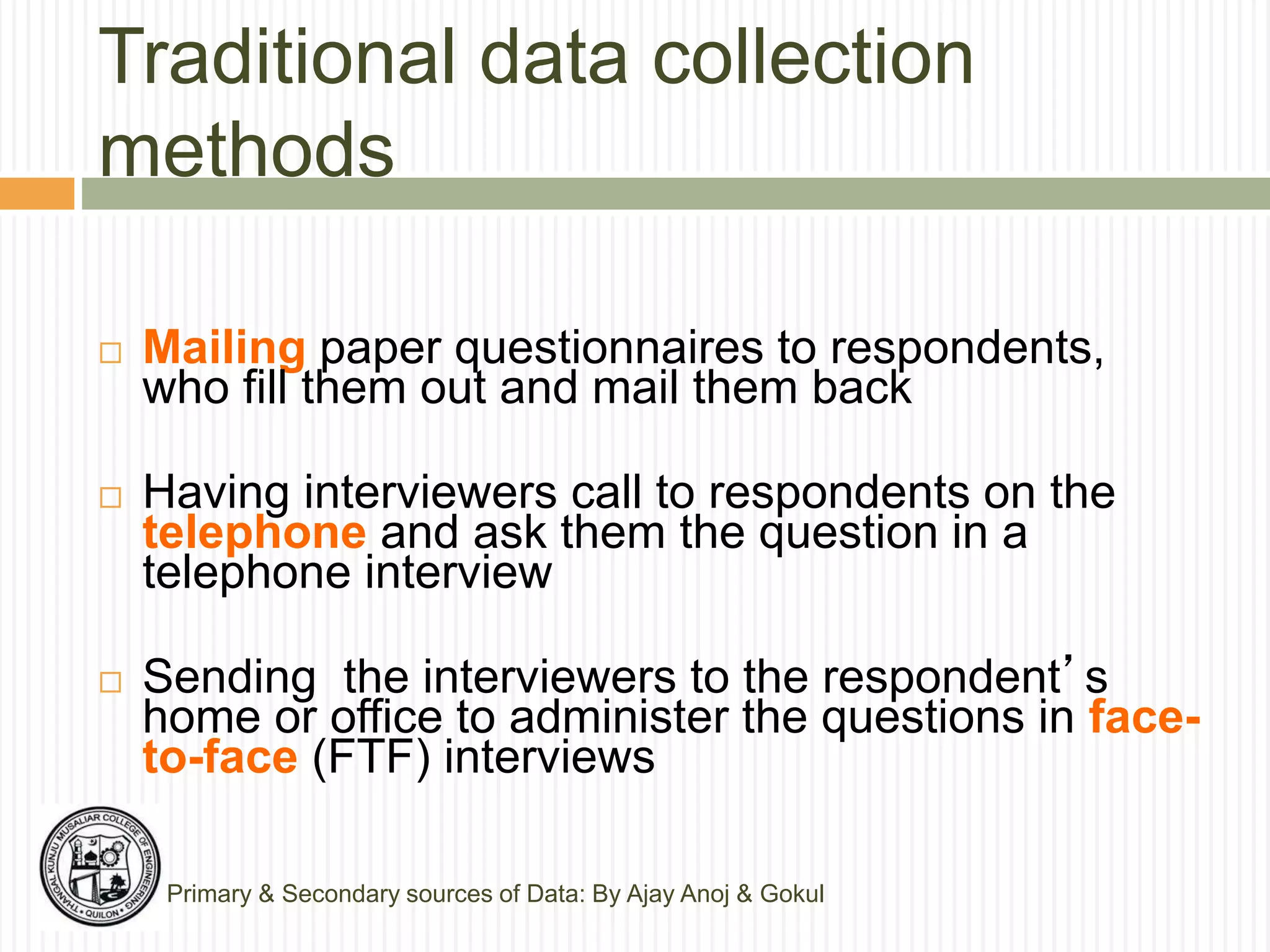
 Mailing paper questionnaires to respondents,
who fill them out and mail them back
 Having interviewers call to respondents on the
telephone and ask them the question in a
telephone interview
 Sending the interviewers to the respondent’s
home or office to administer the questions in face-
to-face (FTF) interviews
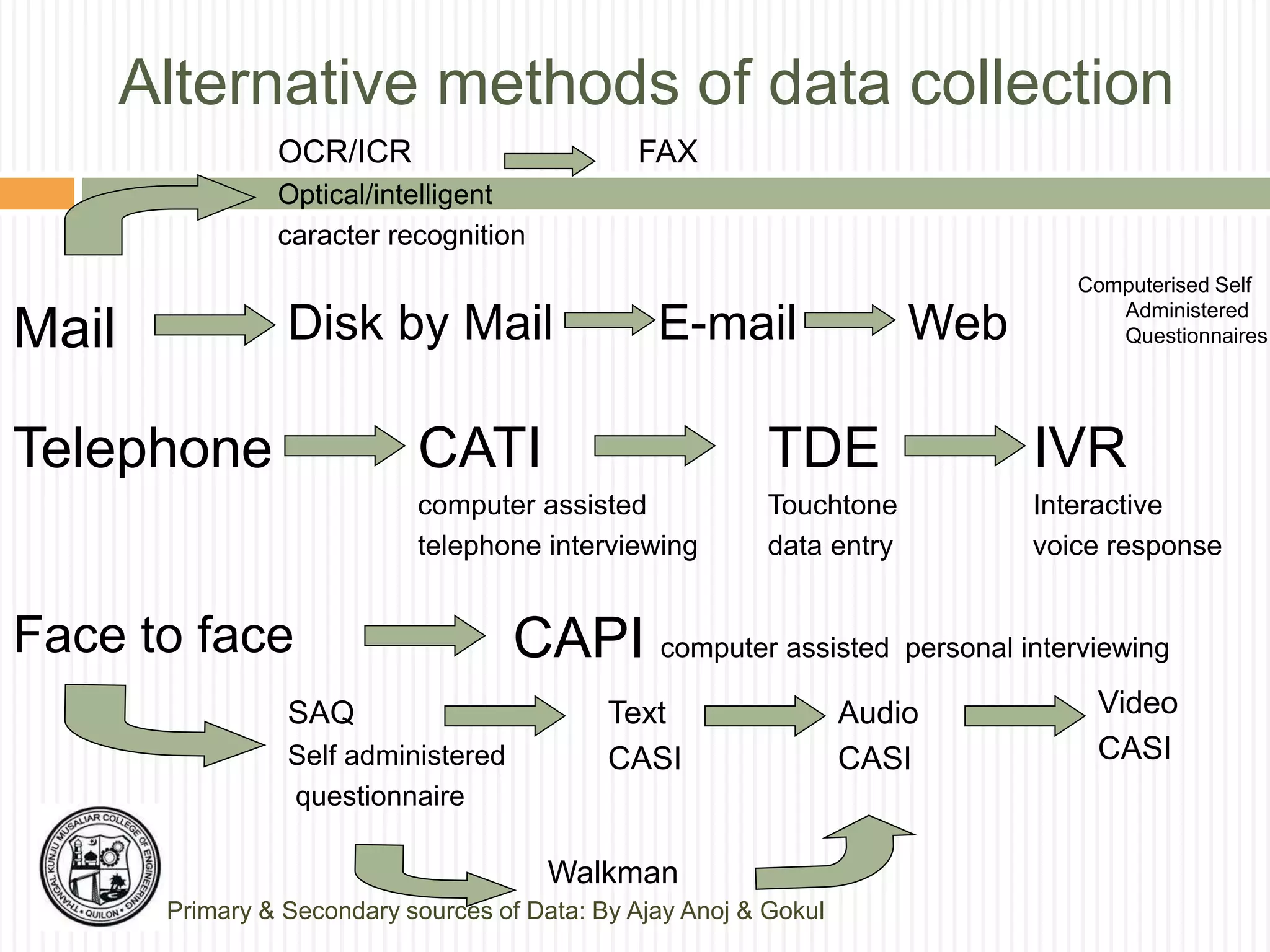
Alternative methods of data collection
Face to face
Telephone
Mail
CATI
computer assisted
telephone interviewing
CAPI computer assisted personal interviewing
TDE
Touchtone
data entry
OCR/ICR
Optical/intelligent
caracter recognition
FAX
Disk by Mail E-mail Web
Computerised Self
Administered
Questionnaires
IVR
Interactive
voice response
SAQ
Self administered
questionnaire
Walkman
Text
CASI
Audio
CASI
Video
CASI
Primary & Secondary sources of Data: By Ajay Anoj & Gokul
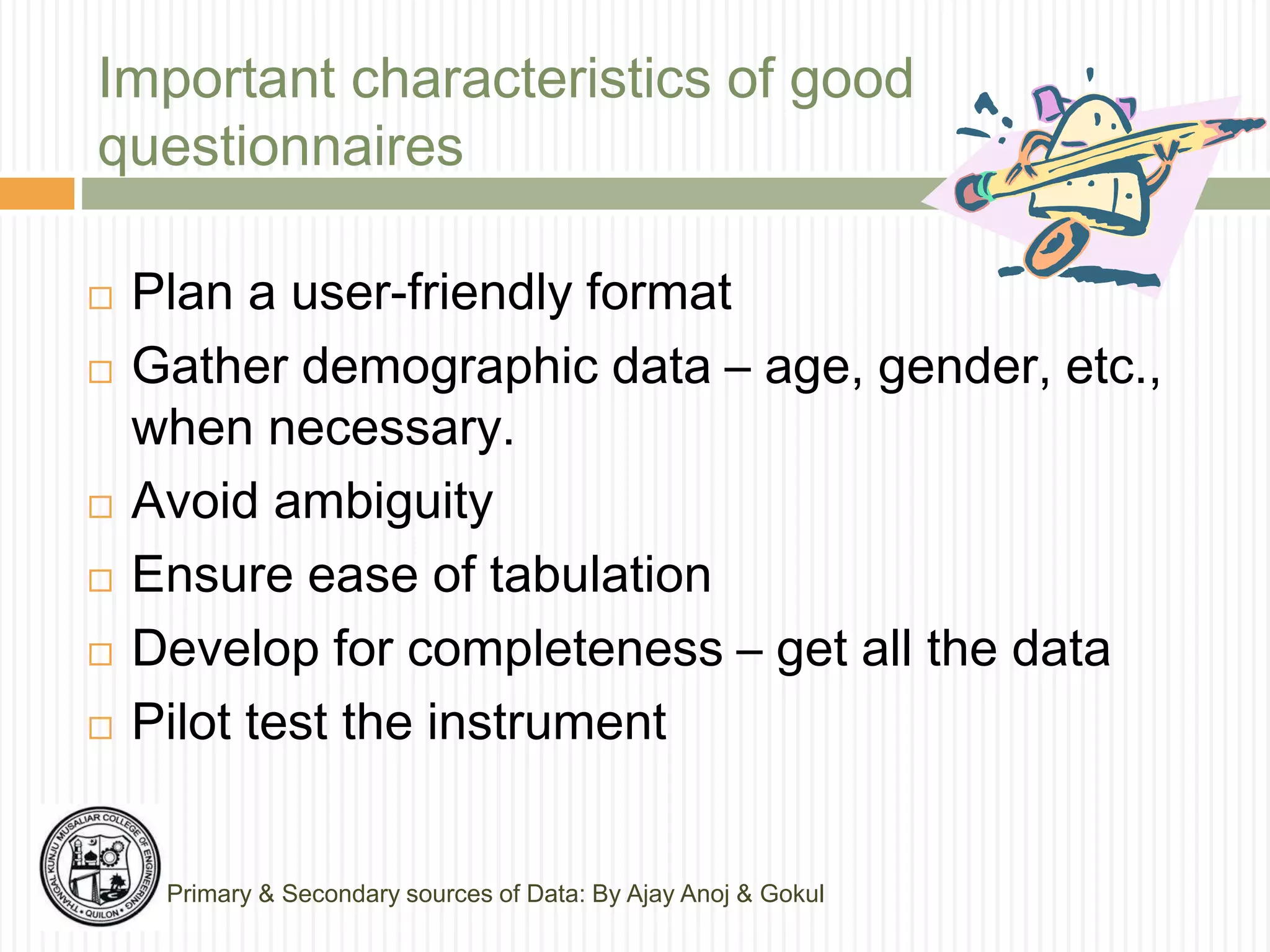
Important characteristics of good
questionnaires
 Plan a user-friendly format
 Gather demographic data – age, gender, etc.,
when necessary.
 Avoid ambiguity
 Ensure ease of tabulation
 Develop for completeness – get all the data
 Pilot test the instrument
Primary & Secondary sources of Data: By Ajay Anoj & Gokul
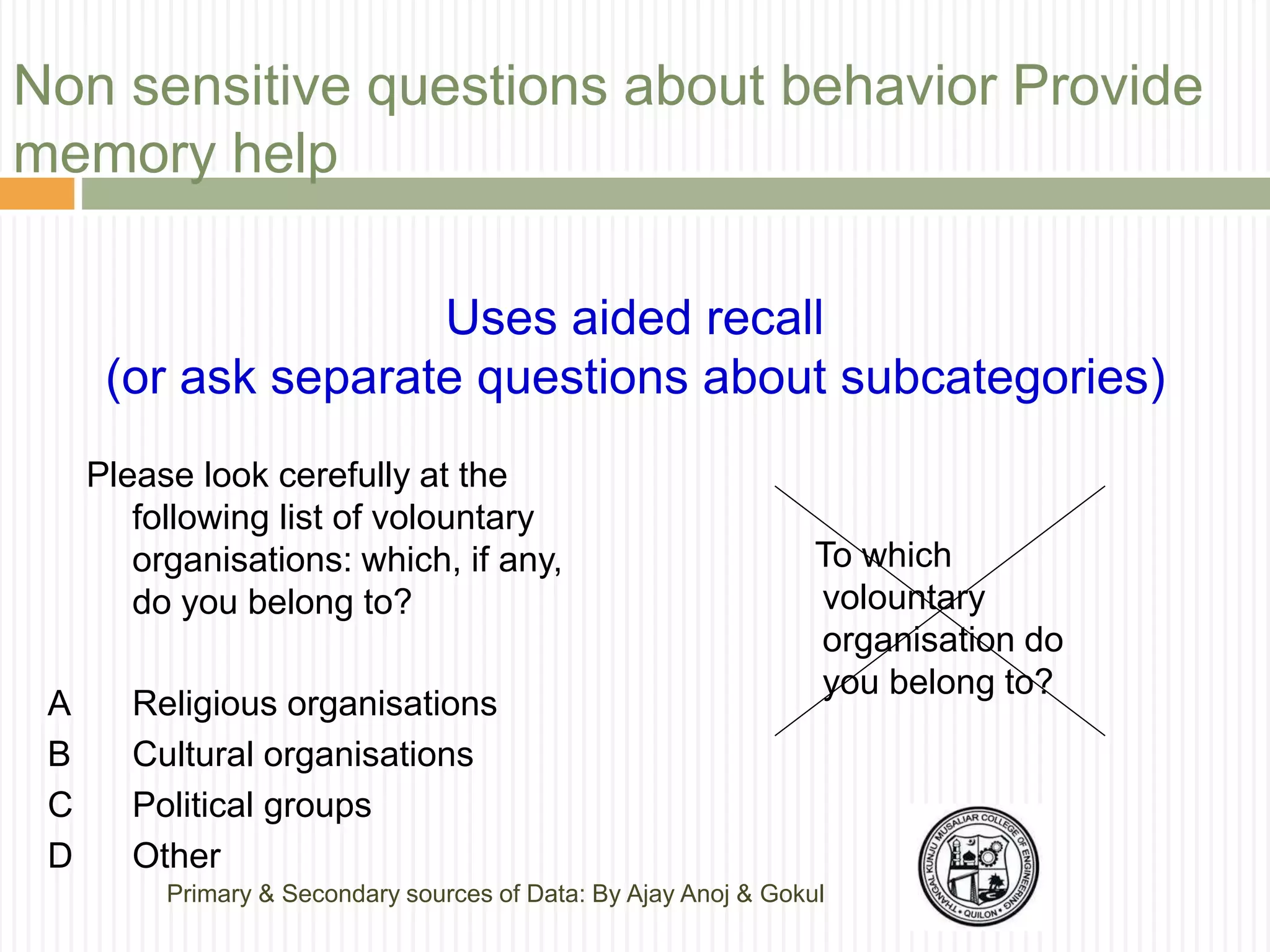
Non sensitive questions about behavior Provide
memory help
Uses aided recall
(or ask separate questions about subcategories)
Please look cerefully at the
following list of volountary
organisations: which, if any,
do you belong to?
A Religious organisations
B Cultural organisations
C Political groups
D Other
To which
volountary
organisation do
you belong to?
Primary & Secondary sources of Data: By Ajay Anoj & Gokul
Non sensitive questions about behavior Pay
attention to the wording
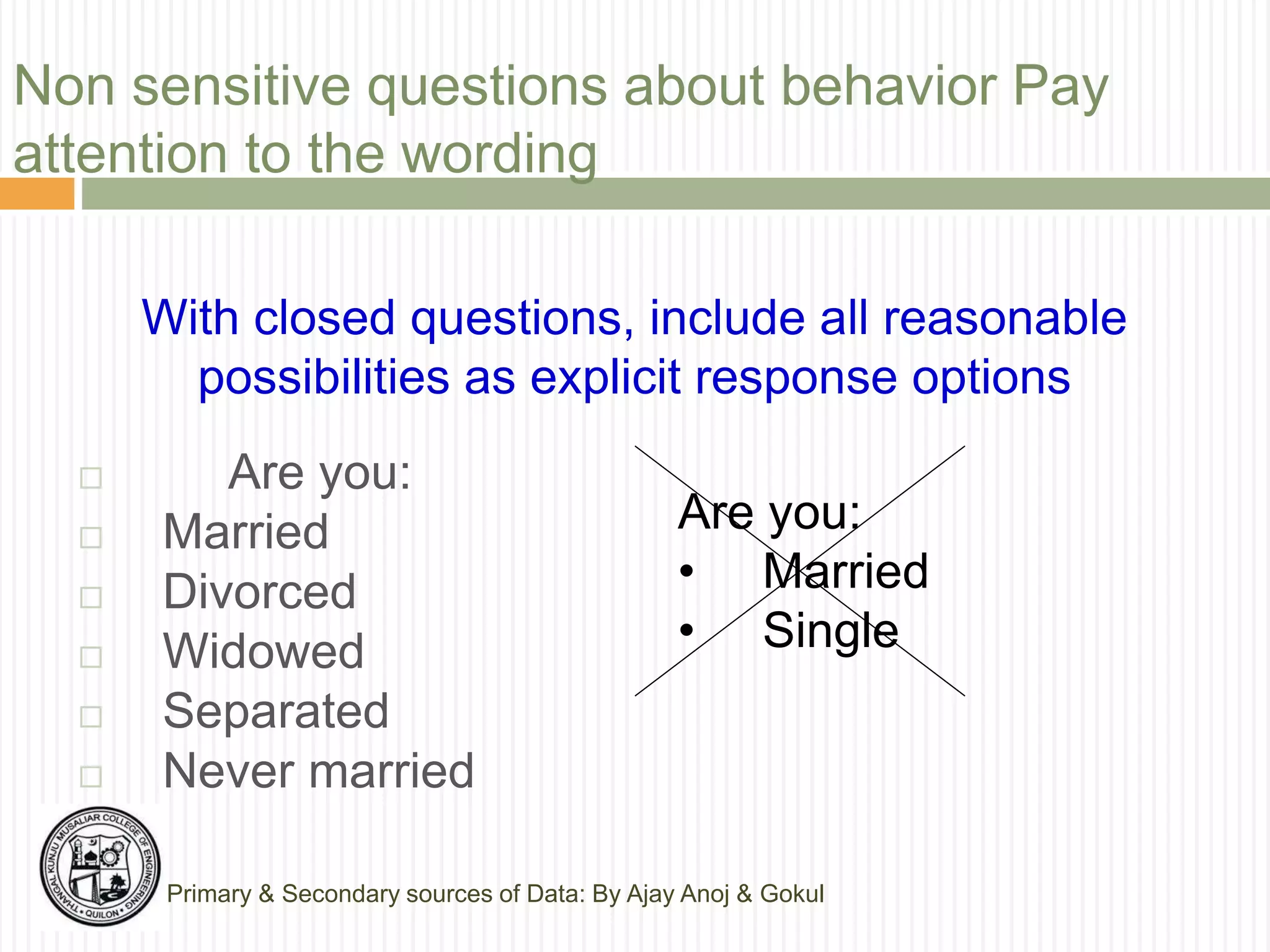
 Are you:
 Married
 Divorced
 Widowed
 Separated
 Never married
With closed questions, include all reasonable
possibilities as explicit response options
Are you:
• Married
• Single
Primary & Secondary sources of Data: By Ajay Anoj & Gokul
CONTDD…
Primary & Secondary sources of Data: By Ajay Anoj & Gokul
 HAND OVER TO GOKUL PG
Secondary Data
Primary & Secondary sources of Data: By Ajay Anoj & Gokul
 •Secondary data are those that have already been
collected by others.
 •These are usually in journals, periodicals, dailies,
research publications, official records etc.
 •Secondary data may be available in the published or
unpublished form. When it is not possible to collect
the data by primary method, the investigator go for
Secondary method.
 •This Data collected for some purpose other than the
problem at hand.
Method of Collecting Secondary
Data
Primary & Secondary sources of Data: By Ajay Anoj & Gokul
 1. Published Sources
 a) International Publication
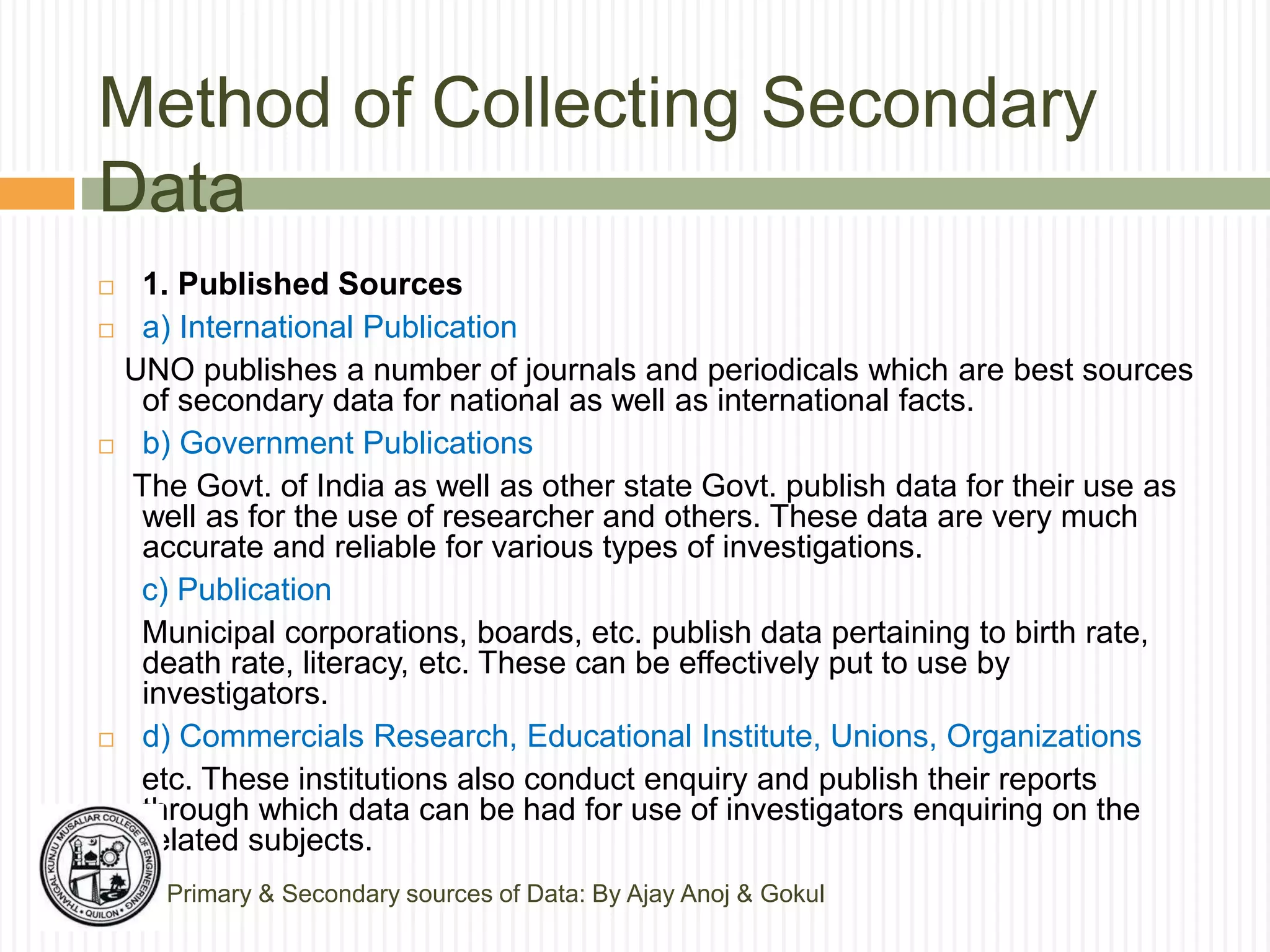
UNO publishes a number of journals and periodicals which are best sources
of secondary data for national as well as international facts.
 b) Government Publications
The Govt. of India as well as other state Govt. publish data for their use as
well as for the use of researcher and others. These data are very much
accurate and reliable for various types of investigations.
c) Publication
Municipal corporations, boards, etc. publish data pertaining to birth rate,
death rate, literacy, etc. These can be effectively put to use by
investigators.
 d) Commercials Research, Educational Institute, Unions, Organizations
etc. These institutions also conduct enquiry and publish their reports
through which data can be had for use of investigators enquiring on the
related subjects.
Method of Collecting Secondary
Data
Primary & Secondary sources of Data: By Ajay Anoj & Gokul
 2. Unpublished Sources
In some of the cases, enquiry are conducted,
data are classified and analysed but due to
some reasons or other findings are published
though they are preserved either by the
individual or a society. They can also be used
by the investigators as Secondary Data.
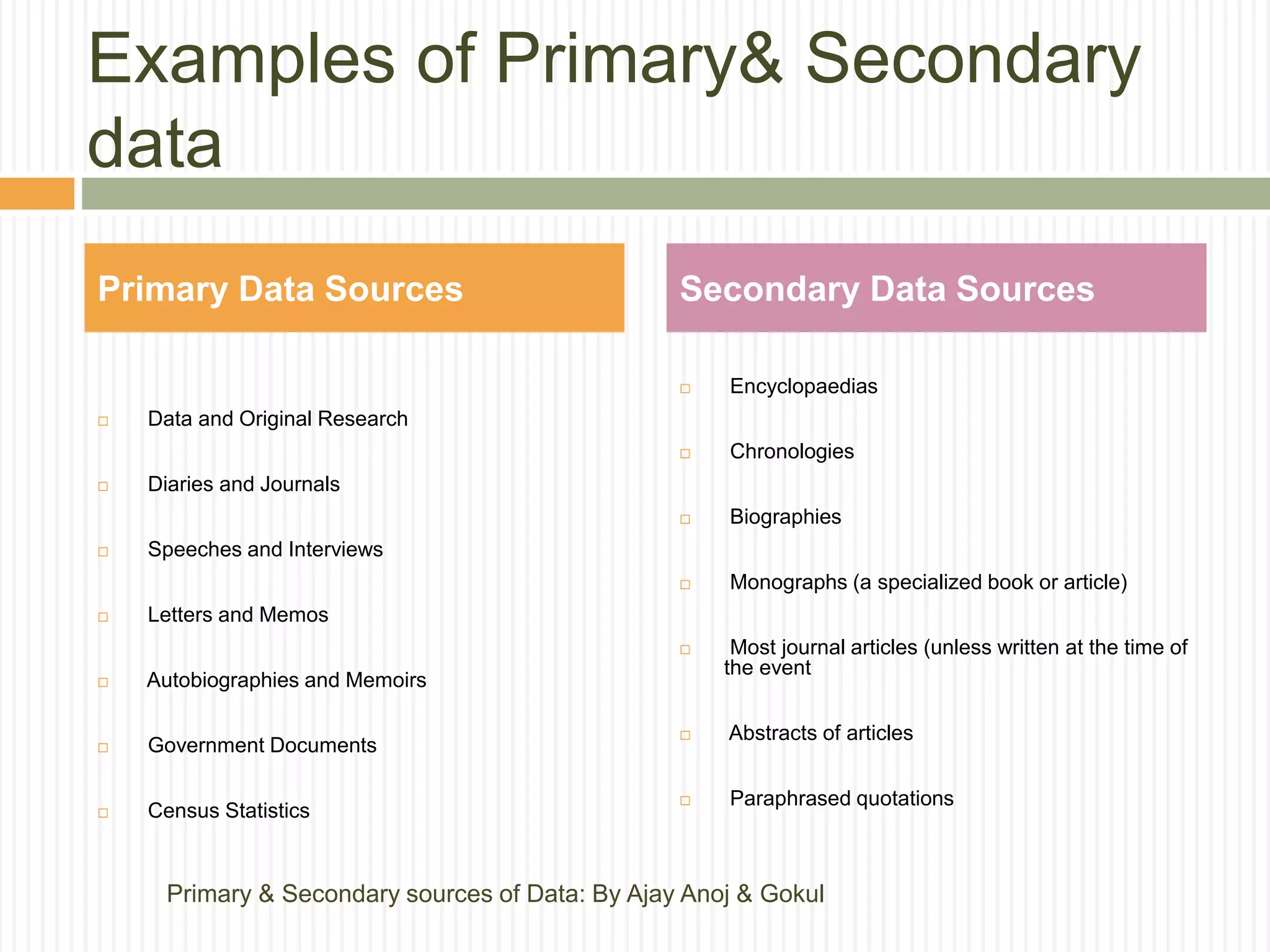
Examples of Primary& Secondary
data
 Data and Original Research
 Diaries and Journals
 Speeches and Interviews
 Letters and Memos
 Autobiographies and Memoirs
 Government Documents
 Census Statistics
 Encyclopaedias
 Chronologies
 Biographies
 Monographs (a specialized book or article)
 Most journal articles (unless written at the time of
the event
 Abstracts of articles
 Paraphrased quotations
Primary & Secondary sources of Data: By Ajay Anoj & Gokul
Primary Data Sources Secondary Data Sources
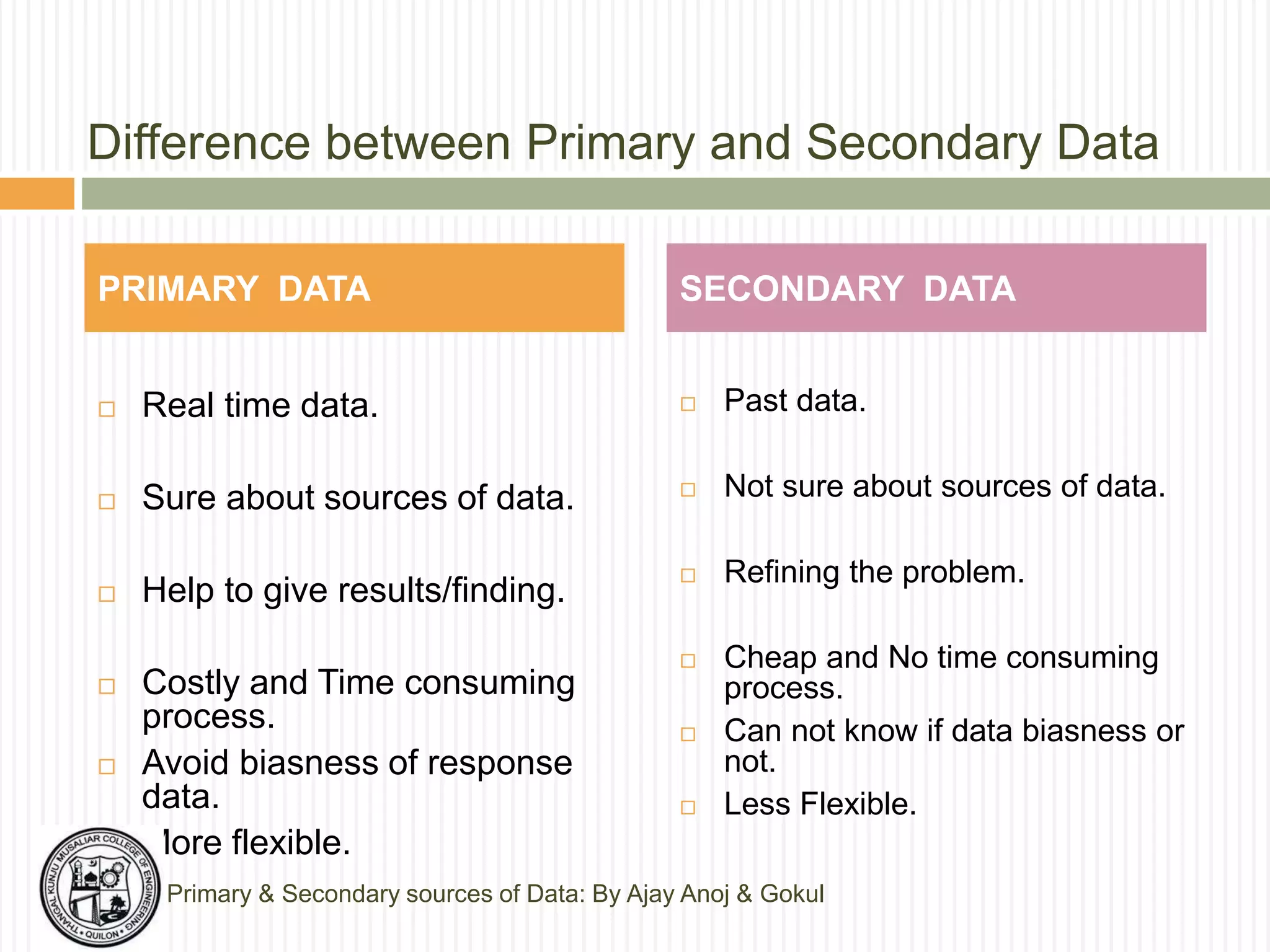
Difference between Primary and Secondary Data
 Real time data.
 Sure about sources of data.
 Help to give results/finding.
 Costly and Time consuming
process.
 Avoid biasness of response
data.
 More flexible.
 Past data.
 Not sure about sources of data.
 Refining the problem.
 Cheap and No time consuming
process.
 Can not know if data biasness or
not.
 Less Flexible.
Primary & Secondary sources of Data: By Ajay Anoj & Gokul
PRIMARY DATA SECONDARY DATA
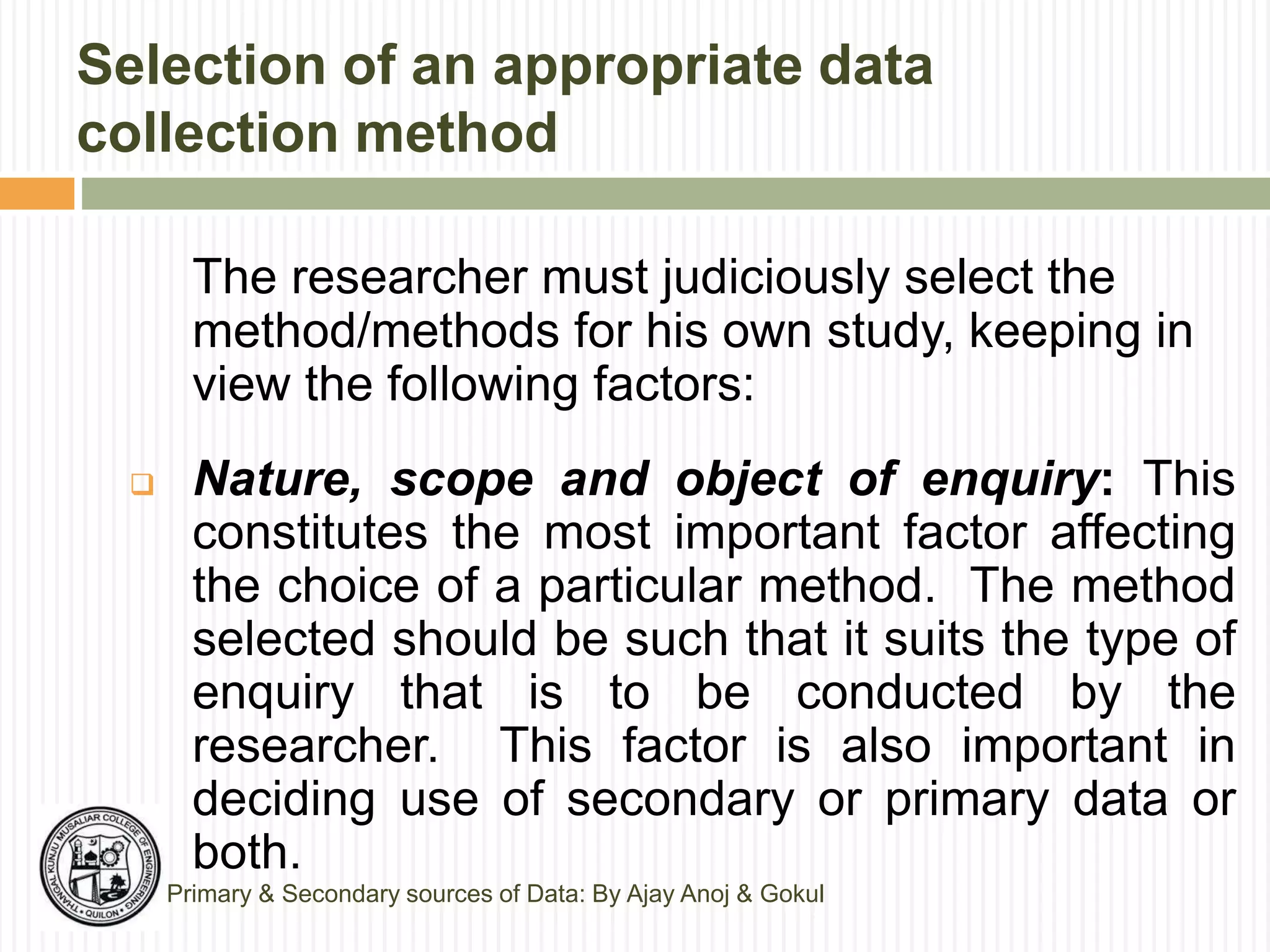
Selection of an appropriate data
collection method
The researcher must judiciously select the
method/methods for his own study, keeping in
view the following factors:
 Nature, scope and object of enquiry: This
constitutes the most important factor affecting
the choice of a particular method. The method
selected should be such that it suits the type of
enquiry that is to be conducted by the
researcher. This factor is also important in
deciding use of secondary or primary data or
both.
Primary & Secondary sources of Data: By Ajay Anoj & Gokul
Selection of an appropriate data
collection method (cont…)
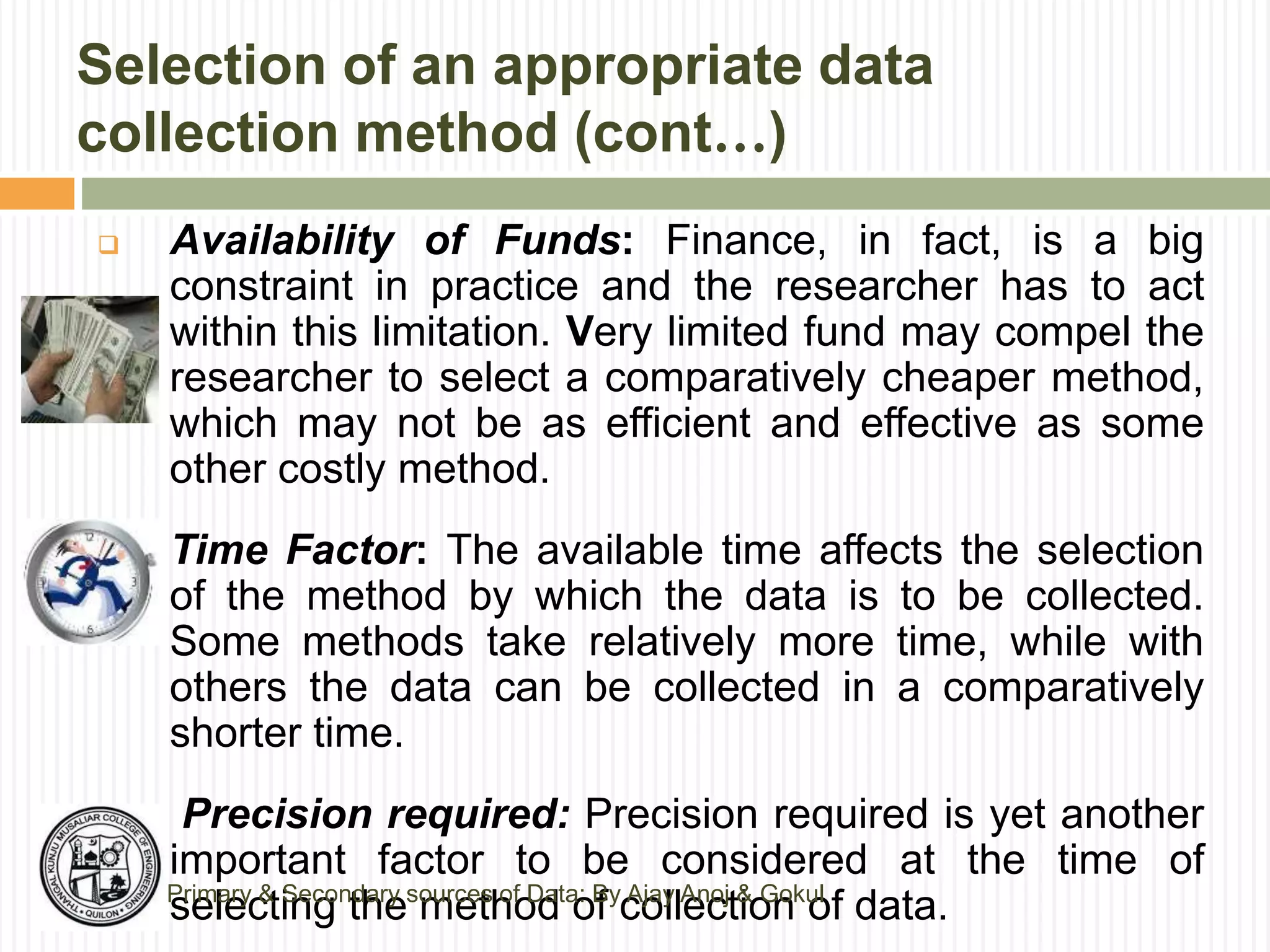
 Availability of Funds: Finance, in fact, is a big
constraint in practice and the researcher has to act
within this limitation. Very limited fund may compel the
researcher to select a comparatively cheaper method,
which may not be as efficient and effective as some
other costly method.
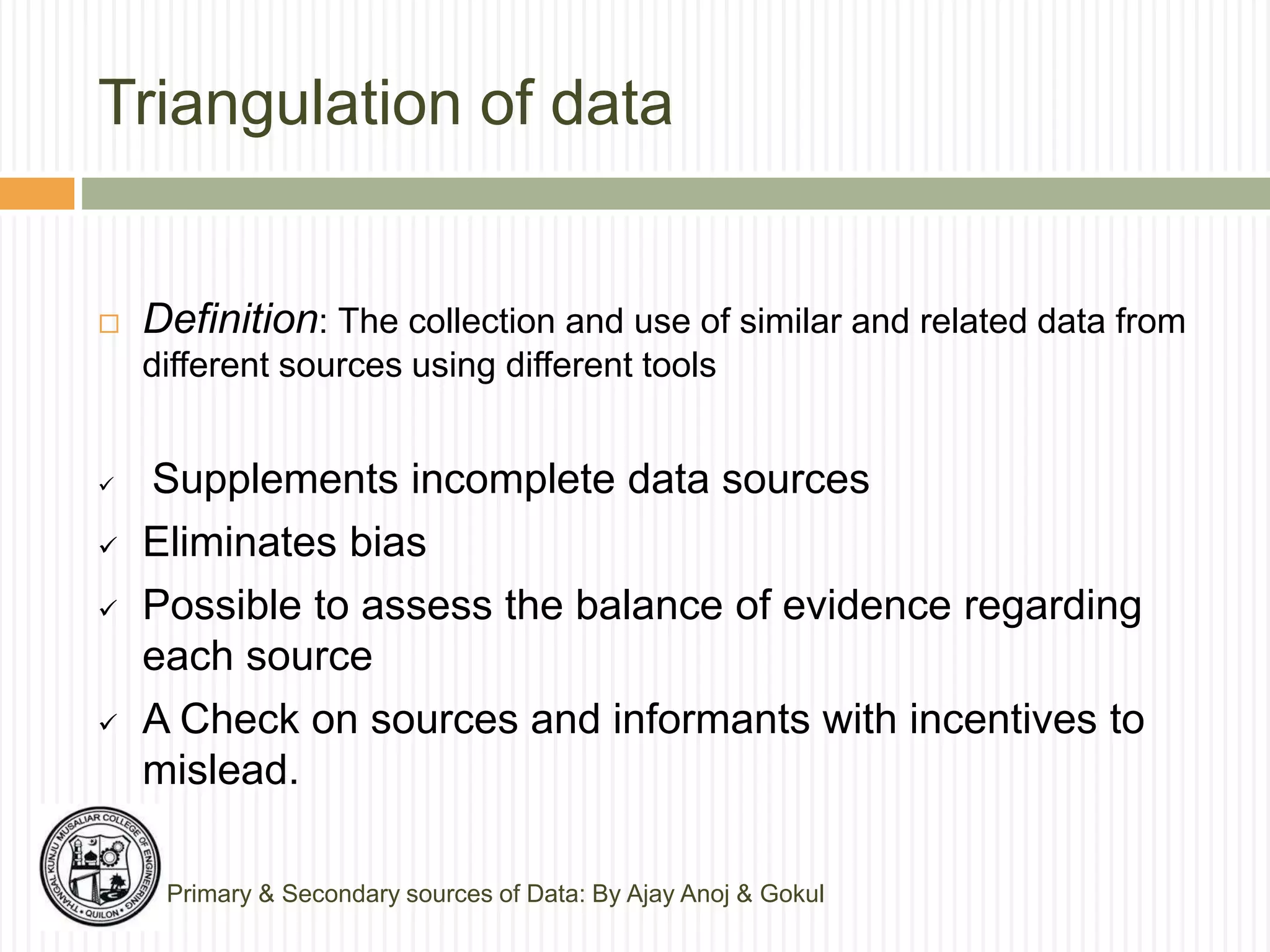
 Time Factor: The available time affects the selection
of the method by which the data is to be collected.
Some methods take relatively more time, while with
others the data can be collected in a comparatively
shorter time.
 Precision required: Precision required is yet another
important factor to be considered at the time of
selecting the method of collection of data.Primary & Secondary sources of Data: By Ajay Anoj & Gokul
Triangulation of data
 Definition: The collection and use of similar and related data from
different sources using different tools
 Supplements incomplete data sources
 Eliminates bias
 Possible to assess the balance of evidence regarding
each source
 A Check on sources and informants with incentives to
mislead.
Primary & Secondary sources of Data: By Ajay Anoj & Gokul
IMPORTANT
Remember: each method of data collection has
its use and none is superior in all
situations
Desirable: selection of method depends on the
nature of a particular problem in
consideration of time and resources.
Required: Experience and ability of the
researcher.
Primary & Secondary sources of Data: By Ajay Anoj & Gokul
THANK YOU !
Primary & Secondary sources of Data: By Ajay Anoj & Gokul
Questions/Discussions
 Question One
 Discussion
 Discussion
 Question Two
 Discussion
 Questions Three
 Discussion
Primary & Secondary sources of Data: By Ajay Anoj & Gokul

Primary and Secondary Data collection - Ajay Anoj & Gokul

  • 1.
    PRIMARY & SECONDARY SOURCEOF DATA COLLECTION RESEARCH METHOD FOR MANAGERS PRESENTED BY : GOKUL P G & AJAY ANOJ KUMAR MBA – TKM COE Primary & Secondary sources of Data: By Ajay Anoj & Gokul
  • 2.
    Objective : Tounderstand “Primary & Secondary Data collection”  Introduction  Need for Data Collection  Factors to be considered for data collection  Sources of Data  Primary Data and Collection Methods  Traditional and New Aged Means of data Collection  Questionnaires with examples  Secondary Sources & Collection Methods  Differences between Primary & Secondary sources  Selection of Appropriate data collection &Triangulation of Data Primary & Secondary sources of Data: By Ajay Anoj & Gokul
  • 3.
    Need of DataCollection  Why is Data Collection Needed ?  •To get information for analysis.  •To get idea about real time situation.  •For comparison between two situation. Primary & Secondary sources of Data: By Ajay Anoj & Gokul
  • 4.
    Factors to beconsidered before collection of Data Primary & Secondary sources of Data: By Ajay Anoj & Gokul  •Object and scope of the enquiry.  •Sources of information.  •Quantitative expression.  •Techniques of data collection.  •Unit of collection.
  • 5.
    Sources of Data Primary& Secondary sources of Data: By Ajay Anoj & Gokul
  • 6.
    Internal and ExternalSource of Data  Many institutions and departments have information about their regular functions, for their own internal purpose.  When those information is used in any survey, it’s called Internal Source Of Collection of Data.  E.g.., Railway Educational Institutes & Social Welfare Societies etc.  When information is collected form outside agencies, it is called external source of data.  Such type of data are either Primary or Secondary.  This type of information can be collected by Census or Sampling method by conducting surveys. Primary & Secondary sources of Data: By Ajay Anoj & Gokul Internal Sources of Data External Sources of Data
  • 7.
    Primary Data Primary &Secondary sources of Data: By Ajay Anoj & Gokul  •Primary data are those which are collected for the first time.  •It is real time data which are collected by the researcher himself.  •This is the process of Collecting and making use of the data.  •This Data originated by the researcher specifically to address the research problem.
  • 8.
    Primary Research methods Primary& Secondary sources of Data: By Ajay Anoj & Gokul  Focus Groups – bring together respondents with common characteristics  Observation - actually view respondents  Experiment - controlled variables and respondent groups.  Non-personal survey – on site, telephone, mail, fax, computer, panel  Personal interview - one-on-one survey with respondents  Official records – internal document survey research
  • 9.
    Method of CollectingPrimary Data Primary & Secondary sources of Data: By Ajay Anoj & Gokul  1. Direct personal Investigation ( i.e. Interview Method) Under this method the investigator collects the data personally. He approaches the objects, conducts the enquiry on the spot, collects information and does the needful. For the successful collection of data under this method, it’s necessary that the investigator should be polite, unbiased and ware of the local conditions, environment and languages.
  • 10.
    Method of CollectingPrimary Data Primary & Secondary sources of Data: By Ajay Anoj & Gokul  2. Indirect oral investigation ( i.e. through enumerators) Under this the investigator doesn’t collects the information directly, instead he gets them indirectly through those persons who know the information and who are ready to part away with the information they posses. This method is used in case where direct contact is not possible.  3. Investigation through Local reporters Questionnaire In this method data are not collected through specially appointed agents/ correspondents/investigators/enumerators but local agents or correspondents are requested to collect the information. They collect the information in their own fashion and according to their liking’s and disliking.
  • 11.
    Method of CollectingPrimary Data Primary & Secondary sources of Data: By Ajay Anoj & Gokul  4. Investigation through mailed Questionnaire Under this method the investigator may either appoint local agents/ investigators/ enumerators and mail them the questionnaire for collecting information or collecting by his own using mail or telephone.
  • 12.
    Method of CollectingPrimary Data Primary & Secondary sources of Data: By Ajay Anoj & Gokul 5. Investigation through Observation  In this watching behavior of object and most commonly used method in behavior science. One major problem in this method is that Natural response is not obtained when respondent know he is observed.  Type of Observation- 1)Participant Observation 2)Non-Participant Observation 3)Disguised Observation 4)Controlled Observation 5)Uncontrolled Observation
  • 13.
    Traditional data collection methods Primary& Secondary sources of Data: By Ajay Anoj & Gokul  Mailing paper questionnaires to respondents, who fill them out and mail them back  Having interviewers call to respondents on the telephone and ask them the question in a telephone interview  Sending the interviewers to the respondent’s home or office to administer the questions in face- to-face (FTF) interviews
  • 14.
    Alternative methods ofdata collection Face to face Telephone Mail CATI computer assisted telephone interviewing CAPI computer assisted personal interviewing TDE Touchtone data entry OCR/ICR Optical/intelligent caracter recognition FAX Disk by Mail E-mail Web Computerised Self Administered Questionnaires IVR Interactive voice response SAQ Self administered questionnaire Walkman Text CASI Audio CASI Video CASI Primary & Secondary sources of Data: By Ajay Anoj & Gokul
  • 15.
    Important characteristics ofgood questionnaires  Plan a user-friendly format  Gather demographic data – age, gender, etc., when necessary.  Avoid ambiguity  Ensure ease of tabulation  Develop for completeness – get all the data  Pilot test the instrument Primary & Secondary sources of Data: By Ajay Anoj & Gokul
  • 16.
    Non sensitive questionsabout behavior Provide memory help Uses aided recall (or ask separate questions about subcategories) Please look cerefully at the following list of volountary organisations: which, if any, do you belong to? A Religious organisations B Cultural organisations C Political groups D Other To which volountary organisation do you belong to? Primary & Secondary sources of Data: By Ajay Anoj & Gokul
  • 17.
    Non sensitive questionsabout behavior Pay attention to the wording  Are you:  Married  Divorced  Widowed  Separated  Never married With closed questions, include all reasonable possibilities as explicit response options Are you: • Married • Single Primary & Secondary sources of Data: By Ajay Anoj & Gokul
  • 18.
    CONTDD… Primary & Secondarysources of Data: By Ajay Anoj & Gokul  HAND OVER TO GOKUL PG
  • 19.
    Secondary Data Primary &Secondary sources of Data: By Ajay Anoj & Gokul  •Secondary data are those that have already been collected by others.  •These are usually in journals, periodicals, dailies, research publications, official records etc.  •Secondary data may be available in the published or unpublished form. When it is not possible to collect the data by primary method, the investigator go for Secondary method.  •This Data collected for some purpose other than the problem at hand.
  • 20.
    Method of CollectingSecondary Data Primary & Secondary sources of Data: By Ajay Anoj & Gokul  1. Published Sources  a) International Publication UNO publishes a number of journals and periodicals which are best sources of secondary data for national as well as international facts.  b) Government Publications The Govt. of India as well as other state Govt. publish data for their use as well as for the use of researcher and others. These data are very much accurate and reliable for various types of investigations. c) Publication Municipal corporations, boards, etc. publish data pertaining to birth rate, death rate, literacy, etc. These can be effectively put to use by investigators.  d) Commercials Research, Educational Institute, Unions, Organizations etc. These institutions also conduct enquiry and publish their reports through which data can be had for use of investigators enquiring on the related subjects.
  • 21.
    Method of CollectingSecondary Data Primary & Secondary sources of Data: By Ajay Anoj & Gokul  2. Unpublished Sources In some of the cases, enquiry are conducted, data are classified and analysed but due to some reasons or other findings are published though they are preserved either by the individual or a society. They can also be used by the investigators as Secondary Data.
  • 22.
    Examples of Primary&Secondary data  Data and Original Research  Diaries and Journals  Speeches and Interviews  Letters and Memos  Autobiographies and Memoirs  Government Documents  Census Statistics  Encyclopaedias  Chronologies  Biographies  Monographs (a specialized book or article)  Most journal articles (unless written at the time of the event  Abstracts of articles  Paraphrased quotations Primary & Secondary sources of Data: By Ajay Anoj & Gokul Primary Data Sources Secondary Data Sources
  • 23.
    Difference between Primaryand Secondary Data  Real time data.  Sure about sources of data.  Help to give results/finding.  Costly and Time consuming process.  Avoid biasness of response data.  More flexible.  Past data.  Not sure about sources of data.  Refining the problem.  Cheap and No time consuming process.  Can not know if data biasness or not.  Less Flexible. Primary & Secondary sources of Data: By Ajay Anoj & Gokul PRIMARY DATA SECONDARY DATA
  • 24.
    Selection of anappropriate data collection method The researcher must judiciously select the method/methods for his own study, keeping in view the following factors:  Nature, scope and object of enquiry: This constitutes the most important factor affecting the choice of a particular method. The method selected should be such that it suits the type of enquiry that is to be conducted by the researcher. This factor is also important in deciding use of secondary or primary data or both. Primary & Secondary sources of Data: By Ajay Anoj & Gokul
  • 25.
    Selection of anappropriate data collection method (cont…)  Availability of Funds: Finance, in fact, is a big constraint in practice and the researcher has to act within this limitation. Very limited fund may compel the researcher to select a comparatively cheaper method, which may not be as efficient and effective as some other costly method.  Time Factor: The available time affects the selection of the method by which the data is to be collected. Some methods take relatively more time, while with others the data can be collected in a comparatively shorter time.  Precision required: Precision required is yet another important factor to be considered at the time of selecting the method of collection of data.Primary & Secondary sources of Data: By Ajay Anoj & Gokul
  • 26.
    Triangulation of data Definition: The collection and use of similar and related data from different sources using different tools  Supplements incomplete data sources  Eliminates bias  Possible to assess the balance of evidence regarding each source  A Check on sources and informants with incentives to mislead. Primary & Secondary sources of Data: By Ajay Anoj & Gokul
  • 27.
    IMPORTANT Remember: each methodof data collection has its use and none is superior in all situations Desirable: selection of method depends on the nature of a particular problem in consideration of time and resources. Required: Experience and ability of the researcher. Primary & Secondary sources of Data: By Ajay Anoj & Gokul
  • 28.
    THANK YOU ! Primary& Secondary sources of Data: By Ajay Anoj & Gokul
  • 29.
    Questions/Discussions  Question One Discussion  Discussion  Question Two  Discussion  Questions Three  Discussion Primary & Secondary sources of Data: By Ajay Anoj & Gokul

Editor's Notes

  • #3 Introductory notes.
  • #4 Conclusion to course, lecture, et al.
  • #30 An opportunity for questions and discussions.