PROCESSING AND ANALYSIS OF DATA 
12/6/2014 ITFT COLLEGE CHANDIGARH
PROCESSING OPERATIONS 
1) EDITING 
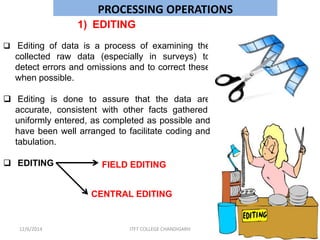
 Editing of data is a process of examining the 
collected raw data (especially in surveys) to 
detect errors and omissions and to correct these 
when possible. 
 Editing is done to assure that the data are 
accurate, consistent with other facts gathered, 
uniformly entered, as completed as possible and 
have been well arranged to facilitate coding and 
tabulation. 
 EDITING FIELD EDITING 
CENTRAL EDITING 
12/6/2014 ITFT COLLEGE CHANDIGARH
FIELD EDITING 
Field editing consists in the review of the reporting forms by the 
investigator for completing (translating or rewriting) what the latter 
has written in abbreviated and/or in illegible form at the time of 
recording the respondents’ responses. 
This type of editing is necessary in view of the fact that 
individual writing styles often can be difficult for others to decipher. 
CENTRAL EDITING 
Central editing should take place when all forms or schedules 
have been completed and returned to the office. 
 This type of editing implies that all forms should get a thorough 
editing by a single editor in a small study and by a team of editors 
in case of a large inquiry. 
12/6/2014 ITFT COLLEGE CHANDIGARH
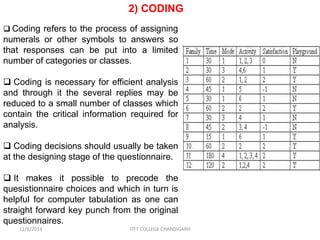
2) CODING 
 Coding refers to the process of assigning 
numerals or other symbols to answers so 
that responses can be put into a limited 
number of categories or classes. 
 Coding is necessary for efficient analysis 
and through it the several replies may be 
reduced to a small number of classes which 
contain the critical information required for 
analysis. 
 Coding decisions should usually be taken 
at the designing stage of the questionnaire. 
 It makes it possible to precode the 
quesistionnaire choices and which in turn is 
helpful for computer tabulation as one can 
straight forward key punch from the original 
questionnaires. 
12/6/2014 ITFT COLLEGE CHANDIGARH
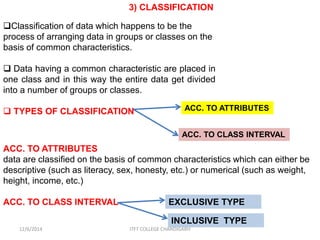
3) CLASSIFICATION 
Classification of data which happens to be the 
process of arranging data in groups or classes on the 
basis of common characteristics. 
 Data having a common characteristic are placed in 
one class and in this way the entire data get divided 
into a number of groups or classes. 
 TYPES OF CLASSIFICATION ACC. TO ATTRIBUTES 
ACC. TO CLASS INTERVAL 
ACC. TO ATTRIBUTES 
data are classified on the basis of common characteristics which can either be 
descriptive (such as literacy, sex, honesty, etc.) or numerical (such as weight, 
height, income, etc.) 
ACC. TO CLASS INTERVAL EXCLUSIVE TYPE 
INCLUSIVE TYPE 
12/6/2014 ITFT COLLEGE CHANDIGARH
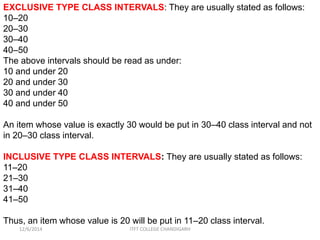
EXCLUSIVE TYPE CLASS INTERVALS: They are usually stated as follows: 
10–20 
20–30 
30–40 
40–50 
The above intervals should be read as under: 
10 and under 20 
20 and under 30 
30 and under 40 
40 and under 50 
An item whose value is exactly 30 would be put in 30–40 class interval and not 
in 20–30 class interval. 
INCLUSIVE TYPE CLASS INTERVALS: They are usually stated as follows: 
11–20 
21–30 
31–40 
41–50 
Thus, an item whose value is 20 will be put in 11–20 class interval. 
12/6/2014 ITFT COLLEGE CHANDIGARH
3) TABULATION 
Tabulation is the process of summarizing raw data 
and displaying the same in compact form (i.e., In the 
form of statistical tables) for further analysis. 
 In A broader sense, tabulation is an orderly 
arrangement of data in columns and rows. 
Tabulation is essential because of the following 
reasons 
It conserves space and reduces explanatory and 
descriptive statement to a minimum. 
It facilitates the process of comparison. 
It facilitates the summation of items and the detection 
of errors and omissions. 
It provides a basis for various statistical 
computations. 
12/6/2014 ITFT COLLEGE CHANDIGARH
GENERALLY ACCEPTED PRINCIPLES OF TABULATION: 
1) Every table should have a clear, concise and adequate title and this title 
should always be placed just above the body of the table. 
2) Every table should be given a distinct number to facilitate easy reference. 
3) The column headings (captions) and the row headings (stubs) of the table 
should be clear and brief. 
4) The units of measurement under each heading or sub-heading must 
always be indicated. 
5) Explanatory footnotes, if any, concerning the table should be placed 
directly beneath the table, along with the reference symbols used in the 
table. 
6) Source or sources from where the data in the table have been obtained 
must be indicated just below the table. 
7) Usually the columns are separated from one another by lines which make 
the table more readable and attractive. 
12/6/2014 ITFT COLLEGE CHANDIGARH
8) Those columns whose data are to be compared should be kept side by 
side. Similarly, percentages and/or averages must also be kept close to the 
data. 
9) It is generally considered better to approximate figures before tabulation 
as the same would reduce unnecessary details in the table itself. 
10) It is important that all column figures be properly aligned. Decimal points 
and (+) or (–) signs should be in perfect alignment. 
11) Abbreviations should be avoided to the extent possible and ditto marks 
should not be used in the table. 
12) Miscellaneous and exceptional items, if any, should be usually placed in 
the last row of the table. 
13) The arrangement of the categories in a table may be chronological, 
geographical, alphabetical or according to magnitude to facilitate 
comparison. 
12/6/2014 ITFT COLLEGE CHANDIGARH
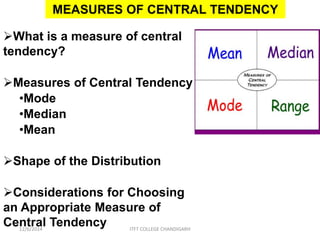
MEASURES OF CENTRAL TENDENCY 
What is a measure of central 
tendency? 
Measures of Central Tendency 
•Mode 
•Median 
•Mean 
Shape of the Distribution 
Considerations for Choosing 
an Appropriate Measure of 
Central Tendency 
12/6/2014 ITFT COLLEGE CHANDIGARH
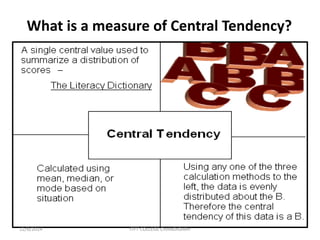
What is a measure of Central Tendency? 
12/6/2014 ITFT COLLEGE CHANDIGARH
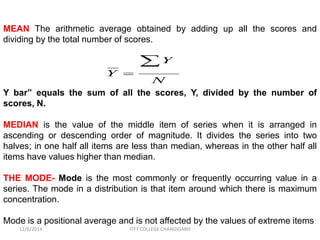
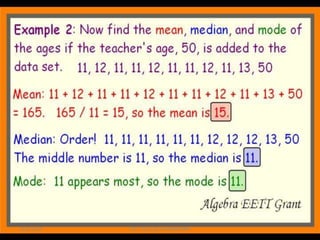
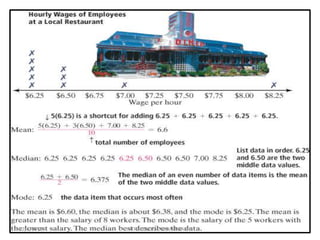
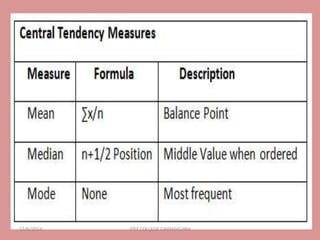
MEAN The arithmetic average obtained by adding up all the scores and 
dividing by the total number of scores. 
Y 
 
N 
Y 
 
Y bar” equals the sum of all the scores, Y, divided by the number of 
scores, N. 
MEDIAN is the value of the middle item of series when it is arranged in 
ascending or descending order of magnitude. It divides the series into two 
halves; in one half all items are less than median, whereas in the other half all 
items have values higher than median. 
THE MODE- Mode is the most commonly or frequently occurring value in a 
series. The mode in a distribution is that item around which there is maximum 
concentration. 
Mode is a positional average and is not affected by the values of extreme items 
12/6/2014 ITFT COLLEGE CHANDIGARH
MEASURES OF DISPERSION 
Important measures of dispersion are 
 Range 
Mean Deviation 
Standard Deviation. 
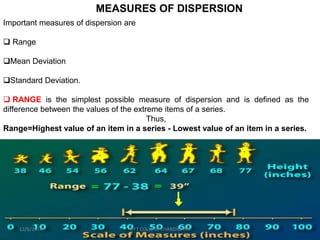
 RANGE is the simplest possible measure of dispersion and is defined as the 
difference between the values of the extreme items of a series. 
Thus, 
Range=Highest value of an item in a series - Lowest value of an item in a series. 
12/6/2014 ITFT COLLEGE CHANDIGARH
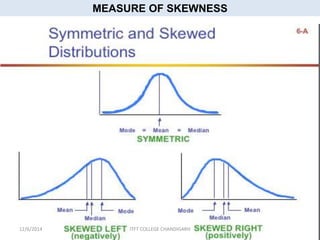
MEASURE OF SKEWNESS 
12/6/2014 ITFT COLLEGE CHANDIGARH

processng and analysis of data

  • 1.
    PROCESSING AND ANALYSISOF DATA 12/6/2014 ITFT COLLEGE CHANDIGARH
  • 2.
  • 3.
    PROCESSING OPERATIONS 1)EDITING  Editing of data is a process of examining the collected raw data (especially in surveys) to detect errors and omissions and to correct these when possible.  Editing is done to assure that the data are accurate, consistent with other facts gathered, uniformly entered, as completed as possible and have been well arranged to facilitate coding and tabulation.  EDITING FIELD EDITING CENTRAL EDITING 12/6/2014 ITFT COLLEGE CHANDIGARH
  • 4.
    FIELD EDITING Fieldediting consists in the review of the reporting forms by the investigator for completing (translating or rewriting) what the latter has written in abbreviated and/or in illegible form at the time of recording the respondents’ responses. This type of editing is necessary in view of the fact that individual writing styles often can be difficult for others to decipher. CENTRAL EDITING Central editing should take place when all forms or schedules have been completed and returned to the office.  This type of editing implies that all forms should get a thorough editing by a single editor in a small study and by a team of editors in case of a large inquiry. 12/6/2014 ITFT COLLEGE CHANDIGARH
  • 5.
    2) CODING Coding refers to the process of assigning numerals or other symbols to answers so that responses can be put into a limited number of categories or classes.  Coding is necessary for efficient analysis and through it the several replies may be reduced to a small number of classes which contain the critical information required for analysis.  Coding decisions should usually be taken at the designing stage of the questionnaire.  It makes it possible to precode the quesistionnaire choices and which in turn is helpful for computer tabulation as one can straight forward key punch from the original questionnaires. 12/6/2014 ITFT COLLEGE CHANDIGARH
  • 6.
    3) CLASSIFICATION Classificationof data which happens to be the process of arranging data in groups or classes on the basis of common characteristics.  Data having a common characteristic are placed in one class and in this way the entire data get divided into a number of groups or classes.  TYPES OF CLASSIFICATION ACC. TO ATTRIBUTES ACC. TO CLASS INTERVAL ACC. TO ATTRIBUTES data are classified on the basis of common characteristics which can either be descriptive (such as literacy, sex, honesty, etc.) or numerical (such as weight, height, income, etc.) ACC. TO CLASS INTERVAL EXCLUSIVE TYPE INCLUSIVE TYPE 12/6/2014 ITFT COLLEGE CHANDIGARH
  • 7.
    EXCLUSIVE TYPE CLASSINTERVALS: They are usually stated as follows: 10–20 20–30 30–40 40–50 The above intervals should be read as under: 10 and under 20 20 and under 30 30 and under 40 40 and under 50 An item whose value is exactly 30 would be put in 30–40 class interval and not in 20–30 class interval. INCLUSIVE TYPE CLASS INTERVALS: They are usually stated as follows: 11–20 21–30 31–40 41–50 Thus, an item whose value is 20 will be put in 11–20 class interval. 12/6/2014 ITFT COLLEGE CHANDIGARH
  • 8.
    3) TABULATION Tabulationis the process of summarizing raw data and displaying the same in compact form (i.e., In the form of statistical tables) for further analysis.  In A broader sense, tabulation is an orderly arrangement of data in columns and rows. Tabulation is essential because of the following reasons It conserves space and reduces explanatory and descriptive statement to a minimum. It facilitates the process of comparison. It facilitates the summation of items and the detection of errors and omissions. It provides a basis for various statistical computations. 12/6/2014 ITFT COLLEGE CHANDIGARH
  • 9.
    GENERALLY ACCEPTED PRINCIPLESOF TABULATION: 1) Every table should have a clear, concise and adequate title and this title should always be placed just above the body of the table. 2) Every table should be given a distinct number to facilitate easy reference. 3) The column headings (captions) and the row headings (stubs) of the table should be clear and brief. 4) The units of measurement under each heading or sub-heading must always be indicated. 5) Explanatory footnotes, if any, concerning the table should be placed directly beneath the table, along with the reference symbols used in the table. 6) Source or sources from where the data in the table have been obtained must be indicated just below the table. 7) Usually the columns are separated from one another by lines which make the table more readable and attractive. 12/6/2014 ITFT COLLEGE CHANDIGARH
  • 10.
    8) Those columnswhose data are to be compared should be kept side by side. Similarly, percentages and/or averages must also be kept close to the data. 9) It is generally considered better to approximate figures before tabulation as the same would reduce unnecessary details in the table itself. 10) It is important that all column figures be properly aligned. Decimal points and (+) or (–) signs should be in perfect alignment. 11) Abbreviations should be avoided to the extent possible and ditto marks should not be used in the table. 12) Miscellaneous and exceptional items, if any, should be usually placed in the last row of the table. 13) The arrangement of the categories in a table may be chronological, geographical, alphabetical or according to magnitude to facilitate comparison. 12/6/2014 ITFT COLLEGE CHANDIGARH
  • 11.
  • 12.
    MEASURES OF CENTRALTENDENCY What is a measure of central tendency? Measures of Central Tendency •Mode •Median •Mean Shape of the Distribution Considerations for Choosing an Appropriate Measure of Central Tendency 12/6/2014 ITFT COLLEGE CHANDIGARH
  • 13.
    What is ameasure of Central Tendency? 12/6/2014 ITFT COLLEGE CHANDIGARH
  • 14.
    MEAN The arithmeticaverage obtained by adding up all the scores and dividing by the total number of scores. Y  N Y  Y bar” equals the sum of all the scores, Y, divided by the number of scores, N. MEDIAN is the value of the middle item of series when it is arranged in ascending or descending order of magnitude. It divides the series into two halves; in one half all items are less than median, whereas in the other half all items have values higher than median. THE MODE- Mode is the most commonly or frequently occurring value in a series. The mode in a distribution is that item around which there is maximum concentration. Mode is a positional average and is not affected by the values of extreme items 12/6/2014 ITFT COLLEGE CHANDIGARH
  • 15.
  • 16.
  • 17.
  • 18.
    MEASURES OF DISPERSION Important measures of dispersion are  Range Mean Deviation Standard Deviation.  RANGE is the simplest possible measure of dispersion and is defined as the difference between the values of the extreme items of a series. Thus, Range=Highest value of an item in a series - Lowest value of an item in a series. 12/6/2014 ITFT COLLEGE CHANDIGARH
  • 19.
    MEASURE OF SKEWNESS 12/6/2014 ITFT COLLEGE CHANDIGARH
  • 20.