GMPS
UG, PG, PHYSICAL EDUCATION
COACHING CENTER
G – GANDHI BSc., MPEd., MPhil., PhD
M- MAHALINGAM BSc., MPEd., MPhil., PhD
P- PRABHU PANDIAN BSc., MPEd., MPhil., PhD
S- SARAVANAN BSc., MPEd., MPhil.
FORMULATING HYPOTHESIS
Begins with an assumption called HYPOTHESIS
HYPOTHESIS:
An hypothesis is really a temporary
explanation, a kind of educated guess about
what will happen under certain conditions.
EXAMPLE
Q: Do plants need light to grow ?
Ex: IF green plants need light to grow,
THEN only plants kept in light will display
growth.
NOTE: Most of the times it is an
“IF…. THEN… statement”
Take the following and make an hypothesis
• Do living things give off CO2 when they digest
food?
• A scientist think that living things give off
carbon dioxide as they break down food. He
predicts that carbon dioxide can be detected
as an organism digests food.
What is Hypothesis Testing
A set of logical and statistical guidelines
used to make decisions from sample statistics
to population characteristics.
Hypotheses Testing
 The intent of hypothesis testing is to
formally examine two opposing
conjectures (hypotheses), H0 and HA/H1
These two hypotheses are mutually
exclusive and exhaustive.
Sample information is collected and
analysed.
Basic Concepts in Hypotheses Testing
• Null Hypotheses &Alternate Hypotheses
• Level of Significance
• Critical Region
• Decision Rule(Test of Hypothesis)
• Type I & Type II Errors
• Two Tailed & One Tailed Tests
• One Sample & Two Sample Tests
NULL HYPOTHESIS
• Specific statement about a population
parameter made for the purposes of
argument.
• It Is always about a population parameter, not
about a sample statistic.
Alternate Hypothesis
• Represents all other possible parameter
values except that stated in the null
hypothesis.
• Denoted by H1 / HA.
Level of Significance
• The critical probability in choosing between the
null & alternative hypotheses.
• The higher the significance level, the higher the
probability of rejecting a null hypothesis when its
true.
• Confidence level:
A percentage or decimal value that tells how
confident a researcher can be about being
correct.
Critical Region
• The Acceptance and Rejection region.
• If the value of mean falls within the rejection
region, the null hypothesis is rejected.
Decision Rule (Test of Hypothesis)
The rule according to which we accept or
reject null hypothesis.
Type I Error & Type II Error
• A Type I error is the mistake of rejecting the
null hypothesis when it is true.
• α- Type I error.
• A Type II error is the mistake of failing to reject
the null hypothesis when it is false.
• β- Type II error.
Type I Error & Type II Error
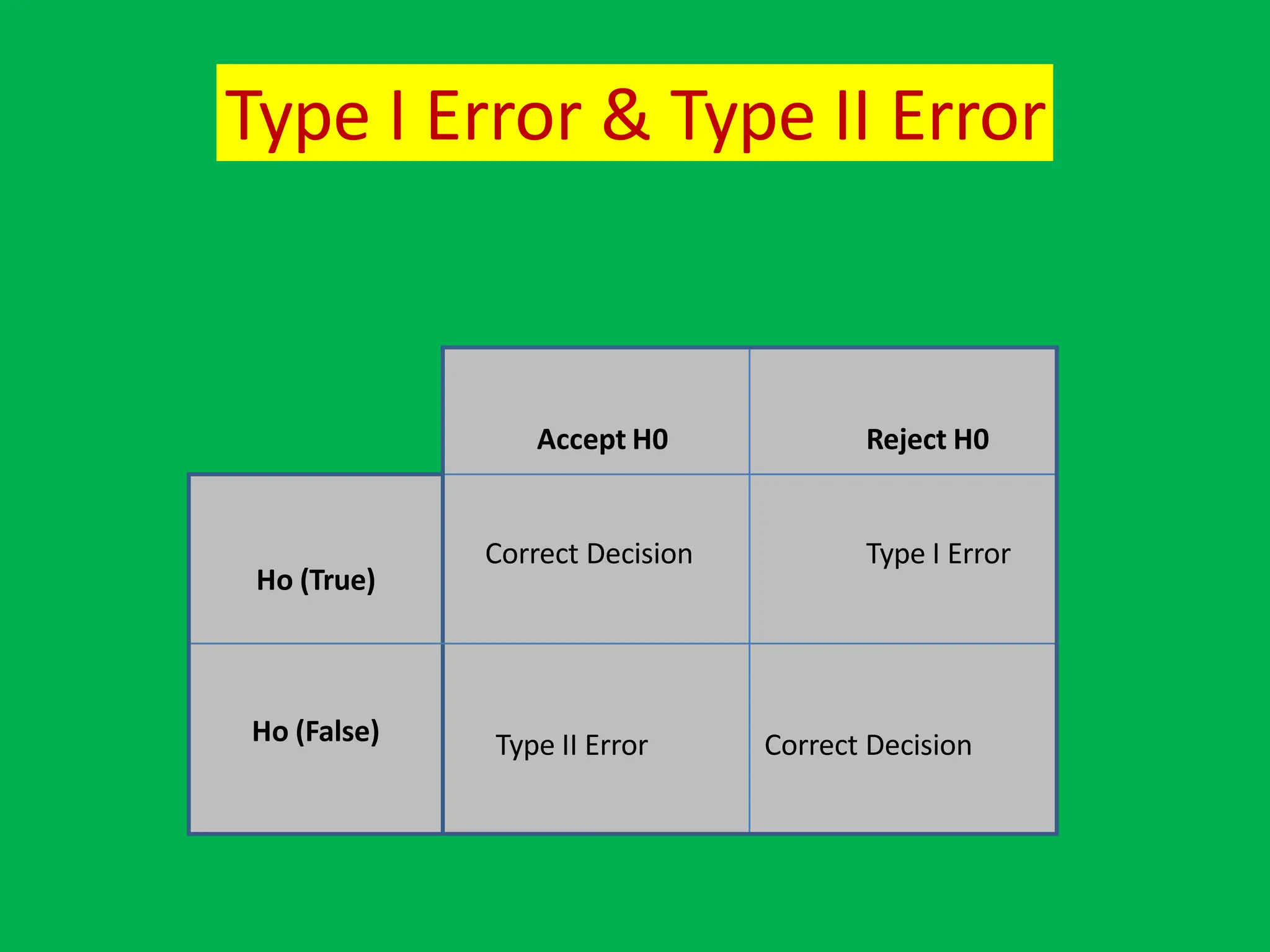
Accept H0 Reject H0
Ho (True)
Correct Decision Type I Error
Ho (False) Type II Error Correct Decision
Type I Error & Type II Error
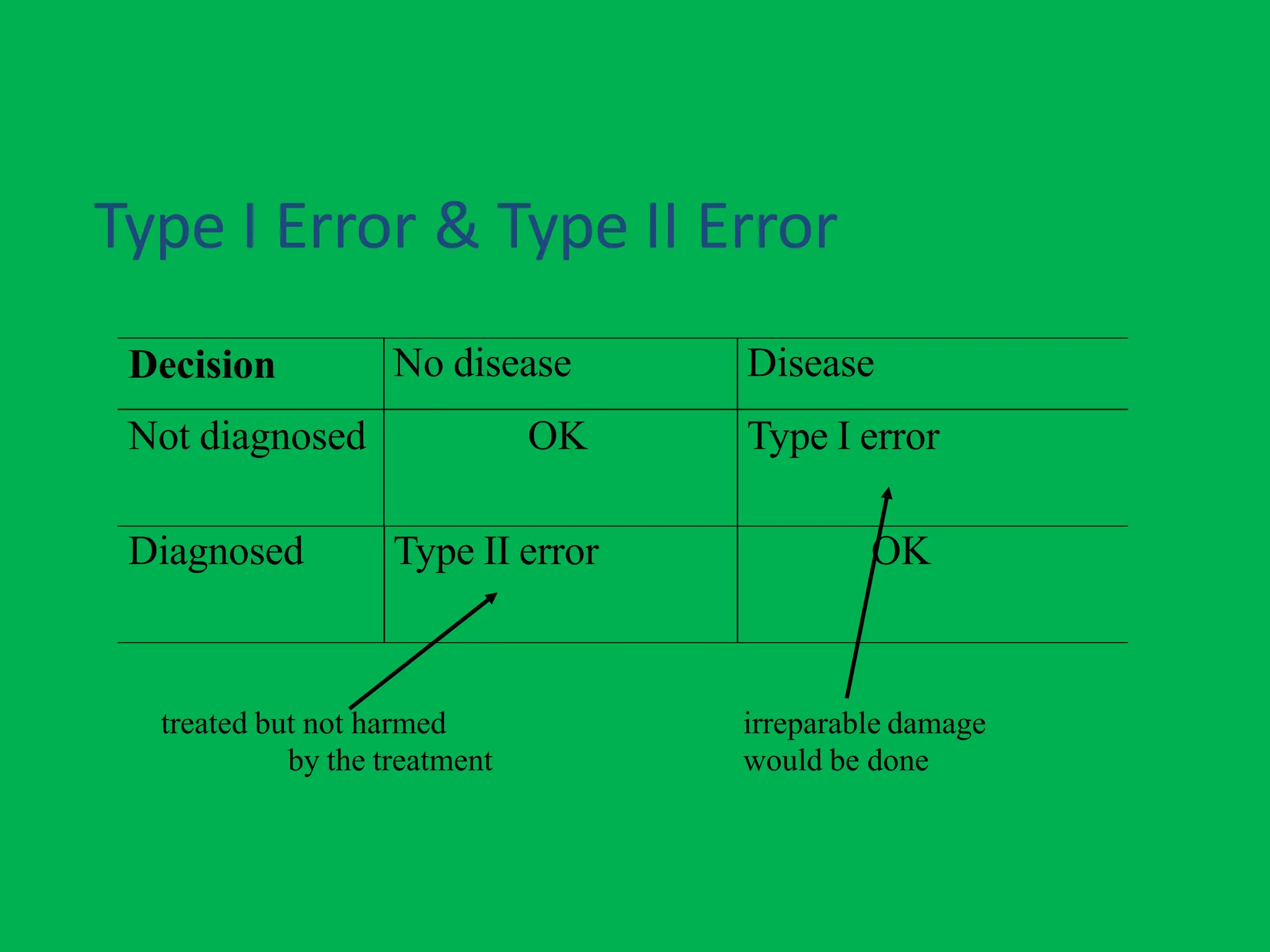
Decision No disease Disease
Not diagnosed OK Type I error
Diagnosed Type II error OK
treated but not harmed
by the treatment
irreparable damage
would be done
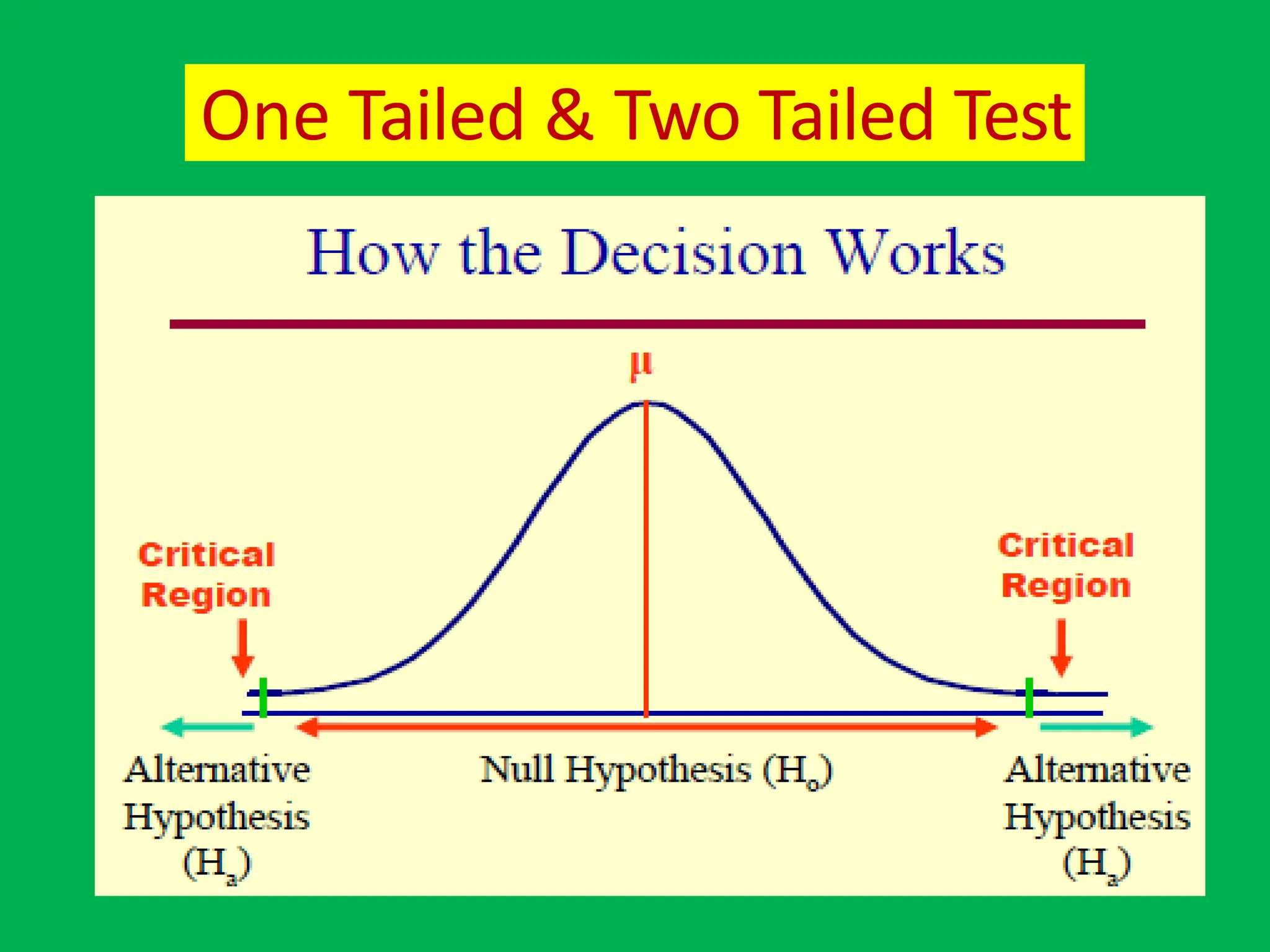
One Tailed & Two Tailed Test
• Two-Tailed Tests
• If the null hypothesis is rejected for values of the
test statistic falling into either tail of its sampling
distribution.
• A deviation in either direction would reject the
null hypothesis
• Normally α is divided into α/2 on one side and
α/2 on the other.
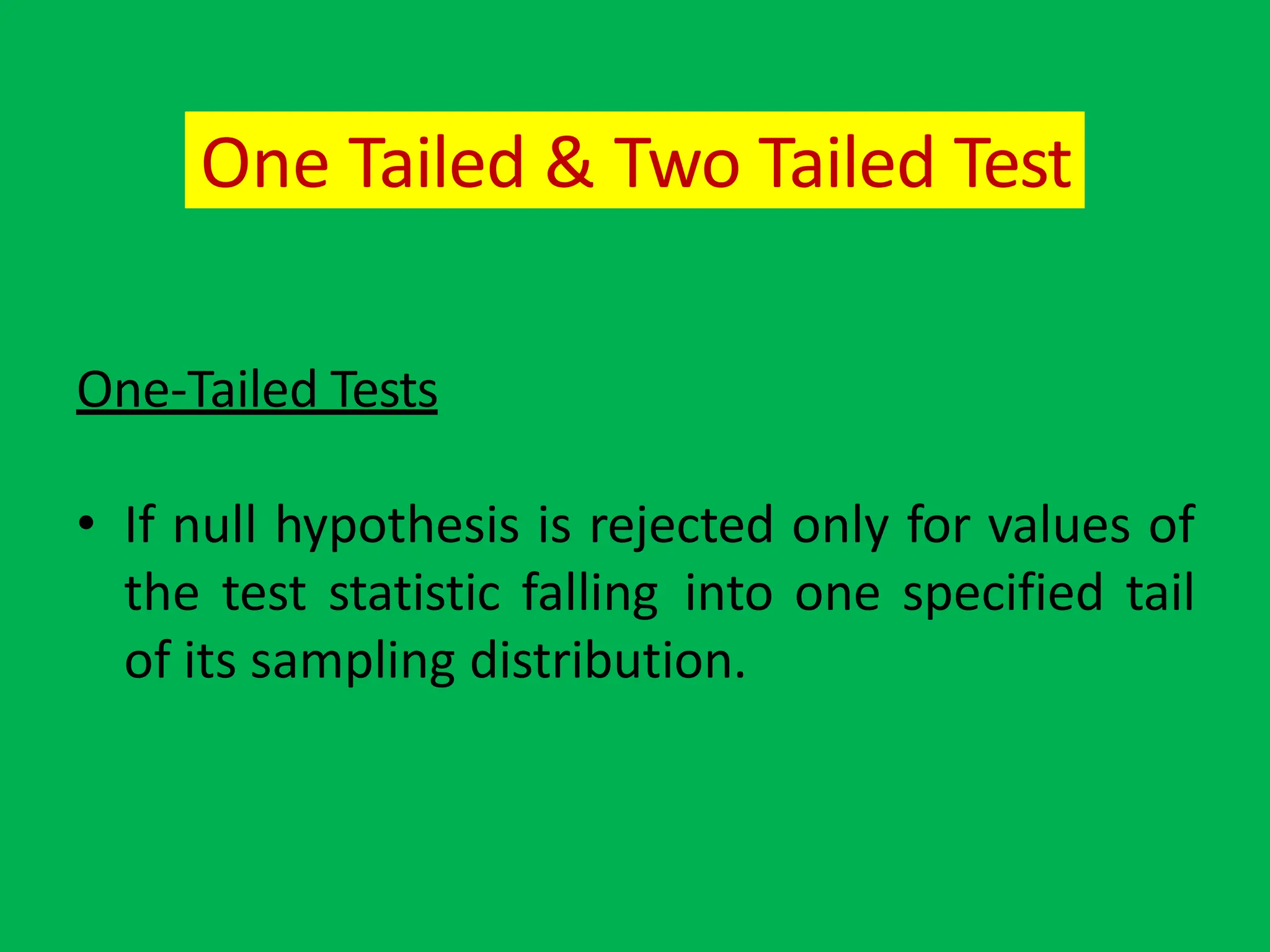
One Tailed & Two Tailed Test
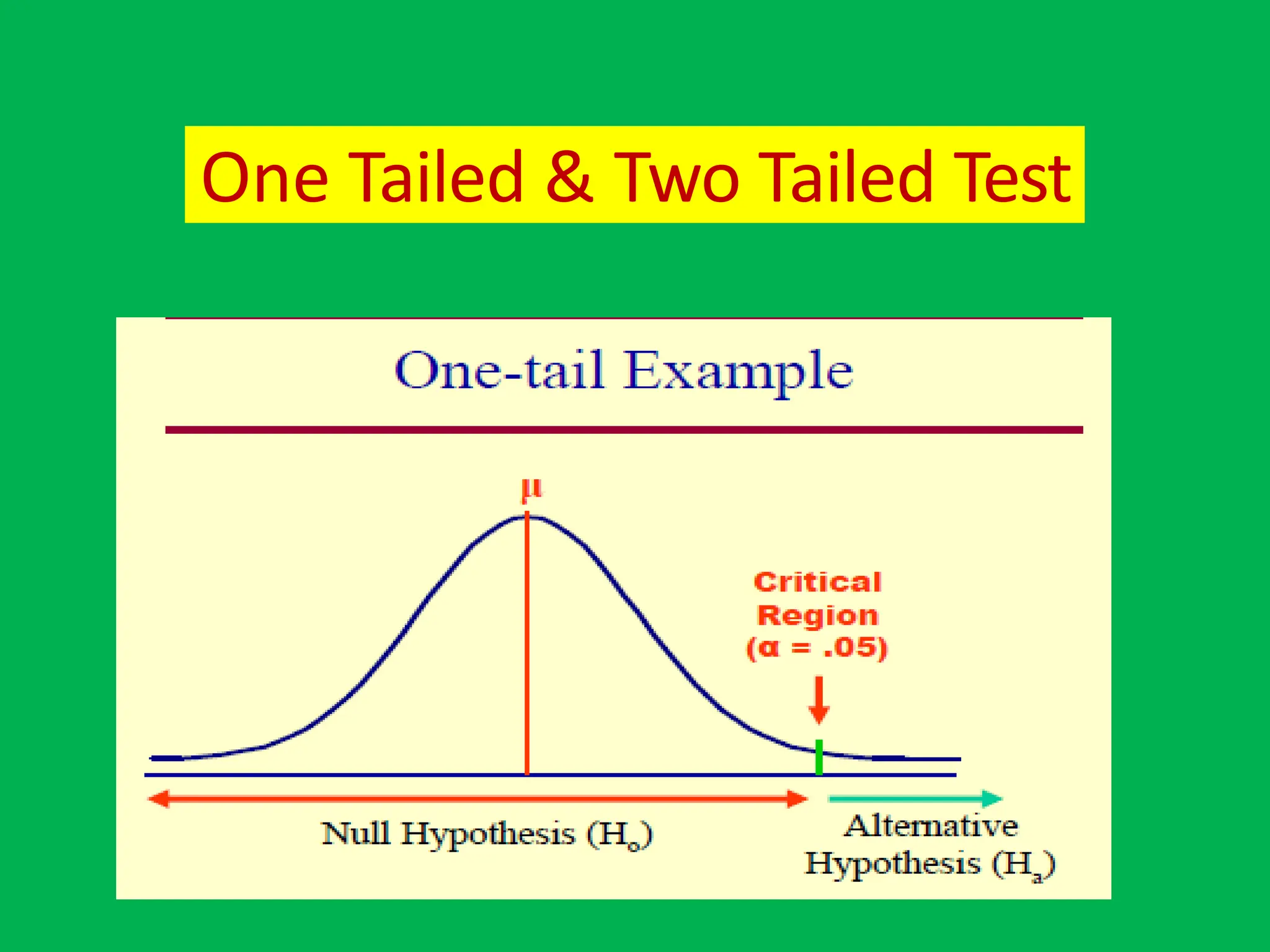
One-Tailed Tests
• If null hypothesis is rejected only for values of
the test statistic falling into one specified tail
of its sampling distribution.
One Tailed & Two Tailed Test
One Sample & Two Sample Tests
• One Sample Test
When we want to draw inferences about the
population on the basis of given sample.
• Two Sample Test
When we want to compare and draw inferences
about 2 populations on the basis of given
samples.
Independent & Paired Samples
• Independent Samples
Drawn randomly from different populations.
• Paired Samples
When the data for the two samples relate to
the same group of respondents.
Types of Hypotheses
• Research hypotheses.
• Logical hypotheses.
– Null hypothesis (Ho).
– Alternative hypothesis (HA/H1).
• Statistical hypotheses.
Hypothesis makes the
following
contributions in
research study
Cont…
• It provides clarity to the research problem and
research objectives
• It describes, explains or predicts the expected
results or outcome of the research.
• It indicates the type of research design.
• It directs the research study process.
Cont…
• It identifies the population of the research study
that is to be investigated or examined.
• It facilitates data collection, data analysis and
data interpretation
Type of
Hypothesis
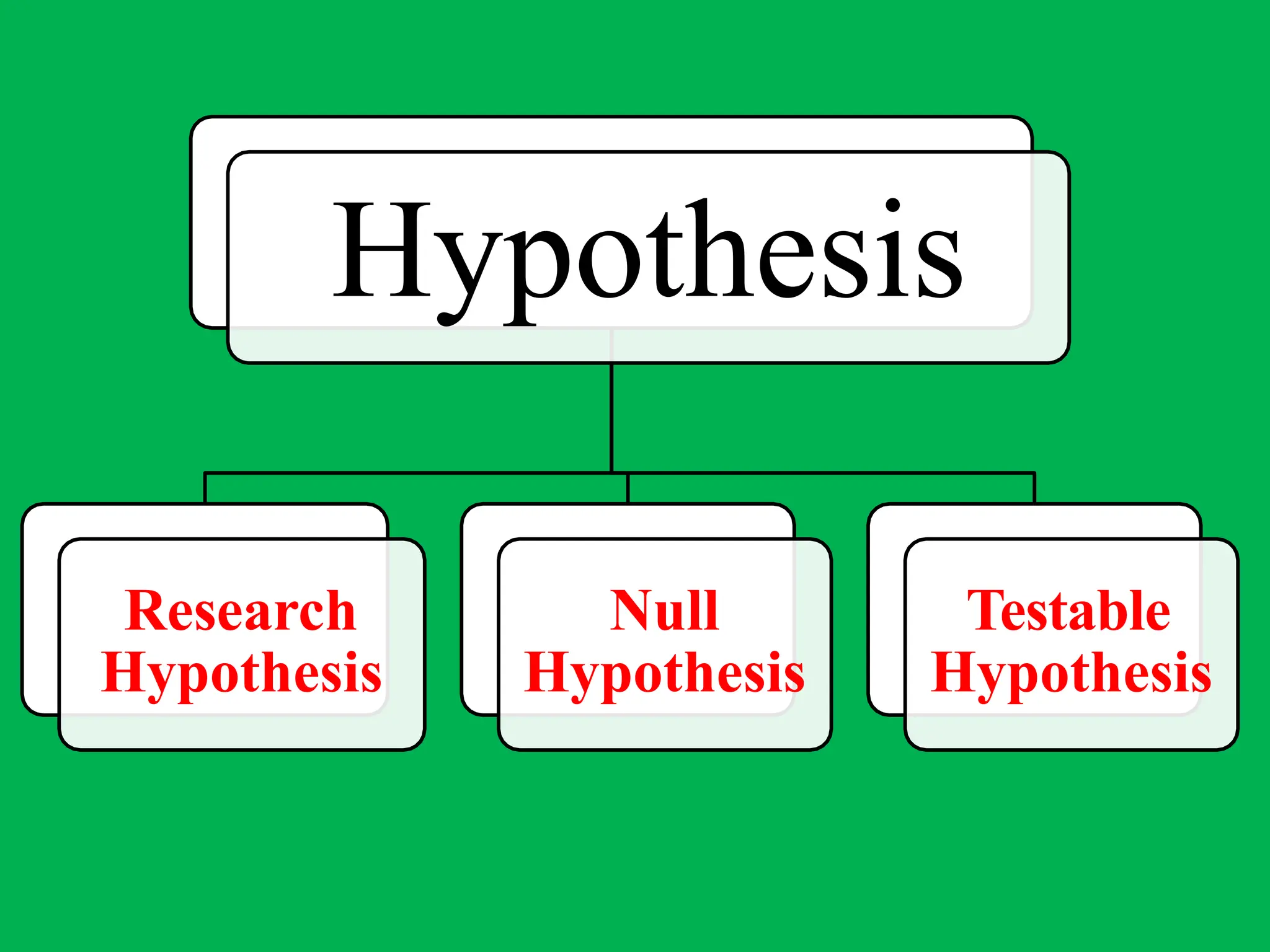
Hypothesis
Research
Hypothesis
Null
Hypothesis
Testable
Hypothesis
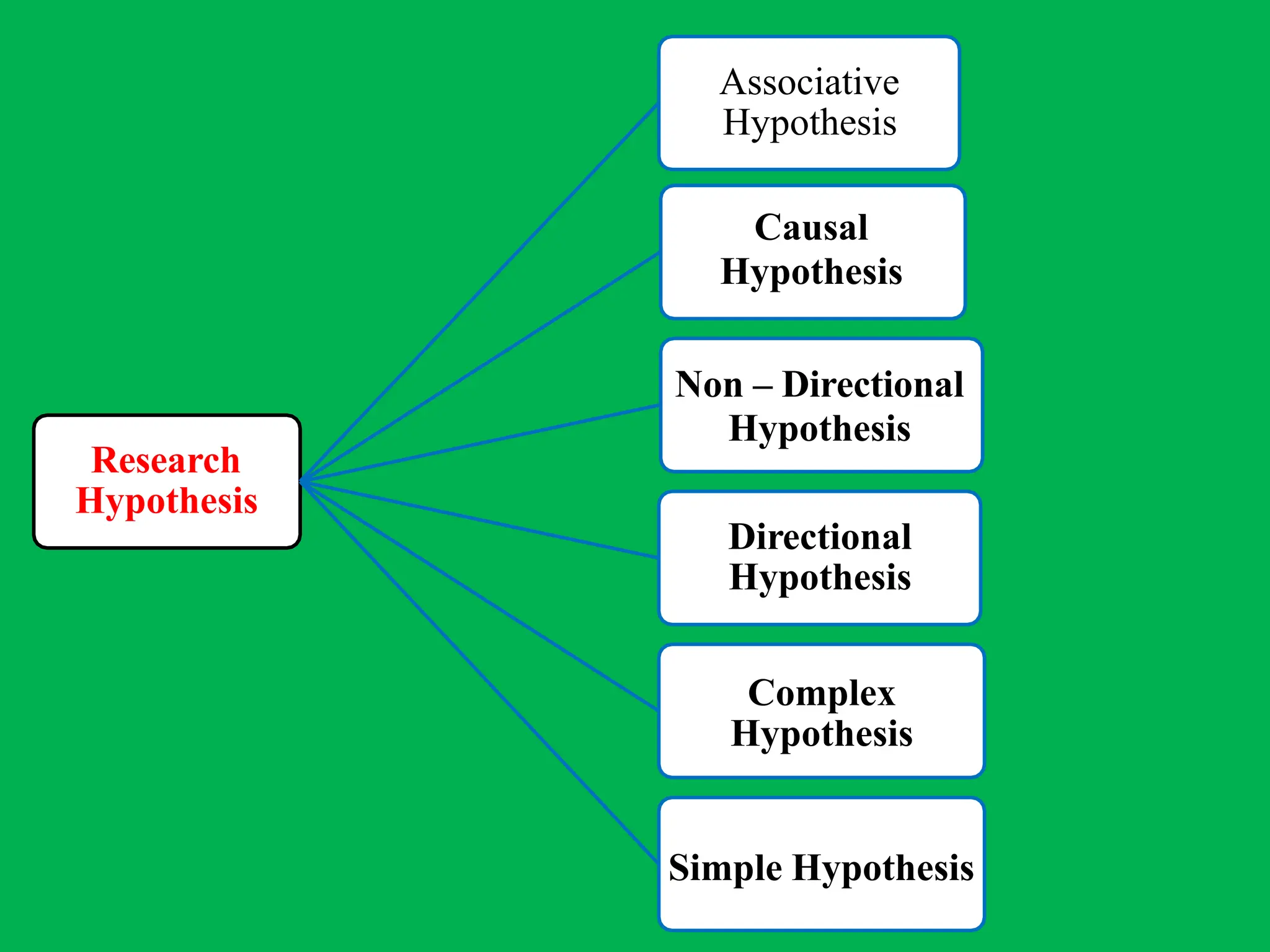
Research
Hypothesis
Associative
Hypothesis
Causal
Hypothesis
Non – Directional
Hypothesis
Directional
Hypothesis
Complex
Hypothesis
Simple Hypothesis
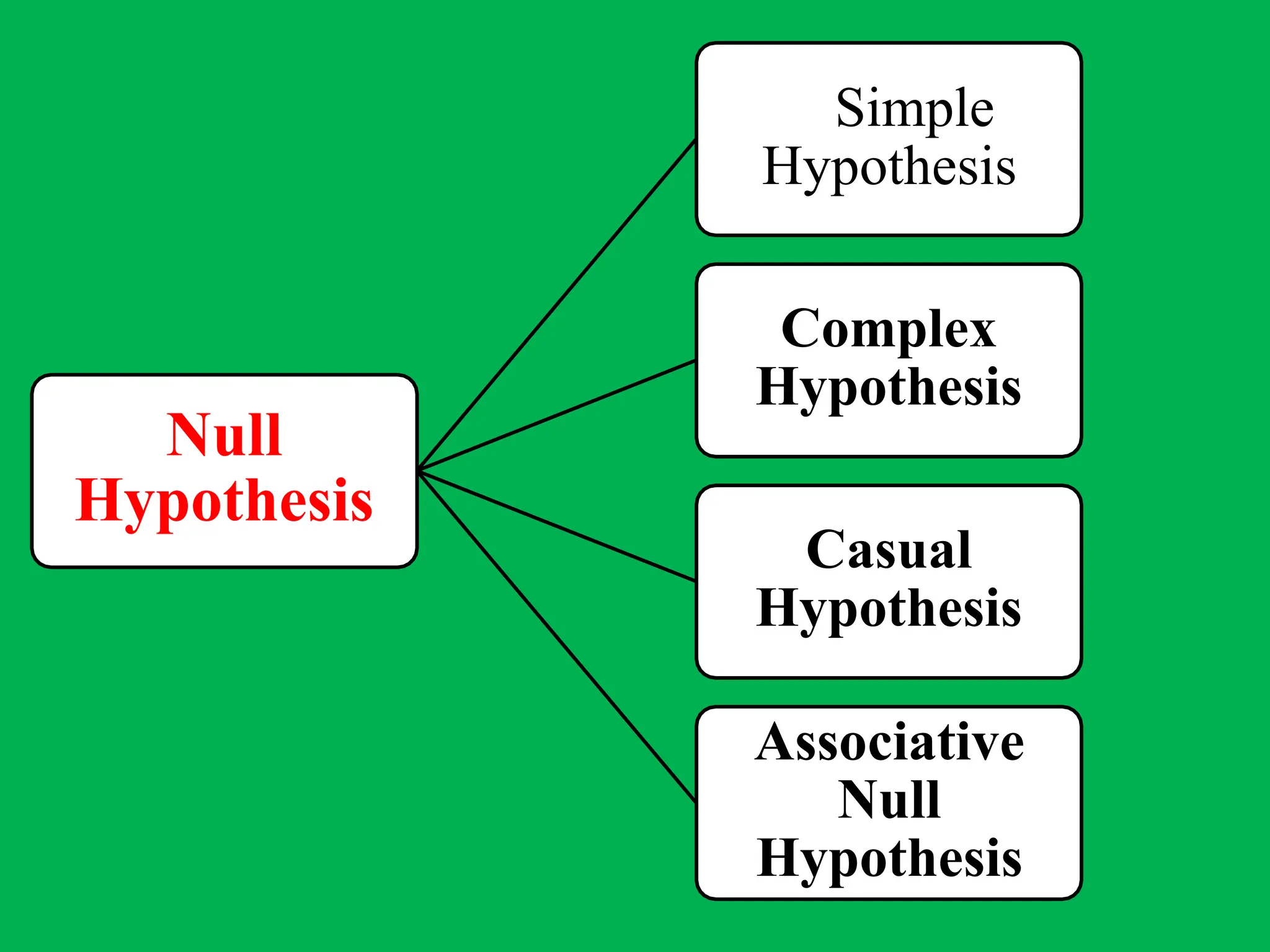
Null
Hypothesis
Simple
Hypothesis
Complex
Hypothesis
Casual
Hypothesis
Associative
Null
Hypothesis
Testable
Hypothesis
Simple Hypothesis
• simple hypothesis predicts that, there exist
a relationship between the independent
variable and dependent variable.
Research Hypothesis
Cont…simple hypothesis
• Example- two session (Plyometric)/day
increase the playing (Jumping) performance.
– In the above example, 2 session/day Plyometric is
independent variable and Jumping is dependent
variable. The statement shows that there exists a
relationship between 2 session Plyometric and
playing (Jumping) performance.
Complex Hypothesis
• Complex hypothesis predicts that
there exists relationship between two
or more independent and dependent
variable.
Cont…Complex Hypothesis
• Example – To make developed world cup
athlete.
– In the above example, three independent variable
are:-A) Types of Training B) Nutrition, C) Body
type.
– And three dependent variable are:- a) Speed
B) strength C) Power
Directional Hypothesis
• Directional Hypothesis predicts the direction of
the relationship between the independent and
dependent variable.
• Example- High quality of nursing education will
lead to high quality of nursing practice skills.
Non directional Hypothesis
• Non -directional Hypothesis predicts the
relationship between the independent variable and
the dependent variable but does not specific the
directional of the relationship.
• Example- teacher student relationship influence
student’s learning.
Causal Hypothesis
• Causal Hypothesis predicts a cause and effects
relationship or interaction between the
independent variable and dependent variable.
This hypothesis predicts the effect of the
independent variable on the dependent
variable.
Cont…
• In this the independent variable is the experimental
or treatment variable. The dependent variable is the
outcome variable.
• Example – early postoperative ambulation will
lead to prompt recovery.
Associative hypothesis
• Associative Hypothesis predicts an associative
relationship between the independent variable
and the dependent variable.
• When there is a change in any one of the
variables, changes also occurs in the other
variable.
Cont…
• The associative relationship between the
independent and dependent variables may have
either.
– Positive association
– Negative association
Null hypothesis
Cont…
• Null Hypothesis is also called statistical
hypothesis because this type of hypothesis is used
for statistical testing and statically interpretation.
The null hypothesis predicts that, there is no
relationship between the independent variable and
dependent variable.
• Example- Changing the jersey color
will not change the performance
Testable Hypothesis
• The testable hypothesis predicts relationship
between the independent variable and the
dependent variable and theses variable are
testable or measurable.
Cont…
• Example – Increase in patient’s body
temperature causes increase in patient’s
pulse rate.
Research hypothesis and types brief explanation

Research hypothesis and types brief explanation

  • 1.
    GMPS UG, PG, PHYSICALEDUCATION COACHING CENTER G – GANDHI BSc., MPEd., MPhil., PhD M- MAHALINGAM BSc., MPEd., MPhil., PhD P- PRABHU PANDIAN BSc., MPEd., MPhil., PhD S- SARAVANAN BSc., MPEd., MPhil.
  • 4.
    FORMULATING HYPOTHESIS Begins withan assumption called HYPOTHESIS HYPOTHESIS: An hypothesis is really a temporary explanation, a kind of educated guess about what will happen under certain conditions.
  • 5.
    EXAMPLE Q: Do plantsneed light to grow ? Ex: IF green plants need light to grow, THEN only plants kept in light will display growth. NOTE: Most of the times it is an “IF…. THEN… statement”
  • 6.
    Take the followingand make an hypothesis • Do living things give off CO2 when they digest food? • A scientist think that living things give off carbon dioxide as they break down food. He predicts that carbon dioxide can be detected as an organism digests food.
  • 7.
    What is HypothesisTesting A set of logical and statistical guidelines used to make decisions from sample statistics to population characteristics.
  • 8.
    Hypotheses Testing  Theintent of hypothesis testing is to formally examine two opposing conjectures (hypotheses), H0 and HA/H1 These two hypotheses are mutually exclusive and exhaustive. Sample information is collected and analysed.
  • 9.
    Basic Concepts inHypotheses Testing • Null Hypotheses &Alternate Hypotheses • Level of Significance • Critical Region • Decision Rule(Test of Hypothesis) • Type I & Type II Errors • Two Tailed & One Tailed Tests • One Sample & Two Sample Tests
  • 10.
    NULL HYPOTHESIS • Specificstatement about a population parameter made for the purposes of argument. • It Is always about a population parameter, not about a sample statistic.
  • 11.
    Alternate Hypothesis • Representsall other possible parameter values except that stated in the null hypothesis. • Denoted by H1 / HA.
  • 12.
    Level of Significance •The critical probability in choosing between the null & alternative hypotheses. • The higher the significance level, the higher the probability of rejecting a null hypothesis when its true. • Confidence level: A percentage or decimal value that tells how confident a researcher can be about being correct.
  • 13.
    Critical Region • TheAcceptance and Rejection region. • If the value of mean falls within the rejection region, the null hypothesis is rejected.
  • 14.
    Decision Rule (Testof Hypothesis) The rule according to which we accept or reject null hypothesis.
  • 15.
    Type I Error& Type II Error • A Type I error is the mistake of rejecting the null hypothesis when it is true. • α- Type I error. • A Type II error is the mistake of failing to reject the null hypothesis when it is false. • β- Type II error.
  • 16.
    Type I Error& Type II Error Accept H0 Reject H0 Ho (True) Correct Decision Type I Error Ho (False) Type II Error Correct Decision
  • 17.
    Type I Error& Type II Error Decision No disease Disease Not diagnosed OK Type I error Diagnosed Type II error OK treated but not harmed by the treatment irreparable damage would be done
  • 18.
    One Tailed &Two Tailed Test • Two-Tailed Tests • If the null hypothesis is rejected for values of the test statistic falling into either tail of its sampling distribution. • A deviation in either direction would reject the null hypothesis • Normally α is divided into α/2 on one side and α/2 on the other.
  • 19.
    One Tailed &Two Tailed Test
  • 20.
    One Tailed &Two Tailed Test One-Tailed Tests • If null hypothesis is rejected only for values of the test statistic falling into one specified tail of its sampling distribution.
  • 21.
    One Tailed &Two Tailed Test
  • 22.
    One Tailed &Two Tailed Test
  • 24.
    One Sample &Two Sample Tests • One Sample Test When we want to draw inferences about the population on the basis of given sample. • Two Sample Test When we want to compare and draw inferences about 2 populations on the basis of given samples.
  • 25.
    Independent & PairedSamples • Independent Samples Drawn randomly from different populations. • Paired Samples When the data for the two samples relate to the same group of respondents.
  • 26.
    Types of Hypotheses •Research hypotheses. • Logical hypotheses. – Null hypothesis (Ho). – Alternative hypothesis (HA/H1). • Statistical hypotheses.
  • 27.
  • 28.
    Cont… • It providesclarity to the research problem and research objectives • It describes, explains or predicts the expected results or outcome of the research. • It indicates the type of research design. • It directs the research study process.
  • 29.
    Cont… • It identifiesthe population of the research study that is to be investigated or examined. • It facilitates data collection, data analysis and data interpretation
  • 30.
  • 31.
  • 32.
  • 33.
  • 34.
  • 35.
    Simple Hypothesis • simplehypothesis predicts that, there exist a relationship between the independent variable and dependent variable.
  • 36.
  • 37.
    Cont…simple hypothesis • Example-two session (Plyometric)/day increase the playing (Jumping) performance. – In the above example, 2 session/day Plyometric is independent variable and Jumping is dependent variable. The statement shows that there exists a relationship between 2 session Plyometric and playing (Jumping) performance.
  • 38.
    Complex Hypothesis • Complexhypothesis predicts that there exists relationship between two or more independent and dependent variable.
  • 39.
    Cont…Complex Hypothesis • Example– To make developed world cup athlete. – In the above example, three independent variable are:-A) Types of Training B) Nutrition, C) Body type. – And three dependent variable are:- a) Speed B) strength C) Power
  • 40.
    Directional Hypothesis • DirectionalHypothesis predicts the direction of the relationship between the independent and dependent variable. • Example- High quality of nursing education will lead to high quality of nursing practice skills.
  • 41.
    Non directional Hypothesis •Non -directional Hypothesis predicts the relationship between the independent variable and the dependent variable but does not specific the directional of the relationship. • Example- teacher student relationship influence student’s learning.
  • 42.
    Causal Hypothesis • CausalHypothesis predicts a cause and effects relationship or interaction between the independent variable and dependent variable. This hypothesis predicts the effect of the independent variable on the dependent variable.
  • 43.
    Cont… • In thisthe independent variable is the experimental or treatment variable. The dependent variable is the outcome variable. • Example – early postoperative ambulation will lead to prompt recovery.
  • 44.
    Associative hypothesis • AssociativeHypothesis predicts an associative relationship between the independent variable and the dependent variable. • When there is a change in any one of the variables, changes also occurs in the other variable.
  • 45.
    Cont… • The associativerelationship between the independent and dependent variables may have either. – Positive association – Negative association
  • 46.
  • 47.
    Cont… • Null Hypothesisis also called statistical hypothesis because this type of hypothesis is used for statistical testing and statically interpretation. The null hypothesis predicts that, there is no relationship between the independent variable and dependent variable.
  • 48.
    • Example- Changingthe jersey color will not change the performance
  • 49.
    Testable Hypothesis • Thetestable hypothesis predicts relationship between the independent variable and the dependent variable and theses variable are testable or measurable.
  • 50.
    Cont… • Example –Increase in patient’s body temperature causes increase in patient’s pulse rate.