Basharat Rasheed Mirza
 Meaning of Hypothesis
 Definition of Hypothesis
 Characteristics of Hypothesis
 Categories of Hypothesis
 Forming a Hypothesis
 Testing of Hypothesis
 Hypothesis means mere assumptions
or suppositions which are to be
proved or disproved.
 Hypothesis is a formal question that is
intended to resolve.
 A wild or wise guess
 An educated guess
 A tentative point of view
 A proposition not yet tested
 A preliminary explanation
 A preliminary Postulate
 “A hypothesis is a conjectural statement of the relation
between two or more variables”. (Kerlinger, 1956)
 “Hypotheses are single tentative guesses, good hunches
– assumed for use in devising theory or planning
experiments intended to be given a direct experimental
test when possible”. (Eric Rogers, 1966)
 “Hypothesis is a formal statement that presents the
expected relationship between an independent and
dependent variable.”(Creswell, 1994)
 Guides/gives direction to the study/investigation
 Defines Facts that are relevant and not relevant
 Suggests which form of research design is likely to be the
most appropriate
 Provides a framework for organizing the conclusions of the
findings
 Limits the research to specific area
 Offers explanations for the relationships between those
variables that can be empirically tested
 Furnishes proof that the researcher has sufficient background
knowledge to enable her/him to make suggestions in order to
extend existing knowledge
 Structures the next phase in the investigation and therefore
furnishes continuity to the examination of the problem
 Related to problem
 Clear & Precise
 Amenable with time
 Testable
 States relation
 Specific & Simple
A hypothesis
 must make a prediction
 must identify at least two variables
 should have an elucidating power
 should strive to furnish an acceptable explanation or
accounting of a fact
 must be falsifiable meaning hypotheses must be
capable of being refuted based on the results of the
study
 must be formulated in simple, understandable terms
 should correspond with existing knowledge
 In general, a hypothesis needs to be unambiguous,
specific, quantifiable, testable and generalize-able.
Can be categorized in different ways
1. Based on their formulation
 Null Hypotheses and Alternate Hypotheses
2. Based on direction
 Directional and Non-directional Hypothesis
3. Based on their derivation
 Inductive and Deductive Hypotheses
 Null hypothesis always predicts that there is
no relationship between the variables being
studied.
 The researcher wishes to disapprove this
hypothesis.
 It is denoted by H0
 For example:
◦ “There is no relationship between learning and
intelligence.”
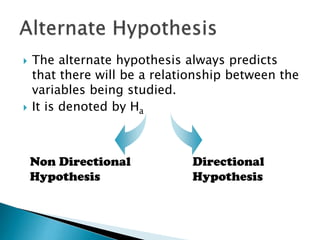
 The alternate hypothesis always predicts
that there will be a relationship between the
variables being studied.
 It is denoted by Ha
Non Directional
Hypothesis
Directional
Hypothesis
 If the hypothesis simply predicts that there will be a
difference between the two groups, then it is a non-
directional hypothesis. It is non-directional because it
predicts that there will be a difference but does not
specify how the groups will differ.
 e.g. Lack of attention leads to failure.
 If, however, the hypothesis uses so-called comparison
terms, such as “greater,”“less,”“better,” or “worse,” then
its a directional hypothesis. It is directional because it
predicts that there will be a difference between the two
groups and it specifies how the two groups will differ.
 e.g. A person whose attitude is positive towards studies
is more likely to succeed than one who do not.
 A hypothesis is formulated after
 the problem has been stated and
 the literature study has been conducted
 It is formulated when the researcher is totally
aware of the theoretical and empirical
background to the problem
 Hypotheses is formulated using induction and
deduction method
 Hypothesis will be generated from the
problem statement.
 Read the problem statement thoroughly.
 Narrow or limit it and express it as a research
question.
 A research hypothesis has two elements(variables)
that are in relation to one another.
 Avoid judgmental words in hypothesis.
 Hypothesis must involve an issue or question that
cannot be answered exclusively.
 It is best to choose a hypothesis where there is some
level of familiarity with the disciplines that are most
relevant to the topic.
 All the terms must be clearly understood and defined.
 It is to be noted that hypothesis may change over
time as the research progresses.
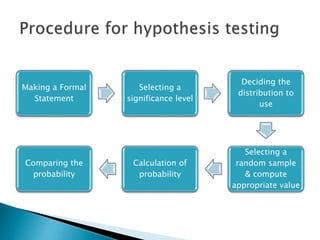
Making a Formal
Statement
Selecting a
significance level
Deciding the
distribution to
use
Selecting a
random sample
& compute
appropriate value
Calculation of
probability
Comparing the
probability
Thank you

Hypothesis presentation

  • 1.
  • 2.
     Meaning ofHypothesis  Definition of Hypothesis  Characteristics of Hypothesis  Categories of Hypothesis  Forming a Hypothesis  Testing of Hypothesis
  • 3.
     Hypothesis meansmere assumptions or suppositions which are to be proved or disproved.  Hypothesis is a formal question that is intended to resolve.
  • 4.
     A wildor wise guess  An educated guess  A tentative point of view  A proposition not yet tested  A preliminary explanation  A preliminary Postulate
  • 5.
     “A hypothesisis a conjectural statement of the relation between two or more variables”. (Kerlinger, 1956)  “Hypotheses are single tentative guesses, good hunches – assumed for use in devising theory or planning experiments intended to be given a direct experimental test when possible”. (Eric Rogers, 1966)  “Hypothesis is a formal statement that presents the expected relationship between an independent and dependent variable.”(Creswell, 1994)
  • 6.
     Guides/gives directionto the study/investigation  Defines Facts that are relevant and not relevant  Suggests which form of research design is likely to be the most appropriate  Provides a framework for organizing the conclusions of the findings  Limits the research to specific area  Offers explanations for the relationships between those variables that can be empirically tested  Furnishes proof that the researcher has sufficient background knowledge to enable her/him to make suggestions in order to extend existing knowledge  Structures the next phase in the investigation and therefore furnishes continuity to the examination of the problem
  • 7.
     Related toproblem  Clear & Precise  Amenable with time  Testable  States relation  Specific & Simple
  • 8.
    A hypothesis  mustmake a prediction  must identify at least two variables  should have an elucidating power  should strive to furnish an acceptable explanation or accounting of a fact  must be falsifiable meaning hypotheses must be capable of being refuted based on the results of the study  must be formulated in simple, understandable terms  should correspond with existing knowledge  In general, a hypothesis needs to be unambiguous, specific, quantifiable, testable and generalize-able.
  • 9.
    Can be categorizedin different ways 1. Based on their formulation  Null Hypotheses and Alternate Hypotheses 2. Based on direction  Directional and Non-directional Hypothesis 3. Based on their derivation  Inductive and Deductive Hypotheses
  • 10.
     Null hypothesisalways predicts that there is no relationship between the variables being studied.  The researcher wishes to disapprove this hypothesis.  It is denoted by H0  For example: ◦ “There is no relationship between learning and intelligence.”
  • 11.
     The alternatehypothesis always predicts that there will be a relationship between the variables being studied.  It is denoted by Ha Non Directional Hypothesis Directional Hypothesis
  • 12.
     If thehypothesis simply predicts that there will be a difference between the two groups, then it is a non- directional hypothesis. It is non-directional because it predicts that there will be a difference but does not specify how the groups will differ.  e.g. Lack of attention leads to failure.  If, however, the hypothesis uses so-called comparison terms, such as “greater,”“less,”“better,” or “worse,” then its a directional hypothesis. It is directional because it predicts that there will be a difference between the two groups and it specifies how the two groups will differ.  e.g. A person whose attitude is positive towards studies is more likely to succeed than one who do not.
  • 13.
     A hypothesisis formulated after  the problem has been stated and  the literature study has been conducted  It is formulated when the researcher is totally aware of the theoretical and empirical background to the problem  Hypotheses is formulated using induction and deduction method  Hypothesis will be generated from the problem statement.
  • 14.
     Read theproblem statement thoroughly.  Narrow or limit it and express it as a research question.  A research hypothesis has two elements(variables) that are in relation to one another.  Avoid judgmental words in hypothesis.  Hypothesis must involve an issue or question that cannot be answered exclusively.  It is best to choose a hypothesis where there is some level of familiarity with the disciplines that are most relevant to the topic.  All the terms must be clearly understood and defined.  It is to be noted that hypothesis may change over time as the research progresses.
  • 15.
    Making a Formal Statement Selectinga significance level Deciding the distribution to use Selecting a random sample & compute appropriate value Calculation of probability Comparing the probability
  • 16.