2
What is research?
 research.
 1.a. the systematic investigation into and study of materials,
sources, etc, in order to establish facts and reach new
conclusions.
 b. an endeavour to discover new or collate old facts etc by the
scientific study of a subject or by a course of critical
investigation. [Oxford Concise Dictionary]
3
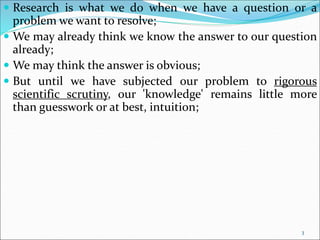
 Research is what we do when we have a question or a
problem we want to resolve;
 We may already think we know the answer to our question
already;
 We may think the answer is obvious;
 But until we have subjected our problem to rigorous
scientific scrutiny, our 'knowledge' remains little more
than guesswork or at best, intuition;
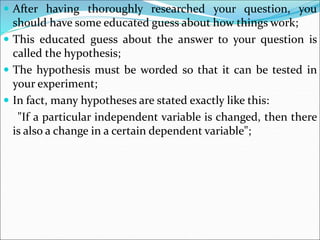
 After having thoroughly researched your question, you
should have some educated guess about how things work;
 This educated guess about the answer to your question is
called the hypothesis;
 The hypothesis must be worded so that it can be tested in
your experiment;
 In fact, many hypotheses are stated exactly like this:
"If a particular independent variable is changed, then there
is also a change in a certain dependent variable";
What is a Hypothesis?
 Hypothesis is an idea or explanation for something that is
based on known facts but has not yet been proved ;
 A hypothesis is an educated guess about how things work;
 Most of the time a hypothesis is written as: "If _____[I do
this] _____, then _____[this]_____ will happen."
 A hypothesis is a conjectural statement of the relation
between two or more variables. (Kerlinger, 1956)
 Hypothesis is a formal statement that presents the expected
relationship between an independent and dependent
variable. (Creswell, 1994)
 Hypothesis is a tentative explanation that accounts for a set
of f acts and can be tested by further investigation;
 A hypothesis may be precisely defined as a tentative
proposition suggested as a solution to a problem or as an
explanation of some phenomenon. (Ary, Jacobs and
Razavieh, 1984)
 Hypothesis is a tentative explanation that accounts for a set
offacts and can be tested by further investigation.
 Example Hypotheses
 • "If I open the faucet [faucet opening size is the
independent variable], then it will increase the flow of water
[flow of water is the dependent variable].
 • "Raising the temperature of a cup of water [temperature
is the independent variable] will increase the amount of
sugar that dissolves [the amount of sugar is the dependent
variable]."
 • "If a plant receives fertilizer [having fertilizer is the
independent variable], then it will grow to be bigger than a
plant that does not receive fertilizer [plant size is the
dependent variable]."
 • "If I put fenders on a bicycle [having fenders is the
independent variable], then they will keep the rider dry when
riding through puddles [the dependent variable is how much
water splashes on the rider]."
Statements expressing the relation between
two or more measurable variables.
They should carry clear implications for
testing the stated relations.
 Hypothesis needs to be structured before
the data-gathering and interpretation phase
of the research.
 A good hypothesis indicates that the
researcher has sufficient knowledge in the
area to undertake the investigation.
The hypothesis gives direction to the
collection and interpretation of data.
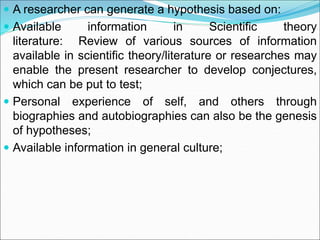
 A researcher can generate a hypothesis based on:
 Available information in Scientific theory
literature: Review of various sources of information
available in scientific theory/literature or researches may
enable the present researcher to develop conjectures,
which can be put to test;
 Personal experience of self, and others through
biographies and autobiographies can also be the genesis
of hypotheses;
 Available information in general culture;
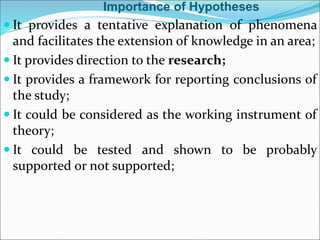
Importance of Hypotheses
 It provides a tentative explanation of phenomena
and facilitates the extension of knowledge in an area;
 It provides direction to the research;
 It provides a framework for reporting conclusions of
the study;
 It could be considered as the working instrument of
theory;
 It could be tested and shown to be probably
supported or not supported;
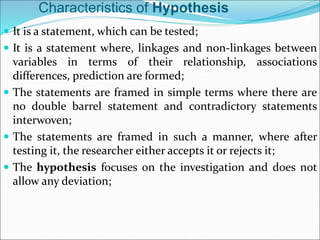
Characteristics of Hypothesis
 It is a statement, which can be tested;
 It is a statement where, linkages and non-linkages between
variables in terms of their relationship, associations
differences, prediction are formed;
 The statements are framed in simple terms where there are
no double barrel statement and contradictory statements
interwoven;
 The statements are framed in such a manner, where after
testing it, the researcher either accepts it or rejects it;
 The hypothesis focuses on the investigation and does not
allow any deviation;
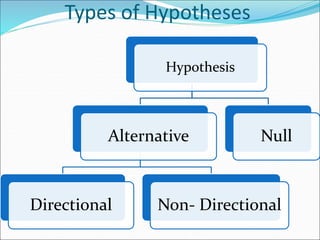
Types of Hypotheses
Hypothesis
Alternative
Directional Non- Directional
Null
NULL HYPOTHESIS
 Null hypothesis is a statement that there is no actual
relationship between variables;
 (HO or HN) A null hypothesis may read, “There is no
difference between…….” ;
 The final conclusion of the investigator will either retain a null
hypothesis or reject a null hypothesis in favor of a alternative
hypothesis;
 Example: “There is no significant difference in the anxiety
level of children of High IQ and those of low IQ”;
 Null Hypothesis is one where, the researcher makes a conjectural
statement that the variables under study are disjointed;
 He/ She does not talk of any relationship between the variables;
 By so doing, the researcher wishes to explore whether the variables
under study have any level and direction of influence on the other
or not;
ALTERNATIVE HYPOTHESIS
 ALTERNATIVE HYPOTHESIS: An alternative
hypothesis is a statement that suggests a potential
outcome that the researcher may expect.
 It comes from prior literature or studies;
 The two types of alternative hypothesis are:
 Directional Hypothesis;
 Non-directional Hypothesis;
DIRECTIONAL HYPOTHESIS
 A type of alternative hypothesis that specifies the
direction of expected findings;
 Sometimes directional hypothesis is created to examine the
relationship among variables rather than to compare groups;
 Directional hypothesis may read, “… is more than..”, “…will
be lesser..”;
 Example :“Children with high IQ will exhibit more anxiety
than children with low IQ”;
NON-DIRECTIONAL HYPOTHESIS
 A type of alternative hypothesis in which no definite
direction of the expected findings is specified;
 The researcher may not no what can be predicted from the
past literature;
 It may read, “..there is a difference between..”;
 Example:“There is a difference in the anxiety level of the
children of high IQ and those of low IQ”;
Generating the research hypothesis

Generating the research hypothesis

  • 2.
    2 What is research? research.  1.a. the systematic investigation into and study of materials, sources, etc, in order to establish facts and reach new conclusions.  b. an endeavour to discover new or collate old facts etc by the scientific study of a subject or by a course of critical investigation. [Oxford Concise Dictionary]
  • 3.
    3  Research iswhat we do when we have a question or a problem we want to resolve;  We may already think we know the answer to our question already;  We may think the answer is obvious;  But until we have subjected our problem to rigorous scientific scrutiny, our 'knowledge' remains little more than guesswork or at best, intuition;
  • 4.
     After havingthoroughly researched your question, you should have some educated guess about how things work;  This educated guess about the answer to your question is called the hypothesis;  The hypothesis must be worded so that it can be tested in your experiment;  In fact, many hypotheses are stated exactly like this: "If a particular independent variable is changed, then there is also a change in a certain dependent variable";
  • 5.
    What is aHypothesis?  Hypothesis is an idea or explanation for something that is based on known facts but has not yet been proved ;  A hypothesis is an educated guess about how things work;  Most of the time a hypothesis is written as: "If _____[I do this] _____, then _____[this]_____ will happen."
  • 6.
     A hypothesisis a conjectural statement of the relation between two or more variables. (Kerlinger, 1956)  Hypothesis is a formal statement that presents the expected relationship between an independent and dependent variable. (Creswell, 1994)  Hypothesis is a tentative explanation that accounts for a set of f acts and can be tested by further investigation;  A hypothesis may be precisely defined as a tentative proposition suggested as a solution to a problem or as an explanation of some phenomenon. (Ary, Jacobs and Razavieh, 1984)  Hypothesis is a tentative explanation that accounts for a set offacts and can be tested by further investigation.
  • 7.
     Example Hypotheses • "If I open the faucet [faucet opening size is the independent variable], then it will increase the flow of water [flow of water is the dependent variable].  • "Raising the temperature of a cup of water [temperature is the independent variable] will increase the amount of sugar that dissolves [the amount of sugar is the dependent variable]."  • "If a plant receives fertilizer [having fertilizer is the independent variable], then it will grow to be bigger than a plant that does not receive fertilizer [plant size is the dependent variable]."  • "If I put fenders on a bicycle [having fenders is the independent variable], then they will keep the rider dry when riding through puddles [the dependent variable is how much water splashes on the rider]."
  • 8.
    Statements expressing therelation between two or more measurable variables. They should carry clear implications for testing the stated relations.  Hypothesis needs to be structured before the data-gathering and interpretation phase of the research.  A good hypothesis indicates that the researcher has sufficient knowledge in the area to undertake the investigation. The hypothesis gives direction to the collection and interpretation of data.
  • 12.
     A researchercan generate a hypothesis based on:  Available information in Scientific theory literature: Review of various sources of information available in scientific theory/literature or researches may enable the present researcher to develop conjectures, which can be put to test;  Personal experience of self, and others through biographies and autobiographies can also be the genesis of hypotheses;  Available information in general culture;
  • 13.
    Importance of Hypotheses It provides a tentative explanation of phenomena and facilitates the extension of knowledge in an area;  It provides direction to the research;  It provides a framework for reporting conclusions of the study;  It could be considered as the working instrument of theory;  It could be tested and shown to be probably supported or not supported;
  • 14.
    Characteristics of Hypothesis It is a statement, which can be tested;  It is a statement where, linkages and non-linkages between variables in terms of their relationship, associations differences, prediction are formed;  The statements are framed in simple terms where there are no double barrel statement and contradictory statements interwoven;  The statements are framed in such a manner, where after testing it, the researcher either accepts it or rejects it;  The hypothesis focuses on the investigation and does not allow any deviation;
  • 15.
  • 16.
    NULL HYPOTHESIS  Nullhypothesis is a statement that there is no actual relationship between variables;  (HO or HN) A null hypothesis may read, “There is no difference between…….” ;  The final conclusion of the investigator will either retain a null hypothesis or reject a null hypothesis in favor of a alternative hypothesis;  Example: “There is no significant difference in the anxiety level of children of High IQ and those of low IQ”;  Null Hypothesis is one where, the researcher makes a conjectural statement that the variables under study are disjointed;  He/ She does not talk of any relationship between the variables;  By so doing, the researcher wishes to explore whether the variables under study have any level and direction of influence on the other or not;
  • 17.
    ALTERNATIVE HYPOTHESIS  ALTERNATIVEHYPOTHESIS: An alternative hypothesis is a statement that suggests a potential outcome that the researcher may expect.  It comes from prior literature or studies;  The two types of alternative hypothesis are:  Directional Hypothesis;  Non-directional Hypothesis;
  • 18.
    DIRECTIONAL HYPOTHESIS  Atype of alternative hypothesis that specifies the direction of expected findings;  Sometimes directional hypothesis is created to examine the relationship among variables rather than to compare groups;  Directional hypothesis may read, “… is more than..”, “…will be lesser..”;  Example :“Children with high IQ will exhibit more anxiety than children with low IQ”;
  • 19.
    NON-DIRECTIONAL HYPOTHESIS  Atype of alternative hypothesis in which no definite direction of the expected findings is specified;  The researcher may not no what can be predicted from the past literature;  It may read, “..there is a difference between..”;  Example:“There is a difference in the anxiety level of the children of high IQ and those of low IQ”;