RESEARCH
ASSUMPTION
INTRODUCTION
• An assumption is a realistic expectation which is
something that we believe to be true.
• However, no adequate evidence exists to support this
belief.
• In other words, an assumption is an act of faith which
does not have empirical evidenced to support.
• Assumption provide a basis to develop theories &
research instrument & therefore, influence the
development & implement of research process.
DEFINITION
• Assumptions are statements that are taken
for granted or are considered true, even
through they have not been scientifically
tested.
• Assumption are principles those are
accepted as being true based on logic or
reasons, but without proof or verification.
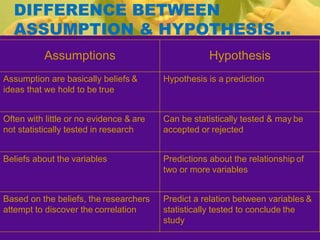
DIFFERENCE BETWEEN
ASSUMPTION & HYPOTHESIS…
Assumptions Hypothesis
Assumption are basically beliefs &
ideas that we hold to be true
Hypothesis is a prediction
Often with little or no evidence & are
not statistically tested in research
Can be statistically tested & may be
accepted or rejected
Beliefs about the variables Predictions about the relationship of
two or more variables
Based on the beliefs, the researchers
attempt to discover the correlation
Predict a relation between variables &
statistically tested to conclude the
study
USES OF ASSUMPTION IN
RESEARCH
Research is built upon assumptions since a
foundation is needed to move forward. One
must assume something to discover something.
Assumptions listed in research paper may be
good sources of the research topics.
Assumption provide basis to conduct of the
research study.
Tested assumptions through research studies
expand the professionals body of knowledge.
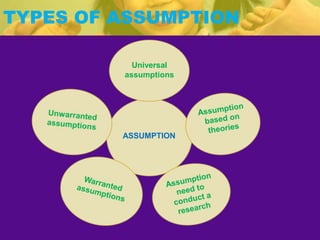
TYPES OF ASSUMPTION
ASSUMPTION
Universal
assumptions
1. Universalassumption:
• Universal assumptions are beliefs that are
assumed to be true by a large part of
society, but testing such assumptions is
not always possible.
• For example, ‘there is a supernatural
power which governs this universe’.
2. Assumptions basedon
theories:
• Assumptions may also be drawn from
theories.
• If a research study is based on a theory, the
assumption of the particular theory may
become assumption of that particular
research study.
• For example, ‘a study on Roy’s Adaptation
Model will use assumption of this particular
theoretical model.’
3. Assumptions needed to
conduct a research:
• Some of the common-sense assumptions
may be developed to conduct a particular
study.
• For example, ‘prevalence of coronary artery
disease is more common among urban
people as compared to rural people’.
4. Warrantedassumption:
• These are stated along with evidence to
support.
• For example, ‘regular prayers bring
success because they boost morale’.
5. Unwarrantedassumptions:
• These are stated without any supportive
evidence.
• For example, ‘Almighty God exists
everywhere in this universe’.

Research assumptions

  • 1.
  • 2.
    INTRODUCTION • An assumptionis a realistic expectation which is something that we believe to be true. • However, no adequate evidence exists to support this belief. • In other words, an assumption is an act of faith which does not have empirical evidenced to support. • Assumption provide a basis to develop theories & research instrument & therefore, influence the development & implement of research process.
  • 3.
    DEFINITION • Assumptions arestatements that are taken for granted or are considered true, even through they have not been scientifically tested. • Assumption are principles those are accepted as being true based on logic or reasons, but without proof or verification.
  • 4.
    DIFFERENCE BETWEEN ASSUMPTION &HYPOTHESIS… Assumptions Hypothesis Assumption are basically beliefs & ideas that we hold to be true Hypothesis is a prediction Often with little or no evidence & are not statistically tested in research Can be statistically tested & may be accepted or rejected Beliefs about the variables Predictions about the relationship of two or more variables Based on the beliefs, the researchers attempt to discover the correlation Predict a relation between variables & statistically tested to conclude the study
  • 5.
    USES OF ASSUMPTIONIN RESEARCH Research is built upon assumptions since a foundation is needed to move forward. One must assume something to discover something. Assumptions listed in research paper may be good sources of the research topics. Assumption provide basis to conduct of the research study. Tested assumptions through research studies expand the professionals body of knowledge.
  • 6.
  • 7.
    1. Universalassumption: • Universalassumptions are beliefs that are assumed to be true by a large part of society, but testing such assumptions is not always possible. • For example, ‘there is a supernatural power which governs this universe’.
  • 8.
    2. Assumptions basedon theories: •Assumptions may also be drawn from theories. • If a research study is based on a theory, the assumption of the particular theory may become assumption of that particular research study. • For example, ‘a study on Roy’s Adaptation Model will use assumption of this particular theoretical model.’
  • 9.
    3. Assumptions neededto conduct a research: • Some of the common-sense assumptions may be developed to conduct a particular study. • For example, ‘prevalence of coronary artery disease is more common among urban people as compared to rural people’.
  • 10.
    4. Warrantedassumption: • Theseare stated along with evidence to support. • For example, ‘regular prayers bring success because they boost morale’.
  • 11.
    5. Unwarrantedassumptions: • Theseare stated without any supportive evidence. • For example, ‘Almighty God exists everywhere in this universe’.