SAMPLING
INTRODUCTION
• Sampling is a process of selecting
representative units from an entire population
of a study. Sample is not always possible to
study an entire population; therefore, the
researcher draws a representative part of a
population through sampling process.
DEFINITION
• The process of selecting a number of
individuals for a study in such a way that the
individuals represent the larger group from
which they were selected.
SAMPLE
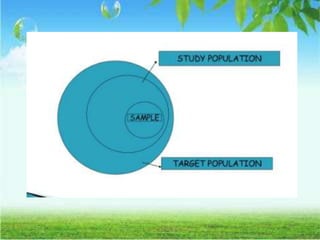
• Sample may be defined as representative unit
of a target population, which is to be worked
upon by researchers during their study. In
other words, sample consists of a subset of
units which comprise the population selected
by investigators or researchers to participate
in their research project.
POPULATION
• The larger group from which individuals are
selected to participate in a study. Population is
the aggregation of all the units in which a
researcher is interested. In other words,
population is the set of people or entire to
which the results of a research are to be
generalized.
TYPES OF POPULATION
• Target Population: A target population consist
of the total number of people or objects
which are meeting the designated set of
criteria.
In other words, it is the aggregate of all the
cases with a certain phenomenon about which
the researcher would like to make a
generalization.
Continue….
• Accessible population: It is the aggregate of
cases that conform to designated criteria &
are also accessible as subjects for a study.
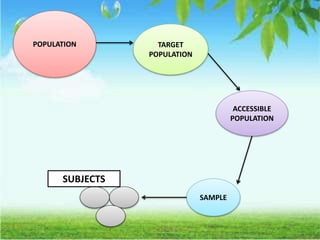
POPULATION TARGET
POPULATION
ACCESSIBLE
POPULATION
SAMPLE
SUBJECTS
PURPOSE
• Economical: In most cases, it is not possible &
economical for researchers to study an entire
population. With the help of sampling, the
researcher can save lots of time, money, &
resources to study a phenomenon.
Continue….
• Improved quality of data: It is a proven fact that
when a person handles less amount the work of
fewer number of people, then it is easier to
ensure the quality of the outcome.
• Quick study results: Studying an entire
population itself will take a lot of time, and
generating research results of a large mass will
be almost impossible as most research studies
have time limits.
Continue….
• Precision and accuracy of data: Conducting a
study on an entire population provides
researchers with voluminous data, and
maintaining precision of that data becomes a
cumbersome task.
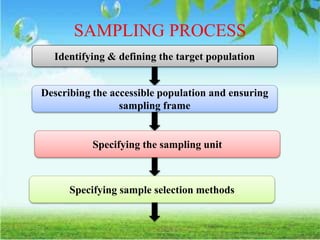
SAMPLING PROCESS
Identifying & defining the target population
Describing the accessible population and ensuring
sampling frame
Specifying the sampling unit
Specifying sample selection methods
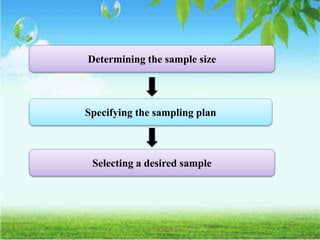
Determining the sample size
Specifying the sampling plan
Selecting a desired sample
FACTORS INFLUENCING SAMPLING
PROCESS
1. Nature of the researcher
Inexperienced investigator
Lack of interest
Lack of honesty
Intensive workload
Inadequate supervision
Continue….
2. Nature of the sample
• Inappropriate sampling technique
• equate supervision
• Sample size
• Defective sampling frame
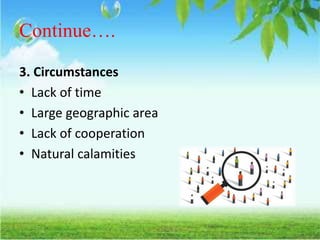
Continue….
3. Circumstances
• Lack of time
• Large geographic area
• Lack of cooperation
• Natural calamities
TYPES OF SAMPLING TECHNIQUES
• Sampling is the process of selecting a
representative part of the population.
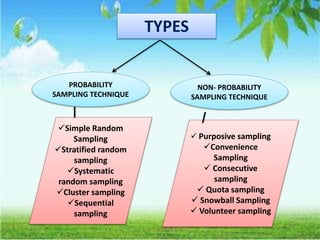
• Sampling techniques are classified in two
broad categories:
 Probability sampling techniques
 Non- Probability sampling techniques
TYPES
PROBABILITY
SAMPLING TECHNIQUE
NON- PROBABILITY
SAMPLING TECHNIQUE
Simple Random
Sampling
Stratified random
sampling
Systematic
random sampling
Cluster sampling
Sequential
sampling
 Purposive sampling
Convenience
Sampling
 Consecutive
sampling
 Quota sampling
 Snowball Sampling
 Volunteer sampling
PROBABILITY SAMPLING
TECHNIQUE
• It is based on the theory of probability.
• It involve random selection of the
elements/members of the population. In this,
every subject in a population has equal
chance to be selected sampling for a study.
• In probability sampling techniques, the
chances of systematic bias is relatively less
because subjects are randomly selected.
1. Simple random sampling
• This is the most pure & basic probability
sampling design.
• In this type of sampling design, every member
of population has an equal chance of being
selected as subject.
• The entire process of sampling is done in a
single step, with each subject selected
independently of the other members of the
population.
Continue….
• The first step of the simple random sampling
technique is to identify the accessible
population & prepare a list of all the
elements/members of the population. The list
of the subjects in population is called as
sampling frame & sample drawn from
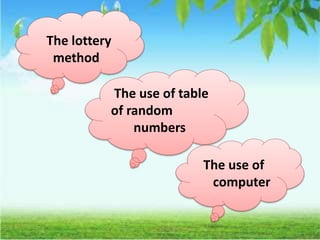
sampling frame by using following methods:
The lottery
method
The use of table
of random
numbers
The use of
computer
The lottery method
• It is most primitive & mechanical method.
• Each member of the population is assigned a
unique number.
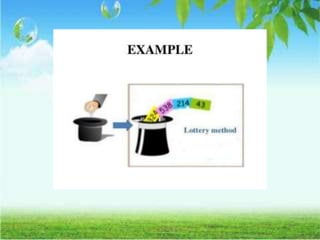
• Each number is placed in a bowel or hat & mixed
thoroughly.
• The blind-folded researcher then picks numbered
tags from the hat.
• All the individuals bearing the numbers picked by
the researcher are the subjects for the study.
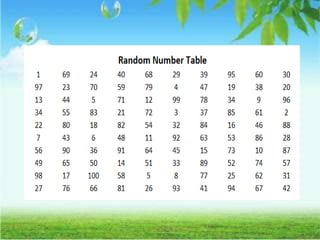
The use of table of random numbers
• This is most commonly & accurately used
method in simple random sampling.
• Random table present several numbers in
rows & columns.
• Researcher initially prepare a numbered list of
the members of the population, & then with a
blindfold chooses a number from the random
table.
Continue….
• The same procedure is continued until the
desired number of the subject is achieved.
• If repeatedly similar numbers are
encountered, they are ignored & next
numbers are considered until desired
numbers of the subject are achieved.
The use of computer
• Nowadays random tables may be generated
from the computer, & subjects may be
selected as described in the use of random
table.
• For populations with a small number of
members, it is advisable to use the first
method, but if the population has many
members, a computer-aided random selection
is preferred.
MERITS
• Ease of assembling the
samples
• Fair way of selecting the
sample
• Require minimum
knowledge about the
population in advance
• It’s an unbiased probability
method
• Free from sampling errors
DEMERITS
• It requires a complete and
up to date list of all the
members of the population
• Does not make use of
knowledge about a
population which
researchers may already
have
• Lot of procedure needs to
be done before sapling
• Expensive and time
consuming
2. Stratified random sampling
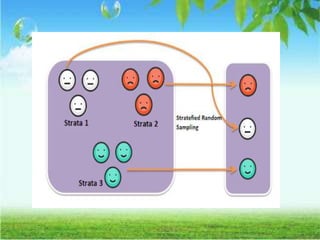
• This method is used for heterogeneous
population.
• It is a probability sampling technique wherein
the researcher divides the entire population
into different homogeneous subgroups or
strata, & then randomly selects the final
subjects proportionally from the different
strata.
Continue….
• The strata are divided according selected traits
of the population such as age, gender,
religion, socio- economic status, diagnosis,
education, geographical region, type of
institution, type of care, type of registered
nurses, nursing area specialization, site of
care, etc.
MERITS
• It represents all groups in
population
• It observes relation
between sub groups
• It observes smallest and
most inaccessible
subgroups in population
• It gives higher statistical
precision
• It saves lot time, money and
efforts
DEMERITS
• It requires accurate
information of the
proportion of
population in each
stratum
• Large population must
be available from which
the sample is being
taken
• Possibility of faulty
classification
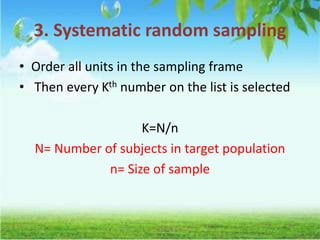
3. Systematic random sampling
• Order all units in the sampling frame
• Then every Kth number on the list is selected
K=N/n
N= Number of subjects in target population
n= Size of sample
Continue….
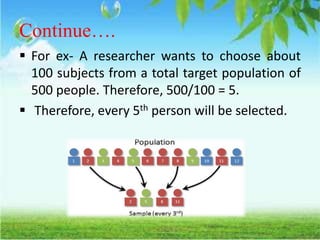
 For ex- A researcher wants to choose about
100 subjects from a total target population of
500 people. Therefore, 500/100 = 5.
 Therefore, every 5th person will be selected.
MERITS
• It is convenient and
simple to carry out
• Distribution of sample
is spread evenly over
the entire given
population
• It is less cumbersome,
less time consuming
and cheaper
DEMERITS
• If first subject is not
selected randomly it
becomes a non-
random sampling
technique
• Sometimes it results in
biased samples
• If sampling frame is
non- random, this
sampling technique
may not be appropriate
to select a
representative sample
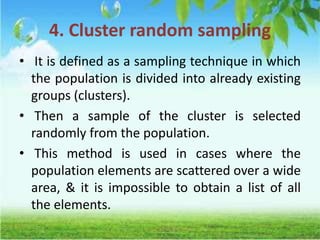
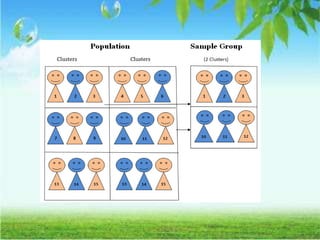
4. Cluster random sampling
• It is defined as a sampling technique in which
the population is divided into already existing
groups (clusters).
• Then a sample of the cluster is selected
randomly from the population.
• This method is used in cases where the
population elements are scattered over a wide
area, & it is impossible to obtain a list of all
the elements.
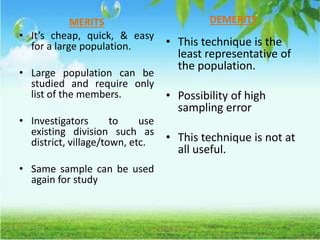
MERITS
• It’s cheap, quick, & easy
for a large population.
• Large population can be
studied and require only
list of the members.
• Investigators to use
existing division such as
district, village/town, etc.
• Same sample can be used
again for study
DEMERITS
• This technique is the
least representative of
the population.
• Possibility of high
sampling error
• This technique is not at
all useful.
5. Sequential Sampling
• This method of sample selection is slightly
different from other methods.
• Here the sample size is not fixed. The
investigator initially selects small sample &
tries out to make inferences; if not able to
draw results, he or she then adds more
subjects until clear-cut inferences can be
drawn.
Continue….
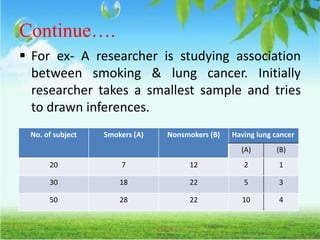
 For ex- A researcher is studying association
between smoking & lung cancer. Initially
researcher takes a smallest sample and tries
to drawn inferences.
No. of subject Smokers (A) Nonsmokers (B) Having lung cancer
(A) (B)
20 7 12 2 1
30 18 22 5 3
50 28 22 10 4
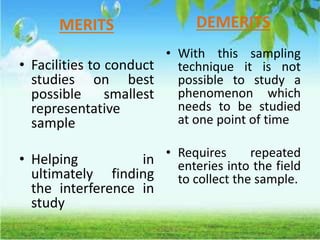
MERITS
• Facilities to conduct
studies on best
possible smallest
representative
sample
• Helping in
ultimately finding
the interference in
study
DEMERITS
• With this sampling
technique it is not
possible to study a
phenomenon which
needs to be studied
at one point of time
• Requires repeated
enteries into the field
to collect the sample.
NON PROBABILITY SAMPLING
TECHNIQUE
• It is a technique wherein the samples are
gathered in a process that does not given all
the individuals in the population equal
chances of being selected in the sample.
• In other words, in this type of sampling
every subject does not have equal chance to
be selected because elements are chosen by
choice not by chance through non-random
sampling methods.
1. Purposive sampling
• It is more commonly known as ‘judgmental’
sampling’.
• In this type of sampling, subjects are chosen
to be part of the sample with a specific
purpose in mind.
• In purposive sampling, the researcher
believes that some subjects are fit for
research compared to other individual. This is
the reason why they are purposively chosen
as subject.
Continue….
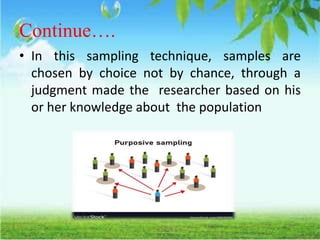
• In this sampling technique, samples are
chosen by choice not by chance, through a
judgment made the researcher based on his
or her knowledge about the population
MERITS
• Simple to draw sample
& useful in explorative
studies
• Save resources, require
less fieldwork.
DEMERITS
• Require considerable
knowledge about the
population under study.
• It is not always reliable
sample, as conscious biases
may exist.
• Two main weakness of
purposive sampling are with
the authority & in the
sampling process.
• It is usually biased since no
randomization was used to
obtain the sample.
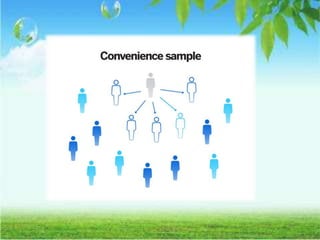
2. Convenience Sampling
• It is probably the most common of all
sampling techniques because it is fast,
inexpensive, easy, & the subject are readily
available.
• It is a non probability sampling technique
where subjects are selected because of their
convenient accessibility & proximity to the
researcher.
• The subjects are selected just because they
are easiest to recruit for the study.
• It is also known as an accidental sampling.
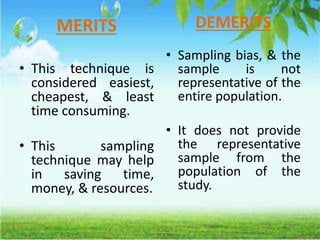
MERITS
• This technique is
considered easiest,
cheapest, & least
time consuming.
• This sampling
technique may help
in saving time,
money, & resources.
DEMERITS
• Sampling bias, & the
sample is not
representative of the
entire population.
• It does not provide
the representative
sample from the
population of the
study.
3. Consecutive Sampling
• In this sampling technique, the investigator
pick up all the available subjects who are
meeting the preset inclusion & exclusion
criteria.
• This technique is generally used in small-sized
populations.
MERITS
• Little effort for sampling
• It is not expensive, not
time consuming, & not
workforce intensive.
• Ensures more
representativeness of
the selected sample.
DEMERITS
• Researcher has not set
plans about the sample
size & sampling
schedule.
• It always does not
guarantee the selection
of representative
sample.
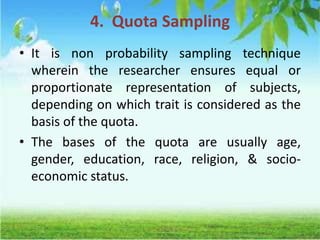
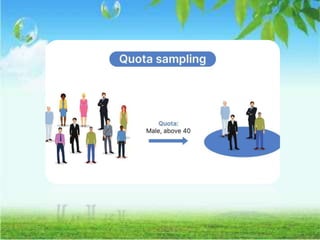
4. Quota Sampling
• It is non probability sampling technique
wherein the researcher ensures equal or
proportionate representation of subjects,
depending on which trait is considered as the
basis of the quota.
• The bases of the quota are usually age,
gender, education, race, religion, & socio-
economic status.
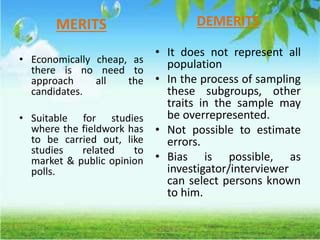
MERITS
• Economically cheap, as
there is no need to
approach all the
candidates.
• Suitable for studies
where the fieldwork has
to be carried out, like
studies related to
market & public opinion
polls.
DEMERITS
• It does not represent all
population
• In the process of sampling
these subgroups, other
traits in the sample may
be overrepresented.
• Not possible to estimate
errors.
• Bias is possible, as
investigator/interviewer
can select persons known
to him.
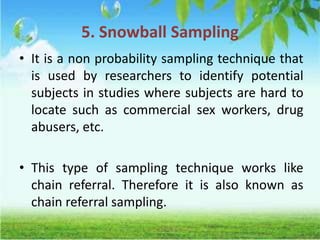
5. Snowball Sampling
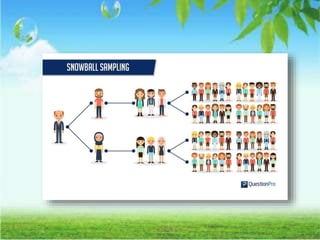
• It is a non probability sampling technique that
is used by researchers to identify potential
subjects in studies where subjects are hard to
locate such as commercial sex workers, drug
abusers, etc.
• This type of sampling technique works like
chain referral. Therefore it is also known as
chain referral sampling.
Continue….
• After observing the initial subject, the
researcher asks for assistance from the
subject to help in identify people with a
similar trait of interest.
• The researcher then observes the nominated
subjects & continues in the same way until
obtaining sufficient number of subjects.
MERITS
• The chain referral
process allows the
researcher to reach
populations that are
difficult to sample when
using other sampling
methods.
• The process is cheap,
simple, & cost-efficient.
• Need little planning &
lesser workforce
DEMERITS
• Researcher has little
control over the sampling
method.
• Representativeness of the
sample is not guaranteed.
• Sampling bias is also a
fear of researchers when
using this sampling
technique.
6. Volunteer Sampling
• Volunteer sampling is a sampling technique
where participants self-select to become part
of a study because they volunteer when asked,
or respond to an advert.
• SAMPLING ERRORS: errors that occur in data
due to the errors inherit in sampling from a
population.
• WHEN DOES SAMPLING ERROR OCCURS: it
occurs when researchers takes a random
sample instead of observing every individual
subject that comprises a population. While
dealing with large population this process
becomes the only option, so sampling error is
extremely difficult to avoid
sampling.pptx

sampling.pptx

  • 2.
  • 3.
    INTRODUCTION • Sampling isa process of selecting representative units from an entire population of a study. Sample is not always possible to study an entire population; therefore, the researcher draws a representative part of a population through sampling process.
  • 4.
    DEFINITION • The processof selecting a number of individuals for a study in such a way that the individuals represent the larger group from which they were selected.
  • 6.
    SAMPLE • Sample maybe defined as representative unit of a target population, which is to be worked upon by researchers during their study. In other words, sample consists of a subset of units which comprise the population selected by investigators or researchers to participate in their research project.
  • 7.
    POPULATION • The largergroup from which individuals are selected to participate in a study. Population is the aggregation of all the units in which a researcher is interested. In other words, population is the set of people or entire to which the results of a research are to be generalized.
  • 8.
    TYPES OF POPULATION •Target Population: A target population consist of the total number of people or objects which are meeting the designated set of criteria. In other words, it is the aggregate of all the cases with a certain phenomenon about which the researcher would like to make a generalization.
  • 9.
    Continue…. • Accessible population:It is the aggregate of cases that conform to designated criteria & are also accessible as subjects for a study.
  • 10.
  • 11.
    PURPOSE • Economical: Inmost cases, it is not possible & economical for researchers to study an entire population. With the help of sampling, the researcher can save lots of time, money, & resources to study a phenomenon.
  • 12.
    Continue…. • Improved qualityof data: It is a proven fact that when a person handles less amount the work of fewer number of people, then it is easier to ensure the quality of the outcome. • Quick study results: Studying an entire population itself will take a lot of time, and generating research results of a large mass will be almost impossible as most research studies have time limits.
  • 13.
    Continue…. • Precision andaccuracy of data: Conducting a study on an entire population provides researchers with voluminous data, and maintaining precision of that data becomes a cumbersome task.
  • 14.
    SAMPLING PROCESS Identifying &defining the target population Describing the accessible population and ensuring sampling frame Specifying the sampling unit Specifying sample selection methods
  • 15.
    Determining the samplesize Specifying the sampling plan Selecting a desired sample
  • 16.
    FACTORS INFLUENCING SAMPLING PROCESS 1.Nature of the researcher Inexperienced investigator Lack of interest Lack of honesty Intensive workload Inadequate supervision
  • 17.
    Continue…. 2. Nature ofthe sample • Inappropriate sampling technique • equate supervision • Sample size • Defective sampling frame
  • 18.
    Continue…. 3. Circumstances • Lackof time • Large geographic area • Lack of cooperation • Natural calamities
  • 19.
    TYPES OF SAMPLINGTECHNIQUES • Sampling is the process of selecting a representative part of the population. • Sampling techniques are classified in two broad categories:  Probability sampling techniques  Non- Probability sampling techniques
  • 20.
    TYPES PROBABILITY SAMPLING TECHNIQUE NON- PROBABILITY SAMPLINGTECHNIQUE Simple Random Sampling Stratified random sampling Systematic random sampling Cluster sampling Sequential sampling  Purposive sampling Convenience Sampling  Consecutive sampling  Quota sampling  Snowball Sampling  Volunteer sampling
  • 21.
    PROBABILITY SAMPLING TECHNIQUE • Itis based on the theory of probability. • It involve random selection of the elements/members of the population. In this, every subject in a population has equal chance to be selected sampling for a study. • In probability sampling techniques, the chances of systematic bias is relatively less because subjects are randomly selected.
  • 22.
    1. Simple randomsampling • This is the most pure & basic probability sampling design. • In this type of sampling design, every member of population has an equal chance of being selected as subject. • The entire process of sampling is done in a single step, with each subject selected independently of the other members of the population.
  • 23.
    Continue…. • The firststep of the simple random sampling technique is to identify the accessible population & prepare a list of all the elements/members of the population. The list of the subjects in population is called as sampling frame & sample drawn from sampling frame by using following methods:
  • 24.
    The lottery method The useof table of random numbers The use of computer
  • 25.
    The lottery method •It is most primitive & mechanical method. • Each member of the population is assigned a unique number. • Each number is placed in a bowel or hat & mixed thoroughly. • The blind-folded researcher then picks numbered tags from the hat. • All the individuals bearing the numbers picked by the researcher are the subjects for the study.
  • 27.
    The use oftable of random numbers • This is most commonly & accurately used method in simple random sampling. • Random table present several numbers in rows & columns. • Researcher initially prepare a numbered list of the members of the population, & then with a blindfold chooses a number from the random table.
  • 28.
    Continue…. • The sameprocedure is continued until the desired number of the subject is achieved. • If repeatedly similar numbers are encountered, they are ignored & next numbers are considered until desired numbers of the subject are achieved.
  • 30.
    The use ofcomputer • Nowadays random tables may be generated from the computer, & subjects may be selected as described in the use of random table. • For populations with a small number of members, it is advisable to use the first method, but if the population has many members, a computer-aided random selection is preferred.
  • 31.
    MERITS • Ease ofassembling the samples • Fair way of selecting the sample • Require minimum knowledge about the population in advance • It’s an unbiased probability method • Free from sampling errors DEMERITS • It requires a complete and up to date list of all the members of the population • Does not make use of knowledge about a population which researchers may already have • Lot of procedure needs to be done before sapling • Expensive and time consuming
  • 32.
    2. Stratified randomsampling • This method is used for heterogeneous population. • It is a probability sampling technique wherein the researcher divides the entire population into different homogeneous subgroups or strata, & then randomly selects the final subjects proportionally from the different strata.
  • 33.
    Continue…. • The strataare divided according selected traits of the population such as age, gender, religion, socio- economic status, diagnosis, education, geographical region, type of institution, type of care, type of registered nurses, nursing area specialization, site of care, etc.
  • 35.
    MERITS • It representsall groups in population • It observes relation between sub groups • It observes smallest and most inaccessible subgroups in population • It gives higher statistical precision • It saves lot time, money and efforts DEMERITS • It requires accurate information of the proportion of population in each stratum • Large population must be available from which the sample is being taken • Possibility of faulty classification
  • 36.
    3. Systematic randomsampling • Order all units in the sampling frame • Then every Kth number on the list is selected K=N/n N= Number of subjects in target population n= Size of sample
  • 37.
    Continue….  For ex-A researcher wants to choose about 100 subjects from a total target population of 500 people. Therefore, 500/100 = 5.  Therefore, every 5th person will be selected.
  • 38.
    MERITS • It isconvenient and simple to carry out • Distribution of sample is spread evenly over the entire given population • It is less cumbersome, less time consuming and cheaper DEMERITS • If first subject is not selected randomly it becomes a non- random sampling technique • Sometimes it results in biased samples • If sampling frame is non- random, this sampling technique may not be appropriate to select a representative sample
  • 39.
    4. Cluster randomsampling • It is defined as a sampling technique in which the population is divided into already existing groups (clusters). • Then a sample of the cluster is selected randomly from the population. • This method is used in cases where the population elements are scattered over a wide area, & it is impossible to obtain a list of all the elements.
  • 41.
    MERITS • It’s cheap,quick, & easy for a large population. • Large population can be studied and require only list of the members. • Investigators to use existing division such as district, village/town, etc. • Same sample can be used again for study DEMERITS • This technique is the least representative of the population. • Possibility of high sampling error • This technique is not at all useful.
  • 42.
    5. Sequential Sampling •This method of sample selection is slightly different from other methods. • Here the sample size is not fixed. The investigator initially selects small sample & tries out to make inferences; if not able to draw results, he or she then adds more subjects until clear-cut inferences can be drawn.
  • 43.
    Continue….  For ex-A researcher is studying association between smoking & lung cancer. Initially researcher takes a smallest sample and tries to drawn inferences. No. of subject Smokers (A) Nonsmokers (B) Having lung cancer (A) (B) 20 7 12 2 1 30 18 22 5 3 50 28 22 10 4
  • 44.
    MERITS • Facilities toconduct studies on best possible smallest representative sample • Helping in ultimately finding the interference in study DEMERITS • With this sampling technique it is not possible to study a phenomenon which needs to be studied at one point of time • Requires repeated enteries into the field to collect the sample.
  • 45.
    NON PROBABILITY SAMPLING TECHNIQUE •It is a technique wherein the samples are gathered in a process that does not given all the individuals in the population equal chances of being selected in the sample. • In other words, in this type of sampling every subject does not have equal chance to be selected because elements are chosen by choice not by chance through non-random sampling methods.
  • 46.
    1. Purposive sampling •It is more commonly known as ‘judgmental’ sampling’. • In this type of sampling, subjects are chosen to be part of the sample with a specific purpose in mind. • In purposive sampling, the researcher believes that some subjects are fit for research compared to other individual. This is the reason why they are purposively chosen as subject.
  • 47.
    Continue…. • In thissampling technique, samples are chosen by choice not by chance, through a judgment made the researcher based on his or her knowledge about the population
  • 48.
    MERITS • Simple todraw sample & useful in explorative studies • Save resources, require less fieldwork. DEMERITS • Require considerable knowledge about the population under study. • It is not always reliable sample, as conscious biases may exist. • Two main weakness of purposive sampling are with the authority & in the sampling process. • It is usually biased since no randomization was used to obtain the sample.
  • 49.
    2. Convenience Sampling •It is probably the most common of all sampling techniques because it is fast, inexpensive, easy, & the subject are readily available. • It is a non probability sampling technique where subjects are selected because of their convenient accessibility & proximity to the researcher. • The subjects are selected just because they are easiest to recruit for the study. • It is also known as an accidental sampling.
  • 51.
    MERITS • This techniqueis considered easiest, cheapest, & least time consuming. • This sampling technique may help in saving time, money, & resources. DEMERITS • Sampling bias, & the sample is not representative of the entire population. • It does not provide the representative sample from the population of the study.
  • 52.
    3. Consecutive Sampling •In this sampling technique, the investigator pick up all the available subjects who are meeting the preset inclusion & exclusion criteria. • This technique is generally used in small-sized populations.
  • 53.
    MERITS • Little effortfor sampling • It is not expensive, not time consuming, & not workforce intensive. • Ensures more representativeness of the selected sample. DEMERITS • Researcher has not set plans about the sample size & sampling schedule. • It always does not guarantee the selection of representative sample.
  • 54.
    4. Quota Sampling •It is non probability sampling technique wherein the researcher ensures equal or proportionate representation of subjects, depending on which trait is considered as the basis of the quota. • The bases of the quota are usually age, gender, education, race, religion, & socio- economic status.
  • 56.
    MERITS • Economically cheap,as there is no need to approach all the candidates. • Suitable for studies where the fieldwork has to be carried out, like studies related to market & public opinion polls. DEMERITS • It does not represent all population • In the process of sampling these subgroups, other traits in the sample may be overrepresented. • Not possible to estimate errors. • Bias is possible, as investigator/interviewer can select persons known to him.
  • 57.
    5. Snowball Sampling •It is a non probability sampling technique that is used by researchers to identify potential subjects in studies where subjects are hard to locate such as commercial sex workers, drug abusers, etc. • This type of sampling technique works like chain referral. Therefore it is also known as chain referral sampling.
  • 58.
    Continue…. • After observingthe initial subject, the researcher asks for assistance from the subject to help in identify people with a similar trait of interest. • The researcher then observes the nominated subjects & continues in the same way until obtaining sufficient number of subjects.
  • 60.
    MERITS • The chainreferral process allows the researcher to reach populations that are difficult to sample when using other sampling methods. • The process is cheap, simple, & cost-efficient. • Need little planning & lesser workforce DEMERITS • Researcher has little control over the sampling method. • Representativeness of the sample is not guaranteed. • Sampling bias is also a fear of researchers when using this sampling technique.
  • 61.
    6. Volunteer Sampling •Volunteer sampling is a sampling technique where participants self-select to become part of a study because they volunteer when asked, or respond to an advert.
  • 62.
    • SAMPLING ERRORS:errors that occur in data due to the errors inherit in sampling from a population.
  • 63.
    • WHEN DOESSAMPLING ERROR OCCURS: it occurs when researchers takes a random sample instead of observing every individual subject that comprises a population. While dealing with large population this process becomes the only option, so sampling error is extremely difficult to avoid