
Preeti Kana Sikder
Assistant Professor
Department of Law & Justice
Jahangirnagar University
Hammersley &
Atkinson, 1995
“In a qualitative study,
research design should
be a reflexive process
operating through
every stage of a
project”
The activities of collecting and
analyzing data, developing
and modifying theory,
elaborating or refocusing the
research questions, and
identifying and dealing with
validity threats are usually
going on more or less
simultaneously, each
influencing all of the others
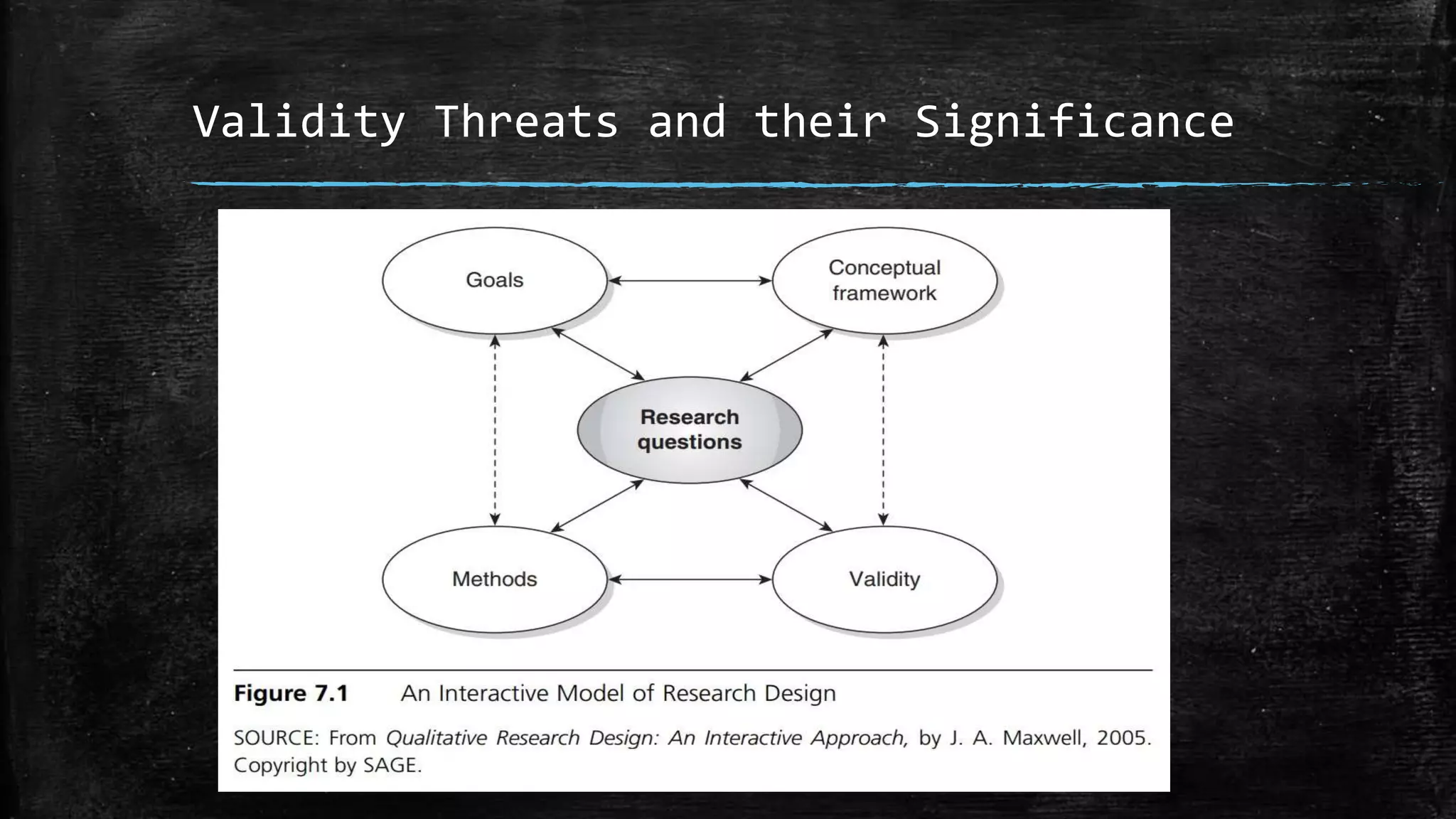
Why is Validity relevant?
▪ How might your results and conclusions be wrong?
▪ What are the plausible alternative interpretations
and validity threats to these, and how will you deal
with these?
▪ How can the data that you have, or that you could
potentially collect, support or challenge your ideas
about what’s going on?
▪ Why should we believe your results?
▪ Validity threats and their significance
▪ What is meant byValidity?
▪ Criteria for validity
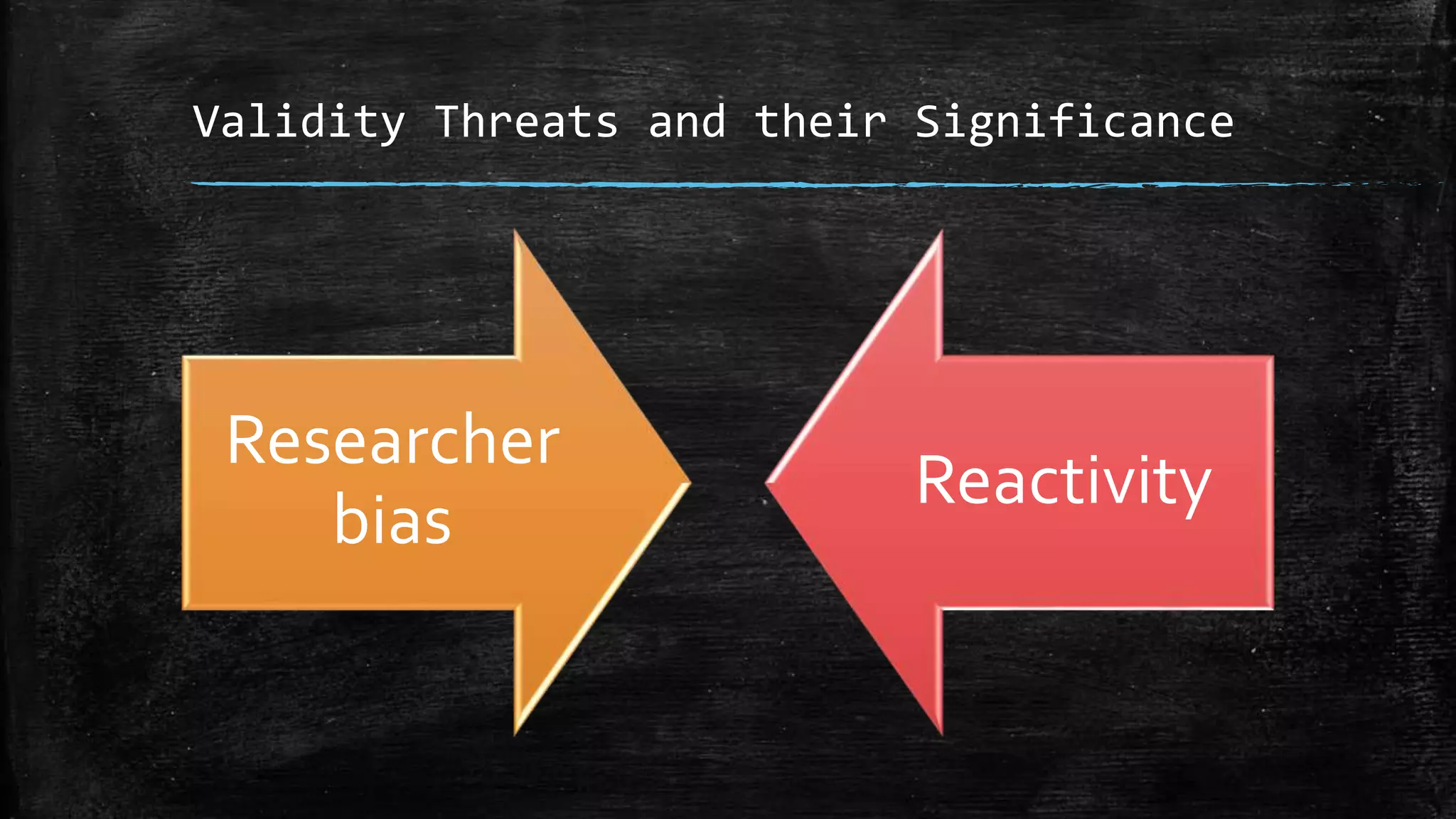
Validity Threats and their Significance
Researcher
bias
Reactivity
▪ According to Collingridge and Gantt, 2008 –
“In qualitative research validity means selecting an
appropriate method for a given question and
applying that method in a coherent, justifiable and
rigorous manner. Careful craftsmanship and
attention to detail makes legitimate results possible
and allows for defensible knowledge claims.”
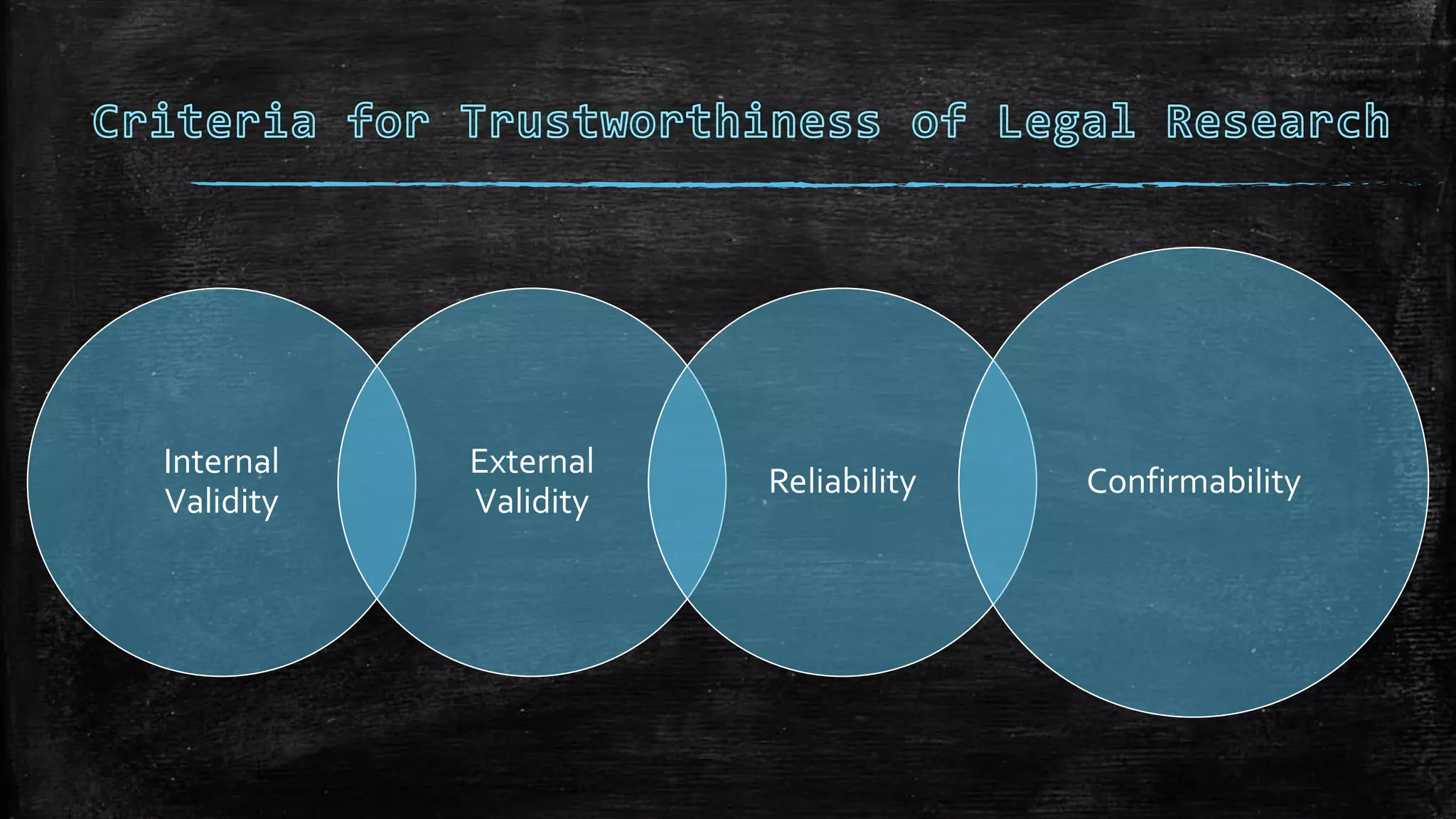
Internal
Validity
External
Validity
Reliability Confirmability
Ensuring Internal Validity
▪ In order to ensure internal validity, the researcher should carry out
prolonged engagement to elicit all dimensions.
▪ There shall be use of thick and rich description of the process and
product along with the context.
▪ Peer debriefing: the process whereby a researcher calls upon a
disinterested peer—a peer who is not involved in the research
project—to aid in probing the researcher's thinking around all or parts
of the research process.
▪ Examining rival explanation and atypical cases ensure internal
validity
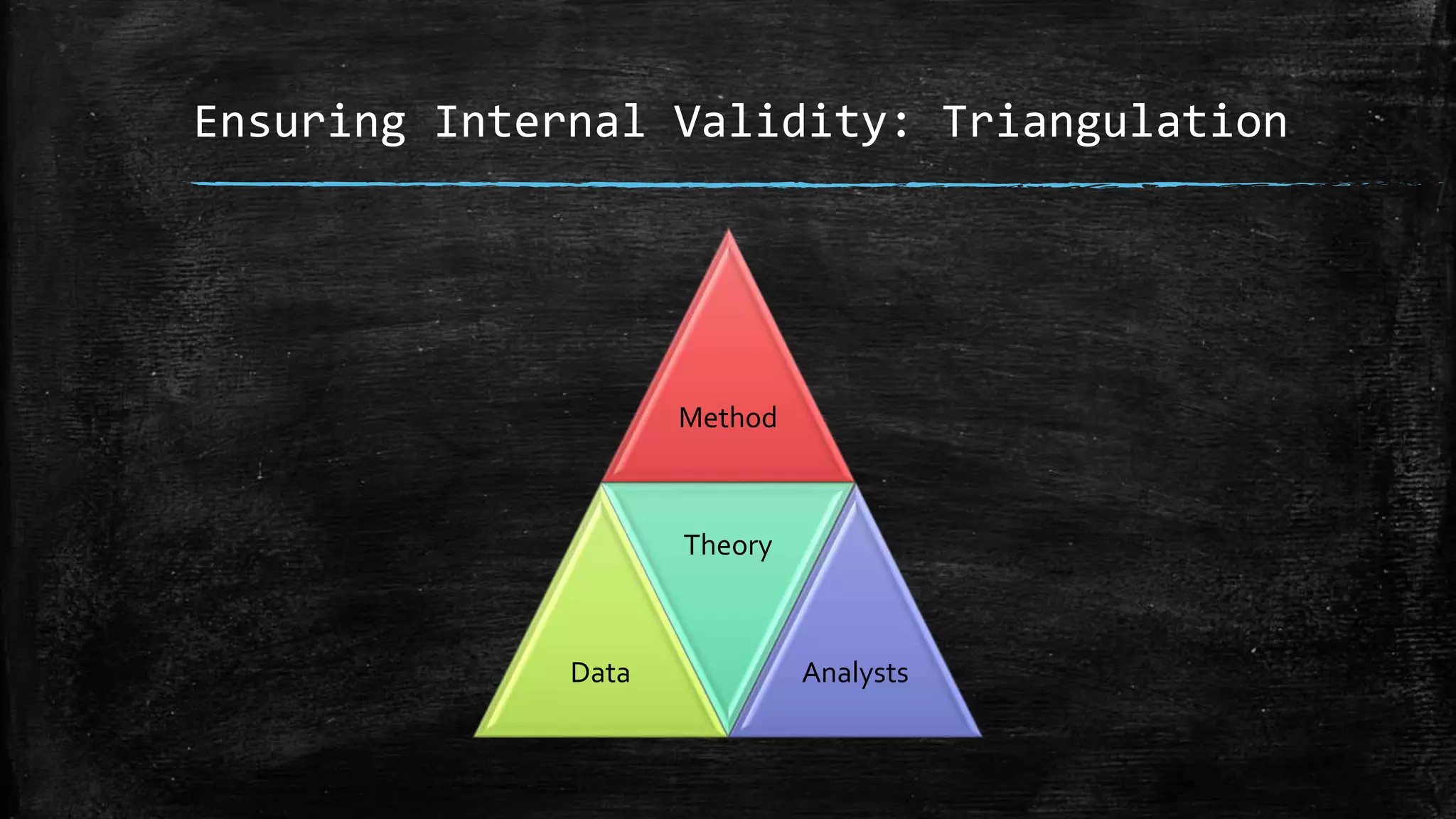
Ensuring Internal Validity: Triangulation
Method
Data
Theory
Analysts
Ensuring Internal Validity: Triangulation
▪ Method: Using more than one methods of data collection and study
approach
▪ Data: Data collected through more than one sampling strategies
from different individuals or groups (persons) in different social
situations (sites) at different point of times – reduce biases.
▪ Analysts: Use of more than one researcher with complementary
background to collect and interpret data or use of more than one
analyst (from different gender, race and culture) to analyse the data.
▪ Theory: Use of more than one disciplinary lens or theory or
theoretical position in the analysis of the same data set.
The Issue of Probability Sampling
▪ Probability sampling method is a sampling method that utilizes
some form of random selection.
▪ In order to have such random selection, the researcher must set
up some process or procedure that assures that the different
units in your population have equal probabilities of being
chosen.
▪ Types of probability sampling include:
– Simple random sampling
– Stratified random sampling
– Systematic random sampling
– Cluster Random sampling
External Validity
▪ Generalisability
▪ Applicability of the concept to a larger group or
other people, is context dependent. If there are
similarities in time frame, place, people, and setting
- transferable
Generalisation in QLR
▪ Qualitative researchers often study only a single setting or
a small number of individuals or sites, using theoretical or
purposeful rather than probability sampling, and rarely
make explicit claims about the generalizability of their
accounts.
▪ Indeed, the value of a qualitative study may depend on its
lack of generalizability in the sense of being representative
of a larger population; it may provide an account of a
setting or population that is illuminating as an extreme
case or “ideal type.”
The generalizability of qualitative
studies is usually based not on explicit
sampling of some defined population to
which the results can be extended, but
on the development of a theory that can
be extended to other cases
Reliability
▪ Reliability in qualitative research means adopting research
methods that are accepted by the research community as
legitimate ways of collecting and analysing data.
Specifically, reliable qualitative methods consistently
produce rich and meaningful descriptions of phenomena.
▪ In QLR, when different researchers come up with different
findings, it is not because an unreliable method was used,
rather, the fact that people experience social phenomena in
different ways and observed as such.
Confirmability
▪ Reflexivity is the influence of researcher position and
background or preoccupation.
▪ In order to confirm that the finding is not influenced by
reflexivity, researcher should:
– Mention his preoccupations (say who you are)
– Maintain empathic neutrality
– Tape own data and transcribe
– Analysis process and notes shall be recorded (auditable)
There is no “cookbook” for doing
qualitative research. The
appropriate answer to almost any
question about the use of
qualitative methods is,
“It depends.”
The value and feasibility of your research methods cannot be
guaranteed by your adhering to methodological rules; rather, they
depend on the specific setting and phenomena you are studying and
the actual consequences of your strategy for studying it.
Sources used for this lecture
▪ Md. Munir-ul Islam, Validity, Reliability and
Limitation of Qualitative Legal Research, 24th Basic
Course on Qualitative Research Methodology,
icddr,b, January 2019
▪ Joseph Alex Maxwell, Qualitative Research Design:
An InteractiveApproach, 2012

Validity and Reliability in Qualitative Legal Research

  • 1.
    Preeti Kana Sikder AssistantProfessor Department of Law & Justice Jahangirnagar University
  • 2.
    Hammersley & Atkinson, 1995 “Ina qualitative study, research design should be a reflexive process operating through every stage of a project” The activities of collecting and analyzing data, developing and modifying theory, elaborating or refocusing the research questions, and identifying and dealing with validity threats are usually going on more or less simultaneously, each influencing all of the others
  • 3.
    Why is Validityrelevant? ▪ How might your results and conclusions be wrong? ▪ What are the plausible alternative interpretations and validity threats to these, and how will you deal with these? ▪ How can the data that you have, or that you could potentially collect, support or challenge your ideas about what’s going on? ▪ Why should we believe your results?
  • 4.
    ▪ Validity threatsand their significance ▪ What is meant byValidity? ▪ Criteria for validity
  • 5.
    Validity Threats andtheir Significance
  • 6.
    Validity Threats andtheir Significance Researcher bias Reactivity
  • 7.
    ▪ According toCollingridge and Gantt, 2008 – “In qualitative research validity means selecting an appropriate method for a given question and applying that method in a coherent, justifiable and rigorous manner. Careful craftsmanship and attention to detail makes legitimate results possible and allows for defensible knowledge claims.”
  • 8.
  • 9.
    Ensuring Internal Validity ▪In order to ensure internal validity, the researcher should carry out prolonged engagement to elicit all dimensions. ▪ There shall be use of thick and rich description of the process and product along with the context. ▪ Peer debriefing: the process whereby a researcher calls upon a disinterested peer—a peer who is not involved in the research project—to aid in probing the researcher's thinking around all or parts of the research process. ▪ Examining rival explanation and atypical cases ensure internal validity
  • 10.
    Ensuring Internal Validity:Triangulation Method Data Theory Analysts
  • 11.
    Ensuring Internal Validity:Triangulation ▪ Method: Using more than one methods of data collection and study approach ▪ Data: Data collected through more than one sampling strategies from different individuals or groups (persons) in different social situations (sites) at different point of times – reduce biases. ▪ Analysts: Use of more than one researcher with complementary background to collect and interpret data or use of more than one analyst (from different gender, race and culture) to analyse the data. ▪ Theory: Use of more than one disciplinary lens or theory or theoretical position in the analysis of the same data set.
  • 12.
    The Issue ofProbability Sampling ▪ Probability sampling method is a sampling method that utilizes some form of random selection. ▪ In order to have such random selection, the researcher must set up some process or procedure that assures that the different units in your population have equal probabilities of being chosen. ▪ Types of probability sampling include: – Simple random sampling – Stratified random sampling – Systematic random sampling – Cluster Random sampling
  • 13.
    External Validity ▪ Generalisability ▪Applicability of the concept to a larger group or other people, is context dependent. If there are similarities in time frame, place, people, and setting - transferable
  • 14.
    Generalisation in QLR ▪Qualitative researchers often study only a single setting or a small number of individuals or sites, using theoretical or purposeful rather than probability sampling, and rarely make explicit claims about the generalizability of their accounts. ▪ Indeed, the value of a qualitative study may depend on its lack of generalizability in the sense of being representative of a larger population; it may provide an account of a setting or population that is illuminating as an extreme case or “ideal type.”
  • 15.
    The generalizability ofqualitative studies is usually based not on explicit sampling of some defined population to which the results can be extended, but on the development of a theory that can be extended to other cases
  • 16.
    Reliability ▪ Reliability inqualitative research means adopting research methods that are accepted by the research community as legitimate ways of collecting and analysing data. Specifically, reliable qualitative methods consistently produce rich and meaningful descriptions of phenomena. ▪ In QLR, when different researchers come up with different findings, it is not because an unreliable method was used, rather, the fact that people experience social phenomena in different ways and observed as such.
  • 17.
    Confirmability ▪ Reflexivity isthe influence of researcher position and background or preoccupation. ▪ In order to confirm that the finding is not influenced by reflexivity, researcher should: – Mention his preoccupations (say who you are) – Maintain empathic neutrality – Tape own data and transcribe – Analysis process and notes shall be recorded (auditable)
  • 18.
    There is no“cookbook” for doing qualitative research. The appropriate answer to almost any question about the use of qualitative methods is, “It depends.” The value and feasibility of your research methods cannot be guaranteed by your adhering to methodological rules; rather, they depend on the specific setting and phenomena you are studying and the actual consequences of your strategy for studying it.
  • 19.
    Sources used forthis lecture ▪ Md. Munir-ul Islam, Validity, Reliability and Limitation of Qualitative Legal Research, 24th Basic Course on Qualitative Research Methodology, icddr,b, January 2019 ▪ Joseph Alex Maxwell, Qualitative Research Design: An InteractiveApproach, 2012