Hypotheses Types,
Formulation, and
Testing
Definition of Hypotheses
Hypotheses are statements in quantitative research in which the
investigator makes a prediction or a guess about the outcome of a
relationship among attributes or characteristics.
Traditionally used in experiments, they serve, like research
questions, to narrow the purpose statement to specific predictions.
These predictions are not simply an “educated guess.” Rather,
researchers base them on results from past research and literature
where investigators have found certain results and can now offer
predictions as to what other investigators will find when they repeat
the study with new people or at new sites.
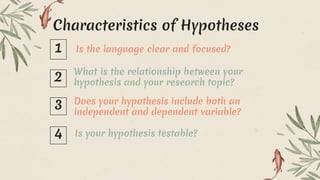
Characteristics of Hypotheses
Is the language clear and focused?
Is your hypothesis testable?
What is the relationship between your
hypothesis and your research topic?
Does your hypothesis include both an
independent and dependent variable?
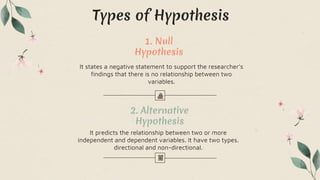
Types of Hypothesis
2. Alternative
Hypothesis
It predicts the relationship between two or more
independent and dependent variables. It have two types.
directional and non-directional.
It states a negative statement to support the researcher’s
findings that there is no relationship between two
variables.
1. Null
Hypothesis
4. Directional
Hypothesis
5. Non-
Directional
Hypothesis
It specifies the expected
direction to be followed to
determine the relationship
between variables, and is
derived from theory.
Furthermore, it implies
researcher’s intellectual
commitment to a particular
outcome.
It does not predict the exact
direction or nature of the
relationship between the two
variables. Non-directional
hypothesis is used when
there is no theory involved or
when findings contradict
previous research.
Importance of a Testable
Hypothesis
To devise and perform an experiment using scientific
method, you need to make sure that your hypothesis is
testable. To be considered testable, some essential criteria
must be met:
• There must be a possibility to prove that the hypothesis is
true.
• There must be a possibility to prove that the hypothesis is
false.
• The results of the hypothesis must be reproducible.
4 Steps of Hypothesis Testing
The first step is for the analyst to state the two hypotheses so that
only one can be right.
The next step is to formulate an analysis plan, which outlines how the
data will be evaluated.
The third step is to carry out the plan and physically analyze the
sample data.
The fourth and final step is to analyze the results and either reject the
null hypothesis, or state that the null hypothesis is plausible.
Thank you
Resources
How to Write a Research Hypothesis. (2019, February 14). Enago Academy.
https://www.enago.com/academy/how-to-develop-a-good-research-hypothesis/
Majaski, C. (2021). How Hypothesis Testing Works. Investopedia.
https://www.investopedia.com/terms/h/hypothesistesting.asp

Hypothesis types, formulation, and testing

  • 1.
  • 2.
    Definition of Hypotheses Hypothesesare statements in quantitative research in which the investigator makes a prediction or a guess about the outcome of a relationship among attributes or characteristics. Traditionally used in experiments, they serve, like research questions, to narrow the purpose statement to specific predictions. These predictions are not simply an “educated guess.” Rather, researchers base them on results from past research and literature where investigators have found certain results and can now offer predictions as to what other investigators will find when they repeat the study with new people or at new sites.
  • 3.
    Characteristics of Hypotheses Isthe language clear and focused? Is your hypothesis testable? What is the relationship between your hypothesis and your research topic? Does your hypothesis include both an independent and dependent variable?
  • 4.
    Types of Hypothesis 2.Alternative Hypothesis It predicts the relationship between two or more independent and dependent variables. It have two types. directional and non-directional. It states a negative statement to support the researcher’s findings that there is no relationship between two variables. 1. Null Hypothesis
  • 5.
    4. Directional Hypothesis 5. Non- Directional Hypothesis Itspecifies the expected direction to be followed to determine the relationship between variables, and is derived from theory. Furthermore, it implies researcher’s intellectual commitment to a particular outcome. It does not predict the exact direction or nature of the relationship between the two variables. Non-directional hypothesis is used when there is no theory involved or when findings contradict previous research.
  • 6.
    Importance of aTestable Hypothesis To devise and perform an experiment using scientific method, you need to make sure that your hypothesis is testable. To be considered testable, some essential criteria must be met: • There must be a possibility to prove that the hypothesis is true. • There must be a possibility to prove that the hypothesis is false. • The results of the hypothesis must be reproducible.
  • 7.
    4 Steps ofHypothesis Testing The first step is for the analyst to state the two hypotheses so that only one can be right. The next step is to formulate an analysis plan, which outlines how the data will be evaluated. The third step is to carry out the plan and physically analyze the sample data. The fourth and final step is to analyze the results and either reject the null hypothesis, or state that the null hypothesis is plausible.
  • 8.
  • 9.
    Resources How to Writea Research Hypothesis. (2019, February 14). Enago Academy. https://www.enago.com/academy/how-to-develop-a-good-research-hypothesis/ Majaski, C. (2021). How Hypothesis Testing Works. Investopedia. https://www.investopedia.com/terms/h/hypothesistesting.asp