
PRESENTATION
ON
ASSUMPTIONS
Submitted By
Latika Kashyap
M.Sc. Nursing
INTRODUCTION:
 An assumption is a realistic expectation which is
something that we believe to be true.
 An assumption is an act of faith which does not
have empirical evidence to support it.
 Assumption provides a basis to develop theories
and research instruments and therefore, influence
the development and implementation of research
process.
DEFINITION:
 Assumptions are statement that is taken for
granted or are considered true, even though they
have not been scientifically tested.
 Assumptions are principles those are accepted as
being true based on logic or reason, but without
proof or verification.
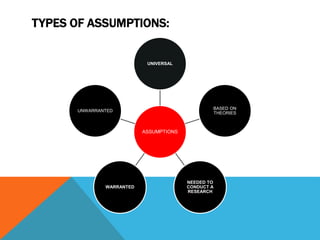
TYPES OF ASSUMPTIONS:
ASSUMPTIONS
UNIVERSAL
BASED ON
THEORIES
NEEDED TO
CONDUCT A
RESEARCH
WARRANTED
UNWARRANTED
UNIVERSAL ASSUMPTIONS:
Universal assumptions are beliefs that are assumed to be
true by a large part of society, but testing such
assumptions is not always possible.
Example: there is a supernatural power which governs this
universe.
ASSUMPTIONS BASED ON THEORIES:
Assumptions may also be drawn from theories.
If a research study is based on a theory, the
assumption of the particular theory may become
assumption of that particular research study.
Example: a study based on Roy’s Adaptation Model
will use assumption of this particular theoretical
model.
ASSUMPTIONS NEEDED TO CONDUCT A
RESEARCH:
Some of the common-sense assumption may be
develop to conduct a particular study.
Example: prevalence of coronary artery disease is
more common among urban people as compared
to rural people.
WARRANTED ASSUMPTION:
These are stated along with evidence to support.
Example: regular prayers bring success because they
boost morale.
UNWARRANTED ASSUMPTION:
These are stated without any supportive
Example: almighty God exist everywhere in this
universe.
USES OF ASSUMPTIONS IN RESEARCH:
 Research is built upon assumptions since a
foundation is needed to move forward. One must
assume something to discover something.
 Assumptions listed in research paper may be good
sources of the research topics.
 Assumptions provide basis to conduct of the
research.
 Tested assumptions through research studies
expand the professional body of knowledge.
EXAMPLES OF ASSUMPTIONS:
 People are aware of the experiences that most affect
their life choices.
 People want to assume control of their own health
problems.
 Stress should be avoided.
 Health is the priority for most of the people.
 Increased knowledge about an event lowers anxiety
about the event.
 Receiving health care at home is preferred to
receiving health care in an institute.
ASSUMPTIONS
• Assumptions are basically
beliefs & ideas that we hold to
be true.
• Often with little or no evidence
& are not statistically tested in
research.
• Beliefs about the variables.
• Based on the beliefs, the
researchers attempt to
discover the correlation.
HYPOTHESIS
• Hypothesis is a prediction.
• Can be statistically tested &
may be accepted or rejected.
• Predictions about the
relationship of two or more
variables.
• Predict a relation between
variables & statistically tested
to conclude the study.
DIFFERENCE BETWEEN ASSUMPTIONS AND
HYPOTHESIS
DELIMITATIONS:
Limitations are restrictions of the study due to
theoretical or methodological reasons, which may
decrease the credibility and generalizability of the
research findings.
TYPES OF LIMITATIONS:
1. THEORETICAL LIMITATIONS:
They restrict the ability of research findings to
generalize due to the use of specific theoretical
concept in study, or limiting the study of variables
through operational definitions.
2. METHODOLOGICAL LIMITATIONS:
These usually result from some of the methodological
factors such as unrepresentative sample, weak
design, single setting, limited control over
extraneous variables, poor implementations of
treatment protocol, research tools with limited
reliability and validity, poor data collection
procedures, ineffective use of statistical analysis
etc.
THANK YOU

PRESENTATION ON Assumptions.pptx

  • 1.
  • 2.
    INTRODUCTION:  An assumptionis a realistic expectation which is something that we believe to be true.  An assumption is an act of faith which does not have empirical evidence to support it.  Assumption provides a basis to develop theories and research instruments and therefore, influence the development and implementation of research process.
  • 3.
    DEFINITION:  Assumptions arestatement that is taken for granted or are considered true, even though they have not been scientifically tested.  Assumptions are principles those are accepted as being true based on logic or reason, but without proof or verification.
  • 4.
    TYPES OF ASSUMPTIONS: ASSUMPTIONS UNIVERSAL BASEDON THEORIES NEEDED TO CONDUCT A RESEARCH WARRANTED UNWARRANTED
  • 5.
    UNIVERSAL ASSUMPTIONS: Universal assumptionsare beliefs that are assumed to be true by a large part of society, but testing such assumptions is not always possible. Example: there is a supernatural power which governs this universe.
  • 6.
    ASSUMPTIONS BASED ONTHEORIES: Assumptions may also be drawn from theories. If a research study is based on a theory, the assumption of the particular theory may become assumption of that particular research study. Example: a study based on Roy’s Adaptation Model will use assumption of this particular theoretical model.
  • 7.
    ASSUMPTIONS NEEDED TOCONDUCT A RESEARCH: Some of the common-sense assumption may be develop to conduct a particular study. Example: prevalence of coronary artery disease is more common among urban people as compared to rural people.
  • 8.
    WARRANTED ASSUMPTION: These arestated along with evidence to support. Example: regular prayers bring success because they boost morale.
  • 9.
    UNWARRANTED ASSUMPTION: These arestated without any supportive Example: almighty God exist everywhere in this universe.
  • 10.
    USES OF ASSUMPTIONSIN RESEARCH:  Research is built upon assumptions since a foundation is needed to move forward. One must assume something to discover something.  Assumptions listed in research paper may be good sources of the research topics.  Assumptions provide basis to conduct of the research.  Tested assumptions through research studies expand the professional body of knowledge.
  • 11.
    EXAMPLES OF ASSUMPTIONS: People are aware of the experiences that most affect their life choices.  People want to assume control of their own health problems.  Stress should be avoided.  Health is the priority for most of the people.  Increased knowledge about an event lowers anxiety about the event.  Receiving health care at home is preferred to receiving health care in an institute.
  • 12.
    ASSUMPTIONS • Assumptions arebasically beliefs & ideas that we hold to be true. • Often with little or no evidence & are not statistically tested in research. • Beliefs about the variables. • Based on the beliefs, the researchers attempt to discover the correlation. HYPOTHESIS • Hypothesis is a prediction. • Can be statistically tested & may be accepted or rejected. • Predictions about the relationship of two or more variables. • Predict a relation between variables & statistically tested to conclude the study. DIFFERENCE BETWEEN ASSUMPTIONS AND HYPOTHESIS
  • 13.
    DELIMITATIONS: Limitations are restrictionsof the study due to theoretical or methodological reasons, which may decrease the credibility and generalizability of the research findings.
  • 14.
    TYPES OF LIMITATIONS: 1.THEORETICAL LIMITATIONS: They restrict the ability of research findings to generalize due to the use of specific theoretical concept in study, or limiting the study of variables through operational definitions.
  • 15.
    2. METHODOLOGICAL LIMITATIONS: Theseusually result from some of the methodological factors such as unrepresentative sample, weak design, single setting, limited control over extraneous variables, poor implementations of treatment protocol, research tools with limited reliability and validity, poor data collection procedures, ineffective use of statistical analysis etc.
  • 16.