DEVELOPING THEORETICAL AND CONCEPTUAL FRAMEWORKS

M. Dablo- Dec.14, 11

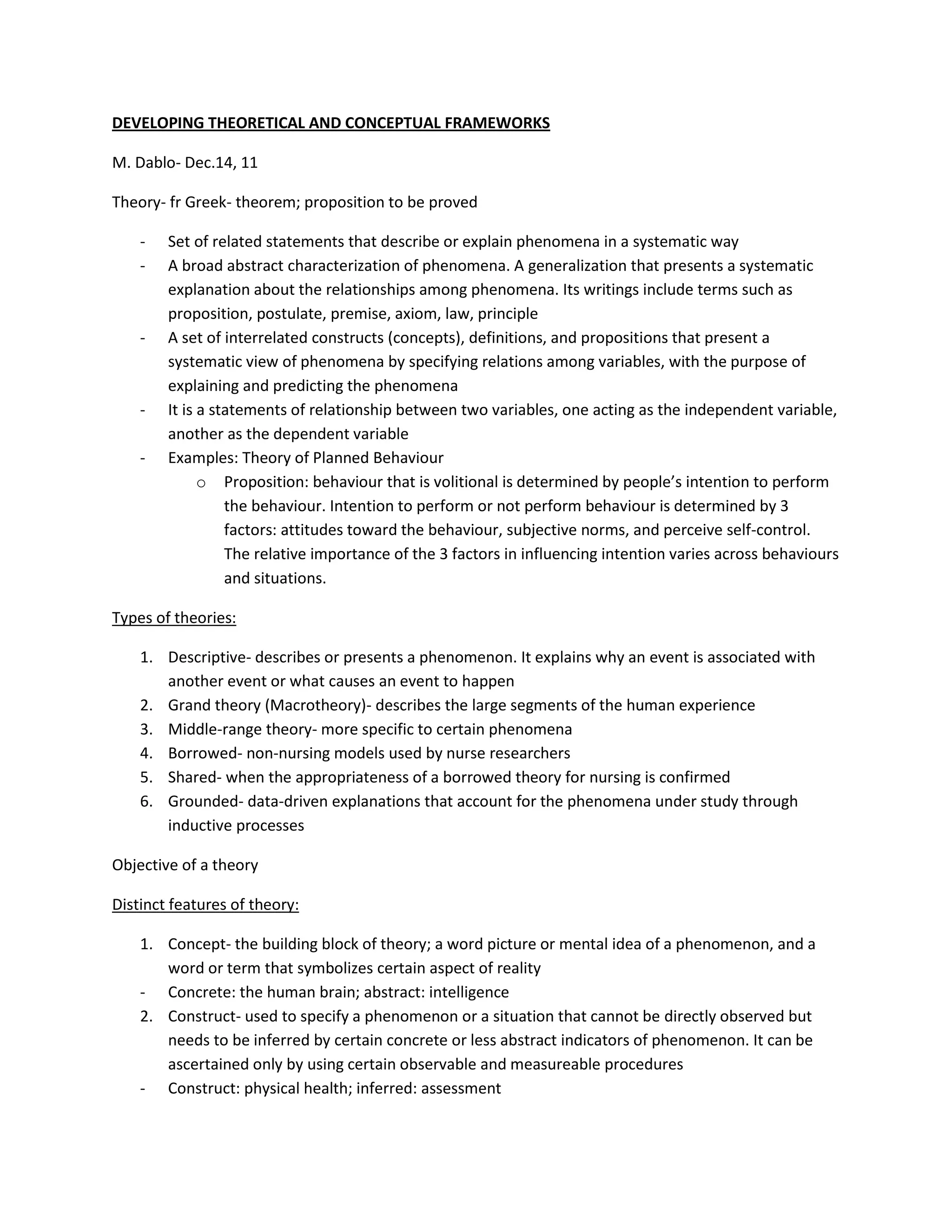
Theory- fr Greek- theorem; proposition to be proved

    -   Set of related statements that describe or explain phenomena in a systematic way
    -   A broad abstract characterization of phenomena. A generalization that presents a systematic
        explanation about the relationships among phenomena. Its writings include terms such as
        proposition, postulate, premise, axiom, law, principle
    -   A set of interrelated constructs (concepts), definitions, and propositions that present a
        systematic view of phenomena by specifying relations among variables, with the purpose of
        explaining and predicting the phenomena
    -   It is a statements of relationship between two variables, one acting as the independent variable,
        another as the dependent variable
    -   Examples: Theory of Planned Behaviour
              o Proposition: behaviour that is volitional is determined by people’s intention to perform
                  the behaviour. Intention to perform or not perform behaviour is determined by 3
                  factors: attitudes toward the behaviour, subjective norms, and perceive self-control.
                  The relative importance of the 3 factors in influencing intention varies across behaviours
                  and situations.

Types of theories:

    1. Descriptive- describes or presents a phenomenon. It explains why an event is associated with
       another event or what causes an event to happen
    2. Grand theory (Macrotheory)- describes the large segments of the human experience
    3. Middle-range theory- more specific to certain phenomena
    4. Borrowed- non-nursing models used by nurse researchers
    5. Shared- when the appropriateness of a borrowed theory for nursing is confirmed
    6. Grounded- data-driven explanations that account for the phenomena under study through
       inductive processes

Objective of a theory

Distinct features of theory:

    1. Concept- the building block of theory; a word picture or mental idea of a phenomenon, and a
       word or term that symbolizes certain aspect of reality
    - Concrete: the human brain; abstract: intelligence
    2. Construct- used to specify a phenomenon or a situation that cannot be directly observed but
       needs to be inferred by certain concrete or less abstract indicators of phenomenon. It can be
       ascertained only by using certain observable and measureable procedures
    - Construct: physical health; inferred: assessment
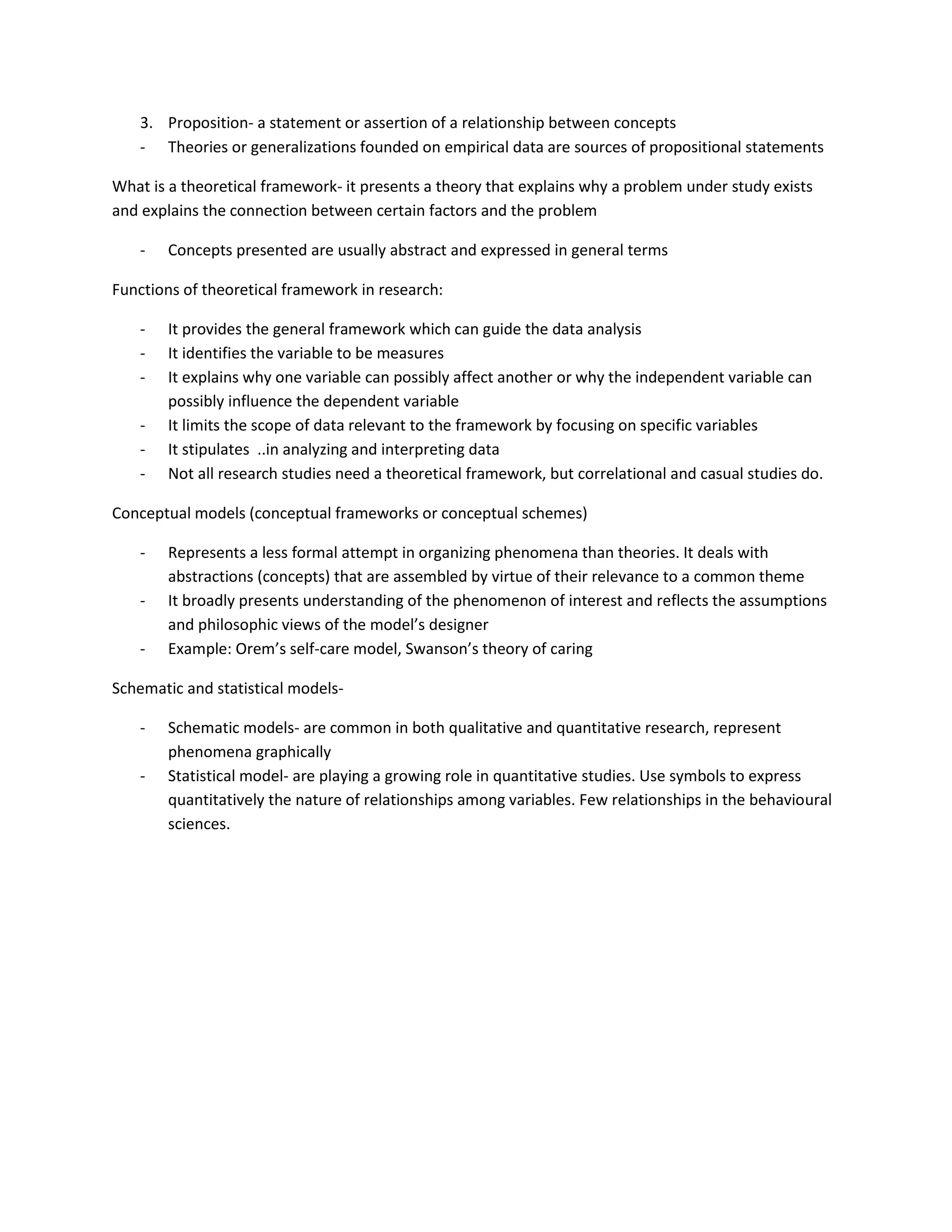
3. Proposition- a statement or assertion of a relationship between concepts
   - Theories or generalizations founded on empirical data are sources of propositional statements

What is a theoretical framework- it presents a theory that explains why a problem under study exists
and explains the connection between certain factors and the problem

   -   Concepts presented are usually abstract and expressed in general terms

Functions of theoretical framework in research:

   -   It provides the general framework which can guide the data analysis
   -   It identifies the variable to be measures
   -   It explains why one variable can possibly affect another or why the independent variable can
       possibly influence the dependent variable
   -   It limits the scope of data relevant to the framework by focusing on specific variables
   -   It stipulates ..in analyzing and interpreting data
   -   Not all research studies need a theoretical framework, but correlational and casual studies do.

Conceptual models (conceptual frameworks or conceptual schemes)

   -   Represents a less formal attempt in organizing phenomena than theories. It deals with
       abstractions (concepts) that are assembled by virtue of their relevance to a common theme
   -   It broadly presents understanding of the phenomenon of interest and reflects the assumptions
       and philosophic views of the model’s designer
   -   Example: Orem’s self-care model, Swanson’s theory of caring

Schematic and statistical models-

   -   Schematic models- are common in both qualitative and quantitative research, represent
       phenomena graphically
   -   Statistical model- are playing a growing role in quantitative studies. Use symbols to express
       quantitatively the nature of relationships among variables. Few relationships in the behavioural
       sciences.
CONCEPTUALIZING THE RESEARCH STUDY

Statement of purpose: or purpose statement, summary of overall goal

   -     The title itself is the objective/purpose
   -     Purpose statements: a declarative statement that advances the overall direction or focus for the
         study
   -     Research questions: interrogative statements that narrow the purpose statement to specific
         questions that researchers seek to answer in their study
   -     Research hypotheses: declarative statements in quantitative research in which the investigator
         makes a prediction or conjecture about the outcomes relationship
   -     Research objective: a statement of intent for the study that specifies specific goals that the
         investigator plans to achieve in a study


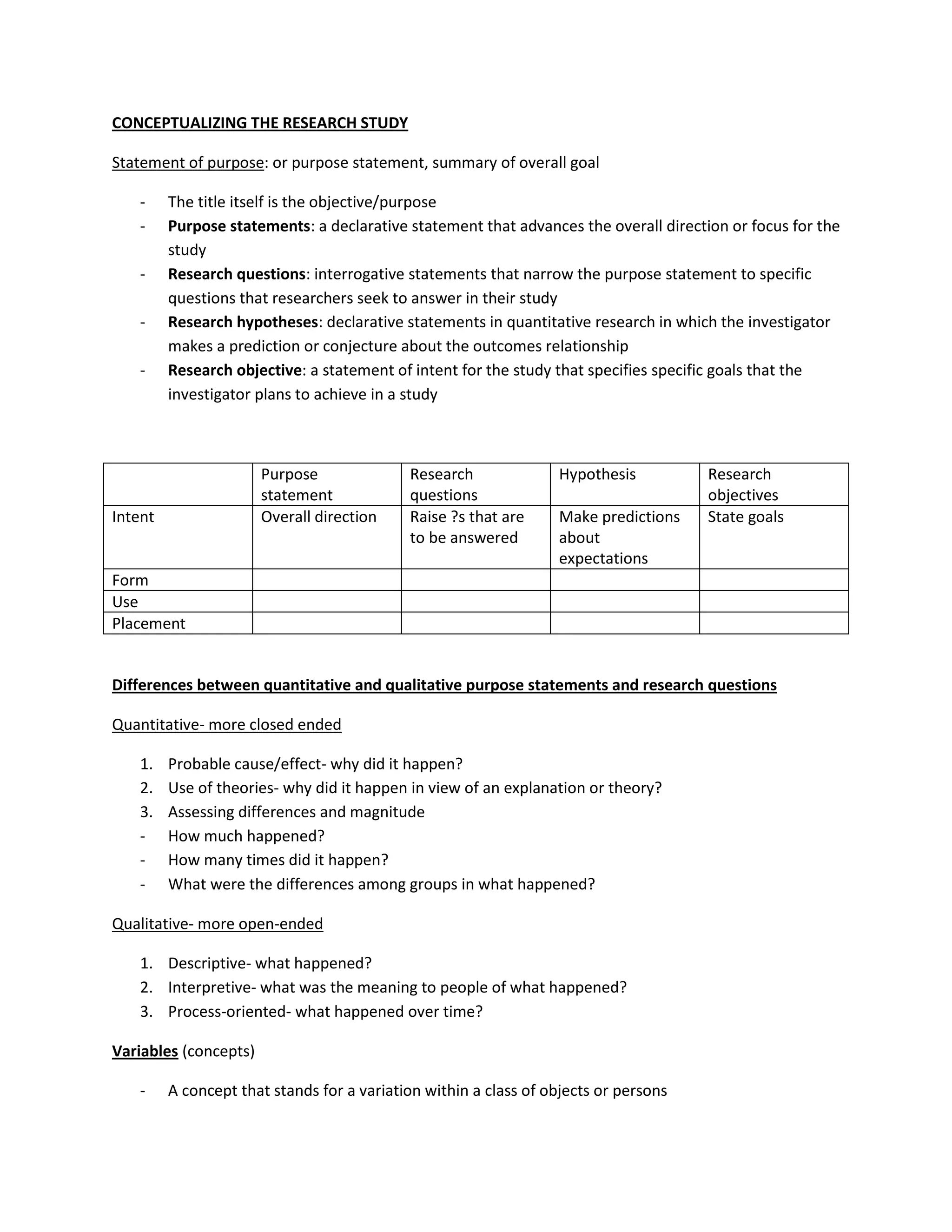
                       Purpose              Research              Hypothesis          Research
                       statement            questions                                 objectives
Intent                 Overall direction    Raise ?s that are     Make predictions    State goals
                                            to be answered        about
                                                                  expectations
Form
Use
Placement


Differences between quantitative and qualitative purpose statements and research questions

Quantitative- more closed ended

   1.    Probable cause/effect- why did it happen?
   2.    Use of theories- why did it happen in view of an explanation or theory?
   3.    Assessing differences and magnitude
   -     How much happened?
   -     How many times did it happen?
   -     What were the differences among groups in what happened?

Qualitative- more open-ended

   1. Descriptive- what happened?
   2. Interpretive- what was the meaning to people of what happened?
   3. Process-oriented- what happened over time?

Variables (concepts)

   -     A concept that stands for a variation within a class of objects or persons
-   A characteristic or property that can take different values or attributes
   -   These are central building blocks of quantitative studies
   -   Ex: weight, anxiety levels, income, etc.

   Types of variables:

   1. Dependent variable- is the “assumed effect” of another variable
   - The change that occurs in the study population when one or more factors are changed or when
      an interventions is introduced
   - Sometimes the dependent variable is the problem itself
   2. Independent- the “assumed cause” of a problem
   - Ex: The relationship between exposure to mass media and smoking habits among young adults”
       independent: Exposure to mass media (what is the level of exposure to mass media among
      young adults); dependent: smoking habits (what is the level of smoking habits among young
      adults?)
   - Assumed reason for any “change” or variation in the dependent variable
   3. Intervening- is a factor that works “between” the independent and dependent variable
   - It can weaken (decrease) or strengthen (increase) the effect of the independent on the
      dependent variables
   - Also called a “facilitating variable”, “moderator” or a control variable
   - Ex: Knowledge on the dangers of smoking, attitudes towards life, and smoking habits of young
      professionals independent: knowledge on the dangers of smoking; Intervening: attitudes
      towards life; dependent: smoking habits

   4. Antecedent- is a factor or characteristic which is found before the independent variable
   - Expected to influence the independent variable/s, usually irreversible
   - Ex: extent of exposure to print media and reading ability of college freshmen  antecedent:
      gender, residence, parent’s education; independent: extent of exposure to print media;
      dependent: reading ability

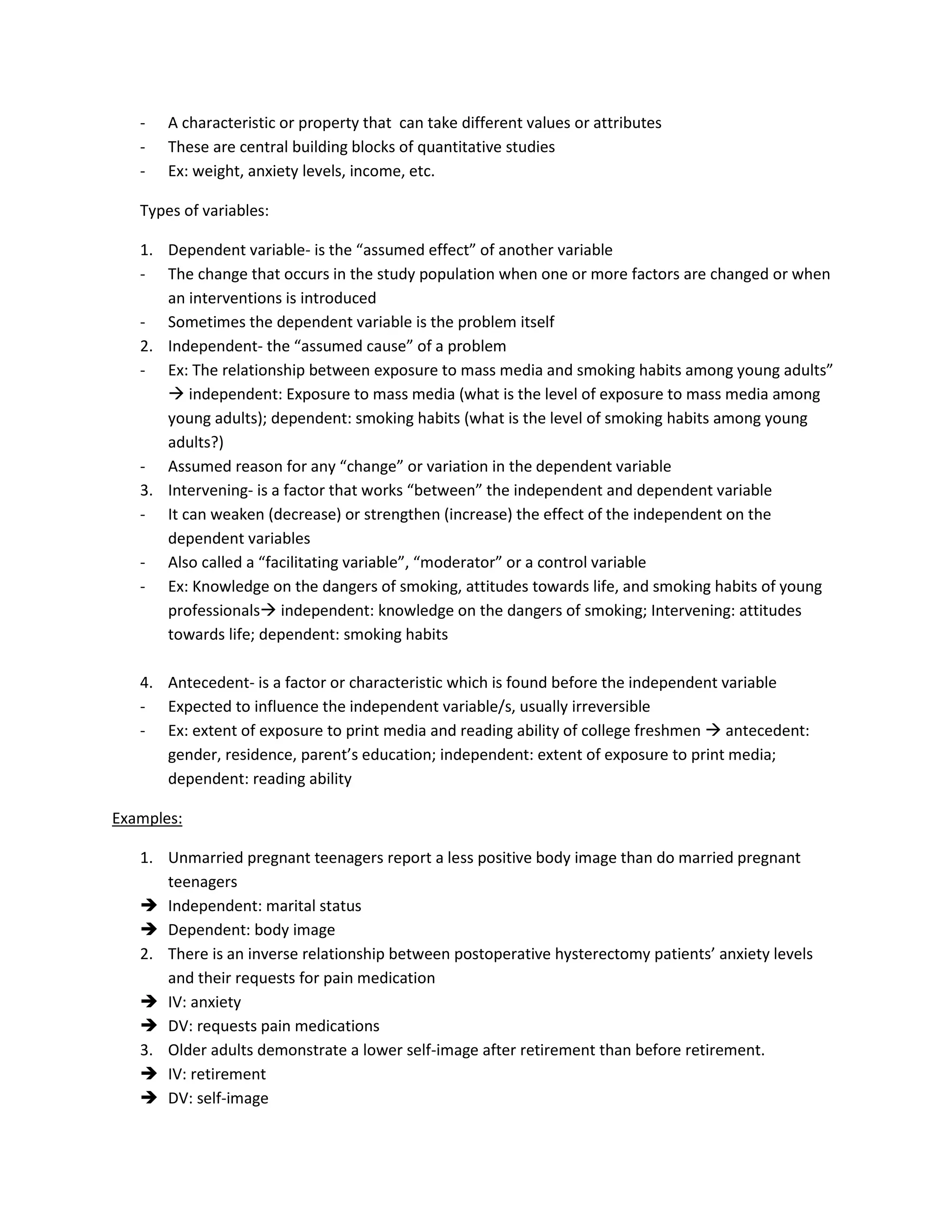
Examples:

   1. Unmarried pregnant teenagers report a less positive body image than do married pregnant
      teenagers
    Independent: marital status
    Dependent: body image
   2. There is an inverse relationship between postoperative hysterectomy patients’ anxiety levels
      and their requests for pain medication
    IV: anxiety
    DV: requests pain medications
   3. Older adults demonstrate a lower self-image after retirement than before retirement.
    IV: retirement
    DV: self-image
Operational definition of variables:

    -   Gives a specific meaning to the variable. It clarifies how a variable is used and measured in the
        study
    -   A variable must be defined in terms of events/units of measurement that are observable by the
        senses

Establishing categories of variables

    1. Mutually exclusive categories- do not overlap when a respondent cannot be assigned to more
       than one category.
    - Define terms as how it is being used in your study
    2. Exhausative categories


What is a research design?

    -   It is the researcher’s overall plan for answering the research question
    -   It is the blue print of the study. It guides the collection, measurement and analysis of data
    -   It is a plan or course of action which the researcher follows in order to answer the research
        question/s or solve the research problem.

Research developing theoretical and conceptual frameworks

  • 1.
    DEVELOPING THEORETICAL ANDCONCEPTUAL FRAMEWORKS M. Dablo- Dec.14, 11 Theory- fr Greek- theorem; proposition to be proved - Set of related statements that describe or explain phenomena in a systematic way - A broad abstract characterization of phenomena. A generalization that presents a systematic explanation about the relationships among phenomena. Its writings include terms such as proposition, postulate, premise, axiom, law, principle - A set of interrelated constructs (concepts), definitions, and propositions that present a systematic view of phenomena by specifying relations among variables, with the purpose of explaining and predicting the phenomena - It is a statements of relationship between two variables, one acting as the independent variable, another as the dependent variable - Examples: Theory of Planned Behaviour o Proposition: behaviour that is volitional is determined by people’s intention to perform the behaviour. Intention to perform or not perform behaviour is determined by 3 factors: attitudes toward the behaviour, subjective norms, and perceive self-control. The relative importance of the 3 factors in influencing intention varies across behaviours and situations. Types of theories: 1. Descriptive- describes or presents a phenomenon. It explains why an event is associated with another event or what causes an event to happen 2. Grand theory (Macrotheory)- describes the large segments of the human experience 3. Middle-range theory- more specific to certain phenomena 4. Borrowed- non-nursing models used by nurse researchers 5. Shared- when the appropriateness of a borrowed theory for nursing is confirmed 6. Grounded- data-driven explanations that account for the phenomena under study through inductive processes Objective of a theory Distinct features of theory: 1. Concept- the building block of theory; a word picture or mental idea of a phenomenon, and a word or term that symbolizes certain aspect of reality - Concrete: the human brain; abstract: intelligence 2. Construct- used to specify a phenomenon or a situation that cannot be directly observed but needs to be inferred by certain concrete or less abstract indicators of phenomenon. It can be ascertained only by using certain observable and measureable procedures - Construct: physical health; inferred: assessment
  • 2.
    3. Proposition- astatement or assertion of a relationship between concepts - Theories or generalizations founded on empirical data are sources of propositional statements What is a theoretical framework- it presents a theory that explains why a problem under study exists and explains the connection between certain factors and the problem - Concepts presented are usually abstract and expressed in general terms Functions of theoretical framework in research: - It provides the general framework which can guide the data analysis - It identifies the variable to be measures - It explains why one variable can possibly affect another or why the independent variable can possibly influence the dependent variable - It limits the scope of data relevant to the framework by focusing on specific variables - It stipulates ..in analyzing and interpreting data - Not all research studies need a theoretical framework, but correlational and casual studies do. Conceptual models (conceptual frameworks or conceptual schemes) - Represents a less formal attempt in organizing phenomena than theories. It deals with abstractions (concepts) that are assembled by virtue of their relevance to a common theme - It broadly presents understanding of the phenomenon of interest and reflects the assumptions and philosophic views of the model’s designer - Example: Orem’s self-care model, Swanson’s theory of caring Schematic and statistical models- - Schematic models- are common in both qualitative and quantitative research, represent phenomena graphically - Statistical model- are playing a growing role in quantitative studies. Use symbols to express quantitatively the nature of relationships among variables. Few relationships in the behavioural sciences.
  • 3.
    CONCEPTUALIZING THE RESEARCHSTUDY Statement of purpose: or purpose statement, summary of overall goal - The title itself is the objective/purpose - Purpose statements: a declarative statement that advances the overall direction or focus for the study - Research questions: interrogative statements that narrow the purpose statement to specific questions that researchers seek to answer in their study - Research hypotheses: declarative statements in quantitative research in which the investigator makes a prediction or conjecture about the outcomes relationship - Research objective: a statement of intent for the study that specifies specific goals that the investigator plans to achieve in a study Purpose Research Hypothesis Research statement questions objectives Intent Overall direction Raise ?s that are Make predictions State goals to be answered about expectations Form Use Placement Differences between quantitative and qualitative purpose statements and research questions Quantitative- more closed ended 1. Probable cause/effect- why did it happen? 2. Use of theories- why did it happen in view of an explanation or theory? 3. Assessing differences and magnitude - How much happened? - How many times did it happen? - What were the differences among groups in what happened? Qualitative- more open-ended 1. Descriptive- what happened? 2. Interpretive- what was the meaning to people of what happened? 3. Process-oriented- what happened over time? Variables (concepts) - A concept that stands for a variation within a class of objects or persons
  • 4.
    - A characteristic or property that can take different values or attributes - These are central building blocks of quantitative studies - Ex: weight, anxiety levels, income, etc. Types of variables: 1. Dependent variable- is the “assumed effect” of another variable - The change that occurs in the study population when one or more factors are changed or when an interventions is introduced - Sometimes the dependent variable is the problem itself 2. Independent- the “assumed cause” of a problem - Ex: The relationship between exposure to mass media and smoking habits among young adults”  independent: Exposure to mass media (what is the level of exposure to mass media among young adults); dependent: smoking habits (what is the level of smoking habits among young adults?) - Assumed reason for any “change” or variation in the dependent variable 3. Intervening- is a factor that works “between” the independent and dependent variable - It can weaken (decrease) or strengthen (increase) the effect of the independent on the dependent variables - Also called a “facilitating variable”, “moderator” or a control variable - Ex: Knowledge on the dangers of smoking, attitudes towards life, and smoking habits of young professionals independent: knowledge on the dangers of smoking; Intervening: attitudes towards life; dependent: smoking habits 4. Antecedent- is a factor or characteristic which is found before the independent variable - Expected to influence the independent variable/s, usually irreversible - Ex: extent of exposure to print media and reading ability of college freshmen  antecedent: gender, residence, parent’s education; independent: extent of exposure to print media; dependent: reading ability Examples: 1. Unmarried pregnant teenagers report a less positive body image than do married pregnant teenagers  Independent: marital status  Dependent: body image 2. There is an inverse relationship between postoperative hysterectomy patients’ anxiety levels and their requests for pain medication  IV: anxiety  DV: requests pain medications 3. Older adults demonstrate a lower self-image after retirement than before retirement.  IV: retirement  DV: self-image
  • 5.
    Operational definition ofvariables: - Gives a specific meaning to the variable. It clarifies how a variable is used and measured in the study - A variable must be defined in terms of events/units of measurement that are observable by the senses Establishing categories of variables 1. Mutually exclusive categories- do not overlap when a respondent cannot be assigned to more than one category. - Define terms as how it is being used in your study 2. Exhausative categories What is a research design? - It is the researcher’s overall plan for answering the research question - It is the blue print of the study. It guides the collection, measurement and analysis of data - It is a plan or course of action which the researcher follows in order to answer the research question/s or solve the research problem.