Theoretical
&
Conceptual Frame-work
-Theoretical Frame-work
-Conceptual Frame-work
Theory
Theories are constructed in order to explain, predict
and master phenomena (e.g.
relationships, events, or the behavior). In many
instances we are constructing models of reality.
A theory makes generalizations about
observations and consists of an
interrelated, coherent set of ideas and
models.
A theoretical framework is analogous to
the frame of the house.
Just as the foundation supports a house,
a theoretical framework provides a
rationale for predictions about the
relationships among variables of a
research study
Prof.Dr.RS Mehta, MSND, BPKIHS
Theoretical Framework
What is the central concept(s)
integral to the study?
Connecting the study to theory:
basic research
Prof.Dr.RS Mehta, MSND, BPKIHS
5
THEORETICAL FRAMEWORK AND
RESEARCH METHODOLOGY
Theoretical Framework
 Identify the variables investigated in the
study.
 Illustrate how the variables interact with
each other as hypothesised in the
research by the aid of diagram/s (if
possible).
Prof.Dr.RS Mehta, MSND, BPKIHS
Theory
 Provides patterns for the interpretation of data
 Links one study to another
 Supplies frameworks within which concepts and
variables acquire special significance
 Allows us to interpret the larger meaning of our
findings for ourselves and others
Prof.Dr.RS Mehta, MSND, BPKIHS
The Conceptual Framework …
provides direction for
 programs
 courses
 teaching
 candidate performance
 scholarship
 service
 unit accountability
Prof.Dr.RS Mehta, MSND, BPKIHS
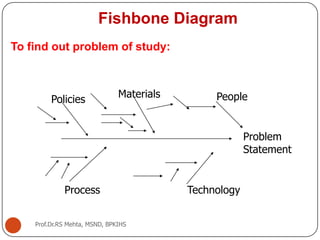
Fishbone Diagram
To find out problem of study:
Problem
Statement
Policies
Materials People
Process Technology
Prof.Dr.RS Mehta, MSND, BPKIHS
The Conceptual Framework …
is
 knowledge-based
 articulated
 shared
 coherent
 consistent with the unit and/or institutional
mission
 continuously evaluated
Prof.Dr.RS Mehta, MSND, BPKIHS
What is a conceptual framework?
 A written or visual presentation that:
– “explains either graphically, or in narrative form,
the main things to be studied – the key factors,
concepts or variables -
– and the presumed relationship among them”.
Prof.Dr.RS Mehta, MSND, BPKIHS
What specific forms might a
conceptual framework take?
 The possibilities include:
– Flow charts.
– Tree diagrams.
– Shape based diagrams – triangles, concentric
circles, overlapping circles.
– Mind maps.
– Software systems.
Prof.Dr.RS Mehta, MSND, BPKIHS
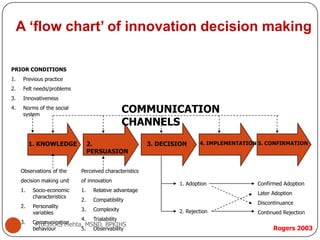
A ‘flow chart’ of innovation decision making
PRIOR CONDITIONS
1. Previous practice
2. Felt needs/problems
3. Innovativeness
4. Norms of the social
system
COMMUNICATION
CHANNELS
1. KNOWLEDGE 2.
PERSUASION
4. IMPLEMENTATION3. DECISION
1. Adoption
2. Rejection
Confirmed Adoption
Later Adoption
Discontinuance
Continued Rejection
Perceived characteristics
of innovation
1. Relative advantage
2. Compatibility
3. Complexity
4. Trialability
5. Observability
Observations of the
decision making unit
1. Socio-economic
characteristics
2. Personality
variables
3. Communication
behaviour
5. CONFIRMATION
Rogers 2003
Prof.Dr.RS Mehta, MSND, BPKIHS
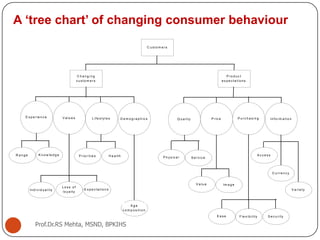
A ‘tree chart’ of changing consumer behaviour
C u s to m e rs
C h a n g i n g
c u s to m e rs
E x p e rie n c e V a lu e s L i fe s ty le s D e m o g ra p h ic s
P ro d u c t
e x p e c ta ti o n s
Q u a l ity P ric e P u rc h a s in g In fo rm a tio n
P h y s ic a l S e rv ic e
E a s e F le x i b ility
R a n g e
In d i v id u a lity
H e a lth
A g e
c o m p o s iti o n
S e c u rity
L o s s o f
lo y a lty
V a lu e Im a g e
P rio ritie s
E x p e c ta tio n s
K n o w le d g e A c c e s s
C u rre n c y
V a rie ty
Prof.Dr.RS Mehta, MSND, BPKIHS
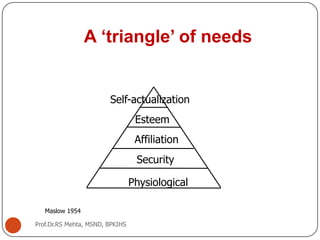
A ‘triangle’ of needs
Self-actualization
Esteem
Affiliation
Security
Physiological
Maslow 1954
Prof.Dr.RS Mehta, MSND, BPKIHS
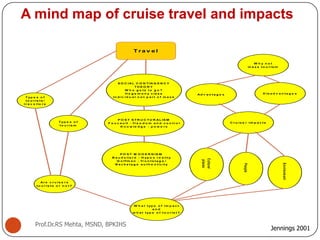
A mind map of cruise travel and impacts
T r a v e l
T yp e s o f
t o u r is t s /
t r a v e lle r s
T yp e s o f
t o u r is m
Ar e c r u is e r s
t o u r is t s o r n o t ?
S O C IAL C O N T IN G E N C Y
T H E O R Y
W h o g e t s t o g o ?
H e g e m o n y c la s s
In d iv id u a l n o t p a r t o f m a s s
P O S T S T R U C T U R AL IS M
F o u c a u lt - f r e e d o m a n d c o n t r o l
K n o w le d g e - p o w e r s
P O S T M O D E R N IS M
B a u d s ila r d - H yp e s r e a lit y
G o f f m a n - f r o n t s t a g e /
B a c k s t a g e a u t h e n t ic it y
Culture/
places
People
Environment
C r u is e r im p a c t s
Ad v a n t a g e s D is a d v a n t a g e s
W h y n o t
m a s s t o u r is m
W h a t t yp e o f im p a c t
a n d
w h a t t yp e o f t o u r is t ?
Jennings 2001
Prof.Dr.RS Mehta, MSND, BPKIHS
The Use of a Theoretical Framework as a
Guide in a Research Study
The theoretical framework plays an important role in
guiding the entire process of the research study
 Theories are constructed in order to explain, predict
and master phenomena (e.g. relationships, events, or
the behavior). In many instances we are constructing
models of reality.
 A theory makes generalizations about observations and
consists of an interrelated, coherent set of ideas and
models.
Prof.Dr.RS Mehta, MSND, BPKIHS
The Use of a Theoretical Framework as a
Guide in a Research Study
If the framework is logically sound and
substantiated by previous research studies, there is
a strong possibility that the predictions or
hypotheses evolving from that framework will be
supported
In some cases, a theoretical rationale in
inappropriately used. e.g. a theory is designed to
explain a particular behavior in infants may not be
appropriate for the study of those behaviors in
adults
Prof.Dr.RS Mehta, MSND, BPKIHS
Formulating the Theoretical Framework
Purpose:
• It helps the researcher see clearly the
variables of the study;
• It can provide him with a general
framework for data analysis;
• It is essential in preparing a research
proposal using descriptive and
experimental methods.
Prof.Dr.RS Mehta, MSND, BPKIHS
conceptual framework
 A conceptual framework is used in
research to outline possible courses of
action or to present a preferred
approach to an idea or thought.
Prof.Dr.RS Mehta, MSND, BPKIHS
How to Develop a Theoretical Framework or
conceptual framework
1. Select concepts
a concept is an image or symbolic
representation of an abstract idea. e.g.
health, pain, intelligence …
2. Identify the interrelationships among
concepts
Prof.Dr.RS Mehta, MSND, BPKIHS
How to Develop a Theoretical Framework…
3.Formulating definitions:
concepts must be clearly defined
A. Conceptual definition: conveys the general meaning of
the concept
B. Operational definition: adds another dimension to the
conceptual definition by delineating the procedures or
operations required to measure the concept
Some concepts are easily defined in operational terms, e.g.
pulse, other concepts are more difficult to define
operationally, e.g. coping
Prof.Dr.RS Mehta, MSND, BPKIHS
4. Formulating the theoretical rationale
 Through the literature review, an investigator
becomes aware of or confirms identified
theoretical connections between variables
 In evaluating the formulation of the theoretical
rationale, the internal structures, such as
concepts and their definitions, should have clarity
and continuity, and the approach to
understanding phenomena, whether inductive or
deductive, should be logical
Prof.Dr.RS Mehta, MSND, BPKIHS
Contribution of Nursing Theories or
Frameworks to Research
When developing a theoretical framework
for nursing research studies, knowledge
is acquired through:
Disciplines other than nursing and borrowed
for the purpose of answering nursing
questions
Identifying and asking questions about
phenomena that are unique to nursing
Prof.Dr.RS Mehta, MSND, BPKIHS
Contribution of Nursing Theories or
Frameworks to Research
Theories unique to nursing help nursing
define how it is different from other
disciplines
The central phenomena of interest to
nursing are persons, environment, health
& nursing
Prof.Dr.RS Mehta, MSND, BPKIHS
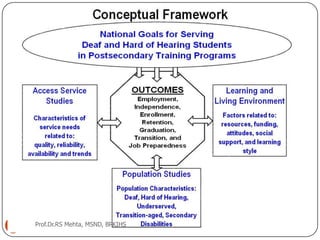
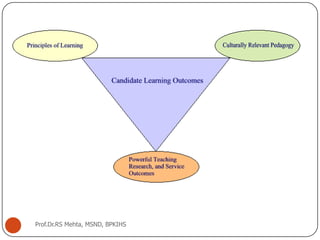
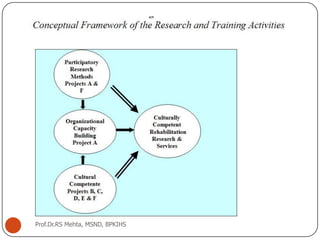
Examples:
Prof.Dr.RS Mehta, MSND, BPKIHS
Thank You
Prof.Dr.RS Mehta, MSND, BPKIHS

Theoretical & conceptual framework

  • 1.
  • 2.
    Theory Theories are constructedin order to explain, predict and master phenomena (e.g. relationships, events, or the behavior). In many instances we are constructing models of reality. A theory makes generalizations about observations and consists of an interrelated, coherent set of ideas and models.
  • 3.
    A theoretical frameworkis analogous to the frame of the house. Just as the foundation supports a house, a theoretical framework provides a rationale for predictions about the relationships among variables of a research study Prof.Dr.RS Mehta, MSND, BPKIHS
  • 4.
    Theoretical Framework What isthe central concept(s) integral to the study? Connecting the study to theory: basic research Prof.Dr.RS Mehta, MSND, BPKIHS
  • 5.
    5 THEORETICAL FRAMEWORK AND RESEARCHMETHODOLOGY Theoretical Framework  Identify the variables investigated in the study.  Illustrate how the variables interact with each other as hypothesised in the research by the aid of diagram/s (if possible). Prof.Dr.RS Mehta, MSND, BPKIHS
  • 6.
    Theory  Provides patternsfor the interpretation of data  Links one study to another  Supplies frameworks within which concepts and variables acquire special significance  Allows us to interpret the larger meaning of our findings for ourselves and others Prof.Dr.RS Mehta, MSND, BPKIHS
  • 7.
    The Conceptual Framework… provides direction for  programs  courses  teaching  candidate performance  scholarship  service  unit accountability Prof.Dr.RS Mehta, MSND, BPKIHS
  • 8.
    Fishbone Diagram To findout problem of study: Problem Statement Policies Materials People Process Technology Prof.Dr.RS Mehta, MSND, BPKIHS
  • 9.
    The Conceptual Framework… is  knowledge-based  articulated  shared  coherent  consistent with the unit and/or institutional mission  continuously evaluated Prof.Dr.RS Mehta, MSND, BPKIHS
  • 10.
    What is aconceptual framework?  A written or visual presentation that: – “explains either graphically, or in narrative form, the main things to be studied – the key factors, concepts or variables - – and the presumed relationship among them”. Prof.Dr.RS Mehta, MSND, BPKIHS
  • 11.
    What specific formsmight a conceptual framework take?  The possibilities include: – Flow charts. – Tree diagrams. – Shape based diagrams – triangles, concentric circles, overlapping circles. – Mind maps. – Software systems. Prof.Dr.RS Mehta, MSND, BPKIHS
  • 12.
    A ‘flow chart’of innovation decision making PRIOR CONDITIONS 1. Previous practice 2. Felt needs/problems 3. Innovativeness 4. Norms of the social system COMMUNICATION CHANNELS 1. KNOWLEDGE 2. PERSUASION 4. IMPLEMENTATION3. DECISION 1. Adoption 2. Rejection Confirmed Adoption Later Adoption Discontinuance Continued Rejection Perceived characteristics of innovation 1. Relative advantage 2. Compatibility 3. Complexity 4. Trialability 5. Observability Observations of the decision making unit 1. Socio-economic characteristics 2. Personality variables 3. Communication behaviour 5. CONFIRMATION Rogers 2003 Prof.Dr.RS Mehta, MSND, BPKIHS
  • 13.
    A ‘tree chart’of changing consumer behaviour C u s to m e rs C h a n g i n g c u s to m e rs E x p e rie n c e V a lu e s L i fe s ty le s D e m o g ra p h ic s P ro d u c t e x p e c ta ti o n s Q u a l ity P ric e P u rc h a s in g In fo rm a tio n P h y s ic a l S e rv ic e E a s e F le x i b ility R a n g e In d i v id u a lity H e a lth A g e c o m p o s iti o n S e c u rity L o s s o f lo y a lty V a lu e Im a g e P rio ritie s E x p e c ta tio n s K n o w le d g e A c c e s s C u rre n c y V a rie ty Prof.Dr.RS Mehta, MSND, BPKIHS
  • 14.
    A ‘triangle’ ofneeds Self-actualization Esteem Affiliation Security Physiological Maslow 1954 Prof.Dr.RS Mehta, MSND, BPKIHS
  • 15.
    A mind mapof cruise travel and impacts T r a v e l T yp e s o f t o u r is t s / t r a v e lle r s T yp e s o f t o u r is m Ar e c r u is e r s t o u r is t s o r n o t ? S O C IAL C O N T IN G E N C Y T H E O R Y W h o g e t s t o g o ? H e g e m o n y c la s s In d iv id u a l n o t p a r t o f m a s s P O S T S T R U C T U R AL IS M F o u c a u lt - f r e e d o m a n d c o n t r o l K n o w le d g e - p o w e r s P O S T M O D E R N IS M B a u d s ila r d - H yp e s r e a lit y G o f f m a n - f r o n t s t a g e / B a c k s t a g e a u t h e n t ic it y Culture/ places People Environment C r u is e r im p a c t s Ad v a n t a g e s D is a d v a n t a g e s W h y n o t m a s s t o u r is m W h a t t yp e o f im p a c t a n d w h a t t yp e o f t o u r is t ? Jennings 2001 Prof.Dr.RS Mehta, MSND, BPKIHS
  • 16.
    The Use ofa Theoretical Framework as a Guide in a Research Study The theoretical framework plays an important role in guiding the entire process of the research study  Theories are constructed in order to explain, predict and master phenomena (e.g. relationships, events, or the behavior). In many instances we are constructing models of reality.  A theory makes generalizations about observations and consists of an interrelated, coherent set of ideas and models. Prof.Dr.RS Mehta, MSND, BPKIHS
  • 17.
    The Use ofa Theoretical Framework as a Guide in a Research Study If the framework is logically sound and substantiated by previous research studies, there is a strong possibility that the predictions or hypotheses evolving from that framework will be supported In some cases, a theoretical rationale in inappropriately used. e.g. a theory is designed to explain a particular behavior in infants may not be appropriate for the study of those behaviors in adults Prof.Dr.RS Mehta, MSND, BPKIHS
  • 18.
    Formulating the TheoreticalFramework Purpose: • It helps the researcher see clearly the variables of the study; • It can provide him with a general framework for data analysis; • It is essential in preparing a research proposal using descriptive and experimental methods. Prof.Dr.RS Mehta, MSND, BPKIHS
  • 19.
    conceptual framework  Aconceptual framework is used in research to outline possible courses of action or to present a preferred approach to an idea or thought. Prof.Dr.RS Mehta, MSND, BPKIHS
  • 20.
    How to Developa Theoretical Framework or conceptual framework 1. Select concepts a concept is an image or symbolic representation of an abstract idea. e.g. health, pain, intelligence … 2. Identify the interrelationships among concepts Prof.Dr.RS Mehta, MSND, BPKIHS
  • 21.
    How to Developa Theoretical Framework… 3.Formulating definitions: concepts must be clearly defined A. Conceptual definition: conveys the general meaning of the concept B. Operational definition: adds another dimension to the conceptual definition by delineating the procedures or operations required to measure the concept Some concepts are easily defined in operational terms, e.g. pulse, other concepts are more difficult to define operationally, e.g. coping Prof.Dr.RS Mehta, MSND, BPKIHS
  • 22.
    4. Formulating thetheoretical rationale  Through the literature review, an investigator becomes aware of or confirms identified theoretical connections between variables  In evaluating the formulation of the theoretical rationale, the internal structures, such as concepts and their definitions, should have clarity and continuity, and the approach to understanding phenomena, whether inductive or deductive, should be logical Prof.Dr.RS Mehta, MSND, BPKIHS
  • 23.
    Contribution of NursingTheories or Frameworks to Research When developing a theoretical framework for nursing research studies, knowledge is acquired through: Disciplines other than nursing and borrowed for the purpose of answering nursing questions Identifying and asking questions about phenomena that are unique to nursing Prof.Dr.RS Mehta, MSND, BPKIHS
  • 24.
    Contribution of NursingTheories or Frameworks to Research Theories unique to nursing help nursing define how it is different from other disciplines The central phenomena of interest to nursing are persons, environment, health & nursing Prof.Dr.RS Mehta, MSND, BPKIHS
  • 25.
  • 26.
  • 27.
  • 28.
  • 29.
  • 30.
  • 31.
  • 32.