RESEARCH PROBLEM, HYPOTHESIS & CONCEPTUAL FRAME WORK Meghana Sudhir
Introduction   Formulation of the research problem and developing hypothesis are key preliminary steps in the research process. A problem is a question posed for solutions.
Sources of problems There are three main sources for locating a problem or topic.  They are Experience  :  The nurses’ every day experience provides a rich supply of problems for investigations. For the beginning researchers in particular experience is often the most compelling source for topics .
Sources of problems:   Nursing literature:   Ideal for research project; often come from reading the nursing literature.  The beginning nurse researcher would project from regularly reading the nursing research journal ; may help the investigator to familiarize with the wordings of research problems and active conduct of research studies.
Sources of problems: Theory :  The third major source of problems lies in the  theoretical system  and conceptual schemes which have been developed in nursing and other related disciplines. If a  researcher decides to base a research project  exclusively on a  theory, deduction from the theory must be developed. Example : Levine’s (1969) conceptual frame work on nursing which  concerns conservation. Seley’s (1956) theory of adaptations to stress.
Steps in Developing and Refining  Research Problems Selecting a topic  Narrowing the topic  Evaluating research problem
The development of a research problem is essentially a creative process dependent upon imagination, insight and ingenuity. Developing and Refining  Research Problems
Developing and Refining Research Problems Researchers generally begin with an interest in some broad topic area such as pain management, family communication patterns, self-care patterns of elders or management of urinary incontinence.
Developing and Refining Research Problems Usually the research focuses on the dependent variable of the study, the variable that will be predicted or explained through its relationship to the independent variable.
Brainstorming with teachers, advisors or colleagues may provide valuable feedback that helps the researcher to focus on a specific problem area.
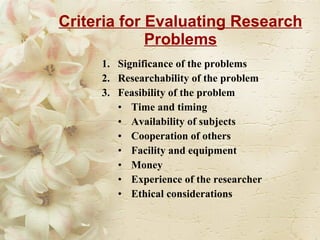
Criteria for Evaluating Research Problems Significance of the problems Researchability of the problem  Feasibility of the problem Time and timing Availability of subjects Cooperation of others Facility and equipment Money Experience of the researcher Ethical considerations
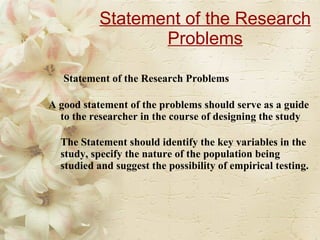
Statement of the Research Problems   Statement of the Research Problems A good statement of the problems should serve as a guide to the researcher in the course of designing the study  The Statement should identify the key variables in the study, specify the nature of the population being studied and suggest the possibility of empirical testing.
The Final Problem Statement A problem may be written in  Declarative form  or  Interrogative form.
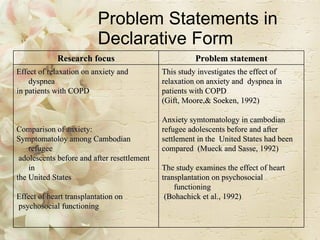
Problem Statements in Declarative Form Research focus Problem statement Effect of relaxation on anxiety and dyspnea  in patients with COPD Comparison of anxiety:  Symptomatoloy among Cambodian refugee adolescents before and after resettlement in  the United States  Effect of heart transplantation on psychosocial functioning  This study investigates the effect of  relaxation on anxiety and  dyspnea in  patients with COPD  (Gift, Moore,& Soeken, 1992) Anxiety symtomatology in cambodian  refugee adolescents before and after  settlement in the  United States had been  compared  (Mueck and Sasse, 1992) The study examines the effect of heart  transplantation on psychosocial functioning (Bohachick et al., 1992)
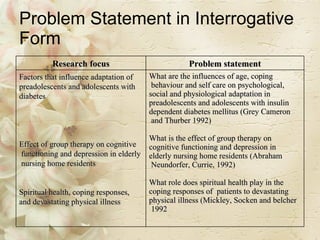
Problem Statement in Interrogative Form Research focus Problem statement Factors that influence adaptation of  preadolescents and adolescents with  diabetes Effect of group therapy on cognitive functioning and depression in elderly nursing home residents  Spiritual health, coping responses,  and devastating physical illness  What are the influences of age, coping behaviour and self care on psychological,  social and physiological adaptation in  preadolescents and adolescents with insulin  dependent diabetes mellitus (Grey Cameron and Thurber 1992) What is the effect of group therapy on  cognitive functioning and depression in  elderly nursing home residents (Abraham Neundorfer, Currie, 1992) What role does spiritual health play in the  coping responses of  patients to devastating  physical illness (Mickley, Socken and belcher 1992
Formulation of objectives The purpose must always indicate the focus of the study.  It is specific but it may be more or less comprehensive,  the purpose must indicate exactly what the investigator intends to do to answer the questions.  It should include how data are to be collected or what is observed and the setting of the study.
Statement of the problem Example “ A study to compare the knowledge and practice of post natal mothers regarding neonatal care from selected urban and rural settings of Bangalore”.
Objectives To assess the knowledge of postnatal mothers regarding the neonatal care To describe the practices followed in their family regarding neonatal care To determine the association between knowledge and practices of neonatal care To determine association of knowledge with selected variable To compare the knowledge and practice of neonatal care between urban and rural mother
Clarifying the objectives (a). Focus on objective one  Knowledge of postnatal mothers regarding neonatal care, breast feeding, cord care, prevention of infection and maintenance of warmth (b). Focus on objective two  Practice of family regarding neonatal care  (c). Selected characteristic of respondent   Age, Religion, Education, Occupation, Type of  family, Income etc.
HYPOTHESIS A hypothesis is a prediction about the relationship between two or more variables.  A hypothesis thus translates a quantitative research question in to a precise prediction of expected outcomes. The hypothesis is an important part of the scientific method and research studies.
Characteristics of a good hypothesis Testable Logical Directly related to the research problem Represents a single unit or subject of the problem Factually or theoretically based  States relationship between variables Sets the limits of the study Stated in such a form that it can be accepted or rejected A hypothesis is composed of an independent variable (cause)  and a dependent variable (effect)
The derivation of hypothesis There are two types of developing hypothesis  Induction  Deduction  -  Constitute the intellectual machinery involved in deriving hypothesis.
Inductive hypothesis  is a generalization based on observed relationships.  Researchers observe certain patterns, trends or associations  among phenomena and then use the observations  as a basis for predictions.
Deductive hypotheses  Through deductive reasoning, a researcher can develop hypotheses based on general theoretical principles. Deductive reasoning have as a starting point theories that are applied to particular situations.
Types of Hypotheses
Simple Vs Complex Hypotheses Simple   hypothesis is a hypothesis that expresses an expected relationship between one independent and one dependent variable.  Complex   hypothesis is a prediction of a relationship between two (or more) independent variables and two (or more) dependent variables. Complex hypotheses some times are referred to as  multivariate hypotheses  because they involve multiple variables.
Directional Vs Non-directional Hypotheses Directional   hypothesis is one that specifies not only the existence but the expected direction of the relationship between variables. Non-directional  hypothesis by contrast does not stipulate the direction of the relationship.
Research Vs Null Hypotheses  Hypotheses are sometimes classified as being either research  hypotheses or null hypotheses. Research hypotheses  also referred to as substantive,  declarative, or scientific hypotheses, are statements of  expected relationships between variables  Null hypotheses  or statistical hypotheses state that there is  no relationship between the independent and dependent  variables.
Hypothesis Testing Hypotheses are formally tested  through statistical  procedures. Researchers seek to determine through statistics whether their hypotheses have a high probability of being correct. However, hypotheses are  never proved through hypothesis testing. Rather, they are accepted or supported .
An operational definition of a concept specifies the operations that researchers must perform to collect the required information. OPERATIONAL DEFINITION
CONCEPTUAL FRAMEWORK
Concepts   are mental images or ideas relating to  phenomena or objects that share common properties.  Fact   is defined as any event or phenomenon that can be  observed and on which the observer agrees. Principles   state a relationship between two facts that  may be used to explain, guide and predict action. A   theory   is used in the broad sense to refer to an abstraction  which summarizes and explains phenomena. The conceptualization part of the research process might well be  called the thinking part of the research while the factual part of the research process is more related to the doing aspect.
PURPOSES OF THEORIES AND CONCEPTUAL MODELS To make research findings meaningful and generalizable. Efficient mechanisms for drawing together accumulated facts, sometimes from separate and isolated investigations. Guide a researcher’s understanding of not only the what of natural phenomena but also the ‘why’ of their occurrence. Theories provide a basis for predicting the occurrence of phenomena. Prediction, in turn, has implications for the control of the phenomena. Help to stimulate research and the extension of knowledge by providing both direction and impetus.
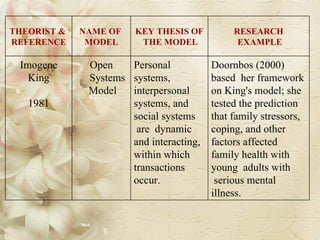
THEORIST &  REFERENCE NAME OF  MODEL KEY THESIS OF THE MODEL RESEARCH EXAMPLE Imogene King 1981 Open Systems Model Personal  systems, interpersonal  systems, and  social systems are  dynamic  and interacting,  within which  transactions  occur.  Doornbos (2000)  based  her framework on King's model; she  tested the prediction  that family stressors,  coping, and other  factors affected  family health with  young  adults with serious mental  illness.
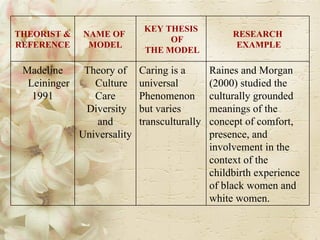
THEORIST &  REFERENCE NAME OF  MODEL KEY THESIS OF THE MODEL RESEARCH EXAMPLE Madeline Leininger 1991 Theory of Culture Care Diversity and  Universality Caring is a  universal  Phenomenon but varies  transculturally  Raines and Morgan  (2000) studied the  culturally grounded  meanings of the  concept of comfort,  presence, and  involvement in the  context of the  childbirth experience  of black women and  white women.
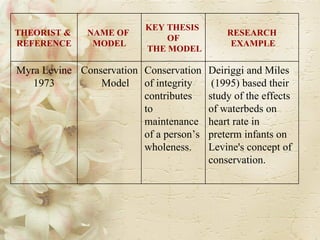
THEORIST &  REFERENCE NAME OF  MODEL KEY THESIS  OF THE MODEL RESEARCH EXAMPLE Myra Levine 1973 Conservation Model Conservation  of integrity  contributes  to  maintenance  of a person’s  wholeness.  Deiriggi and Miles (1995) based their  study of the effects  of waterbeds on  heart rate in  preterm infants on  Levine's concept of  conservation.
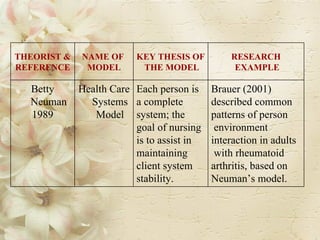
THEORIST &  REFERENCE NAME OF  MODEL KEY THESIS OF THE MODEL RESEARCH EXAMPLE Betty Neuman 1989 Health Care Systems Model Each person is  a complete  system; the  goal of nursing  is to assist in  maintaining  client system stability.  Brauer (2001)  described common  patterns of person environment  interaction in adults with rheumatoid  arthritis, based on  Neuman’s model.
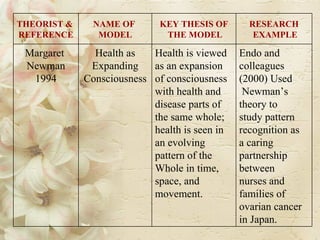
THEORIST &  REFERENCE NAME OF  MODEL KEY THESIS OF THE MODEL RESEARCH EXAMPLE Margaret  Newman 1994 Health as Expanding  Consciousness Health is viewed  as an expansion  of consciousness  with health and  disease parts of  the same whole; health is seen in  an evolving  pattern of the  Whole in time, space, and movement. Endo and colleagues  (2000) Used Newman’s  theory to  study pattern  recognition as  a caring  partnership  between  nurses and  families of  ovarian cancer in Japan.
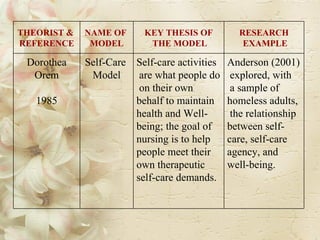
THEORIST &  REFERENCE NAME OF  MODEL KEY THESIS OF THE MODEL RESEARCH EXAMPLE Dorothea Orem 1985 Self-Care  Model Self-care activities are what people do on their own  behalf to maintain  health and Well- being; the goal of  nursing is to help  people meet their  own therapeutic  self-care demands.  Anderson (2001) explored, with a sample of  homeless adults, the relationship  between self- care, self-care  agency, and  well-being.
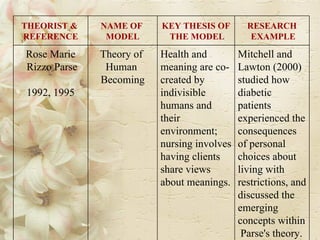
THEORIST &  REFERENCE NAME OF  MODEL KEY THESIS OF THE MODEL RESEARCH EXAMPLE Rose Marie Rizzo Parse 1992, 1995 Theory of  Human  Becoming Health and  meaning are co- created by  indivisible  humans and  their  environment;  nursing involves having clients  share views  about meanings.  Mitchell and  Lawton (2000) studied how  diabetic  patients  experienced the consequences  of personal  choices about  living with  restrictions, and discussed the  emerging  concepts within Parse's theory.
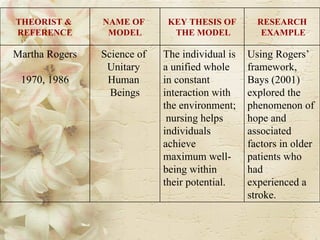
THEORIST &  REFERENCE NAME OF  MODEL KEY THESIS OF THE MODEL RESEARCH EXAMPLE Martha Rogers 1970, 1986 Science of  Unitary  Human  Beings The individual is a unified whole  in constant  interaction with  the environment; nursing helps  individuals  achieve  maximum well- being within  their potential.  Using Rogers’  framework,  Bays (2001) explored the  phenomenon of  hope and  associated  factors in older patients who  had  experienced a  stroke.
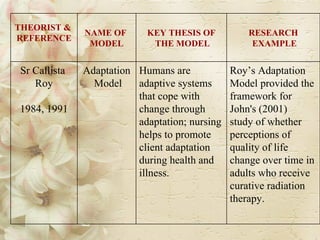
THEORIST &  REFERENCE NAME OF  MODEL KEY THESIS OF THE MODEL RESEARCH EXAMPLE Sr Callista  Roy 1984, 1991 Adaptation Model Humans are  adaptive systems  that cope with  change through  adaptation; nursing  helps to promote  client adaptation  during health and  illness.  Roy’s Adaptation  Model provided the  framework for  John's (2001) study of whether perceptions of  quality of life change over time in adults who receive curative radiation therapy.
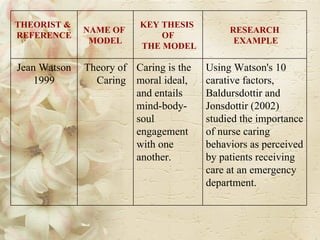
THEORIST &  REFERENCE NAME OF  MODEL KEY THESIS  OF THE MODEL RESEARCH EXAMPLE Jean Watson 1999 Theory of Caring Caring is the moral ideal, and entails  mind-body- soul  engagement  with one  another. Using Watson's 10  carative factors,  Baldursdottir and  Jonsdottir (2002)  studied the importance of nurse caring  behaviors as perceived by patients receiving care at an emergency  department.
THANK YOU !

Research problem, hypothesis & conceptual framework

  • 1.
    RESEARCH PROBLEM, HYPOTHESIS& CONCEPTUAL FRAME WORK Meghana Sudhir
  • 2.
    Introduction Formulation of the research problem and developing hypothesis are key preliminary steps in the research process. A problem is a question posed for solutions.
  • 3.
    Sources of problemsThere are three main sources for locating a problem or topic. They are Experience : The nurses’ every day experience provides a rich supply of problems for investigations. For the beginning researchers in particular experience is often the most compelling source for topics .
  • 4.
    Sources of problems: Nursing literature: Ideal for research project; often come from reading the nursing literature. The beginning nurse researcher would project from regularly reading the nursing research journal ; may help the investigator to familiarize with the wordings of research problems and active conduct of research studies.
  • 5.
    Sources of problems:Theory : The third major source of problems lies in the theoretical system and conceptual schemes which have been developed in nursing and other related disciplines. If a researcher decides to base a research project exclusively on a theory, deduction from the theory must be developed. Example : Levine’s (1969) conceptual frame work on nursing which concerns conservation. Seley’s (1956) theory of adaptations to stress.
  • 6.
    Steps in Developingand Refining Research Problems Selecting a topic Narrowing the topic Evaluating research problem
  • 7.
    The development ofa research problem is essentially a creative process dependent upon imagination, insight and ingenuity. Developing and Refining Research Problems
  • 8.
    Developing and RefiningResearch Problems Researchers generally begin with an interest in some broad topic area such as pain management, family communication patterns, self-care patterns of elders or management of urinary incontinence.
  • 9.
    Developing and RefiningResearch Problems Usually the research focuses on the dependent variable of the study, the variable that will be predicted or explained through its relationship to the independent variable.
  • 10.
    Brainstorming with teachers,advisors or colleagues may provide valuable feedback that helps the researcher to focus on a specific problem area.
  • 11.
    Criteria for EvaluatingResearch Problems Significance of the problems Researchability of the problem Feasibility of the problem Time and timing Availability of subjects Cooperation of others Facility and equipment Money Experience of the researcher Ethical considerations
  • 12.
    Statement of theResearch Problems Statement of the Research Problems A good statement of the problems should serve as a guide to the researcher in the course of designing the study The Statement should identify the key variables in the study, specify the nature of the population being studied and suggest the possibility of empirical testing.
  • 13.
    The Final ProblemStatement A problem may be written in Declarative form or Interrogative form.
  • 14.
    Problem Statements inDeclarative Form Research focus Problem statement Effect of relaxation on anxiety and dyspnea in patients with COPD Comparison of anxiety: Symptomatoloy among Cambodian refugee adolescents before and after resettlement in the United States Effect of heart transplantation on psychosocial functioning This study investigates the effect of relaxation on anxiety and dyspnea in patients with COPD (Gift, Moore,& Soeken, 1992) Anxiety symtomatology in cambodian refugee adolescents before and after settlement in the United States had been compared (Mueck and Sasse, 1992) The study examines the effect of heart transplantation on psychosocial functioning (Bohachick et al., 1992)
  • 15.
    Problem Statement inInterrogative Form Research focus Problem statement Factors that influence adaptation of preadolescents and adolescents with diabetes Effect of group therapy on cognitive functioning and depression in elderly nursing home residents Spiritual health, coping responses, and devastating physical illness What are the influences of age, coping behaviour and self care on psychological, social and physiological adaptation in preadolescents and adolescents with insulin dependent diabetes mellitus (Grey Cameron and Thurber 1992) What is the effect of group therapy on cognitive functioning and depression in elderly nursing home residents (Abraham Neundorfer, Currie, 1992) What role does spiritual health play in the coping responses of patients to devastating physical illness (Mickley, Socken and belcher 1992
  • 16.
    Formulation of objectivesThe purpose must always indicate the focus of the study. It is specific but it may be more or less comprehensive, the purpose must indicate exactly what the investigator intends to do to answer the questions. It should include how data are to be collected or what is observed and the setting of the study.
  • 17.
    Statement of theproblem Example “ A study to compare the knowledge and practice of post natal mothers regarding neonatal care from selected urban and rural settings of Bangalore”.
  • 18.
    Objectives To assessthe knowledge of postnatal mothers regarding the neonatal care To describe the practices followed in their family regarding neonatal care To determine the association between knowledge and practices of neonatal care To determine association of knowledge with selected variable To compare the knowledge and practice of neonatal care between urban and rural mother
  • 19.
    Clarifying the objectives(a). Focus on objective one Knowledge of postnatal mothers regarding neonatal care, breast feeding, cord care, prevention of infection and maintenance of warmth (b). Focus on objective two Practice of family regarding neonatal care (c). Selected characteristic of respondent Age, Religion, Education, Occupation, Type of family, Income etc.
  • 20.
    HYPOTHESIS A hypothesisis a prediction about the relationship between two or more variables. A hypothesis thus translates a quantitative research question in to a precise prediction of expected outcomes. The hypothesis is an important part of the scientific method and research studies.
  • 21.
    Characteristics of agood hypothesis Testable Logical Directly related to the research problem Represents a single unit or subject of the problem Factually or theoretically based States relationship between variables Sets the limits of the study Stated in such a form that it can be accepted or rejected A hypothesis is composed of an independent variable (cause) and a dependent variable (effect)
  • 22.
    The derivation ofhypothesis There are two types of developing hypothesis Induction Deduction - Constitute the intellectual machinery involved in deriving hypothesis.
  • 23.
    Inductive hypothesis is a generalization based on observed relationships. Researchers observe certain patterns, trends or associations among phenomena and then use the observations as a basis for predictions.
  • 24.
    Deductive hypotheses Through deductive reasoning, a researcher can develop hypotheses based on general theoretical principles. Deductive reasoning have as a starting point theories that are applied to particular situations.
  • 25.
  • 26.
    Simple Vs ComplexHypotheses Simple hypothesis is a hypothesis that expresses an expected relationship between one independent and one dependent variable. Complex hypothesis is a prediction of a relationship between two (or more) independent variables and two (or more) dependent variables. Complex hypotheses some times are referred to as multivariate hypotheses because they involve multiple variables.
  • 27.
    Directional Vs Non-directionalHypotheses Directional hypothesis is one that specifies not only the existence but the expected direction of the relationship between variables. Non-directional hypothesis by contrast does not stipulate the direction of the relationship.
  • 28.
    Research Vs NullHypotheses Hypotheses are sometimes classified as being either research hypotheses or null hypotheses. Research hypotheses also referred to as substantive, declarative, or scientific hypotheses, are statements of expected relationships between variables Null hypotheses or statistical hypotheses state that there is no relationship between the independent and dependent variables.
  • 29.
    Hypothesis Testing Hypothesesare formally tested through statistical procedures. Researchers seek to determine through statistics whether their hypotheses have a high probability of being correct. However, hypotheses are never proved through hypothesis testing. Rather, they are accepted or supported .
  • 30.
    An operational definitionof a concept specifies the operations that researchers must perform to collect the required information. OPERATIONAL DEFINITION
  • 31.
  • 32.
    Concepts are mental images or ideas relating to phenomena or objects that share common properties. Fact is defined as any event or phenomenon that can be observed and on which the observer agrees. Principles state a relationship between two facts that may be used to explain, guide and predict action. A theory is used in the broad sense to refer to an abstraction which summarizes and explains phenomena. The conceptualization part of the research process might well be called the thinking part of the research while the factual part of the research process is more related to the doing aspect.
  • 33.
    PURPOSES OF THEORIESAND CONCEPTUAL MODELS To make research findings meaningful and generalizable. Efficient mechanisms for drawing together accumulated facts, sometimes from separate and isolated investigations. Guide a researcher’s understanding of not only the what of natural phenomena but also the ‘why’ of their occurrence. Theories provide a basis for predicting the occurrence of phenomena. Prediction, in turn, has implications for the control of the phenomena. Help to stimulate research and the extension of knowledge by providing both direction and impetus.
  • 34.
    THEORIST & REFERENCE NAME OF MODEL KEY THESIS OF THE MODEL RESEARCH EXAMPLE Imogene King 1981 Open Systems Model Personal systems, interpersonal systems, and social systems are dynamic and interacting, within which transactions occur. Doornbos (2000) based her framework on King's model; she tested the prediction that family stressors, coping, and other factors affected family health with young adults with serious mental illness.
  • 35.
    THEORIST & REFERENCE NAME OF MODEL KEY THESIS OF THE MODEL RESEARCH EXAMPLE Madeline Leininger 1991 Theory of Culture Care Diversity and Universality Caring is a universal Phenomenon but varies transculturally Raines and Morgan (2000) studied the culturally grounded meanings of the concept of comfort, presence, and involvement in the context of the childbirth experience of black women and white women.
  • 36.
    THEORIST & REFERENCE NAME OF MODEL KEY THESIS OF THE MODEL RESEARCH EXAMPLE Myra Levine 1973 Conservation Model Conservation of integrity contributes to maintenance of a person’s wholeness. Deiriggi and Miles (1995) based their study of the effects of waterbeds on heart rate in preterm infants on Levine's concept of conservation.
  • 37.
    THEORIST & REFERENCE NAME OF MODEL KEY THESIS OF THE MODEL RESEARCH EXAMPLE Betty Neuman 1989 Health Care Systems Model Each person is a complete system; the goal of nursing is to assist in maintaining client system stability. Brauer (2001) described common patterns of person environment interaction in adults with rheumatoid arthritis, based on Neuman’s model.
  • 38.
    THEORIST & REFERENCE NAME OF MODEL KEY THESIS OF THE MODEL RESEARCH EXAMPLE Margaret Newman 1994 Health as Expanding Consciousness Health is viewed as an expansion of consciousness with health and disease parts of the same whole; health is seen in an evolving pattern of the Whole in time, space, and movement. Endo and colleagues (2000) Used Newman’s theory to study pattern recognition as a caring partnership between nurses and families of ovarian cancer in Japan.
  • 39.
    THEORIST & REFERENCE NAME OF MODEL KEY THESIS OF THE MODEL RESEARCH EXAMPLE Dorothea Orem 1985 Self-Care Model Self-care activities are what people do on their own behalf to maintain health and Well- being; the goal of nursing is to help people meet their own therapeutic self-care demands. Anderson (2001) explored, with a sample of homeless adults, the relationship between self- care, self-care agency, and well-being.
  • 40.
    THEORIST & REFERENCE NAME OF MODEL KEY THESIS OF THE MODEL RESEARCH EXAMPLE Rose Marie Rizzo Parse 1992, 1995 Theory of Human Becoming Health and meaning are co- created by indivisible humans and their environment; nursing involves having clients share views about meanings. Mitchell and Lawton (2000) studied how diabetic patients experienced the consequences of personal choices about living with restrictions, and discussed the emerging concepts within Parse's theory.
  • 41.
    THEORIST & REFERENCE NAME OF MODEL KEY THESIS OF THE MODEL RESEARCH EXAMPLE Martha Rogers 1970, 1986 Science of Unitary Human Beings The individual is a unified whole in constant interaction with the environment; nursing helps individuals achieve maximum well- being within their potential. Using Rogers’ framework, Bays (2001) explored the phenomenon of hope and associated factors in older patients who had experienced a stroke.
  • 42.
    THEORIST & REFERENCE NAME OF MODEL KEY THESIS OF THE MODEL RESEARCH EXAMPLE Sr Callista Roy 1984, 1991 Adaptation Model Humans are adaptive systems that cope with change through adaptation; nursing helps to promote client adaptation during health and illness. Roy’s Adaptation Model provided the framework for John's (2001) study of whether perceptions of quality of life change over time in adults who receive curative radiation therapy.
  • 43.
    THEORIST & REFERENCE NAME OF MODEL KEY THESIS OF THE MODEL RESEARCH EXAMPLE Jean Watson 1999 Theory of Caring Caring is the moral ideal, and entails mind-body- soul engagement with one another. Using Watson's 10 carative factors, Baldursdottir and Jonsdottir (2002) studied the importance of nurse caring behaviors as perceived by patients receiving care at an emergency department.
  • 44.