THEORETICAL
AND
CONCEPTUAL FRAMEWORK
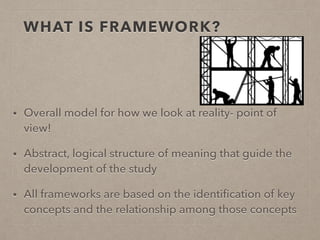
WHAT IS FRAMEWORK?
• Overall model for how we look at reality- point of
view!
• Abstract, logical structure of meaning that guide the
development of the study
• All frameworks are based on the identification of key
concepts and the relationship among those concepts
UNDERSTANDING THE KEY
CONCEPTS
• Research- a systematic controlled, empirical and critical
investigation of natual/social phenomena
• Theory- a set of interrelated concepts which structure a
systematic view of phenomena for the purpose of explaining or
predicting
• Concepts- an image or symbolic representation of an abstract
idea
• Research framework- a structure that provides guidance for the
researcher as study questions are fine-tuned, methods for
measuring variables are selected and analysed are planned
THEORETICAL FRAMEWORK
• Derived from theory
• The theory that a researcher chooses to guide him/her
research
• It is the application of theory or a set of concepts
drawn from one and the same theory to offer an
explanation of an event or shed some light on a
particular phenomenon or research problem
• Deductively applied
CONCEPTUAL FRAMEWORK
• Derived from concepts
• If research problem cannot meaningfully be researched in
reference to only one theory or concepts resident within one
theory
• The researcher synthesise the existing views in the literature
concerning a given situation- both theoretical and empirical
findings
• The synthesis is called conceptual framework- representing an
integrated way of looking at problem
• It is the end result of bringing together a number of related
concepts to explain or predict given even or give a broader
understanding of the phenomenon of interest or research
problem
DIFFERENCE BETWEEN CONCEPTUAL
AND THEORETICAL FRAMEWORK
Table 1: A summary of the conceptual differences between conceptual and theoretical trameworks
Variable Conceptual framework Theoretical framework
Genesis (a) Created by the researcher from a variety Evolves, or ‘takes shape’, from reviewed
of conceptual or theoretical perspectives;(b) literature and/or the data collected.
Adopted / adapted from a pre-existing theory
or theoretical perspective.
Purpose (a) Helps the researcher see clearly the (a) Helps the researcher see clearly the main
main variables and concepts in a given variables and concepts in a given study;
study;
(b) Provides the researcher with a (b) Provides the researcher with a general
general approach (methodology – research pproach (methodology – research design,
design, target population and research a target population and research sample,
sample, data collection & analysis); data collection & analysis); and
(c) Guides the researcher in the collection, (c) Guides the researcher in the collection,
interpretation and explanation of the data, interpretation and explanation of the data.
where no dominant theoretical
perspective exists
(d) Guides future research – specifically
where the conceptual framework integrates
literature review and field data.
Conceptual Synthesis of relevant concepts. Application of a theory as a whole
Meaning or in part.
Process Underlying (a) Mainly inductive, as in social sciences Mainly deductive, as in the natural sciences
Review of where research problems cannot ordinarily where hypothesis testing takes place to
Literature be explained by one theoretical perspective; verify the ‘power’ of a theory.
(b) Some social science research also gets
driven by theories, but theories in the social
sciences tend not to have the same ‘power’
as those in the natural sciences.
Methodological (a)May be located in both quantitative and (a) Located mainly in the quantitative
Approach qualitative research paradigms; increasingly, research paradigm;
mixed-methods approaches are recommended;
(b) Data mostly collected through both (b) Data collected mainly through
empirical and descriptive survey instruments, experimental designs, empirical surveys
interviews and direct observations – hence, and tests;
a preponderance of qualitative data; (c) Efforts made to standardize context, or
(c) Strong on consideration of context. else ignore it.
Scope of Limited to specific research problem and Wider application beyond the current
Application or context. research problem and context.
DIFFERENCE BETWEEN CONCEPTUAL AND THEORETICAL FRAMEWORK
RELEVANCE
• Help the researcher see clearly the main variables and
Concepts in a given study
• To provide with a general approach (methodology-
research design, target population and research sample,
data collection and analysis)
• Guide the researcher in data collection, interpretation and
explanation
THE SPECTACLES TO SEE THE WORLD, AT THE SAME TIME,
PLACING BOUNDARIES ON ONE’S VISION AND HORIZONS
REFERENCE
• Imenda, Sitwala (2014) “is There a Conceptual
Difference between Theoretical and Conceptual
Frameworks”, Journal of Social Science, 38 (2),
185-195

Social Research: Theoretical and Conceptual Framework

  • 1.
  • 2.
    WHAT IS FRAMEWORK? •Overall model for how we look at reality- point of view! • Abstract, logical structure of meaning that guide the development of the study • All frameworks are based on the identification of key concepts and the relationship among those concepts
  • 3.
    UNDERSTANDING THE KEY CONCEPTS •Research- a systematic controlled, empirical and critical investigation of natual/social phenomena • Theory- a set of interrelated concepts which structure a systematic view of phenomena for the purpose of explaining or predicting • Concepts- an image or symbolic representation of an abstract idea • Research framework- a structure that provides guidance for the researcher as study questions are fine-tuned, methods for measuring variables are selected and analysed are planned
  • 4.
    THEORETICAL FRAMEWORK • Derivedfrom theory • The theory that a researcher chooses to guide him/her research • It is the application of theory or a set of concepts drawn from one and the same theory to offer an explanation of an event or shed some light on a particular phenomenon or research problem • Deductively applied
  • 5.
    CONCEPTUAL FRAMEWORK • Derivedfrom concepts • If research problem cannot meaningfully be researched in reference to only one theory or concepts resident within one theory • The researcher synthesise the existing views in the literature concerning a given situation- both theoretical and empirical findings • The synthesis is called conceptual framework- representing an integrated way of looking at problem • It is the end result of bringing together a number of related concepts to explain or predict given even or give a broader understanding of the phenomenon of interest or research problem
  • 6.
    DIFFERENCE BETWEEN CONCEPTUAL ANDTHEORETICAL FRAMEWORK
  • 7.
    Table 1: Asummary of the conceptual differences between conceptual and theoretical trameworks Variable Conceptual framework Theoretical framework Genesis (a) Created by the researcher from a variety Evolves, or ‘takes shape’, from reviewed of conceptual or theoretical perspectives;(b) literature and/or the data collected. Adopted / adapted from a pre-existing theory or theoretical perspective. Purpose (a) Helps the researcher see clearly the (a) Helps the researcher see clearly the main main variables and concepts in a given variables and concepts in a given study; study; (b) Provides the researcher with a (b) Provides the researcher with a general general approach (methodology – research pproach (methodology – research design, design, target population and research a target population and research sample, sample, data collection & analysis); data collection & analysis); and (c) Guides the researcher in the collection, (c) Guides the researcher in the collection, interpretation and explanation of the data, interpretation and explanation of the data. where no dominant theoretical perspective exists (d) Guides future research – specifically where the conceptual framework integrates literature review and field data. Conceptual Synthesis of relevant concepts. Application of a theory as a whole Meaning or in part. Process Underlying (a) Mainly inductive, as in social sciences Mainly deductive, as in the natural sciences Review of where research problems cannot ordinarily where hypothesis testing takes place to Literature be explained by one theoretical perspective; verify the ‘power’ of a theory. (b) Some social science research also gets driven by theories, but theories in the social sciences tend not to have the same ‘power’ as those in the natural sciences. Methodological (a)May be located in both quantitative and (a) Located mainly in the quantitative Approach qualitative research paradigms; increasingly, research paradigm; mixed-methods approaches are recommended; (b) Data mostly collected through both (b) Data collected mainly through empirical and descriptive survey instruments, experimental designs, empirical surveys interviews and direct observations – hence, and tests; a preponderance of qualitative data; (c) Efforts made to standardize context, or (c) Strong on consideration of context. else ignore it. Scope of Limited to specific research problem and Wider application beyond the current Application or context. research problem and context. DIFFERENCE BETWEEN CONCEPTUAL AND THEORETICAL FRAMEWORK
  • 8.
    RELEVANCE • Help theresearcher see clearly the main variables and Concepts in a given study • To provide with a general approach (methodology- research design, target population and research sample, data collection and analysis) • Guide the researcher in data collection, interpretation and explanation THE SPECTACLES TO SEE THE WORLD, AT THE SAME TIME, PLACING BOUNDARIES ON ONE’S VISION AND HORIZONS
  • 9.
    REFERENCE • Imenda, Sitwala(2014) “is There a Conceptual Difference between Theoretical and Conceptual Frameworks”, Journal of Social Science, 38 (2), 185-195