Information Unit - TAO
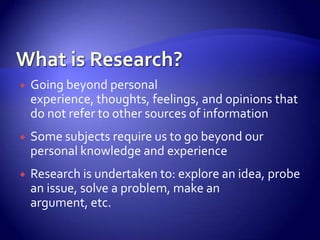
   Going beyond personal
    experience, thoughts, feelings, and opinions that
    do not refer to other sources of information
   Some subjects require us to go beyond our
    personal knowledge and experience
   Research is undertaken to: explore an idea, probe
    an issue, solve a problem, make an
    argument, etc.
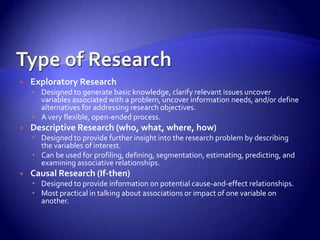
   Exploratory Research
     Designed to generate basic knowledge, clarify relevant issues uncover
      variables associated with a problem, uncover information needs, and/or define
      alternatives for addressing research objectives.
     A very flexible, open-ended process.
   Descriptive Research (who, what, where, how)
     Designed to provide further insight into the research problem by describing
      the variables of interest.
     Can be used for profiling, defining, segmentation, estimating, predicting, and
      examining associative relationships.
   Causal Research (If-then)
     Designed to provide information on potential cause-and-effect relationships.
     Most practical in talking about associations or impact of one variable on
      another.
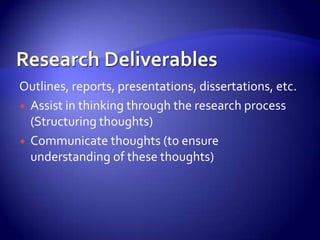
Outlines, reports, presentations, dissertations, etc.
 Assist in thinking through the research process
  (Structuring thoughts)
 Communicate thoughts (to ensure
  understanding of these thoughts)
   Primary (firsthand observation and investigation)
    surveys, interviews, experiments, data
    collection, etc.
   Secondary (other studies and research)
    books, articles, etc.
   Quantitative
    (traditional, positivist, experimental, empirical)
   Qualitative
    (constructive, naturalistic, interpretive, post-
    positivist)
Used to describe the overall framework used to look at
reality. Based on philosophical stand, research model
defines/identifies basic concepts/ideas and describes
reality and conditions to study.
   Quantitative (Deductive process, cause and
    effect, static research design, context
    free, generalizations leading to
    predictions, explanation and understanding, testing
    accuracy and reliability).
   Qualitative (Inductive process, simultaneous shaping
    of factors, emerging design, context bound, theories
    developed for understanding, verification of
    accuracy and reliability).
   Historical
   Comparative
   Descriptive
   Correlation
   Experimental
   Evaluation
   Action
   Ethnogenic
   Politics
   Cultural
   Initial exploration
   Setting the Terms of Reference (TOR)
   Data collection / information gathering
   Organizing information / data
   Analysis
   Results
   Confirmation of results
   Recommendations
   Drafting report
   Presentation

Understanding Research

  • 1.
  • 2.
    Going beyond personal experience, thoughts, feelings, and opinions that do not refer to other sources of information  Some subjects require us to go beyond our personal knowledge and experience  Research is undertaken to: explore an idea, probe an issue, solve a problem, make an argument, etc.
  • 3.
    Exploratory Research  Designed to generate basic knowledge, clarify relevant issues uncover variables associated with a problem, uncover information needs, and/or define alternatives for addressing research objectives.  A very flexible, open-ended process.  Descriptive Research (who, what, where, how)  Designed to provide further insight into the research problem by describing the variables of interest.  Can be used for profiling, defining, segmentation, estimating, predicting, and examining associative relationships.  Causal Research (If-then)  Designed to provide information on potential cause-and-effect relationships.  Most practical in talking about associations or impact of one variable on another.
  • 4.
    Outlines, reports, presentations,dissertations, etc.  Assist in thinking through the research process (Structuring thoughts)  Communicate thoughts (to ensure understanding of these thoughts)
  • 5.
    Primary (firsthand observation and investigation) surveys, interviews, experiments, data collection, etc.  Secondary (other studies and research) books, articles, etc.
  • 6.
    Quantitative (traditional, positivist, experimental, empirical)  Qualitative (constructive, naturalistic, interpretive, post- positivist) Used to describe the overall framework used to look at reality. Based on philosophical stand, research model defines/identifies basic concepts/ideas and describes reality and conditions to study.
  • 7.
    Quantitative (Deductive process, cause and effect, static research design, context free, generalizations leading to predictions, explanation and understanding, testing accuracy and reliability).  Qualitative (Inductive process, simultaneous shaping of factors, emerging design, context bound, theories developed for understanding, verification of accuracy and reliability).
  • 8.
    Historical  Comparative  Descriptive  Correlation  Experimental  Evaluation  Action  Ethnogenic  Politics  Cultural
  • 9.
    Initial exploration  Setting the Terms of Reference (TOR)  Data collection / information gathering  Organizing information / data  Analysis  Results  Confirmation of results  Recommendations  Drafting report  Presentation

Editor's Notes

  • #7 Positivist rejects metaphysics
  • #9 Ethnogeneic: about human races