FE 600a: EDUCATION RESEARCH I
PRESENTATION:
a)Clearly describe quantitative research
b)With examples describe at-least five key characteristics of
Quantitative research
PRESENTERS:
MR. KAYUNI, EMMANUEL (MSc. Ed/BL)
&
MS. KOMBA, FARAJA (MSc.Ed/CH
PRESENTATION OUTLINE
Introduction to Quantitative research
Characteristics of the Quantitative research
INTRODUCTION TO RESEARCH
Research is the scientific and systematic procedures of
collecting, analysing and interpreting data about a phenomenon
for the purpose of solving an immediate problem or creating
knowledge that is generally acceptable.
Research in other way can be considered as diligent search for
the knowledge or truth.
Research can either be Quantitative or Qualitative research or
mixed both Quan and Qual approaches
Selection of the research approach is depending with the nature
of the problem and the researcher’s competence on particular
approach.
QUANTITATIVE RESEARCH
Quantitative research is an objective, systematic
numerical examination and interpretation of data to obtain
information about the world for the purpose of describing
and explaining of the reality of the phenomenon that those
observation reflect.
Quantitative research is based on the Positivist thought
According to positivist, a statement is considered
meaningful and true if it can be verified by sense
experience
Introduction cont…
Quant Research is based on the measurement of quantity or amount
It is applicable to phenomenon that can be explained in terms of
quantity
It is more appropriate to determine the extent of the problem
This approach involves the generation of data in quantitative form
which can be subjected to rigorous Quantitative analysis in formal
and rigid fashion.
CHARACTERISTICS OF QUANTITATIVE RESEARCH
i. Large sample size
ii. Collection of numerical data
iii. Structured research methods
iv. Data analysed using statistical packages which yield
descriptive and inferential statistics
v. Highly reliable and reusable outcome
Large sample size
The first and foremost characteristic of quantitative research is the large
sample size to conduct research.
Quantitative research is done on a large number of audiences to ensure its
reliability.
For-example, in a research done by NECTA titled “Analysis on the
assessment of reading, writing and arithmetic skills (3rs) of standard two
pupils 2019” involved the use of large number of its participant;
In which 524 schools involved in 10 regions. A total of 30,158 pupils were
assessed in Writing Skills whereas a total of 28,816 pupils were assessed
in Reading Skills and Arithmetic Skills.
Collection of numerical data
Data are objective and independent of the people’s
perception
Quantitative researcher assumes that social life can be
measured using numbers.
Methods like likert scale, questionnaires and surveys all
turn respondent’s responses into number that can be used
for statistical analyisis
Structured data collection methods
Structured research methods like questionnaires (close ended), polls, and
surveys are used to conduct quantitative research.
In-depth information about the preferences of the audience can be drawn
using these structured research methods.
Moreover, with the help of the Internet and social media, it is effortless to
reach the vast population irrespective of geographical boundaries.
In addition to this, these research methods are easy to conduct through
offline means.
Also, a participant is only required to fill out the questionnaire and is not
required to be part of the research process for a long time.
Data analysed using statistical packages which yield
descriptive and inferential statistics
In quantitative research data analysis is done after data
collection
Measurement of variables are in form of number
These numbers are entered in the computer and analysed
Most used computer application software for analysing
quantitative data is SPSS (Statistical Package for Social
Sciences).
Tests that can be done when analysing quantitative data
includes
ANOVA, MANOVA, Chi Test, T-test, Z-test, H-W test,
Highly reliable and reusable outcome
The outcome of quantitative research methods is quite
reliable, as participants of the research face close-ended
questions.
Therefore, there are fewer chances of getting vague
information or wrong information from the participants.
Moreover, the Outcome of quantitative research is easy to
understand and explain.
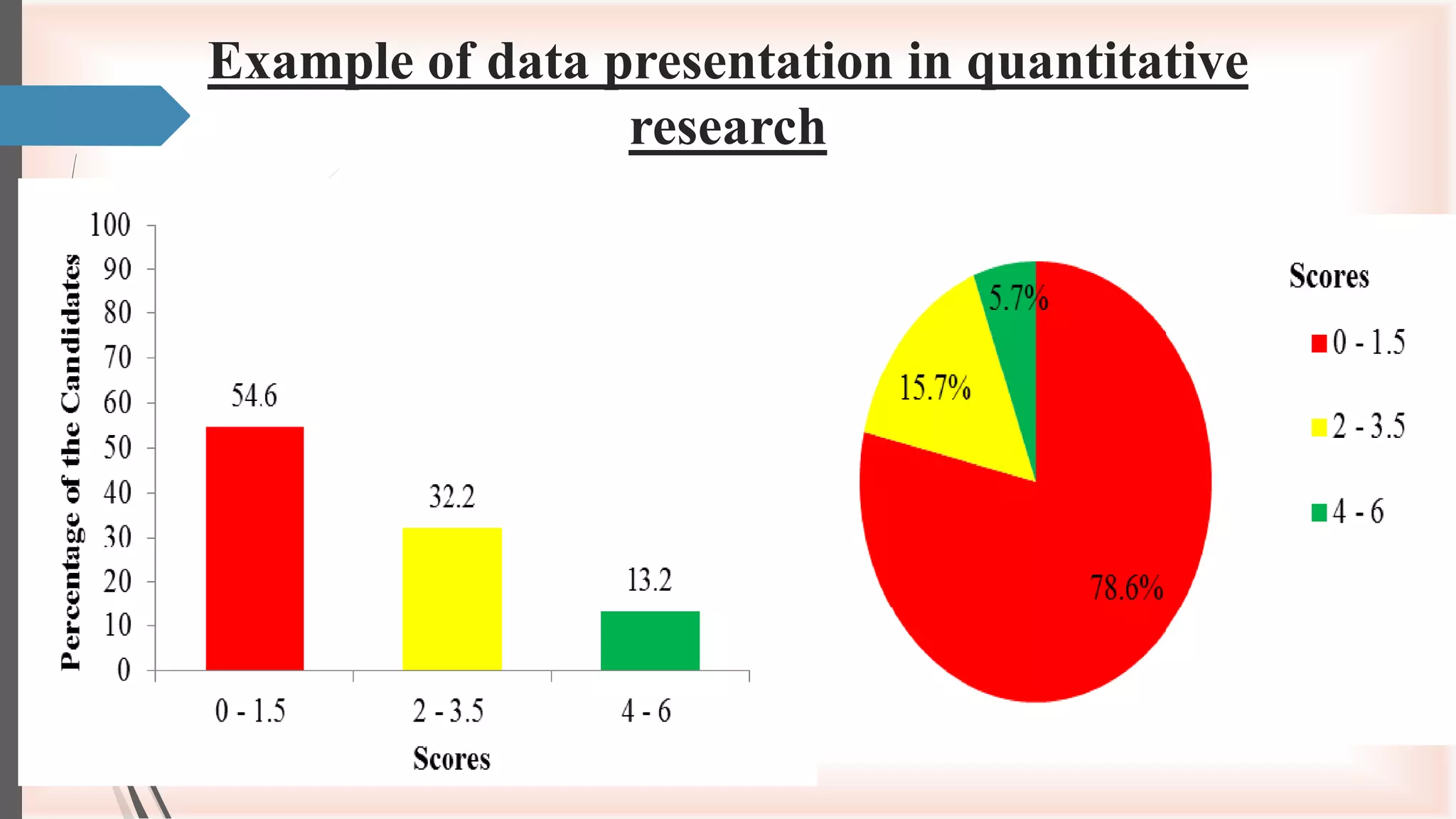
The researchers present the outcome of the research and
the targeted population of the research can understand
the shared information quickly because it is represented
in the form of tables and graphs
Example of data presentation in quantitative
research
Another characteristic of quantitative research is that
the outcome of quantitative research can be used
multiple times.
 Data collected for one research purpose can be used for
the prior study of another research problem.
Sometimes, researchers make the use of the outcome of
research for similar research problems, which reduces
the expense and time required for conducting research.
CHARACTERISTICS OF QUANTITAIVE RESEARCH

CHARACTERISTICS OF QUANTITAIVE RESEARCH

  • 1.
    FE 600a: EDUCATIONRESEARCH I PRESENTATION: a)Clearly describe quantitative research b)With examples describe at-least five key characteristics of Quantitative research PRESENTERS: MR. KAYUNI, EMMANUEL (MSc. Ed/BL) & MS. KOMBA, FARAJA (MSc.Ed/CH
  • 2.
    PRESENTATION OUTLINE Introduction toQuantitative research Characteristics of the Quantitative research
  • 3.
    INTRODUCTION TO RESEARCH Researchis the scientific and systematic procedures of collecting, analysing and interpreting data about a phenomenon for the purpose of solving an immediate problem or creating knowledge that is generally acceptable. Research in other way can be considered as diligent search for the knowledge or truth. Research can either be Quantitative or Qualitative research or mixed both Quan and Qual approaches Selection of the research approach is depending with the nature of the problem and the researcher’s competence on particular approach.
  • 4.
    QUANTITATIVE RESEARCH Quantitative researchis an objective, systematic numerical examination and interpretation of data to obtain information about the world for the purpose of describing and explaining of the reality of the phenomenon that those observation reflect. Quantitative research is based on the Positivist thought According to positivist, a statement is considered meaningful and true if it can be verified by sense experience
  • 5.
    Introduction cont… Quant Researchis based on the measurement of quantity or amount It is applicable to phenomenon that can be explained in terms of quantity It is more appropriate to determine the extent of the problem This approach involves the generation of data in quantitative form which can be subjected to rigorous Quantitative analysis in formal and rigid fashion.
  • 6.
    CHARACTERISTICS OF QUANTITATIVERESEARCH i. Large sample size ii. Collection of numerical data iii. Structured research methods iv. Data analysed using statistical packages which yield descriptive and inferential statistics v. Highly reliable and reusable outcome
  • 7.
    Large sample size Thefirst and foremost characteristic of quantitative research is the large sample size to conduct research. Quantitative research is done on a large number of audiences to ensure its reliability. For-example, in a research done by NECTA titled “Analysis on the assessment of reading, writing and arithmetic skills (3rs) of standard two pupils 2019” involved the use of large number of its participant; In which 524 schools involved in 10 regions. A total of 30,158 pupils were assessed in Writing Skills whereas a total of 28,816 pupils were assessed in Reading Skills and Arithmetic Skills.
  • 8.
    Collection of numericaldata Data are objective and independent of the people’s perception Quantitative researcher assumes that social life can be measured using numbers. Methods like likert scale, questionnaires and surveys all turn respondent’s responses into number that can be used for statistical analyisis
  • 9.
    Structured data collectionmethods Structured research methods like questionnaires (close ended), polls, and surveys are used to conduct quantitative research. In-depth information about the preferences of the audience can be drawn using these structured research methods. Moreover, with the help of the Internet and social media, it is effortless to reach the vast population irrespective of geographical boundaries. In addition to this, these research methods are easy to conduct through offline means. Also, a participant is only required to fill out the questionnaire and is not required to be part of the research process for a long time.
  • 11.
    Data analysed usingstatistical packages which yield descriptive and inferential statistics In quantitative research data analysis is done after data collection Measurement of variables are in form of number These numbers are entered in the computer and analysed Most used computer application software for analysing quantitative data is SPSS (Statistical Package for Social Sciences). Tests that can be done when analysing quantitative data includes ANOVA, MANOVA, Chi Test, T-test, Z-test, H-W test,
  • 12.
    Highly reliable andreusable outcome The outcome of quantitative research methods is quite reliable, as participants of the research face close-ended questions. Therefore, there are fewer chances of getting vague information or wrong information from the participants. Moreover, the Outcome of quantitative research is easy to understand and explain. The researchers present the outcome of the research and the targeted population of the research can understand the shared information quickly because it is represented in the form of tables and graphs
  • 13.
    Example of datapresentation in quantitative research
  • 14.
    Another characteristic ofquantitative research is that the outcome of quantitative research can be used multiple times.  Data collected for one research purpose can be used for the prior study of another research problem. Sometimes, researchers make the use of the outcome of research for similar research problems, which reduces the expense and time required for conducting research.