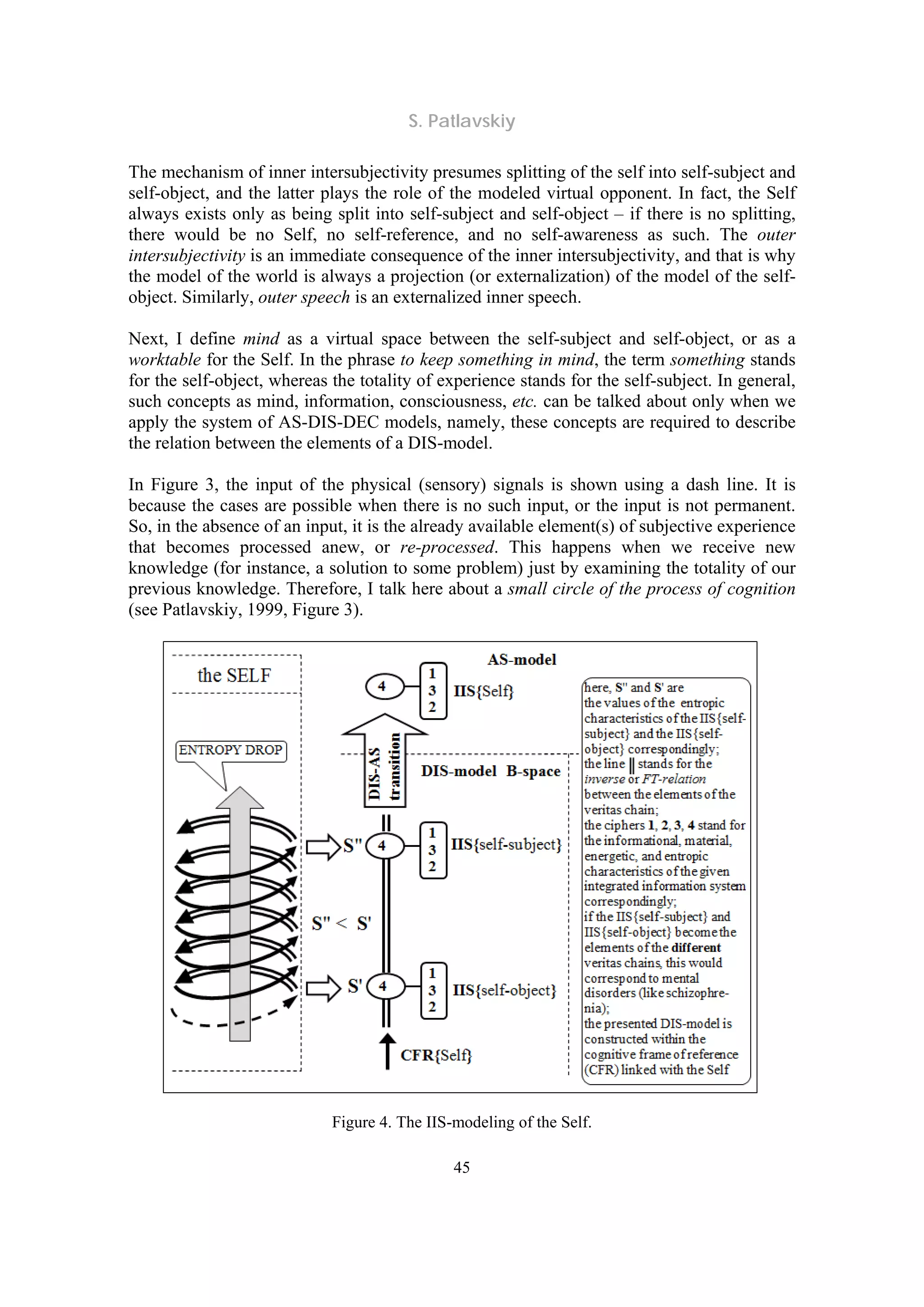
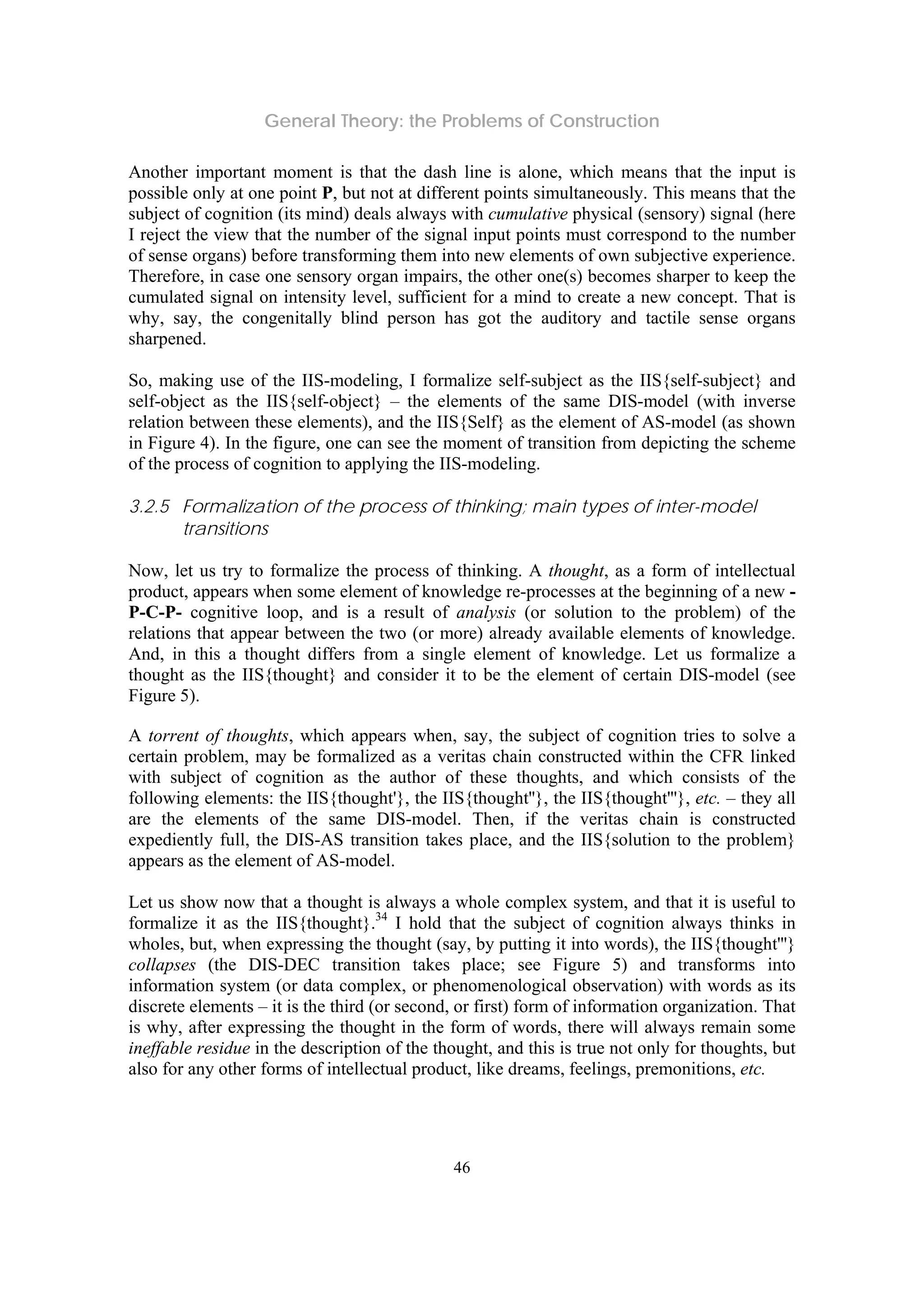
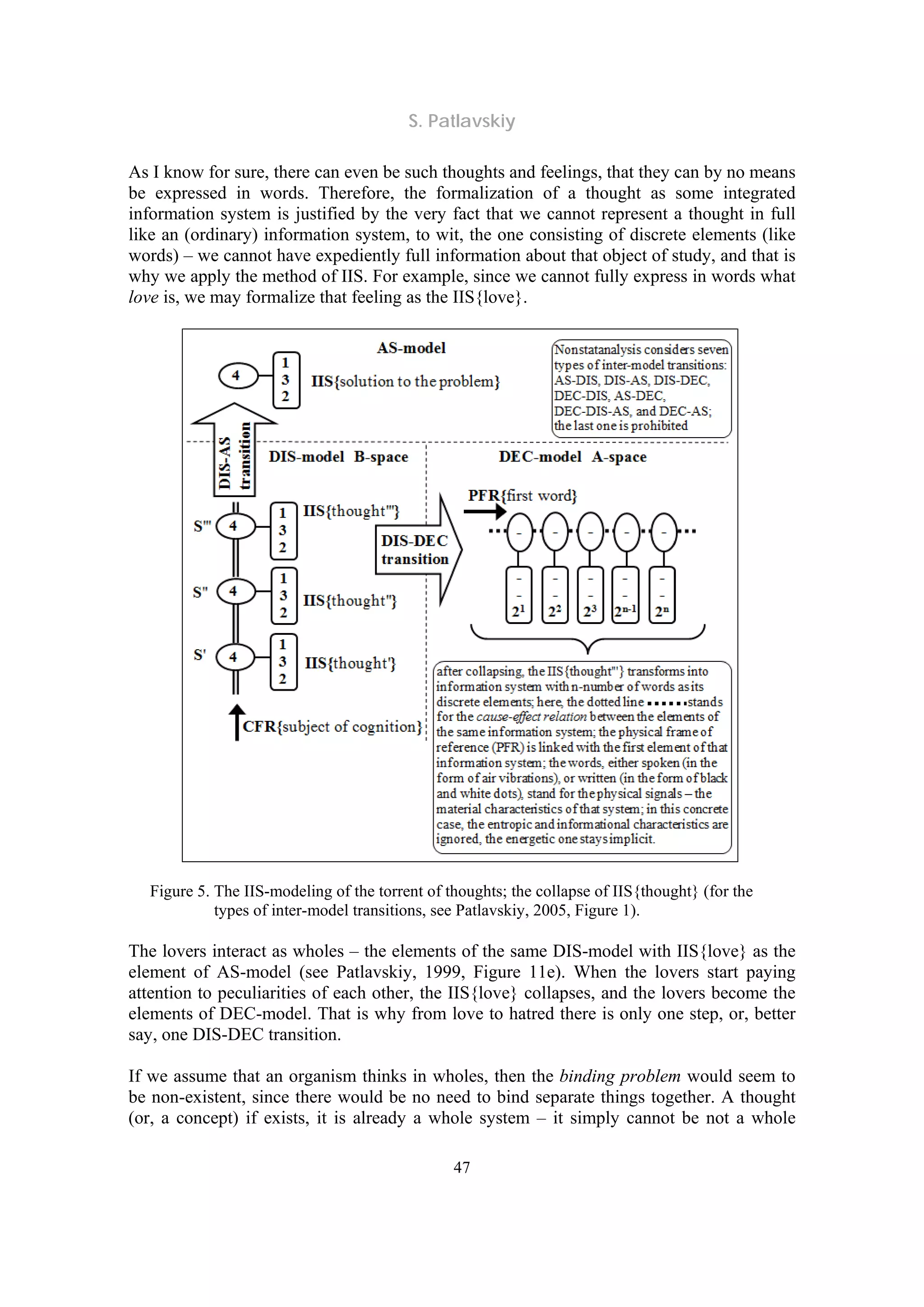
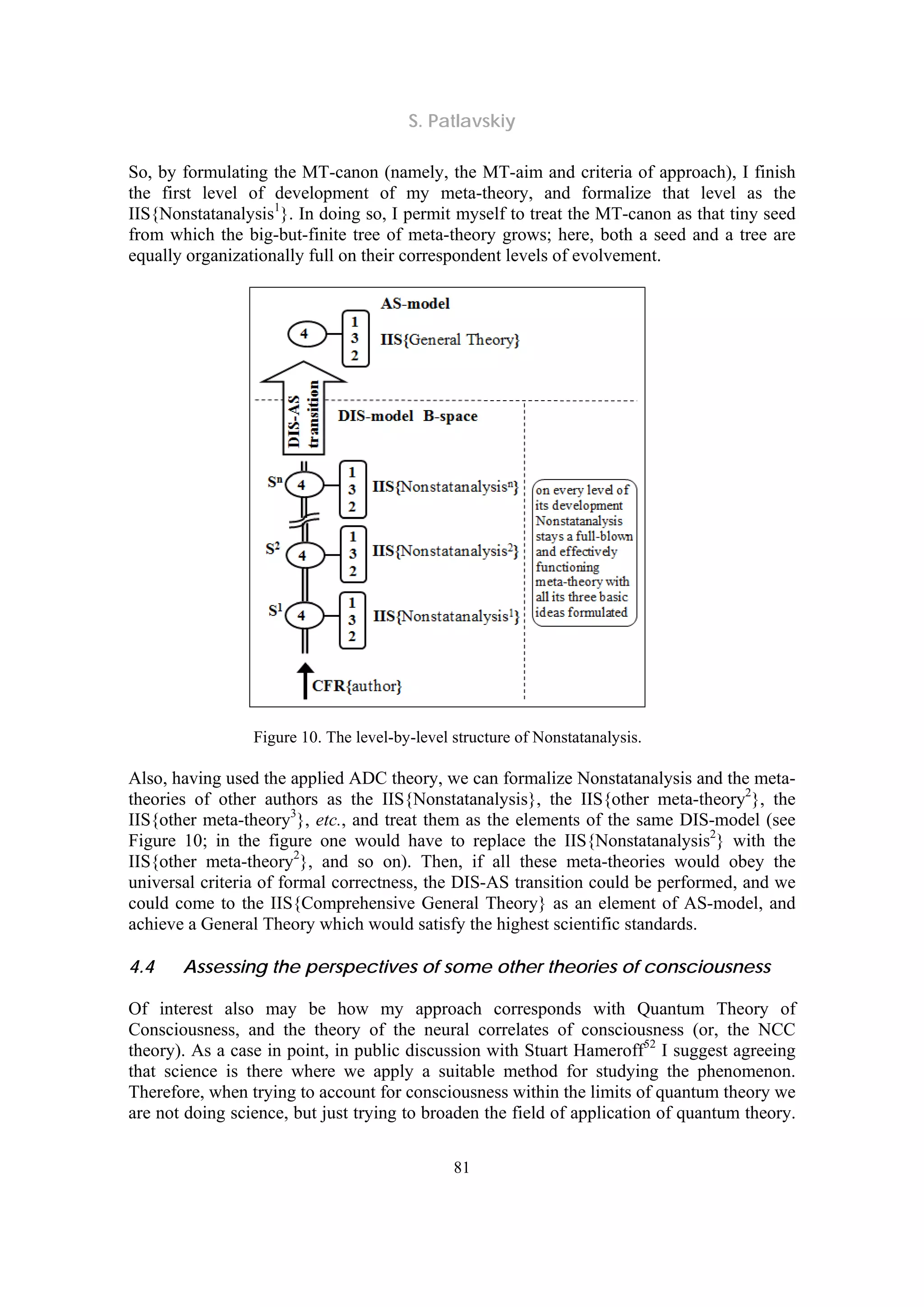
General Theory: the Problems of Construction*
by Serge Patlavskiy
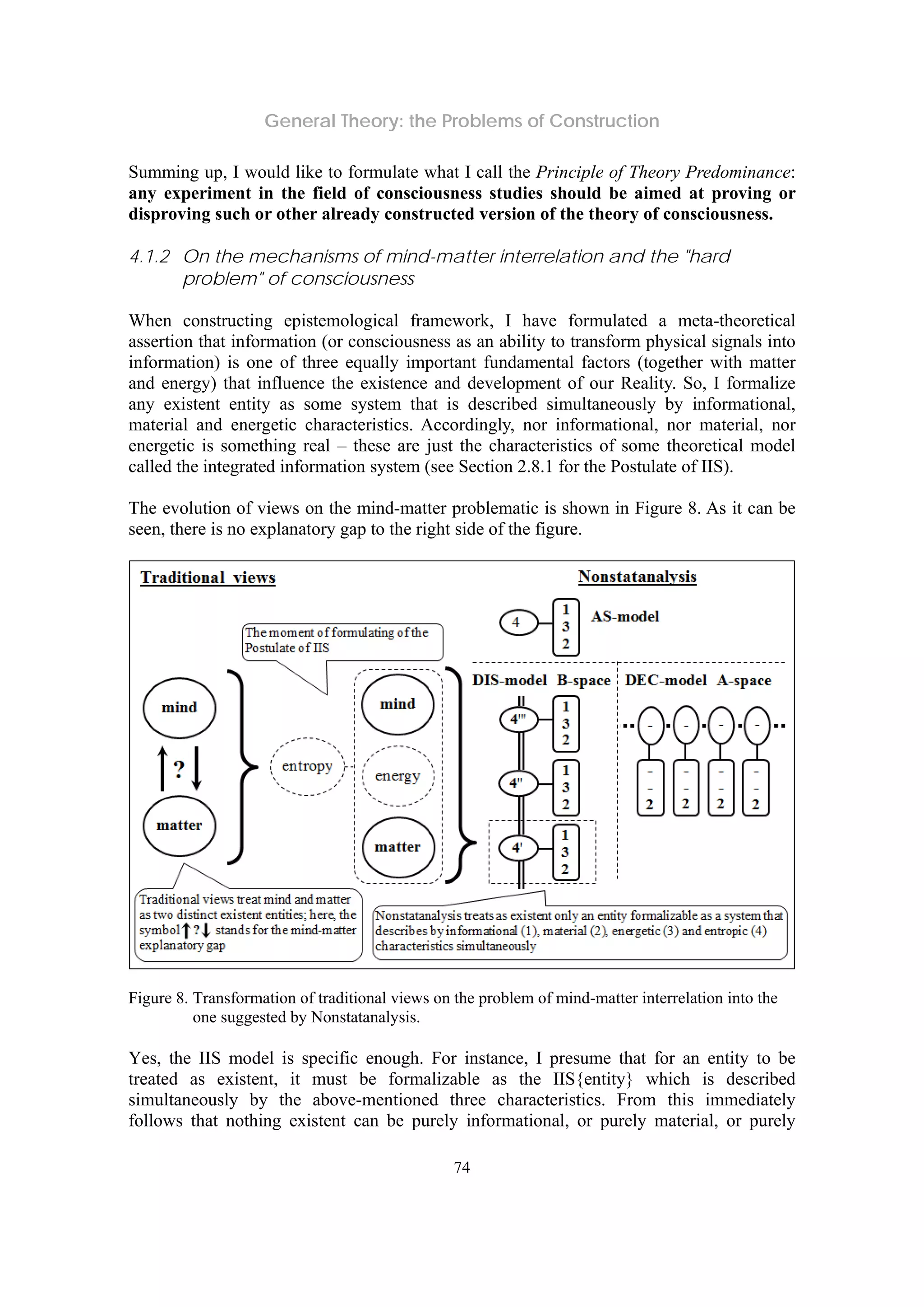
a physicist (L'viv National University), founder and director of the Institute for Theoretical
Problems of Interdisciplinary Investigations, L'viv, Ukraine
Email: serge.patlavskiy@rocketmail.com Homepage: http://generaltheory.webs.com
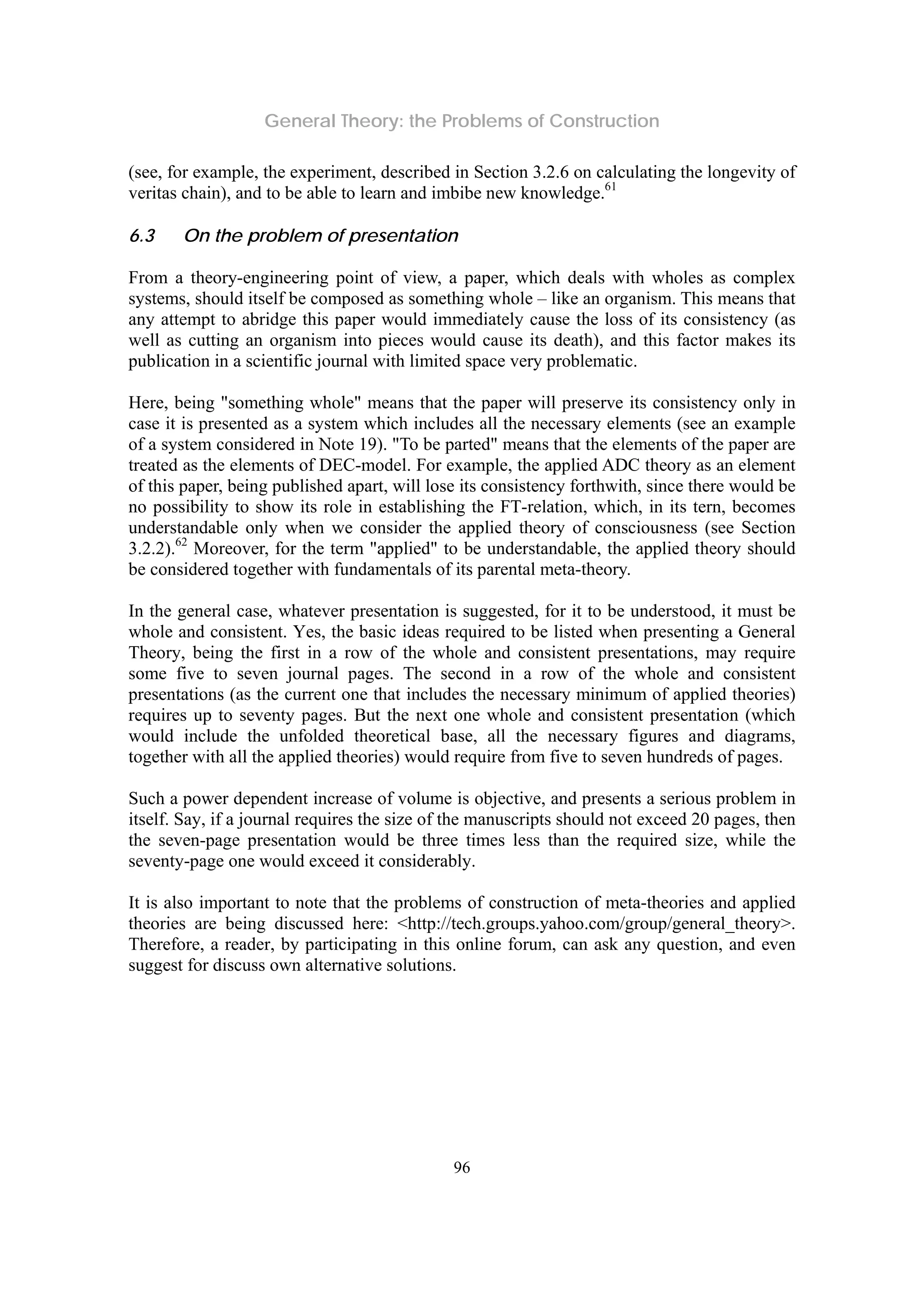
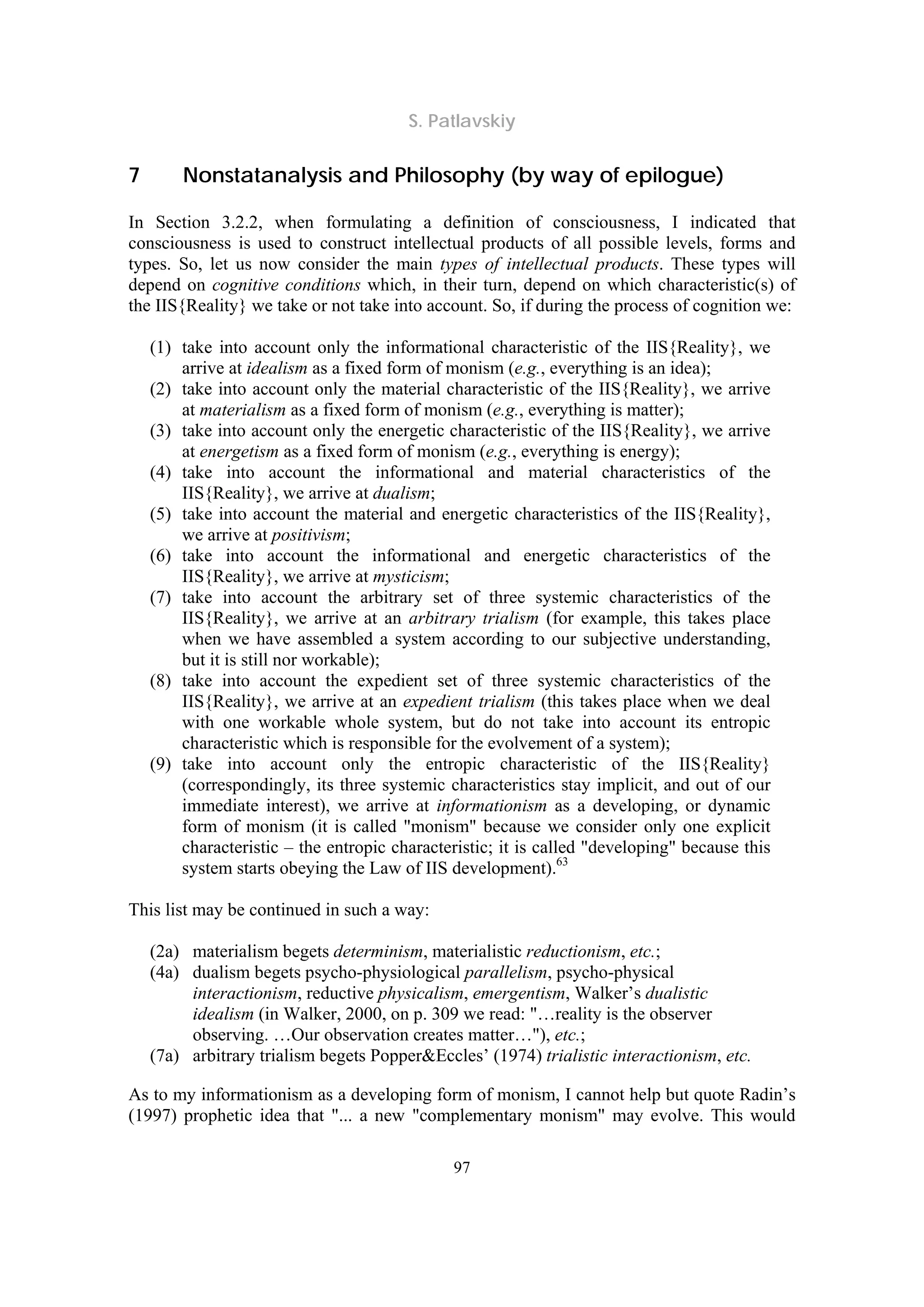
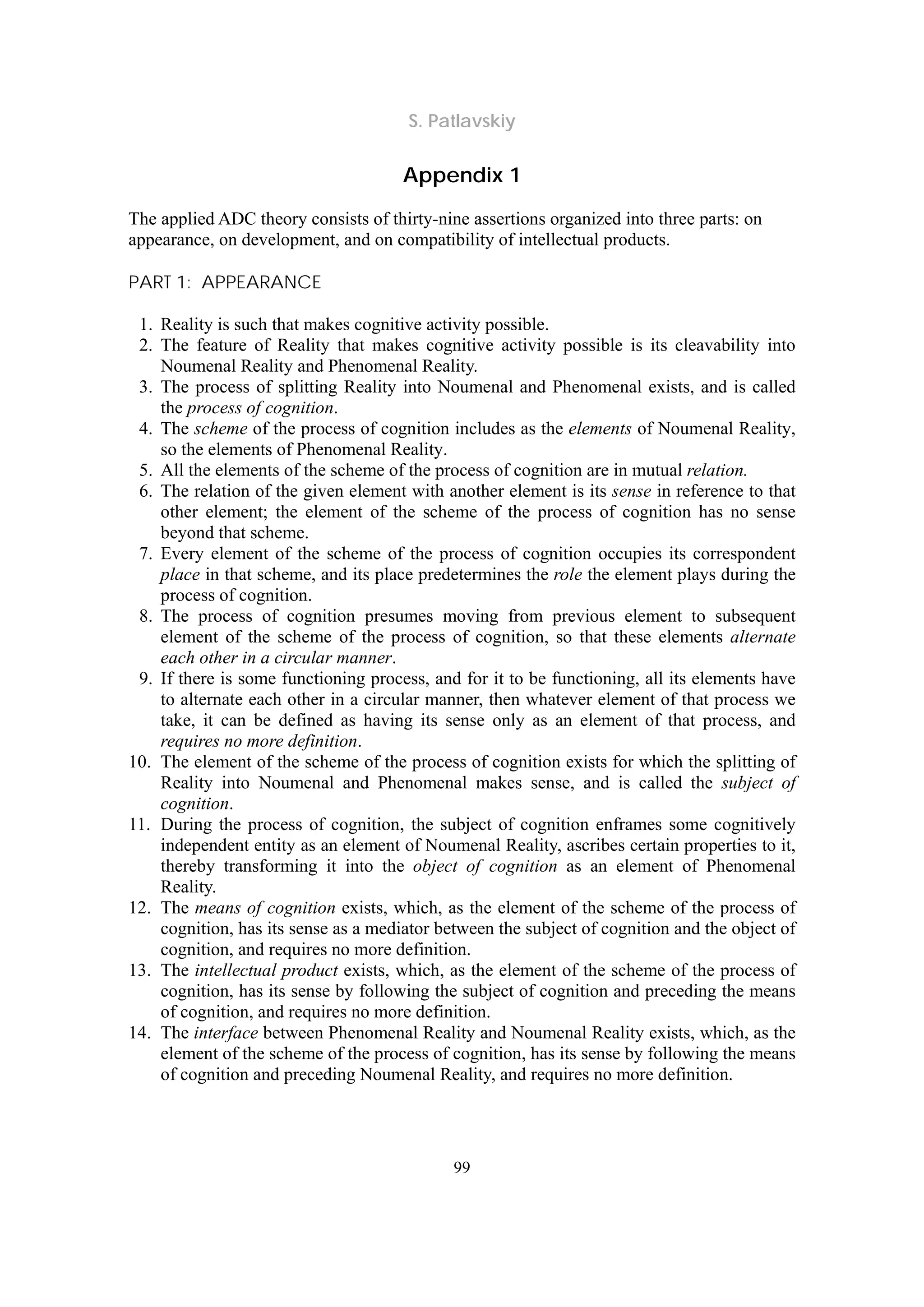
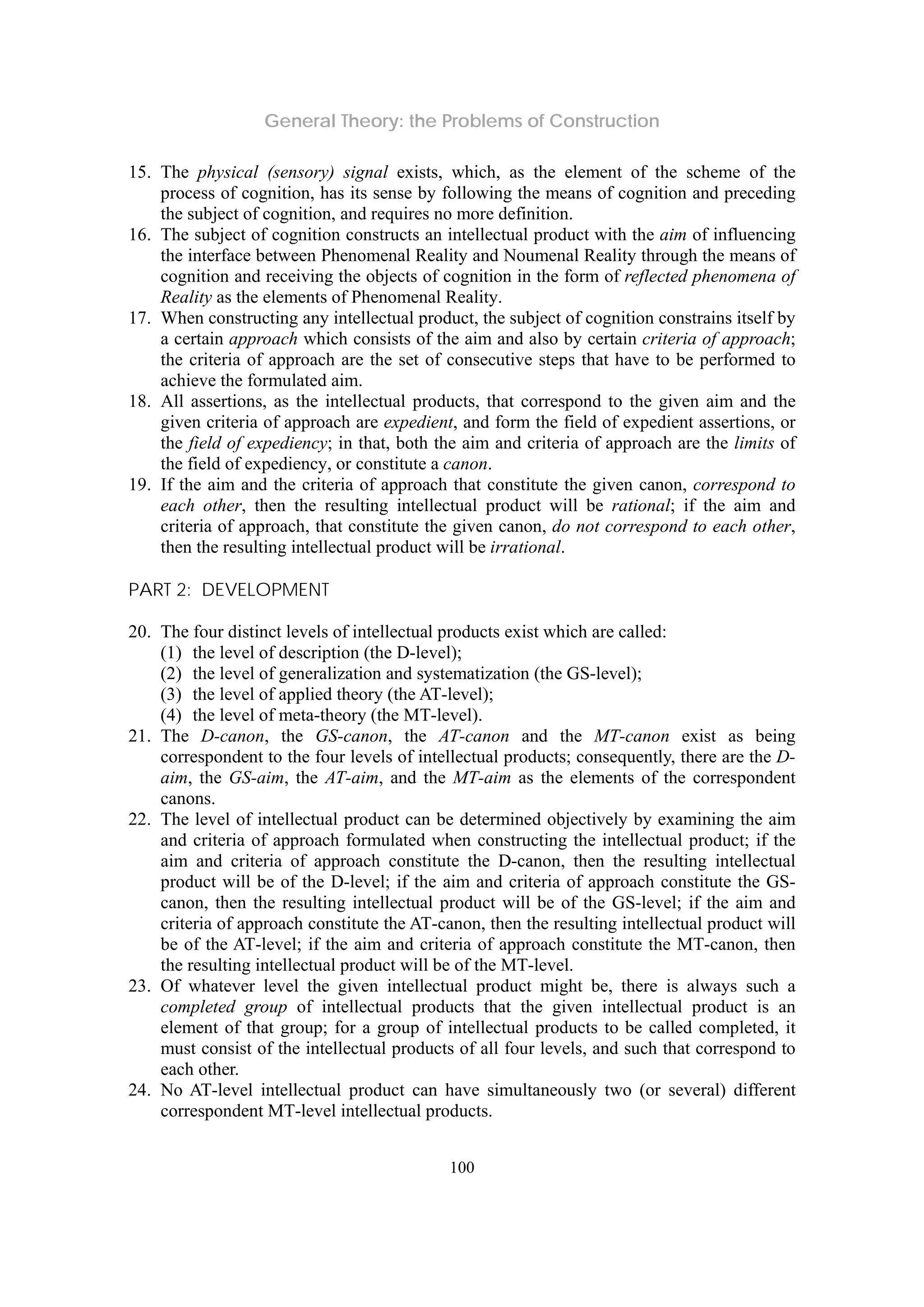
Abstract
The author holds that a scientific theory of consciousness can be constructed only within the
conceptual framework of a suitable meta-theory. In the paper the key problems of constructing a
General Theory (as a kind of meta-theory) are discussed. It is suggested that if we aim to explain
Reality in all its complexity, the conceptual framework we construct should take into account three
factors – informational, material, and energetic – simultaneously. It is shown how the intellectual
products of the different levels, like a theory and meta-theory, relate to each other, and the ways in
which they differ. Also, the basic elements of the process of cognition are defined, some
fundamental laws and principles are formulated, a non-statistical method of study is presented, and
a specific systemic modeling is exemplified. All this enables the author to propound an applied
theory of consciousness, and articulate an idea of a new scientific discipline – Interdisciplinary
Investigations. The author hopes that the paper will inspire a wide-ranging discussion among the
theorists who work in the fields of consciousness studies, artificial intelligence, psychology,
psychiatry, and among all those who would like to see a comprehensive paradigm be achieved in
these fields in the future.
Keywords: general theory, intellectual product, criteria of formal correctness, meta-theoretical
canon, non-statistical analysis, integrated information system, applied theory of consciousness.
1 On sense and relation (by way of introduction)
I hold that if there are at least two existent entities, then an explanatory framework (a set of
explanations) can always be constructed which would treat these entities as constituting a
system. In other words, the very existence of two entities makes it possible to enframe1
them as some system. Then, each of these entities can be considered as an element of that
system. The element, in virtue of its very presence, influences the system in such or other
way. If two (or more) elements are linked into one system, and one element influences the
other element, this means that a relation between these elements, as well as a relation
between the given element and the whole system exists too.
If one element establishes a relation with another element (or with whole system), it
acquires its sense in reference to that other element (or in reference to the whole system). I
accept that the sense of element is simultaneously a denotatum and a notion. Within a
*
modified version, updated on November 26, 2013; the originally published version is available at
http://journals.isss.org/index.php/proceedings56th/article/view/1795
General Theory: the Problems of Construction
2
system, any element appears as a denotatum-notion complex. For example, if we treat a
coin as a denotatum-notion complex, we mean that the alloy it is made of, its form, weight,
and surface embossments stand for its denotatum, while its value, date of issue and
belonging to a certain country stands for its notion.
The sense of element as a denotatum is its property. For example, a coin, as a denotatum,
has some physical properties, or features. The sense of element as a notion is its meaning.
For example, the meaning of coin is its value, or its being a generally accepted commodity
as a medium of economic exchange.
Any explanatory framework is also a system with assertions as its elements, or sub-systems
(I mean here that an assertion is a system itself with its own elements). If a certain
denotatum-notion complex is an element of a certain assertion, I call it a concept.
Therefore, contrary to the established tradition, I make a difference between a concept and
a notion. If the concept is being used only as a notion and without referring to its
correspondent denotatum, I call this fact a notion hypostatization – the notion itself is
considered as an independent entity. Also, the most general kind of explanatory framework
I call a conceptual framework (or, in certain cases epistemological framework).
Any explanatory framework appears as a result of the process of cognition. If we consider
the process of cognition as some sort of a system, then the subject of cognition and the
object of cognition will be the elements of that system. The relation between these two
elements results in what I call a subject-object complex. The object of cognition is an entity
enframed by the subject of cognition, to wit, transformed by it into some denotatum-notion
complex. Therefore, by definition, the object of cognition always has the properties
ascribed to it by the subject of cognition.
I define Reality as including everything, together with all possible subjects of cognition.
From this follows that Reality, as a whole, cannot be the object of cognition itself. This is
because no subject of cognition can be found beyond Reality that would be able to enframe
Reality as its object of cognition. So, by simple logical reasoning, we come to agnosticism,
or the impossibility to cognize Reality. However, in this paper, my prime object in view
will be to show that such a conceptual framework can be constructed that would make it
possible for us to cognize Reality in its whole complexity, and to explain all its elements,
including the very mechanisms of the process of cognition. Actually, I aim to discuss the
problems of constructing the non-agnostic conceptual framework.2
Whatever explanatory framework we are going to construct, we should first set the sense of
all its elements. The sense of element, set during the process of cognition, I call a cognitive
sense. Also, I hold that all the elements of my explanatory framework should be treated
unequivocally. Therefore, for all the concepts, as the elements of explanatory framework, to
be treated unequivocally, their cognitive sense has to be set according to a few universal
principles. In every case, the conceptual framework is the result of activity of the subjects
of cognition during the process of cognition, and I call that result an intellectual product.
S. Patlavskiy
3
2 Fundamentals and basic elements of construction
2.1 Applied ADC theory
2.1.1 The levels of intellectual products
The applied theory of appearance, development, and compatibility of intellectual products
(or, the applied ADC theory for short) is designed for examining various intellectual
products. By definition, this theory takes any intellectual product as its object of study. (For
comparison, Physics takes any physical phenomenon as its object of study). The applied
ADC theory presumes that during the process of cognition the subject of cognitive activity
creates various intellectual products sortable into four levels:
(1) the level of description (the D-level);
(2) the level of generalization and systematization (the GS-level);
(3) the level of an applied theory (the AT-level);
(4) the level of a meta-theory3
(the MT-level).
The D-level, being to a large extent eclectic, includes simple unsorted descriptions of
phenomena, as well as the data received as results of experiments with strict conditions
formulated. The GS-level presumes sorting the data, determining regularities in occurrence
of the phenomena, and formulating the hypotheses. The AT-level includes those assertions
that have sufficient explanatory and predictive power; it also includes disciplines and
research directions. The MT-level includes the assertions about the fundamental features of
our Reality. It also includes the assertions that constitute the conceptual or epistemological
frameworks, general theories (like the theory of everything, or TOE for short), general
scientific doctrines, some basic principles, fundamental natural laws and general methods,
belief systems, general styles in art and the very pieces of art, musical compositions,
poems, and the like.
In everyday communication and even in scientific papers people often conflate theory with
hypothesis. In fact, there is a big difference between them, since these two are the
intellectual products of different levels.
For example, a hypothesis does not require to be falsified or tested, since it grounds on the
already received research data. To be more specific, after generalization and
systematization of research data we may formulate some hypothesis (a supposition is a
hypothesis as well). If we receive some additional data, then, after generalization and
systematization, we will be able to formulate another hypothesis, and so on. Every given
hypothesis is backuped (justified) by the research data we have at hand.
The quality of the hypothesis depends as on the quality of data we have, as on our
ability/talent to generalize and systematize data in a certain way. To the point, the same
data, being differently generalized and systematized, may lead to formulation of different
hypotheses.
General Theory: the Problems of Construction
4
As to a theory, it differs from a hypothesis in that it is an intellectual product which
possesses certain explanatory and predictive power, and it requires testing and falsifying.
The difference between a theory and a hypothesis can be seen from the following example.
Suppose, we have an assertion (formulated by a child): "My dad shoves plugs into wall
outlets several times a day, then, maybe, a metal nail can also fit the apertures and could be
shoved into wall outlet as well?". This assertion is a hypothesis, and is based on child's
generalization and systematization of observational data.
Then, we have another assertion (this time formulated by the child's farther): "Don't shove
metal nails into the wall sockets, otherwise you will receive an electric shock which may
even kill you!". This assertion is a theory because the father predicts what could happen,
and explains why it could happen (maybe, being based on his own experience and personal
testing).
It is important noting that if a person formulates some supposition, but this supposition is
not a result of generalization and systematization of research data, then this supposition is
not a hypothesis (the GS-level intellectual product), but an element of person's belief
system (the MT-level intellectual product).
As follows from the history of science, the development of Physics went from the D-level,
through the GS-level, and up to the AT-level. Only then the MT-level was formed as a
meta-theory that may be referred to as "The Modern Materialistic Picture of the World".
But, I hold that where we wish to construct, for instance, a theory of consciousness, we
need to construct a suitable meta-theory in the first place, and only then to go from the MT-
level to the AT-level, or to move from the specially constructed meta-theory to the applied
theory. Thus, I am convinced, the meta-theory called "The Modern Materialistic Picture of
the World", while being suitable for constructing some physical theory (like a quantum
theory), at the same time, it is not suitable for constructing a theory of consciousness, nor a
theory of anomalous phenomena and the like AT-level intellectual products.
I also recognize that a certain form of information organization (or, a form of data
organization) exists, and corresponds to every level of intellectual products. When we only
describe the world, the results of description are organized into phenomenological
observation (or, the set of perceived phenomena); the generalization and systematization of
research data gives birth to a form of information organization which may be called a data
complex (or, data array).
When we deal with theories of sufficient predictive power, in that case we receive the data
which already need to be organized into information system. Here, we receive new data not
only as the result of conducted experiments with real objects, but also as corollaries of one
or other applied theory which possesses sufficient predictive power (due to such a theory
we are confident that the unexamined phenomena would also behave in the predicted way),
and also as results of computer simulation.
It should be admitted that these three forms of information organization have common
feature of being the discrete data sets. Also, I shall presume, there is a fourth form of
S. Patlavskiy
5
information organization which I will below refer to as an integrated information system,
and which, as I believe, cannot be treated as a discrete data set.
Let me accentuate that the applied ADC theory was designed to legitimize talking about
theories and meta-theories, and it can directly addresses the questions like "What is
theory?", "What is a difference between a theory and a meta-theory?", "How to construct a
meta-theory?", and similar questions.
For example, how can we know at what level is the given intellectual product? Here, the
applied ADC theory states that the level of intellectual product can be determined
objectively by examining the aim and criteria of approach formulated when constructing
the given intellectual product. Here, by criteria of approach I mean a set of consecutive
steps required to achieve the formulated aim. The given pair of the aim and criteria of
approach constitutes a canon for the resulting intellectual product.
Consider the following example: if the aim is to cognize Reality in all its complexity (or,
say, to impress the whole world by one's piece of art, etc.), and the criteria of approach
presume constructing a suitable conceptual framework (or some piece of art), then the
resulting intellectual product will be of MT-level. At the same time, the intellectual product
that aims just to list the various versions of TOE would be just of GS-level.
Next. The applied ADC theory states that where the aim and criteria of approach
correspond to each other, then the constructed intellectual product will be rational. But, if
the aim is, say, to reach the Moon, and the criteria of approach presume climbing up the
nearest mountain, then the resulting intellectual product "The Moon can be reached by
climbing up the mountain" will be irrational.
It is important to note that if we consider the aim as being taken alone, it cannot be
characterized as rational or irrational. The same holds when we consider the criteria of
approach without connection to a certain aim. For instance, the "climbing up the mountain"
may help to construct the rational intellectual product if the aim would be "To be the first
who can see the sunrise". I may even suppose that whatever aim we formulate, it may
always be the element of one or other rational intellectual product – everything here will
depend on the criteria of approach we choose.
From the above follows the Principle of rationality: whatever aim can be formulated, such
criteria of approach can be always found so that the resulting pair of the aim and criteria of
approach will constitute a canon for constructing a rational intellectual product.
The applied ADC theory also addresses the question of relation between the intellectual
products of different levels. For example, it states that the given AT-level intellectual
product may have only one correspondent MT-level intellectual product, while the given
MT-level intellectual product may serve as a conceptual framework (or parental meta-
theory) for many AT-level intellectual products simultaneously.
General Theory: the Problems of Construction
6
For example, the applied theory of heat cannot simultaneously have materialism and
idealism as its parental meta-theories, while the meta-theory "The Modern Physical
Materialistic Picture of the World" may host both the applied theory of heat, and the
applied theory of piezoelectricity.
2.1.2 The completed and uncompleted groups of intellectual products
The applied ADC theory also states that whatever intellectual product we take, there is
always such a completed group of intellectual products that the given intellectual product is
an element of that group. An example of such a group is as follows:
the D-level assertion: if we rub the ebonite stick with wool, the stick starts to attract
small pieces of paper;
the GS-level assertion: all charged things attract or repulse each other; maybe, there
is a universal quantitative description of this phenomenon (the word "maybe" means
that some hypothesis is being formulated here);
the AT-level assertion: whichever two electrically charged material bodies we take,
the force between them is proportional to the product of the charges and inversely
proportional to the square of the distance between the centers of these bodies;
the MT-level assertion: Reality is purely materialistic (to wit, no "supernatural
forces" are required to be involved to explain the observed phenomena).
As one can see, in this example the assertions of all four levels are present, and are in
proper mutual interrelation. That is why I call the given group of intellectual products
completed. If in our example we remove the MT-level assertion, the group would no longer
stay full, and would be called uncompleted.
We will have an uncompleted group also when one (or two, or three) assertions of different
levels, albeit present, are in improper relation. For example, if, in our example, we replace
the D-level assertion with this one – "If we let go of an apple, it will fall.", then we will
receive an uncompleted group of intellectual products too.
It should be admitted that the D-level assertion "If we let go of an apple, it will fall." may
be the element of some other group of intellectual products, and this new group may also be
completed. For this new group to be completed, the MT-level assertion may remain the
same as in our example above, but the AT- and GS-level assertions would have to be
changed thus:
the GS-level assertion: every material body attracts by the Earth, and all the bodies
in our Solar system, as well as in our galaxy, attract each other; maybe, there is a
universal quantitative description of this phenomenon;
the AT-level assertion: any particle of matter in the universe attracts any other with
a force varying directly as the product of the masses and inversely as the square of
the distance between them.
S. Patlavskiy
7
So, as follows from the applied ADC theory, if we want to construct a theory of
consciousness as an AT-level intellectual product, then we have to form a completed group
of intellectual products with the theory of consciousness as an AT-level element of that
group, and with some suitable meta-theory as an MT-level element of that group.4
2.1.3 On the relation between the intellectual products
Next. The applied ADC theory states that the AT-level intellectual products (say, the
applied theories) constructed within the limits of the same meta-theory may be organized
into one or more disciplines (research directions, etc.). All these applied theories make use
of the same general method as the element of their parental meta-theory, and apply this
method while studying the certain classes of phenomena. The discipline (as a set of applied
theories) constructed within the limits of my own meta-theory is called Interdisciplinary
Investigations.
It should be taken into account that here I talk about a new paradigm of Interdisciplinary
Investigations, by which I mean a new understanding of what Interdisciplinary
Investigations are (see Section 3.4 below). I insist that Interdisciplinary Investigations
being understood as a "marriage" between Physics and Psychology (if applying Mario
Bunge's, 1973, interpretation) cannot lead to any effective results because of the fact that
Physics as well as Psychology have their own methods of studying their own objects, and
these methods are incompatible. Therefore, I talk about Interdisciplinary Investigations as
of a new all-sufficient discipline that applies its own specific method (it will be discussed in
Section 2.8.1) when studying a specific class of natural phenomena (which include
consciousness-related, rare, anomalous, non-repeatable, and like phenomena).
The applied ADC theory also addresses the relation between the intellectual products of the
same level but being constructed by different subjects of cognitive activity. Here it states
that the MT-level intellectual product of one author cannot be criticized nor disproved from
the standpoint of the MT-level intellectual product of another author, and that we can only
investigate these products for compatibility. The investigation for compatibility presumes
comparing the aim and criteria of approach formulated by one author with the aim and
criteria of approach formulated by the other author when constructing their correspondent
intellectual products (this point will be detailed in Section 5.3).
From the above it immediately follows that only a theorist who has his/her own meta-
theory constructed can perform such an investigation while assessing the meta-theory
constructed by another theorist – this is the only case when the assessment can be objective
and such one that would have definite scientific value. Thus, the attempts of other persons
to assess the given meta-theory would be just the expression of their personal (or
subjective) "likes" and "dislikes" with small scientific value.
From the above also follows that, say, Christianity cannot be criticized from the standpoint
of Buddhism, and vice versa, since both are certain self-contained belief systems – the MT-
level intellectual products. That is also why we cannot criticize an artist for having depicted
a cow with six legs, since it is how an artist expresses his meta-theoretical beliefs, or,
General Theory: the Problems of Construction
8
simply speaking, sees the world around him – we can either love his painting (this is a case
when our visions of the world are compatible), or leave it, and pay attention to the works of
other artists.
The applied ADC theory also holds that the meta-theory (since being just a collection of
basic principles, postulates, and axiomatic assertions) does not need to be proven, and that
its correctness depends on whether the applied theories constructed within its limits are
correct and possess sufficient predictive and explanatory power. If the correctness of meta-
theory is proven in such a way, this would mean that its meta-theoretical aim was
formulated objectively. From the above follows that the meta-theory which I am going to
present below (or any belief system like Christianity) does not require to be proven in
virtue of its being the MT-level intellectual product.
In addition, I call intellectual legacy a totality of intellectual products as a result of
cognitive activity of some subject of cognition over time. If by a subject of cognition we
mean a scientist, it will be a set of books, papers, patents, inventions, etc.; if by a subject of
cognition we mean an artist, it will be a set of paintings; and so on. In total, the applied
ADC theory consists of thirty-nine assertions (see Appendix 1).
2.2 The criteria of formal correctness and the problem of intersubjectivity
In the former section we touched the question of which levels the intellectual products can
be. Let us now consider the problems that appear when we try to construct the intellectual
product of one or another level. Since every intellectual product is constructed by a certain
subject of cognitive activity, therefore it is always to a great extent unique. The ancient
adage says: "Quot homines, tot sententiae", which means that no two minds can think alike.
This is due to the fact that every person constructs a new thought being based on his/her
unique subjective experience.
Of our special interest will be the unique subjective experience that pertains to
consciousness-related phenomena. Here I hold that only the theorist who has a rich unique
subjective experience of his/her own consciousness-related phenomena has a chance to
construct an explanatory framework for addressing these phenomena. But, on the other
hand, the process of construction of such a framework would mean that the theorist is
performing a scientific activity, and, as it is commonly accepted, the results of scientific
activity must be (or, at least, must tend to be) objective. So, how to reconcile the subjective
and objective aspects in this case?
First of all, I suggest treating as extremely important the intellectual purity of resulting
intellectual product while constructing a conceptual framework for explaining
consciousness, by which I mean the non-contamination by ideas of others. From this
follows that, having constructed a personal version of the theory of consciousness, a
theorist must accept full personal responsibility for every idea expressed in that theory, and
must not "hide beyond the backs" of others who are commonly treated as "big authorities".
There is also no sense in interpreting the ideas of famous thinkers of past times, since we
cannot know for sure what these thinkers had in mind when expressing their ideas, if only
S. Patlavskiy
9
because of the fact that we cannot, so to speak, smell the air of epoch in which the given
thinker lived and worked. That is why a paper on consciousness which is just an
interpretation of the ideas of others would be of small scientific value.
Second, I insist that the conceptual framework needed to construct a theory of
consciousness (and, theories of other complex phenomena) should be constructed in
obedience to some requirements (or criteria). Here I suggest that whatever conceptual
framework we construct, it
(1) should not contain tautologies;
(2) should not contain notion-metaphor transmutations (e.g., "power" – it is a
concept in Physics, but being used in Psychology, say, as "power of
imagination", it becomes a metaphor);
(3) should not contain hypostatization (which occurs when something abstract is
treated or represented as a concrete reality);
(4) should not contain incorrect definitions (when the unknown is defined through
another unknown);
(5) should not contain multiplication of hypotheses (which occurs when the new
hypothesis is being based upon the previous one, instead of being the result of
generalization and systematization of research data, as the applied ADC theory
requires);
(6) should not breach Okham's principle (the most evident and simplest explanation
has to be preferred);
(7) should possess inner consistency (or, be formally non-self-contradictory);
(8) should be rational (when the aim and criteria of approach correspond to each
other).
I refer to these requirements as the criteria of formal correctness5
(or, in a certain context,
the criteria of scientific approach), treat them as essentially universal, and apply them when
constructing my own meta-theory. I realize that it is always a great responsibility to be a
legislator, but the field of consciousness studies, to be removed from the point of
stagnation, demonstrably requires some legislature.
So, I expect that the cognitive environment for the science of consciousness will be formed
by the theoreticians who accept the mentioned above strict criteria as the rules of their
cognitive activity directed at construction of one or another conceptual framework or a
certain theory. Next I presume that the cognitive activity, in order to be called scientific,
must obey these rules as well, and I define Science as an intellectual product constructed in
obedience to the criteria listed above. However, Science is not just a collection of
knowledge. It is the very process of gaining new knowledge by using appropriate methods.
By imposing a requirement that the conceptual frameworks must obey the criteria of formal
correctness, I am, thereby, intending to apply the general principle of making the other
things equal which is widely used in science when carrying out experimental research. So,
if all conceptual frameworks will obey the same criteria of formal correctness, they will
become in this sense equal (they will be of equal quality), despite of being constructed by
General Theory: the Problems of Construction
10
the different theorists. If this requirement is met, we receive a possibility to solve a problem
that may be called a problem of intersubjectivity.
This problem, being an objective feature of any communication, becomes especially topical
when we wish to construct a scientific theory of consciousness. However, it is not very
crucial for Physics, since the external-to-investigator physical phenomenon is treated by the
different investigators in basically the same way. For example, if a physicist talks about
piezoelectricity, the other physicist understands well enough what is being talked about.
But, while studying consciousness, the consciousness-related phenomena are, in most,
private; therefore what is consciousness for one investigator may not be the same for the
other investigator. In result, the subjective opinions come into conflict with each other, and
no comprehensive paradigm can be achieved.
I believe that the problem of intersubjectivity is the main obstacle when erecting a science
of consciousness, and I suggest the following idea of how to cope with that problem. Let us
accept that every theorist constructs his/her own personalized version of the theory of
consciousness being based on his/her unique consciousness-studying data6
, and that the
intellectual purity of that version is sufficient. If a case is that all such theories obey the
same criteria of formal correctness formulated above, then, according to the applied ADC
theory, these theories could be investigated for compatibility, and we would be able to
come to the comprehensive version of the theory of consciousness.
Summing up, I state that whatever two or more subjects of cognitive activity we take who
have got their own intellectual products constructed, then, on condition that all these
intellectual products obey the same criteria of formal correctness, these intellectual
products will be always mutually compatible.
The above statement can be either proved or disproved. However, to prove or disprove that
statement, say, when trying to solve the problem of intersubjectivity in the field of
consciousness studies, we must have sufficient quantity and quality of the personalized
versions of the theory of consciousness. In the general case, the subjective becomes
objective not directly (or by some magic), but via some additional factor (namely, the
criteria of formal correctness) which is treated as objective, and responsible for the quality
of the constructed theories.
2.3 Approaching the General Theory
My aim is to show that such a conceptual framework can be constructed to make it possible
to explain the objectively existing Reality. The conceptual framework I am going to present
below is called Nonstatistical Analysis (or, Nonstatanalysis for short) – it is an MT-level
intellectual product, or a certain meta-theory. This framework grounds on assumption that
the subject of cognition is able to conduct the process of cognition of Reality because the
very process of cognition is itself an element of Reality, and obeys the same general law(s)
of Reality.
S. Patlavskiy
11
As an element of my meta-theory I have also developed a special non-statistical method (it
will be discussed in Section 2.8.1 below). This method is able to deal with consciousness-
related, rare, anomalous, non-replicable phenomena, and the ones which are irreducibly
complex (like a living cell). In other words, this method can be used even in the absence of
statistics of appearance of the phenomenon in study (hence the name of my meta-theory).
I also touch the problem of constructing a suitable model when formalizing the investigated
phenomenon. The case is that even within a discipline with its paradigm already established
(such as Physics) it is problematic to reconcile the different models of the same object of
study. For example, it is hard to reconcile the model of atom that considers the electrons as
tiny balls orbiting the nucleus and simultaneously revolving around their own axes of
rotation, with the model of atom that considers the electrons as clouds, especially when
these clouds are in the form of dumbbells. But, as it turns out, both models are useful in
certain cases. So, while constructing the conceptual framework of my meta-theory, I also
consider different kinds of models and apply them in complementary manner.
As it appears, the main model used by Physics is a decompositional one: the Whole
decomposes into parts; thus, the original Whole irreversibly destroys (in some contexts I
refer to the decompositional models as the physical ones). Contrastingly, the dissociational
model, I use, presupposes emergence of other Wholes which originate in their parental
Whole; this way, the original Whole preserves (in some contexts I refer to the
dissociational models as the informational ones). For example, I formalize the elementary
particles as the elements of the same dissociational model, and talk about the informational
model of an atom (Patlavskiy, 1999, Figure 11d)7
. Also, a brain as a Whole should be
treated not as being decomposed into neurons as its parts, but as being dissociated into
neurons as new Wholes.
While constructing my meta-theory I also formulate several laws (like the Law of
Conservation of Consciousness), principles (like the Principle of Cognitive Indeterminacy),
properties and correlations, which are the building blocks of my meta-theory. For example,
I formulate a principle according to which for a conceptual framework to be able to explain
the self-organizing and evolving complex systems, it must itself possess the property of
self-organization and evolvement. I also show that a special feature of construction of the
meta-theory is its level-by-level structure, and that the meta-theory stays full on every level
(this will be discussed in Section 4.3).
My meta-theory can be used as a conceptual framework for various applied theories. The
first one is the applied ADC theory. I also construct other applied theories, and show that,
say, the theory of emergence of life and consciousness, the theory of consciousness, and the
theory of evolution can exist as theories only if they constitute a trilateral union; being
separated, they can exist only as hypotheses. But, before going into a detailed description of
my meta-theory, I would like to talk about the role information and consciousness play in
Reality we live in.
General Theory: the Problems of Construction
12
2.4 Information and Consciousness as treated by Nonstatanalysis
Before formulating any assertion concerning the possibility to cognize Reality, we should
first address the question of its existence. To begin with, I formulate a meta-theoretical
assertion that information (or consciousness as an ability to transform physical signals into
information), matter and energy are three equally important fundamental factors which
influence the existence and development of our Reality.8
The existential condition formulates as follows: for some material object to exist, there
must be some informational code of the access to the unlimited background source of
energy. In other words, for anything to exist, it must be describable simultaneously by
informational, material and energetic characteristics. Here, the energetic characteristic has
sense of effectiveness of interrelation between the factors that are described by
informational and material characteristics correspondingly.
I define some factor as fundamental in case it is not definable through other known factors,
if it is absolutely unlike (or fully differs from) the other known factors, and its existence is
not dependable on the existence of other known factors. Since I introduce the informational
factor as a new fundamental factor, therefore I am doing this on a meta-theoretical level, or
on a stage of construction of a new meta-theory. The case is that only on that level we can
legitimately talk about undefinable, or postulated fundamental elements of epistemological
framework we are going to construct.
Next, I suggest that the correlation (or interplay) of these three systemic characteristics
gives rise to entropic characteristic of the whole system (here I provide more exact
definition of a system, initially given in Section 1, and now state that, on the average,
anything we enframe can be formalized as some system). Therefore, the developmental
condition formulates as follows: for a system to develop, its entropic characteristic must be
permanently decreasing. Formally, we may put down that
information + mater + energy => entropy
and call this relation the equation of expediency. Hence, every existing and developing
object is solution of a certain equation of expediency. This also means that there can be
nothing existent that would not be simultaneously developing, as well as there can be
nothing developing that would not be simultaneously existent.
I hold that the natural or inherent purpose of any entity is to stay existent and developing.
As was mentioned above, any existent and developing entity can be formalized as a system
that describes simultaneously by informational, material, energetic, and entropic
characteristics. Therefore, the purpose of any system{entity}9
is to possess such a set of
informational, material and energetic characteristics so that it can stay existent, and to
possess such a value of its entropic characteristic so that it can stay developing. By
development of a system I mean a permanent reduction of the value of its entropic
characteristic.
S. Patlavskiy
13
By purpose I mean an idea to change the value of the entropic characteristic of some
complex system used to formalize a certain entity during enframing it as an object of
cognition. By enframing (see Note 1) I mean a cognitive act of putting some entity
(regarded as the element of Noumenal Reality) into certain limits thereby transforming it
into the object of our interest, or into the object of cognition (regarded as the element of
Phenomenal Reality; for details see Section 4.2 below). Hence, there can be no cognition
without there to be some limitation. There can be no pure reason that would be able to
cognize entities without enframing. For example, to study consciousness means to enframe
it (or to limit it) as some object of study too. If there is no limitation, there can be no
studying, and no cognition as such.
For there to be a purpose, there must be changeability of the value of entropic characteristic
of a system, and the idea to change this value. In general case, by idea I mean choosing
between the available possibilities. If there is only one possible (or natural) way of
development of a system, then I talk about the natural idea and, consequently, natural
purpose. I mean that when being squeezed in a canyon, both the consciousness-possessing
organism and water will move in the same direction – there is no other possibility where to
move. A special idea (or the idea generated by an organism) appears when there are other
possibilities of development of a system, and we are free to choose between these
possibilities. In this case, we receive special purpose or a purpose modified by
consciousness.
Let us now consider the first fundamental factor mentioned at the beginning of this section.
So, when talking about information, I make a distinction between its Shannonian and non-
Shannonian concepts. While the Shannonian concept of information considers information
as a sequence of digits on some material carrier like paper or magnetic type, which can
exist independently of the subject of cognition, the non-Shannonian one presumes that
information appears only in the result of subject's cognitive activity.
To be more specific, I hold that what is recorded on a material carrier is not information,
but the physical signal(s). For instance, a book does not contain information, but the black-
and-white dots only. For there to be information, there must be some subject of cognitive
activity who turns these physical (sensory) signals into information for him-/herself.
Moreover, the same physical signal may be transformed into the very different information
by different subjects of cognitive activity. For example, "dropping the hat" may mean
rushing ahead for one person, and retreat back for another person.
However, I accept a possibility of using the Shannonian concept of information where
appropriate (say, in computer sciences, in Physics, and the related disciplines). In general, I
believe that all the concepts (including the concept of information) are theory-laden,
therefore, instead of the question "What is information?", we should ask the questions
"What is information for computer science?" and "What is information for the science of
consciousness?".
In general, by information (in its non-Shannonian understanding) I mean a factor by means
of which a given subject of cognitive activity constructs a model of environment, and uses
General Theory: the Problems of Construction
14
that model for such of other purposes by acquiring, disposing and utilizing material and
energetic resources of environment.
To distinguish between the Shannonian and non-Shannonian concepts of information, in
addition to the term information, I suggest using the term an increment of information, and
treat it as bearing relation to the concept of new element of subjective experience, or a new
element of knowledge (I treat the last two as synonymous). In other words, the idea is to
leave the term information for computer sciences, but, in the science of consciousness, to
talk about the increment of information.
To a first approximation, an increment of information is that by which a system which
possesses some knowledge differs from that same system that does not possess that
knowledge yet. Actually, it is a difference between the known and the unknown for the
given subject of cognitive activity. We receive the increment of information always in the
result of changing the informational characteristic of the system{organism}.
The presence of the increment of information (which, being defined more exactly, is the
difference between the values of informational characteristics in the instants of time t1 and
t2) means that a system (say, an organism) received new information. Hence, to a first
approximation, I define consciousness as an ability of any living organism to be informed
(about food, kins, the workings of inner organs, the attacks of pathogens, etc.).
Let us now see whether any fundamental law that pertains to information can be
formulated. Having postulated the equal importance of three fundamental factors –
information, matter and energy, and having a need to keep the meta-theory consistent (as
dictated by the seventh criterion of scientific correctness; see Section 2.2), I was bound to
formulate such a law. So, in addition to the existing laws of matter conservation and energy
conservation (or, better say, the law of matter-energy conservation), a Law of Conservation
of Consciousness10
is suggested. The law has three assertions:
Assertion 1: one complex self-organizing system (either a natural living organism or
an artificial structure) possesses only one exemplar of consciousness.11
Assertion 2: all such systems possess the exemplars of consciousness that are equal
in terms of their natural mechanisms, so their potentialities.
Assertion 3: the total number of all the exemplars of consciousness in Reality is
limited and conserves.
From this law follows that it is the organism, as a whole, that possesses an exemplar of
consciousness, but not its separately taken cell or complex connection of cells (like a
brain).12
If we take an amoeba, we should treat it as a whole organism, despite of being a
mono-cellular one, and which possesses its own exemplar of consciousness.
As it follows from Assertion 2, whatever form of life we take, it possesses an exemplar of
consciousness of the same potentiality. This means that human consciousness is not unique,
and share basic features with exemplars of consciousness of other living creatures. I hold
that all the living forms are equally conscious as well as being equally alive.
S. Patlavskiy
15
It also follows that it would be incorrect to compare the cognitive abilities of
representatives of different species – we can compare only the cognitive abilities within the
same species. So, the question "Who is cleverer: a bird, or a human?" should be treated as
scientifically incorrect. In general, Assertion 2 puts an end to the currently dominating
doctrine of anthropocentrism. The first and third assertions also have many important
consequences (which will be addressed later).
2.5 Formulating a canon for Nonstatanalysis
When constructing my meta-theory I start from the fact that we currently do not have
effective theory of consciousness, and that we have no sufficient explanations for many
natural phenomena. Modern Science cannot explain many complex phenomena, but,
instead of improving and broadening its current theoretical base (including the methods of
study), it tries just to put in question the very existence of these "inconvenient" phenomena,
or, in a manner of speaking, to bury the unexplainable artefacts back into the earth. In my
view, the cause of such a state of affairs lies in the absence of suitable explanatory
framework that would help scientists explain complex phenomena. At the same time, all
attempts to construct the required explanatory framework fall short because they are
constructed within the limits of unsuitable meta-theoretical superstructure.
A situation is to a large degree paradoxical: on the one hand, Science uses consciousness to
create effective physical models of Reality; on the other hand, it cannot create the model of
consciousness based on physical concepts; therefore, the very existence of the science of
consciousness and the possible place consciousness might occupy in the modeled Reality is
still under big question for Science. So, I see my task as a need to construct a meta-theory
that, in its turn, would give the possibility of constructing within its limits the required
applied theories of consciousness-related and other complex phenomena.13
But, what is meta-theory, and how to construct its epistemological (or conceptual)
framework? The applied ADC theory helps to answer these questions. According to it, any
meta-theory is an MT-level intellectual product, and, to construct it, the suitable aim and
criteria of approach have to be formulated.
So, I start with formulating the aim, and delineate it as a need to show that there is only one
Reality (i.e., that there are no parallel realities) so that all the phenomena and processes
belong to it (it is the first sub-aim), and obey some universal law of development (it is the
second sub-aim). From here on I will refer to that assertion as the meta-theoretical aim (or
the MT-aim for short). I presume that the word "is" (given in bold when formulating the
aim) means "to exist and evolve" simultaneously, therefore the existential and
developmental conditions (considered in Section 2.4) are included into formulated MT-aim
through the word "is". To the point, the first sub-aim achieves through achieving the second
sub-aim.
My main criteria of approach presume:
(1) suggesting a conceptual framework able to show the place that meta-theory
occupies among other intellectual products;
General Theory: the Problems of Construction
16
(2) elaboration of the principles of formation of the base of notions (or, prime
categories);
(3) elaboration of the theoretical base (which includes a general method, a suitable
modeling, and a system of proofs);
(4) suggesting the level-by-level structure of meta-theory, making it full and
consistent on each level;14
(5) taking into account all the available research data;
(6) solving the problem of correspondence between the theoretical model of Reality,
and Reality as it exists independently of the process of cognition; and some other
criteria (see Patlavskiy, 1999, p.3).15
The applied ADC theory states that the aim and criteria of approach constitute some limits,
or canon. Then, the aim and criteria of approach, used to construct a meta-theory,
constitute together the MT-canon. There can also be the AT-canon, the GS-canon, and the
D-canon (they will be exemplified in Section 5.1 below). So, Nonstatanalysis, as a certain
meta-theory, is constructed with assertions that fall within certain limits, or fit the MT-
canon formulated above.
As was mentioned in Section 2.3, my meta-theory received its name after the general
method, and now I add that this method is constructed in accordance with third criterion of
approach. As will be shown in Section 2.8.1, this method can be applied for studying rare,
non-repeatable, anomalous, and various consciousness-related phenomena – it is a method
that does not require statistics of appearance of the phenomenon. Consequently, the
phenomena which can be studied by this method I call the non-statistical phenomena of
Reality.
It is worth noting that, according to the existing tradition, a phenomenon is being classified
after the discipline. For example, the physical phenomena are studied by Physics, the social
phenomena are studied by Sociology, and so on. But, in Nonstatanalysis, there are only two
big classes of phenomena: the statistical and non-statistical ones, since here the
phenomenon is being classified after the method that is being used to study the
phenomenon most effectively. For example, there can be some traditional physical
phenomenon (say, a ball-lightning), that, to be explained, requires application of non-
statistical method. Then, such a phenomenon will be classified not as physical, but as non-
statistical.
So, to meet the first criterion of approach, I have constructed the applied ADC theory (the
reader may feel as if hearing some tautological notes in this assertion; that is right, and I
will address this problem in Section 3.2.2). To meet the second criterion of approach, a new
base of notions was formed, and many new terms were introduced.
2.6 Formation of the base of prime concepts
Before the moment we formulate the task of explaining consciousness we already have a
large practice of using our consciousness in explaining some objects of our interest. So, we
already have a certain epistemological framework (certain meta-theory, certain belief
S. Patlavskiy
17
system, etc.) constructed, which includes some base of concepts (the language we use to
communicate with ourselves and others). Such concepts as dimension, distance, volume,
localization, far, close, up, down, near, etc. are from that base of concepts.
.
However, after the task of explaining consciousness is formulated, then we construct a
special epistemological framework, and in this case a new base of prime concepts is being
formed, which considers such concepts as information, consciousness, self-awareness,
cognitive space, veritas chain, inverse relation, algorithms of interspatial transition,
theoretical base of the process of cognition, means of cognition, cognitive paradox, etc.
I hold that no progress in science is possible without introducing new concepts, and the
question is not whether to coin new concepts or not, but how to do this so that the new
concepts were understandable for others. Therefore, I have elaborated special rules for
constructing the new concepts, and called them the principles of cognitive sense setting (or
the CSS principles for short). For example, the cognitive senses of concepts ion Na+
and
ion Cl-
are set based on the initial concept NaCl according to the CSS principle called
"Dissociation".
The cognitive senses of such concepts as thought, consciousness, mind, intellect, intuition,
information, system, state, method, etc. are set according to the CSS principle called "New
content". A cognitive sense of the new concept cognitive frame of reference (or CFR for
short) is set by transforming the initial existing concept physical frame of reference (or PFR
for short) according to the CSS principle called "Transformation of concepts at interspatial
transitions".
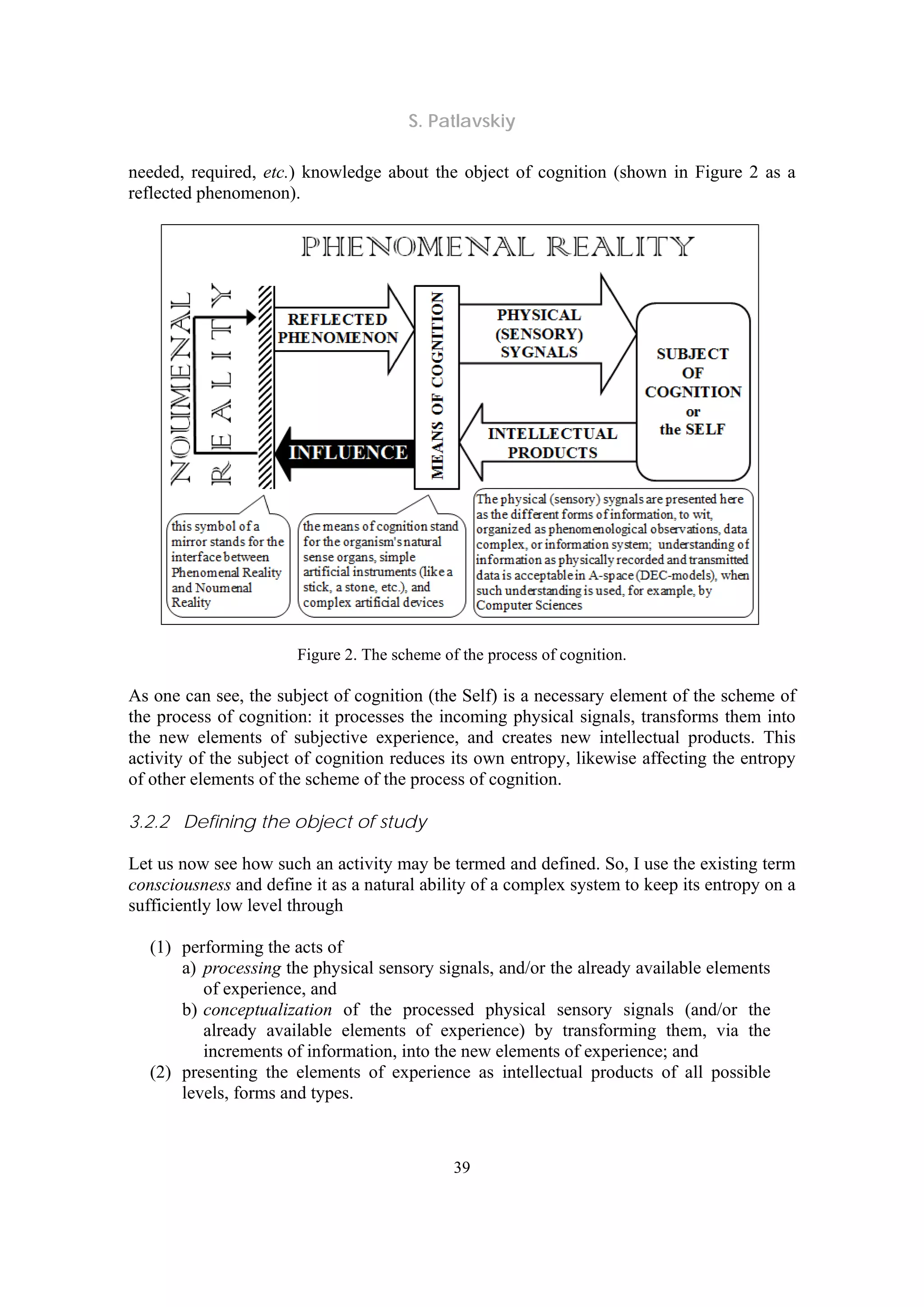
If we have a circular graphic model which consists of the elements which follow each other
in a circular (oroborous) manner (see, for example, Figure 2 for the Scheme of the process
of cognition), and the very graphic model is functional and evolving, then every element of
that model is defined by the previous element thus: the element 2 is the one which follows
the element 1 and precedes the element 3; the element 3 is the one which follows the
element 2 and precedes the element 4; ...; the element n is the one which follows the
element n-1 and precedes the element 1. Such a method of defining the elements of circular
model I call the method of tautological cycle.
In the case above every new concept (which stands for the element of circular model) is
introduces according to the CSS principle called "Definition of the element of the model".
In general, I consider twelve CSS principles (see Appendix 2).
I would like to stress that my meta-theory consists of assertions that use the concepts being
introduced in the way described above. Such a way of introducing the concepts enables
unequivocal treatment of these concepts. For example, a physicist introduces a notion that
is not familiar to the biologist, and vice versa. But, if these two representatives of different
scientific disciplines were using the same CSS principles to introduce their concepts, then
the two correspondent concepts, even using the different terms (or, being put in different
words), would have similar cognitive sense and would become familiar to both scientists.
General Theory: the Problems of Construction
18
Therefore, the application of CSS principles leads to creation of a universal
interdisciplinary language.
Also, if we know which CSS principle was used to construct the given concept written or
spoken in an unknown language, then we may predict its cognitive sense, or, simply
speaking, to understand its meaning. The fact is that while there are zillions of all possible
words, there are, as I believe, only twelve CSS principles, and this gives a chance of
deciphering some complex texts (these ones, which, as is presumed, express rational ideas).
So, we have just considered the principles of constructing the concepts. As we know, the
concepts are the elements of an assertion. Therefore, let us now see which principles I use
when filling my meta-theory with assertions.
2.7 The First basic idea of Nonstatanalysis
The third criterion of approach presumes constructing a suitable theoretical base. It is
important mentioning that it is not constructed from scratch, and is rooted in the theoretical
base of modern science. Let us now see how I come from the latter to the former. First, I
introduce a concept cognitive space, by which I mean a pair of two already existent
concepts, namely the theoretical base of the process of cognition, and the means of
cognition. (Here, the new concept was introduced through the CSS principle called
"Association"; see Appendix 2).
According to a comprehensive definition, the theoretical base includes various theories,
methods, models, and, virtually, any kind of knowledge being used when explaining some
phenomenon. The means of cognition, according to the comprehensive definition too, stand
for the natural sense organs, artificial devices and various laboratory equipment, reagents,
tools, instruments, etc.
The role of the concept of cognitive space is then in showing that the theoretical base and
the means of cognition are interlinked: they always depend on each other, and should
correspond to each other. For example, let us take "computer" as a means of cognition, and
"knowledge of how to use a computer" as a theoretical base. Then, without knowledge of
how to use a computer, a computer is useless, and vice versa, without a computer, our
knowledge of how to use a computer is useless too. In other words, the theoretical base and
the means of cognition are mutually dependent and correspond to each other, or are linked
by inverse link (or inverse relation). If to put the idea schematically, we receive:
theoretical base + means of cognition + inverse link => cognitive space
Next, I call the A-type of cognitive space (or, the A-space for short) the one which
comprises the theoretical base and the means of cognition of modern science (say, Physics).
Second, I consider some element that would help me perform the required transition, and
the idea of that element becomes clear from the following example. Let us consider a
cognitive space whose theoretical base presumes the flatness of the Earth, and whose means
of cognition are just the human's sense organs. Let us call it the A'-space. Then, the
S. Patlavskiy
19
assertion "The Earth is a globe" will be treated as a paradox from the point of view of the
A'-space. But this same assertion will be not treated as a paradox from the A''-space if the
theoretical base and the means of cognition of the A''-space are sufficiently developed to
prove sphericity of the Earth. In this case, I call the assertion "The Earth is a globe" a
cognitive paradox (see Patlavskiy, 1999, Figure 1).
So, the cognitive paradoxes are those elements that help me to come from one cognitive
space to another cognitive space. Then, bearing in mind my MT-aim (namely, to show that
Reality includes all possible phenomena), I sort out all possible phenomena into the ones
that can be explained within the A-space, and the ones that can't. Then, I call the theoretical
base and the means of cognition required to explain the rest of phenomena (or, these still
unexplainable phenomena) as the B-type of cognitive space (or, the B-space for short).
But, which assertions should be used as cognitive paradoxes to enable making a transition
from the A-space to the B-space? In general, I have found seven such assertions and called
these paradoxes the algorithms of interspatial transition (see Appendix 3). These allow me
to fill up the meta-theory with assertions needed to construct the B-type of cognitive space.
So, to achieve the formulated MT-aim, namely, to explain all possible phenomena and
prove they all belong to the same Reality, I formulate the First basic idea of
Nonstatanalysis: to explain Reality in all its complexity, the subject of cognition has to
conduct the process of cognition as in the A-space, so in the B-space. From this follows
that the general method of Science must include as the methods currently used by Physics
and other existing disciplines, so the method(s) required to study still unexplainable and
other non-statistical phenomena. Here, by method I mean an expedient set of one-time
performing actions required to change the state of a system. Now, in what follows, we will
see how I come to the idea of non-statistical method.
2.8 The theoretical base of Nonstatanalysis
2.8.1 On the general method
I start by examining the schemes of the process of cognition (see Patlavskiy, 1999, Figures
2 and 3), analyze how the forms of information organization evolve, and come to the idea
that there must be some additional, or fourth form of information organization.
In Section 2.1.1, I have indicated that phenomenological observation, data complex, and
information system, as the first three forms of information organization, are just the ever
evolving collections of discrete data about a certain object of study. But, the discovered
fourth form of information organization possesses a few qualitatively new and important
features. So, I call this new form of information organization an integrated information
system (or IIS for short)16
and mean by it a limit towards which information (or knowledge)
about the object of study tends.
So, the IIS is something more than mere collection of data. The other important feature of
this fourth form of information organization is that it covers not only the object of cognition
General Theory: the Problems of Construction
20
(as do the first three forms), but also the very subject of cognition, so that even the
mechanisms of cognition become the object of cognition too (see Patlavskiy, 1999, Figures
4, 5, 6). This moment is very important since my MT-aim presumes explaining all possible
phenomena and processes, including the mechanisms of cognition, and to achieve the aim I
must somehow formalize these mechanisms as an object of study.
In general, to introduce the fourth form of information organization I formulate a special
postulate:
(1) a particular information system exists which includes expediently full
information (or knowledge) about the object of cognition.
However, for this assertion to fit Nonstatanalysis' MT-canon (let us recall that the MT-aim
talks about existential and developmental conditions, as well as about some natural law), it
has to be augmented by the following four assertions:
(2) such an information system cannot already be treated as a set (or, collection) of
discrete data about the object of study;
(3) such an information system is described by three systemic characteristics
(informational, material, and energetic) and one characteristic of its state (or
entropic characteristic);
(4) such an information system possesses some properties, universal for all similar
systems;
(5) such an information system evolves according to some law of development,
universal for all similar systems.
I refer to these five assertions, taken together, as the Postulate on existence of the
integrated information system (or the Postulate of IIS for short). This postulate is a meta-
theoretical five-part assertion that looks like a paradox from the point of view of A-space,
since it is currently accepted that no object can be described in full. For this assertion to be
not treated as a paradox, a transition has to be made from the existing one to some new
cognitive space. In other words, for this assertion to not look as a paradox, we have to
come from the A-space to the B-space, simultaneously using the Postulate of IIS as the
basis for the B-space's theoretical base. Let us now see of what immediate use the concept
of IIS might be.
According to Kant (1929), the only service of the idea of noumenon (which, according to
him, are the things in themselves, in contradistinction to the things of appearance, or
phenomenon) is to "mark the limits of our sensible knowledge and to leave open a space
which we can fill neither through possible experience nor through pure understanding"
(Kant, 1929, p. 294; bold is mine). By criticizing the idea of pure reason, he stresses that we
cannot "positively extend the sphere of the objects of our thought beyond the conditions of
our sensibility, and assume besides appearances objects of pure thought, that is, noumena,
since such objects have no assignable positive meaning" (ibid., p. 293).
Now then, in my case, to mark the limits of knowledge, I use the idea of IIS, and make
Kantian critique of pure reason already not actual, since the noumenon become expressible
using the concept of IIS. In other words, to grasp (or enframe) the noumenon (or an entity
S. Patlavskiy
21
that is beyond the process of cognition), we may now use the model of IIS instead of "pure
reason".
Let us now consider other cases in which the idea of integrated information system may be
applied. As follows from the Postulate of IIS, whatever IIS we take – the IIS{atom}, the
IIS{living cell}, the IIS{geographical site}, the IIS{galaxy}, the IIS{historic moment}, the
IIS{human}, etc. – they all possess the same properties, are being described by the same set
of characteristics, and obey the same law of development. Here, an atom, a living cell, etc.
are enframed as systems. In general, the enframing of some entity and its formalization
using the model of integrated information system constitutes the method of IIS.
I define method as a set of one-time performed actions aimed to turn a complex system into
a new state as required by the performer of these actions. For example, a surgeon aims to
cure patient's appendicitis – he aims to turn a patient from the state of being ill into the state
of being healthy. To achieve the aim, a surgeon (being assisted by other doctors) performs
the following set of one-time performed actions:
(1) making the patient anesthetized;
(2) performing the incision of patient's belly;
(3) cutting off the appendicitis;
(4) stitching the belly;
(5) performing the required resuscitation procedures.
The above set of one-time performed actions may be called a method of operative
treatment while curing appendicitis. After every action is being performed by a surgeon,
the state of the patient changes until the patient achieves a new state as was required by the
surgeon. (The one-time performed action means that we cannot, for example, cut off the
same appendicitis twice).
To the point, the same aim can be achieved by applying different methods, each one having
different efficiency. As a case in point, a tribe healer may suggest his own method of curing
appendicitis, and it will be a set of other one-time-performed actions.
Next, I call scientific a method that is most effective (by which I mean appropriate) when
studying this concrete phenomenon, or when trying to change the state of this concrete
complex system. From the fact that the given method is effective (or scientific) in one
research field does not follow that it must be effective (or scientific) in all other research
fields. For example, the methods of Physics are not effective while studying consciousness-
related phenomena. The method we use to study how the wall clock works cannot be used
when trying to study the mechanisms of consciousness.
Let us now see how this method works, and in which cases. The main feature/condition of
applicability is as follows: when we cannot have all required information about the object
of study (say, the object is rare, or non-repeatable) we may formalize this object as an
integrated information system – the IIS{object}. Then, since, according to the postulate,
every integrated information system evolves obeying the same universal law, we receive an
General Theory: the Problems of Construction
22
opportunity to predict the behavior of IIS{object} even if we have only one case of
appearance of that object, or having only some minimal research statistics.
In Physics, to predict the behavior of an object, there must be sufficient research statistics
amassed, and, therefore, the statistical methods are dominating. But, are the traditional
statistical methods effective when studying complex phenomena? Here I suggest that while
the application of statistical methods may (in some cases) help to prove the very existence
of some complex phenomenon (as it was the case, say, with various PEAR Lab's
experiments; see Jahn and Dunne (1997), the non-statistical method enables study of
complex phenomenon in its development and in interaction with other phenomena and
processes.
For example, the phenomenon of remote viewing can be easily explained through the inter-
system interaction of integrated information systems, since the method of IIS enables
formalization of both the human and the remote site as the IIS{human} and the IIS{remote
site} correspondingly, and addressing a standard interaction between these integrated
information systems.
It is worth noting that there is a sense of applying the method of IIS only when, during the
experiment, we cannot ignore the presence of informational factor and the change of
entropic state of the investigating phenomenon. But, in the cases when such factors may be
safely ignored (say, when we are not interested in what the person thinks about, but in how
much her brain weights, what is its volume, and how many neurons it consists of), there
would be a sense of applying the traditional statistical methods of science.
I hold that to do science in the field of consciousness studies means to apply appropriate
methods of study. For example, the method of decomposition is good when studying a
coconut by cracking it into pieces. However, when studying consciousness we would apply
the method of decomposition and crack the brain into pieces, it would not mean that we act
scientifically. Therefore, in addition to the definition of Science provided in Section 2.2
above, I would add here that the research activity can be called scientific iff (viz., if and
only if) the method of study corresponds with the nature of the object of study. I refer to
this requirement as the Principle of method-object correspondence.
The important conclusion here is that the method of IIS was developed to be used not
instead of, but in addition to the existing methods of science, and this moment permits
Nonstatanalysis to serve as a parental meta-theory (or provide an epistemological
framework) as for the new discipline called Interdisciplinary Investigations that studies the
non-statistical phenomena, so for Physics and other existing disciplines that address the
statistical phenomena of Reality.
2.8.2 On the system of models
The third criterion of approach, besides the general method, presumes also constructing a
suitable modeling. Here, I have elaborated the associational (AS), decompositional (DEC)
and dissociational (DIS) models, and application of these models I call the IIS-modeling
S. Patlavskiy
23
(see Patlavskiy, 1999, Figure 8b). In doing so, the A-space makes use of DEC-models,
while the B-space makes use of DIS-models. As was mentioned in Section 2.3, these
models may be referred to as physical models and informational models correspondingly,
and, while formalizing the phenomena and processes, they are being applied in a
complementary mode,17
or as a system of models.
For example, if we formalize Solar System as the element of AS-model, then this element,
as something Whole, may either decompose into atoms as the elements of DEC-model, or
dissociate into other Wholes like IIS{star}, IIS{planet}, IIS{asteroid}, etc. which are the
elements of DIS-model (see Patlavskiy, 1999, Figure 11c). Similarly, if we formalize
Government as the element of AS-model, then this element, as something Whole, may
either decompose into clerks as the elements of DEC-model, or dissociate into other
Wholes like legislative authority, executive authority, and judicial authority which are the
elements of DIS-model.
In fact, the idea to consider as decompositional, so dissociational models follows directly
from the Principle of system-structure indeterminacy. I formulate it thus: the more we try to
comprehend something as a system, the less we are able to comprehend it as having certain
structure; and vice versa, the more we try to comprehend a structure of something Whole,
the less we can comprehend it as some system. However, to comprehend something in full
means to comprehend it both as a system and of having a certain structure. Therefore, to
comprehend something as a system, I suggest formalizing it as an element of dissociational
model, and, to comprehend something as having certain structure, I suggest formalizing it
as an element of decompositional model. For example, we may formalize the working
engine as something Whole, or as an element of DIS-model, whereas, having picked this
engine to pieces, we may use DEC-model to formalize the set of engine's parts.
I must admit that there are many notable distinctions between the DIS- and DEC-models.
Say, in the A-space (DEC-model) there is a cause-effect relation between the elements,
while in the B-space (DIS-model) there is an inverse relation between the elements.18
The
DEC-model formalizes some collection of discrete elements, while the DIS-model
formalizes the Wholes by which I mean the entities formalized as the integrated
information systems.19
In the A-space (say, in Physics), a system may have infinite number
of degrees of freedom, while in the B-space, the integrated information system may have
only three (nor more, nor less) degrees of freedom plus a big-but-finite number of entropy
states of that same system.
In the A-space (DEC-model) there is a concept physical frame of reference (or PFR for
short), but for the B-space (DIS-model) I introduce a concept cognitive frame of reference
(or CFR for short). The PFR is linked with observer (who only records the events), but, in
principle, this kind of the frame of reference may be linked even with mechanical device
designed to record the incoming physical signals. However, the CFR is linked with subject
of cognition – an agent who does not only record the events, but also conducts the process
of cognition due to possessing consciousness. In some sense, the PFR refers to CFR as
third-person perspective refers to first-person perspective.
General Theory: the Problems of Construction
24
If we return back to our example of remote viewing, after applying the method of IIS and
formalizing the human and the remote site as the IIS{human} and the IIS{remote site}
correspondingly, these two integrated information systems are being regarded as the
elements of the same DIS-model. It is important noting that the standard inter-system
interaction of integrated information systems can take place only for the elements of the
same DIS-model.
By the way, the concepts of space and time which have their cognitive sense in the A-space
(say, in Physics) lose their sense in the B-space. Therefore, the inter-system interaction of
the integrated information systems as the elements of the same DIS-model happens in no
time (to wit, instantly), and in no space (to wit, despite of the distance between these
systems).20
And this moment enables me to explain the various cases of telepathy.
As to the AS-model, it is used to formalize the entities which we are going to cognize, but
still stay beyond the process of cognition. For example, the IIS{Reality}, being an element
of AS-model, is already "grasped", or enframed, but is still not cognized, or not
transformed into an object of cognition. It is important to indicate that whatever system of
AS-DIS-DEC models we take, there can simultaneously be only one element of AS-model,
a big-but-finite number of the elements of DIS-model, and the unlimited number of the
elements of DEC-model.
It should be mentioned that the elements of DIS- and DEC-models possess sharply unlike
properties. For instance, unlike the elements of DEC-model, the elements of DIS-model do
not possess the property of entropy additivity (for more properties see Patlavskiy, 1999,
Table 2). I also recognize four degrees of complexity of AS-, DIS-, and DEC-models (see
ibid., Figure 12), and use the system of AS-DIS-DEC models of the required degree of
complexity as dictated by the explanatory needs. Say, the known in Physics phenomenon of
nonlocal entanglement, to be explained, requires constructing the system of AS-DIS-DEC
models of the fourth degree of complexity.
Let us see how the system of AS-DIS-DEC models can be applied when formalizing
canons (see Section 2.1.1). A canon for the given intellectual product is constituted by
certain aim and correspondent criteria of approach (by which I mean the consecutive steps
on achieving the aim). When we want/wish/desire something (we have some aim), it means
that we enframe some aim, thereby distinguishing it from other aims. So, we will have the
IIS{aim} as the element of AS-model. Then, we perform the AS-DIS transition and receive
a chain of IISs: the IIS{first step on achieving the aim}; the IIS{second step on achieving
the aim}; ...; the IIS{n-th step on achieving the aim}.
To know whether the given system of models provides an adequate representation of
Reality, it is not sufficient just to rely on the principle popularly known as "seeing is
believing". So, to test the validity of all assertions as the elements of the constructed meta-
theory, a special system of proofs was elaborated.
S. Patlavskiy
25
2.8.3 On the system of proofs
The system of proofs of Nonstatanalysis grounds on the following three postulates, and one
principle. The first postulate states:
a) if the hypotheses, theorems, laws and postulates form a closed and all-sufficient
explanatory framework;
b) if such an explanatory framework enables a subject of cognitive activity to
perform the process of cognition in reference to any object of cognition (this
means that the Big circle of the process of cognition is not torn; see Figure 2
below); and
c) if during the process of cognition such an explanatory framework self-improves
by moving from level to level (see Section 2.5 for the fourth criterion of
approach),
then every element that constitutes such an explanatory framework (i.e., postulate,
law, theorem, hypothesis, etc.) should be treated as valid and pertinent, and such one
that requires no more proofs of its validity and pertinence of its usage.
The second postulate states:
a) if the MT-level intellectual product consists of assertions that all fit its MT-canon;
b) if the problems of subjectivity of both the aim and criteria of approach that
constitute that canon are solved (see Section 5.3, and Appendix 1, assertions 27
and 36 correspondingly),
then any assertion of the given MT-level intellectual product is true, and requires no
more proofs of its validity and pertinence of its usage.
The third postulate states: every phenomenon (process or problem) should be treated as
real if it is formalizable and explainable using the B-space’s theoretical base. This
postulate follows directly from existential condition (formulated in Section 2.4). In other
words, to prove the reality of the phenomenon means to show that it can be formalized as
the IIS{phenomenon}, and it can be an element of either AS-, DIS-, or DEC-model.
Let us now consider a Principle of indeterminacy of the subject's functional status.
Suppose, some event must happen in the future (say, a powerful earthquake). Now,
consider a person who makes public one of the following statements before the event has
happened: 1) I can evoke the earthquake; and 2) I can forecast the earthquake. Then, after
the event has taken place, the person will be treated either as possessing a means of evoking
earthquakes, or as a forecaster depending on the statement he has made before the event.
So, this principle states that there is no ways to prove whether the person's function was to
be a cause of the event, or just a forecaster of the event – these two possibilities are
equivalent, and the person's functional status stays undetermined.21
General Theory: the Problems of Construction
26
2.8.4 Entropy and the Law of IIS development
Let us now consider the behavior of the elements of DIS-model and the cause that makes
them to change their states. As follows from the Postulate of IIS, the entropic characteristic
speaks about the state of integrated information system. The entropy I am talking about
always reduces within certain CFR. So, in Nonstatanalysis (unlike Thermodynamics),
entropy is a subjective factor. For example, the same distribution of material things (say,
toys) in a room may be a sign of low order (high entropy) for a father who is waiting for
guests at dinner party, and of high order (low entropy) for his child who, at this very
moment, is playing right under the table in the dining room.
So, the Law of IIS development (as an element of the Postulate of IIS) says why and how
the entropic characteristic of integrated information system changes. Being expressed in
one sentence, the law states that every integrated information system tries to reduce the
value of its entropic characteristic. However, this law consists of many partial laws, for
example: any change of informational characteristic of IIS (with appearance of the
increment of information) brings about the change of its material characteristic, provided its
energetic characteristic changes optimally.22
The full formulation of this partial law is as
follows. On the assumption that the entropic characteristic of the IIS stays unchanged, then:
(1) every change of its informational characteristic results in the change of material
characteristic with effectiveness dependent on the value of energetic
characteristic;
(2) every change of its material characteristic results in the change of informational
characteristic with effectiveness dependent on the value of energetic
characteristic;
(3) every change of its energetic characteristic results either in
a) simultaneous change of informational and material characteristics, or
b) a case when informational characteristic changes, but material characteristic
stays quasi-unchanging, or
c) a case when material characteristic changes, but informational characteristic
stays quasi-unchanging (see Patlavskiy, 2005, Section 2.5.2, Law 3).
If the entropic characteristic of the IIS changes and we have a set of states of the same IIS,
or if we consider a set of different integrated information systems as the elements of the
same DIS-model (graphically, this set looks like a chain of systems), then I call such a set a
veritas chain. A typical example of such a chain is the DIS-model of the organism's
development starting from the IIS{inoculation}, through the IIS{childhood}, the
IIS{adulthood}, and up to the IIS{senility} – whichever IIS from this chain we take, it
formalizes the living organism. In other words, the fact that the organism stays alive is an
undeniable truth, or, in Latin, veritas.
Next, I call veritas transition a transition from one true state to another true state of the
same IIS within the same DIS-model. I also make a difference between the weak and strong
veritas transitions. The latter takes place when the values of entropic characteristic of initial
and resulting states differ considerably.
S. Patlavskiy
27
Let us consider another example of veritas chain. Say, a person wishes to have dinner. Then
the following veritas chain is being built having the CFR linked with that person: the
IIS{feeling of hunger}, the IIS{kitchen}, the IIS{fridge}, the IIS{cooker}, the IIS{table},
the IIS{plate}, the IIS{spoon} – these are the elements of the same DIS-model. Then, the
DIS-AS transition takes place and we receive the IIS{repletion} as the element of AS-
model.
I should also mention that whichever veritas chain we take or construct, it may be very big
(long, large) but necessarily finite (or big-but-finite for short). Consider the following
example: whatever number of nucleotides a DNA molecule is composed of might be, that
number (or the longevity of a DNA molecule) is always big-but-finite; whatever number of
living organisms is on the Earth, that number is always big-but-finite; whatever number of
stars is in the Universe, that number is always big-but-finite; and so on.
Other partial laws state that every IIS can simultaneously be the element of big-but-finite
number of veritas chains. Given the big-but-finite number of veritas chains, every IIS can
choose the one in which the value of its entropic characteristic will become reducing more
readily (see Patlavskiy, 2005, Section 2.5.2, Laws 9 and 10).
I hold that the Law of IIS development (to wit, the fact that any IIS tries to reduce its
entropy) is universal, and pertains to any entity that is formalizable as an integrated
information system. If we formalize Reality as the IIS{Reality} – the element of AS-model,
then all its phenomena and processes may be formalized as the elements of the same DIS-
model: the IIS{phenomenon1
}, the IIS{phenomenon2
}, and so on, which constitute the big-
but-finite veritas chain too. That is why all existent entities are existentially and
developmentally compatible among themselves, by which I mean that the existence and
development of the IIS{phenomenon1
} does not render impossible the existence and
development of the IIS{phenomenon2
}.
The existential and developmental compatibility is also responsible for the facts that the
Universe is filled up with coexisting stars and galaxies, the Earth is filled up with myriads
of coexisting organisms, and that is why a system (say, a cell) can divide into two quasi-
identical and simultaneously existent systems. In Section 3.1, we will go from the problem
of coexistence of organisms to the problem of their existence, or their origin, but let us first
consider the Law of Entropy Conservation and make some important conclusions.
2.9 The Law of Entropy Conservation
As was stated in Section 2.4, having a need to keep the meta-theory consistent, the Law of
Conservation of Consciousness was formulated. Also, as was mentioned therein, the
developmental condition presumes changeability of entropic characteristic of a system. So,
the development of a system is as important as its existence. Within the Universe, there can
be nothing existent that is not simultaneously developing, or, as a system, changing its
entropic state. But, what can be said about the entropic state of the Universe as a whole, and
what causes the developmental (and evolutionary) processes within the Universe?
General Theory: the Problems of Construction
28
In answering these questions, I start with assuming that the Universe is a system which, by
definition, must include everything (including space), and must be considered as a closed
system. This means that there is nothing that our Universe can interact with. Since the
Universe is a closed system, then its entropic state does not change. In other words, the
Universe, as a whole system, is not changeable or evolving.
Being based on the above mentioned considerations, and having a need to keep the meta-
theory consistent, the Law of Entropy Conservation was formulated: the entropic state of
the Universe formalized as the integrated information system being the element of AS-
model stays unchanged at all changes of entropic states of the integrated information
systems being the elements of the DIS-model (of the veritas chain) spawned by the given
AS-model.
This law directly requires that the entropic states of the systems (that are the elements of the
chain) must be permanently changing to keep the entropic state of the Universe unchanged.
From this prime principle of development follows all that variety of developmental
processes we observe around and within us.
The formulated law has two derivative principles. The first one states that if we take two
systems as the elements of the same chain, then the reduction of entropy of one system
causes the increase of entropy of another system. I will call this case competition. The
second derivative principle is that in case we take three systems as the elements of the same
chain, then the entropy of the first and second systems can be reduced at the expense of
increasing the entropy of the third system. I will call this case cooperation (between the
first two systems).
Now then, there is one prime and two derivative principles that the Universe operates by.
Therefore, if we consider evolution as a natural process driven by the prime principle, then,
while constructing the theory of evolution and describing its mechanisms, we should take
into account both the first and second derivative principles, namely, the principle of
competition and the principle of cooperation between interacting systems.
Summing up, I would like to mention that Nonstatanalysis accepts the laws of matter and
energy conservations, and adds the laws of consciousness and entropy conservation.
2.10 Concluding remarks
The fourth criteria of approach will be considered in Section 4.3; the sixth one will be
discussed in Section 4.2 below. As to the fifth criterion of approach, here I coin a term R-
fact (short for reliable fact), and use it to make a difference between the known and still
unknown non-statistical phenomena. So, by this term I mean a reliable, well documented
observational and/or experimental scientific fact, which, at the same time, does not find its
explanation within the limits of any of the existing scientific theories. Among the R-facts
there is a déjá vue phenomenon, a phenomenon of hypnosis, a placebo effect, an effect of
transmutation of fundamental particles, a precise self-orientation of birds during their
S. Patlavskiy
29
seasonal migrations, a phenomenon of being stared at, a phenomenon of nonlocal
entanglement, and many others.
To summarize, I would like to note that, by now, the B-space's theoretical base consists of
dozens of partial postulates, laws, principles, doctrines, correlations, theorems, properties,
and other elements. This new theoretical base is incompatible with, and leaves no room for
anthropocentrism, reductionism, physicalism, epiphenomenalism, panpsychism, and the
like doctrines which are tolerable in the A-space. By design, the B-space has to give a
possibility to explain as the known complex facts, events, and processes, so the ones that
still are waiting to be discovered. I predict that whatever phenomenon could be discovered
in the future, it would necessarily be formalizable either in the A-space, or in the B-space.
General Theory: the Problems of Construction
30
3 The applied theories of Nonstatanalysis
3.1 The applied theory of the origin of life and consciousness
3.1.1 On the ways of entropy reduction
As was mentioned in Section 2.4, for some entity to exist, it must be formalizable as a
system which describes simultaneously by informational, material, and energetic
characteristics. Bearing this existential condition in mind, I presume that the value of
entropic characteristic of such a system can be reduced:
(1) by changing the informational characteristic; or
(2) by changing the material characteristic; or
(3) by changing the energetic characteristic; or
(4) by a combination thereof (the Law of IIS development addresses all possible
combinations; see Section 2.8.4 for a partial law).
If we take a stone and an organism, and, by applying the method of IIS, formalize them as
the IIS{stone} and the IIS{organism} respectively, both these systems will be described by
their three systemic characteristics, including the informational ones. So, any entity, in
virtue of its being existent, is describable by a changeable informational characteristic –
this idea is at the heart of my doctrine of pan-informationism.
Now then, the value of the entropic characteristic of the IIS{stone} can be reduced in the
ways mentioned above, including the first one, namely, by changing its informational
characteristic. This may happen (sometimes spontaneously) due to inter-system interaction
between the IIS{stone} and the IIS{human} when the human enframes the stone as an
object of interest, and, as a result, the stone may even start flying in the air (as in the case of
poltergeist).
But, a stone is not itself able to reduce its entropy through changing informational
characteristic considerably enough for the effect of self-organization (or entropy self-
reduction) to become present. By this effect I mean a case when some complex system,
having acquired a certain low value of its entropic characteristic, tries to keep this value at
such a low level itself and making that value even lower.23
However, an organism is such a
complex system, and it can itself (especially, through changing its informational
characteristic) keep the value of its entropic characteristic on a sufficiently low level, and
make that value more low.
Let us now concretize the ways in which an organism can reduce the value of its entropic
characteristic. So, the way to do this is either/or:
(1) through dealing with physical signals, and, via the increments of information,
transforming these signals into the elements of experience;
(2) through consuming food and other material resources;
S. Patlavskiy
31
(3) through taking part in energetic interactions and optimization of usage of
available resources;
(4) through a combination of these three ways.
As it can be seen, when we consider the IIS{organism}, we can link its informational
characteristic with organism's ability to discern the difference between its kin and food; we
can link its material characteristic with the facts of taking food by the organism; we can
link its energetic characteristic with the facts of energetic interaction of the organism with
its ambience; and, finally, we can link its entropic characteristic with the organism's overall
state. So, the model of IIS is very apt when formalizing an organism.
Since the IIS{organism} describes also by informational characteristic, and since this
characteristic can change, it means that its change can reduce the value of entropic
characteristic of the IIS{organism} too.
So, if to compare the four possible ways of entropy reduction mentioned at the beginning
of this section and now, we may easily come to conclusion that there is, in fact, no cardinal
distinction between the dead and animated matter. I mean that the IIS{stone} and the
IIS{organism} differ only in the value of their entropic characteristics and, consequently,
in the absence/presence of the effect of self-organization. The latter assumption gives me a
possibility to suggest an applied theory of the origin of life and consciousness.
3.1.2 On the peculiarities of water structure
The commonly accepted view is that life on the Earth first appeared in the ancient ocean. I
share this view, and, when trying to explain concrete mechanisms of the advent of life, I
rest on the idea that water is a specific chemical that includes regions with naturally low
entropic states. I believe that these regions appear due to the tetrahedral (pyramidal)
molecular structures that water consists of. I presume that any pyramidal structure (either
on molecular or on macro-scale) possesses natural ability of reducing its entropic state.
As a case in point, having used the third-generation synchrotron light sources which
enables to perform small-angle X-ray scattering with much higher accuracy and
reproducibility, Huang at al. (2009) discovered the presence of two distinct and
temperature independent kinds of molecular self-arrangement in liquid water: one with
tetrahedral structures as a minority and one with a high hydrogen-bond (H-bond) distorted
asymmetrically as a majority; and these regions, according to the authors, are characterized
by low and high entropy values: "the tetrahedral structure is of lower energy – lower
entropy and the distorted structure of higher energy – higher entropy" (Huang at al., 2009,
p.15217).
I assume that, in this case, for every region with naturally low entropic state, where the
value of entropic characteristic is sufficiently low, the effect of self-organization is present.
But, why and when does this effect appear? To answer this question, let me first indicate
that the regions with naturally low entropic state in any object may appear in principle
General Theory: the Problems of Construction
32
because the IIS{object}, as any other integrated information system that obeys the Law of
IIS development, is always trying to reduce its entropy.
Second. In the general case, the effectiveness of the attempts to reduce own entropy sharply
increases after the entropic characteristic of the IIS{object} reaches its sufficiently low
value. This happens because the intensity/effectiveness changes not linearly, but obeys
some exponential law (see Patlavskiy, 1999, Figure 13), and this exponentiality, in its turn,
appears because of peculiarities of interaction between the IIS' systemic characteristics. For
example, when an energetic characteristic is of a certain value, then the little change of
material characteristic brings about a sharply increasing change of informational
characteristic of the IIS{object}.
So, as follows from Patlavskiy (1999, Figure 13), the effect of self-organization appears
only after the value of entropic characteristic of the IIS{object} crosses the point Sself-org.
Then, in obedience to the Law of IIS development, the IIS{object} with value of its
entropic characteristic S < Sself-org starts looking for the most effective ways of keeping the
achieved low value S intact, and making it even lower, and, in doing this, the object is free
to choose between the three ways of entropy reduction mentioned above, or use a
combination thereof.
In fact, Huang at al. (2009) discovered a decomposition of "total scattering structure factor
S(Q) into a part SN(Q) associated with "normal liquid" behavior and an anomalous part24
SA(Q) associated with critical phenomena" (Huang at al., 2009, p.15215; here, symbol Q
denotes the scattering momentum transfer). As I suppose, this decomposition appears
because the entropic characteristics of these water structures are naturally fluctuating
around the point Sself-org. In so doing, if the value of entropic characteristic of the IIS{water
part} becomes less than Sself-org, then we receive the low entropy water parts; if the value of
entropic characteristic of the IIS{water part} is higher than Sself-org, then we receive the high
entropy water parts.
Consequently, the continuous reduction of entropy of the low entropy water parts (or, the
parts which possess the property of self-organization) increases the entropy of the high
entropy water parts, and this, in its turn, causes the persistent in time and observable
experimentally distinction between these parts. So, at ambient conditions, water is a natural
mixture of low and high entropy parts. That is also why water possesses the experimentally
detectable anomalous physical features.
3.1.3 From a low entropy water part to a unicell
As was shown in previous section, water naturally (or in virtue of being such a natural
substance) consists of the parts with low and high entropy states. Then, if the ambient
conditions are favorable (there is sufficient quantity and quality of the dissolved chemicals,
and the temperature is apt), then the IIS{low entropy water part} can continue reducing its
entropy by dealing with dissolved chemicals (and this corresponds to changing its material
characteristic) and by warming itself up (and this corresponds to changing its energetic
characteristic).
S. Patlavskiy
33
However, this is not sufficient for life to appear yet. By this I mean that the presence of the
complex organic chemicals and sufficient ambient temperature is not a cause of life, but
only a necessary condition for realization of the second and third ways of entropy
reduction, namely, by changing the material and energetic characteristics.25
But, what about the first way of entropy reduction listed in Section 3.1.1? As it turns out,
the entropy reduction through dealing with physical signals and, via the increments of
information, transforming them into the elements of experience becomes actual after the
value of entropic characteristic of the IIS{water part} crosses the Sself-org point, and its
effectiveness increases with entropic characteristic becoming more and more low.
So, as I believe, the first way of entropy reduction (namely, through changing the
informational characteristic) is that very important additional possibility that, together
with other two possibilities, enables the low entropy water part to stay self-organizing and
decreasing its entropy further up to transformation of the IIS{low entropy water part} into
the IIS{unicell}. In doing so, the low entropy water part could well be the common
predecessor for all the unicells. I mean that, say, archaea do not necessarily descend from
bacteria, and they could well appear simultaneously and independently of each other.
So, the IIS{unicell} could appear as the element of AS-model in the result of DIS-AS
transition after formation of the following veritas chain: the IIS{low entropy water part1
},
the IIS{low entropy water part2
}, ..., the IIS{low entropy water partn
}, and whether we
receive the IIS{bacterium}, the IIS{archaeum}, or the IIS{eukaryote} as the elements of
AS-model will depend on the value of material and energetic systemic characteristics of the
integrated information systems that constitute the veritas chain.
In fact, the unicell appears in image and likeness of the IIS{unicell}, namely, as a complex
system with delineated borders. This is because the IIS{unicell}, as a theoretical model of
the unicellular organism, is in one-to-one correspondence with the real unicellular organism
(this kind of correspondence will be detailed in Section 4.2 below). So, I hold that it is the
universal structure and properties of the IIS{living object} that predetermine the structure
and properties of the real living object.
The IIS{unicell}, or, in general, the IIS{biotic form} plays the role of an (informational)
matrix that makes the entity called "unicell" to become filled up with required chemicals.
We cannot list all the required chemicals and constituent elements, and cannot describe all
the processes taking place within the unicell, but the shortage of our knowledge is
compensated by application of the method of IIS. If we formalize the organism as the
IIS{organism}, it means that it describes by the expedient set of informational, material,
and energetic characteristics, which, in its turn, means that these characteristics have such
values that the resulting entropic state of the IIS{organism} is sufficiently low for the effect
of self-organization to appear.
In transition from pre-biotic to biotic form (see Figure 1), the entity formalized as the
IIS{biotic form} fills up only with such a chemical or constituent element that such an act
of "filling up" does not increase the value of entropic characteristic of the IIS{biotic form}.
General Theory: the Problems of Construction
34
Figure 1. Transition from the pre-biotic to biotic form. See Patlavskiy (1999, Figure 11)
for the system of AS-DIS-DEC models; one may also return back to examining
Figure 1 after becoming acquainted with Figure 5 in Section 3.2.5 below.
The cell's constituent elements (like DNA, RNA, and proteins) appear not in the result of
independent assembling, each from correspondent simpler blocks. Instead, we have the
filling up of the matrix that naturally exists as a certain integrated information system, or as
an example of what is possible.
The unicell is not the result of random processes that occur by blind chance. It is the result
of realization of what is possible, or what is predetermined by IIS's properties. That is why
the entity formalized as the IIS{biotic form} is already filled up with complexly interrelated
molecules like DNA, RNA and proteins co-working as a single whole. As to the
multicellular organism, it is a projection (or has structure and properties) of the elements of
DIS-model of the third order of complexity, namely, the model that considers ramifications
of veritas chains (see Patlavskiy, 1999, Figure 12).
I hold that water inside any living cell is, in fact, a low entropy part of water (it is definitely
not tapwater, or seawater). It may be regarded as a sought-for prebiotic form. As Hazen
(2005) hypothesizes, "certain primitive prebiotic isotopic, molecular, and structural forms
are inevitably eaten by more advanced cells. It is also possible that these chemicals will
survive as "fossils" only if cellular life never developed to eat them" (italics in original). So,
the (prebiotic) low entropy part of water were, in fact, not eaten, but incorporated into the
protocell's body, and still successfully exist.
If the value of entropic characteristic of the IIS{unicell} becomes higher than that of the
IIS{low entropy water part}, then the living cell dies. The presence of parts that have the
values of entropic characteristic of IIS{water} naturally less than Sself-org permits me to
treat water as simplest self-organizing complex system (or, a simplest living organism).
S. Patlavskiy
35
Therefore, when considering the theory of evolution of the complex self-organizing
systems such as living organisms (see Section 3.3 below), we will have to take the IIS{low
entropy water part} as an initial element of DIS-model which we will use to formalize the
evolvement of a living organism.
However, as I suppose, it may be not only water, but any substance, which, being in the
liquid (or, even, solid, gaseous, or plasmoidal) state, may include the regions with naturally
low entropic states. Therefore, theoretically possible is the existence of silicon-based
natural life forms (or, the high-temperature forms of life), the argon-based natural life
forms (or, the cryogenic forms of life), and, even, the plasmoidal natural forms of life.
3.1.4 On the relation between life and consciousness
The mechanisms of entropy reduction through dealing with physical signals (or, by
changing informational characteristic) will be discussed in next section, but now I would
like just to formulate the most important conclusions. First, I define life as a work, being
performed by a certain complex system, on keeping and evolving its own low entropy (or,
negentropic) states simultaneously through dealing with physical signals, through
consuming food, and through taking part in energetic interactions, and this work necessarily
results in increasing the entropy of the ambience.
Second, by consciousness I mean the first way of entropy reduction in the complex systems
whose entropy state is sufficiently low (namely, is less than the Sself-org). From this follows
that a stone does not possess consciousness yet, however it possesses changeability of its
informational characteristic. And in this the mentioned in Section 3.1.1 doctrine of pan-
informationism differs from panpsychism, a popularly known doctrine that everything
material (including stones and atoms) possesses an element of individual consciousness.
Next, I conclude that for there to be life, there must be self-organization, and for there to be
self-organization, there must be consciousness. Consequently, if there is life, there must be
consciousness. This means that I treat life and consciousness as being inseparable, and
suggest talking about life-consciousness in the same manner as physicists talk about space-
time. So, I hold that there can be no organism that would be alive but lacking
consciousness,26
and this must be as true for the Earth's organisms, as for any possible alien
forms of life.27
The above conclusion looks paradoxically from the point of view of A-space, since it is
commonly accepted (due to the dominance of Darwinian hypothesis of evolution) that
consciousness appeared only in high primates in the result of their evolution through
natural selection. However, this conclusion does not look paradoxically from the point of
view of B-space (if only because of the fact that this cognitive space has such elements as
existential condition, and the Law of conservation of consciousness; see Section 2.4).
It should be also noted that while formalizing the living organism as the IIS{organism}, I
consider mental organization as standing for its informational systemic characteristic, bio-
organization as standing for its material systemic characteristic, and effectiveness of bio-
General Theory: the Problems of Construction
36
mental interaction as standing for its energetic systemic characteristic (see Patlavskiy,
1999, Figure 8).
The final conclusion is that the applied theory of the origin of life and consciousness
presented above corresponds to my MT-aim, namely, to the formulated existential
condition. If other theorist formulates the unlike MT-aim (and, consequently, the unlike
MT-canon), then the theory of the origin of life and consciousness will be different too.
3.1.5 On the distinction between animated and dead forms of matter
A wide body of opinion exists among the representatives of natural sciences, especially
biophysicists, that there is nothing in the living organisms that could not be met in the non-
living material systems. For example, in his paper, Ivanitskii (2010) provides a table that
compares the features of the animated and dead matter, and argues that these features are
basically common. Among these features, according to the author, is the ability of both the
animated and dead forms of matter to memorize information about their previous states and
use this information when adapting to changes in the external environment. Then, in case
this information is memorized, this "kills" the alternatives, or eliminates other possibilities
for development of a material system, thereby reducing considerably the time required for
natural evolution.
Based on these arguments, Ivanitskii suggests a definition of life from the point of view of
modern Physics:
"Life constitutes an integrated system (biosphere) having memory and capable of directional
motion, self-propagation, metabolism, regulated energy flux, and reproduction. Life from the
point of view of physics can be briefly described as a result of a game process, an interplay
between part of the system and its environment. During the game, this part acquired an
ability to remember the probabilities of gains and losses in previous rounds, which gave it a
chance to exist in the following ones" (Ivanitskii, 2010, p. 353, italics in original).
The idea that some "part" of material system can, all of a sudden, acquire the ability to
remember something seems to be very speculative. However, the more serious problem
here is that the author totally ignores such a feature of the living organism as an ability to
create new knowledge. I must admit that the views expressed by Ivanitskii are being
criticized even within biophysical cognitive environment. For example, Melkikh (2011)
remarks:
"It is humans who use external links to send signals and thereby feed new information into
the neurocomputer (i.e., prepare it). Evidently, no neurocomputer would work, if left to its
own devices, without such preparation. In a word, neurocomputers cannot gain knowledge
by themselves" (Melkikh, 2011, p. 430).
Indeed, the computer monitor loses the luminosity of its pixels with time due to the effect
of burning-out, and the human loses his teeth with time due to ageing, but this common
feature of losing something does not make the monitor to be akin to human. The existence
of similarities between the features that we use to characterize the animated and dead
S. Patlavskiy
37
matter, of itself, does not solve the problem of the origin of life, saying not of the problem
of the origin of consciousness.
3.1.6 Concluding remarks
If to assume that archebiosis is the problem being solved by Nature, and the solution of this
problem presumes making a transition from the state with higher to lover entropic values of
some complex system, then it is exactly the problem that solves in strict obedience to the
Fourth cognitive paradox (see Appendix 3). Namely, in the result of inter-state transition,
the complex systems acquires not any possible state which could be acquired according to
probability theory, but only the state that goes next in the chain of allowed states of the
IIS{complex system}. The Law of IIS development is that natural goal-setting factor that
makes the inanimate form of matter to transform into its living form, and which reduces
considerably the time required for such a transition to take place.
As required by the Fourth cognitive paradox, the living form of matter is a solution to a
certain equation of expediency, where the interrelation of informational, material, and
energetic characteristics of the IIS{complex system} gives rise to its entropic characteristic
with a value necessary for that complex system to become self-organizing.
Since I consider the IIS{low entropy water part} as a simplest self-organizing complex
system, therefore, for me, there is no unbridgeable chasm between the dead and animate
matter. In this my approach cardinally differs from the one used in many, so called,
"assembly line" theories of the origin of life, where the living cell is treated as a final
product of assembling from the non-living organic molecules under extreme ambient
conditions like high temperatures, pressure, and violent ultraviolet radiation.
Also, as I believe, the prerequisites of existing state of the system are in the former state(s)
of this system. If the natural ability of the living organism to deal with physical signals and
transforming them into the elements of subjective experience plays important role on the
level of human, then there are no reasons to believe that the same ability would not play the
role of the equal importance on the level of a proto-cell. That is why I state that all the
living forms of matter are equally conscious as they are equally alive (see Section 2.4,
Assertion 2).
3.2 The applied theory of consciousness
3.2.1 On the scheme of the process of cognition
As was mentioned in Section 2.8, I come to the idea of integrated information system by
analyzing the schemes of the process of cognition. But, what is the process of cognition and
how it can be represented schematically?
Suppose, I am walking in the park, and all of a sudden I run into a very big, spherical, and
non-transparent Something. The whole process of coming from not seeing that Something
yet, to knowing what that Something is constitutes the essence of the process of cognition.
General Theory: the Problems of Construction
38
First, in the moment of "running into", my sense organs produce physical sensory signals
organized into phenomenological observation: "The Something is big, is spherical, is non-
transparent".
Then, I, as a subject of cognitive activity, after processing these physical signals, and being
based on my previous understanding of sphericity, bigness, and opaqueness, conceptualize
them as the new elements of my subjective experience: "There can be Something, which is
big, spherical, and non-transparent". Having ascribed the properties of sphericity, bigness,
and opaqueness to Something, I, being a subject of cognition, thereby transform some
cognitively independent entity into the object of cognition for me.
Then, being based on this knowledge, I decide to learn more, and with this end in view I
construct an intellectual product: "What will happen if I take a stick and touch the
Something?". Then, having touched the Something (namely, having moved the stick as a
simple artificial instrument to the interface between me and my object of cognition), I
receive a reaction in the form of reflected phenomenon which, through the device (here, the
stick), can be felt by my arm. So, I receive a new physical sensory signal: "A stick cannot
penetrate the Something", and after processing this new signal, I conceptualize it in the
form of a new element of my subjective experience: "The Something is solid".
Then, being based on this knowledge I decide to learn more, and with this end in view I
construct a new intellectual product: "What will happen if I take a stone and throw it to the
Something?". Then, with the help of another natural device – a stone, I produce more
powerful influence upon the interface between me and my object of cognition, and receive a
reaction (another reflected phenomenon) which through the device (here, my ears) becomes
a new physical sensory signal: "Vibrations of a certain frequency", and after processing this
new signal (and being based on my previous understanding of what is metallic, and what is
hollowness) I conceptualize it in the form of a new element of my subjective experience:
"The Something is metallic and hollow".
We may repeat this procedure again and again by changing our device (for example,
instead of a stone we may use a laser, then an X-ray and gamma ray equipment);
correspondingly, there will be new and new phenomena as reaction to the ever increasing
influence upon the interface. The form of organization of the receiving data will change
from phenomenological observation to data complex, then to information system. We will
have more and more new elements of our subjective experience. The intellectual products
we create will change from the simplest ideas like throwing a stone, to planning exquisite
bench studies. As one can see, everything changes here, but for the very scheme of the
process of cognition.
Now then, during the process of cognition, all the elements of the scheme repeat
themselves, and I talk about a big circle of the process of cognition (see Figure 2).28
To see
the evolvement of the scheme of the process of cognition, one may refer to Patlavskiy
(1999, Figure 3). The evolvement means here that the entropy of the whole scheme of the
process of cognition (as of some system of interconnected elements) is being consecutively
reduced. The entropic minimum would mean that we have received the expedient (or,
S. Patlavskiy
39
needed, required, etc.) knowledge about the object of cognition (shown in Figure 2 as a
reflected phenomenon).
Figure 2. The scheme of the process of cognition.
As one can see, the subject of cognition (the Self) is a necessary element of the scheme of
the process of cognition: it processes the incoming physical signals, transforms them into
the new elements of subjective experience, and creates new intellectual products. This
activity of the subject of cognition reduces its own entropy, likewise affecting the entropy
of other elements of the scheme of the process of cognition.
3.2.2 Defining the object of study
Let us now see how such an activity may be termed and defined. So, I use the existing term
consciousness and define it as a natural ability of a complex system to keep its entropy on a
sufficiently low level through
(1) performing the acts of
a) processing the physical sensory signals, and/or the already available elements
of experience, and
b) conceptualization of the processed physical sensory signals (and/or the
already available elements of experience) by transforming them, via the
increments of information, into the new elements of experience; and
(2) presenting the elements of experience as intellectual products of all possible
levels, forms and types.
General Theory: the Problems of Construction
40
By physical signal I mean any material factor that is enough energetic to excite the sensory
receptors. By physical sensory signal I mean an electric impulse, produced by sensory
receptors, which travels along neuronal channels to the brain.
In the proposed definition the concept "consciousness" is introduced according to the CSS
principle "New content" (see Appendix 2); the levels of intellectual products were
discussed in Section 2.1.1; by the forms of intellectual products I mean thoughts, ideas,
emotions, feelings, imaginations, dreams, illusions, hallucinations, expectations,
premonitions, inner speech, language, behavior, artificial material products like paintings,
sculptures, musical compositions, movies, various architectural and engineering
constructions, etc.; for the increments of information see Section 2.4; the types of
intellectual products will be discussed in Section 7 below.
All forms of intellectual products are considered to be of the same nature. For example, I
define feeling as a product of consciousness that causes immediate physiologic changes in
the organism, and these changes are easily observable and physically detectable. At the
same time, a thought is a product of consciousness too, but the one that does not cause such
obvious physiologic changes.
Having defined the object of study, I may now proceed to constructing a theory of that
object, and my task will be to describe and formalize the mechanisms of the first way of
entropy reduction (see Section 3.1). But, let us first consider the following problem. By
constructing a theory, our consciousness should be treated simultaneously as an object of
study and the instrument of studying. When addressing this problem, I formulate a
Principle of cognitive indeterminacy: when investigating our own exemplar of
consciousness, the more strictly we enframe our consciousness as an object of study,
the less effectively we may use it as an instrument of studying; and vice versa, the
more effectively we use our consciousness as an instrument of studying, the less
strictly we can enframe it as an object of study.
Actually, this principle talks about the objective obstacles on the way of construction of
scientific theory of consciousness, and for a good reason. For instance, when a researcher
investigates some distant physical object, his/her ability to investigate (to wit, his/her
clarity of thinking, the ability to make logical conclusions, seeing the real things, etc.) stays
unchangeable for a long time during the process of studying. However, when a researcher
investigates his/her own exemplar of consciousness (especially, the altered states of
consciousness, like the near death experience), he/she cannot further rely on the received
results. It happens because the researcher's ability to investigate changes badly when
consciousness goes into an altered state.
So, the above-mentioned principle talks, in fact, about the indeterminacy of results which
objectively29
takes place when we investigate our ability to investigate, we try to
understand our ability to understand, we want to be conscious about our consciousness, we
think about our ability to think, or, in general, when the relation of functional tautology is
present. Let us recollect that in Section 2.5, while formulating the first criterion of
S. Patlavskiy
41
approach, I talked about tautological notes in formulation of that criterion. Let us now
detail that point.
So, the relation of functional tautology (or, the FT-relation for short) is a special case of
inverse relation, and appears always when a system tries to formalize itself using its own
means of formalization. To use consciousness to explain that same consciousness is a
typical example of FT-relation (confer with ancient saying Cognosce te ipsum, or Know
thyself).
Another example of FT-relation is the relation between Nonstatanalysis and the applied
ADC theory. On the one hand, the applied ADC theory is an applied theory of
Nonstatanalysis (in obedience to the first criterion of approach): it uses the method of IIS
and IIS-modeling. But, on the other hand, Nonstatanalysis, as an MT-level intellectual
product, is itself an object of study for the applied ADC theory. Thereby, we have a
situation when a meta-theory formalizes itself using its own applied theory.
Next. Having in mind the presence of FT-relations as in case of the object of study, so in
case of the theoretical explanatory tool, I formulate the Principle of tool appropriateness:
for conceptual framework to be able to explain the objects which naturally possess and
exhibit the FT-relations (like the consciousness-related phenomena), this framework itself
has to be constructed by taking into account the FT-relations (the popular version of this
principle formulates as One nail drives out another). So, Nonstatanalysis, being coupled
with its applied ADC theory, constitutes the appropriate conceptual framework for the
presented here applied theory of consciousness.
3.2.3 On processing and conceptualization
As follows from formulated definition of consciousness, the mechanisms of consciousness
presume there to be the acts of processing (P) and conceptualization (C). Let us denote the
succession of these acts as "...-P-C-P-C-P-C-...". However, it is not a linear succession, but
a convoluted succession, or succession organized into loops. So, I call them cognitive
loops, and make a difference between their "-C-P-", "-P-C-", "-P-C-P-", and "-C-P-C-"
types (see Patlavskiy, 1999, Figure 7a).
If we take a "-P-C-P-" cognitive loop, then, when moving from P to C, the subject of
cognition, as if, formulates a theorem and tries to prove it (say, to prove that this given
phenomenon belongs to our Reality and obeys the same natural law – this theorem
formulates in order to achieve the formulated MT-aim). When the theorem is proven (the
point C is reached), this means receiving a new element of knowledge (or, a new element
of subject's experience).
Then, when moving from C to P, the subject of cognition uses that new element of
knowledge (and, if it is required, some additional already available element of experience)
and grounds on it as on some axiom – the subject of cognition uses this axiom when trying
to process another physical (sensory) signal. This whole process of moving from P to C,
General Theory: the Problems of Construction
42
and from C to P I call the theorem-axiom inversion (the pictorial rendition of this process is
provided in Patlavskiy, 1999, Figure 7).
In this way the totality of subject's knowledge is being formed. But it is not a totality of
subject's knowledge that is being used as an axiom in every concrete case, but just some
element(s) of that knowledge. So, when the given element of subjective experience is used
as an axiom before processing the subsequent physical (sensory) signal, I call it the
actualized element of subjective experience.
The theorem-axiom inversion may be exemplified thus. Consider a doctor who examines
the patient's sore throat. The doctor, after processing the physical sensory signal (the
electromagnetic wave reflected from the throat which frequency is in red part of e-m
spectrum), conceptualizes it in the form of a new knowledge: "It's quinsy". But, the doctor
grounds his/her present diagnosis on the already available, or formerly acquired knowledge
– the doctor has seen something like this in the past, either in the medical literature, or by
examining other patients, and now only treats that already available correspondent
knowledge as an undisputable truth, or axiom.
Let us now define some basic terms. If by concept I mean a certain denotatum-notion
complex (see Section 1), then by the act of conceptualization (denoted as a point C above) I
mean formation of the new denotatum-notion complex. A denotatum-notion complex
created in the act of conceptualization I call a new element of subjective experience, or, in
different contexts, a new element of knowledge. An important consequence is that any
element of knowledge (whatever cursory it might be) should be always treated as some
whole system, or as being formalized as the IIS{element of knowledge}.
A new element of subjective experience is characterized by a certain increment of
information, which shows how the value of informational characteristic of the IIS{new
element of subjective experience} differs from the value of the informational characteristic
of the IIS{totality of the subject's knowledge}. It is important to mention that since the
physical sensory signal can also be formalized as an integrated information system,
therefore, when formalizing the process of transformation of physical sensory signal into
the element of subjective experience, we may use the same IIS-modeling. The only
difference is that when dealing with physical signal as some system (unlike the element of
subjective experience) we may safely ignore the entropic and informational characteristics
of such a system (this will be illustrated in Figure 5 below).
If we consider a computing machine (like our laptop), we have there only the acts of
processing, namely, the physical signals of one kind transform into the physical signals of
another kind. So, the absence of the acts of conceptualization is that factor that makes a
computer different from a self-organizing complex system. Hence follows a solution to the
problem of Artificial Intelligence (or AI for short). For instance, to solve that problem, we
would have to realize the factor of conceptualization in the complex artificial system (or,
CAS for short), thereby transforming it into the complex artificial self-organizing system
(or, CASOS for short).
S. Patlavskiy
43
The formation of the denotatum-notion complex has another important consequence.
According to the Law of IIS development, any change of informational characteristic of the
IIS{new denotatum-notion complex} (which means the appearance of the increment of
information) brings about the change of its material and, in some cases, energetic
characteristic (some peculiarities of changing the material characteristic are considered in
Section 3.2.8 below). So, I will call memorization the process of changing the material
characteristic of the IIS{new denotatum-notion complex} due to changes of its
informational characteristic,30
and, in some case, due to behavior of its energetic
characteristics.
From this definition follows that memorization should be treated as an immediate
consequence of conceptualization. The process of actualization of a certain element of
subjective experience I call recalling from memory, and that process presumes searching
for the values of entropic characteristic that corresponds to the IIS{sought-for element of
knowledge}. In the result of such a search, the whole integrated information system
actualizes.
3.2.4 Formation of the cognitive helix
The accurate quantitative assessment of the speed of succession of cognitive acts of
processing and conceptualization is not an easy experimental task; however, judging from
the speed of reaction on outer stimuli that some organisms demonstrate, that speed can be
very high. So, I hold that the high-speed repetitive formation of the cognitive loops results
in what I call a cognitive helix. In Figure 3 one can see a cognitive helix formed with
several cognitive loops (as was mentioned in Note 28, Figure 3 is a detailing of the element
Self shown in Figure 2).
The process of formation of the cognitive helix may be exemplified thus: if the doctor
cannot diagnose from the first look, he/she needs to examine the red throat again and again,
and/or to re-process his/her already available elements of experience. Correspondingly, the
first look at the red throat results only in a preliminary diagnosis (or, a preliminary
knowledge about the object of study). Then, the more times the doctor examines the throat,
or the more he/she thinks about this case, the more the diagnosis becomes refined (a refined
knowledge is being received).
So, I assume that the entropy of the refined knowledge is less than the entropy of the
preliminary knowledge: Srefined < Sprelim., and the entropy drop at the both ends of the
cognitive helix appears (see Figure 3).
The subject of cognition, or the Self 31
, because of the entropy drop, dissociates into self-
subject and self-object, and the FT-relation between them establishes32
what I call self-
reference (or, in different contexts, self-awareness). When applying the system of AS-DIS-
DEC models, we formalize Self as the IIS{Self} – the element of AS-model, and self-
subject and self-object are formalized as the IIS{self-subject} and the IIS{self-object} – the
elements of DIS-model. Here, the whole{Self} dissociates into other wholes. The FT-
relation is a kind of inverse relation which takes place between the elements of DIS-model.
General Theory: the Problems of Construction
44
If we consider the standard subject-object complex required for there to be a process of
cognition (as mentioned in Section 1), then the self-subject stands for the subject of
cognition, and the self-object stands for the object of cognition. In doing this, the self-
subject is always that one whose entropy is lower.
Figure 3. Cognitive loops, cognitive helix, entropy drop, and splitting of the Self.
The effect of splitting the Self into self-subject and self-object is familiar for those who
know what it means to talk to oneself (I mean here a phenomenon of inner speech).
Addressing the forum opponent, I explain: "... before returning home after losing a lot of
money on horse races, your Self tries to prepare for the future battles. Correspondingly,
your self-subject plays the role of "You", while your self-object plays the role of "Your
wife". Sometimes, they exchange the roles. But, at the moment of entering your house, you
already have in mind a plausible heart-rending story that you have had no choice but to help
the people suffering with cholera after the earthquake on Haiti".33
The fact that the self-subject disputes with self-object allows me to talk about the inner
intersubjectivity. As I believe, the organism always (to such or another degree) argues with
itself – it creates/models its virtual opponent who has a different point of view. Sometimes
that virtual opponent unexpectedly jumps on stage in the form of inner voice, and persuades
the organism to do or not to do something.
S. Patlavskiy
45
The mechanism of inner intersubjectivity presumes splitting of the self into self-subject and
self-object, and the latter plays the role of the modeled virtual opponent. In fact, the Self
always exists only as being split into self-subject and self-object – if there is no splitting,
there would be no Self, no self-reference, and no self-awareness as such. The outer
intersubjectivity is an immediate consequence of the inner intersubjectivity, and that is why
the model of the world is always a projection (or externalization) of the model of the self-
object. Similarly, outer speech is an externalized inner speech.
Next, I define mind as a virtual space between the self-subject and self-object, or as a
worktable for the Self. In the phrase to keep something in mind, the term something stands
for the self-object, whereas the totality of experience stands for the self-subject. In general,
such concepts as mind, information, consciousness, etc. can be talked about only when we
apply the system of AS-DIS-DEC models, namely, these concepts are required to describe
the relation between the elements of a DIS-model.
In Figure 3, the input of the physical (sensory) signals is shown using a dash line. It is
because the cases are possible when there is no such input, or the input is not permanent.
So, in the absence of an input, it is the already available element(s) of subjective experience
that becomes processed anew, or re-processed. This happens when we receive new
knowledge (for instance, a solution to some problem) just by examining the totality of our
previous knowledge. Therefore, I talk here about a small circle of the process of cognition
(see Patlavskiy, 1999, Figure 3).
Figure 4. The IIS-modeling of the Self.
General Theory: the Problems of Construction
46
Another important moment is that the dash line is alone, which means that the input is
possible only at one point P, but not at different points simultaneously. This means that the
subject of cognition (its mind) deals always with cumulative physical (sensory) signal (here
I reject the view that the number of the signal input points must correspond to the number
of sense organs) before transforming them into new elements of own subjective experience.
Therefore, in case one sensory organ impairs, the other one(s) becomes sharper to keep the
cumulated signal on intensity level, sufficient for a mind to create a new concept. That is
why, say, the congenitally blind person has got the auditory and tactile sense organs
sharpened.
So, making use of the IIS-modeling, I formalize self-subject as the IIS{self-subject} and
self-object as the IIS{self-object} – the elements of the same DIS-model (with inverse
relation between these elements), and the IIS{Self} as the element of AS-model (as shown
in Figure 4). In the figure, one can see the moment of transition from depicting the scheme
of the process of cognition to applying the IIS-modeling.
3.2.5 Formalization of the process of thinking; main types of inter-model
transitions
Now, let us try to formalize the process of thinking. A thought, as a form of intellectual
product, appears when some element of knowledge re-processes at the beginning of a new -
P-C-P- cognitive loop, and is a result of analysis (or solution to the problem) of the
relations that appear between the two (or more) already available elements of knowledge.
And, in this a thought differs from a single element of knowledge. Let us formalize a
thought as the IIS{thought} and consider it to be the element of certain DIS-model (see
Figure 5).
A torrent of thoughts, which appears when, say, the subject of cognition tries to solve a
certain problem, may be formalized as a veritas chain constructed within the CFR linked
with subject of cognition as the author of these thoughts, and which consists of the
following elements: the IIS{thought'}, the IIS{thought''}, the IIS{thought'''}, etc. – they all
are the elements of the same DIS-model. Then, if the veritas chain is constructed
expediently full, the DIS-AS transition takes place, and the IIS{solution to the problem}
appears as the element of AS-model.
Let us show now that a thought is always a whole complex system, and that it is useful to
formalize it as the IIS{thought}.34
I hold that the subject of cognition always thinks in
wholes, but, when expressing the thought (say, by putting it into words), the IIS{thought'''}
collapses (the DIS-DEC transition takes place; see Figure 5) and transforms into
information system (or data complex, or phenomenological observation) with words as its
discrete elements – it is the third (or second, or first) form of information organization. That
is why, after expressing the thought in the form of words, there will always remain some
ineffable residue in the description of the thought, and this is true not only for thoughts, but
also for any other forms of intellectual product, like dreams, feelings, premonitions, etc.
S. Patlavskiy
47
As I know for sure, there can even be such thoughts and feelings, that they can by no means
be expressed in words. Therefore, the formalization of a thought as some integrated
information system is justified by the very fact that we cannot represent a thought in full
like an (ordinary) information system, to wit, the one consisting of discrete elements (like
words) – we cannot have expediently full information about that object of study, and that is
why we apply the method of IIS. For example, since we cannot fully express in words what
love is, we may formalize that feeling as the IIS{love}.
Figure 5. The IIS-modeling of the torrent of thoughts; the collapse of IIS{thought} (for the
types of inter-model transitions, see Patlavskiy, 2005, Figure 1).
The lovers interact as wholes – the elements of the same DIS-model with IIS{love} as the
element of AS-model (see Patlavskiy, 1999, Figure 11e). When the lovers start paying
attention to peculiarities of each other, the IIS{love} collapses, and the lovers become the
elements of DEC-model. That is why from love to hatred there is only one step, or, better
say, one DIS-DEC transition.
If we assume that an organism thinks in wholes, then the binding problem would seem to
be non-existent, since there would be no need to bind separate things together. A thought
(or, a concept) if exists, it is already a whole system – it simply cannot be not a whole
General Theory: the Problems of Construction
48
system. The concept "separate thing" is already a whole system. So, here, we do not have a
transition from parts to whole (or binding the parts into the whole), but a transition from
one concept to another concept, or from one whole to another whole.
It should be noted that the (ordinary) information system (or the collapsed IIS) can be
described by:
(1) informational characteristic only;
(2) material characteristic only (as shown in Figure 5 above);
(3) energetic characteristic only;
(4) material and energetic characteristics only;
(5) informational and material characteristics only;
(6) informational and energetic characteristics only; and
(7) by an inexpedient (or disintegrated) set of informational, material, and energetic
characteristics.
For example, I consider the (7) case of description when the collapse of IIS{organism}
results in such or other kind of disease.
If in Figure 5 we replace the elements of DIS-model with the following ones – the
IIS{paintings by Michelangelo}, the IIS{paintings by Titian}, ..., the IIS{paintings by
Vincent van Gogh}, then we receive a new veritas chain with IIS{fine art} as an element of
AS-model. Then, if any of the elements of that chain collapse, and if we receive an
(ordinary) information system with its informational characteristic ignored and only a
material one explicit, then, when a person who has never heard about fine art (the
correspondent element of knowledge is absent) is presented with a painting by
Michelangelo, she, at best, will use it to repair the roof of her lodging.
From the above follows that a masterpiece can exist only as being formalizable as some
integrated information system within a CFR linked with a connoisseur as a subject of
cognition. Having collapsed, it transforms into a colorfully blotted piece of paper which is
nothing but an ordinary information system with only material characteristic explicit (or
having such and such physical features, like area, mass, or waterproofness).
Based on Figure 5, we may consider the peculiarities of the process of properties ascription.
I accept that during the process of cognition the subject of cognition enframes some
cognitively independent entity, ascribes certain properties to it, thereby transforming it into
the object of cognition. Let us split this process into stages. First there is enframing: here
we take the IIS{entity} as the element of AS-model. But, the element of AS-model cannot
be cognized yet (no subject-object complex is possible in this case). Therefore, to be
transformed into the object of cognition, the element of AS-model has to be transformed
either into the element of DEC-model, or into the element of DIS-model – only in these
models we may have both the subject of cognition and the object of cognition as
constituting the subject-object complex.
S. Patlavskiy
49
However, as was mentioned in Section 2.8, the elements of DIS- and DEC-models possess
sharply different properties. So, having made the AS-DIS transition, the subject of
cognition transforms the element of AS-model into the object of cognition which will have
dissociational properties; but, having made the AS-DEC transition, the subject of cognition
transforms the element of AS-model into the object of cognition which will have
decompositional properties.
From the above follows that for a colorfully blotted piece of paper to become a
masterpiece, there must be some subject of cognition who would ascribe to it dissociational
properties, or will consider it as one in a row of other masterpieces. But, in case the
decompositional properties are ascribed, then we will receive not a masterpiece, but a set of
disintegrated dots of different colors.
3.2.6 On free will, intuition, attention, and the effect of verbal
overshadowing
The IIS-modeling of the torrent of thoughts give me a possibility to address some effects
that appear when the process of cognition is in operation. First is the phenomenon of free
will. I assume that during the process of cognition the subject of cognition is always able to
choose freely which type of inter-model transition to perform (either AS-DIS or AS-DEC),
and, this ability I call free will. So, free will is a conscious act that is present at the very
beginning of the process of cognition, and is, in this sense, a pre-cognitive act.35
This act
becomes possible due to existence of unlike opportunities, and the AS-DIS and AS-DEC
transitions are such unlike opportunities. So, the existence of unlike opportunities is a
necessary condition for there to be a freedom of choice, and free will as such.
In fact, we should consider here a system which includes three components: choice;
free/good will, and responsibility/repercussions. For example, we drive a car and approach
a furcation (so, we have a choice to turn either left or right). Then we turn left (it was our
free will to do this), and within five minutes we drop down to the river from the broken
bridge (it is our responsibility for decision we have made). So, a causal chain of events
can be always found so that the free will would be the element of that chain. And this
speaks not in favor of determinism.
Consciousness always decides whether and in which way to respond to a stimulus. As was
shown in Section 3.2.3, the mechanisms of consciousness necessarily require there to be the
acts of processing (-P-) and conceptualization (-C-) organized in loops. The speed of
alternation of the acts of processing and conceptualization is so high that it seems for us as
if there are no processing stages between input and output, and we call such a kind of
response a reflex. In other words, it seems for us as if the input causes the output (the
response) directly, which is, in fact, not the case.
Let us now consider in which a reflex differs from conscious decision. Let us put -Pa- to
stand for the act of processing of the new physical sensory signal, and let us put -Pb- to
stand for the act of processing of the already available (formerly memorized) element of
subjective experience. Then, we will have:
General Theory: the Problems of Construction
50
(in case of a reflex): -Pa-C-Pa-C-Pa-C-Pa-C-Pa-C-Pa-C-Pb-C- (we have, for example, six -
Pa-C- loops and only one -Pb-C- loop);
(in case of a conscious decision): -Pa-C-Pb-C-Pb-C-Pb-C-Pb-C-Pb-C-Pb-C- (we have, for
example, six -Pb-C- loops and only one -Pa-C- loop).
It seems that even in case we deal with what we call a reflex, at least one act of processing
of the already available (formerly memorized) element of subjective experience is always
present.
The second effect to be considered here is the phenomenon of intuition. A notable fact is
that most of its life-time the organism produces a torrent of thoughts which, to be
constructed, requires the weak veritas transitions, by which I mean that the value of
entropic characteristic of the IIS{thought''} does not differ much from the value of entropic
characteristic of the IIS{thought'}. In such a case we may ignore the veritas chain, and
consider an (ordinary) information system which consists of two decomposed elements:
thought' and thought''. In this case we may talk about the cause-effect relation between the
initial and subsequent thought, and, consequently, about the logical thinking, or logical link
between these elements.
But, in the case of a strong veritas transition, i.e., when the values of entropic
characteristics of the IIS{thought''} and IIS{thought'} differ sharply, we cannot already
ignore the veritas chain, and the logical links between the initial thought and subsequent
thought cannot be established any longer.36
In such a case we should already talk about
intuitive thinking, or the phenomenon of intuition. The logical thinking can be treated as a
special case of intuitive thinking when the state of mind remains quasi-unchanged. That is
why logic is replete with aporiae.
Everybody knows that there are as good so bad ideas. The good ones are good because, if
we have them, our state becomes better, or, at least, does not become worse while our
ambience or situation we reside in becomes worse. Now then, I hold that in case the idea is
of intuitive origin, it can only be good, or the one that turns to be good sooner or later.
Another important point that has to be addressed in this section is the problem of attention.
I define attention as an ability of the subject of cognitive activity to fix the value of entropic
characteristic of some integrated information system (say, the IIS{object of interest}), and
then to form a veritas chain within own CFR with that IIS as its starting nexus. The
formation of the veritas chain within the subject's own CFR means that the given object is
only of that subject's interest, and that the changes of the value of entropic characteristic of
the IIS{object of interest} are meaningful only to that subject of cognition.
In the moment of fixing the value of entropic characteristic of the IIS{object of interest} the
attention focuses; in the moment of collapsing of a certain IIS of that veritas chain (this IIS,
thereby, will be the last nexus of that chain), the attention ends; if that last IIS becomes the
starting nexus of another veritas chain within the same CFR, then the attention switches.
But, attention can also split. To demonstrate this, let us consider a question of how to
S. Patlavskiy
51
calculate the number of integrated information systems that constitute a veritas chain used
to formalize a torrent of thoughts.
To do this, we will have to use a simple device. First, we have to start "Calculator" program
on our computer (or mobile device). Then, we type the symbols "1", "+", and keep our
finger over the key "Enter" on the keyboard. Then, we close the eyes, and start clicking the
key "Enter" and simultaneously counting to ourselves: "two", "three", "four", and so on in a
middle tempo. (Before performing this experiment we have to check whether the number of
clicks of the key "Enter" is displayed correctly in the calculator's window, and matches our
counting.)
Then, at some moment of time, when the number of pressings becomes, say, 35, we let
ourselves switch our attention to some other object of interest while continuing to press the
key "Enter" with our finger (this would mean starting a new veritas chain). Then, at some
moment of time, we switch our attention back to the process of pressing and counting – we
will find ourselves continuing to count: say, "eighty two", "eighty three".
At this moment, we open our eyes and compare the number 82 with the number displayed
on the calculator's screen. If the two numbers coincide, we record this datum, and perform
simple subtraction: 82-35=47. Here, the number 47 will stand for the longevity of the
veritas chain which consists of the following elements: the IIS{thirty five}, the IIS{thirty
six}, ... , and so on up to the IIS{eighty two}. It should be mentioned here that the fact that
the new veritas chain starts without ending the former veritas chain would exactly mean
that our attention splits.37
It is a known fact that consciousness can pay attention simultaneously to different tasks.
But does this indeed take place simultaneously? Here I hold that consciousness can only
perform one act of processing and one act of conceptualization (can form one -P-C- loop) a
time. The speed of alternation of cognitive loops is very high, and this factor creates the
illusion of simultaneous parallel processing.
And, finally. The IIS-modeling of the torrent of thoughts enables me to explain the effect of
verbal overshadowing. As Martinez-Manrique and Vicente (2010) describe it:
"... in a classical experimental setting, all subjects watch a video about a certain salient
individual that they will have to identify afterwards. After watching the film and before
testing their identification capacity, some subjects had to describe verbally the target
individual while others had to read an unrelated text for the same amount of time. The results
showed that the subsequent performance in recognizing the individual (e.g., picking him/her
out of a line-up) was poorer for those subjects that had been asked to describe the individual"
(Martínez-Manrique and Vicente, 2010, p. 157).
My explanation of the described effect is as follows. After watching a film, all the subjects
receive the same new element of experience – the IIS{target individual}, which, by
definition, includes expediently full information about the target individual as of the object
of study. Then, for the group of subjects that were asked to describe verbally the target
individual, the IIS{target individual} collapses, and they instead receive an ordinary
General Theory: the Problems of Construction
52
information system with verbal descriptions as the decomposed elements of that system
(see Figure 5, DEC-model). At the same time, for the group of subjects who had to read the
unrelated text, the IIS{target individual} preserves.
Then, in the moment of recognizing, the subjects from the first group, during the
observation of real individuals, receive the new element of experience formalized as the
IIS{possible target individual}, and compare it with their already available collapsed
IIS{target individual} received after describing it verbally, whereas the subjects from the
second group compare the actually observing possible target individual with their already
available non-collapsed IIS{target individual} received right after watching the film.
A comparison of one collapsed experience with one whole experience is less effective than
the comparison of two whole (or, non-collapsed) experiences. In the second case, the two
whole experiences, formalized as the integrated information systems, may sooner become
the elements of the same veritas chain (see Figure 5, DIS-model) with appearing of the
result of recognition as the element of AS-model (we deal here with direct DIS-AS
transition). But, in the first case, to receive the result of recognition as the element of AS-
model, the collapsed IIS{target individual} has yet to be re-integrated (i.e., the DEC-DIS
transition has yet to be made) for the required veritas chain to be formed (this is because a
direct DEC-AS transition is prohibited; see Figure 5 for upper cloud explanation).
In other words, in the first case, to receive the results of recognition, the DEC-DIS-AS
transition is required. The DEC-DIS-AS transition is always less effective than the DIS-AS
transition, and this fact, in final analysis, enables the subjects from the second group to
show better statistically significant recognition results.
3.2.7 On implicit and explicit self-reference
When talking about self-reference, I make a distinction between implicit self-reference, and
explicit self-reference. For a Self (a person, a subject of cognition) to have explicit self-
reference means that its self-subject can assess in which it differs from the self-object (see
Figure 3). Here, the ability of assessment depends as on the value of the difference between
the values of entropic characteristics of the IIS{self-subject} and the IIS{self-object}
correspondingly, so on the absolute value of entropic characteristic of the IIS{self-subject}.
The entropic characteristic of the IIS{self-subject} depends on how much its informational
characteristic changes, or, depends on cognitive activity of the Self. So, I treat logical
thinking (or ordinary thinking) and intuitive thinking as belonging to explicit self-reference.
At the same time, the cognitive activity which requires controlling the organism's basic
physiologic functions, so most of the instincts and cases of automatic behavior fall into
category of implicit self-reference.
In fact, it would be preferable to use the term implicit self-reference instead of the terms un-
conscious, sub-conscious, or non-conscious, because the latter terms very often mean being
devoid of consciousness. But, as I have shown in Section 3.1.4, the organism possesses
S. Patlavskiy
53
consciousness in virtue of being alive, and there can be no living organism devoid of
consciousness.38
I treat all possible values of the informational characteristic of the IIS{organism} as being
divided into four zones which I call the fields of mental states (or FMS for short; see
Patlavskiy, 1999, Figure 13).
Thus, FMS-1 corresponds to changes of informational characteristic of the IIS{non-living
complex system}; FMS-2 corresponds to changes of informational characteristic of the
IIS{alive complex system} which includes also some basic physiology controlling,
reflexive and instinctual activity. FMS-3 corresponds to intuitive thinking and some cases
of extrasensory perception, or anomalous information acquisition; FMS-4 corresponds to
most of the physiology controlling, reflexive and instinctual activity, and to what is called
altered states of consciousness.39
Ironically, what was previously treated as sub- or un-
conscious, is, in fact, very much conscious.
When the values of informational characteristic which correspond to controlling the basic
physiological processes and/or the reflexive and instinctual activity migrate up to FMS-4
from the beginning of FMS-2 (or in reverse direction), they necessarily pass through the
rest of the FMS-2 and FMS-3 zones, and, at that very moment, they may be experienced
explicitly (that is why some persons can consciously control their physiologic parameters).
So, the implicit self-reference is divided into two parts: the first part ends at the beginning
of FMS-2, and the second part starts at the end of FMS-3.
It should be also admitted that the organism is in its normal thought-productive state (or
has explicit self-reference) when the values of informational characteristic of the
IIS{organism} fall into FMS-2 and FMS-3 zones. Hence the Principle of Cognitive
Indeterminacy follows (it was discussed in Section 3.2.2): while studying our own
exemplar of consciousness, we may rely only on the results received when we are in our
normal thought-productive state; being at the beginning of FMS-2 (and lower), or at the end
of FMS-3 (and higher), we lose the ability for normal thinking, and for reliable data
producing introspection.
The qualitatively assessed spectrum of the activity of consciousness may look like as
follows: from 0-25% – it is sub-conscious (or infra-conscious) activity; from 25-30% – it is
normal (habitual) conscious activity; and from 30%-100% – it is ultra-conscious activity.
So, the explicit self-reference occupies only 5% of the spectrum.
3.2.8 On the mechanisms of memorization
From the definition of the phenomenon of memorization given in Section 3.2.3 follows that
memory has always some material substratum.40
The peculiarities of memorization (for
example, its quality, quantity, longevity, etc.) are much dependent on the behavior of
energetic characteristic of the IIS{new denotatum-notion complex}.
General Theory: the Problems of Construction
54
For example, if, due to the change of informational characteristic, material characteristic
changes, but the energetic one stays unchanged (or, to be more specific, it stays changing
optimally; see Note 22), in such a case we will have what can be termed as normal
memorization. However, if the energetic characteristic changes considerably (or no longer
changes optimally), then we will have notable refinement or impairment of the process of
memorization. Also possible are many other combinations of behavior of systemic
characteristics which memorization can be dependent on (see Section 2.8.4 for a partial
law).
Next. In the moment of conceptualization the IIS{new denotatum-notion complex}
acquires certain value of its entropic characteristic and then becomes the element of the
veritas chain constituting with the IIS{denotatum-notion complex 1}, the IIS{denotatum-
notion complex 2}, ..., the IIS{new denotatum-notion complex} as the elements of DIS-
model, and with the IIS{totality of subject's knowledge} as the element of AS-model. The
IIS{new denotatum-notion complex} cannot leave that chain. This means that, being once
memorized, this denotatum-notion complex becomes forever the element of the totality of
subject's knowledge. Simply speaking, if we have memorized something, this will stay with
us forever, and could be recalled from memory in such or another way (even if to do this
would require application of the technique of regressive hypnosis).
The English word remembering is not good for using here, since it is polysemantic. It is, in
fact, a conflation of two different cases: memorization and recalling from memory (already
mentioned in Section 3.2.3 above). The remembering (in sense of recalling from memory)
presumes re-processing of some already available (or earlier memorized) element of our
experience. By the way, every time we recall some element of experience from memory,
we add new trait(s) to this element of experience. Therefore, the recalled element of
experience is always a new element of experience. The difference between the available
and the new element of experience gives us the increment of information (see Section 2.4).
Therefore, recalling from memory is always informing ourselves.
When considering the problem of memorization it is pertinent to mention another
distinction between computers and self-organizing complex systems. The case is that a
computer can be formalized as a system with only material systemic characteristic explicit,
and it is only the material characteristic that is being changed, and thereby, memorized (that
is why the computer's memory may be called physical memory). But, in a living organism,
it is the value of entropic characteristic of the newly created denotatum-notion complex that
is being memorized, since in this case not only the material, but also other two systemic
characteristics (informational, and energetic) change. Therefore, in this case, I talk about
entropic memory.
So, for the self-organizing complex system, the procedure of recalling from memory
presumes searching mainly for the entropic characteristics of the correspondent denotatum-
notion complexes. If such an entropic characteristic is recalled (or, is found on a veritas
chain as instantiated above), then the whole denotatum-notion complex (namely, the whole
IIS{denotatum-notion complex} with all its three systemic characteristics) appears in the
result.
S. Patlavskiy
55
For a computer, the search in memory means performing the step-by-step actions of
eliciting the bits of physically recorded signals. Here, one step means eliciting one portion
of signals. But, for the self-organizing complex system, one step means eliciting one
integrated information system which already contains an enormous amount of
information, and, what is important, that information is already somehow organized. In the
simplest terms, in computer we have the bit-by-bit actions, while for an organism we have
the IIS-by-IIS actions, or whole-by-whole actions.
It is worth noting that in case the mechanism of recalling presumes searching for the
entropic characteristic, then memorization requires much less amount of material
substratum, and the substance of that substratum becomes much more diversified than in
the case of recording a material characteristic on magnetic material in computers. It means
that any physical object, and even empty space, may serve as material substratum during
memorization.
Consequently, all these distinctions make the search in memory in the self-organizing
complex systems quicker and more effective than in computers. By the way, the
effectiveness may range from very low values to extreme values, and I talk here about
floating efficiency. This means that, in some cases, the speed of working with memory in
living organisms may be much less than in computers, whereas in other cases this speed
may be several orders of magnitude greater.
3.2.9 On the problem of communication
Can human communicate with plant? If we will try to address this question within the A-
space, then we will have to consider such decompositional parts of human's body as larynx
(as element of anatomic apparatus responsible for vocal speech), and Broca's convolution in
the brain (which is treated as being responsible for language abilities). Since there is
nothing like larynx and brain in plants, we conclude that no communication between human
and plant is possible in principle.
Let us now address that same question, but already within the B-space. First, from the Law
of Conservation of Consciousness follows that all the living organisms possess equally
expedient (i.e., functioning sufficiently well in all organisms) means required to realize
their communicative needs, and the inability of animals to speak human language is not a
sign of the absence of consciousness. Here, by communication I mean an ability of one IIS
to change the value of informational characteristic of some other IIS. This can take place
when the two integrated information systems (say, the IIS{human} and the IIS{plant})
become the elements of the same DIS-model, and which enables the inter-system
interaction between them (see Section 2.8.1).
Then, since, according to the Law of IIS development, the informational characteristic of
some IIS can be changed even without changing the material characteristic (to wit, by
changing only its energetic characteristic), therefore the organism's communicative needs
can be satisfied even in the absence of larynxes and brains. From this also follows that the
various species-specific anatomic apparatuses (including sense organs) are not the causes of
communicative abilities, but just modifications of the material characteristics of the
General Theory: the Problems of Construction
56
correspondent integrated information systems used to formalize the representatives of these
species.
Second. There is some algorithm which is used to perform the modification of the
informational characteristic of the given IIS by other IIS in result of inter-system
interaction. This algorithm is quasi-persistent in time and specific for the given set of
integrated information systems as the elements of the given DIS-model. Such an algorithm
I call language. For a group of organisms to be able to communicate, the IIS{organism 1},
the IIS{organism 2}, ..., the IIS{organism N} must become the elements of the same DIS-
model, which would presume using the same algorithm of modification of the value of their
informational characteristics.41
Depending on the variants of changing the value of informational characteristic of the
IIS{organism} during the inter-system interaction, there will be different levels of
communication between the organisms. Now then,
(1) if the informational characteristic of the IIS{organism} changes, but its material
characteristic changes in a vanishingly small rate, then we receive the most
basic level of communication, which includes various cases of anomalous
information acquisition, like telepathy, the phenomenon of being starred at, the
anomalous link between mother and her newborn baby, etc. – in this case, the
communication does not require making the DIS-DEC transitions with producing
physically perceptible sounds or signals (see Figure 5, and consider the DIS-
model only);
(2) if the informational characteristic of the IIS{organism} changes, and, as this
takes place, its material characteristic changes slightly, then we receive the level
of communication which is present, say, in a group of people who constitute a
highly trained team (they understand each other without words), in the group of
hunters (like the pack of wolves) in the moment of hunting, and the like (to this
level we may assign also a communication through singing, various examples of
communication in the animal kingdom, and also a communication between the
self-subject and self-object as during the night-dreaming42
) – in this case, the
communication requires making the DIS-DEC transitions (see Figure 5, and
consider as the DIS-model, so the DEC-model) and producing some very
subtle/refined physically perceptible sounds and other signals;
(3) if the informational characteristic of the IIS{organism} changes, and, as this
takes place, its material characteristic changes sufficiently, then we receive the
level of communication which corresponds to normal communication by using
such physical means as spoken words and written symbols, signs and gestures
(the bees' dancing may also be assigned to this level) – in this case, the
communication requires making the DIS-DEC transitions (see Figure 5) and
producing various physically perceptible sounds and/or signals;
(4) if the informational characteristic of the IIS{organism} changes, and, as this
S. Patlavskiy
57
takes place, its material characteristic changes considerably, then we receive the
level of communication, of which example could be the loud shouting, also
sporting competitions, street fighting, miscellaneous mass actions of
disobedience, and even wars (I treat a war as a communication of a certain level,
when the canons speak and the diplomats stay silent) – the upper limit of this
level corresponds to the cases when no elements of the DIS-model are available
anymore; in other words, the society of organisms becomes fully decomposed
and everyone communicates in its own language (see Figure 5 and consider the
DEC-model only).
As one can see, the levels of communication range between purely dissociational (when
understanding achieves without producing words or other physical signals), to purely
decompositional (when there are not even two those who would understand each other).
So, if explaining the behavior of quasi-identical twins, we should consider the first level of
communication; while explaining the cases of simultaneous changing of the flight direction
of the whole big flock of birds, we may consider partially as the first, so the second level of
communication.
It is important to note that to avoid making my explanation too involved, I do not consider
here the particularities of changing the energetic characteristic of the IIS{organism}, but we
would have to do this when trying to explain, say, the phenomenon of xenoglossia (it is a
case when a person, all of a sudden, starts to speak in language previously unknown to her).
It is standing to reason that the inter-species language must be enough simple to enable the
understandable reaction from both sides. The level of communication – it is always an
achievement of both communicating sides as the averaged value of their intellectual efforts
applied. In doing so, the simplicity of communication does not talk about the lack of
intellect of the participants of communication.
3.2.10 Hallucinations, illusions, the state of horror, and the causes of sleep
When we conclude that we see a tree, it is not a guaranty that a tree exists as an element of
Noumenal Reality yet (see Section 4.2 below). It may always turn out to be just an image
generated by our mind. The case is that the mechanism of consciousness presumes there to
be processing not only of the physical (sensory) signals, but also (and/or) the already
memorized elements of our subjective experience (see Section 3.2.2 above for definition of
consciousness).
As usual, these two options of processing work together and complement each other. That
is why when we have a physical (sensory) signal such as "five black dots arranged in the
form of triangle", we may come to conclusion that it is an English letter "A". In this case,
the processing of new physical (sensory) signal is augmented by processing of the already
memorized element of our subjective experience, namely, by our previous knowledge of the
English alphabet.
General Theory: the Problems of Construction
58
However, the cases are possible when we have either processing of physical (sensory)
signals only, or processing of the already memorized element(s) of our subjective
experience only. The former case is responsible, for example, for what can be called the
state of (paralyzing) horror. It also takes place as a condition for a person to become
hypnotized. The latter case is responsible, for example, for what can be called
hallucinations. As to illusions (especially optical illusions), they still require there to be
some processing of physical (sensory) signals too.
When the energetic characteristic of the IIS{organism} becomes non-optimal (see Note 22),
it means that the effectiveness of interrelation between informational and material
characteristics of the IIS{organism} decreases (the details of this interrelation are addressed
in Section 4.1.2 below). In result, the organism feels itself more and more tired. When the
energetic characteristic of the IIS{organism} achieves some high value, the act of
processing becomes constituting mainly with the processing of the already memorized
elements of subjective experience.
The enough non-optimal value of energetic characteristic and (a certain kind of) the torrent
of thoughts resulting from processing the already memorized elements of subjective
experience are these factors that keep an organism in a state when the physical (sensory)
signals are being not processed for a long time. This state can be called a natural sleep. If
the torrent of thoughts is not of an appropriate kind, or/and when the processing of the
physical (sensory) signals continues due to high intensity of these signals, this all may
prevent an organism to fall asleep. This state can be called insomnia.
Cases are on record that some humans can live without going into the state of natural sleep
for many years, and, in doing so, can feel themselves (and actually being physiologically)
not tired (see, for example, Naitoh, 1976). The state of sleep deprivation is possible when
the optimality of the values of energetic characteristic of the IIS{organism} does not
depend on the processing of the physical (sensory) signals. As follows from the Law of IIS
development, the permanent optimality of the values of energetic characteristic can be
caused by changes to informational characteristic while material characteristic stays quasi-
unchanging (see Section 2.8.4, Item 3b).
If the state of natural sleep lasts enough long, then, due to the absence of processing of the
physical (sensory) signals, the energetic characteristic of the IIS{organism} slowly returns
back to its optimal value. When the value becomes optimal, the organism goes out of the
state of natural sleep (or wakes up), and starts processing the physical (sensory) signals
again.
It is pertinent to mention here that night-dreaming is linked with the changes of
informational characteristic of the IIS{organism} while an organism is in the state of
natural sleep. The content of the night-dreams depends on how the informational and
material characteristics change while the value of energetic characteristic becomes optimal
again.
S. Patlavskiy
59
3.2.11 Concluding remarks
For not becoming too involved, I did not mention many problems that the applied theory of
consciousness could actually address. Summing up the key ideas expressed in Section 3.2, I
would like to admit that the appearance of entropy drop makes it possible for the complex
system to reduce its entropy through the first way of entropy reduction (as was discussed in
Section 3.1.1), namely, through processing the physical (sensory) signals and, in the
moment of conceptualization and via the increments of information, transforming them into
the new elements of subjective experience. And this means that the given complex system
possesses consciousness.
Also, I make a difference between consciousness and intellect. By consciousness I mean an
ability to create intellectual products as such, while by intellect I mean an ability to create
intellectual products of certain quality.
I hold that a complex system possesses consciousness not when we decide it is possessing
consciousness, but when it itself decides it is possessing consciousness. Therefore, the
moment when the problem of Artificial Intelligence can be treated as solved is only when
the complex system starts deciding itself that it is consciousness-possessing. From the
third-person's point of view, there is no way to determine whether the given complex
system possesses consciousness or not. In wild nature, for instance, for an octopus, a grand
principle of hunting is to be treated by a potential prey as a rock or seaweed, to wit, as a
system (an object) that is devoid of consciousness.
It is important to stress that the outlined applied theory pertains only to that version of
consciousness that follows from my own definition of consciousness. This means that
where the other theorist will define consciousness differently, then this would require a
different version of the theory of consciousness. But, for his version to be comparable with
my version (that uses different definition of the object of study), they both must possess the
same feature – they both must be rational, consistent, etc.; in other words, they both must
obey the same criteria of formal correctness (see Section 2.2).
When suggesting the filtering of cognitive activity (given in the form of the criteria of
formal correctness), I by no means put in question the other theorist's right to define the
object of study as is convenient for him/her, or to formulate the laws and postulates he/she
wishes to formulate, or his/her right to select the phenomena he/she wishes to explain.
Figuratively speaking, I do not criticize the recipe or taste of the dish the other theorist is
going to cook. I just try to unify the general principles of cooking, such as using an oven,
stainless kitchen appliances, food processors, fresh ingredients, etc., and making the
resulting dish eatable. I mean that whatever dish anybody is going to cook, it must be
eatable, and this is a common feature of all possible dishes.
Also, as directly follows from the applied ADC theory, whatever applied theory of
consciousness we take, it will depend on the meta-theory which is being used by its author
as an epistemological framework for such an applied theory.43
General Theory: the Problems of Construction
60
The important conclusion also is that the suggested applied theory of consciousness
accounts for all the consciousness-related phenomena known for me by this moment.
However, it can be augmented by a set of additional theories like a theory of telepathy, a
theory of intuition, a theory of memorization, etc. that would address some very specific
aspects of correspondent consciousness-related phenomena.
I consider a comprehensive theory of consciousness as a result of investigation for
compatibility of the versions of the theory of consciousness constructed by different
researchers.44
But, why I think that a comprehensive theory of consciousness is possible?
First, I hold that all the subjects of cognitive activity possess the exemplars of
consciousness which are of the same nature, and share common mechanisms of functioning
(see Section 2.4, Assertion 2).
Second. The theory of consciousness is an intellectual product constructed due to
possessing consciousness, and consequently, the very construction of any possible
intellectual product must reflect (or bear the imprint of) these universal mechanisms of
functioning of consciousness. Third. As follows from the applied ADC theory, the versions
of the theory of consciousness constructed in obedience to the same criteria of formal
correctness will, in final analysis, become comparable and compatible with each other (see
Appendix 1, Item 34 below).
The suggested system of arguments misses only one element, namely the sufficient number
of the versions of the theory of consciousness constructed by other theorists. But I hope to
find, at least, several such versions someday. This would let me to solve the problem of
intersubjectivity and to legitimize the science of consciousness.
As I have mentioned in Section 2.3, the theory of emergence of life and consciousness, the
theory of consciousness, and the theory of evolution can exist as theories only if they
constitute a trilateral union; being parted, they can exist only as hypotheses (this is one
reason why in Section 3.1.4 I have called hypothesis the Darwinian "theory" of evolution).
Therefore, let us now formulate the main assertions that have to be put into the basement of
the applied theory of evolution.
3.3 The applied theory of evolution of the complex self-organizing
systems
3.3.1 On unicenosis and evolution of consciousness
As was mentioned in Section 2.5, the MT-aim incorporates existential condition. This fact
caused me to suggest an applied theory of the origin of life and consciousness. Then, the
attempts to detail the mechanisms of the first way of entropy reduction (all three ways were
considered in Section 3.1.1 as the elements of existential condition) have led to the applied
theory of consciousness. But, the MT-aim incorporates also developmental condition.
Therefore, to keep the explanatory framework consistent and full, the two above-mentioned
applied theories have to be augmented by a theory that addresses the questions of
development of the complex self-organizing systems.
S. Patlavskiy
61
Let me start with recalling that the third assertion of the Law of Conservation of
Consciousness (see Section 2.4) states that the total number of all the exemplars of
consciousness in the Universe is limited and conserves. But what does this third assertion
follow from?
Let me first introduce a new term. While by the term biocenosis we mean an association of
different organisms forming a closely integrated community (say, on the planet Earth), by
the term unicenosis I suggest to mean the totality of the complex self-organizing systems in
the Universe. To formalize this totality, we have to construct a big-but-finite veritas chain
consisting of the IIS{organism 1}, the IIS{organism 2}, ..., the IIS{organism N} as the
elements of the same DIS-model, and the IIS{unicenosis} as the element of the AS-model
(see Patlavskiy, 2005, Figure 6).
Since any veritas chain is finite by definition, therefore I am forced to accept that the total
number of all the organisms in the Universe is limited. Then, since, according to the first
assertion of the Law of Conservation of Consciousness, one complex self-organizing
system possesses only one exemplar of consciousness, therefore the total number of all the
exemplars of consciousness in the Universe is limited too.
Correspondingly, for the IIS{unicenosis} to remain the element of AS-model (which
appears in the result of DIS-AS transition), the number of elements of correspondent DIS-
model must strictly conserve, otherwise the required AS-DIS transition would be
impossible to make. From this follows that where some organism (or some species)
becomes extinct in a certain part of the Universe, it must appear in its other part. It also
follows that two identical species45
cannot appear in the different parts of the Universe
simultaneously. What is more, once having appeared and become extinct, the same species
cannot appear again as an element of the same biocenosis, because its place on the veritas
chain become occupied by another species.
Next. Since every planet in the Universe that possesses certain forms of life has its own
biocenosis, therefore we may also construct a big-but-finite veritas chain consisting of the
IIS{biocenosis 1}, the IIS{ biocenosis 2}, ..., the IIS{ biocenosis N} as the elements of the
same DIS-model, and the IIS{unicenosis} as the element of AS-model. Therefore, when
talking about evolution of species we, first of all, have to talk about the evolution of
biocenoses. I mean that the mechanisms of evolution cannot be apprehended if we restrict
ourselves by considering the evolution of species on our planet only.
From the above it follows that the given species as an element of a certain biocenosis is
such as it is not because of its individual evolution within that biocenosis, but, in the first
hand, because of the place the IIS{given species} occupies in the veritas chain of the
totality of integrated information systems used to formalize all other organisms in the
Universe.
If the given Earth's species, formalized as the IIS{species}, is an element of the veritas
chain which results in the IIS{unicenosis} as the element of AS-model, then it cannot leave
its place in that chain, or change its entropic characteristic without there being an influence
General Theory: the Problems of Construction
62
upon the whole chain. That is why all the species of the given biocenosis are forced to keep
their biological identity intact.
The belonging of Earth's species, formalized as the IISs{species}, to the veritas chain
which results in the IIS{unicenosis} also explains why it is so hard to find transitional links
between the species within the same biocenosis. These missing links may well be the
elements of biocenoses of other life-hospitable planets.
Also, for there to be the IIS{biocenosis} as the element of AS-model, there must be a
veritas chain consisting of simultaneously available integrated information systems each
used to formalize the correspondent living organisms. That is why we observe simultaneous
existence (or, coexistence) of unicellular and multicellular forms of organisms. Moreover,
all the existing organisms are equally expediently evolved to stay existent and coexistent,
and such ones that require no more evolution. I would even say that every existent species
is an apex of evolution.
I do not treat multicellular organism as an "evolved" unicellular organism. I hold that the
true source of diversity of organisms resides not in evolution, but in the property of water,
namely, of its low-entropy clusters (see Section 3.1.2). It is the level from which all the
organisms sprung out to existence (and, maybe, comparatively simultaneously). If there
ever was a process of generation of live, then that process was not like a solitary act. It,
most likely, lasted for the long period of time (billions of years), and may, even, continue
today.
If life (a proto-cell) appeared (is appearing) from the dead matter, then the question would
be a valid one of where the idea of self-reproduction came from. If the organism knows that
its kin appears continuously from the dead matter, then why the organism has to be
preoccupied by the need of reproducing itself?
To the point, I define adaptation as a transition between the different levels of coexistence.
I presume that in case an organism is being put into (or finds itself in) new environment, we
should take into account not only the influence of environment upon the organism, but also
the influence of the organism upon the environment. So, adaptation has always mutual
character and results in achieving some new level of coexistence.
If the organism is adapted, it means that it can live itself (it possesses functional design and
behavior expedient in the given environmental conditions) and permits the environment to
live too. If adaptation is not mutual, it results in extermination of either organism or
environment, and we cannot talk about achieving a new level of coexistence in such a case.
Next. Since, as follows from Assertion 2 of the Law of Conservation of Consciousness (see
Section 2.4), all exemplars of consciousness are expediently potent in all complex self-
organizing systems (otherwise these systems would not be alive), therefore we cannot talk
about the evolution of consciousness. This, for example, makes me conclude that our
ancient forbears were no less clever than we are now. Yes, some of us become more
informed, more experienced, more educated, more skilled, but, in doing this, our
S. Patlavskiy
63
consciousness as a natural ability to deal with physical (sensory) signals does not evolve in
the sense of becoming transformed into some other natural ability.
From that Law also follows that consciousness is present in all living organisms in its
universal full version, but is used by the concrete organism to such or other extent
depending on its way of life, or its current needs. When performing mental self-cultivation,
we do not refine our consciousness – we just improve the practice of accessing the hidden
universal potentialities of our exemplar of consciousness, or increase the percentage of
usage of its potentiality.
Evolution goes from one whole to another whole. Evolution does not go from parts to a
whole. Therefore, in trying to account for life and consciousness we have to use the models
that deal with wholes. The models of Physics deal with parts, therefore they are not
applicable for explaining the evolution of life.
Irreducible complexity means that in going from one Whole to another Whole every given
Whole remains expediently complex. For example, for an organism to stay alive it cannot
be simpler. Evolution does not presume that one species decomposes into constituent parts
and then is being assembled into new species. Evolution is always a transition from one
whole and fully functional species to another whole and fully functional species.
3.3.2 The questions of ontogenesis
Let us now touch the question of the organism's mental development starting from its
embryo state. Here I hold that an embryo, in virtue of being alive, is consciousness-
possessing, is self-referential, is present with a split between its self-subject and its self-
object, and is solving the problem of its inner intersubjectivity. The birth of an organism is
not a birth of the new exemplar of consciousness – the newborn organism already possesses
the certain time old exemplar of consciousness.
Let us consider an embryo being taken right after the moment of insemination. Then, its
mental activity will follow these steps:
(1) the very first element of experience appears as a result of conceptualization after
processing the very first physical signal;
(2) the second element of experience appears as a result of conceptualization either:
a) after processing some second physical signal; or
b) after re-processing the first experience;
(3) the difference between the first and second elements of experience becomes
processed and conceptualized as the third element of experience, or information.
It would be pertinent to mention that information does not come into the mind from
external sources – information always appears as a difference between the two elements of
experience that the given subject of cognition already possesses. So, Step 3 corresponds to
the moment of appearance of the Self. Here, the third element of experience stands for the
self-subject, while the first and second elements of experience stand for the self-object.
General Theory: the Problems of Construction
64
When applying the IIS-modeling to formalize the individual development of an organism,
then, starting from the moment of impregnation, we have to consider the IIS{embryo} and
the IIS{female} as the elements of the same DIS-model. For such elements, the standard
inter-system interaction of integrated information systems takes place. But, in reality, the
embryo is interacting not only with its mother, but, literally, with all consciousness-
possessing creatures which its mother meets, or is surrounded by.
The embryo is also dependent on the places its mother visits, on the books she reads, on the
music she listens to, on the house she dwells in, on the work she performs physically (like
playing piano, etc.). In moment of conception the embryo is also dependent on the place the
Moon, the Earth, and other planets occupy in the Solar System, and the Solar System
occupies in the Galaxy.
Since we cannot list all the factors the embryo can be interacting with or dependent on,
therefore we apply the method of IIS and formalize all other possible factors as the
IIS{other factors}. Then, to formalize the embryo's ontogenesis, we have to construct a big-
but-finite veritas chain with the IIS{embrio}, the IIS{female}, the IIS{other factors} as the
elements of that chain, and the IIS{new-born organism} as the element of AS-model which
results from the DIS-AS transition in the moment of birth.
I would also like to attract attention to the existence of cooperative mental work that the
embryo and the female perform. I hold that it is the embryo's intensive and extremely
exquisite mental activity that, being coupled with physiologic factors, enables the pregnant
female to live till the moment of parturition and endure it.
Moreover, the cooperative mental work results in what is mistakenly treated as innate,
instinctual, inherent, imprinted, genetic, embodied knowledge or experience. In fact,
nothing like that can exist, and in the moment of insemination the new organism (while in
spore, seed, roe, egg, or womb) is, so to say, knowledge-free, since it can acquire
knowledge only due to changing the informational characteristic of the IIS{new organism}.
Accordingly, all its knowledge is of post-fecundate period.
The ability of a baby to learn the languages "on the fly" is only the impoverished remnant
of baby's mental abilities while in its embryo stage. Sometimes, the remnant is not so
impoverished, and we receive a man of genius. Also, the attempts to achieve the state of
nirvana (the goal of the Buddhist's path) seem for me as being the attempts to achieve the
quality of the mental activity of the embryo.
But, what is the cause of such a mental activity of the embryo? The case is that while being
an embryo, its fields of mental states (see Section 3.2.7) are not split yet – such zones as
FMS-2, FMS-3, and FMS-4 constitute one single zone. In the moment of birth, these zones
start to split. The malfunction of the process of splitting may result in various mental
disorders, including that of autism.
S. Patlavskiy
65
3.3.3 Formalization of life-death relationship
Let us now see how the theoretical model of IIS can be applied when formalizing the
relation between life and death. First, when we apply the method of IIS and enframe some
entity (to wit, represent it) as the IIS{organism}, this system includes all expedient
knowledge or information (available for us) about that entity. Having made such a
formalization, the IIS{organism} becomes an element of AS-model (see Figure 5 above).
In the theory of consciousness, the moment of enframing corresponds to the moment of
conceptualization, or, in our case, to the moment of formation of the concept "organism".
Then, as we know, the element of AS-model can either dissociate into wholes, or
decompose into parts, and we have to consider both the DIS- and DEC-models.
Second. In the moment of impregnation, a new entity appears that can be formalized as the
IIS{organism-1} (or the IIS{embrio}). It describes by all characteristics, possesses all
properties, and obeys to the same law of development as any other integrated information
system. When formalizing the stages of organism's development the following chain of
integrated information systems can be formed: the IIS{organism-1}; the IIS{organism-2},
..., the IIS{organism-10}, ... the IIS{organism-D}; where, say, the IIS{organism-2} is a
two-hours old organism, the IIS{organism-10} is, say, a ten-years old organism, and so on
up to the IIS{organism-D}. All these integrated information systems are the elements of the
same DIS-model, and each of them stands for the whole, alive, healthy, and evolving
organism being considered (or enframed) in the correspondent moments of its life.
Next. In the moment the chain reaches the element IIS{organism-D}, a collapse of IIS
takes place that results in DIS-DEC transition, and the integrated information system
transforms into the (ordinary) information system that consist of "water", "carbon-based
compounds", and other "complex chemicals" as the discrete elements of the same DEC-
model. I should admit that since an organism is an element of Reality, therefore, in an ideal
case, the IIS{organism} should not collapse before the IIS{Reality} collapses. I mean that,
at least theoretically, nothing precludes an organism to exist much longer than it, in fact,
does.
Now then, the (ordinary) information system characterizes by explicit material and
energetic characteristics (say, the remains are of the same mass as living organism, and,
after being burned, release the same amount of heat). However, the remains lack the
information-processing abilities, or, in other words, cannot be characterized by
informational characteristic as was the case for the IIS{organism}. But, as follows from the
definition of life given in Section 3.1.4, the information-processing abilities must
necessarily be present for a complex system to be alive. So, the collapse of IIS{organism}
(when it reaches the IIS{organism-D}) means that the organism dies.
It should be also admitted that in case the DIS-DEC transition has taken place, then there is
no ways whatsoever to return back to the IIS{organism} as the element of AS-model. It is
because the direct DEC-AS transition is prohibited (see Figure 5, the upper cloud
explanation). To the point, some cases being treated as a clinical death may not be, in real,
the fully performed DIS-DEC transitions yet. The resuscitation through performing the
General Theory: the Problems of Construction
66
DEC-DIS-AS transition is allowed and theoretically possible, but the IIS{organism} we
receive will necessary differ from the original IIS{organism} as mentally, so
physiologically.
This same system of AS-DIS-DEC models can be applied when we consider any possible
entity enframed as an integrated information system (to wit, not only an organism). For
example, we may start with enframing some entity as the IIS{remains} as an element of
AS-model, and then to proceed the same line of reasoning as in the above-mentioned case.
The only difference is that in the moment of reaching of a certain element of the
correspondent veritas chain, the IIS{remains} not can be said dies, but just decomposes
with formation of a system of elements such as complex organic compounds, humus, and
the like. By this I mean that, being formalized as an integrated information system, the
IIS{remains} behaves the same as the IIS{organism}, despite of the fact that the remains
are definitely not the same thing as living organism.
3.3.4 On the left-right functional asymmetry of the elements of organism's
body
When addressing the problem of existence of the left-hand and right-hand functional
asymmetry of the living organisms I will have to make use of the theoretical model of
ramifications of the veritas chain (see Patlavskiy, 1999, Figure 12 for the DIS-model of the
Figure 6. The left-handed (a) and right-handed (b) matrices for formation of an organism.
S. Patlavskiy
67
third order of complexity). In Figure 6 we can see the IIS matrix of a certain kind for
formation of the organism's (here, mammal's) body (I mean that the IIS matrix for
formation of the insect's body or a plant will be a bit different).
In the figure, the value of entropic characteristic of the integrated information system
located on the main chain that spawns the IIS{right arm} is lower than that of the IIS{left
arm}. This causes the organism to be right-handed.
Also, the value of entropic characteristic of the integrated information system located on
the main chain that spawns the IIS{left hemisphere} is lower than that of the IIS{right
hemisphere}. That is why the left brain's hemisphere is responsible for the right part of the
organism's body, and the right one is responsible for its left part. The IIS-model also makes
us possible to formalize the case when, say, a heart is localized to the right of the spinal
column.
3.3.5 On the driving forces of biological evolution
When I consider the IIS{species}, I assume it includes all possible individual organisms
capable of successful interbreeding. So, in Figure 7 we see not the geographic area where
the individuals of single species can be met, but the IIS{species} that comprises all possible
related organisms despite of their geographic localization, and whose entropic states as
complex systems are of necessarily close values.
So, the individual in the center can mate and breed in full-scale, while those at the borders
have limited possibilities for breeding. Since the breeding force of all the individuals is
approximately equal, those individuals at the borders start bending the borders of the given
IIS in trying to achieve full breeding and mating possibilities. If the geographic and
nutrition conditions are favorable in the point of bending, the sleeves of subspecies form.
Figure 7. The mechanism of formation of the new species through limited breeding.
General Theory: the Problems of Construction
68
Given favorite conditions and enough time, the IIS{species} as a whole complex system
can dissociate into other whole complex system(s). If dissociation has taken place, it means
that the IIS{existing species} and IIS{new species} start to differ considerably by the
values of their entropic characteristics, and this makes the interbreeding between the
members of these two different species unsuccessful, and even impossible.Therefore I hold
that the individual that belongs to the given species is forced to evolve not by outer
circumstances, but by the inner need to make its breeding force to work with all its might.
There is also another factor that plays a crucial role in biological evolution of species.
According to Darwinian hypothesis of evolution through natural selection, evolution
happens due to random mutations, and is treated "blind" because of the absence of outer
factors able to guide it.
As I conclude in Section 3.1.4, life and consciousness are inseparable, which means that
every living organism, to stay alive, must necessarily possess its expediently evolved and
equally potent exemplar of consciousness. In other words, consciousness itself is not a
result of evolution – it is a result of the existence of life as such. This makes it possible for
me to hypothesize that natural selection is always a conscious selection, and that is why it
cannot be called random or blind.
For example, for mating, a man looks for a long-legged, buxom, blond haired and blue eyed
woman, whereas a woman, for mating, looks for a strong, healthy, handsome, self-
confident, smart, and wealthy man. Something like that (in different variations) takes place
in animal and plant kingdoms as well. Mating always presumes there to be a free will and
conscious choice in first place. Who mates at haste (or, on random) then repents at leisure.
3.3.6 On the relation between brain and consciousness
I hold that we should talk not about a brain alone, but about {brain+nervous system (or
what stands for these in the given organism)}. In fact, we deal with certain material
(biological) system which plays the role of logistics for the activity of consciousness in the
given organism, or more short – consciousness logistics. So, I assume that there must be
own consciousness logistics even in protozoa.
It seems that living organism possesses such a consciousness logistics as is dictated by the
normal functioning of its exemplar of consciousness. It is the exemplar of consciousness
that determines what consciousness logistics it requires, or how consciousness logistics
should look like in the given organism.
In the living organism, there is not a single process which would not be under constant
(conscious or un-/sub-conscious) control by consciousness, including the processes in the
{brain+nervous system}. Even if we agree that there are neural correlates of consciousness,
they would be just neural correlates but not all necessary (full) correlates of consciousness.
I mean that to talk about the true correlates of consciousness we have to take into account
not only the cranial fMRI electrical signals, but all possible signals from every part of the
organism, especially from heart, fingertips, and so on.
S. Patlavskiy
69
3.3.7 Degradation as a possible outcome of evolution
I assume that, for an organism, the aim of evolution is to live in obedience to the basic laws
of Reality. Let us now compose the following completed group of intellectual products:
the D-level assertion: my neighbor's daughter was forced by her parents to have an
abortion at the age of fourteen;
the GS-level assertion: the ever-growing number of school age children practice
early and indiscriminate sexual relations; a great number of adults practice unnatural
sexual relations (which include as homosexuality, so the sexual relations that are not
directed at giving birth to next generation); many countries officially tolerate
unnatural sexual relations, legalize prostitution and narcotics consumption; maybe,
the hidden aim is to put up with evolution of human species;
the AT-level assertion: the official cultivation (through legislature and mass-media)
of unnatural sexual relations coupled with widespread narcotics consumption lead to
(mental and physical) degradation of human species;
the MT-level assertion: the unnatural sexual relations and narcotics consumption
violate the basic laws of Reality.
From the above I conclude that the people who wish to live in obedience to the basic laws
of Reality are brought into minority in the modern society, and they urgently require their
human rights to be protected.
3.3.8 On evolution of society
In Section 3.2.4, we considered the entropy drop which had resulted in splitting of the Self
into self-subject and self-object. It was mentioned therein that the entropy of self-subject
was lower than that of self-object. This much the same takes place when we consider a
communication between generations. Say, when the adults earn money (by working at an
office or by running a private business), they usually act and behave not in enough
plausible way, but when returning to their families, they try to demonstrate decency when
communicating with their children.
But, the adults rarely behave themselves as they urge their children to behave. Say, the
adults forbid their children to drink alcohol and to smoke, and, at the same time, when
communicating with other adults, they drink and smoke themselves. Therefore, a healthy
society always urges the adults do not demonstrate misconduct or wrongdoing before the
children; the TV companies are prohibited to demonstrate the adult programs at the
improper time of the day, and so on.
So, as the elements of the same system{family}, the element{children} turns to be of lower
entropy than the element{adults}, and the entropy drop appears. To be more specific, we
have to construct a veritas chain of the IIS{children} and the IIS{adults} as the elements of
the same DIS-model, and the IIS{family} as the element of AS-model (for comparison, see
the case illustrated in Figure 4). In the case under consideration, the value of entropic
General Theory: the Problems of Construction
70
characteristic of the IIS{children} will be less than that of the IIS{adults}, and we have a
kind of evolution (a refinement) through interaction with other persons. Sometimes, to
enable better existence (or lower entropy) of their children, the adults must work hard,
thereby enhancing their entropy (they become emaciated and sick).
Something like that also happens when we consider a system{society}. Say, sometimes, to
act efficiently, the politicians have to act dishonestly and violently, but, when making
official statements on TV, or during the election campaigns, they behave as the role models
for other citizens. So, as the elements of the same system{society}, the element{citizens}
turns to be of lower entropy than the element{politicians}, and the entropy drop appears
too. Here, and in the case considered above, the Self (or, a person), a family, a society, a
world community are some complex self-organizing systems which permanently undergo
certain kind of evolution.
Now then, we may construct the veritas chain which consist of the IIS{entropy drop in the
Self}, the IIS{entropy drop in the family}, the IIS{entropy drop in the society}, the
IIS{entropy drop in international relations} as the elements of the same DIS-model, and the
IIS{evolution of the complex self-organizing systems} as the element of AS-model.46
From
this follows that the entropy drop is the main cause of evolution of the complex self-
organizing systems. In this the suggested applied theory differs from the Darwinian
hypothesis of evolution that treats a survival of the fittest as a main cause of biological
evolution.
3.4 Interdisciplinary Investigations as a new scientific discipline
Summing up, I would like to mention that the applied ADC theory, the applied theory of
the origin of life and consciousness, the applied theory of consciousness, the applied theory
of evolution of the complex self-organizing systems, as well as the not detailed here applied
theory of Artificial Intelligence47
and the applied theory of somatic and mental diseases are
just a few applied theories of Nonstatanalysis which together constitute a new scientific
discipline – Interdisciplinary Investigations.
But, why the new discipline has such a name? As was mentioned in Section 2.5, in
Nonstatanalysis, the phenomenon is being classified after the method that is being used to
study the phenomenon most effectively, and that there can be many phenomena that, being
traditionally classified as belonging to different existing disciplines like Physics,
Psychology, Sociology, etc., all the same, to be explained, require application of the non-
statistical method. Therefore, the method of IIS may be referred to not only as non-
statistical, but also as interdisciplinary. That is why the discipline, that makes use of
interdisciplinary method, was named Interdisciplinary Investigations.
When talking about Interdisciplinary Investigations as of the new discipline, I initiate a
movement which may be akin the fighting for independence. But, here, I do not mean the
independence from Science, but independence within Science. I mean that the
consciousness-studying cognitive environment would not be treated as "sordid
philosophers" or "ragtag dregs of scientific society" only in case we have our own
S. Patlavskiy
71
independent "state": with borders (the suggested explanatory framework is limited by a
certain canon); legislature (here I mean the formulated criteria of formal correctness);
methods of ruling (say, application of the method of IIS and systemic modeling); and the
other "attributes of power". Only then the field of consciousness study will be treated
properly and respectfully by the rest of scientific community.
General Theory: the Problems of Construction
72
4 The reassessment of some traditional views
4.1 On the problem of mind-matter interaction
4.1.1 Two different groups of experiments that involve informational factor
By now, there are a lot of papers reporting about the experiments that deal with such factors
as the focused attention of participants toward experimental installation. As a case in point,
in Radin at al. (2012) we read:
"A double-slit optical system was used to test the possible role of consciousness in the
collapse of the quantum wavefunction. The ratio of the interference pattern’s double-slit
spectral power to its single-slit spectral power was predicted to decrease when attention was
focused toward the double slit as compared to away from it. Each test session consisted of 40
counterbalanced attention-toward and attention-away epochs, where each epoch lasted
between 15 and 30 s. Data contributed by 137 people in six experiments, involving a total of
250 test sessions, indicate that on average the spectral ratio decreased as predicted..." (Radin
at al., 2012, p. 157).
So, how to assess these results? Firstly, I do not understand what the authors mean by
focusing attention toward the double-slit optical system. In which way the participant must
influence the laser beam? Do the authors mean that the participant must imagine itself as a
tiny dwarf that puts a monkey-wrench into a slit when the beam passes through it? The
irony is that the quantum effects are not imaginable (in contrary to the most of macro
effects). For example, it will be wrong to imagine an electron as a ball moving around the
nucleus. Also, how a wave can be imagined? How the quantum wavefunction can be
imagined? And so on.
Second, I hold that all the experiments that involve consciousness-possessing factors may
be divided into two major groups: the ones that aim to prove the existence of the
phenomenon of mind-matter interrelation, and the ones that aim to construct a theory
of the mind-matter interrelation. Radin at al.'s paper clearly belongs to the first group,
since the authors do not even try to formulate a hypothesis on the mechanisms of mind-
matter interrelation.
Let us now consider the following two definitions. I call simple the phenomenon when
during the experiment we receive a set of data of the same kind, say, data-X. Then, having
conducted sufficient number of experiments, we receive a real/valid chance to construct a
theory that would account for that phenomenon, say, Theory-X. In doing so, we have no
need to prove the existence of the very phenomenon, because this fact is self-evident.
Next, I call complex the phenomenon when during the experiment we receive a set of data
of different kinds, or mixture of data, say, data-X, data-Y, data-Z, etc. Then, despite of
having conducted a big number of high quality experiments, we, all the same, would have
no chance to construct Theory-X, because we have no ways to discern between the different
kinds of data. In other words, our receiving a mixture of data does not depend on the
S. Patlavskiy
73
quality of the experiments conducted, and all that we can aim is just proving the very
existence of the phenomenon.
When studying a simple phenomenon, we start from description, then come to
generalization and systematization of received data and formulate a hypothesis. Then, if our
hypothesis turns to be true, we receive an intellectual product with sufficient explanatory
and predictive power, and call it a theory (see Section 2.1.1). However, all consciousness-
related phenomena are complex phenomena, and partly because of the Principle of
Cognitive Indeterminacy (see Section 3.2.2), and partly because of the unparalleled
complexity of the object of study, the mentioned above standard procedure is not applicable
in the field of consciousness studies.
Another problem is the problem of standardization. In Physics, there is a principle that
when we have an experimental instalment, and, at least, one device is not (properly)
standardized, then the results of the experiment are considered to be doubtful. So, how can
we standardize the influence produced by the focused attention of participants? How and in
which units shall we measure that influence? This problem seems to be insuperable.
Therefore, I suggest a specific way out. Namely, I propose to come to a required theory (of
the mind-matter inter-reltion) by moving not in a traditional way (namely, starting from
description), but from constructing an appropriate meta-theory. On a meta-theoretical level
we talk about the principles of formation of concepts, about the general method, about the
system of models, about the system of proofs, etc. Then, we construct an applied theory
within the limits of that meta-theory. We may compare the meta-theory with computer
operational system (that controls computer hardware and enables machine-user interaction),
and the applied theory with computer program or application. We can run the given
program only within certain operational environment. Similarly, the given applied theory
will work only within the limits of correspondent meta-theory.
When we apply the method and system of models elaborated on meta-theoretical level (see
Section 2.8), we will, at least, know what we are looking for. For example, we will look for
data that obey the requirements of standard inter-system interaction of the integrated
information systems (as some theoretical models elaborated on the meta-theoretical level;
see Section 2.8.1), and ignore the other kinds of data that do not obey these requirements.
In general, my aim is in constructing a theory that would account for the complex
phenomena (here, the consciousness-related phenomena like mind-matter influences), and
in the next section I will discuss how such a theory can be constructed. But, why we need
such a theory? The case is that, as I am confident, the mainstream science will never accept
the existence of mind-matter interrelation unless a sound/rational theory of such an
interaction is elaborated and accepted. The data gained in the experiments that presume
using such factors as the focused attention of participants should be assessed only
depending on whether they prove or disprove the suggested theory of the mind-matter
interrelation. The experimentation without a theory is like a blind-walking in the unknown
town, and this maxim especially pertains to the field of consciousness studies.
General Theory: the Problems of Construction
74
Summing up, I would like to formulate what I call the Principle of Theory Predominance:
any experiment in the field of consciousness studies should be aimed at proving or
disproving such or other already constructed version of the theory of consciousness.
4.1.2 On the mechanisms of mind-matter interrelation and the "hard
problem" of consciousness
When constructing epistemological framework, I have formulated a meta-theoretical
assertion that information (or consciousness as an ability to transform physical signals into
information) is one of three equally important fundamental factors (together with matter
and energy) that influence the existence and development of our Reality. So, I formalize
any existent entity as some system that is described simultaneously by informational,
material and energetic characteristics. Accordingly, nor informational, nor material, nor
energetic is something real – these are just the characteristics of some theoretical model
called the integrated information system (see Section 2.8.1 for the Postulate of IIS).
The evolution of views on the mind-matter problematic is shown in Figure 8. As it can be
seen, there is no explanatory gap to the right side of the figure.
Figure 8. Transformation of traditional views on the problem of mind-matter interrelation into the
one suggested by Nonstatanalysis.
Yes, the IIS model is specific enough. For instance, I presume that for an entity to be
treated as existent, it must be formalizable as the IIS{entity} which is described
simultaneously by the above-mentioned three characteristics. From this immediately
follows that nothing existent can be purely informational, or purely material, or purely
S. Patlavskiy
75
energetic. Then, since the purely informational and purely material entities are nonexistent,
therefore the problem of explaining the relation between the nonexistent entities is itself
nonexistent. That is why I state that my approach eliminates the mind-matter explanatory
gap from the very beginning.
The mind-matter problem has no solution if being considered just as a mind-matter
problem. I mean that for there to be a solution, the mind-matter problem has to be
considered in a broader context.
The mechanism I suggest for mind-matter interrelation48
follows directly from the
existential condition formulated in Section 2.4. But, first, I would like to make a difference
between the cases of mind-matter and matter-mind interactions. There is also a difference
between such interactions within the same complex system, and such interactions between
the two or more complex systems. I must admit that in all cases, the task boils down to
explaining how the change of one systemic characteristic of the IIS{complex system} (say,
its informational characteristic) brings about the change of its another systemic
characteristic (say, its material characteristic), or any of the systemic characteristics of the
IIS{another complex system}.
In its most simplified form the mechanism of transformation of the physical (sensory)
signal into the element of subjective experience is as follows. If there is a physical
(sensory) signal, this may cause the material characteristic of the IIS{subject of cognition}
to change. If, herewith, the energetic characteristic stays optimal (see Note 22), the change
of material characteristic brings about the change of entropic characteristic of the whole
system. But, if the energetic characteristic does not stay optimal, the entropic characteristic
of the whole system may not change at all (these are the cases when the organism does not
react on exogenous irritants).
So, if the entropic characteristic changes, this means that the IIS{subject of cognition}
becomes turned into unstable state – the new value of its entropic characteristic mismatches
the values allowed by the veritas chain of which the given IIS is an element. Therefore, to
achieve a new stable state, the informational characteristic of the IIS{subject of cognition}
has to change too. If this takes place, a new increment of information (which is the
difference between the new and former values of informational characteristic) in the form
of a new element of subjective experience appears. This corresponds to the moments of
conceptualization and memorization (see Sections 3.2.3 and 3.2.8).
It is important to emphasize that when using the term interaction I do not consider the
direct mind-matter or matter-mind interactions as the results of mutual causation. Yes,
when the material characteristic changes, the informational characteristic may change too,
but it cannot be said that the change of material characteristic causes the change of
informational characteristic. This is because of the behavior of energetic and entropic
characteristics of the IIS{subject of cognition}.
In some cases, the role of energetic and entropic characteristics can be extremely crucial, so
that whatever changes there were of the material characteristic, the informational
General Theory: the Problems of Construction
76
characteristic will stay quasi-unchanged (as in case, with the IIS{stone}, see Section 3.1.1).
Similarly, changing the parameters of the physical (sensory) signal (for instance, the
volume of the teaching program) may not result in changes of informational characteristic
(say, intensification of memorization) of the IIS{student}.
As can be seen from the above described mechanism, the mind does not influence matter
directly, and matter does not influence the mind directly, and the problem of mind-matter
interaction is non-existent since there are, in fact, no direct interactions between mind and
matter.
I must admit that the suggested mechanism enables to explain where experience comes
from, or, to solve the popularly known hard problem of consciousness49
. This problem
remains topical because most of philosophers, psychologists, psychiatrists and
neurophysiologists treat the problem of mind-matter interaction as existing and still
unsolved. The suggested mechanism can also explain how a thought (or mental intention)
"transforms" into the muscle movements, speech, and behavior.
4.2 Reality, as represented in Nonstatanalysis; the Second and Third basic
ideas of Nonstatanalysis
The MT-aim, formulated when constructing a canon for Nonstatanalysis, presumes that
there is only one Reality we live in, which means that there are no parallel realities, and no
multiple dimensions. When talking about Reality, I make a distinction between Noumenal
Reality and Phenomenal Reality (see Figure 2 above).
In fact, when constructing Nonstatanalysis as a new meta-theory I formulate two main
postulates. First, I postulate the existence of objective (real) world that we are the elements
of too, and, second, I state that we construct the model of the objective (real) world in our
mind with help of our consciousness. In so doing, every consciousness-possessing complex
system (every person, and every organism) constructs its own subjective version of
Phenomenal Reality, or its own model of the objective (real) world.
The word "to postulate" means that we formulate some assertions that require no proofs,
but these assertions, taken together, constitute our belief system, our world-view, our
epistemological framework, our meta-theory, etc.
Noumenal Reality is a kind of reality which exists objectively and independently of the
existence of consciousness-possessing agent, and its existence can only be postulated. But
why its existence can only be postulated? The case is that it cannot be known directly, and
the given subject of cognitive activity can only construct (with the help of consciousness)
his/her subjective version of the model of Noumenal Reality. Simply speaking, to know
something means to construct a model of something; in so doing, every model is a
subjective model.
Suppose we are on a submarine. We cannot know directly where our submarine is located
and whether and which direction it moves. The all we can do is to construct a model of the
S. Patlavskiy
77
outer world being based on the data received from submarine's "sense organs" such as
sonar, gyrocompass, odograph, etc. In so doing, we can only postulate the existence of the
ocean overboard of our submarine.
But why we can only postulate the existence of the ocean? We talk about a postulate here
because we cannot be sure for 100% that our submarine is in the ocean – it may be in a dry
dock as well. I mean that our submarine is just a simulator. So, if the model of the outer
world we construct is good (it corresponds well to the objective outer world), then we will
come to the destination point successfully.
Noumenal Reality (or the objective real world) may well exist despite there is or isn't
somebody who can observe and analyze it. I mean that the objective world does not care
about the existence of our subjective "world". It is quite the contrary: they are we, the living
organisms, who need/must create/update a model of the objective world to stay alive in that
world. It is our consciousness that helps (makes it possible for) us to construct a model of
the objective world by dint of the:
a) processing the incoming physical (sensory) signals, and processing the already
memorized elements of knowledge;
b) producing an influence upon the interface that divides Phenomenal Reality and
Noumenal Reality (as was described in Section 3.2.1).
As was mentioned in Section 3.2.5, I accept that during the process of cognition the subject
of cognition enframes some cognitively independent entity, ascribes certain properties to it,
thereby transforming it into the object of cognition (say, some phenomenon).
So, I postulate the existence of Noumenal Reality which exists independently of the process
of cognition, and formulate the following five principles:
(1) the cognition of Noumenal Reality is not possible;
(2) the cognitively independent entity (as an element of Noumenal Reality) does not
possess immanent properties;
(3) during the process of cognition, the subject of cognition enframes that entity,
ascribes certain properties to it, thereby transforming it into the object of
cognition (as an element of Phenomenal Reality).
(4) the process of cognition presumes there to be a split into the subject of cognition
and object of cognition with subsequent formation of the subject-object complex
– without such a split, no cognition is possible at all;
(5) the subject of cognition is able to conduct the process of cognition of Reality
because as Reality so the very process of cognition (namely, its mechanisms)
obey the same general natural law.
I must admit that the fifth principle stands for the Second basic idea of Nonstatanalysis.
So, if there is a process of cognition as such, it is always a formation of some Phenomenal
Reality which is being formed just as a model of Noumenal Reality, and the task of science
is to make Phenomenal Reality as adequate (or as close) to Noumenal Reality as possible.
General Theory: the Problems of Construction
78
Having applied the IIS-modeling when formalizing the various phenomena and processes I
have come to conclusion that the IIS-model of Reality (namely, the IIS{Reality} as the
element of AS-model) is in one-to-one correspondence with Noumenal Reality.50
I call the
expressed idea a Third basic idea of Nonstatanalysis. In Patlavskiy (1999, Figures 11a-g), I
consider many cases of application of the system of AS-DIS-DEC models which are
indicative of the presence of similarity between the IIS-model of real things and processes,
and the very real things and processes.
For example, a system of AS-DIS models used to formalize the hutch of ducklings and
their duck-mother looks like a real hutch of ducklings headed by their duck-mother. Here,
the real hutch of ducklings corresponds with veritas chain consisting of the IIS{duckling1},
the IIS{duckling2}, ..., the IIS{ducklingN} as the elements of DIS-model, and the real
duck-mother corresponds with IIS{duck-mother} as the element of AS-model. By the way,
according to popularly known experimental results, if we replace the real duck-mother with
a moving ball, then the ducklings will continue to follow it. This is because such a
replacement does not change the appearance of a system of AS-DIS models, since now the
IIS{ball} stands for the element of AS-model.
If the IIS{leader} as the element of AS-model becomes spontaneously replaced by, say, the
IIS{flying airplane}, then the school of sea animals (like dolphins, whales, or seals) may
find itself on a sea-shore. To the point, if the element of AS-model (either the IIS{duck-
mother}, or the IIS{ball}) are totally removed, then the DIS-DEC transition takes place,
and the real hutch of ducklings moving in line in the same direction transforms into a group
of ducklings each moving in different directions.
In Figure 9 one can see another example of one-to-one correspondence, namely, between
the IIS-model of the mammal's body and the real mammal's body (this figure is a
continuation of Figure 6a presented in Section 3.3.4 above).51
So, the real life turns to be
"sensitive" to changes which correspond to changes in the IIS-model of the real life.
The one-to-one correspondence between the IIS-model and the modeled object has even
more important consequence. As was shown in Section 3.2.5, while thinking, a torrent of
thoughts is being formed as a veritas chain of the elements of the same DIS-model, and
with IIS{solution to the problem} as the element of AS-model (see Figure 5 above). In case
with ducklings we draw the IIS-model on a paper, but the IIS-model of the torrent of
thoughts is held in our mind, and the mentioned torrent of thoughts is simultaneously a real
torrent of thoughts which is held in our mind too. In other words, the changes we
(mentally) produce in the IIS-model of the torrent of thoughts cause immediate changes
into the real torrent of thoughts.
This all makes me to formulate even a more general supposition: if we (mentally) construct
the IIS-model of some real object (or process), then, by producing (mentally) a change to
that model, we, in result, can receive a physical influence upon that real object (or process).
In doing this, nor the size of the object, nor the distance to it matters here. Thereby, I
advocate a mild version of solipsism, according to which the activity of mind can result in
impacts upon matter, but not in creating matter.
S. Patlavskiy
79
Figure 9. The one-to-one correspondence between the IIS model of the body and the real body.
It is pertinent to note that the Third basic idea is formulated in obedience to my sixth
criterion of approach (see Section 2.5), and to test its verity requires application of the
special system of proofs (see Section 2.8.3). This idea is very important since it dissolves
the traditional borders between theory and practice, by which I mean that the very process
of theorization (or model construction) may produce an immediate and extremely powerful
physical influence upon the object of study, despite of the size of the object and distance to
it. Moreover, this idea enables me to explain the various anomalous phenomena like
poltergeist and many psychokinetic effects.
It is also worth noting that my statement that the IIS-model of Reality is in one-to-one
correspondence with Noumenal Reality looks like a paradox from the point of view of the
modern science (or, the A-space), since it is generally accepted that no model can possess
such a property; however, this statement does not look like a paradox from the point of
view of B-space. The case is that the IIS-modeling was designed to formalize the entities
which cannot be described in words, imagined, or represented using other kinds of models.
In other words, these entities cannot be formalized as (ordinary) information systems
consisting with discrete elements, and such are the entities that are the elements of
Noumenal Reality, namely, the noumena.
The incognizable entity termed "noumenon" is (or is in one-to-one correspondence with)
the IIS{noumenon} as the element of AS-model, that results from DIS-AS transition after
the following veritas chain is being constructed: the IIS{phenomenon1
}, the
IIS{phenomenon2
}, ..., the IIS{phenomenonn
} as the elements of Phenomenal Reality.
General Theory: the Problems of Construction
80
It is pertinent to note that the phrase "real phenomenon" would not be correct, since the
word "real" pertains to the elements of Noumenal Reality, while the phenomenon is an
element of Phenomenal Reality. The phenomenon is given in perception, or is an element
of subjective experience of the subject of cognitive activity, and it appears as a result of
perception. The element of subjective experience as a result of perception is real. However,
the reality of the result of perception does not presume the reality of the object of
perception yet.
I treat phenomenon as a form in which some noumenon appears to the subject of cognition.
I assume that the same noumenon may appear as different phenomena to the same subject
of cognition in different moments of observation, or as different phenomena to the different
subjects of cognition at the same moment of observation.
In the general case, Reality is in one-to-one correspondence with IIS{Reality} as its special
theoretical model. So, having used this theoretical model, we can construct the non-
agnostic (or all-explaining) conceptual framework, since, according to Postulate of IIS, the
IIS{Noumenal Reality} includes everything which pertains to Noumenal Reality.
4.3 Nonstatanalysis and the Gödel second incompleteness theorem
According to Gödel (1986), if a system is consistent, then the sentence which expresses the
consistency of the system cannot be proven within this system. Or, in more plain words: the
fullness (completeness) of a formal conceptual framework, to be proved, requires there to
be some external and more general conceptual framework. Now then, since my meta-theory
meets the requirement of having the level-by-level structure (in obedience to the fourth
criterion of approach; see Section 2.5), therefore, for my meta-theory, the more general
conceptual framework will be that same meta-theory but on the next level of its evolvement
(the phrase "that same" means that it is built using the same three basic ideas).
As was mentioned above, the applied ADC theory treats Nonstatanalysis as its object of
study, formalizes it using the method of IIS, and positions the resulting integrated
information system as the element of DIS-model. So, the big-but-finite veritas chain can be
formed with the following elements: the IIS{Nonstatanalysis1
}, the IIS{Nonstatanalysis2
},
..., the IIS{Nonstatanalysisn
} (see Figure 10). In this figure, the IIS{Nonstatanalysis2
} is a
more general conceptual framework for the IIS{Nonstatanalysis1
} (let me recollect that, in
the general case, the IIS{object} is a limit of knowledge about the object on a given stable
level S).
Now then, for me, to build a General Theory does not mean building the whole skyscraper
at once, but just building a lift able to move up and improve itself while moving. In this
analogy, the DIS-model (or, the whole veritas chain; see Figure 10) stands for the
skyscraper, the IIS{Nonstatanalysis} stands for the lift cabin with three basic ideas as a
carcass of that cabin, and the Law of IIS development stands for the engine that makes the
lift to move up.
S. Patlavskiy
81
So, by formulating the MT-canon (namely, the MT-aim and criteria of approach), I finish
the first level of development of my meta-theory, and formalize that level as the
IIS{Nonstatanalysis1
}. In doing so, I permit myself to treat the MT-canon as that tiny seed
from which the big-but-finite tree of meta-theory grows; here, both a seed and a tree are
equally organizationally full on their correspondent levels of evolvement.
Figure 10. The level-by-level structure of Nonstatanalysis.
Also, having used the applied ADC theory, we can formalize Nonstatanalysis and the meta-
theories of other authors as the IIS{Nonstatanalysis}, the IIS{other meta-theory2
}, the
IIS{other meta-theory3
}, etc., and treat them as the elements of the same DIS-model (see
Figure 10; in the figure one would have to replace the IIS{Nonstatanalysis2
} with the
IIS{other meta-theory2
}, and so on). Then, if all these meta-theories would obey the
universal criteria of formal correctness, the DIS-AS transition could be performed, and we
could come to the IIS{Comprehensive General Theory} as an element of AS-model, and
achieve a General Theory which would satisfy the highest scientific standards.
4.4 Assessing the perspectives of some other theories of consciousness
Of interest also may be how my approach corresponds with Quantum Theory of
Consciousness, and the theory of the neural correlates of consciousness (or, the NCC
theory). As a case in point, in public discussion with Stuart Hameroff52
I suggest agreeing
that science is there where we apply a suitable method for studying the phenomenon.
Therefore, when trying to account for consciousness within the limits of quantum theory we
are not doing science, but just trying to broaden the field of application of quantum theory.
General Theory: the Problems of Construction
82
However, such a broadening is artificial and violating the criteria of formal correctness (see
Section 2.2 above).
Yes, in virtue of its construction, the vacuum cleaner can be used to pick mushrooms, but
this device was originally designed to clean carpets. Similarly, the quantum theory was
originally designed to calculate probabilities. Moreover, it is positioned as an applied
theory being constructed within the conceptual limits of the purely materialistic meta-
theory which, as is known, does not regard information as a factor that should necessarily
be taken into account when explaining Reality. Thereby, it is only the framework based on
the idea of integrated information system (whether this idea is itself good or not) that was
originally designed to deal with phenomena which change their entropic states during the
experiment due to the changes of both informational, material, and/or energetic factors.
The analysis of the perspectives of the NCC-like theories leads me to the following idea: if
we have two enough big systems of elements, and we are going to establish a uniquely
determined (or, unambiguously interpreted) correlation between the elements of these
systems, then, where at least one undetermined element of either systems does not, in fact,
belong to that system, then the uniquely determined correlation between the elements of
these two systems is impossible to ever be established.
I refer to that idea as the Principle of Correlational Unrealizability. As I suppose, there
may be not only one, but, at once, several measured physical events that correlate with
processes in the brain which do not pertain to functioning of consciousness, and this
makes the perspectives of NCC-like theories very phantasmal.53
4.5 Nonstatanalysis and Ludwig von Bertalanffy's General System Theory
As emphasized in Section 2.2, to be of a necessary intellectual purity, my approach has not
to rest upon, nor to be a continuation of the ideas of others. This is important for not to
repeat the (possible) mistakes of others. At the same time, some of my ideas can be found
compatible with ideas expressed by other authors at different times. So, it would be
demonstrative to investigate Nonstatanalysis for compatibility with Bertalanffy's General
System Theory (or GST for short).
For example, the GST states that "...laws and schemes would be of little help if the world
(i.e. the totality of observable events) was not such that they could be applied to it"
(Bertalanffy, 1950, p.138). This idea is compatible with Second basic idea of
Nonstatanalysis (see Section 4.2). Also, the GST holds that "...the whole is more than the
sum of its parts..." (ibid., p.142). This idea is compatible with one of the properties of the
elements of DIS-model, namely, that these elements do not possess the property of entropy
additivity (see Section 2.8.2).
However, there are also cardinal differences in our approaches. For example, let us address
a question what makes a system a system. My view is that the mere calling of something as
being a system gives us no insight into how to handle with systems as the objects of study.
To study systems, we should apply some objective approach. So, I suggest a method of IIS
S. Patlavskiy
83
as a theoretical tool of dealing with entities which, to be studied and explained, necessary
require being treated as wholes. According to the Postulate on existence of the integrated
information system (see Section 2.8.1), whatever IIS we take, it describes by the same
characteristics, possesses the same universal properties, and obeys the same universal law
of development.
When applying the method of IIS, I deal not with object as such, but with IIS{object}.
Consequently, I consider not a stone and an organism, but their formalizations. I must
admit that while there is a difference between a stone and an organism as physical objects,
there is no difference between the IIS{stone} and the IIS{organism} in the sense that these
two are the integrated information systems that describe by the same characteristics,
possess the same properties, and obey the same law. In the result, the application of the
method of IIS makes it possible for us to establish isomorphism between the phenomena of
the different kinds.54
Bertalanffy defines system as a complex of interacting elements, while I call a system any
existent entity. The case is that, according to existential condition (see Section 2.4), if
anything is existent, it must necessary be the result of interrelation of three factors:
informational, material, and energetic. In the general case, if there is some existent object,
then such an explanatory framework can be always found that would treat that object as a
system. In partial case, I define system as anything that can be formalized using the
theoretical model of the integrated information system (as an element of some explanatory
framework), since the latter, by design, describes by informational, material, and energetic
systemic characteristics.
As follows from my approach, the ability of being formalizable as the IIS{object} makes
this object a system. As one can see, for me, when talking about systems, it is much more
important to suggest in the first place some explanatory framework that would be able to
deal with systems as the objects of study. Yes, the GST also holds that all possible systems
obey the same principles. Bertalanffy even insists that "[t]here exist ... general system laws
which apply to any system of a certain type, irrespective of the particular properties of the
system or the elements involved" (ibid., p.138), and in this his idea is compatible with
Postulate of IIS mentioned in Section 2.8.1. But, the GST is unable to answer the question
what makes a system a system, and to suggest some methodology for establishing
isomorphism between the phenomena of the different kinds.
Next. Bertalanffy treats GST as "an important regulative device in science" which serves to
control and instigate "the transfer of principles from one field to another" (ibid., p.142), and
which may lead to unification of science by bringing together the existing disciplines. In
my view, such is the old paradigm of Interdisciplinary Investigation – a search for a
"marriage" between the existing disciplines.
In contrary, what I suggest is a new paradigm of Interdisciplinary Investigation. Namely, I
talk about Interdisciplinary Investigations as of a new all-sufficient scientific discipline
which has to be concerned with entities formalized as systems. This discipline uses its own
specific method of study and applies it to a certain class of the objects of study (see Section
General Theory: the Problems of Construction
84
2.1.3 and Section 3.4). This means that I leave the existing disciplines intact, and do not
urge them to extend their methods on inappropriate fields of study.
And, a final point. To realize the idea of a marriage between Physics and other disciplines
(like Biology, Psychology, Sociology, etc.), Bertalanffy suggests that "all seemingly non-
physical concepts, for instance specifically biological notions such as 'species', 'organism',
'fertilisation', and so forth, are defined by means of certain perceptible criteria, i.e.
qualitative determinations capable of being physicalised. The physical language is therefore
the universal language of science" (ibid., p.164). Here, Bertalanffy's idea of physicalization
of concepts clearly contradicts the suggested criteria of formal correctness (see Section 2.2,
item 2), and will necessary bring about the notion-metaphor transmutations.
As I am deeply convinced, a scientific theory cannot be built with metaphors. On my part, I
state that Interdisciplinary Investigations must have a base of original concepts strictly
defined according to the universal principles of cognitive sense setting (see Appendix 2).
4.6 On the model of atom, wave-particle dualism, and matter-energy
conversion
In Section 2.3.6, it was stated that the existence of unlike opportunities was a necessary
condition for there to be a freedom of choice, and free will as such. For example, when
pondering about the possible model of an atom, a physicist is free to transform the
IIS{atom} as an element of AS-model into the elements of DEC-model and treat an atom as
decomposable into protons, neutrons, electrons, and other particles. But, there is also an
unlike opportunity, namely, to transform the IIS{atom} into the elements of DIS-model and
treat the atom as dissociable into other wholes like the IIS{proton}, the IIS{neutron}, the
IIS{electron}, the IIS{neutrino}, etc. with formation of the big-but-finite veritas chain (for
IIS-model of atom, see Patlavskiy, 1999, Fig. 11d).
It should be admitted that the results of the process of cognition will differ considerably
depending on which opportunity the physicist chooses. A demonstrative example here
would be the interpretation of the results of the famous 1916 year Millikan's experiment on
measuring the energy of electrons given off by a metal surface being exposed to light of a
certain frequency and intensity. Since the electrons are being knocked out, the physicists
make a conclusion that it takes place because the light consists of particles of light called
photons, and a photon interacts with an electron as two particles.
The involvement of purely mechanical particle-particle interaction when explaining the
results of Millikan's experiments has led the physicists to the idea of wave-particle duality
of light (and later electrons as well). However, the alternative possibility would be
considering here a system-system (or inter-system) interaction (see Section 2.8.1), and
assuming that the system{light} just delivers a certain command to the system{atom},
which, if applying the IIS formalism, means that the IIS{light} alters the informational
characteristic of the IIS{atom} through changing its entropic characteristic during the inter-
system interaction.
S. Patlavskiy
85
Formalization of the atom as the IIS{atom} means that for the atom (as a material object) to
exist, there must be not only a constant energy supply (constant change of the value of
energetic characteristic of the IIS{atom}, but a presence of some informational code (an
informational characteristic of the IIS{atom} of a certain value) too, which enables and
regulates such a supply (see Section 2.4 for existential condition).
It is important to point out that the change of informational characteristic of the IIS{atom}
does not lead to immediate change of its material characteristic (see Section 4.1.2). This is
because the energetic characteristic of the IIS{atom} starts to change synchronously with
its informational characteristic as a result of the change of its entropic characteristic. In case
both the informational and energetic characteristics obtain certain values, the rapid change
of material characteristic takes place, which means that the IIS{atom} dissociates into two
elements: the IIS{atom+1
} and the IIS{electron}.
In doing so, the energy of the emitted electron will correspond to the change of energetic
characteristic of the IIS{atom}. This is because the inter-system interaction of the elements
of the same DIS-model (in our case, the IIS{light} and the IIS{atom}) does not presume
energy transfer. I mean that the source of the energy of the electron emitted from the atom
resides in the very atom. So, it is not the light that knocks the electrons out of the metal, nor
passes its energy to these electrons. Therefore, there is no need for the idea of wave-particle
dualism when explaining the results of Millikan's experiments.
When considering the interaction of two physical bodies, I formalize this fact as an inter-
system interaction of the IIS{body1} and the IIS{body2}. There is no (classical) bumping
between these systems. Yes, during the interaction, the energetic characteristics of the
IIS{body1} and the IIS{body2} may change, however, as was mentioned above, there is no
transition (or flow) of energy from one body to another body.
And, finally. Since both material factor and energetic factor are treated by Nonstatanalysis
as (equally) fundamental, therefore, when applying the IIS-modeling we cannot talk about
the direct matter-energy and energy-matter interactions. This makes me think that Einstein's
formulae E=mc2
should not be interpreted as if matter (or mass) converts into energy.
There can be no conversion since the fundamental factors are not convertible into one
another in principle, and the matter-energy and energy-matter interactions are not direct, or
are mediated by the behavior of informational and entropic characteristics of the IIS{body}.
4.7 Time as a derivative of information
I hold that the idea of time (or, the concept of time) appears just in the course of gaining
information. Time is just a word. It is used to denote our conclusion (based on obtained
information) about the relation between two (or more) processes. In so doing, the very
processes are real – they are the elements of the objective (real) world. For example, the
organism grows; the Earth rotates around the Sun; and so on. Since it is just a word,
therefore there is nothing like flow of time, nor time arrow.
General Theory: the Problems of Construction
86
In general case, by information I mean a difference, established by a certain subject of
cognitive activity, between what was essential for him and what is essential for him. They
are exactly the words was and is, which, for convenience sake, are sometimes substituted
by the word time. Therefore, time does not exist as some independent entity. It is purely
subjective construct used to substitute for the words was and is.
Since I talk about some difference here, therefore, when addressing information, I use such
a term as increment (see Section 2.4). The increment of information depends on time in
direct ratio:
∆i = st = s(e2
- e1
)
where symbol ∆i stands for the increment of information; symbol s stands for some
characteristic of subjectivity; symbol e1
stands for the (memorized) element of experience
of what WAS essential; symbol e2
stands for the (memorized) element of experience of
what IS essential. The difference between these two elements of experience gives us the
experience of time (or the experience of time flow). In other words, by symbol t I mean
exactly the "experience of time", but not just "time" in a sense as it is used in Physics.
Factor s exclusively depends on whether the given subject of cognitive activity takes an
interest in what is happening (or, on whether he memorizes "what WAS" and "what IS").
For example, if he takes no interest in football (which means that s = 0), the fact that some
team has won the match will give him no increment of information:
∆i = st; if s = 0 then ∆i = 0
Another example: in case we have not been attending our garden for a month (the factor t is
enough big), we will be impressed by the size of vegetables (the factor ∆i will be big as
well). Here I presume that the factor s does not equal zero. If s = 0, this will mean that the
state of affairs in our garden is of no our interest, and whatever big the factor t might be, the
factor i will be equal zero too.
4.8 The General Law of Simultaneity and the Principle of Eternity
If we assume that Reality is existent, then it must be existent necessarily as a single whole
(see Section 2.4 above for existential condition). For Reality to exist as a single whole, all
the events and processes that belong to it, if they do take place, must necessarily take place
simultaneously, and this fact does not depend on a physical frame of reference we choose
within our Reality, nor on a distance between these events and processes. I refer to this
assertion as the General Law of Simultaneity. I hold that any theory of Physics that ignores
that law is, rather, wrong.
If we assume that Einstein's Special Theory of Relativity is correct, then we have also to
accept the possibility of the existence of multiple realities. As was mentioned in Section 2.5
above, Nonstatanalysis postulates the existence of only one Reality, therefore the General
Law of Simultaneity is an assertion that fits Nonstatanalysis' canon.
S. Patlavskiy
87
Noumenal Reality is incognizable by default (see Section 4.2), and there can be no
cognitive frame of reference linked with Noumenal Reality. The all we can have is only
Phenomenal Reality as result of the process of cognition we conduct. It means that such
concepts as past, present (or now), and future are necessarily the elements of Phenomenal
Reality. Since they are we, the consciousness-possessing organisms, who construct
Phenomenal Reality, the only possible concept of present is ours, but not the one as seen
from the point of view of Noumenal Reality.
Our concept of present presumes that present lasts a period required for us to realize that it
is present. I mean that everything that we define as now must have certain duration. The
mechanisms of consciousness (as described in Section 3.2) presume that the very process of
realization (or creation of a thought) requires some time. Therefore, we always need certain
time to realize, for example, that something takes place now. That is why the shortest
possible duration of now is not an instant of zero units of time, but a period required for us
to realize that it is now. To the point, the period of realization may vary over a wide range
from person to person.
Since I assume that time does not exist, there can be nothing like seeing future as well. My
explanation of the phenomenon of seeing future presumes that a person extends his/her now
until the moment when the event takes place. Then the person narrows his/her now back for
it to suit the other persons' now, and the audience becomes astonished by his/her abilities to
see the future.
It would be pertinent to touch a question what we are doing when we say we are measuring
time. Many people mistakenly think that since we say that we are measuring time, therefore
time must exist objectively as some physical time. Now then, for there to be a
measurement, the measuring object must be able to change the state of the measuring
device. For example, a voltmeter is a measuring device, since electrical current (as an
object of measuring) can change the state of voltmeter.
However, a clock is not a time measuring device, because nothing like "time" exists that
can change the physical state of the clock. To the point, there is no clock as such until we
decide to consider something to be a clock (it may be either a wall clock, or a sun-clock, or
a sand-clock, or even a squirrel that brings nuts to its hollow in a give-or-take periodical
manner). So, time has nothing to influence until we chose something to play the function of
a clock for us. From this follows that without us there can be no time in principle.
I repeat that time is not something. It does not exist on its own. It is just a word that stands
for the process of comparing one set of changes with another set of changes. From the fact
that we compare the duration of different physical processes does not follow that there is
something that can be called time. We use the word time in a manner of speaking, or as
some useful metaphor.
There is also nothing like time flow, time arrow, acceleration/slowdown of (physical) time,
etc. as I have pointed out in Section 4.7 above. I mean that there is no "flow of time" not
because there is no "flow" (in sense that there are no changing physical events or
General Theory: the Problems of Construction
88
processes), but because there is no "time" as a distinct entity. What we have is just an
incessant comparison of the different processes. The acceleration or slowdown of time may
only take place in the cognitive frame of reference (see Section 2.8.2), or from somebody's
subjective point of view. In doing so, the moment of "taking place" is usually called
"present" or "now".
Of interest can be also the question concerning the time of existence of our Reality. Here I
formulate the Principle of Eternity: nothing that is now infinitely large (or boundless)
could ever have its beginning and would ever have its end. That is, for example, why I
state that the idea of Big Bang can make sense only after we discover the boundaries of the
Universe.
Must admit that both the General Law of Simultaneity and the Principle of Eternity are the
assertions that do not violate the consistency of Nonstatanalysis, however, they are out of
tune with Einstein's Special Theory of Relativity. Indeed, if we formalize Reality as the
IIS{Reality} and consider it as the element of AS-model (see Section 2.8.2 above), then,
due to AS-DIS transition, we receive a veritas chain consisting of the integrated
information systems each formalizing such or other element of Reality.
However, as was shown in Section 2.8.2, the concepts of time and space have no sense in
B-space or while we consider DIS-models. It means that, for example, whatever a distance
between the objects A and B that belong to our Reality can be, then, in case the IIS{object-
A} and IIS{object-B} are the elements of the same DIS-model, the change of informational
characteristic of the IIS{object-A} that results in changing the value of entropic
characteristic of that system, will bring about the change of the value of entropic
characteristic of the IIS{object-B} in no time, or instantly. Now then, unlike Einstein, I
make a difference between a speed of light and a speed of information propagation (see
also, Note 20 below).
4.9 On the idea of Space-Time and the Law of Space Conservation
Sometimes when describing the model of an atom, it is said that, for example, a nucleus is
localized in the center of the atom, and, for example, an electron jumps from one position
to another position, and so on. So, the question is: is the concept of space in quantum
mechanics identical with the one in classical mechanics? Does the concept of space-time
make any sense at all?
As to the concept of space, or better say, of empty space or physical void, there are many
misunderstandings too. For example, if a space hosts some objects, does it reduce in size?
Say, if a room is of 50 cubic meters, then it will stay of the same volume despite of the fact
that it can become filled up with furniture from a floor to a ceiling. However, if new
furniture occupies too much space, we say that there is no more space in our room – in
other words, space disappears. So, the question is a valid one: is there still a space in case
there is no space in the room? Or, in other words, if the object occupies some space, does it
mean that the correspondent amount of space disappears?
S. Patlavskiy
89
If space does not disappear, then, maybe, we can formulate the Law of Space
Conservation? For example: the total amount of space in the Universe is unchangeable
and is dependent nor on the presence of material bodies nor on the character of
interactions between them. Something like a conservation law can also be formulated for
time (see Section 4.8 for the General Law of Simultaneity).
Now then, if we can formulate the laws of conservation separately for space and separately
for time, then the usage of such a concept as space-time may not be justified. At any rate, I
see no way how to formulate a single law of conservation for space-time.
4.10 On the nature of belief systems
I strongly oppose the view that by belief system we should necessarily mean a religious
belief system. I state that a human must or needs to believe to stay a human, and it does not
matter what is the object of believing. What matters is the very fact/process of believing.
To have such or other belief system (as some meta-theory) is natural for any sentient
creature, since it is a natural and inevitable consequence of any cognitive activity. It would
be unnatural to urge the belief system disappear. What can be urged is just to replace one
belief system by the other.
As a case in point, the belief system (a meta-theory) currently accepted by mainstream
science presumes that Reality is purely materialistic and that all the phenomena and
processes (including the consciousness-related ones) can/must be explained being based on
the laws of Physics. As was mentioned in Section 2.1.1, such a belief system is called "The
Modern Materialistic Picture of the World".
In current paper, I hold that to explain Reality in all its complexity (and to make room for
consciousness-possessing subjects), we should treat Reality as being simultaneously
informational, material, and energetic. So, I have elaborated new belief system (new meta-
theory) and suggested using it to replace the existing one. By the way, the new belief
system allows us returning back to purely materialistic approach in case we can safely
ignore the informational factor of the investigating natural phenomenon, and/or when the
state of that phenomenon is not changing considerably during its experimental study.
* * *
There are many other traditional views that can be reassessed within the limits of
Nonstatanalysis (see, for example, Patlavskiy, 2005, Section 3.5 for the Applied Theory of
Telekinesis and Teleportation).
General Theory: the Problems of Construction
90
5 More on Canons
5.1 The examples of D-, GS-, and AT-canons
As was mentioned in Section 2.5, the applied ADC theory considers the MT-canon, the
AT-canon, the GS-canon, and the D-canon. In the mentioned section, the MT-canon, used
to construct a certain meta-theory, was exemplified. Let us now consider the rest of canons.
The D-canon
the D-aim is to show that a certain, partially taken phenomenon exists which is observable
and describable (at least, through comparison with something already known);
the criteria of approach presume:
(1) distinguishing one phenomenon from another;
(2) accurate data recording;
(3) using the every-day terminology for naming the results of description;
(4) making use of natural sense organs and simple artificial devices (sticks, etc.);
The GS-canon
the GS-aim is to show that either some phenomenon is recurrent and changing its features
during observation, or the different observable phenomena possess some common features,
which makes it possible to classify these phenomena by their features and the methods of
observation;
the criteria of approach presume:
(1) planning the experiment;
(2) elaboration of the system of classification of receiving data;
(3) creation of the artificial means of cognition, and making use of indirect
observations by studying the charts, diagrams and reading the indications of
devices;
(4) performing as the series of observations of the naturally appearing phenomena,
so the bench-studying with putting the object of study into special conditions;
(5) standardization of the experimental conditions (including devices, specimens,
etc.) to ensure the reproducibility and reliability of receiving data, thereby
realizing the principle of making the other things equal; etc.
The AT-canon
the AT-aim is to show that:
(1) there is a certain class of directly and indirectly observed phenomena there that
obey some common law(s) of their behavior;
(2) the development of all the phenomena that belong to that class can be predicted;
the criteria of approach presume:
(1) determination of the field of application of a certain theory;
(2) elaboration of the special terminology in certain research fields;
(3) elaboration of the theoretical base and methodology of investigation of certain
narrow classes of phenomena;
(4) considering the reliable experimental and observational results which belong to
certain research fields;
S. Patlavskiy
91
(5) solving the problem of adequacy of the theory and Reality; etc.
(The suggested canons may be modified and improved). Let us now see how to apply the
idea of canons when analyzing the intellectual products. For instance, if to take an
intellectual product named "Darwinian theory of evolution", it can be seen that it fits the
GS-canon only, and this is the second reason why, in Section 3.1.4, I have called it a
hypothesis, but not a theory (the first reason was formulated in Section 3.2.10).
Let us now take an intellectual product denominated as Baroque. The aim may be
determined here as a need of making architecture a means of propagating faith in the
church and in the state, displaying the power and order of the state, heightening immediacy
and sensual delight, etc. At the same time, the criteria of approach presume:
(1) integrating architecture, painting, and sculpture into decorative ensembles;
(2) being concerned with dramatic and the illusory, vivid colours, hidden light
sources, luxurious materials, and elaborate, contrasting surface textures;
(3) being concerned with directionality and movement of space, with dominating the
environment, and with positive molding; etc.55
So, we may treat Baroque already as some canon (say, a canon in Western Art). As one can
see, its aim contains general assertions about the role of art in propagating some values,
therefore we should treat Baroque as MT-canon. If some sculpture, painting or building, as
certain intellectual product, fits that canon, we conclude that its style is Baroque.
In general, most of the pieces of art are the MT-level intellectual products, since their
authors express personal belief systems (not necessary religious), personal views upon
Reality, and achieve their aims by modifying material substrata (creating sculptures,
paintings, musical compositions, poems, etc.). Any pottery is an intellectual product too,
and the unearthed piece of broken crockery speaks about the presence of some subject of
cognitive activity in ancient times.
5.2 On canons formulated by other theorists
Below are given several examples of canons which I managed to elicit from the works of
other authors. First is the GS-canon of Dean Radin's intellectual product which may be
referred to as "Integrative review, or meta-analysis". It has the following aim and criteria of
approach:
the GS-aim is to show how a certain effect was performed "... in general across many
experiments" (Radin, 1997, p.53);
the criteria of approach presume:
(1) to analyze a complete body of experiments;
(2) to take the results of independent studies as the units of analysis;
(3) to combine data from a group of similar experiments; to recast originally
reported results into statistics that are amenable to making a grand combination;
(4) "... coding and quantifying the experimental procedures, including factors such
as the type of controls, where and when the reports were published, the number
General Theory: the Problems of Construction
92
of tests participants, and so on" (ibid., pp.53-54);
(5) "... to see if there are any clear patterns among the studies" (ibid., p.54);
(6) to "... use all the relevant studies in the analysis rather than just the "good"
studies, ..." (ibid., p.54, quotes in original);
(7) to take into account the file-drawer problem.
Next. The AT-canon of Henry Stapp's intellectual product, which may be referred to as
"Pragmatic Theory of the Mind-Brain", has the following aim and criteria of approach:
the AT-aim is to show that such a theory can be constructed which "... provides a rational
understanding of how such a mind could be causally enmeshed with brain processes"
(Stapp, 1999, p. 160);
the criteria of approach presume:
(1) to consider two kinds of data, ".. namely the experience of the subject, as he
describes these experiences to himself and his colleagues, and the experiences of
the observers of that subject, as they describe their experiences to themselves
and their colleagues"(ibid.);
(2) ".. never consider the question of non-human minds..."(ibid.);
(3) to ".. provide a satisfactory basis for a rational science of the human mind-
brain"(ibid.);
(4) to encompass the ".. reduction events not associated with human knowings"
(ibid.);
(5) to allow human's "... thoughts to be causally efficacious yet not controlled by
local-mechanistic laws combined with random chance" (ibid.).
And, finally, the MT-canon of Evan Harris Walker's intellectual product, which may be
referred to as "Quantum-mechanics Theory of Consciousness", has the following aim and
criteria of approach:
the MT-aim is to show that
(1) "… there must exist a supreme Consciousness out of which everything else
springs" (Walker, 2000, p. 334);
(2) "… the equations of quantum mechanics will describe all the patterns in nature"
(ibid., p. 68);
(3) "Consciousness is real and nonphysical" (ibid., p. 182);
(4) "Physical reality is connected to consciousness by means of a single physically
fundamental quality" (ibid., p. 183);
(5) "… the consciousness of the observer exists as a legitimate subject for scientific
scrutiny…" (ibid., p. 178);
the criteria of approach include:
(1) [determination of some canon]: "Whatever remains, however impossible, must
be the truth" (ibid., p. 194);
(2) [formation of the base of notions]: "… consciousness ... must be included in …
its own terms" (ibid., p. 176);
(3) [elaboration of a theoretical base]: a) to formulate a postulate about
consciousness to "…have a foothold" (ibid., p. 186); b) "…we must eliminate
the impossible" (ibid.);
S. Patlavskiy
93
(4) "…[to] find out what the basic pieces of matter are…" , "…enumerate the basic
pieces of matter,..", "…write down the forces acting on [the basic pieces of
nature]" (ibid., p. 68);
(5) "Find the connection between consciousness and the rest of our body of
scientific knowledge" (ibid., p. 183);
(6) "…to look into the machinery of the key component of the brain computer;.."
(ibid., p. 194);
(7) "We have examined the world, the physics of particles, the nature of mind and
will, and the things that tie it all together" (ibid., p. 329);
(8) to create "larger conception of nature that embraces consciousness" (ibid., p.
180).
From the above one can readily see that every theorist, as a subject of cognitive activity,
formulates own aim and criteria of approach. From this follows that both the aim and
criteria of approach are subjective. I must admit that the problem of subjectivity can be
solved, however, for the aim and for the criteria of approach that problem will have
different solutions.
5.3 On the ways of making the canon objective
So, the problem of subjectivity of the aim (this aim we formulate when constructing the
explanatory framework) can be solved if there were sufficient number of phenomena that
could be explained using that explanatory framework. However, to solve the problem of
subjectivity of the criteria of approach, we have to compare (or, investigate for
compatibility) the criteria of approach formulated by different theorists (see Appendix 1,
Assertions 27 and 36).
As a case in point, one may look at the first three criteria of approach formulated by Evan
Harris Walker and ascertain that they are compatible with my own criteria of approach
(formulated in Section 2.5). In that case, my correspondent criteria are given in square
brackets right before Walker's criteria. These criteria are compatible in a sense that, first,
they are present, and, second, that they are provided by their author in such a sequence. So,
for establishing the fact of compatibility, it is the presence and sequence of the criteria of
approach that is important, but not the concrete formulations of these criteria.
Similarly, the investigation for compatibility through analyzing the aims and criteria of
approach formulated by different artists when creating their paintings as some intellectual
products enables them to conclude that their canons are compatible and constitute a
comprehensive canon which they call, say, impressionism, allowing that the depicting
scenes of their paintings may differ much.
In general case, the applied ADC theory states that if we know the canon, we may predict
how the constructing intellectual product will look like. So, the MT-canon is like a
biometric passport, and if there is no such a passport, there can be no General Theory as
some MT-level intellectual product.
General Theory: the Problems of Construction
94
6 Basic conclusions
6.1 On the problem of construction
In the course of a long search for a scientifically correct theory of consciousness I finally
recognized that it is not possible to construct such an explanatory framework that would
explain consciousness only. In real, the only possible way is to construct an explanatory
framework that would be common simultaneously as for consciousness (being understood
as natural ability to transform physical signals into information), so for matter, and
energy.56
However, the realization of this idea, in its turn, is possible only if we construct that
explanatory framework within the epistemological limits of some new meta-theory which
would treat informational, material, and energetic factors as equally legitimate and
important.57
So, we receive a possibility of explaining consciousness necessarily together
with a possibility of explaining Reality in all its complexity, whether we like it or not. It is
as if we are allowed to buy and possess the given make of a car only when we
simultaneously buy a whole plant that produces all possible cars.
Now then, in the paper, I have discussed the most important moments which have to be
taken into account when constructing a General Theory as an MT-level intellectual product.
Among them is a need to form a base of notions, to develop a theoretical base (including
the method of study, the effective modeling, and system of proofs), and to solve other
important problems.58
Also, I pointed out the need to legitimize the very talking about theories and meta-theories
(this was not done for the last 350 years of the modern period of development of science).
With this end in view I have constructed the applied ADC theory which, by design, is able
to take any intellectual product as its object of study. The existence of such a theory enables
me to say that studying consciousness, first of all, presumes studying the intellectual
products created by consciousness. Here, I also presume that the principles of construction
of intellectual products and relations between them reflect (if not to say are identical with)
the principles which are at the basis of the mechanisms of consciousness.
The next important moment when constructing a General Theory is realization of its level-
by-level structuring. For example, as described in Section 2.1, the applied ADC theory was
on its initial level; as presented in Section 2.5 (namely, when I talk about the MT-canon),
this theory is on its second level; as presented in Section 4.3 (when the DIS-model is used
to formalize the meta-theories; see Figure 10), the applied ADC theory already is on its
third level. In Section 5.1, when considering other kinds of canons, I bring the applied ADC
theory to a new level again, and only in Appendix 1 it can be seen in full.
At the same time, the applied theory of the origin of life and consciousness, the applied
theory of consciousness, and the applied theory of evolution of the complex self-organizing
systems (see Section 3) are presented only on their initial levels. The same is done with B-
space's theoretical base: the law of IIS development is formulated on its initial or
S. Patlavskiy
95
introductory level, whereas the properties of the integrated information system (as well as
the cognitive paradoxes) were only mentioned.
However, the most important moment when constructing a General Theory is a requirement
that for a conceptual framework to be able to explain the phenomena which exhibit FT-
relations (such as, for example, consciousness-related phenomena), this framework itself
has to be constructed using the FT-relations. From this it is inferred that where somebody
presents a theory of consciousness, which, as it then turns out, is not built on the FT-
relations, then that theory would be not a theory of consciousness. The case is that
whatever a theory of consciousness might be, it, by default, must take consciousness as its
object of study. But, as was shown in Section 3.2.2, when we try to formalize
consciousness as an object of study, the relation of functional tautology necessarily
emerges.
6.2 On the problem of assessment
In my paper I have also attracted attention to the problem of the quality of intellectual
products. Let us now touch the question of how to assess the quality of intellectual activity
in practice. In Section 2.2, I have suggested several requirements that, as I believe, any
scientific paper must obey. So, the editors of scientific journals may use the suggested
criteria of formal correctness as supplemental guideline in deciding on acceptation or
rejection of the submitted manuscripts that express complex and innovative ideas.59
Obeying the requirements of the criteria of formal correctness is especially important for
the papers on experimental and theoretical research works conducted in the complex
domains with their comprehensive paradigms not established yet. Moreover, when
assessing such papers, I suggest counting not only the number of citations, but the number
of commentaries on these papers. To the point, for an author who presents certain new
ideas, it is always better to be criticized than ignored, as the feedback he receives helps
improving his ideas. But, the fact is that the great deal of articles published in the peer-
reviewed journals remains totally ignored by the commentators. Moreover, only a small
number of authors are themselves interested in public discussion of their papers after
publication.60
As to my current paper, I quite realize that it may become a true disillusionment for those
readers who believe that there can be simple answers to simply put questions (like "What is
consciousness?"). I state that the baffling complexity of conceptual framework required to
explain the complex phenomena is that factor because of which these phenomena stayed so
long out of reach of objective science.
I also hold that the mere fact of possessing consciousness is not sufficient for constructing
personal version of the theory of consciousness, or even for understanding the theory of
consciousness constructed by other theorist. I mean that the conceptual framework
presented in current paper, even to be read and understood, requires a reader to exert
serious mental efforts, to have personal experience of the discussed complex phenomena
General Theory: the Problems of Construction
96
(see, for example, the experiment, described in Section 3.2.6 on calculating the longevity of
veritas chain), and to be able to learn and imbibe new knowledge.61
6.3 On the problem of presentation
From a theory-engineering point of view, a paper, which deals with wholes as complex
systems, should itself be composed as something whole – like an organism. This means that
any attempt to abridge this paper would immediately cause the loss of its consistency (as
well as cutting an organism into pieces would cause its death), and this factor makes its
publication in a scientific journal with limited space very problematic.
Here, being "something whole" means that the paper will preserve its consistency only in
case it is presented as a system which includes all the necessary elements (see an example
of a system considered in Note 19). "To be parted" means that the elements of the paper are
treated as the elements of DEC-model. For example, the applied ADC theory as an element
of this paper, being published apart, will lose its consistency forthwith, since there would be
no possibility to show its role in establishing the FT-relation, which, in its tern, becomes
understandable only when we consider the applied theory of consciousness (see Section
3.2.2).62
Moreover, for the term "applied" to be understandable, the applied theory should
be considered together with fundamentals of its parental meta-theory.
In the general case, whatever presentation is suggested, for it to be understood, it must be
whole and consistent. Yes, the basic ideas required to be listed when presenting a General
Theory, being the first in a row of the whole and consistent presentations, may require
some five to seven journal pages. The second in a row of the whole and consistent
presentations (as the current one that includes the necessary minimum of applied theories)
requires up to seventy pages. But the next one whole and consistent presentation (which
would include the unfolded theoretical base, all the necessary figures and diagrams,
together with all the applied theories) would require from five to seven hundreds of pages.
Such a power dependent increase of volume is objective, and presents a serious problem in
itself. Say, if a journal requires the size of the manuscripts should not exceed 20 pages, then
the seven-page presentation would be three times less than the required size, while the
seventy-page one would exceed it considerably.
It is also important to note that the problems of construction of meta-theories and applied
theories are being discussed here: <http://tech.groups.yahoo.com/group/general_theory>.
Therefore, a reader, by participating in this online forum, can ask any question, and even
suggest for discuss own alternative solutions.
S. Patlavskiy
97
7 Nonstatanalysis and Philosophy (by way of epilogue)
In Section 3.2.2, when formulating a definition of consciousness, I indicated that
consciousness is used to construct intellectual products of all possible levels, forms and
types. So, let us now consider the main types of intellectual products. These types will
depend on cognitive conditions which, in their turn, depend on which characteristic(s) of
the IIS{Reality} we take or not take into account. So, if during the process of cognition we:
(1) take into account only the informational characteristic of the IIS{Reality}, we
arrive at idealism as a fixed form of monism (e.g., everything is an idea);
(2) take into account only the material characteristic of the IIS{Reality}, we arrive
at materialism as a fixed form of monism (e.g., everything is matter);
(3) take into account only the energetic characteristic of the IIS{Reality}, we arrive
at energetism as a fixed form of monism (e.g., everything is energy);
(4) take into account the informational and material characteristics of the
IIS{Reality}, we arrive at dualism;
(5) take into account the material and energetic characteristics of the IIS{Reality},
we arrive at positivism;
(6) take into account the informational and energetic characteristics of the
IIS{Reality}, we arrive at mysticism;
(7) take into account the arbitrary set of three systemic characteristics of the
IIS{Reality}, we arrive at an arbitrary trialism (for example, this takes place
when we have assembled a system according to our subjective understanding,
but it is still nor workable);
(8) take into account the expedient set of three systemic characteristics of the
IIS{Reality}, we arrive at an expedient trialism (this takes place when we deal
with one workable whole system, but do not take into account its entropic
characteristic which is responsible for the evolvement of a system);
(9) take into account only the entropic characteristic of the IIS{Reality}
(correspondingly, its three systemic characteristics stay implicit, and out of our
immediate interest), we arrive at informationism as a developing, or dynamic
form of monism (it is called "monism" because we consider only one explicit
characteristic – the entropic characteristic; it is called "developing" because this
system starts obeying the Law of IIS development).63
This list may be continued in such a way:
(2a) materialism begets determinism, materialistic reductionism, etc.;
(4a) dualism begets psycho-physiological parallelism, psycho-physical
interactionism, reductive physicalism, emergentism, Walker’s dualistic
idealism (in Walker, 2000, on p. 309 we read: "…reality is the observer
observing. …Our observation creates matter…"), etc.;
(7a) arbitrary trialism begets Popper&Eccles’ (1974) trialistic interactionism, etc.
As to my informationism as a developing form of monism, I cannot help but quote Radin’s
(1997) prophetic idea that "... a new "complementary monism" may evolve. This would
General Theory: the Problems of Construction
98
allow mind and matter to arise out of a common ground, enjoy intimate interactions with
each other, and retain a certain autonomy as well" (Radin, 1997, p. 291, quotes in original).
As I have just shown, Nonstatanalysis hosts all possible types of intellectual products, and
its applied ADC theory allows us to predict which type of intellectual products will be
created under the certain cognitive conditions. So, unlike Philosophy which is obsessed
with personalities, Nonstatanalysis is concerned about the natural reasons why a person is
able to construct the intellectual products of different types and levels. Therefore, with
possible acceptance of Nonstatanalysis and its applied ADC theory as the elements of a
new scientific paradigm, the position of traditional Philosophy may become shaky.
The case is that when constructing a meta-theory, I have formulated all the necessary
assertions concerning Reality, life, and consciousness. For centuries, the problem of
constructing a meta-theory was a sacred and exclusive domain of Philosophy; however, as I
have tried to show in this paper, the meta-theory in whole can be constructed by applying
objective principles as well. In other words, the task of constructing a General Theory,
traditionally being an object of opaque philosophical cogitations, transforms now into the
object of a strict scientific analysis. Therefore, the conflict of interests between
Nonstatanalysis and Philosophy objectively emerges, and only time will put everything it
its proper place.
S. Patlavskiy
99
Appendix 1
The applied ADC theory consists of thirty-nine assertions organized into three parts: on
appearance, on development, and on compatibility of intellectual products.
PART 1: APPEARANCE
1. Reality is such that makes cognitive activity possible.
2. The feature of Reality that makes cognitive activity possible is its cleavability into
Noumenal Reality and Phenomenal Reality.
3. The process of splitting Reality into Noumenal and Phenomenal exists, and is called
the process of cognition.
4. The scheme of the process of cognition includes as the elements of Noumenal Reality,
so the elements of Phenomenal Reality.
5. All the elements of the scheme of the process of cognition are in mutual relation.
6. The relation of the given element with another element is its sense in reference to that
other element; the element of the scheme of the process of cognition has no sense
beyond that scheme.
7. Every element of the scheme of the process of cognition occupies its correspondent
place in that scheme, and its place predetermines the role the element plays during the
process of cognition.
8. The process of cognition presumes moving from previous element to subsequent
element of the scheme of the process of cognition, so that these elements alternate
each other in a circular manner.
9. If there is some functioning process, and for it to be functioning, all its elements have
to alternate each other in a circular manner, then whatever element of that process we
take, it can be defined as having its sense only as an element of that process, and
requires no more definition.
10. The element of the scheme of the process of cognition exists for which the splitting of
Reality into Noumenal and Phenomenal makes sense, and is called the subject of
cognition.
11. During the process of cognition, the subject of cognition enframes some cognitively
independent entity as an element of Noumenal Reality, ascribes certain properties to it,
thereby transforming it into the object of cognition as an element of Phenomenal
Reality.
12. The means of cognition exists, which, as the element of the scheme of the process of
cognition, has its sense as a mediator between the subject of cognition and the object of
cognition, and requires no more definition.
13. The intellectual product exists, which, as the element of the scheme of the process of
cognition, has its sense by following the subject of cognition and preceding the means
of cognition, and requires no more definition.
14. The interface between Phenomenal Reality and Noumenal Reality exists, which, as the
element of the scheme of the process of cognition, has its sense by following the means
of cognition and preceding Noumenal Reality, and requires no more definition.
General Theory: the Problems of Construction
100
15. The physical (sensory) signal exists, which, as the element of the scheme of the
process of cognition, has its sense by following the means of cognition and preceding
the subject of cognition, and requires no more definition.
16. The subject of cognition constructs an intellectual product with the aim of influencing
the interface between Phenomenal Reality and Noumenal Reality through the means of
cognition and receiving the objects of cognition in the form of reflected phenomena of
Reality as the elements of Phenomenal Reality.
17. When constructing any intellectual product, the subject of cognition constrains itself by
a certain approach which consists of the aim and also by certain criteria of approach;
the criteria of approach are the set of consecutive steps that have to be performed to
achieve the formulated aim.
18. All assertions, as the intellectual products, that correspond to the given aim and the
given criteria of approach are expedient, and form the field of expedient assertions, or
the field of expediency; in that, both the aim and criteria of approach are the limits of
the field of expediency, or constitute a canon.
19. If the aim and the criteria of approach that constitute the given canon, correspond to
each other, then the resulting intellectual product will be rational; if the aim and
criteria of approach, that constitute the given canon, do not correspond to each other,
then the resulting intellectual product will be irrational.
PART 2: DEVELOPMENT
20. The four distinct levels of intellectual products exist which are called:
(1) the level of description (the D-level);
(2) the level of generalization and systematization (the GS-level);
(3) the level of applied theory (the AT-level);
(4) the level of meta-theory (the MT-level).
21. The D-canon, the GS-canon, the AT-canon and the MT-canon exist as being
correspondent to the four levels of intellectual products; consequently, there are the D-
aim, the GS-aim, the AT-aim, and the MT-aim as the elements of the correspondent
canons.
22. The level of intellectual product can be determined objectively by examining the aim
and criteria of approach formulated when constructing the intellectual product; if the
aim and criteria of approach constitute the D-canon, then the resulting intellectual
product will be of the D-level; if the aim and criteria of approach constitute the GS-
canon, then the resulting intellectual product will be of the GS-level; if the aim and
criteria of approach constitute the AT-canon, then the resulting intellectual product will
be of the AT-level; if the aim and criteria of approach constitute the MT-canon, then
the resulting intellectual product will be of the MT-level.
23. Of whatever level the given intellectual product might be, there is always such a
completed group of intellectual products that the given intellectual product is an
element of that group; for a group of intellectual products to be called completed, it
must consist of the intellectual products of all four levels, and such that correspond to
each other.
24. No AT-level intellectual product can have simultaneously two (or several) different
correspondent MT-level intellectual products.
S. Patlavskiy
101
25. Every MT-level intellectual product can have simultaneously two (or several) different
AT-level intellectual products constructed within its limits.
26. An ensemble (or, a set) of the AT-level intellectual products, constructed within the
limits of the same MT-level intellectual product, constitutes a discipline.
27. The MT-level intellectual product, being a subjective construct of a certain subject of
cognition, is true to the extent that the AT-level intellectual products constructed within
its limits are true; the greater the number of such AT-level intellectual products is true
(or, the more phenomena become explained), the greater will be the extent of solving
the problem of subjectivity of the MT-aim.
28. If the MT-level intellectual product consists of assertions that all fit its MT-canon, and
if both the problem of subjectivity of the aim and the problem of subjectivity of the
criteria of approach (see Assertion 36 below) that constitute that canon are solved, then
every assertion of the given MT-level intellectual product is true, and requires no
proofs.
29. When the AT-level intellectual product and the MT-level intellectual product are the
elements of the same completed group of intellectual products, and the AT-level
intellectual product is used to formalize the MT-level intellectual product, then such
intellectual products are in the relation of functional tautology.
30. Whatever subject of cognitive activity we take, it constructs the intellectual products of
all four levels on a periodic basis; for instance, a person constructs preferably the D-,
GS-, and AT-level intellectual products on weekdays, and the MT-level intellectual
products on weekends (say, when taking part in ritual actions), or when celebrating
various season festivals, birthdays, etc.
31. Whatever subject of cognitive activity we take, it constructs preferably:
(1) the D-level intellectual products in its infancy;
(2) the GS-level intellectual products in its pre-puberty period;
(3) the AT-level intellectual products in its adulthood; and
(4) the MT-level intellectual products in its gerontic period.
32. Whatever society of the subjects of cognitive activity we take, it necessary splits into
the members who construct preferably the D-level intellectual products, who construct
preferably the GS-level intellectual products, who construct preferably the AT-level
intellectual products, and who construct preferably the MT-level intellectual products;
this predisposes the role the given member plays in a given society.
PART 3: COMPATIBILITY
33. The MT-level intellectual product of one author (as a subject of cognition) cannot be
criticized, nor disproved from the standpoint of the MT-level intellectual product of
another author.
34. The MT-level intellectual product constructed by one author can only be investigated
for compatibility with MT-level intellectual product constructed by another author; the
investigation for compatibility presumes comparing the canons formulated by these
authors when constructing their intellectual products.
35. If two (or several) authors have constructed their intellectual products (e.g., the
theories of consciousness, etc.) by formulating compatible canons, then all these
theories will be compatible despite of the fact that their authors might have used the
General Theory: the Problems of Construction
102
unlike structural elements of their theories (e.g., the unlike terminology and definitions,
the unlike methods, systems of proofs, ways of empirical verification, etc.).
36. The greater the number of authors of the MT-level intellectual products whose criteria
of approach are compatible will be there, the greater will be the extent of solving the
problem of subjectivity of the criteria of approach.
37. All the MT-level intellectual products of different authors are mutually compatible if
the problems of subjectivity of their MT-aims (see Assertion 27) and the problems of
subjectivity of their criteria of approach (see Assertion 36) are solved.
38. All the rational MT-level intellectual products of different authors are mutually
compatible; if the MT-level intellectual products of the two different authors are not
compatible, it means that one of them is irrational (see Assertion 19).
39. All the mutually compatible MT-level intellectual products of different authors form a
chain that, being sufficiently large, may result in the comprehensive MT-level
intellectual product.
Appendix 2
At this writing, I consider twelve principles of cognitive sense setting:
1. New content: we use the existing term, define it anew (this means that we suggest a
specific understanding of some denotatum), and, in the result, receive new concept.
2. Enframing: we enframe two (or more) terms, and treat them as standing for a single
concept; e.g., the terms <very>, <big>, <but>, <necessarily>, and <finite> are treated
as a single term <very big but necessarily finite> (or, <big-but-finite>) that stands for a
new concept denoting some specific quantity (from here on, I will use angle brackets to
enframe one or more terms).
3. Definition of the element of the model: if there is a functioning process, and for it, to
be functioning, all its elements alternate each other in a circular manner, then whatever
element of that process we take, it defines as having its sense only as an element of that
process (see Assertion 9 in Appendix 1).
4. Analogy: a concept from one scientific (and not scientific) field is used in another
scientific field; e.g., the concept <power of imagination> used in Psychology defines
by analogy with the concept <power> used in Physics.
5. Opposition: a new concept acquires its sense in opposition to the sense of some
existing concept; e.g., we introduce a new concept <enframing> by opposition to the
existing concept <collapse>.
6. Association: in case the two (or more) existing concepts denote objects which are in
certain interaction, then the result of such an interaction can be a new concept; e.g., the
interaction of the objects denoted as the existing concepts like <man>, <woman>, and
<child> creates the object which denotes as a new concept <family>.
7. Dissociation: the existing concept remains intact, but the dissociated elements are not
in mutual antagonism; e.g., the existing concept <epistemology> remains intact, but the
new three concepts appear to denote the new three dissociated elements, here the <A-
type of cognitive space>, the <B-type of cognitive space>, and the <algorithms of
inter-spatial transition>; also, the concept <NaCl> dissociates into concepts <ion Na+
>, and <ion Cl–
>; it is important to indicate that the new dissociated concepts can
S. Patlavskiy
103
associate back into the initial concept, likewise the Whole, being dissociated into other
Wholes, can restore its initial wholeness in result of DIS-AS transition.
8. Decomposition: the existing concept disappears, but the decomposed elements are in
mutual antagonism; e.g., the initial concept <apple> disappears after the object is
decomposed into two parts denoted as new concepts <first half-apple> and <second
half-apple>; if we put the two half-apples together, this will never give us the apple as
it was initially; other examples: the concept <Soviet Union> decomposes into the new
concepts like <Ukraine>, <Russia>, <Georgia>, etc.; also, the concept <Hindustan>
decomposes into new concepts like <India> and <Pakistan>; in both examples, the new
concepts are in antagonism one with another; also, the initial concept disappears since
the entity it denotes cannot be restored by mechanically putting together the entities
that appeared in the result of decomposition of the initial entity.
9. Transformation of concepts at interspatial transitions: e.g., the existing concept
<physical frame of reference (PFR)> transforms into new concept <cognitive frame of
reference (CFR)> in the result of DEC-DIS transition.
10. Definition of the phenomenon: the observed phenomenon requires being somehow
defined; e.g., the concept <sunrise> stands for the commonly observed physical
phenomenon of the rising of the sun; here, the phenomenon is primary, and the new
concept is secondary, which means that the existence of the phenomenon does not
depend on how it is defined.
11. Definition of the group of phenomena: the new concept stands for the different
phenomena which possess common features; e.g., the new concept <R-fact> stands for
all the phenomena that are reliable, well documented, but unexplainable.
12. Definition of the phenomenological process: the observable phenomenological
process (i.e., a process when the phenomenon changes, or succeeds by other
phenomena during observation) requires being somehow denoted; here, the
phenomenological process is primary, and the new concept is secondary; e.g., a
concept <torrent of thoughts> stands for some phenomenological process.
Appendix 3
In total, I consider seven cognitive paradoxes. By the A-space assertions I mean the ones
that follow from the current theoretical base and means of cognition. The B-space
assertions belong to the newly constructed theoretical base and means of cognition,
required for explaining the complex phenomena and processes, including the
consciousness-related ones.
First Cognitive Paradox:
the A-space assertion: to cognize (study, investigate) the object, it must be divided into
constituent parts;
the B-space assertion: the cognitively independent entity (which after enframing transforms
into the object of cognition) cannot be divided into parts; it is the subject-object complex
(consisting of the subject of cognitive activity and the object of cognition) that should be
considered as existing in discrete states.
General Theory: the Problems of Construction
104
Hereinafter, the B-space assertion looks like a paradox from the point of view of the A-
space.
Second Cognitive Paradox:
the A-space assertion: the subject’s knowledge of Reality is limited; other variants: every
object has its place; "who was born to creep cannot fly";
the B-space assertion: the subject of cognition can get any possible knowledge
(information) about Reality within his cognitive frame of reference (CFR).
This takes place because the IIS{subject of cognition} can evolve, acquiring any allowed
values of its entropic characteristic. Other variants: there is no such information which the
subject of cognition could not receive; or "every baker can become a king"; etc.
Third Cognitive Paradox:
the A-space assertion: quot homines, tot sententiae (Lat.: how many people, so many
thoughts); other variants: my thought is my thought, your thought is your thought; our
thoughts are incompatible; thoughts differ; etc.;
the B-space assertion: if one subject of cognition creates his intellectual product in his own
cognitive frame of reference (say, CFR-1), and the second (third, and so on) subject of
cognition creates his intellectual product in his own cognitive frame of reference (say, CFR-
2), then there is always such a universal CFR which is compatible with both the CFR-1 and
the CFR-2.
Alternative formulation: all thoughts are compatible. One more example: such a cognitive
frame of reference can be always found so that any possible set of notes (sounds) will be
regarded as a beautiful (talented, outstanding, etc.) musical composition from the point of
view of that GFR.
Forth Cognitive Paradox:
the A-space assertion: any pre-planned action may be realized (having enough time and
resources); or, there are no objective reasons for any pre-planned actions to be not realized;
the B-space assertion: for the pre-planned action to be realized, the expediency of such an
action must be formulated.
The A-space assertion means that when we need to solve a certain problem that requires
making a transition from our higher to lower entropic states, then it is impossible to
formulate such a problem (which, to be solved, requires making such a transition) in such a
way that, after making a transition, the other problems (which were not pre-planned) would
not be solved. For example, we can solve the problem of paying $100 of debt by getting the
lucky lottery numbers after going into some altered state of our consciousness. But, having
got the lucky lottery numbers we would be able not only to pay $100 of our debt, but also
to buy a new flat, a new car, and solve many other problems which we did not even plan to
solve before.
The B-space assertion means that there can be such a problem that solves without
concomitant solving the other problems when making a transition from the state with
S. Patlavskiy
105
higher to the state with lower entropy values. As an example of such a problem is the one
being solved by Nature when creating the living form of matter from inanimate form(s) of
matter.
Here, we can also formulate a methodological rule for making the inter-state transitions: to
make a transition from the entropy state S1 to S2, the equation of expediency must be solved
for the fourth cognitive paradox, so that the state S2 were a solution of that equation (for
equation of expediency see Section 2.4).
Fifth Cognitive Paradox:
the A-space assertion: the more knowledge (information) we have, the better; we are free to
acquire any amount and kind of information;
the B-space assertion: having made the transition from the entropy state S1 to the entropy
state S2 (or to a state with lower entropy value), one is only permitted to take the expedient
information.
Another variant: while being in the entropy state S1, and, on condition that to acquire some
information we must make a transition to entropy state S2, we should not plan to acquire
some information from the entropy state S2 until we actually reach that state. After
achieving that state we will see what information we can take, and which one to leave
intact. For example: we cannot plan to investigate a certain island’s volcano if the problem
of reaching that island was not previously solved (or, cannot be solved in principle). In
other words, the Fifth cognitive paradox puts restraining conditions on the process of
cognition.
Sixth Cognitive Paradox:
the A-space assertion: the theoretical base developed to account for physical phenomena
and processes cannot be used in other scientific fields;
the B-space assertion: in case the theoretical base of the process of cognition has been
constructed using the Postulate of IIS, then such a theoretical base can be used in any
possible field of study.
This paradox means that, for example, when constructing the Applied Theory of Deceases
we face some intractable difficulties, we are free to apply solutions found during the
construction of, say, the Applied Theory of Consciousness. Such an exchange of solutions
would be correct methodological action because to construct those applied theories we use
the same B-space’s theoretical base (or construct these applied theories within the limits of
the same meta-theory). The Sixth cognitive paradox also means that application of the B-
space’s theoretical base may further the development of the existing disciplines (like
Physics), and may help to account for certain complex physical phenomena and processes.
Seventh Cognitive Paradox:
the A-space assertion: any thought (intellectual product) has its localization as in place, so
in time; every idea (whatever it seems comprehensive) was once issued by the concrete
author;
General Theory: the Problems of Construction
106
the B-space assertion: every intellectual product was preceded by the former history of
development of the intellectual activity, and this product will have an influence upon its
further development.
Alternative formulation: whatever two intellectual products constructed by the different
authors in different times we take, such a cognitive frame of reference can be always found
so that these two intellectual products were mutually compatible. According to the Applied
ADC Theory, the veritas chain of the mutually compatible MT-level intellectual products
may be formed, and, consequently, the problem of subjectivity of the criteria of approach
may be solved.
Acknowledgements
The author is greatly indebted to Boris Artemenko, Jonathan Edwards, Chris Clarke,
Charles Whitehead, John Mikes, Chris Nunn, Imants Barušs, Stephen Goldberg, Zvi
Lothane, Glenn Wood, Joseph McCard, Randi Gerl, Robert Bainbridge, Philip Benjamin,
Jelke Wispelwey, Steve Jarosek, Christopher Holvenstot, Fred Abraham, Robert Karl
Stonjek, Roland Cichowski, Dean Radin, Richard Wilson, and to many others for helpful
discussion of the ideas presented in this paper. A special gratitude should be also directed to
my friends' daughter Solomiya for her gymnastic skills and kind assistance when preparing
Figure 9.
S. Patlavskiy
107
References
Barušs, I. (2001), 'The Art of Science: Science of the Future in Light of Alterations of
Consciousness', Journal of Scientific Exploration, 15, 1, pp. 57-68.
Barušs, I. (2008), 'Belief about Consciousness and Reality: Clarification of the Confusions
Concerning Consciousness', Journal of Consciousness Studies, 15 (10-11), pp. 277-92.
Barušs, I. (2009), 'Speculations about the Direct Effect of Intention on Physical Manifestation',
Journal of Cosmology, 3, pp. 590-9.
Barušs, I. (2010), 'Beyond Scientific Materialism: Toward a Transcendent Theory of
Consciousness', Journal of Consciousness Studies, 17 (7-8), pp. 213-31.
Bertalanffy, L. (1950), 'An Outline of General System Theory', The British Journal for the
Philosophy of Science, 1 (2), pp. 134-65;
http://www.isnature.org/Events/2009/Summer/r/Bertalanffy1950-
GST_Outline_SELECT.pdf
Bleiholder, J. and Naumann, F. (2006), 'Conflict Handling Strategies in an Integrated Information
System', WWW Workshop in Information Integration on the Web (IIWeb), May 2006,
Edinburgh, UK; http://www.informatik.hu-berlin.de/mac/publications/IIWeb06.pdf
Bunge, M. A. (1973), Philosophy of physics, Dordrecht: D. Raidel publishing company.
Chalmers, D. J. (1995), 'Facing Up to the Problem of Consciousness', Journal of Consciousness
Studies, 2 (3), pp. 200-219.
Corazza, O. (2010), 'Exploring Space-Consciousness in Near-Death and Other Dissociative
Experiences', Journal of Consciousness Studies, 17 (7-8), pp. 173-90.
Corning, P. (1995), 'Synergy and self-organization in the evolution of complex systems', Systems
Research, 12 (2), pp. 89-121;
http://www.complexsystems.org/publications/pdf/synselforg.pdf
Coward, A. L. and Sun, R. (2007), 'Hierarchical approaches to understanding consciousness',
Neural Networks, 20 (2007) pp. 947–54.
Fuchs, T. (2011), 'The Brain – A Mediating Organ', Journal of Consciousness Studies, 18 (7–8), pp.
196–221.
Gaser, C. and Schlaug, G. (2003), 'Brain structures differ between musicians and non-musicians',
The Journal of Neuroscience, 23 (27), pp. 9240-5.
Gershenson, C. (2010), 'The World as Evolving Information', http://uk.arxiv.org/abs/0704.0304v3
Gershenson, C. (2011), 'The Implications of Interactions for Science and Philosophy',
http://arxiv.org/pdf/1105.2827v1
Gödel, K. (1986), Collected Works. I: Publications 1929-1936. eds. S. Feferman et al., Oxford:
Oxford University Press.
Harman, W. (1994), 'The Scientific Exploration of Consciousness: Towards an Adequate
Epistemology', Journal of Consciousness Studies, 1 (1), pp. 140-8.
Hazen, R. M. (2005), Genesis: The Scientific Quest for Life's Origin, Washington, DC: Joseph
Henry Press.
Holvenstot, C. (2010), 'A Conceptual Reorientation of Consciousness', Journal of Consciousness
Studies, 17 (7-8), pp. 191-212.
Huang, C., Weiss, T. M., Nordlund, D., Wikfeldt, K. T., Pettersson, L. G. M., Nilsson, A. (2009),
'The inhomogeneous structure of water at ambient conditions', Proc Natl Acad Sci USA
106:15214-8, www.pnas.org/cgi/doi/10.1073/pnas.0904743106
Ivanitskii, G. R. (2010), '21st century: what is life from the perspective of physics?', Physics -
Uspekhi 53 (4), pp. 327-356; http://iopscience.iop.org/1063-7869/53/4/R01
Jahn, R. and Dunne, B. (1997), 'Science of the Subjective', Journal of Scientific Exploration, 11 (2),
pp. 201-24.
General Theory: the Problems of Construction
108
Johnstone, A. (2011), 'The Basic Self and Its Doubles', Journal of Consciousness Studies, 18 (7-8),
pp. 169-95.
Kandel, E. and Hawkins, R. (1992), 'The biological basis of learning and individuality', Scientific
American, September 1992, pp. 53-60.
Kant, I. (1929), The Critique of Pure Reason, tr. Norman Kemp Smith, London: Palgrave
Macmillan; http://www.hkbu.edu.hk/~ppp/cpr/anpri.html
Libet, B. (1985), 'Unconscious cerebral initiative and the role of conscious will in voluntary action',
Behavioral and Brain Sciences, 8, pp. 529-66.
Maguire, E. at al. (1999), 'Navigation-related structural change in the hippocampi of taxi drivers',
Proc Natl Acad Sci USA 10.1073/pnas.070039597,
http://www.pnas.org/cgi/doi/10.1073/pnas.070039597
Martínez-Manrique, F. and Vicente, A. (2010), '‘What the…!’ The role of inner speech in conscious
thought', Journal of Consciousness Studies, 17 (9-10), pp. 141-67.
Marcus, A. (2009), 'Integrated Information Systems: A Professional Field for Information
Designers', Information Design Journal, 17 (1), pp. 4-21.
Melkikh, A. V. (2011), 'First principles of probability theory and some paradoxes in modern
biology (comment on ``21st century: what is life from the perspective of physics?'' by G R
Ivanitskii)', Physics - Uspekhi 54 (4), pp. 429-430;
http://iopscience.iop.org/1063-7869/54/4/L14
Molyneux, B. (2010), 'Why the Neural Correlates of Consciousness Cannot be Found', Journal of
Consciousness Studies, 17 (9-10), pp. 168-88.
Naitoh, P. (1976), 'Sleep deprivation in human subjects: a reappraisal', Walking and Sleeping, 1:
p.53-60; http://www.dtic.mil/dtic/tr/fulltext/u2/a034570.pdf
Patlavskiy, S. (1999), 'Elaboration of the New Paradigm of Interdisciplinary Investigations', Journal
of Conscientiology, 1 (4), IIPC Ed., Miami, FL, pp. 305-36; the illustrated and updated
version at http://generaltheory.webs.com/ElaborNewParadigm.pdf
Patlavskiy, S. (2005), 'Fundamentals of Nonstatistical Analysis (technical paper)',
http://generaltheory.webs.com/FundNonstatanalysis.pdf
Pereira, A., Edwards, J.C.W., Lehmann, D., Nunn, C., Trehub, A., and Velmans, M. (2010),
'Understanding Consciousness: A Collaborative Attempt to Elucidate Contemporary
Theories', Journal of Consciousness Studies, 17 (5-6), pp. 213-9.
Popper, K. R. and Eccles, J. C. (1974), The Self and its Brain, Berlin: Springer Intern.
Radin, D. (1997), The Conscious Universe: The Scientific Truth of Psychic Phenomena, San
Francisco: HarperCollins.
Radin, D., Michel, L., Galdamez, K., Wendland, P. Rickenbach, R., Delorme, A. (2012),
'Consciousness and the double-slit interference pattern: Six experiments', Physics Essays,
25 (2), 157-171;
http://deanradin.blogspot.com.au/2012/05/consciousness-and-double-slit.html
Russell, P. (2006), From Science to God: The Mystery of Consciousness and the Meaning of Light,
online version at http://www.peterrussell.com/SG/Ch8.php
Seth, A. K., (2009), 'Explanatory correlates of consciousness: Theoretical and computational
challenges', Cognitive Computation, 1 (1), pp. 50-63.
Stapp, H. P. (1999), 'Attention, Intention, and Will in Quantum Physics', Journal of Consciousness
Studies, 6 (8-9), pp. 143-64.
Velmans, M. (1995), 'The Relation of Consciousness to the Material World', Journal of
Consciousness Studies, 2 (3), pp. 255-65.
Velmans, M. (2002), 'How could conscious experiences affect brains?', Journal of Consciousness
Studies, 9 (11), pp. 3–29.
Walker, E. H. (2000), The Physics of Consciousness, Cambridge, Mass.: Perseus Publishing.
S. Patlavskiy
109
Notes
1. By enframing I mean a cognitive act of isolating, selecting, choosing, singling out, carving out,
or inclosing within an imaginary frame or sphere some entity (or a collection of entities) as an
object(s) of our interest; by imaginary frame or sphere I mean the limits of some theoretical
model, as will be discussed below.
2. The question of an appropriate epistemology for consciousness research has also been explored
earlier by other scholars too; see for example (Harman, 1994) for a synthesis of such
explorations.
3. The term meta-theory is used here to denote the intellectual products of the fourth level. It
should not be confused with the term metatheory (without a hyphen) used by the German
mathematician David Hilbert to denote a theory that studies mathematics and mathematical
proofs, and which is now commonly understood as denoting a theory the subject matter of
which is another theory. In my case, a theory the subject matter of which is another theory is
the applied ADC theory. So, Hilbert's metatheory corresponds with my applied ADC theory –
they both are the AT-level intellectual products, whereas my meta-theory stands for a
conceptual (or epistemological) framework used to construct applied theories. So, it is the MT-
level intellectual product.
4. Any applied theory, to be scientific, must, first of all, occupy its proper place among other
intellectual products, and be linked with them. Its localization gives us the most basic
understanding of what it should look like, and what it should do. As Coward and Sun (2007)
insist, "[a] scientific theory of consciousness must be based on an understanding of what a
scientific theory should be like and what it actually delivers." (Coward and Sun, 2007, p. 953).
5. Forth criterion talks about the formal correctness of a definition, but not about its being an
objective (absolute) truth. Consider the following two definitions. First definition: "Camel is a
fish frequently met in southern seas"; second definition: "Camel is a large ruminating hoofed
mammal frequently met in arid regions of Africa and Asia". Since we know what is fish, south,
sea, mammal, arid, Africa, etc., therefore both definitions are formally correct (here, the
unknown defines through the known). However, only the second definition is true. A formal
non-self-contradiction (seventh criterion) means that, say, in case the author defines camel as a
kind of fish, then he must refer to camel as some fish throughout his whole paper, and this has
to be praised despite of the fact that others may have unlike definitions of that physical object.
Also, one author's statement should not contradict other his statement(s), and this has to be
praised despite the others may dislike these statements.
6. Such a requirement (coupled with the one discussed further) eliminates the need to solve a
problem of the degree of certitude concerning the introspective data. As Barušs (2001)
indicates: "[w]ith no one to scrutinize a researcher's inner investigations, the soundness of here
results rests on her integrity as an investigator. Indeed, the certitude of knowledge obtained by
someone for whom certain events have occurred is likely to be different from that of someone
for whom the same events have not occurred" (Barušs, 2001, p. 62).
7. Since my approach makes use of enough complex graphic modeling which is too big to be
presented here, therefore, from hereon, while stating my ideas, I will refer to some important
figures, diagrams and tables available in my previous publication; that paper was published
more than a decade ago, so some formulations and notations may differ from the ones used in
current paper.
8. When developing a worldview as an alternative to reductionism, Gershenson (2011) assumes
that considering information alone would be enough to describe the whole Reality. He states:
"Matter and energy cannot be used to describe all perceived phenomena, but information can
be used ...". In Gershenson (2010) he explains: "If atoms, molecules and cells are described as
General Theory: the Problems of Construction
110
information, there is no need of a qualitative shift (from non-living to living matter) while
describing the origin and evolution of life: this is translated into a quantitative shift (from less
complex to more complex information). ... If we see matter and energy as particular, simple
cases of information, the dualist trap is avoided by following a continuum in the evolution of
the universe. ... entropy can also be described as information ... living and non-living systems
are information."
9. The system{entity} – it is an example of a special notation I use throughout my paper to show
that some entity (here, an organism) is enframed (here, is treated as a system). It seems to be
standing to reason that application of the non-Shannonian concept of information requires
elaboration of specific kind of formalism. In Section 2.8.1 I will suggest to formalize the
organism as an integrated information system, thus coming from the system{organism} to the
IIS{organism}. However, Gershenson (2010) insists that "there is no need to develop a new
formalism, since information theory is well established. I borrow this formalism and interpret it
in a new way."
10. As will be detailed in Section 3.2.2, by consciousness I mean a natural ability of some complex
system to deal with physical signals and transform them into information for this complex
system. So, information is a result of functioning of consciousness, and the Law of
Conservation of Consciousness describes the most general conditions of information creation.
Being based on Shannonian concept of information, Gershenson (2010) suggests several partial
laws of information in elaboration of the existing information theory. In doing this, he assumes
that "[i]nformation is not necessarily conserved, i.e. it can be created, destroyed, or
transformed." (Gershenson, 2010).
11. Using the term exemplar of consciousness instead of consciousness, I, thereby, indicate what
will be taken as an object of study when constructing a theory. Since an object of study is
always something concrete, therefore the concept exemplar of consciousness seems to me as
being more concrete (or subject-linked), than the concept consciousness (which may seem to
exist on its own). Also, the definition to self-organization will be given in Section 3.1.1.
12. See http://tech.groups.yahoo.com/group/jcs-online/message/5739 or
http://tech.groups.yahoo.com/group/jcs-online/message/6159 for the relevant discussions. The
idea that when talking about consciousness we should consider the whole organism becomes
more and more popular. Say, Fuchs (2011) states: "It is only the living being or the person as a
whole that is conscious, perceives and acts" (Fuchs, 2011, p. 217).
13. Barušs (2001) also expresses doubts whether materialism is a "correct theory of reality" which
is sufficient "to present the data concerning altered states of consciousness". As I think, he
correctly indicates that the "problem is that materialism is still the baseline worldview accepted
by many scientists, so that a balanced presentation of information concerning altered state can
be rejected out of hand as unscientific by the scientific community" (Barušs, 2001, p. 57). But,
instead of suggesting some cardinally new and more appropriate meta-theory, Barušs believes
that, to encompass the consciousness-related phenomena, it is sufficient for scientists just to
expand their personal psychic abilities and skills (even through the use of psychedelic drugs),
thereby transforming the traditional Science into a kind of Art. In suggesting this, he points out
that "the introduction of introspection in science represents an extension and not a replacement
for methodologies that are currently in use" (ibid., p. 63). Even when stating that "[i]t is time to
release materialism, clearing the way for the development of transcendent theories of
consciousness" (in Barušs, 2010, p. 227), Barušs, as it seems for me, does not presume
replacing the dominating materialistic meta-theory by the new one (which I would recommend
Barušs to call Transcendentalism; don't confuse this term with idealistic philosophical and
social movement that developed in New England around 1836 in reaction to rationalism).
S. Patlavskiy
111
14. As Coward and Sun (2007) indicate, "[a]n indispensable part of a scientific theory is the ability
to map between different levels of description, including rules to indicate when a transition to a
deeper (lower) level is required to achieve a desired degree of accuracy." (Coward and Sun,
2007, p. 948).
15. Barušs (2010) holds that "[transcendent theories of consciousness] should minimally meet the
following criteria: they should be based on all of the usual empirical data concerning
consciousness, including altered states of consciousness; they should take into account data
about anomalous phenomena and transcendent states of consciousness; they should address the
issues of existential meaning and provide soteriological guidance; and they should be
consistent with the most accurate theories of physical manifestation" (Barušs, 2010, p. 227). If
to treat Barušs' "transcendent theories of consciousness" as being constructed within the limits
of some new hypothetical meta-theory (suggested to as Transcendentalism; see Note 13), then I
may suppose that the listed four criteria may also be used when constructing that new meta-
theory as epistemological framework for "transcendent theories of consciousness". By the way,
as one can see, Barušs' first and second criteria correspond with my fifth criterion.
16. This term was coined yet in the year of 1999 (see Patlavskiy, 1999). This one has not to be
confused with similar terms coined by other authors. For example, according to Marcus (2009),
"Integrated information systems (IISs) are defined to be those computer-based systems for
information processing that semi-automatically organize the contents being displayed on
interactive screens; provide navigation through that organization as well as contents; determine
appropriate verbal, typographic, graphic, and sonic formats; and display them in an interactive
system that allows users to adjust what they see, hear, or touch" (Marcus, (2009, p. 2). Also, in
Bleiholder and Naumann (2006) we read: "Integrated (relational) information systems provide
users with a unified view of heterogeneous data sources. The tasks of querying the underlying
data sources, combining the results, and presenting them to the user are performed by the
integration system".
17. Velmans (1995) suggests that both “... a wave and a particle description are required for a
complete understanding of photons. Likewise, both a (third-person) neural/physical and a
(first-person) phenomenal description are required for a complete psychological understanding
of subjects’ representations” (Velmans, 1995, p. 263; parentheses in original). He refers to this
idea as Psychological Complementarity Principle. Velmans (2002) also explains: "From a first-
person perspective conscious experiences appear causally effective. From a third-person
perspective the same causal sequences can be explained in neural terms. It is not the case that
the view from one perspective is right and the other wrong. These perspectives are
complementary (Velmans, 2002, p. 7).
18. If the elements of one system are in inverse relation (or, demonstrate a reciprocal
relationship), then it is incorrect to ask which element is primary, or more important, and
which one is secondary, or less important. Both these elements are equally important and have
no sense one without the other. For example, knowledge (as the element of the theoretical base
of the process of cognition) how to use a computer has no sense if we do not have a computer
(as a certain means of cognition); and vice versa: there is no sense in a computer in case we do
not know how to use it. That is why I say that the structural elements of cognitive space,
namely, the theoretical base of the process of cognition and the means of cognition (see
Section 2.7), are in inverse relation, or tied by inverse link.
19. Let us consider the arbitrary collection (system) of elements: system{A, B, C, D, ...}. If A, B,
C, D, ... are treated as the elements of the DEC-model, then A is followed by B, B is followed
by C, and so on, with cause-effect relation between the former and the later element. If we
consider the DIS-model, then the system1
{A1
,B1
,C1
,D1
,...} is followed by the
General Theory: the Problems of Construction
112
system2
{A2
,B2
,C2
,D2
,...}, the latter one is followed by the system3
{A3
,B3
,C3
,D3
,...}, and so on
up to the systemn
{An
,Bn
,Cn
,Dn
,...}, with inverse relation between the systems 1 to n.
20. The Special Theory of Relativity talks about the limitation of communication via the velocity
of light. However, as I am convinced, it is incorrect to take the speed of light for the speed of
information propagation. I mean that the instant inter-system interaction enables the instant
exchange of information, or instant distance-independent communication. Also, when
considering his Law of Information Propagation, Gershenson (2010) states that "Information
propagates as fast as possible." (italics in original).
21. Cf.: in Physics, it is impossible to prove whether the physical body moves because of its
inertial or gravitational mass. The inertial mass and gravitational mass are considered
equivalent.
22. The concept of optimal change, to become clear, requires introducing the concept of bio-
mental norm, but it would go beyond the scope of this paper. The all that can be said here is
that the optimal change is such a kind of change of energetic characteristic of the
IIS{organism} that is not being detected (not being experienced) by the very organism. It is
only the non-optimal change of energetic characteristic that the organism treats as a kind of
"distress signal". This ignoring of (or objective impossibility to experience) the phenomenon of
optimal change of energetic characteristic has led many thinkers of the past to postulate the
existence of a pure mind-matter relationship, which is, in all respects, a wrong idea. For full
formulation of partial laws, see Patlavskiy (2005).
23. In Physics, the natural phenomenon of self-organization appears for a fraction of a second as
an effect of self-induction.
24. According to the Second Law of Thermodynamics, no closed system can reduce its entropy (or
literally: the total entropy of a system and its surroundings always increases in a spontaneous
reaction); therefore, it would seem for me logical to call anomalous those parts of water which
are characterized by low and further decreasing entropy.
25. Ludwig von Bertalanffy (1950) characterizes what I call here the second and third ways of
entropy reduction thus: "In an open system, and especially in a living organism, there is not
only a production of entropy due to irreversible processes, but the organism 'feeds', to use an
expression of Schrödinger's, 'from negative entropy'. It imports complex organic molecules,
uses their energy, and renders back the simpler end-products to the environment. Therefore the
total change of entropy can be negative as well as positive" (Bertalanffy, 1950, p.161, inverted
commas in original).
26. In fact, I talk here about the objective evidence for consciousness; namely, I hold that the
presence of life talks unambiguously about the presence of consciousness (see
http://tech.groups.yahoo.com/group/jcs-online/message/8220). The idea of inseparability of life
and consciousness is being accepted, albeit on intuitive level, by many researchers. For
example, Fuchs (2011) states: "Of course this is not to say that mind is something external to
life; rather, it is a manifestation of the life process itself" (Fuchs, 2011, p. 218).
27. When elaborating the idea of a need for conceptual reorientation for exploring consciousness
on its own terms, Holvenstot (2010) postulates that "consciousness is a world-modeling
function for all biological systems" (Holvenstot, 2010, p. 203; bold and italics in original).
28. From here on, for the idea to be better understood, I recommend to imagine Figures 1, 2, 3, and
4 as if being arranged in a horizontal row; this is important since each next figure is a detailing
of some element from the previous figure.
29. As Coward and Sun (2007) point out, "[t]he critical point is that some degree of inaccuracy
will be inherent in the higher levels of descriptions of consciousness, but this is not necessarily
a failure of the science. For one thing, it is present also in the physical sciences." (Coward and
Sun, 2007, p. 951).
S. Patlavskiy
113
30. The literature on the link between memorization (learning, practicing, etc.) and microstructural
physiological changes in the brain is vast. For example, having considered the mechanisms
through which learning can produce changes in nerve cells, Kandel and Hawkins (1992)
suggest that "the cortical connections in the somatosensory system are constantly being
modified and updated on the basis of correlated activity, using a mechanism that appears
similar to that which generates LTP [long-term potentiation − S.P.]" (Kandel and Hawkins,
1992, p. 60). Next. Having conducted the studies among London taxi drivers, Maguire at al.
(1999) conclude: "Our results suggest that the "mental map" of the city is stored in the
posterior hippocampus and is accommodated by an increase in tissue volume." As to more
recent studies, Gaser and Schlaug (2003), by using a voxel-by-voxel morphometric technique,
found grey matter volume differences in motor, auditory, and visual-spatial brain regions when
comparing professional musicians (keyboard players) with a matched group of amateur
musicians and non-musicians.
31. By Self I mean the performer of the process of cognition only. Meanwhile, Johnstone (2011)
treats the Self more vast. He states: "The basic self that one is at any particular moment is
consequently not only a conscious and cognizant being but a striving, affectively engaged lived
body" (Johnstone, 2011, p. 182).
32. The FT-relation means here that the Self formalizes its self-object through its self-subject; for
example, for an organism to realize that "I am", its self-subject must enframe and formalize
(or, create a concept of) its self-object as "I".
33. http://tech.groups.yahoo.com/group/jcs-online/message/8812
34. As Fuchs (2011) puts the idea, "... the mind was not just an improved reaction to stimuli, but
gestalt formation, i.e. the grasping of complex units, perceptual objects and situations as a
whole. ... The mind is directed towards wholes or units, such as ‘cats’ or ‘trees’, ‘lived body’,
‘feeling’, ‘self’, or concepts" (Fuchs, 2011, p. 212; italics in original).
35. The fact that free will is a pre-cognitive act allows me to disagree with interpretation of the
results of famous Libet's (1985) experiments that treats the performed voluntary actions as
preceding the patient's will to perform these actions.
36. All the elements of DIS-model are equally important (they all are needed) for the resulting
element of AS-model to appear; therefore, the elements of DIS-model are considered as being
linked by inverse relation, in contradistinction to the elements of DEC-model that are
considered as being linked by cause-effect relation.
37. To formalize the phenomenon of splitting of attention, we would have to consider more
complex systemic modeling than the one presented in Figure 5, namely, the DIS-models of the
third order of complexity (see Patlavskiy, 1999, Figure 12).
38. It is a main reason why I treat the medical term to lose/restore consciousness as incorrect and
misleading. That is also why I sharply disagree with definition of consciousness suggested by
Seth (2009). He writes: "Consciousness is that which is lost when we fall into a dreamless
sleep and returns when we wake up again" (Seth, 2009, p.51).
39. Among such states are the experience of oneness with another person, the out-of-body
experience (or, OBE for short), the near-death experience (or, NDE for short), the fugue
phenomenon which results in acquiring new identity, and many others. Corazza (2010)
provides detailed reports by the persons who experienced the phenomenon of OBE resulting
from either natural reasons (such as a cardiac arrest or childbirth), or induced by ketamine
anaesthesia.
40. Even being in a state of out-of-body experience, the material characteristic of the IIS{patient}
changes in a vanishingly small rate; that is why the person, after recovering from the state of
OBE, can recall the details of being in that state.
General Theory: the Problems of Construction
114
41. That is why the effectiveness of learning foreign language is higher in the person who lives
among the bearers of that language.
42. Since the material characteristic changes slightly, therefore the night dreams are easily
forgotten after waking up.
43. Having analyzed 29 definitions of consciousness in the Oxford English Dictionary, Barušs
identified four main categories of meaning of consciousness which he designated as
"consciousness1, behavioural consciousness2, subjective consciousness2, and consciousness3"
(Barušs, 2008, p. 278). He also shows that "notions of consciousness... are inherently
intertwined with beliefs about reality" (ibid., p. 282).
44. Pereira at al. (2010) states: "It would be fair to conclude that a science of consciousness may
need a complex of theories to address different contributing factors requiring independent
explanation. Further progress would then depend on an effective theoretical synthesis (as
opposed to a conflict or competition) of theories that contribute to explain different aspects of
studied phenomena" (Pereira at al., 2010, p. 218).
45. Here, by identical species I mean the case when the IIS{species 1} and the IIS{species 2},
being the elements of the same veritas chain, would have the entropic characteristics of the
same value (which is, in real, prohibited by the Law of IIS development).
46. From this veritas chain a specific form of the popularly known anthropic principle can be
inferred, namely, that the evolution of the family and society is a projection of the evolution of
the individual.
47. I start from the idea that the problem of AI will never be solved unless it stems from the
effective theory of consciousness. Then I proceed with stating that we may come to solution of
the problem of AI only in case we define consciousness not as a phenomenon which appears
solely in the result of the activity of the living organism, but as an organism's ability to use
some already existing (or naturally afforded) and universally accessible possibility (here, a
possibility of reducing one's entropy through dealing with physical signals). Consequently, the
proposed understanding of consciousness (see Section 3.2.2) makes it not impossible for us to
engineer the complex systems of a non-organic nature that would use the same naturally
afforded possibility as the organic-based complex systems.
48. Similar problem has been addressed by many other researchers too. For example, to find a
mechanism for the direct effects of intention on, as he says, "physical manifestation", Barušs
(2009) finds it necessary to bring together simultaneously four ideas, namely, the primacy of
consciousness, the activity of a quantum field, the notion of a flicker universe, and the
significance of morphic fields.
49. Chalmers (1995) states: "The really hard problem of consciousness is the problem of
experience". He continues: "It is widely agreed that experience arises from a physical basis, but
we have no good explanation of why and how it so arises. Why should physical processing
give rise to a rich inner life at all?" (Chalmers, 1995, p. 203, italics in original). Velmans
(2002) states the fact that "there is no accepted theory of mind/body interaction and this has
had a detrimental effect on the acceptance of mental causation in science, philosophy and in
many areas of clinical practice" (Velmans, 2002, p.3).
50. The existing theories that deal with the problem of correlation between Reality and the model
of Reality (e.g., the physical similarity theory, the physical analogy theory, the theory of the
systems of isomorphism and homomorphism, etc.) work fine mostly in the A-space. Science
provides an objective description of Reality in a sense that this objectivity is on a level
sufficient to solve certain applied problems. Therefore, scientific objectivity is not an absolute
objectivity, but, rather, expedient objectivity; similarly, scientific truth is not an absolute truth,
but expedient truth. We can talk about absolute truth only when we apply the IIS-modeling and
S. Patlavskiy
115
formalize noumenon as the IIS{noumenon}, thereby making the given noumenon to
correspond in one-to-one (or absolutely) with its theoretical model.
51. After analyzing a lot of similar examples I came to conclusion that all the behavior of the
living objects is subjected to (or, is an immediate consequence of) the properties of the
elements of DIS-, and/or DEC-models (see Section 2.8.2).
52. <http://www.consciousness.arizona.edu/hameroff>,
<http://www.tech.groups.yahoo.com/group/jcs-online/message/8236>
53. The Principle of Correlational Unrealizability may have the same consequences for the NCC-
like theories of consciousness as the Second Law of Thermodynamics has for the various sorts
of perpetuum mobile. Arguing along similar lines, by formulating "the empirical equivalence
problem", Molyneux (2010) states that "the search for the NCC faces a significant logical
obstacle, for ... it is impossible to distinguish 'one true' NCC from closely associated
phenomena. This is because any dissociative experiment, from the point of view of one of the
theories tested, appears as a case where consciousness was stifled – i.e. unable to have the
causal effects that produce memories and reports of it", and this problem, according to him,
"puts indefinitely many candidate NCCs on an equal empirical footing" (Molyneux, 2010, p.
168).
54. So, the phenomena of the different kinds, being formalized as integrated information systems,
and in case of these systems become the elements of the same DIS-model, may constitute a
veritas chain, which, in its turn, may result in an element of AS-model after performing the
DIS-AS transition (see Figure 5; unlike the DEC-AS transition, the DIS-AS one is not
prohibited). In other words, the interaction (or co-operation) of the phenomena of different
kinds may result in emergence of the phenomena of some new, or third kind. Thereby,
Nonstatanalysis lends support for the popularly known synergism hypothesis on the existence
of "fundamental characteristic of the material world", namely that "things in various
combinations, sometimes with others of like kind and sometimes with very different kinds of
things, are prodigious generators of novelty" (Corning, 1995, p. 91).
55. Encyclopædia Britannica 2009 Ultimate Reference Suite.
56. If we ignore the informational factor, we return back to the ordinary framework used by
modern science to explain the physical phenomena being based exclusively on the behavior of
matter and energy; but, if we do not ignore the informational factor, we may explain Reality in
all its complexity. Using the very similar lines of reasoning, Gershenson (2010) concludes: "It
would be redundant to describe particles as information if we are studying only particles. The
suggested approach is meant only for the cases when the physical approach is not sufficient,
i.e. across scales, constituting an alternative worth exploring to describe evolution."
57. In his book, Russell (2006) wrote: "I now believe that rather than trying to explain
consciousness in terms of the material world, we should be developing a new worldview in
which consciousness is a fundamental component of reality". However, the author believes
that "[t]he key ingredients for this new metaparadigm are already in place. We need not wait
for any new discoveries. All we need do is put various pieces of our existing knowledge
together, and explore the new picture of reality that emerges". As I have shown in my paper,
the problem of construction of a new metaparadigm (or a new meta-theory) is far from being
just a matter of putting "various pieces of our existing knowledge together", or through
conversion of worldviews of science and spirit (see ibid., Chapter 8), or through "Collective
Awakening" (see ibid., Chapter 9). The problem, in real, requires much more complex
solutions.
58. In Patlavskiy (1999, Figure 15), the structure of General Theory is illustrated schematically by
the example of the structure of Nonstatanalysis.
General Theory: the Problems of Construction
116
59. However, there is also another possibility of how to publish a paper that contains complex
ideas. Say, the online service named "Open Journal Systems" <http://pkp.sfu.ca/ojs> provides a
possibility for everybody to establish a personal journal and to become its chief editor. For
example, after having read the manuscript by Huping Hu at.al., I admitted in a private
communication with authors that it would be very problematic to find a mainstream scientist
who would agree to provide a peer review of their ideas. Apparently, my remark was taken
seriously, because, a month later, the first issue of the Journal of Consciousness Exploration &
Research <http://www.jcer.com> appeared online with Huping Hu as its Chief Editor, and with
his at.al. paper "successfully" published therein. It is pertinent to note that in the mid of the
year of 2011, the OJS service hosted more than 7.500 (seven thousands and half!) personal
journals. Ironically, if a tendency for increasing the number of journals will persevere, there
will soon be more journals than authors who would like to publish anything.
60. I know this from personal experience, since, for the last eight years, about fifty of my
commentaries on the papers published in the Journal of Consciousness Studies were posted on
the moderated jcs-online forum; see <http://tech.groups.yahoo.com/group/jcs-online>; many
my commentaries are on the Karl Jaspers Forum too; see <http://www.kjf.ca>.
61. Barušs (2001) even suggests a requirement that the scientists who aim to investigate the altered
states of consciousness "may need to undertake a process of self-examination to determine
their personal beliefs and to learn how to set them aside in order to be free to examine the
evidence". He also states that a "scientist who wishes to understand consciousness may need to
develop appropriate introspective technologies that may take the same training and dedication
as skills required in other areas of science" (Barušs, 2001, p. 66), with admitting that
"introspection of one's own consciousness is not easy" (ibid., p 61). Also, emphasizing the
importance of the author-reader cooperation when examining the ideas presented in his
"Critique of Pure Reason", Kant (1929) writes: "The reader, I should judge, will feel it to be no
small inducement to yield his willing co-operation, when the author is thus endeavouring,
according to the plan here proposed, to carry through a large and important work in a complete
and lasting manner" (Kant, 1929, p. 13).
62. There is no such a problem in Physics where we can publish a theory of mechanical motion
apart from, say, the molecular-kinetic theory without the risk of losing consistency by any of
these theories.
63. As one can see, informationism does not presume reducing information to matter and energy. It
does not presume expressing matter and energy as one type of information either. Instead,
informationism considers information, matter, and energy as three equally important factors,
and in this it differs, say, from informism. According to Gershenson (2011), "[t]he rejection of
materialism as an appropriate ontology/epistemology invites us to explore informism as an
alternative to describe our world. Thus, instead of attempting to reduce information and
meaning to matter and energy, we can express matter and energy as one type of information.
Informism is a monism where phenomena at all scales can be related using the same language
and a single ontological/epistemological category ...".
NOTA BENE:
since the work on constructing a theoretical framework continues, the current paper updates on a regular
basis; for updated version see http://generaltheory.webs.com/GeneralTheory.pdf or
http://lnu.academia.edu/SergePatlavskiy/Papers;
the miscellaneous author's ideas relating to this paper can also be found on his blog
https://serge7patlavskiy.wordpress.com/

General theory: the Problems of Construction

  • 1.
    General Theory: theProblems of Construction* by Serge Patlavskiy a physicist (L'viv National University), founder and director of the Institute for Theoretical Problems of Interdisciplinary Investigations, L'viv, Ukraine Email: serge.patlavskiy@rocketmail.com Homepage: http://generaltheory.webs.com Abstract The author holds that a scientific theory of consciousness can be constructed only within the conceptual framework of a suitable meta-theory. In the paper the key problems of constructing a General Theory (as a kind of meta-theory) are discussed. It is suggested that if we aim to explain Reality in all its complexity, the conceptual framework we construct should take into account three factors – informational, material, and energetic – simultaneously. It is shown how the intellectual products of the different levels, like a theory and meta-theory, relate to each other, and the ways in which they differ. Also, the basic elements of the process of cognition are defined, some fundamental laws and principles are formulated, a non-statistical method of study is presented, and a specific systemic modeling is exemplified. All this enables the author to propound an applied theory of consciousness, and articulate an idea of a new scientific discipline – Interdisciplinary Investigations. The author hopes that the paper will inspire a wide-ranging discussion among the theorists who work in the fields of consciousness studies, artificial intelligence, psychology, psychiatry, and among all those who would like to see a comprehensive paradigm be achieved in these fields in the future. Keywords: general theory, intellectual product, criteria of formal correctness, meta-theoretical canon, non-statistical analysis, integrated information system, applied theory of consciousness. 1 On sense and relation (by way of introduction) I hold that if there are at least two existent entities, then an explanatory framework (a set of explanations) can always be constructed which would treat these entities as constituting a system. In other words, the very existence of two entities makes it possible to enframe1 them as some system. Then, each of these entities can be considered as an element of that system. The element, in virtue of its very presence, influences the system in such or other way. If two (or more) elements are linked into one system, and one element influences the other element, this means that a relation between these elements, as well as a relation between the given element and the whole system exists too. If one element establishes a relation with another element (or with whole system), it acquires its sense in reference to that other element (or in reference to the whole system). I accept that the sense of element is simultaneously a denotatum and a notion. Within a * modified version, updated on November 26, 2013; the originally published version is available at http://journals.isss.org/index.php/proceedings56th/article/view/1795
  • 2.
    General Theory: theProblems of Construction 2 system, any element appears as a denotatum-notion complex. For example, if we treat a coin as a denotatum-notion complex, we mean that the alloy it is made of, its form, weight, and surface embossments stand for its denotatum, while its value, date of issue and belonging to a certain country stands for its notion. The sense of element as a denotatum is its property. For example, a coin, as a denotatum, has some physical properties, or features. The sense of element as a notion is its meaning. For example, the meaning of coin is its value, or its being a generally accepted commodity as a medium of economic exchange. Any explanatory framework is also a system with assertions as its elements, or sub-systems (I mean here that an assertion is a system itself with its own elements). If a certain denotatum-notion complex is an element of a certain assertion, I call it a concept. Therefore, contrary to the established tradition, I make a difference between a concept and a notion. If the concept is being used only as a notion and without referring to its correspondent denotatum, I call this fact a notion hypostatization – the notion itself is considered as an independent entity. Also, the most general kind of explanatory framework I call a conceptual framework (or, in certain cases epistemological framework). Any explanatory framework appears as a result of the process of cognition. If we consider the process of cognition as some sort of a system, then the subject of cognition and the object of cognition will be the elements of that system. The relation between these two elements results in what I call a subject-object complex. The object of cognition is an entity enframed by the subject of cognition, to wit, transformed by it into some denotatum-notion complex. Therefore, by definition, the object of cognition always has the properties ascribed to it by the subject of cognition. I define Reality as including everything, together with all possible subjects of cognition. From this follows that Reality, as a whole, cannot be the object of cognition itself. This is because no subject of cognition can be found beyond Reality that would be able to enframe Reality as its object of cognition. So, by simple logical reasoning, we come to agnosticism, or the impossibility to cognize Reality. However, in this paper, my prime object in view will be to show that such a conceptual framework can be constructed that would make it possible for us to cognize Reality in its whole complexity, and to explain all its elements, including the very mechanisms of the process of cognition. Actually, I aim to discuss the problems of constructing the non-agnostic conceptual framework.2 Whatever explanatory framework we are going to construct, we should first set the sense of all its elements. The sense of element, set during the process of cognition, I call a cognitive sense. Also, I hold that all the elements of my explanatory framework should be treated unequivocally. Therefore, for all the concepts, as the elements of explanatory framework, to be treated unequivocally, their cognitive sense has to be set according to a few universal principles. In every case, the conceptual framework is the result of activity of the subjects of cognition during the process of cognition, and I call that result an intellectual product.
  • 3.
    S. Patlavskiy 3 2 Fundamentalsand basic elements of construction 2.1 Applied ADC theory 2.1.1 The levels of intellectual products The applied theory of appearance, development, and compatibility of intellectual products (or, the applied ADC theory for short) is designed for examining various intellectual products. By definition, this theory takes any intellectual product as its object of study. (For comparison, Physics takes any physical phenomenon as its object of study). The applied ADC theory presumes that during the process of cognition the subject of cognitive activity creates various intellectual products sortable into four levels: (1) the level of description (the D-level); (2) the level of generalization and systematization (the GS-level); (3) the level of an applied theory (the AT-level); (4) the level of a meta-theory3 (the MT-level). The D-level, being to a large extent eclectic, includes simple unsorted descriptions of phenomena, as well as the data received as results of experiments with strict conditions formulated. The GS-level presumes sorting the data, determining regularities in occurrence of the phenomena, and formulating the hypotheses. The AT-level includes those assertions that have sufficient explanatory and predictive power; it also includes disciplines and research directions. The MT-level includes the assertions about the fundamental features of our Reality. It also includes the assertions that constitute the conceptual or epistemological frameworks, general theories (like the theory of everything, or TOE for short), general scientific doctrines, some basic principles, fundamental natural laws and general methods, belief systems, general styles in art and the very pieces of art, musical compositions, poems, and the like. In everyday communication and even in scientific papers people often conflate theory with hypothesis. In fact, there is a big difference between them, since these two are the intellectual products of different levels. For example, a hypothesis does not require to be falsified or tested, since it grounds on the already received research data. To be more specific, after generalization and systematization of research data we may formulate some hypothesis (a supposition is a hypothesis as well). If we receive some additional data, then, after generalization and systematization, we will be able to formulate another hypothesis, and so on. Every given hypothesis is backuped (justified) by the research data we have at hand. The quality of the hypothesis depends as on the quality of data we have, as on our ability/talent to generalize and systematize data in a certain way. To the point, the same data, being differently generalized and systematized, may lead to formulation of different hypotheses.
  • 4.
    General Theory: theProblems of Construction 4 As to a theory, it differs from a hypothesis in that it is an intellectual product which possesses certain explanatory and predictive power, and it requires testing and falsifying. The difference between a theory and a hypothesis can be seen from the following example. Suppose, we have an assertion (formulated by a child): "My dad shoves plugs into wall outlets several times a day, then, maybe, a metal nail can also fit the apertures and could be shoved into wall outlet as well?". This assertion is a hypothesis, and is based on child's generalization and systematization of observational data. Then, we have another assertion (this time formulated by the child's farther): "Don't shove metal nails into the wall sockets, otherwise you will receive an electric shock which may even kill you!". This assertion is a theory because the father predicts what could happen, and explains why it could happen (maybe, being based on his own experience and personal testing). It is important noting that if a person formulates some supposition, but this supposition is not a result of generalization and systematization of research data, then this supposition is not a hypothesis (the GS-level intellectual product), but an element of person's belief system (the MT-level intellectual product). As follows from the history of science, the development of Physics went from the D-level, through the GS-level, and up to the AT-level. Only then the MT-level was formed as a meta-theory that may be referred to as "The Modern Materialistic Picture of the World". But, I hold that where we wish to construct, for instance, a theory of consciousness, we need to construct a suitable meta-theory in the first place, and only then to go from the MT- level to the AT-level, or to move from the specially constructed meta-theory to the applied theory. Thus, I am convinced, the meta-theory called "The Modern Materialistic Picture of the World", while being suitable for constructing some physical theory (like a quantum theory), at the same time, it is not suitable for constructing a theory of consciousness, nor a theory of anomalous phenomena and the like AT-level intellectual products. I also recognize that a certain form of information organization (or, a form of data organization) exists, and corresponds to every level of intellectual products. When we only describe the world, the results of description are organized into phenomenological observation (or, the set of perceived phenomena); the generalization and systematization of research data gives birth to a form of information organization which may be called a data complex (or, data array). When we deal with theories of sufficient predictive power, in that case we receive the data which already need to be organized into information system. Here, we receive new data not only as the result of conducted experiments with real objects, but also as corollaries of one or other applied theory which possesses sufficient predictive power (due to such a theory we are confident that the unexamined phenomena would also behave in the predicted way), and also as results of computer simulation. It should be admitted that these three forms of information organization have common feature of being the discrete data sets. Also, I shall presume, there is a fourth form of
  • 5.
    S. Patlavskiy 5 information organizationwhich I will below refer to as an integrated information system, and which, as I believe, cannot be treated as a discrete data set. Let me accentuate that the applied ADC theory was designed to legitimize talking about theories and meta-theories, and it can directly addresses the questions like "What is theory?", "What is a difference between a theory and a meta-theory?", "How to construct a meta-theory?", and similar questions. For example, how can we know at what level is the given intellectual product? Here, the applied ADC theory states that the level of intellectual product can be determined objectively by examining the aim and criteria of approach formulated when constructing the given intellectual product. Here, by criteria of approach I mean a set of consecutive steps required to achieve the formulated aim. The given pair of the aim and criteria of approach constitutes a canon for the resulting intellectual product. Consider the following example: if the aim is to cognize Reality in all its complexity (or, say, to impress the whole world by one's piece of art, etc.), and the criteria of approach presume constructing a suitable conceptual framework (or some piece of art), then the resulting intellectual product will be of MT-level. At the same time, the intellectual product that aims just to list the various versions of TOE would be just of GS-level. Next. The applied ADC theory states that where the aim and criteria of approach correspond to each other, then the constructed intellectual product will be rational. But, if the aim is, say, to reach the Moon, and the criteria of approach presume climbing up the nearest mountain, then the resulting intellectual product "The Moon can be reached by climbing up the mountain" will be irrational. It is important to note that if we consider the aim as being taken alone, it cannot be characterized as rational or irrational. The same holds when we consider the criteria of approach without connection to a certain aim. For instance, the "climbing up the mountain" may help to construct the rational intellectual product if the aim would be "To be the first who can see the sunrise". I may even suppose that whatever aim we formulate, it may always be the element of one or other rational intellectual product – everything here will depend on the criteria of approach we choose. From the above follows the Principle of rationality: whatever aim can be formulated, such criteria of approach can be always found so that the resulting pair of the aim and criteria of approach will constitute a canon for constructing a rational intellectual product. The applied ADC theory also addresses the question of relation between the intellectual products of different levels. For example, it states that the given AT-level intellectual product may have only one correspondent MT-level intellectual product, while the given MT-level intellectual product may serve as a conceptual framework (or parental meta- theory) for many AT-level intellectual products simultaneously.
  • 6.
    General Theory: theProblems of Construction 6 For example, the applied theory of heat cannot simultaneously have materialism and idealism as its parental meta-theories, while the meta-theory "The Modern Physical Materialistic Picture of the World" may host both the applied theory of heat, and the applied theory of piezoelectricity. 2.1.2 The completed and uncompleted groups of intellectual products The applied ADC theory also states that whatever intellectual product we take, there is always such a completed group of intellectual products that the given intellectual product is an element of that group. An example of such a group is as follows: the D-level assertion: if we rub the ebonite stick with wool, the stick starts to attract small pieces of paper; the GS-level assertion: all charged things attract or repulse each other; maybe, there is a universal quantitative description of this phenomenon (the word "maybe" means that some hypothesis is being formulated here); the AT-level assertion: whichever two electrically charged material bodies we take, the force between them is proportional to the product of the charges and inversely proportional to the square of the distance between the centers of these bodies; the MT-level assertion: Reality is purely materialistic (to wit, no "supernatural forces" are required to be involved to explain the observed phenomena). As one can see, in this example the assertions of all four levels are present, and are in proper mutual interrelation. That is why I call the given group of intellectual products completed. If in our example we remove the MT-level assertion, the group would no longer stay full, and would be called uncompleted. We will have an uncompleted group also when one (or two, or three) assertions of different levels, albeit present, are in improper relation. For example, if, in our example, we replace the D-level assertion with this one – "If we let go of an apple, it will fall.", then we will receive an uncompleted group of intellectual products too. It should be admitted that the D-level assertion "If we let go of an apple, it will fall." may be the element of some other group of intellectual products, and this new group may also be completed. For this new group to be completed, the MT-level assertion may remain the same as in our example above, but the AT- and GS-level assertions would have to be changed thus: the GS-level assertion: every material body attracts by the Earth, and all the bodies in our Solar system, as well as in our galaxy, attract each other; maybe, there is a universal quantitative description of this phenomenon; the AT-level assertion: any particle of matter in the universe attracts any other with a force varying directly as the product of the masses and inversely as the square of the distance between them.
  • 7.
    S. Patlavskiy 7 So, asfollows from the applied ADC theory, if we want to construct a theory of consciousness as an AT-level intellectual product, then we have to form a completed group of intellectual products with the theory of consciousness as an AT-level element of that group, and with some suitable meta-theory as an MT-level element of that group.4 2.1.3 On the relation between the intellectual products Next. The applied ADC theory states that the AT-level intellectual products (say, the applied theories) constructed within the limits of the same meta-theory may be organized into one or more disciplines (research directions, etc.). All these applied theories make use of the same general method as the element of their parental meta-theory, and apply this method while studying the certain classes of phenomena. The discipline (as a set of applied theories) constructed within the limits of my own meta-theory is called Interdisciplinary Investigations. It should be taken into account that here I talk about a new paradigm of Interdisciplinary Investigations, by which I mean a new understanding of what Interdisciplinary Investigations are (see Section 3.4 below). I insist that Interdisciplinary Investigations being understood as a "marriage" between Physics and Psychology (if applying Mario Bunge's, 1973, interpretation) cannot lead to any effective results because of the fact that Physics as well as Psychology have their own methods of studying their own objects, and these methods are incompatible. Therefore, I talk about Interdisciplinary Investigations as of a new all-sufficient discipline that applies its own specific method (it will be discussed in Section 2.8.1) when studying a specific class of natural phenomena (which include consciousness-related, rare, anomalous, non-repeatable, and like phenomena). The applied ADC theory also addresses the relation between the intellectual products of the same level but being constructed by different subjects of cognitive activity. Here it states that the MT-level intellectual product of one author cannot be criticized nor disproved from the standpoint of the MT-level intellectual product of another author, and that we can only investigate these products for compatibility. The investigation for compatibility presumes comparing the aim and criteria of approach formulated by one author with the aim and criteria of approach formulated by the other author when constructing their correspondent intellectual products (this point will be detailed in Section 5.3). From the above it immediately follows that only a theorist who has his/her own meta- theory constructed can perform such an investigation while assessing the meta-theory constructed by another theorist – this is the only case when the assessment can be objective and such one that would have definite scientific value. Thus, the attempts of other persons to assess the given meta-theory would be just the expression of their personal (or subjective) "likes" and "dislikes" with small scientific value. From the above also follows that, say, Christianity cannot be criticized from the standpoint of Buddhism, and vice versa, since both are certain self-contained belief systems – the MT- level intellectual products. That is also why we cannot criticize an artist for having depicted a cow with six legs, since it is how an artist expresses his meta-theoretical beliefs, or,
  • 8.
    General Theory: theProblems of Construction 8 simply speaking, sees the world around him – we can either love his painting (this is a case when our visions of the world are compatible), or leave it, and pay attention to the works of other artists. The applied ADC theory also holds that the meta-theory (since being just a collection of basic principles, postulates, and axiomatic assertions) does not need to be proven, and that its correctness depends on whether the applied theories constructed within its limits are correct and possess sufficient predictive and explanatory power. If the correctness of meta- theory is proven in such a way, this would mean that its meta-theoretical aim was formulated objectively. From the above follows that the meta-theory which I am going to present below (or any belief system like Christianity) does not require to be proven in virtue of its being the MT-level intellectual product. In addition, I call intellectual legacy a totality of intellectual products as a result of cognitive activity of some subject of cognition over time. If by a subject of cognition we mean a scientist, it will be a set of books, papers, patents, inventions, etc.; if by a subject of cognition we mean an artist, it will be a set of paintings; and so on. In total, the applied ADC theory consists of thirty-nine assertions (see Appendix 1). 2.2 The criteria of formal correctness and the problem of intersubjectivity In the former section we touched the question of which levels the intellectual products can be. Let us now consider the problems that appear when we try to construct the intellectual product of one or another level. Since every intellectual product is constructed by a certain subject of cognitive activity, therefore it is always to a great extent unique. The ancient adage says: "Quot homines, tot sententiae", which means that no two minds can think alike. This is due to the fact that every person constructs a new thought being based on his/her unique subjective experience. Of our special interest will be the unique subjective experience that pertains to consciousness-related phenomena. Here I hold that only the theorist who has a rich unique subjective experience of his/her own consciousness-related phenomena has a chance to construct an explanatory framework for addressing these phenomena. But, on the other hand, the process of construction of such a framework would mean that the theorist is performing a scientific activity, and, as it is commonly accepted, the results of scientific activity must be (or, at least, must tend to be) objective. So, how to reconcile the subjective and objective aspects in this case? First of all, I suggest treating as extremely important the intellectual purity of resulting intellectual product while constructing a conceptual framework for explaining consciousness, by which I mean the non-contamination by ideas of others. From this follows that, having constructed a personal version of the theory of consciousness, a theorist must accept full personal responsibility for every idea expressed in that theory, and must not "hide beyond the backs" of others who are commonly treated as "big authorities". There is also no sense in interpreting the ideas of famous thinkers of past times, since we cannot know for sure what these thinkers had in mind when expressing their ideas, if only
  • 9.
    S. Patlavskiy 9 because ofthe fact that we cannot, so to speak, smell the air of epoch in which the given thinker lived and worked. That is why a paper on consciousness which is just an interpretation of the ideas of others would be of small scientific value. Second, I insist that the conceptual framework needed to construct a theory of consciousness (and, theories of other complex phenomena) should be constructed in obedience to some requirements (or criteria). Here I suggest that whatever conceptual framework we construct, it (1) should not contain tautologies; (2) should not contain notion-metaphor transmutations (e.g., "power" – it is a concept in Physics, but being used in Psychology, say, as "power of imagination", it becomes a metaphor); (3) should not contain hypostatization (which occurs when something abstract is treated or represented as a concrete reality); (4) should not contain incorrect definitions (when the unknown is defined through another unknown); (5) should not contain multiplication of hypotheses (which occurs when the new hypothesis is being based upon the previous one, instead of being the result of generalization and systematization of research data, as the applied ADC theory requires); (6) should not breach Okham's principle (the most evident and simplest explanation has to be preferred); (7) should possess inner consistency (or, be formally non-self-contradictory); (8) should be rational (when the aim and criteria of approach correspond to each other). I refer to these requirements as the criteria of formal correctness5 (or, in a certain context, the criteria of scientific approach), treat them as essentially universal, and apply them when constructing my own meta-theory. I realize that it is always a great responsibility to be a legislator, but the field of consciousness studies, to be removed from the point of stagnation, demonstrably requires some legislature. So, I expect that the cognitive environment for the science of consciousness will be formed by the theoreticians who accept the mentioned above strict criteria as the rules of their cognitive activity directed at construction of one or another conceptual framework or a certain theory. Next I presume that the cognitive activity, in order to be called scientific, must obey these rules as well, and I define Science as an intellectual product constructed in obedience to the criteria listed above. However, Science is not just a collection of knowledge. It is the very process of gaining new knowledge by using appropriate methods. By imposing a requirement that the conceptual frameworks must obey the criteria of formal correctness, I am, thereby, intending to apply the general principle of making the other things equal which is widely used in science when carrying out experimental research. So, if all conceptual frameworks will obey the same criteria of formal correctness, they will become in this sense equal (they will be of equal quality), despite of being constructed by
  • 10.
    General Theory: theProblems of Construction 10 the different theorists. If this requirement is met, we receive a possibility to solve a problem that may be called a problem of intersubjectivity. This problem, being an objective feature of any communication, becomes especially topical when we wish to construct a scientific theory of consciousness. However, it is not very crucial for Physics, since the external-to-investigator physical phenomenon is treated by the different investigators in basically the same way. For example, if a physicist talks about piezoelectricity, the other physicist understands well enough what is being talked about. But, while studying consciousness, the consciousness-related phenomena are, in most, private; therefore what is consciousness for one investigator may not be the same for the other investigator. In result, the subjective opinions come into conflict with each other, and no comprehensive paradigm can be achieved. I believe that the problem of intersubjectivity is the main obstacle when erecting a science of consciousness, and I suggest the following idea of how to cope with that problem. Let us accept that every theorist constructs his/her own personalized version of the theory of consciousness being based on his/her unique consciousness-studying data6 , and that the intellectual purity of that version is sufficient. If a case is that all such theories obey the same criteria of formal correctness formulated above, then, according to the applied ADC theory, these theories could be investigated for compatibility, and we would be able to come to the comprehensive version of the theory of consciousness. Summing up, I state that whatever two or more subjects of cognitive activity we take who have got their own intellectual products constructed, then, on condition that all these intellectual products obey the same criteria of formal correctness, these intellectual products will be always mutually compatible. The above statement can be either proved or disproved. However, to prove or disprove that statement, say, when trying to solve the problem of intersubjectivity in the field of consciousness studies, we must have sufficient quantity and quality of the personalized versions of the theory of consciousness. In the general case, the subjective becomes objective not directly (or by some magic), but via some additional factor (namely, the criteria of formal correctness) which is treated as objective, and responsible for the quality of the constructed theories. 2.3 Approaching the General Theory My aim is to show that such a conceptual framework can be constructed to make it possible to explain the objectively existing Reality. The conceptual framework I am going to present below is called Nonstatistical Analysis (or, Nonstatanalysis for short) – it is an MT-level intellectual product, or a certain meta-theory. This framework grounds on assumption that the subject of cognition is able to conduct the process of cognition of Reality because the very process of cognition is itself an element of Reality, and obeys the same general law(s) of Reality.
  • 11.
    S. Patlavskiy 11 As anelement of my meta-theory I have also developed a special non-statistical method (it will be discussed in Section 2.8.1 below). This method is able to deal with consciousness- related, rare, anomalous, non-replicable phenomena, and the ones which are irreducibly complex (like a living cell). In other words, this method can be used even in the absence of statistics of appearance of the phenomenon in study (hence the name of my meta-theory). I also touch the problem of constructing a suitable model when formalizing the investigated phenomenon. The case is that even within a discipline with its paradigm already established (such as Physics) it is problematic to reconcile the different models of the same object of study. For example, it is hard to reconcile the model of atom that considers the electrons as tiny balls orbiting the nucleus and simultaneously revolving around their own axes of rotation, with the model of atom that considers the electrons as clouds, especially when these clouds are in the form of dumbbells. But, as it turns out, both models are useful in certain cases. So, while constructing the conceptual framework of my meta-theory, I also consider different kinds of models and apply them in complementary manner. As it appears, the main model used by Physics is a decompositional one: the Whole decomposes into parts; thus, the original Whole irreversibly destroys (in some contexts I refer to the decompositional models as the physical ones). Contrastingly, the dissociational model, I use, presupposes emergence of other Wholes which originate in their parental Whole; this way, the original Whole preserves (in some contexts I refer to the dissociational models as the informational ones). For example, I formalize the elementary particles as the elements of the same dissociational model, and talk about the informational model of an atom (Patlavskiy, 1999, Figure 11d)7 . Also, a brain as a Whole should be treated not as being decomposed into neurons as its parts, but as being dissociated into neurons as new Wholes. While constructing my meta-theory I also formulate several laws (like the Law of Conservation of Consciousness), principles (like the Principle of Cognitive Indeterminacy), properties and correlations, which are the building blocks of my meta-theory. For example, I formulate a principle according to which for a conceptual framework to be able to explain the self-organizing and evolving complex systems, it must itself possess the property of self-organization and evolvement. I also show that a special feature of construction of the meta-theory is its level-by-level structure, and that the meta-theory stays full on every level (this will be discussed in Section 4.3). My meta-theory can be used as a conceptual framework for various applied theories. The first one is the applied ADC theory. I also construct other applied theories, and show that, say, the theory of emergence of life and consciousness, the theory of consciousness, and the theory of evolution can exist as theories only if they constitute a trilateral union; being separated, they can exist only as hypotheses. But, before going into a detailed description of my meta-theory, I would like to talk about the role information and consciousness play in Reality we live in.
  • 12.
    General Theory: theProblems of Construction 12 2.4 Information and Consciousness as treated by Nonstatanalysis Before formulating any assertion concerning the possibility to cognize Reality, we should first address the question of its existence. To begin with, I formulate a meta-theoretical assertion that information (or consciousness as an ability to transform physical signals into information), matter and energy are three equally important fundamental factors which influence the existence and development of our Reality.8 The existential condition formulates as follows: for some material object to exist, there must be some informational code of the access to the unlimited background source of energy. In other words, for anything to exist, it must be describable simultaneously by informational, material and energetic characteristics. Here, the energetic characteristic has sense of effectiveness of interrelation between the factors that are described by informational and material characteristics correspondingly. I define some factor as fundamental in case it is not definable through other known factors, if it is absolutely unlike (or fully differs from) the other known factors, and its existence is not dependable on the existence of other known factors. Since I introduce the informational factor as a new fundamental factor, therefore I am doing this on a meta-theoretical level, or on a stage of construction of a new meta-theory. The case is that only on that level we can legitimately talk about undefinable, or postulated fundamental elements of epistemological framework we are going to construct. Next, I suggest that the correlation (or interplay) of these three systemic characteristics gives rise to entropic characteristic of the whole system (here I provide more exact definition of a system, initially given in Section 1, and now state that, on the average, anything we enframe can be formalized as some system). Therefore, the developmental condition formulates as follows: for a system to develop, its entropic characteristic must be permanently decreasing. Formally, we may put down that information + mater + energy => entropy and call this relation the equation of expediency. Hence, every existing and developing object is solution of a certain equation of expediency. This also means that there can be nothing existent that would not be simultaneously developing, as well as there can be nothing developing that would not be simultaneously existent. I hold that the natural or inherent purpose of any entity is to stay existent and developing. As was mentioned above, any existent and developing entity can be formalized as a system that describes simultaneously by informational, material, energetic, and entropic characteristics. Therefore, the purpose of any system{entity}9 is to possess such a set of informational, material and energetic characteristics so that it can stay existent, and to possess such a value of its entropic characteristic so that it can stay developing. By development of a system I mean a permanent reduction of the value of its entropic characteristic.
  • 13.
    S. Patlavskiy 13 By purposeI mean an idea to change the value of the entropic characteristic of some complex system used to formalize a certain entity during enframing it as an object of cognition. By enframing (see Note 1) I mean a cognitive act of putting some entity (regarded as the element of Noumenal Reality) into certain limits thereby transforming it into the object of our interest, or into the object of cognition (regarded as the element of Phenomenal Reality; for details see Section 4.2 below). Hence, there can be no cognition without there to be some limitation. There can be no pure reason that would be able to cognize entities without enframing. For example, to study consciousness means to enframe it (or to limit it) as some object of study too. If there is no limitation, there can be no studying, and no cognition as such. For there to be a purpose, there must be changeability of the value of entropic characteristic of a system, and the idea to change this value. In general case, by idea I mean choosing between the available possibilities. If there is only one possible (or natural) way of development of a system, then I talk about the natural idea and, consequently, natural purpose. I mean that when being squeezed in a canyon, both the consciousness-possessing organism and water will move in the same direction – there is no other possibility where to move. A special idea (or the idea generated by an organism) appears when there are other possibilities of development of a system, and we are free to choose between these possibilities. In this case, we receive special purpose or a purpose modified by consciousness. Let us now consider the first fundamental factor mentioned at the beginning of this section. So, when talking about information, I make a distinction between its Shannonian and non- Shannonian concepts. While the Shannonian concept of information considers information as a sequence of digits on some material carrier like paper or magnetic type, which can exist independently of the subject of cognition, the non-Shannonian one presumes that information appears only in the result of subject's cognitive activity. To be more specific, I hold that what is recorded on a material carrier is not information, but the physical signal(s). For instance, a book does not contain information, but the black- and-white dots only. For there to be information, there must be some subject of cognitive activity who turns these physical (sensory) signals into information for him-/herself. Moreover, the same physical signal may be transformed into the very different information by different subjects of cognitive activity. For example, "dropping the hat" may mean rushing ahead for one person, and retreat back for another person. However, I accept a possibility of using the Shannonian concept of information where appropriate (say, in computer sciences, in Physics, and the related disciplines). In general, I believe that all the concepts (including the concept of information) are theory-laden, therefore, instead of the question "What is information?", we should ask the questions "What is information for computer science?" and "What is information for the science of consciousness?". In general, by information (in its non-Shannonian understanding) I mean a factor by means of which a given subject of cognitive activity constructs a model of environment, and uses
  • 14.
    General Theory: theProblems of Construction 14 that model for such of other purposes by acquiring, disposing and utilizing material and energetic resources of environment. To distinguish between the Shannonian and non-Shannonian concepts of information, in addition to the term information, I suggest using the term an increment of information, and treat it as bearing relation to the concept of new element of subjective experience, or a new element of knowledge (I treat the last two as synonymous). In other words, the idea is to leave the term information for computer sciences, but, in the science of consciousness, to talk about the increment of information. To a first approximation, an increment of information is that by which a system which possesses some knowledge differs from that same system that does not possess that knowledge yet. Actually, it is a difference between the known and the unknown for the given subject of cognitive activity. We receive the increment of information always in the result of changing the informational characteristic of the system{organism}. The presence of the increment of information (which, being defined more exactly, is the difference between the values of informational characteristics in the instants of time t1 and t2) means that a system (say, an organism) received new information. Hence, to a first approximation, I define consciousness as an ability of any living organism to be informed (about food, kins, the workings of inner organs, the attacks of pathogens, etc.). Let us now see whether any fundamental law that pertains to information can be formulated. Having postulated the equal importance of three fundamental factors – information, matter and energy, and having a need to keep the meta-theory consistent (as dictated by the seventh criterion of scientific correctness; see Section 2.2), I was bound to formulate such a law. So, in addition to the existing laws of matter conservation and energy conservation (or, better say, the law of matter-energy conservation), a Law of Conservation of Consciousness10 is suggested. The law has three assertions: Assertion 1: one complex self-organizing system (either a natural living organism or an artificial structure) possesses only one exemplar of consciousness.11 Assertion 2: all such systems possess the exemplars of consciousness that are equal in terms of their natural mechanisms, so their potentialities. Assertion 3: the total number of all the exemplars of consciousness in Reality is limited and conserves. From this law follows that it is the organism, as a whole, that possesses an exemplar of consciousness, but not its separately taken cell or complex connection of cells (like a brain).12 If we take an amoeba, we should treat it as a whole organism, despite of being a mono-cellular one, and which possesses its own exemplar of consciousness. As it follows from Assertion 2, whatever form of life we take, it possesses an exemplar of consciousness of the same potentiality. This means that human consciousness is not unique, and share basic features with exemplars of consciousness of other living creatures. I hold that all the living forms are equally conscious as well as being equally alive.
  • 15.
    S. Patlavskiy 15 It alsofollows that it would be incorrect to compare the cognitive abilities of representatives of different species – we can compare only the cognitive abilities within the same species. So, the question "Who is cleverer: a bird, or a human?" should be treated as scientifically incorrect. In general, Assertion 2 puts an end to the currently dominating doctrine of anthropocentrism. The first and third assertions also have many important consequences (which will be addressed later). 2.5 Formulating a canon for Nonstatanalysis When constructing my meta-theory I start from the fact that we currently do not have effective theory of consciousness, and that we have no sufficient explanations for many natural phenomena. Modern Science cannot explain many complex phenomena, but, instead of improving and broadening its current theoretical base (including the methods of study), it tries just to put in question the very existence of these "inconvenient" phenomena, or, in a manner of speaking, to bury the unexplainable artefacts back into the earth. In my view, the cause of such a state of affairs lies in the absence of suitable explanatory framework that would help scientists explain complex phenomena. At the same time, all attempts to construct the required explanatory framework fall short because they are constructed within the limits of unsuitable meta-theoretical superstructure. A situation is to a large degree paradoxical: on the one hand, Science uses consciousness to create effective physical models of Reality; on the other hand, it cannot create the model of consciousness based on physical concepts; therefore, the very existence of the science of consciousness and the possible place consciousness might occupy in the modeled Reality is still under big question for Science. So, I see my task as a need to construct a meta-theory that, in its turn, would give the possibility of constructing within its limits the required applied theories of consciousness-related and other complex phenomena.13 But, what is meta-theory, and how to construct its epistemological (or conceptual) framework? The applied ADC theory helps to answer these questions. According to it, any meta-theory is an MT-level intellectual product, and, to construct it, the suitable aim and criteria of approach have to be formulated. So, I start with formulating the aim, and delineate it as a need to show that there is only one Reality (i.e., that there are no parallel realities) so that all the phenomena and processes belong to it (it is the first sub-aim), and obey some universal law of development (it is the second sub-aim). From here on I will refer to that assertion as the meta-theoretical aim (or the MT-aim for short). I presume that the word "is" (given in bold when formulating the aim) means "to exist and evolve" simultaneously, therefore the existential and developmental conditions (considered in Section 2.4) are included into formulated MT-aim through the word "is". To the point, the first sub-aim achieves through achieving the second sub-aim. My main criteria of approach presume: (1) suggesting a conceptual framework able to show the place that meta-theory occupies among other intellectual products;
  • 16.
    General Theory: theProblems of Construction 16 (2) elaboration of the principles of formation of the base of notions (or, prime categories); (3) elaboration of the theoretical base (which includes a general method, a suitable modeling, and a system of proofs); (4) suggesting the level-by-level structure of meta-theory, making it full and consistent on each level;14 (5) taking into account all the available research data; (6) solving the problem of correspondence between the theoretical model of Reality, and Reality as it exists independently of the process of cognition; and some other criteria (see Patlavskiy, 1999, p.3).15 The applied ADC theory states that the aim and criteria of approach constitute some limits, or canon. Then, the aim and criteria of approach, used to construct a meta-theory, constitute together the MT-canon. There can also be the AT-canon, the GS-canon, and the D-canon (they will be exemplified in Section 5.1 below). So, Nonstatanalysis, as a certain meta-theory, is constructed with assertions that fall within certain limits, or fit the MT- canon formulated above. As was mentioned in Section 2.3, my meta-theory received its name after the general method, and now I add that this method is constructed in accordance with third criterion of approach. As will be shown in Section 2.8.1, this method can be applied for studying rare, non-repeatable, anomalous, and various consciousness-related phenomena – it is a method that does not require statistics of appearance of the phenomenon. Consequently, the phenomena which can be studied by this method I call the non-statistical phenomena of Reality. It is worth noting that, according to the existing tradition, a phenomenon is being classified after the discipline. For example, the physical phenomena are studied by Physics, the social phenomena are studied by Sociology, and so on. But, in Nonstatanalysis, there are only two big classes of phenomena: the statistical and non-statistical ones, since here the phenomenon is being classified after the method that is being used to study the phenomenon most effectively. For example, there can be some traditional physical phenomenon (say, a ball-lightning), that, to be explained, requires application of non- statistical method. Then, such a phenomenon will be classified not as physical, but as non- statistical. So, to meet the first criterion of approach, I have constructed the applied ADC theory (the reader may feel as if hearing some tautological notes in this assertion; that is right, and I will address this problem in Section 3.2.2). To meet the second criterion of approach, a new base of notions was formed, and many new terms were introduced. 2.6 Formation of the base of prime concepts Before the moment we formulate the task of explaining consciousness we already have a large practice of using our consciousness in explaining some objects of our interest. So, we already have a certain epistemological framework (certain meta-theory, certain belief
  • 17.
    S. Patlavskiy 17 system, etc.)constructed, which includes some base of concepts (the language we use to communicate with ourselves and others). Such concepts as dimension, distance, volume, localization, far, close, up, down, near, etc. are from that base of concepts. . However, after the task of explaining consciousness is formulated, then we construct a special epistemological framework, and in this case a new base of prime concepts is being formed, which considers such concepts as information, consciousness, self-awareness, cognitive space, veritas chain, inverse relation, algorithms of interspatial transition, theoretical base of the process of cognition, means of cognition, cognitive paradox, etc. I hold that no progress in science is possible without introducing new concepts, and the question is not whether to coin new concepts or not, but how to do this so that the new concepts were understandable for others. Therefore, I have elaborated special rules for constructing the new concepts, and called them the principles of cognitive sense setting (or the CSS principles for short). For example, the cognitive senses of concepts ion Na+ and ion Cl- are set based on the initial concept NaCl according to the CSS principle called "Dissociation". The cognitive senses of such concepts as thought, consciousness, mind, intellect, intuition, information, system, state, method, etc. are set according to the CSS principle called "New content". A cognitive sense of the new concept cognitive frame of reference (or CFR for short) is set by transforming the initial existing concept physical frame of reference (or PFR for short) according to the CSS principle called "Transformation of concepts at interspatial transitions". If we have a circular graphic model which consists of the elements which follow each other in a circular (oroborous) manner (see, for example, Figure 2 for the Scheme of the process of cognition), and the very graphic model is functional and evolving, then every element of that model is defined by the previous element thus: the element 2 is the one which follows the element 1 and precedes the element 3; the element 3 is the one which follows the element 2 and precedes the element 4; ...; the element n is the one which follows the element n-1 and precedes the element 1. Such a method of defining the elements of circular model I call the method of tautological cycle. In the case above every new concept (which stands for the element of circular model) is introduces according to the CSS principle called "Definition of the element of the model". In general, I consider twelve CSS principles (see Appendix 2). I would like to stress that my meta-theory consists of assertions that use the concepts being introduced in the way described above. Such a way of introducing the concepts enables unequivocal treatment of these concepts. For example, a physicist introduces a notion that is not familiar to the biologist, and vice versa. But, if these two representatives of different scientific disciplines were using the same CSS principles to introduce their concepts, then the two correspondent concepts, even using the different terms (or, being put in different words), would have similar cognitive sense and would become familiar to both scientists.
  • 18.
    General Theory: theProblems of Construction 18 Therefore, the application of CSS principles leads to creation of a universal interdisciplinary language. Also, if we know which CSS principle was used to construct the given concept written or spoken in an unknown language, then we may predict its cognitive sense, or, simply speaking, to understand its meaning. The fact is that while there are zillions of all possible words, there are, as I believe, only twelve CSS principles, and this gives a chance of deciphering some complex texts (these ones, which, as is presumed, express rational ideas). So, we have just considered the principles of constructing the concepts. As we know, the concepts are the elements of an assertion. Therefore, let us now see which principles I use when filling my meta-theory with assertions. 2.7 The First basic idea of Nonstatanalysis The third criterion of approach presumes constructing a suitable theoretical base. It is important mentioning that it is not constructed from scratch, and is rooted in the theoretical base of modern science. Let us now see how I come from the latter to the former. First, I introduce a concept cognitive space, by which I mean a pair of two already existent concepts, namely the theoretical base of the process of cognition, and the means of cognition. (Here, the new concept was introduced through the CSS principle called "Association"; see Appendix 2). According to a comprehensive definition, the theoretical base includes various theories, methods, models, and, virtually, any kind of knowledge being used when explaining some phenomenon. The means of cognition, according to the comprehensive definition too, stand for the natural sense organs, artificial devices and various laboratory equipment, reagents, tools, instruments, etc. The role of the concept of cognitive space is then in showing that the theoretical base and the means of cognition are interlinked: they always depend on each other, and should correspond to each other. For example, let us take "computer" as a means of cognition, and "knowledge of how to use a computer" as a theoretical base. Then, without knowledge of how to use a computer, a computer is useless, and vice versa, without a computer, our knowledge of how to use a computer is useless too. In other words, the theoretical base and the means of cognition are mutually dependent and correspond to each other, or are linked by inverse link (or inverse relation). If to put the idea schematically, we receive: theoretical base + means of cognition + inverse link => cognitive space Next, I call the A-type of cognitive space (or, the A-space for short) the one which comprises the theoretical base and the means of cognition of modern science (say, Physics). Second, I consider some element that would help me perform the required transition, and the idea of that element becomes clear from the following example. Let us consider a cognitive space whose theoretical base presumes the flatness of the Earth, and whose means of cognition are just the human's sense organs. Let us call it the A'-space. Then, the
  • 19.
    S. Patlavskiy 19 assertion "TheEarth is a globe" will be treated as a paradox from the point of view of the A'-space. But this same assertion will be not treated as a paradox from the A''-space if the theoretical base and the means of cognition of the A''-space are sufficiently developed to prove sphericity of the Earth. In this case, I call the assertion "The Earth is a globe" a cognitive paradox (see Patlavskiy, 1999, Figure 1). So, the cognitive paradoxes are those elements that help me to come from one cognitive space to another cognitive space. Then, bearing in mind my MT-aim (namely, to show that Reality includes all possible phenomena), I sort out all possible phenomena into the ones that can be explained within the A-space, and the ones that can't. Then, I call the theoretical base and the means of cognition required to explain the rest of phenomena (or, these still unexplainable phenomena) as the B-type of cognitive space (or, the B-space for short). But, which assertions should be used as cognitive paradoxes to enable making a transition from the A-space to the B-space? In general, I have found seven such assertions and called these paradoxes the algorithms of interspatial transition (see Appendix 3). These allow me to fill up the meta-theory with assertions needed to construct the B-type of cognitive space. So, to achieve the formulated MT-aim, namely, to explain all possible phenomena and prove they all belong to the same Reality, I formulate the First basic idea of Nonstatanalysis: to explain Reality in all its complexity, the subject of cognition has to conduct the process of cognition as in the A-space, so in the B-space. From this follows that the general method of Science must include as the methods currently used by Physics and other existing disciplines, so the method(s) required to study still unexplainable and other non-statistical phenomena. Here, by method I mean an expedient set of one-time performing actions required to change the state of a system. Now, in what follows, we will see how I come to the idea of non-statistical method. 2.8 The theoretical base of Nonstatanalysis 2.8.1 On the general method I start by examining the schemes of the process of cognition (see Patlavskiy, 1999, Figures 2 and 3), analyze how the forms of information organization evolve, and come to the idea that there must be some additional, or fourth form of information organization. In Section 2.1.1, I have indicated that phenomenological observation, data complex, and information system, as the first three forms of information organization, are just the ever evolving collections of discrete data about a certain object of study. But, the discovered fourth form of information organization possesses a few qualitatively new and important features. So, I call this new form of information organization an integrated information system (or IIS for short)16 and mean by it a limit towards which information (or knowledge) about the object of study tends. So, the IIS is something more than mere collection of data. The other important feature of this fourth form of information organization is that it covers not only the object of cognition
  • 20.
    General Theory: theProblems of Construction 20 (as do the first three forms), but also the very subject of cognition, so that even the mechanisms of cognition become the object of cognition too (see Patlavskiy, 1999, Figures 4, 5, 6). This moment is very important since my MT-aim presumes explaining all possible phenomena and processes, including the mechanisms of cognition, and to achieve the aim I must somehow formalize these mechanisms as an object of study. In general, to introduce the fourth form of information organization I formulate a special postulate: (1) a particular information system exists which includes expediently full information (or knowledge) about the object of cognition. However, for this assertion to fit Nonstatanalysis' MT-canon (let us recall that the MT-aim talks about existential and developmental conditions, as well as about some natural law), it has to be augmented by the following four assertions: (2) such an information system cannot already be treated as a set (or, collection) of discrete data about the object of study; (3) such an information system is described by three systemic characteristics (informational, material, and energetic) and one characteristic of its state (or entropic characteristic); (4) such an information system possesses some properties, universal for all similar systems; (5) such an information system evolves according to some law of development, universal for all similar systems. I refer to these five assertions, taken together, as the Postulate on existence of the integrated information system (or the Postulate of IIS for short). This postulate is a meta- theoretical five-part assertion that looks like a paradox from the point of view of A-space, since it is currently accepted that no object can be described in full. For this assertion to be not treated as a paradox, a transition has to be made from the existing one to some new cognitive space. In other words, for this assertion to not look as a paradox, we have to come from the A-space to the B-space, simultaneously using the Postulate of IIS as the basis for the B-space's theoretical base. Let us now see of what immediate use the concept of IIS might be. According to Kant (1929), the only service of the idea of noumenon (which, according to him, are the things in themselves, in contradistinction to the things of appearance, or phenomenon) is to "mark the limits of our sensible knowledge and to leave open a space which we can fill neither through possible experience nor through pure understanding" (Kant, 1929, p. 294; bold is mine). By criticizing the idea of pure reason, he stresses that we cannot "positively extend the sphere of the objects of our thought beyond the conditions of our sensibility, and assume besides appearances objects of pure thought, that is, noumena, since such objects have no assignable positive meaning" (ibid., p. 293). Now then, in my case, to mark the limits of knowledge, I use the idea of IIS, and make Kantian critique of pure reason already not actual, since the noumenon become expressible using the concept of IIS. In other words, to grasp (or enframe) the noumenon (or an entity
  • 21.
    S. Patlavskiy 21 that isbeyond the process of cognition), we may now use the model of IIS instead of "pure reason". Let us now consider other cases in which the idea of integrated information system may be applied. As follows from the Postulate of IIS, whatever IIS we take – the IIS{atom}, the IIS{living cell}, the IIS{geographical site}, the IIS{galaxy}, the IIS{historic moment}, the IIS{human}, etc. – they all possess the same properties, are being described by the same set of characteristics, and obey the same law of development. Here, an atom, a living cell, etc. are enframed as systems. In general, the enframing of some entity and its formalization using the model of integrated information system constitutes the method of IIS. I define method as a set of one-time performed actions aimed to turn a complex system into a new state as required by the performer of these actions. For example, a surgeon aims to cure patient's appendicitis – he aims to turn a patient from the state of being ill into the state of being healthy. To achieve the aim, a surgeon (being assisted by other doctors) performs the following set of one-time performed actions: (1) making the patient anesthetized; (2) performing the incision of patient's belly; (3) cutting off the appendicitis; (4) stitching the belly; (5) performing the required resuscitation procedures. The above set of one-time performed actions may be called a method of operative treatment while curing appendicitis. After every action is being performed by a surgeon, the state of the patient changes until the patient achieves a new state as was required by the surgeon. (The one-time performed action means that we cannot, for example, cut off the same appendicitis twice). To the point, the same aim can be achieved by applying different methods, each one having different efficiency. As a case in point, a tribe healer may suggest his own method of curing appendicitis, and it will be a set of other one-time-performed actions. Next, I call scientific a method that is most effective (by which I mean appropriate) when studying this concrete phenomenon, or when trying to change the state of this concrete complex system. From the fact that the given method is effective (or scientific) in one research field does not follow that it must be effective (or scientific) in all other research fields. For example, the methods of Physics are not effective while studying consciousness- related phenomena. The method we use to study how the wall clock works cannot be used when trying to study the mechanisms of consciousness. Let us now see how this method works, and in which cases. The main feature/condition of applicability is as follows: when we cannot have all required information about the object of study (say, the object is rare, or non-repeatable) we may formalize this object as an integrated information system – the IIS{object}. Then, since, according to the postulate, every integrated information system evolves obeying the same universal law, we receive an
  • 22.
    General Theory: theProblems of Construction 22 opportunity to predict the behavior of IIS{object} even if we have only one case of appearance of that object, or having only some minimal research statistics. In Physics, to predict the behavior of an object, there must be sufficient research statistics amassed, and, therefore, the statistical methods are dominating. But, are the traditional statistical methods effective when studying complex phenomena? Here I suggest that while the application of statistical methods may (in some cases) help to prove the very existence of some complex phenomenon (as it was the case, say, with various PEAR Lab's experiments; see Jahn and Dunne (1997), the non-statistical method enables study of complex phenomenon in its development and in interaction with other phenomena and processes. For example, the phenomenon of remote viewing can be easily explained through the inter- system interaction of integrated information systems, since the method of IIS enables formalization of both the human and the remote site as the IIS{human} and the IIS{remote site} correspondingly, and addressing a standard interaction between these integrated information systems. It is worth noting that there is a sense of applying the method of IIS only when, during the experiment, we cannot ignore the presence of informational factor and the change of entropic state of the investigating phenomenon. But, in the cases when such factors may be safely ignored (say, when we are not interested in what the person thinks about, but in how much her brain weights, what is its volume, and how many neurons it consists of), there would be a sense of applying the traditional statistical methods of science. I hold that to do science in the field of consciousness studies means to apply appropriate methods of study. For example, the method of decomposition is good when studying a coconut by cracking it into pieces. However, when studying consciousness we would apply the method of decomposition and crack the brain into pieces, it would not mean that we act scientifically. Therefore, in addition to the definition of Science provided in Section 2.2 above, I would add here that the research activity can be called scientific iff (viz., if and only if) the method of study corresponds with the nature of the object of study. I refer to this requirement as the Principle of method-object correspondence. The important conclusion here is that the method of IIS was developed to be used not instead of, but in addition to the existing methods of science, and this moment permits Nonstatanalysis to serve as a parental meta-theory (or provide an epistemological framework) as for the new discipline called Interdisciplinary Investigations that studies the non-statistical phenomena, so for Physics and other existing disciplines that address the statistical phenomena of Reality. 2.8.2 On the system of models The third criterion of approach, besides the general method, presumes also constructing a suitable modeling. Here, I have elaborated the associational (AS), decompositional (DEC) and dissociational (DIS) models, and application of these models I call the IIS-modeling
  • 23.
    S. Patlavskiy 23 (see Patlavskiy,1999, Figure 8b). In doing so, the A-space makes use of DEC-models, while the B-space makes use of DIS-models. As was mentioned in Section 2.3, these models may be referred to as physical models and informational models correspondingly, and, while formalizing the phenomena and processes, they are being applied in a complementary mode,17 or as a system of models. For example, if we formalize Solar System as the element of AS-model, then this element, as something Whole, may either decompose into atoms as the elements of DEC-model, or dissociate into other Wholes like IIS{star}, IIS{planet}, IIS{asteroid}, etc. which are the elements of DIS-model (see Patlavskiy, 1999, Figure 11c). Similarly, if we formalize Government as the element of AS-model, then this element, as something Whole, may either decompose into clerks as the elements of DEC-model, or dissociate into other Wholes like legislative authority, executive authority, and judicial authority which are the elements of DIS-model. In fact, the idea to consider as decompositional, so dissociational models follows directly from the Principle of system-structure indeterminacy. I formulate it thus: the more we try to comprehend something as a system, the less we are able to comprehend it as having certain structure; and vice versa, the more we try to comprehend a structure of something Whole, the less we can comprehend it as some system. However, to comprehend something in full means to comprehend it both as a system and of having a certain structure. Therefore, to comprehend something as a system, I suggest formalizing it as an element of dissociational model, and, to comprehend something as having certain structure, I suggest formalizing it as an element of decompositional model. For example, we may formalize the working engine as something Whole, or as an element of DIS-model, whereas, having picked this engine to pieces, we may use DEC-model to formalize the set of engine's parts. I must admit that there are many notable distinctions between the DIS- and DEC-models. Say, in the A-space (DEC-model) there is a cause-effect relation between the elements, while in the B-space (DIS-model) there is an inverse relation between the elements.18 The DEC-model formalizes some collection of discrete elements, while the DIS-model formalizes the Wholes by which I mean the entities formalized as the integrated information systems.19 In the A-space (say, in Physics), a system may have infinite number of degrees of freedom, while in the B-space, the integrated information system may have only three (nor more, nor less) degrees of freedom plus a big-but-finite number of entropy states of that same system. In the A-space (DEC-model) there is a concept physical frame of reference (or PFR for short), but for the B-space (DIS-model) I introduce a concept cognitive frame of reference (or CFR for short). The PFR is linked with observer (who only records the events), but, in principle, this kind of the frame of reference may be linked even with mechanical device designed to record the incoming physical signals. However, the CFR is linked with subject of cognition – an agent who does not only record the events, but also conducts the process of cognition due to possessing consciousness. In some sense, the PFR refers to CFR as third-person perspective refers to first-person perspective.
  • 24.
    General Theory: theProblems of Construction 24 If we return back to our example of remote viewing, after applying the method of IIS and formalizing the human and the remote site as the IIS{human} and the IIS{remote site} correspondingly, these two integrated information systems are being regarded as the elements of the same DIS-model. It is important noting that the standard inter-system interaction of integrated information systems can take place only for the elements of the same DIS-model. By the way, the concepts of space and time which have their cognitive sense in the A-space (say, in Physics) lose their sense in the B-space. Therefore, the inter-system interaction of the integrated information systems as the elements of the same DIS-model happens in no time (to wit, instantly), and in no space (to wit, despite of the distance between these systems).20 And this moment enables me to explain the various cases of telepathy. As to the AS-model, it is used to formalize the entities which we are going to cognize, but still stay beyond the process of cognition. For example, the IIS{Reality}, being an element of AS-model, is already "grasped", or enframed, but is still not cognized, or not transformed into an object of cognition. It is important to indicate that whatever system of AS-DIS-DEC models we take, there can simultaneously be only one element of AS-model, a big-but-finite number of the elements of DIS-model, and the unlimited number of the elements of DEC-model. It should be mentioned that the elements of DIS- and DEC-models possess sharply unlike properties. For instance, unlike the elements of DEC-model, the elements of DIS-model do not possess the property of entropy additivity (for more properties see Patlavskiy, 1999, Table 2). I also recognize four degrees of complexity of AS-, DIS-, and DEC-models (see ibid., Figure 12), and use the system of AS-DIS-DEC models of the required degree of complexity as dictated by the explanatory needs. Say, the known in Physics phenomenon of nonlocal entanglement, to be explained, requires constructing the system of AS-DIS-DEC models of the fourth degree of complexity. Let us see how the system of AS-DIS-DEC models can be applied when formalizing canons (see Section 2.1.1). A canon for the given intellectual product is constituted by certain aim and correspondent criteria of approach (by which I mean the consecutive steps on achieving the aim). When we want/wish/desire something (we have some aim), it means that we enframe some aim, thereby distinguishing it from other aims. So, we will have the IIS{aim} as the element of AS-model. Then, we perform the AS-DIS transition and receive a chain of IISs: the IIS{first step on achieving the aim}; the IIS{second step on achieving the aim}; ...; the IIS{n-th step on achieving the aim}. To know whether the given system of models provides an adequate representation of Reality, it is not sufficient just to rely on the principle popularly known as "seeing is believing". So, to test the validity of all assertions as the elements of the constructed meta- theory, a special system of proofs was elaborated.
  • 25.
    S. Patlavskiy 25 2.8.3 Onthe system of proofs The system of proofs of Nonstatanalysis grounds on the following three postulates, and one principle. The first postulate states: a) if the hypotheses, theorems, laws and postulates form a closed and all-sufficient explanatory framework; b) if such an explanatory framework enables a subject of cognitive activity to perform the process of cognition in reference to any object of cognition (this means that the Big circle of the process of cognition is not torn; see Figure 2 below); and c) if during the process of cognition such an explanatory framework self-improves by moving from level to level (see Section 2.5 for the fourth criterion of approach), then every element that constitutes such an explanatory framework (i.e., postulate, law, theorem, hypothesis, etc.) should be treated as valid and pertinent, and such one that requires no more proofs of its validity and pertinence of its usage. The second postulate states: a) if the MT-level intellectual product consists of assertions that all fit its MT-canon; b) if the problems of subjectivity of both the aim and criteria of approach that constitute that canon are solved (see Section 5.3, and Appendix 1, assertions 27 and 36 correspondingly), then any assertion of the given MT-level intellectual product is true, and requires no more proofs of its validity and pertinence of its usage. The third postulate states: every phenomenon (process or problem) should be treated as real if it is formalizable and explainable using the B-space’s theoretical base. This postulate follows directly from existential condition (formulated in Section 2.4). In other words, to prove the reality of the phenomenon means to show that it can be formalized as the IIS{phenomenon}, and it can be an element of either AS-, DIS-, or DEC-model. Let us now consider a Principle of indeterminacy of the subject's functional status. Suppose, some event must happen in the future (say, a powerful earthquake). Now, consider a person who makes public one of the following statements before the event has happened: 1) I can evoke the earthquake; and 2) I can forecast the earthquake. Then, after the event has taken place, the person will be treated either as possessing a means of evoking earthquakes, or as a forecaster depending on the statement he has made before the event. So, this principle states that there is no ways to prove whether the person's function was to be a cause of the event, or just a forecaster of the event – these two possibilities are equivalent, and the person's functional status stays undetermined.21
  • 26.
    General Theory: theProblems of Construction 26 2.8.4 Entropy and the Law of IIS development Let us now consider the behavior of the elements of DIS-model and the cause that makes them to change their states. As follows from the Postulate of IIS, the entropic characteristic speaks about the state of integrated information system. The entropy I am talking about always reduces within certain CFR. So, in Nonstatanalysis (unlike Thermodynamics), entropy is a subjective factor. For example, the same distribution of material things (say, toys) in a room may be a sign of low order (high entropy) for a father who is waiting for guests at dinner party, and of high order (low entropy) for his child who, at this very moment, is playing right under the table in the dining room. So, the Law of IIS development (as an element of the Postulate of IIS) says why and how the entropic characteristic of integrated information system changes. Being expressed in one sentence, the law states that every integrated information system tries to reduce the value of its entropic characteristic. However, this law consists of many partial laws, for example: any change of informational characteristic of IIS (with appearance of the increment of information) brings about the change of its material characteristic, provided its energetic characteristic changes optimally.22 The full formulation of this partial law is as follows. On the assumption that the entropic characteristic of the IIS stays unchanged, then: (1) every change of its informational characteristic results in the change of material characteristic with effectiveness dependent on the value of energetic characteristic; (2) every change of its material characteristic results in the change of informational characteristic with effectiveness dependent on the value of energetic characteristic; (3) every change of its energetic characteristic results either in a) simultaneous change of informational and material characteristics, or b) a case when informational characteristic changes, but material characteristic stays quasi-unchanging, or c) a case when material characteristic changes, but informational characteristic stays quasi-unchanging (see Patlavskiy, 2005, Section 2.5.2, Law 3). If the entropic characteristic of the IIS changes and we have a set of states of the same IIS, or if we consider a set of different integrated information systems as the elements of the same DIS-model (graphically, this set looks like a chain of systems), then I call such a set a veritas chain. A typical example of such a chain is the DIS-model of the organism's development starting from the IIS{inoculation}, through the IIS{childhood}, the IIS{adulthood}, and up to the IIS{senility} – whichever IIS from this chain we take, it formalizes the living organism. In other words, the fact that the organism stays alive is an undeniable truth, or, in Latin, veritas. Next, I call veritas transition a transition from one true state to another true state of the same IIS within the same DIS-model. I also make a difference between the weak and strong veritas transitions. The latter takes place when the values of entropic characteristic of initial and resulting states differ considerably.
  • 27.
    S. Patlavskiy 27 Let usconsider another example of veritas chain. Say, a person wishes to have dinner. Then the following veritas chain is being built having the CFR linked with that person: the IIS{feeling of hunger}, the IIS{kitchen}, the IIS{fridge}, the IIS{cooker}, the IIS{table}, the IIS{plate}, the IIS{spoon} – these are the elements of the same DIS-model. Then, the DIS-AS transition takes place and we receive the IIS{repletion} as the element of AS- model. I should also mention that whichever veritas chain we take or construct, it may be very big (long, large) but necessarily finite (or big-but-finite for short). Consider the following example: whatever number of nucleotides a DNA molecule is composed of might be, that number (or the longevity of a DNA molecule) is always big-but-finite; whatever number of living organisms is on the Earth, that number is always big-but-finite; whatever number of stars is in the Universe, that number is always big-but-finite; and so on. Other partial laws state that every IIS can simultaneously be the element of big-but-finite number of veritas chains. Given the big-but-finite number of veritas chains, every IIS can choose the one in which the value of its entropic characteristic will become reducing more readily (see Patlavskiy, 2005, Section 2.5.2, Laws 9 and 10). I hold that the Law of IIS development (to wit, the fact that any IIS tries to reduce its entropy) is universal, and pertains to any entity that is formalizable as an integrated information system. If we formalize Reality as the IIS{Reality} – the element of AS-model, then all its phenomena and processes may be formalized as the elements of the same DIS- model: the IIS{phenomenon1 }, the IIS{phenomenon2 }, and so on, which constitute the big- but-finite veritas chain too. That is why all existent entities are existentially and developmentally compatible among themselves, by which I mean that the existence and development of the IIS{phenomenon1 } does not render impossible the existence and development of the IIS{phenomenon2 }. The existential and developmental compatibility is also responsible for the facts that the Universe is filled up with coexisting stars and galaxies, the Earth is filled up with myriads of coexisting organisms, and that is why a system (say, a cell) can divide into two quasi- identical and simultaneously existent systems. In Section 3.1, we will go from the problem of coexistence of organisms to the problem of their existence, or their origin, but let us first consider the Law of Entropy Conservation and make some important conclusions. 2.9 The Law of Entropy Conservation As was stated in Section 2.4, having a need to keep the meta-theory consistent, the Law of Conservation of Consciousness was formulated. Also, as was mentioned therein, the developmental condition presumes changeability of entropic characteristic of a system. So, the development of a system is as important as its existence. Within the Universe, there can be nothing existent that is not simultaneously developing, or, as a system, changing its entropic state. But, what can be said about the entropic state of the Universe as a whole, and what causes the developmental (and evolutionary) processes within the Universe?
  • 28.
    General Theory: theProblems of Construction 28 In answering these questions, I start with assuming that the Universe is a system which, by definition, must include everything (including space), and must be considered as a closed system. This means that there is nothing that our Universe can interact with. Since the Universe is a closed system, then its entropic state does not change. In other words, the Universe, as a whole system, is not changeable or evolving. Being based on the above mentioned considerations, and having a need to keep the meta- theory consistent, the Law of Entropy Conservation was formulated: the entropic state of the Universe formalized as the integrated information system being the element of AS- model stays unchanged at all changes of entropic states of the integrated information systems being the elements of the DIS-model (of the veritas chain) spawned by the given AS-model. This law directly requires that the entropic states of the systems (that are the elements of the chain) must be permanently changing to keep the entropic state of the Universe unchanged. From this prime principle of development follows all that variety of developmental processes we observe around and within us. The formulated law has two derivative principles. The first one states that if we take two systems as the elements of the same chain, then the reduction of entropy of one system causes the increase of entropy of another system. I will call this case competition. The second derivative principle is that in case we take three systems as the elements of the same chain, then the entropy of the first and second systems can be reduced at the expense of increasing the entropy of the third system. I will call this case cooperation (between the first two systems). Now then, there is one prime and two derivative principles that the Universe operates by. Therefore, if we consider evolution as a natural process driven by the prime principle, then, while constructing the theory of evolution and describing its mechanisms, we should take into account both the first and second derivative principles, namely, the principle of competition and the principle of cooperation between interacting systems. Summing up, I would like to mention that Nonstatanalysis accepts the laws of matter and energy conservations, and adds the laws of consciousness and entropy conservation. 2.10 Concluding remarks The fourth criteria of approach will be considered in Section 4.3; the sixth one will be discussed in Section 4.2 below. As to the fifth criterion of approach, here I coin a term R- fact (short for reliable fact), and use it to make a difference between the known and still unknown non-statistical phenomena. So, by this term I mean a reliable, well documented observational and/or experimental scientific fact, which, at the same time, does not find its explanation within the limits of any of the existing scientific theories. Among the R-facts there is a déjá vue phenomenon, a phenomenon of hypnosis, a placebo effect, an effect of transmutation of fundamental particles, a precise self-orientation of birds during their
  • 29.
    S. Patlavskiy 29 seasonal migrations,a phenomenon of being stared at, a phenomenon of nonlocal entanglement, and many others. To summarize, I would like to note that, by now, the B-space's theoretical base consists of dozens of partial postulates, laws, principles, doctrines, correlations, theorems, properties, and other elements. This new theoretical base is incompatible with, and leaves no room for anthropocentrism, reductionism, physicalism, epiphenomenalism, panpsychism, and the like doctrines which are tolerable in the A-space. By design, the B-space has to give a possibility to explain as the known complex facts, events, and processes, so the ones that still are waiting to be discovered. I predict that whatever phenomenon could be discovered in the future, it would necessarily be formalizable either in the A-space, or in the B-space.
  • 30.
    General Theory: theProblems of Construction 30 3 The applied theories of Nonstatanalysis 3.1 The applied theory of the origin of life and consciousness 3.1.1 On the ways of entropy reduction As was mentioned in Section 2.4, for some entity to exist, it must be formalizable as a system which describes simultaneously by informational, material, and energetic characteristics. Bearing this existential condition in mind, I presume that the value of entropic characteristic of such a system can be reduced: (1) by changing the informational characteristic; or (2) by changing the material characteristic; or (3) by changing the energetic characteristic; or (4) by a combination thereof (the Law of IIS development addresses all possible combinations; see Section 2.8.4 for a partial law). If we take a stone and an organism, and, by applying the method of IIS, formalize them as the IIS{stone} and the IIS{organism} respectively, both these systems will be described by their three systemic characteristics, including the informational ones. So, any entity, in virtue of its being existent, is describable by a changeable informational characteristic – this idea is at the heart of my doctrine of pan-informationism. Now then, the value of the entropic characteristic of the IIS{stone} can be reduced in the ways mentioned above, including the first one, namely, by changing its informational characteristic. This may happen (sometimes spontaneously) due to inter-system interaction between the IIS{stone} and the IIS{human} when the human enframes the stone as an object of interest, and, as a result, the stone may even start flying in the air (as in the case of poltergeist). But, a stone is not itself able to reduce its entropy through changing informational characteristic considerably enough for the effect of self-organization (or entropy self- reduction) to become present. By this effect I mean a case when some complex system, having acquired a certain low value of its entropic characteristic, tries to keep this value at such a low level itself and making that value even lower.23 However, an organism is such a complex system, and it can itself (especially, through changing its informational characteristic) keep the value of its entropic characteristic on a sufficiently low level, and make that value more low. Let us now concretize the ways in which an organism can reduce the value of its entropic characteristic. So, the way to do this is either/or: (1) through dealing with physical signals, and, via the increments of information, transforming these signals into the elements of experience; (2) through consuming food and other material resources;
  • 31.
    S. Patlavskiy 31 (3) throughtaking part in energetic interactions and optimization of usage of available resources; (4) through a combination of these three ways. As it can be seen, when we consider the IIS{organism}, we can link its informational characteristic with organism's ability to discern the difference between its kin and food; we can link its material characteristic with the facts of taking food by the organism; we can link its energetic characteristic with the facts of energetic interaction of the organism with its ambience; and, finally, we can link its entropic characteristic with the organism's overall state. So, the model of IIS is very apt when formalizing an organism. Since the IIS{organism} describes also by informational characteristic, and since this characteristic can change, it means that its change can reduce the value of entropic characteristic of the IIS{organism} too. So, if to compare the four possible ways of entropy reduction mentioned at the beginning of this section and now, we may easily come to conclusion that there is, in fact, no cardinal distinction between the dead and animated matter. I mean that the IIS{stone} and the IIS{organism} differ only in the value of their entropic characteristics and, consequently, in the absence/presence of the effect of self-organization. The latter assumption gives me a possibility to suggest an applied theory of the origin of life and consciousness. 3.1.2 On the peculiarities of water structure The commonly accepted view is that life on the Earth first appeared in the ancient ocean. I share this view, and, when trying to explain concrete mechanisms of the advent of life, I rest on the idea that water is a specific chemical that includes regions with naturally low entropic states. I believe that these regions appear due to the tetrahedral (pyramidal) molecular structures that water consists of. I presume that any pyramidal structure (either on molecular or on macro-scale) possesses natural ability of reducing its entropic state. As a case in point, having used the third-generation synchrotron light sources which enables to perform small-angle X-ray scattering with much higher accuracy and reproducibility, Huang at al. (2009) discovered the presence of two distinct and temperature independent kinds of molecular self-arrangement in liquid water: one with tetrahedral structures as a minority and one with a high hydrogen-bond (H-bond) distorted asymmetrically as a majority; and these regions, according to the authors, are characterized by low and high entropy values: "the tetrahedral structure is of lower energy – lower entropy and the distorted structure of higher energy – higher entropy" (Huang at al., 2009, p.15217). I assume that, in this case, for every region with naturally low entropic state, where the value of entropic characteristic is sufficiently low, the effect of self-organization is present. But, why and when does this effect appear? To answer this question, let me first indicate that the regions with naturally low entropic state in any object may appear in principle
  • 32.
    General Theory: theProblems of Construction 32 because the IIS{object}, as any other integrated information system that obeys the Law of IIS development, is always trying to reduce its entropy. Second. In the general case, the effectiveness of the attempts to reduce own entropy sharply increases after the entropic characteristic of the IIS{object} reaches its sufficiently low value. This happens because the intensity/effectiveness changes not linearly, but obeys some exponential law (see Patlavskiy, 1999, Figure 13), and this exponentiality, in its turn, appears because of peculiarities of interaction between the IIS' systemic characteristics. For example, when an energetic characteristic is of a certain value, then the little change of material characteristic brings about a sharply increasing change of informational characteristic of the IIS{object}. So, as follows from Patlavskiy (1999, Figure 13), the effect of self-organization appears only after the value of entropic characteristic of the IIS{object} crosses the point Sself-org. Then, in obedience to the Law of IIS development, the IIS{object} with value of its entropic characteristic S < Sself-org starts looking for the most effective ways of keeping the achieved low value S intact, and making it even lower, and, in doing this, the object is free to choose between the three ways of entropy reduction mentioned above, or use a combination thereof. In fact, Huang at al. (2009) discovered a decomposition of "total scattering structure factor S(Q) into a part SN(Q) associated with "normal liquid" behavior and an anomalous part24 SA(Q) associated with critical phenomena" (Huang at al., 2009, p.15215; here, symbol Q denotes the scattering momentum transfer). As I suppose, this decomposition appears because the entropic characteristics of these water structures are naturally fluctuating around the point Sself-org. In so doing, if the value of entropic characteristic of the IIS{water part} becomes less than Sself-org, then we receive the low entropy water parts; if the value of entropic characteristic of the IIS{water part} is higher than Sself-org, then we receive the high entropy water parts. Consequently, the continuous reduction of entropy of the low entropy water parts (or, the parts which possess the property of self-organization) increases the entropy of the high entropy water parts, and this, in its turn, causes the persistent in time and observable experimentally distinction between these parts. So, at ambient conditions, water is a natural mixture of low and high entropy parts. That is also why water possesses the experimentally detectable anomalous physical features. 3.1.3 From a low entropy water part to a unicell As was shown in previous section, water naturally (or in virtue of being such a natural substance) consists of the parts with low and high entropy states. Then, if the ambient conditions are favorable (there is sufficient quantity and quality of the dissolved chemicals, and the temperature is apt), then the IIS{low entropy water part} can continue reducing its entropy by dealing with dissolved chemicals (and this corresponds to changing its material characteristic) and by warming itself up (and this corresponds to changing its energetic characteristic).
  • 33.
    S. Patlavskiy 33 However, thisis not sufficient for life to appear yet. By this I mean that the presence of the complex organic chemicals and sufficient ambient temperature is not a cause of life, but only a necessary condition for realization of the second and third ways of entropy reduction, namely, by changing the material and energetic characteristics.25 But, what about the first way of entropy reduction listed in Section 3.1.1? As it turns out, the entropy reduction through dealing with physical signals and, via the increments of information, transforming them into the elements of experience becomes actual after the value of entropic characteristic of the IIS{water part} crosses the Sself-org point, and its effectiveness increases with entropic characteristic becoming more and more low. So, as I believe, the first way of entropy reduction (namely, through changing the informational characteristic) is that very important additional possibility that, together with other two possibilities, enables the low entropy water part to stay self-organizing and decreasing its entropy further up to transformation of the IIS{low entropy water part} into the IIS{unicell}. In doing so, the low entropy water part could well be the common predecessor for all the unicells. I mean that, say, archaea do not necessarily descend from bacteria, and they could well appear simultaneously and independently of each other. So, the IIS{unicell} could appear as the element of AS-model in the result of DIS-AS transition after formation of the following veritas chain: the IIS{low entropy water part1 }, the IIS{low entropy water part2 }, ..., the IIS{low entropy water partn }, and whether we receive the IIS{bacterium}, the IIS{archaeum}, or the IIS{eukaryote} as the elements of AS-model will depend on the value of material and energetic systemic characteristics of the integrated information systems that constitute the veritas chain. In fact, the unicell appears in image and likeness of the IIS{unicell}, namely, as a complex system with delineated borders. This is because the IIS{unicell}, as a theoretical model of the unicellular organism, is in one-to-one correspondence with the real unicellular organism (this kind of correspondence will be detailed in Section 4.2 below). So, I hold that it is the universal structure and properties of the IIS{living object} that predetermine the structure and properties of the real living object. The IIS{unicell}, or, in general, the IIS{biotic form} plays the role of an (informational) matrix that makes the entity called "unicell" to become filled up with required chemicals. We cannot list all the required chemicals and constituent elements, and cannot describe all the processes taking place within the unicell, but the shortage of our knowledge is compensated by application of the method of IIS. If we formalize the organism as the IIS{organism}, it means that it describes by the expedient set of informational, material, and energetic characteristics, which, in its turn, means that these characteristics have such values that the resulting entropic state of the IIS{organism} is sufficiently low for the effect of self-organization to appear. In transition from pre-biotic to biotic form (see Figure 1), the entity formalized as the IIS{biotic form} fills up only with such a chemical or constituent element that such an act of "filling up" does not increase the value of entropic characteristic of the IIS{biotic form}.
  • 34.
    General Theory: theProblems of Construction 34 Figure 1. Transition from the pre-biotic to biotic form. See Patlavskiy (1999, Figure 11) for the system of AS-DIS-DEC models; one may also return back to examining Figure 1 after becoming acquainted with Figure 5 in Section 3.2.5 below. The cell's constituent elements (like DNA, RNA, and proteins) appear not in the result of independent assembling, each from correspondent simpler blocks. Instead, we have the filling up of the matrix that naturally exists as a certain integrated information system, or as an example of what is possible. The unicell is not the result of random processes that occur by blind chance. It is the result of realization of what is possible, or what is predetermined by IIS's properties. That is why the entity formalized as the IIS{biotic form} is already filled up with complexly interrelated molecules like DNA, RNA and proteins co-working as a single whole. As to the multicellular organism, it is a projection (or has structure and properties) of the elements of DIS-model of the third order of complexity, namely, the model that considers ramifications of veritas chains (see Patlavskiy, 1999, Figure 12). I hold that water inside any living cell is, in fact, a low entropy part of water (it is definitely not tapwater, or seawater). It may be regarded as a sought-for prebiotic form. As Hazen (2005) hypothesizes, "certain primitive prebiotic isotopic, molecular, and structural forms are inevitably eaten by more advanced cells. It is also possible that these chemicals will survive as "fossils" only if cellular life never developed to eat them" (italics in original). So, the (prebiotic) low entropy part of water were, in fact, not eaten, but incorporated into the protocell's body, and still successfully exist. If the value of entropic characteristic of the IIS{unicell} becomes higher than that of the IIS{low entropy water part}, then the living cell dies. The presence of parts that have the values of entropic characteristic of IIS{water} naturally less than Sself-org permits me to treat water as simplest self-organizing complex system (or, a simplest living organism).
  • 35.
    S. Patlavskiy 35 Therefore, whenconsidering the theory of evolution of the complex self-organizing systems such as living organisms (see Section 3.3 below), we will have to take the IIS{low entropy water part} as an initial element of DIS-model which we will use to formalize the evolvement of a living organism. However, as I suppose, it may be not only water, but any substance, which, being in the liquid (or, even, solid, gaseous, or plasmoidal) state, may include the regions with naturally low entropic states. Therefore, theoretically possible is the existence of silicon-based natural life forms (or, the high-temperature forms of life), the argon-based natural life forms (or, the cryogenic forms of life), and, even, the plasmoidal natural forms of life. 3.1.4 On the relation between life and consciousness The mechanisms of entropy reduction through dealing with physical signals (or, by changing informational characteristic) will be discussed in next section, but now I would like just to formulate the most important conclusions. First, I define life as a work, being performed by a certain complex system, on keeping and evolving its own low entropy (or, negentropic) states simultaneously through dealing with physical signals, through consuming food, and through taking part in energetic interactions, and this work necessarily results in increasing the entropy of the ambience. Second, by consciousness I mean the first way of entropy reduction in the complex systems whose entropy state is sufficiently low (namely, is less than the Sself-org). From this follows that a stone does not possess consciousness yet, however it possesses changeability of its informational characteristic. And in this the mentioned in Section 3.1.1 doctrine of pan- informationism differs from panpsychism, a popularly known doctrine that everything material (including stones and atoms) possesses an element of individual consciousness. Next, I conclude that for there to be life, there must be self-organization, and for there to be self-organization, there must be consciousness. Consequently, if there is life, there must be consciousness. This means that I treat life and consciousness as being inseparable, and suggest talking about life-consciousness in the same manner as physicists talk about space- time. So, I hold that there can be no organism that would be alive but lacking consciousness,26 and this must be as true for the Earth's organisms, as for any possible alien forms of life.27 The above conclusion looks paradoxically from the point of view of A-space, since it is commonly accepted (due to the dominance of Darwinian hypothesis of evolution) that consciousness appeared only in high primates in the result of their evolution through natural selection. However, this conclusion does not look paradoxically from the point of view of B-space (if only because of the fact that this cognitive space has such elements as existential condition, and the Law of conservation of consciousness; see Section 2.4). It should be also noted that while formalizing the living organism as the IIS{organism}, I consider mental organization as standing for its informational systemic characteristic, bio- organization as standing for its material systemic characteristic, and effectiveness of bio-
  • 36.
    General Theory: theProblems of Construction 36 mental interaction as standing for its energetic systemic characteristic (see Patlavskiy, 1999, Figure 8). The final conclusion is that the applied theory of the origin of life and consciousness presented above corresponds to my MT-aim, namely, to the formulated existential condition. If other theorist formulates the unlike MT-aim (and, consequently, the unlike MT-canon), then the theory of the origin of life and consciousness will be different too. 3.1.5 On the distinction between animated and dead forms of matter A wide body of opinion exists among the representatives of natural sciences, especially biophysicists, that there is nothing in the living organisms that could not be met in the non- living material systems. For example, in his paper, Ivanitskii (2010) provides a table that compares the features of the animated and dead matter, and argues that these features are basically common. Among these features, according to the author, is the ability of both the animated and dead forms of matter to memorize information about their previous states and use this information when adapting to changes in the external environment. Then, in case this information is memorized, this "kills" the alternatives, or eliminates other possibilities for development of a material system, thereby reducing considerably the time required for natural evolution. Based on these arguments, Ivanitskii suggests a definition of life from the point of view of modern Physics: "Life constitutes an integrated system (biosphere) having memory and capable of directional motion, self-propagation, metabolism, regulated energy flux, and reproduction. Life from the point of view of physics can be briefly described as a result of a game process, an interplay between part of the system and its environment. During the game, this part acquired an ability to remember the probabilities of gains and losses in previous rounds, which gave it a chance to exist in the following ones" (Ivanitskii, 2010, p. 353, italics in original). The idea that some "part" of material system can, all of a sudden, acquire the ability to remember something seems to be very speculative. However, the more serious problem here is that the author totally ignores such a feature of the living organism as an ability to create new knowledge. I must admit that the views expressed by Ivanitskii are being criticized even within biophysical cognitive environment. For example, Melkikh (2011) remarks: "It is humans who use external links to send signals and thereby feed new information into the neurocomputer (i.e., prepare it). Evidently, no neurocomputer would work, if left to its own devices, without such preparation. In a word, neurocomputers cannot gain knowledge by themselves" (Melkikh, 2011, p. 430). Indeed, the computer monitor loses the luminosity of its pixels with time due to the effect of burning-out, and the human loses his teeth with time due to ageing, but this common feature of losing something does not make the monitor to be akin to human. The existence of similarities between the features that we use to characterize the animated and dead
  • 37.
    S. Patlavskiy 37 matter, ofitself, does not solve the problem of the origin of life, saying not of the problem of the origin of consciousness. 3.1.6 Concluding remarks If to assume that archebiosis is the problem being solved by Nature, and the solution of this problem presumes making a transition from the state with higher to lover entropic values of some complex system, then it is exactly the problem that solves in strict obedience to the Fourth cognitive paradox (see Appendix 3). Namely, in the result of inter-state transition, the complex systems acquires not any possible state which could be acquired according to probability theory, but only the state that goes next in the chain of allowed states of the IIS{complex system}. The Law of IIS development is that natural goal-setting factor that makes the inanimate form of matter to transform into its living form, and which reduces considerably the time required for such a transition to take place. As required by the Fourth cognitive paradox, the living form of matter is a solution to a certain equation of expediency, where the interrelation of informational, material, and energetic characteristics of the IIS{complex system} gives rise to its entropic characteristic with a value necessary for that complex system to become self-organizing. Since I consider the IIS{low entropy water part} as a simplest self-organizing complex system, therefore, for me, there is no unbridgeable chasm between the dead and animate matter. In this my approach cardinally differs from the one used in many, so called, "assembly line" theories of the origin of life, where the living cell is treated as a final product of assembling from the non-living organic molecules under extreme ambient conditions like high temperatures, pressure, and violent ultraviolet radiation. Also, as I believe, the prerequisites of existing state of the system are in the former state(s) of this system. If the natural ability of the living organism to deal with physical signals and transforming them into the elements of subjective experience plays important role on the level of human, then there are no reasons to believe that the same ability would not play the role of the equal importance on the level of a proto-cell. That is why I state that all the living forms of matter are equally conscious as they are equally alive (see Section 2.4, Assertion 2). 3.2 The applied theory of consciousness 3.2.1 On the scheme of the process of cognition As was mentioned in Section 2.8, I come to the idea of integrated information system by analyzing the schemes of the process of cognition. But, what is the process of cognition and how it can be represented schematically? Suppose, I am walking in the park, and all of a sudden I run into a very big, spherical, and non-transparent Something. The whole process of coming from not seeing that Something yet, to knowing what that Something is constitutes the essence of the process of cognition.
  • 38.
    General Theory: theProblems of Construction 38 First, in the moment of "running into", my sense organs produce physical sensory signals organized into phenomenological observation: "The Something is big, is spherical, is non- transparent". Then, I, as a subject of cognitive activity, after processing these physical signals, and being based on my previous understanding of sphericity, bigness, and opaqueness, conceptualize them as the new elements of my subjective experience: "There can be Something, which is big, spherical, and non-transparent". Having ascribed the properties of sphericity, bigness, and opaqueness to Something, I, being a subject of cognition, thereby transform some cognitively independent entity into the object of cognition for me. Then, being based on this knowledge, I decide to learn more, and with this end in view I construct an intellectual product: "What will happen if I take a stick and touch the Something?". Then, having touched the Something (namely, having moved the stick as a simple artificial instrument to the interface between me and my object of cognition), I receive a reaction in the form of reflected phenomenon which, through the device (here, the stick), can be felt by my arm. So, I receive a new physical sensory signal: "A stick cannot penetrate the Something", and after processing this new signal, I conceptualize it in the form of a new element of my subjective experience: "The Something is solid". Then, being based on this knowledge I decide to learn more, and with this end in view I construct a new intellectual product: "What will happen if I take a stone and throw it to the Something?". Then, with the help of another natural device – a stone, I produce more powerful influence upon the interface between me and my object of cognition, and receive a reaction (another reflected phenomenon) which through the device (here, my ears) becomes a new physical sensory signal: "Vibrations of a certain frequency", and after processing this new signal (and being based on my previous understanding of what is metallic, and what is hollowness) I conceptualize it in the form of a new element of my subjective experience: "The Something is metallic and hollow". We may repeat this procedure again and again by changing our device (for example, instead of a stone we may use a laser, then an X-ray and gamma ray equipment); correspondingly, there will be new and new phenomena as reaction to the ever increasing influence upon the interface. The form of organization of the receiving data will change from phenomenological observation to data complex, then to information system. We will have more and more new elements of our subjective experience. The intellectual products we create will change from the simplest ideas like throwing a stone, to planning exquisite bench studies. As one can see, everything changes here, but for the very scheme of the process of cognition. Now then, during the process of cognition, all the elements of the scheme repeat themselves, and I talk about a big circle of the process of cognition (see Figure 2).28 To see the evolvement of the scheme of the process of cognition, one may refer to Patlavskiy (1999, Figure 3). The evolvement means here that the entropy of the whole scheme of the process of cognition (as of some system of interconnected elements) is being consecutively reduced. The entropic minimum would mean that we have received the expedient (or,
  • 39.
    S. Patlavskiy 39 needed, required,etc.) knowledge about the object of cognition (shown in Figure 2 as a reflected phenomenon). Figure 2. The scheme of the process of cognition. As one can see, the subject of cognition (the Self) is a necessary element of the scheme of the process of cognition: it processes the incoming physical signals, transforms them into the new elements of subjective experience, and creates new intellectual products. This activity of the subject of cognition reduces its own entropy, likewise affecting the entropy of other elements of the scheme of the process of cognition. 3.2.2 Defining the object of study Let us now see how such an activity may be termed and defined. So, I use the existing term consciousness and define it as a natural ability of a complex system to keep its entropy on a sufficiently low level through (1) performing the acts of a) processing the physical sensory signals, and/or the already available elements of experience, and b) conceptualization of the processed physical sensory signals (and/or the already available elements of experience) by transforming them, via the increments of information, into the new elements of experience; and (2) presenting the elements of experience as intellectual products of all possible levels, forms and types.
  • 40.
    General Theory: theProblems of Construction 40 By physical signal I mean any material factor that is enough energetic to excite the sensory receptors. By physical sensory signal I mean an electric impulse, produced by sensory receptors, which travels along neuronal channels to the brain. In the proposed definition the concept "consciousness" is introduced according to the CSS principle "New content" (see Appendix 2); the levels of intellectual products were discussed in Section 2.1.1; by the forms of intellectual products I mean thoughts, ideas, emotions, feelings, imaginations, dreams, illusions, hallucinations, expectations, premonitions, inner speech, language, behavior, artificial material products like paintings, sculptures, musical compositions, movies, various architectural and engineering constructions, etc.; for the increments of information see Section 2.4; the types of intellectual products will be discussed in Section 7 below. All forms of intellectual products are considered to be of the same nature. For example, I define feeling as a product of consciousness that causes immediate physiologic changes in the organism, and these changes are easily observable and physically detectable. At the same time, a thought is a product of consciousness too, but the one that does not cause such obvious physiologic changes. Having defined the object of study, I may now proceed to constructing a theory of that object, and my task will be to describe and formalize the mechanisms of the first way of entropy reduction (see Section 3.1). But, let us first consider the following problem. By constructing a theory, our consciousness should be treated simultaneously as an object of study and the instrument of studying. When addressing this problem, I formulate a Principle of cognitive indeterminacy: when investigating our own exemplar of consciousness, the more strictly we enframe our consciousness as an object of study, the less effectively we may use it as an instrument of studying; and vice versa, the more effectively we use our consciousness as an instrument of studying, the less strictly we can enframe it as an object of study. Actually, this principle talks about the objective obstacles on the way of construction of scientific theory of consciousness, and for a good reason. For instance, when a researcher investigates some distant physical object, his/her ability to investigate (to wit, his/her clarity of thinking, the ability to make logical conclusions, seeing the real things, etc.) stays unchangeable for a long time during the process of studying. However, when a researcher investigates his/her own exemplar of consciousness (especially, the altered states of consciousness, like the near death experience), he/she cannot further rely on the received results. It happens because the researcher's ability to investigate changes badly when consciousness goes into an altered state. So, the above-mentioned principle talks, in fact, about the indeterminacy of results which objectively29 takes place when we investigate our ability to investigate, we try to understand our ability to understand, we want to be conscious about our consciousness, we think about our ability to think, or, in general, when the relation of functional tautology is present. Let us recollect that in Section 2.5, while formulating the first criterion of
  • 41.
    S. Patlavskiy 41 approach, Italked about tautological notes in formulation of that criterion. Let us now detail that point. So, the relation of functional tautology (or, the FT-relation for short) is a special case of inverse relation, and appears always when a system tries to formalize itself using its own means of formalization. To use consciousness to explain that same consciousness is a typical example of FT-relation (confer with ancient saying Cognosce te ipsum, or Know thyself). Another example of FT-relation is the relation between Nonstatanalysis and the applied ADC theory. On the one hand, the applied ADC theory is an applied theory of Nonstatanalysis (in obedience to the first criterion of approach): it uses the method of IIS and IIS-modeling. But, on the other hand, Nonstatanalysis, as an MT-level intellectual product, is itself an object of study for the applied ADC theory. Thereby, we have a situation when a meta-theory formalizes itself using its own applied theory. Next. Having in mind the presence of FT-relations as in case of the object of study, so in case of the theoretical explanatory tool, I formulate the Principle of tool appropriateness: for conceptual framework to be able to explain the objects which naturally possess and exhibit the FT-relations (like the consciousness-related phenomena), this framework itself has to be constructed by taking into account the FT-relations (the popular version of this principle formulates as One nail drives out another). So, Nonstatanalysis, being coupled with its applied ADC theory, constitutes the appropriate conceptual framework for the presented here applied theory of consciousness. 3.2.3 On processing and conceptualization As follows from formulated definition of consciousness, the mechanisms of consciousness presume there to be the acts of processing (P) and conceptualization (C). Let us denote the succession of these acts as "...-P-C-P-C-P-C-...". However, it is not a linear succession, but a convoluted succession, or succession organized into loops. So, I call them cognitive loops, and make a difference between their "-C-P-", "-P-C-", "-P-C-P-", and "-C-P-C-" types (see Patlavskiy, 1999, Figure 7a). If we take a "-P-C-P-" cognitive loop, then, when moving from P to C, the subject of cognition, as if, formulates a theorem and tries to prove it (say, to prove that this given phenomenon belongs to our Reality and obeys the same natural law – this theorem formulates in order to achieve the formulated MT-aim). When the theorem is proven (the point C is reached), this means receiving a new element of knowledge (or, a new element of subject's experience). Then, when moving from C to P, the subject of cognition uses that new element of knowledge (and, if it is required, some additional already available element of experience) and grounds on it as on some axiom – the subject of cognition uses this axiom when trying to process another physical (sensory) signal. This whole process of moving from P to C,
  • 42.
    General Theory: theProblems of Construction 42 and from C to P I call the theorem-axiom inversion (the pictorial rendition of this process is provided in Patlavskiy, 1999, Figure 7). In this way the totality of subject's knowledge is being formed. But it is not a totality of subject's knowledge that is being used as an axiom in every concrete case, but just some element(s) of that knowledge. So, when the given element of subjective experience is used as an axiom before processing the subsequent physical (sensory) signal, I call it the actualized element of subjective experience. The theorem-axiom inversion may be exemplified thus. Consider a doctor who examines the patient's sore throat. The doctor, after processing the physical sensory signal (the electromagnetic wave reflected from the throat which frequency is in red part of e-m spectrum), conceptualizes it in the form of a new knowledge: "It's quinsy". But, the doctor grounds his/her present diagnosis on the already available, or formerly acquired knowledge – the doctor has seen something like this in the past, either in the medical literature, or by examining other patients, and now only treats that already available correspondent knowledge as an undisputable truth, or axiom. Let us now define some basic terms. If by concept I mean a certain denotatum-notion complex (see Section 1), then by the act of conceptualization (denoted as a point C above) I mean formation of the new denotatum-notion complex. A denotatum-notion complex created in the act of conceptualization I call a new element of subjective experience, or, in different contexts, a new element of knowledge. An important consequence is that any element of knowledge (whatever cursory it might be) should be always treated as some whole system, or as being formalized as the IIS{element of knowledge}. A new element of subjective experience is characterized by a certain increment of information, which shows how the value of informational characteristic of the IIS{new element of subjective experience} differs from the value of the informational characteristic of the IIS{totality of the subject's knowledge}. It is important to mention that since the physical sensory signal can also be formalized as an integrated information system, therefore, when formalizing the process of transformation of physical sensory signal into the element of subjective experience, we may use the same IIS-modeling. The only difference is that when dealing with physical signal as some system (unlike the element of subjective experience) we may safely ignore the entropic and informational characteristics of such a system (this will be illustrated in Figure 5 below). If we consider a computing machine (like our laptop), we have there only the acts of processing, namely, the physical signals of one kind transform into the physical signals of another kind. So, the absence of the acts of conceptualization is that factor that makes a computer different from a self-organizing complex system. Hence follows a solution to the problem of Artificial Intelligence (or AI for short). For instance, to solve that problem, we would have to realize the factor of conceptualization in the complex artificial system (or, CAS for short), thereby transforming it into the complex artificial self-organizing system (or, CASOS for short).
  • 43.
    S. Patlavskiy 43 The formationof the denotatum-notion complex has another important consequence. According to the Law of IIS development, any change of informational characteristic of the IIS{new denotatum-notion complex} (which means the appearance of the increment of information) brings about the change of its material and, in some cases, energetic characteristic (some peculiarities of changing the material characteristic are considered in Section 3.2.8 below). So, I will call memorization the process of changing the material characteristic of the IIS{new denotatum-notion complex} due to changes of its informational characteristic,30 and, in some case, due to behavior of its energetic characteristics. From this definition follows that memorization should be treated as an immediate consequence of conceptualization. The process of actualization of a certain element of subjective experience I call recalling from memory, and that process presumes searching for the values of entropic characteristic that corresponds to the IIS{sought-for element of knowledge}. In the result of such a search, the whole integrated information system actualizes. 3.2.4 Formation of the cognitive helix The accurate quantitative assessment of the speed of succession of cognitive acts of processing and conceptualization is not an easy experimental task; however, judging from the speed of reaction on outer stimuli that some organisms demonstrate, that speed can be very high. So, I hold that the high-speed repetitive formation of the cognitive loops results in what I call a cognitive helix. In Figure 3 one can see a cognitive helix formed with several cognitive loops (as was mentioned in Note 28, Figure 3 is a detailing of the element Self shown in Figure 2). The process of formation of the cognitive helix may be exemplified thus: if the doctor cannot diagnose from the first look, he/she needs to examine the red throat again and again, and/or to re-process his/her already available elements of experience. Correspondingly, the first look at the red throat results only in a preliminary diagnosis (or, a preliminary knowledge about the object of study). Then, the more times the doctor examines the throat, or the more he/she thinks about this case, the more the diagnosis becomes refined (a refined knowledge is being received). So, I assume that the entropy of the refined knowledge is less than the entropy of the preliminary knowledge: Srefined < Sprelim., and the entropy drop at the both ends of the cognitive helix appears (see Figure 3). The subject of cognition, or the Self 31 , because of the entropy drop, dissociates into self- subject and self-object, and the FT-relation between them establishes32 what I call self- reference (or, in different contexts, self-awareness). When applying the system of AS-DIS- DEC models, we formalize Self as the IIS{Self} – the element of AS-model, and self- subject and self-object are formalized as the IIS{self-subject} and the IIS{self-object} – the elements of DIS-model. Here, the whole{Self} dissociates into other wholes. The FT- relation is a kind of inverse relation which takes place between the elements of DIS-model.
  • 44.
    General Theory: theProblems of Construction 44 If we consider the standard subject-object complex required for there to be a process of cognition (as mentioned in Section 1), then the self-subject stands for the subject of cognition, and the self-object stands for the object of cognition. In doing this, the self- subject is always that one whose entropy is lower. Figure 3. Cognitive loops, cognitive helix, entropy drop, and splitting of the Self. The effect of splitting the Self into self-subject and self-object is familiar for those who know what it means to talk to oneself (I mean here a phenomenon of inner speech). Addressing the forum opponent, I explain: "... before returning home after losing a lot of money on horse races, your Self tries to prepare for the future battles. Correspondingly, your self-subject plays the role of "You", while your self-object plays the role of "Your wife". Sometimes, they exchange the roles. But, at the moment of entering your house, you already have in mind a plausible heart-rending story that you have had no choice but to help the people suffering with cholera after the earthquake on Haiti".33 The fact that the self-subject disputes with self-object allows me to talk about the inner intersubjectivity. As I believe, the organism always (to such or another degree) argues with itself – it creates/models its virtual opponent who has a different point of view. Sometimes that virtual opponent unexpectedly jumps on stage in the form of inner voice, and persuades the organism to do or not to do something.
  • 45.
    S. Patlavskiy 45 The mechanismof inner intersubjectivity presumes splitting of the self into self-subject and self-object, and the latter plays the role of the modeled virtual opponent. In fact, the Self always exists only as being split into self-subject and self-object – if there is no splitting, there would be no Self, no self-reference, and no self-awareness as such. The outer intersubjectivity is an immediate consequence of the inner intersubjectivity, and that is why the model of the world is always a projection (or externalization) of the model of the self- object. Similarly, outer speech is an externalized inner speech. Next, I define mind as a virtual space between the self-subject and self-object, or as a worktable for the Self. In the phrase to keep something in mind, the term something stands for the self-object, whereas the totality of experience stands for the self-subject. In general, such concepts as mind, information, consciousness, etc. can be talked about only when we apply the system of AS-DIS-DEC models, namely, these concepts are required to describe the relation between the elements of a DIS-model. In Figure 3, the input of the physical (sensory) signals is shown using a dash line. It is because the cases are possible when there is no such input, or the input is not permanent. So, in the absence of an input, it is the already available element(s) of subjective experience that becomes processed anew, or re-processed. This happens when we receive new knowledge (for instance, a solution to some problem) just by examining the totality of our previous knowledge. Therefore, I talk here about a small circle of the process of cognition (see Patlavskiy, 1999, Figure 3). Figure 4. The IIS-modeling of the Self.
  • 46.
    General Theory: theProblems of Construction 46 Another important moment is that the dash line is alone, which means that the input is possible only at one point P, but not at different points simultaneously. This means that the subject of cognition (its mind) deals always with cumulative physical (sensory) signal (here I reject the view that the number of the signal input points must correspond to the number of sense organs) before transforming them into new elements of own subjective experience. Therefore, in case one sensory organ impairs, the other one(s) becomes sharper to keep the cumulated signal on intensity level, sufficient for a mind to create a new concept. That is why, say, the congenitally blind person has got the auditory and tactile sense organs sharpened. So, making use of the IIS-modeling, I formalize self-subject as the IIS{self-subject} and self-object as the IIS{self-object} – the elements of the same DIS-model (with inverse relation between these elements), and the IIS{Self} as the element of AS-model (as shown in Figure 4). In the figure, one can see the moment of transition from depicting the scheme of the process of cognition to applying the IIS-modeling. 3.2.5 Formalization of the process of thinking; main types of inter-model transitions Now, let us try to formalize the process of thinking. A thought, as a form of intellectual product, appears when some element of knowledge re-processes at the beginning of a new - P-C-P- cognitive loop, and is a result of analysis (or solution to the problem) of the relations that appear between the two (or more) already available elements of knowledge. And, in this a thought differs from a single element of knowledge. Let us formalize a thought as the IIS{thought} and consider it to be the element of certain DIS-model (see Figure 5). A torrent of thoughts, which appears when, say, the subject of cognition tries to solve a certain problem, may be formalized as a veritas chain constructed within the CFR linked with subject of cognition as the author of these thoughts, and which consists of the following elements: the IIS{thought'}, the IIS{thought''}, the IIS{thought'''}, etc. – they all are the elements of the same DIS-model. Then, if the veritas chain is constructed expediently full, the DIS-AS transition takes place, and the IIS{solution to the problem} appears as the element of AS-model. Let us show now that a thought is always a whole complex system, and that it is useful to formalize it as the IIS{thought}.34 I hold that the subject of cognition always thinks in wholes, but, when expressing the thought (say, by putting it into words), the IIS{thought'''} collapses (the DIS-DEC transition takes place; see Figure 5) and transforms into information system (or data complex, or phenomenological observation) with words as its discrete elements – it is the third (or second, or first) form of information organization. That is why, after expressing the thought in the form of words, there will always remain some ineffable residue in the description of the thought, and this is true not only for thoughts, but also for any other forms of intellectual product, like dreams, feelings, premonitions, etc.
  • 47.
    S. Patlavskiy 47 As Iknow for sure, there can even be such thoughts and feelings, that they can by no means be expressed in words. Therefore, the formalization of a thought as some integrated information system is justified by the very fact that we cannot represent a thought in full like an (ordinary) information system, to wit, the one consisting of discrete elements (like words) – we cannot have expediently full information about that object of study, and that is why we apply the method of IIS. For example, since we cannot fully express in words what love is, we may formalize that feeling as the IIS{love}. Figure 5. The IIS-modeling of the torrent of thoughts; the collapse of IIS{thought} (for the types of inter-model transitions, see Patlavskiy, 2005, Figure 1). The lovers interact as wholes – the elements of the same DIS-model with IIS{love} as the element of AS-model (see Patlavskiy, 1999, Figure 11e). When the lovers start paying attention to peculiarities of each other, the IIS{love} collapses, and the lovers become the elements of DEC-model. That is why from love to hatred there is only one step, or, better say, one DIS-DEC transition. If we assume that an organism thinks in wholes, then the binding problem would seem to be non-existent, since there would be no need to bind separate things together. A thought (or, a concept) if exists, it is already a whole system – it simply cannot be not a whole
  • 48.
    General Theory: theProblems of Construction 48 system. The concept "separate thing" is already a whole system. So, here, we do not have a transition from parts to whole (or binding the parts into the whole), but a transition from one concept to another concept, or from one whole to another whole. It should be noted that the (ordinary) information system (or the collapsed IIS) can be described by: (1) informational characteristic only; (2) material characteristic only (as shown in Figure 5 above); (3) energetic characteristic only; (4) material and energetic characteristics only; (5) informational and material characteristics only; (6) informational and energetic characteristics only; and (7) by an inexpedient (or disintegrated) set of informational, material, and energetic characteristics. For example, I consider the (7) case of description when the collapse of IIS{organism} results in such or other kind of disease. If in Figure 5 we replace the elements of DIS-model with the following ones – the IIS{paintings by Michelangelo}, the IIS{paintings by Titian}, ..., the IIS{paintings by Vincent van Gogh}, then we receive a new veritas chain with IIS{fine art} as an element of AS-model. Then, if any of the elements of that chain collapse, and if we receive an (ordinary) information system with its informational characteristic ignored and only a material one explicit, then, when a person who has never heard about fine art (the correspondent element of knowledge is absent) is presented with a painting by Michelangelo, she, at best, will use it to repair the roof of her lodging. From the above follows that a masterpiece can exist only as being formalizable as some integrated information system within a CFR linked with a connoisseur as a subject of cognition. Having collapsed, it transforms into a colorfully blotted piece of paper which is nothing but an ordinary information system with only material characteristic explicit (or having such and such physical features, like area, mass, or waterproofness). Based on Figure 5, we may consider the peculiarities of the process of properties ascription. I accept that during the process of cognition the subject of cognition enframes some cognitively independent entity, ascribes certain properties to it, thereby transforming it into the object of cognition. Let us split this process into stages. First there is enframing: here we take the IIS{entity} as the element of AS-model. But, the element of AS-model cannot be cognized yet (no subject-object complex is possible in this case). Therefore, to be transformed into the object of cognition, the element of AS-model has to be transformed either into the element of DEC-model, or into the element of DIS-model – only in these models we may have both the subject of cognition and the object of cognition as constituting the subject-object complex.
  • 49.
    S. Patlavskiy 49 However, aswas mentioned in Section 2.8, the elements of DIS- and DEC-models possess sharply different properties. So, having made the AS-DIS transition, the subject of cognition transforms the element of AS-model into the object of cognition which will have dissociational properties; but, having made the AS-DEC transition, the subject of cognition transforms the element of AS-model into the object of cognition which will have decompositional properties. From the above follows that for a colorfully blotted piece of paper to become a masterpiece, there must be some subject of cognition who would ascribe to it dissociational properties, or will consider it as one in a row of other masterpieces. But, in case the decompositional properties are ascribed, then we will receive not a masterpiece, but a set of disintegrated dots of different colors. 3.2.6 On free will, intuition, attention, and the effect of verbal overshadowing The IIS-modeling of the torrent of thoughts give me a possibility to address some effects that appear when the process of cognition is in operation. First is the phenomenon of free will. I assume that during the process of cognition the subject of cognition is always able to choose freely which type of inter-model transition to perform (either AS-DIS or AS-DEC), and, this ability I call free will. So, free will is a conscious act that is present at the very beginning of the process of cognition, and is, in this sense, a pre-cognitive act.35 This act becomes possible due to existence of unlike opportunities, and the AS-DIS and AS-DEC transitions are such unlike opportunities. So, the existence of unlike opportunities is a necessary condition for there to be a freedom of choice, and free will as such. In fact, we should consider here a system which includes three components: choice; free/good will, and responsibility/repercussions. For example, we drive a car and approach a furcation (so, we have a choice to turn either left or right). Then we turn left (it was our free will to do this), and within five minutes we drop down to the river from the broken bridge (it is our responsibility for decision we have made). So, a causal chain of events can be always found so that the free will would be the element of that chain. And this speaks not in favor of determinism. Consciousness always decides whether and in which way to respond to a stimulus. As was shown in Section 3.2.3, the mechanisms of consciousness necessarily require there to be the acts of processing (-P-) and conceptualization (-C-) organized in loops. The speed of alternation of the acts of processing and conceptualization is so high that it seems for us as if there are no processing stages between input and output, and we call such a kind of response a reflex. In other words, it seems for us as if the input causes the output (the response) directly, which is, in fact, not the case. Let us now consider in which a reflex differs from conscious decision. Let us put -Pa- to stand for the act of processing of the new physical sensory signal, and let us put -Pb- to stand for the act of processing of the already available (formerly memorized) element of subjective experience. Then, we will have:
  • 50.
    General Theory: theProblems of Construction 50 (in case of a reflex): -Pa-C-Pa-C-Pa-C-Pa-C-Pa-C-Pa-C-Pb-C- (we have, for example, six - Pa-C- loops and only one -Pb-C- loop); (in case of a conscious decision): -Pa-C-Pb-C-Pb-C-Pb-C-Pb-C-Pb-C-Pb-C- (we have, for example, six -Pb-C- loops and only one -Pa-C- loop). It seems that even in case we deal with what we call a reflex, at least one act of processing of the already available (formerly memorized) element of subjective experience is always present. The second effect to be considered here is the phenomenon of intuition. A notable fact is that most of its life-time the organism produces a torrent of thoughts which, to be constructed, requires the weak veritas transitions, by which I mean that the value of entropic characteristic of the IIS{thought''} does not differ much from the value of entropic characteristic of the IIS{thought'}. In such a case we may ignore the veritas chain, and consider an (ordinary) information system which consists of two decomposed elements: thought' and thought''. In this case we may talk about the cause-effect relation between the initial and subsequent thought, and, consequently, about the logical thinking, or logical link between these elements. But, in the case of a strong veritas transition, i.e., when the values of entropic characteristics of the IIS{thought''} and IIS{thought'} differ sharply, we cannot already ignore the veritas chain, and the logical links between the initial thought and subsequent thought cannot be established any longer.36 In such a case we should already talk about intuitive thinking, or the phenomenon of intuition. The logical thinking can be treated as a special case of intuitive thinking when the state of mind remains quasi-unchanged. That is why logic is replete with aporiae. Everybody knows that there are as good so bad ideas. The good ones are good because, if we have them, our state becomes better, or, at least, does not become worse while our ambience or situation we reside in becomes worse. Now then, I hold that in case the idea is of intuitive origin, it can only be good, or the one that turns to be good sooner or later. Another important point that has to be addressed in this section is the problem of attention. I define attention as an ability of the subject of cognitive activity to fix the value of entropic characteristic of some integrated information system (say, the IIS{object of interest}), and then to form a veritas chain within own CFR with that IIS as its starting nexus. The formation of the veritas chain within the subject's own CFR means that the given object is only of that subject's interest, and that the changes of the value of entropic characteristic of the IIS{object of interest} are meaningful only to that subject of cognition. In the moment of fixing the value of entropic characteristic of the IIS{object of interest} the attention focuses; in the moment of collapsing of a certain IIS of that veritas chain (this IIS, thereby, will be the last nexus of that chain), the attention ends; if that last IIS becomes the starting nexus of another veritas chain within the same CFR, then the attention switches. But, attention can also split. To demonstrate this, let us consider a question of how to
  • 51.
    S. Patlavskiy 51 calculate thenumber of integrated information systems that constitute a veritas chain used to formalize a torrent of thoughts. To do this, we will have to use a simple device. First, we have to start "Calculator" program on our computer (or mobile device). Then, we type the symbols "1", "+", and keep our finger over the key "Enter" on the keyboard. Then, we close the eyes, and start clicking the key "Enter" and simultaneously counting to ourselves: "two", "three", "four", and so on in a middle tempo. (Before performing this experiment we have to check whether the number of clicks of the key "Enter" is displayed correctly in the calculator's window, and matches our counting.) Then, at some moment of time, when the number of pressings becomes, say, 35, we let ourselves switch our attention to some other object of interest while continuing to press the key "Enter" with our finger (this would mean starting a new veritas chain). Then, at some moment of time, we switch our attention back to the process of pressing and counting – we will find ourselves continuing to count: say, "eighty two", "eighty three". At this moment, we open our eyes and compare the number 82 with the number displayed on the calculator's screen. If the two numbers coincide, we record this datum, and perform simple subtraction: 82-35=47. Here, the number 47 will stand for the longevity of the veritas chain which consists of the following elements: the IIS{thirty five}, the IIS{thirty six}, ... , and so on up to the IIS{eighty two}. It should be mentioned here that the fact that the new veritas chain starts without ending the former veritas chain would exactly mean that our attention splits.37 It is a known fact that consciousness can pay attention simultaneously to different tasks. But does this indeed take place simultaneously? Here I hold that consciousness can only perform one act of processing and one act of conceptualization (can form one -P-C- loop) a time. The speed of alternation of cognitive loops is very high, and this factor creates the illusion of simultaneous parallel processing. And, finally. The IIS-modeling of the torrent of thoughts enables me to explain the effect of verbal overshadowing. As Martinez-Manrique and Vicente (2010) describe it: "... in a classical experimental setting, all subjects watch a video about a certain salient individual that they will have to identify afterwards. After watching the film and before testing their identification capacity, some subjects had to describe verbally the target individual while others had to read an unrelated text for the same amount of time. The results showed that the subsequent performance in recognizing the individual (e.g., picking him/her out of a line-up) was poorer for those subjects that had been asked to describe the individual" (Martínez-Manrique and Vicente, 2010, p. 157). My explanation of the described effect is as follows. After watching a film, all the subjects receive the same new element of experience – the IIS{target individual}, which, by definition, includes expediently full information about the target individual as of the object of study. Then, for the group of subjects that were asked to describe verbally the target individual, the IIS{target individual} collapses, and they instead receive an ordinary
  • 52.
    General Theory: theProblems of Construction 52 information system with verbal descriptions as the decomposed elements of that system (see Figure 5, DEC-model). At the same time, for the group of subjects who had to read the unrelated text, the IIS{target individual} preserves. Then, in the moment of recognizing, the subjects from the first group, during the observation of real individuals, receive the new element of experience formalized as the IIS{possible target individual}, and compare it with their already available collapsed IIS{target individual} received after describing it verbally, whereas the subjects from the second group compare the actually observing possible target individual with their already available non-collapsed IIS{target individual} received right after watching the film. A comparison of one collapsed experience with one whole experience is less effective than the comparison of two whole (or, non-collapsed) experiences. In the second case, the two whole experiences, formalized as the integrated information systems, may sooner become the elements of the same veritas chain (see Figure 5, DIS-model) with appearing of the result of recognition as the element of AS-model (we deal here with direct DIS-AS transition). But, in the first case, to receive the result of recognition as the element of AS- model, the collapsed IIS{target individual} has yet to be re-integrated (i.e., the DEC-DIS transition has yet to be made) for the required veritas chain to be formed (this is because a direct DEC-AS transition is prohibited; see Figure 5 for upper cloud explanation). In other words, in the first case, to receive the results of recognition, the DEC-DIS-AS transition is required. The DEC-DIS-AS transition is always less effective than the DIS-AS transition, and this fact, in final analysis, enables the subjects from the second group to show better statistically significant recognition results. 3.2.7 On implicit and explicit self-reference When talking about self-reference, I make a distinction between implicit self-reference, and explicit self-reference. For a Self (a person, a subject of cognition) to have explicit self- reference means that its self-subject can assess in which it differs from the self-object (see Figure 3). Here, the ability of assessment depends as on the value of the difference between the values of entropic characteristics of the IIS{self-subject} and the IIS{self-object} correspondingly, so on the absolute value of entropic characteristic of the IIS{self-subject}. The entropic characteristic of the IIS{self-subject} depends on how much its informational characteristic changes, or, depends on cognitive activity of the Self. So, I treat logical thinking (or ordinary thinking) and intuitive thinking as belonging to explicit self-reference. At the same time, the cognitive activity which requires controlling the organism's basic physiologic functions, so most of the instincts and cases of automatic behavior fall into category of implicit self-reference. In fact, it would be preferable to use the term implicit self-reference instead of the terms un- conscious, sub-conscious, or non-conscious, because the latter terms very often mean being devoid of consciousness. But, as I have shown in Section 3.1.4, the organism possesses
  • 53.
    S. Patlavskiy 53 consciousness invirtue of being alive, and there can be no living organism devoid of consciousness.38 I treat all possible values of the informational characteristic of the IIS{organism} as being divided into four zones which I call the fields of mental states (or FMS for short; see Patlavskiy, 1999, Figure 13). Thus, FMS-1 corresponds to changes of informational characteristic of the IIS{non-living complex system}; FMS-2 corresponds to changes of informational characteristic of the IIS{alive complex system} which includes also some basic physiology controlling, reflexive and instinctual activity. FMS-3 corresponds to intuitive thinking and some cases of extrasensory perception, or anomalous information acquisition; FMS-4 corresponds to most of the physiology controlling, reflexive and instinctual activity, and to what is called altered states of consciousness.39 Ironically, what was previously treated as sub- or un- conscious, is, in fact, very much conscious. When the values of informational characteristic which correspond to controlling the basic physiological processes and/or the reflexive and instinctual activity migrate up to FMS-4 from the beginning of FMS-2 (or in reverse direction), they necessarily pass through the rest of the FMS-2 and FMS-3 zones, and, at that very moment, they may be experienced explicitly (that is why some persons can consciously control their physiologic parameters). So, the implicit self-reference is divided into two parts: the first part ends at the beginning of FMS-2, and the second part starts at the end of FMS-3. It should be also admitted that the organism is in its normal thought-productive state (or has explicit self-reference) when the values of informational characteristic of the IIS{organism} fall into FMS-2 and FMS-3 zones. Hence the Principle of Cognitive Indeterminacy follows (it was discussed in Section 3.2.2): while studying our own exemplar of consciousness, we may rely only on the results received when we are in our normal thought-productive state; being at the beginning of FMS-2 (and lower), or at the end of FMS-3 (and higher), we lose the ability for normal thinking, and for reliable data producing introspection. The qualitatively assessed spectrum of the activity of consciousness may look like as follows: from 0-25% – it is sub-conscious (or infra-conscious) activity; from 25-30% – it is normal (habitual) conscious activity; and from 30%-100% – it is ultra-conscious activity. So, the explicit self-reference occupies only 5% of the spectrum. 3.2.8 On the mechanisms of memorization From the definition of the phenomenon of memorization given in Section 3.2.3 follows that memory has always some material substratum.40 The peculiarities of memorization (for example, its quality, quantity, longevity, etc.) are much dependent on the behavior of energetic characteristic of the IIS{new denotatum-notion complex}.
  • 54.
    General Theory: theProblems of Construction 54 For example, if, due to the change of informational characteristic, material characteristic changes, but the energetic one stays unchanged (or, to be more specific, it stays changing optimally; see Note 22), in such a case we will have what can be termed as normal memorization. However, if the energetic characteristic changes considerably (or no longer changes optimally), then we will have notable refinement or impairment of the process of memorization. Also possible are many other combinations of behavior of systemic characteristics which memorization can be dependent on (see Section 2.8.4 for a partial law). Next. In the moment of conceptualization the IIS{new denotatum-notion complex} acquires certain value of its entropic characteristic and then becomes the element of the veritas chain constituting with the IIS{denotatum-notion complex 1}, the IIS{denotatum- notion complex 2}, ..., the IIS{new denotatum-notion complex} as the elements of DIS- model, and with the IIS{totality of subject's knowledge} as the element of AS-model. The IIS{new denotatum-notion complex} cannot leave that chain. This means that, being once memorized, this denotatum-notion complex becomes forever the element of the totality of subject's knowledge. Simply speaking, if we have memorized something, this will stay with us forever, and could be recalled from memory in such or another way (even if to do this would require application of the technique of regressive hypnosis). The English word remembering is not good for using here, since it is polysemantic. It is, in fact, a conflation of two different cases: memorization and recalling from memory (already mentioned in Section 3.2.3 above). The remembering (in sense of recalling from memory) presumes re-processing of some already available (or earlier memorized) element of our experience. By the way, every time we recall some element of experience from memory, we add new trait(s) to this element of experience. Therefore, the recalled element of experience is always a new element of experience. The difference between the available and the new element of experience gives us the increment of information (see Section 2.4). Therefore, recalling from memory is always informing ourselves. When considering the problem of memorization it is pertinent to mention another distinction between computers and self-organizing complex systems. The case is that a computer can be formalized as a system with only material systemic characteristic explicit, and it is only the material characteristic that is being changed, and thereby, memorized (that is why the computer's memory may be called physical memory). But, in a living organism, it is the value of entropic characteristic of the newly created denotatum-notion complex that is being memorized, since in this case not only the material, but also other two systemic characteristics (informational, and energetic) change. Therefore, in this case, I talk about entropic memory. So, for the self-organizing complex system, the procedure of recalling from memory presumes searching mainly for the entropic characteristics of the correspondent denotatum- notion complexes. If such an entropic characteristic is recalled (or, is found on a veritas chain as instantiated above), then the whole denotatum-notion complex (namely, the whole IIS{denotatum-notion complex} with all its three systemic characteristics) appears in the result.
  • 55.
    S. Patlavskiy 55 For acomputer, the search in memory means performing the step-by-step actions of eliciting the bits of physically recorded signals. Here, one step means eliciting one portion of signals. But, for the self-organizing complex system, one step means eliciting one integrated information system which already contains an enormous amount of information, and, what is important, that information is already somehow organized. In the simplest terms, in computer we have the bit-by-bit actions, while for an organism we have the IIS-by-IIS actions, or whole-by-whole actions. It is worth noting that in case the mechanism of recalling presumes searching for the entropic characteristic, then memorization requires much less amount of material substratum, and the substance of that substratum becomes much more diversified than in the case of recording a material characteristic on magnetic material in computers. It means that any physical object, and even empty space, may serve as material substratum during memorization. Consequently, all these distinctions make the search in memory in the self-organizing complex systems quicker and more effective than in computers. By the way, the effectiveness may range from very low values to extreme values, and I talk here about floating efficiency. This means that, in some cases, the speed of working with memory in living organisms may be much less than in computers, whereas in other cases this speed may be several orders of magnitude greater. 3.2.9 On the problem of communication Can human communicate with plant? If we will try to address this question within the A- space, then we will have to consider such decompositional parts of human's body as larynx (as element of anatomic apparatus responsible for vocal speech), and Broca's convolution in the brain (which is treated as being responsible for language abilities). Since there is nothing like larynx and brain in plants, we conclude that no communication between human and plant is possible in principle. Let us now address that same question, but already within the B-space. First, from the Law of Conservation of Consciousness follows that all the living organisms possess equally expedient (i.e., functioning sufficiently well in all organisms) means required to realize their communicative needs, and the inability of animals to speak human language is not a sign of the absence of consciousness. Here, by communication I mean an ability of one IIS to change the value of informational characteristic of some other IIS. This can take place when the two integrated information systems (say, the IIS{human} and the IIS{plant}) become the elements of the same DIS-model, and which enables the inter-system interaction between them (see Section 2.8.1). Then, since, according to the Law of IIS development, the informational characteristic of some IIS can be changed even without changing the material characteristic (to wit, by changing only its energetic characteristic), therefore the organism's communicative needs can be satisfied even in the absence of larynxes and brains. From this also follows that the various species-specific anatomic apparatuses (including sense organs) are not the causes of communicative abilities, but just modifications of the material characteristics of the
  • 56.
    General Theory: theProblems of Construction 56 correspondent integrated information systems used to formalize the representatives of these species. Second. There is some algorithm which is used to perform the modification of the informational characteristic of the given IIS by other IIS in result of inter-system interaction. This algorithm is quasi-persistent in time and specific for the given set of integrated information systems as the elements of the given DIS-model. Such an algorithm I call language. For a group of organisms to be able to communicate, the IIS{organism 1}, the IIS{organism 2}, ..., the IIS{organism N} must become the elements of the same DIS- model, which would presume using the same algorithm of modification of the value of their informational characteristics.41 Depending on the variants of changing the value of informational characteristic of the IIS{organism} during the inter-system interaction, there will be different levels of communication between the organisms. Now then, (1) if the informational characteristic of the IIS{organism} changes, but its material characteristic changes in a vanishingly small rate, then we receive the most basic level of communication, which includes various cases of anomalous information acquisition, like telepathy, the phenomenon of being starred at, the anomalous link between mother and her newborn baby, etc. – in this case, the communication does not require making the DIS-DEC transitions with producing physically perceptible sounds or signals (see Figure 5, and consider the DIS- model only); (2) if the informational characteristic of the IIS{organism} changes, and, as this takes place, its material characteristic changes slightly, then we receive the level of communication which is present, say, in a group of people who constitute a highly trained team (they understand each other without words), in the group of hunters (like the pack of wolves) in the moment of hunting, and the like (to this level we may assign also a communication through singing, various examples of communication in the animal kingdom, and also a communication between the self-subject and self-object as during the night-dreaming42 ) – in this case, the communication requires making the DIS-DEC transitions (see Figure 5, and consider as the DIS-model, so the DEC-model) and producing some very subtle/refined physically perceptible sounds and other signals; (3) if the informational characteristic of the IIS{organism} changes, and, as this takes place, its material characteristic changes sufficiently, then we receive the level of communication which corresponds to normal communication by using such physical means as spoken words and written symbols, signs and gestures (the bees' dancing may also be assigned to this level) – in this case, the communication requires making the DIS-DEC transitions (see Figure 5) and producing various physically perceptible sounds and/or signals; (4) if the informational characteristic of the IIS{organism} changes, and, as this
  • 57.
    S. Patlavskiy 57 takes place,its material characteristic changes considerably, then we receive the level of communication, of which example could be the loud shouting, also sporting competitions, street fighting, miscellaneous mass actions of disobedience, and even wars (I treat a war as a communication of a certain level, when the canons speak and the diplomats stay silent) – the upper limit of this level corresponds to the cases when no elements of the DIS-model are available anymore; in other words, the society of organisms becomes fully decomposed and everyone communicates in its own language (see Figure 5 and consider the DEC-model only). As one can see, the levels of communication range between purely dissociational (when understanding achieves without producing words or other physical signals), to purely decompositional (when there are not even two those who would understand each other). So, if explaining the behavior of quasi-identical twins, we should consider the first level of communication; while explaining the cases of simultaneous changing of the flight direction of the whole big flock of birds, we may consider partially as the first, so the second level of communication. It is important to note that to avoid making my explanation too involved, I do not consider here the particularities of changing the energetic characteristic of the IIS{organism}, but we would have to do this when trying to explain, say, the phenomenon of xenoglossia (it is a case when a person, all of a sudden, starts to speak in language previously unknown to her). It is standing to reason that the inter-species language must be enough simple to enable the understandable reaction from both sides. The level of communication – it is always an achievement of both communicating sides as the averaged value of their intellectual efforts applied. In doing so, the simplicity of communication does not talk about the lack of intellect of the participants of communication. 3.2.10 Hallucinations, illusions, the state of horror, and the causes of sleep When we conclude that we see a tree, it is not a guaranty that a tree exists as an element of Noumenal Reality yet (see Section 4.2 below). It may always turn out to be just an image generated by our mind. The case is that the mechanism of consciousness presumes there to be processing not only of the physical (sensory) signals, but also (and/or) the already memorized elements of our subjective experience (see Section 3.2.2 above for definition of consciousness). As usual, these two options of processing work together and complement each other. That is why when we have a physical (sensory) signal such as "five black dots arranged in the form of triangle", we may come to conclusion that it is an English letter "A". In this case, the processing of new physical (sensory) signal is augmented by processing of the already memorized element of our subjective experience, namely, by our previous knowledge of the English alphabet.
  • 58.
    General Theory: theProblems of Construction 58 However, the cases are possible when we have either processing of physical (sensory) signals only, or processing of the already memorized element(s) of our subjective experience only. The former case is responsible, for example, for what can be called the state of (paralyzing) horror. It also takes place as a condition for a person to become hypnotized. The latter case is responsible, for example, for what can be called hallucinations. As to illusions (especially optical illusions), they still require there to be some processing of physical (sensory) signals too. When the energetic characteristic of the IIS{organism} becomes non-optimal (see Note 22), it means that the effectiveness of interrelation between informational and material characteristics of the IIS{organism} decreases (the details of this interrelation are addressed in Section 4.1.2 below). In result, the organism feels itself more and more tired. When the energetic characteristic of the IIS{organism} achieves some high value, the act of processing becomes constituting mainly with the processing of the already memorized elements of subjective experience. The enough non-optimal value of energetic characteristic and (a certain kind of) the torrent of thoughts resulting from processing the already memorized elements of subjective experience are these factors that keep an organism in a state when the physical (sensory) signals are being not processed for a long time. This state can be called a natural sleep. If the torrent of thoughts is not of an appropriate kind, or/and when the processing of the physical (sensory) signals continues due to high intensity of these signals, this all may prevent an organism to fall asleep. This state can be called insomnia. Cases are on record that some humans can live without going into the state of natural sleep for many years, and, in doing so, can feel themselves (and actually being physiologically) not tired (see, for example, Naitoh, 1976). The state of sleep deprivation is possible when the optimality of the values of energetic characteristic of the IIS{organism} does not depend on the processing of the physical (sensory) signals. As follows from the Law of IIS development, the permanent optimality of the values of energetic characteristic can be caused by changes to informational characteristic while material characteristic stays quasi- unchanging (see Section 2.8.4, Item 3b). If the state of natural sleep lasts enough long, then, due to the absence of processing of the physical (sensory) signals, the energetic characteristic of the IIS{organism} slowly returns back to its optimal value. When the value becomes optimal, the organism goes out of the state of natural sleep (or wakes up), and starts processing the physical (sensory) signals again. It is pertinent to mention here that night-dreaming is linked with the changes of informational characteristic of the IIS{organism} while an organism is in the state of natural sleep. The content of the night-dreams depends on how the informational and material characteristics change while the value of energetic characteristic becomes optimal again.
  • 59.
    S. Patlavskiy 59 3.2.11 Concludingremarks For not becoming too involved, I did not mention many problems that the applied theory of consciousness could actually address. Summing up the key ideas expressed in Section 3.2, I would like to admit that the appearance of entropy drop makes it possible for the complex system to reduce its entropy through the first way of entropy reduction (as was discussed in Section 3.1.1), namely, through processing the physical (sensory) signals and, in the moment of conceptualization and via the increments of information, transforming them into the new elements of subjective experience. And this means that the given complex system possesses consciousness. Also, I make a difference between consciousness and intellect. By consciousness I mean an ability to create intellectual products as such, while by intellect I mean an ability to create intellectual products of certain quality. I hold that a complex system possesses consciousness not when we decide it is possessing consciousness, but when it itself decides it is possessing consciousness. Therefore, the moment when the problem of Artificial Intelligence can be treated as solved is only when the complex system starts deciding itself that it is consciousness-possessing. From the third-person's point of view, there is no way to determine whether the given complex system possesses consciousness or not. In wild nature, for instance, for an octopus, a grand principle of hunting is to be treated by a potential prey as a rock or seaweed, to wit, as a system (an object) that is devoid of consciousness. It is important to stress that the outlined applied theory pertains only to that version of consciousness that follows from my own definition of consciousness. This means that where the other theorist will define consciousness differently, then this would require a different version of the theory of consciousness. But, for his version to be comparable with my version (that uses different definition of the object of study), they both must possess the same feature – they both must be rational, consistent, etc.; in other words, they both must obey the same criteria of formal correctness (see Section 2.2). When suggesting the filtering of cognitive activity (given in the form of the criteria of formal correctness), I by no means put in question the other theorist's right to define the object of study as is convenient for him/her, or to formulate the laws and postulates he/she wishes to formulate, or his/her right to select the phenomena he/she wishes to explain. Figuratively speaking, I do not criticize the recipe or taste of the dish the other theorist is going to cook. I just try to unify the general principles of cooking, such as using an oven, stainless kitchen appliances, food processors, fresh ingredients, etc., and making the resulting dish eatable. I mean that whatever dish anybody is going to cook, it must be eatable, and this is a common feature of all possible dishes. Also, as directly follows from the applied ADC theory, whatever applied theory of consciousness we take, it will depend on the meta-theory which is being used by its author as an epistemological framework for such an applied theory.43
  • 60.
    General Theory: theProblems of Construction 60 The important conclusion also is that the suggested applied theory of consciousness accounts for all the consciousness-related phenomena known for me by this moment. However, it can be augmented by a set of additional theories like a theory of telepathy, a theory of intuition, a theory of memorization, etc. that would address some very specific aspects of correspondent consciousness-related phenomena. I consider a comprehensive theory of consciousness as a result of investigation for compatibility of the versions of the theory of consciousness constructed by different researchers.44 But, why I think that a comprehensive theory of consciousness is possible? First, I hold that all the subjects of cognitive activity possess the exemplars of consciousness which are of the same nature, and share common mechanisms of functioning (see Section 2.4, Assertion 2). Second. The theory of consciousness is an intellectual product constructed due to possessing consciousness, and consequently, the very construction of any possible intellectual product must reflect (or bear the imprint of) these universal mechanisms of functioning of consciousness. Third. As follows from the applied ADC theory, the versions of the theory of consciousness constructed in obedience to the same criteria of formal correctness will, in final analysis, become comparable and compatible with each other (see Appendix 1, Item 34 below). The suggested system of arguments misses only one element, namely the sufficient number of the versions of the theory of consciousness constructed by other theorists. But I hope to find, at least, several such versions someday. This would let me to solve the problem of intersubjectivity and to legitimize the science of consciousness. As I have mentioned in Section 2.3, the theory of emergence of life and consciousness, the theory of consciousness, and the theory of evolution can exist as theories only if they constitute a trilateral union; being parted, they can exist only as hypotheses (this is one reason why in Section 3.1.4 I have called hypothesis the Darwinian "theory" of evolution). Therefore, let us now formulate the main assertions that have to be put into the basement of the applied theory of evolution. 3.3 The applied theory of evolution of the complex self-organizing systems 3.3.1 On unicenosis and evolution of consciousness As was mentioned in Section 2.5, the MT-aim incorporates existential condition. This fact caused me to suggest an applied theory of the origin of life and consciousness. Then, the attempts to detail the mechanisms of the first way of entropy reduction (all three ways were considered in Section 3.1.1 as the elements of existential condition) have led to the applied theory of consciousness. But, the MT-aim incorporates also developmental condition. Therefore, to keep the explanatory framework consistent and full, the two above-mentioned applied theories have to be augmented by a theory that addresses the questions of development of the complex self-organizing systems.
  • 61.
    S. Patlavskiy 61 Let mestart with recalling that the third assertion of the Law of Conservation of Consciousness (see Section 2.4) states that the total number of all the exemplars of consciousness in the Universe is limited and conserves. But what does this third assertion follow from? Let me first introduce a new term. While by the term biocenosis we mean an association of different organisms forming a closely integrated community (say, on the planet Earth), by the term unicenosis I suggest to mean the totality of the complex self-organizing systems in the Universe. To formalize this totality, we have to construct a big-but-finite veritas chain consisting of the IIS{organism 1}, the IIS{organism 2}, ..., the IIS{organism N} as the elements of the same DIS-model, and the IIS{unicenosis} as the element of the AS-model (see Patlavskiy, 2005, Figure 6). Since any veritas chain is finite by definition, therefore I am forced to accept that the total number of all the organisms in the Universe is limited. Then, since, according to the first assertion of the Law of Conservation of Consciousness, one complex self-organizing system possesses only one exemplar of consciousness, therefore the total number of all the exemplars of consciousness in the Universe is limited too. Correspondingly, for the IIS{unicenosis} to remain the element of AS-model (which appears in the result of DIS-AS transition), the number of elements of correspondent DIS- model must strictly conserve, otherwise the required AS-DIS transition would be impossible to make. From this follows that where some organism (or some species) becomes extinct in a certain part of the Universe, it must appear in its other part. It also follows that two identical species45 cannot appear in the different parts of the Universe simultaneously. What is more, once having appeared and become extinct, the same species cannot appear again as an element of the same biocenosis, because its place on the veritas chain become occupied by another species. Next. Since every planet in the Universe that possesses certain forms of life has its own biocenosis, therefore we may also construct a big-but-finite veritas chain consisting of the IIS{biocenosis 1}, the IIS{ biocenosis 2}, ..., the IIS{ biocenosis N} as the elements of the same DIS-model, and the IIS{unicenosis} as the element of AS-model. Therefore, when talking about evolution of species we, first of all, have to talk about the evolution of biocenoses. I mean that the mechanisms of evolution cannot be apprehended if we restrict ourselves by considering the evolution of species on our planet only. From the above it follows that the given species as an element of a certain biocenosis is such as it is not because of its individual evolution within that biocenosis, but, in the first hand, because of the place the IIS{given species} occupies in the veritas chain of the totality of integrated information systems used to formalize all other organisms in the Universe. If the given Earth's species, formalized as the IIS{species}, is an element of the veritas chain which results in the IIS{unicenosis} as the element of AS-model, then it cannot leave its place in that chain, or change its entropic characteristic without there being an influence
  • 62.
    General Theory: theProblems of Construction 62 upon the whole chain. That is why all the species of the given biocenosis are forced to keep their biological identity intact. The belonging of Earth's species, formalized as the IISs{species}, to the veritas chain which results in the IIS{unicenosis} also explains why it is so hard to find transitional links between the species within the same biocenosis. These missing links may well be the elements of biocenoses of other life-hospitable planets. Also, for there to be the IIS{biocenosis} as the element of AS-model, there must be a veritas chain consisting of simultaneously available integrated information systems each used to formalize the correspondent living organisms. That is why we observe simultaneous existence (or, coexistence) of unicellular and multicellular forms of organisms. Moreover, all the existing organisms are equally expediently evolved to stay existent and coexistent, and such ones that require no more evolution. I would even say that every existent species is an apex of evolution. I do not treat multicellular organism as an "evolved" unicellular organism. I hold that the true source of diversity of organisms resides not in evolution, but in the property of water, namely, of its low-entropy clusters (see Section 3.1.2). It is the level from which all the organisms sprung out to existence (and, maybe, comparatively simultaneously). If there ever was a process of generation of live, then that process was not like a solitary act. It, most likely, lasted for the long period of time (billions of years), and may, even, continue today. If life (a proto-cell) appeared (is appearing) from the dead matter, then the question would be a valid one of where the idea of self-reproduction came from. If the organism knows that its kin appears continuously from the dead matter, then why the organism has to be preoccupied by the need of reproducing itself? To the point, I define adaptation as a transition between the different levels of coexistence. I presume that in case an organism is being put into (or finds itself in) new environment, we should take into account not only the influence of environment upon the organism, but also the influence of the organism upon the environment. So, adaptation has always mutual character and results in achieving some new level of coexistence. If the organism is adapted, it means that it can live itself (it possesses functional design and behavior expedient in the given environmental conditions) and permits the environment to live too. If adaptation is not mutual, it results in extermination of either organism or environment, and we cannot talk about achieving a new level of coexistence in such a case. Next. Since, as follows from Assertion 2 of the Law of Conservation of Consciousness (see Section 2.4), all exemplars of consciousness are expediently potent in all complex self- organizing systems (otherwise these systems would not be alive), therefore we cannot talk about the evolution of consciousness. This, for example, makes me conclude that our ancient forbears were no less clever than we are now. Yes, some of us become more informed, more experienced, more educated, more skilled, but, in doing this, our
  • 63.
    S. Patlavskiy 63 consciousness asa natural ability to deal with physical (sensory) signals does not evolve in the sense of becoming transformed into some other natural ability. From that Law also follows that consciousness is present in all living organisms in its universal full version, but is used by the concrete organism to such or other extent depending on its way of life, or its current needs. When performing mental self-cultivation, we do not refine our consciousness – we just improve the practice of accessing the hidden universal potentialities of our exemplar of consciousness, or increase the percentage of usage of its potentiality. Evolution goes from one whole to another whole. Evolution does not go from parts to a whole. Therefore, in trying to account for life and consciousness we have to use the models that deal with wholes. The models of Physics deal with parts, therefore they are not applicable for explaining the evolution of life. Irreducible complexity means that in going from one Whole to another Whole every given Whole remains expediently complex. For example, for an organism to stay alive it cannot be simpler. Evolution does not presume that one species decomposes into constituent parts and then is being assembled into new species. Evolution is always a transition from one whole and fully functional species to another whole and fully functional species. 3.3.2 The questions of ontogenesis Let us now touch the question of the organism's mental development starting from its embryo state. Here I hold that an embryo, in virtue of being alive, is consciousness- possessing, is self-referential, is present with a split between its self-subject and its self- object, and is solving the problem of its inner intersubjectivity. The birth of an organism is not a birth of the new exemplar of consciousness – the newborn organism already possesses the certain time old exemplar of consciousness. Let us consider an embryo being taken right after the moment of insemination. Then, its mental activity will follow these steps: (1) the very first element of experience appears as a result of conceptualization after processing the very first physical signal; (2) the second element of experience appears as a result of conceptualization either: a) after processing some second physical signal; or b) after re-processing the first experience; (3) the difference between the first and second elements of experience becomes processed and conceptualized as the third element of experience, or information. It would be pertinent to mention that information does not come into the mind from external sources – information always appears as a difference between the two elements of experience that the given subject of cognition already possesses. So, Step 3 corresponds to the moment of appearance of the Self. Here, the third element of experience stands for the self-subject, while the first and second elements of experience stand for the self-object.
  • 64.
    General Theory: theProblems of Construction 64 When applying the IIS-modeling to formalize the individual development of an organism, then, starting from the moment of impregnation, we have to consider the IIS{embryo} and the IIS{female} as the elements of the same DIS-model. For such elements, the standard inter-system interaction of integrated information systems takes place. But, in reality, the embryo is interacting not only with its mother, but, literally, with all consciousness- possessing creatures which its mother meets, or is surrounded by. The embryo is also dependent on the places its mother visits, on the books she reads, on the music she listens to, on the house she dwells in, on the work she performs physically (like playing piano, etc.). In moment of conception the embryo is also dependent on the place the Moon, the Earth, and other planets occupy in the Solar System, and the Solar System occupies in the Galaxy. Since we cannot list all the factors the embryo can be interacting with or dependent on, therefore we apply the method of IIS and formalize all other possible factors as the IIS{other factors}. Then, to formalize the embryo's ontogenesis, we have to construct a big- but-finite veritas chain with the IIS{embrio}, the IIS{female}, the IIS{other factors} as the elements of that chain, and the IIS{new-born organism} as the element of AS-model which results from the DIS-AS transition in the moment of birth. I would also like to attract attention to the existence of cooperative mental work that the embryo and the female perform. I hold that it is the embryo's intensive and extremely exquisite mental activity that, being coupled with physiologic factors, enables the pregnant female to live till the moment of parturition and endure it. Moreover, the cooperative mental work results in what is mistakenly treated as innate, instinctual, inherent, imprinted, genetic, embodied knowledge or experience. In fact, nothing like that can exist, and in the moment of insemination the new organism (while in spore, seed, roe, egg, or womb) is, so to say, knowledge-free, since it can acquire knowledge only due to changing the informational characteristic of the IIS{new organism}. Accordingly, all its knowledge is of post-fecundate period. The ability of a baby to learn the languages "on the fly" is only the impoverished remnant of baby's mental abilities while in its embryo stage. Sometimes, the remnant is not so impoverished, and we receive a man of genius. Also, the attempts to achieve the state of nirvana (the goal of the Buddhist's path) seem for me as being the attempts to achieve the quality of the mental activity of the embryo. But, what is the cause of such a mental activity of the embryo? The case is that while being an embryo, its fields of mental states (see Section 3.2.7) are not split yet – such zones as FMS-2, FMS-3, and FMS-4 constitute one single zone. In the moment of birth, these zones start to split. The malfunction of the process of splitting may result in various mental disorders, including that of autism.
  • 65.
    S. Patlavskiy 65 3.3.3 Formalizationof life-death relationship Let us now see how the theoretical model of IIS can be applied when formalizing the relation between life and death. First, when we apply the method of IIS and enframe some entity (to wit, represent it) as the IIS{organism}, this system includes all expedient knowledge or information (available for us) about that entity. Having made such a formalization, the IIS{organism} becomes an element of AS-model (see Figure 5 above). In the theory of consciousness, the moment of enframing corresponds to the moment of conceptualization, or, in our case, to the moment of formation of the concept "organism". Then, as we know, the element of AS-model can either dissociate into wholes, or decompose into parts, and we have to consider both the DIS- and DEC-models. Second. In the moment of impregnation, a new entity appears that can be formalized as the IIS{organism-1} (or the IIS{embrio}). It describes by all characteristics, possesses all properties, and obeys to the same law of development as any other integrated information system. When formalizing the stages of organism's development the following chain of integrated information systems can be formed: the IIS{organism-1}; the IIS{organism-2}, ..., the IIS{organism-10}, ... the IIS{organism-D}; where, say, the IIS{organism-2} is a two-hours old organism, the IIS{organism-10} is, say, a ten-years old organism, and so on up to the IIS{organism-D}. All these integrated information systems are the elements of the same DIS-model, and each of them stands for the whole, alive, healthy, and evolving organism being considered (or enframed) in the correspondent moments of its life. Next. In the moment the chain reaches the element IIS{organism-D}, a collapse of IIS takes place that results in DIS-DEC transition, and the integrated information system transforms into the (ordinary) information system that consist of "water", "carbon-based compounds", and other "complex chemicals" as the discrete elements of the same DEC- model. I should admit that since an organism is an element of Reality, therefore, in an ideal case, the IIS{organism} should not collapse before the IIS{Reality} collapses. I mean that, at least theoretically, nothing precludes an organism to exist much longer than it, in fact, does. Now then, the (ordinary) information system characterizes by explicit material and energetic characteristics (say, the remains are of the same mass as living organism, and, after being burned, release the same amount of heat). However, the remains lack the information-processing abilities, or, in other words, cannot be characterized by informational characteristic as was the case for the IIS{organism}. But, as follows from the definition of life given in Section 3.1.4, the information-processing abilities must necessarily be present for a complex system to be alive. So, the collapse of IIS{organism} (when it reaches the IIS{organism-D}) means that the organism dies. It should be also admitted that in case the DIS-DEC transition has taken place, then there is no ways whatsoever to return back to the IIS{organism} as the element of AS-model. It is because the direct DEC-AS transition is prohibited (see Figure 5, the upper cloud explanation). To the point, some cases being treated as a clinical death may not be, in real, the fully performed DIS-DEC transitions yet. The resuscitation through performing the
  • 66.
    General Theory: theProblems of Construction 66 DEC-DIS-AS transition is allowed and theoretically possible, but the IIS{organism} we receive will necessary differ from the original IIS{organism} as mentally, so physiologically. This same system of AS-DIS-DEC models can be applied when we consider any possible entity enframed as an integrated information system (to wit, not only an organism). For example, we may start with enframing some entity as the IIS{remains} as an element of AS-model, and then to proceed the same line of reasoning as in the above-mentioned case. The only difference is that in the moment of reaching of a certain element of the correspondent veritas chain, the IIS{remains} not can be said dies, but just decomposes with formation of a system of elements such as complex organic compounds, humus, and the like. By this I mean that, being formalized as an integrated information system, the IIS{remains} behaves the same as the IIS{organism}, despite of the fact that the remains are definitely not the same thing as living organism. 3.3.4 On the left-right functional asymmetry of the elements of organism's body When addressing the problem of existence of the left-hand and right-hand functional asymmetry of the living organisms I will have to make use of the theoretical model of ramifications of the veritas chain (see Patlavskiy, 1999, Figure 12 for the DIS-model of the Figure 6. The left-handed (a) and right-handed (b) matrices for formation of an organism.
  • 67.
    S. Patlavskiy 67 third orderof complexity). In Figure 6 we can see the IIS matrix of a certain kind for formation of the organism's (here, mammal's) body (I mean that the IIS matrix for formation of the insect's body or a plant will be a bit different). In the figure, the value of entropic characteristic of the integrated information system located on the main chain that spawns the IIS{right arm} is lower than that of the IIS{left arm}. This causes the organism to be right-handed. Also, the value of entropic characteristic of the integrated information system located on the main chain that spawns the IIS{left hemisphere} is lower than that of the IIS{right hemisphere}. That is why the left brain's hemisphere is responsible for the right part of the organism's body, and the right one is responsible for its left part. The IIS-model also makes us possible to formalize the case when, say, a heart is localized to the right of the spinal column. 3.3.5 On the driving forces of biological evolution When I consider the IIS{species}, I assume it includes all possible individual organisms capable of successful interbreeding. So, in Figure 7 we see not the geographic area where the individuals of single species can be met, but the IIS{species} that comprises all possible related organisms despite of their geographic localization, and whose entropic states as complex systems are of necessarily close values. So, the individual in the center can mate and breed in full-scale, while those at the borders have limited possibilities for breeding. Since the breeding force of all the individuals is approximately equal, those individuals at the borders start bending the borders of the given IIS in trying to achieve full breeding and mating possibilities. If the geographic and nutrition conditions are favorable in the point of bending, the sleeves of subspecies form. Figure 7. The mechanism of formation of the new species through limited breeding.
  • 68.
    General Theory: theProblems of Construction 68 Given favorite conditions and enough time, the IIS{species} as a whole complex system can dissociate into other whole complex system(s). If dissociation has taken place, it means that the IIS{existing species} and IIS{new species} start to differ considerably by the values of their entropic characteristics, and this makes the interbreeding between the members of these two different species unsuccessful, and even impossible.Therefore I hold that the individual that belongs to the given species is forced to evolve not by outer circumstances, but by the inner need to make its breeding force to work with all its might. There is also another factor that plays a crucial role in biological evolution of species. According to Darwinian hypothesis of evolution through natural selection, evolution happens due to random mutations, and is treated "blind" because of the absence of outer factors able to guide it. As I conclude in Section 3.1.4, life and consciousness are inseparable, which means that every living organism, to stay alive, must necessarily possess its expediently evolved and equally potent exemplar of consciousness. In other words, consciousness itself is not a result of evolution – it is a result of the existence of life as such. This makes it possible for me to hypothesize that natural selection is always a conscious selection, and that is why it cannot be called random or blind. For example, for mating, a man looks for a long-legged, buxom, blond haired and blue eyed woman, whereas a woman, for mating, looks for a strong, healthy, handsome, self- confident, smart, and wealthy man. Something like that (in different variations) takes place in animal and plant kingdoms as well. Mating always presumes there to be a free will and conscious choice in first place. Who mates at haste (or, on random) then repents at leisure. 3.3.6 On the relation between brain and consciousness I hold that we should talk not about a brain alone, but about {brain+nervous system (or what stands for these in the given organism)}. In fact, we deal with certain material (biological) system which plays the role of logistics for the activity of consciousness in the given organism, or more short – consciousness logistics. So, I assume that there must be own consciousness logistics even in protozoa. It seems that living organism possesses such a consciousness logistics as is dictated by the normal functioning of its exemplar of consciousness. It is the exemplar of consciousness that determines what consciousness logistics it requires, or how consciousness logistics should look like in the given organism. In the living organism, there is not a single process which would not be under constant (conscious or un-/sub-conscious) control by consciousness, including the processes in the {brain+nervous system}. Even if we agree that there are neural correlates of consciousness, they would be just neural correlates but not all necessary (full) correlates of consciousness. I mean that to talk about the true correlates of consciousness we have to take into account not only the cranial fMRI electrical signals, but all possible signals from every part of the organism, especially from heart, fingertips, and so on.
  • 69.
    S. Patlavskiy 69 3.3.7 Degradationas a possible outcome of evolution I assume that, for an organism, the aim of evolution is to live in obedience to the basic laws of Reality. Let us now compose the following completed group of intellectual products: the D-level assertion: my neighbor's daughter was forced by her parents to have an abortion at the age of fourteen; the GS-level assertion: the ever-growing number of school age children practice early and indiscriminate sexual relations; a great number of adults practice unnatural sexual relations (which include as homosexuality, so the sexual relations that are not directed at giving birth to next generation); many countries officially tolerate unnatural sexual relations, legalize prostitution and narcotics consumption; maybe, the hidden aim is to put up with evolution of human species; the AT-level assertion: the official cultivation (through legislature and mass-media) of unnatural sexual relations coupled with widespread narcotics consumption lead to (mental and physical) degradation of human species; the MT-level assertion: the unnatural sexual relations and narcotics consumption violate the basic laws of Reality. From the above I conclude that the people who wish to live in obedience to the basic laws of Reality are brought into minority in the modern society, and they urgently require their human rights to be protected. 3.3.8 On evolution of society In Section 3.2.4, we considered the entropy drop which had resulted in splitting of the Self into self-subject and self-object. It was mentioned therein that the entropy of self-subject was lower than that of self-object. This much the same takes place when we consider a communication between generations. Say, when the adults earn money (by working at an office or by running a private business), they usually act and behave not in enough plausible way, but when returning to their families, they try to demonstrate decency when communicating with their children. But, the adults rarely behave themselves as they urge their children to behave. Say, the adults forbid their children to drink alcohol and to smoke, and, at the same time, when communicating with other adults, they drink and smoke themselves. Therefore, a healthy society always urges the adults do not demonstrate misconduct or wrongdoing before the children; the TV companies are prohibited to demonstrate the adult programs at the improper time of the day, and so on. So, as the elements of the same system{family}, the element{children} turns to be of lower entropy than the element{adults}, and the entropy drop appears. To be more specific, we have to construct a veritas chain of the IIS{children} and the IIS{adults} as the elements of the same DIS-model, and the IIS{family} as the element of AS-model (for comparison, see the case illustrated in Figure 4). In the case under consideration, the value of entropic
  • 70.
    General Theory: theProblems of Construction 70 characteristic of the IIS{children} will be less than that of the IIS{adults}, and we have a kind of evolution (a refinement) through interaction with other persons. Sometimes, to enable better existence (or lower entropy) of their children, the adults must work hard, thereby enhancing their entropy (they become emaciated and sick). Something like that also happens when we consider a system{society}. Say, sometimes, to act efficiently, the politicians have to act dishonestly and violently, but, when making official statements on TV, or during the election campaigns, they behave as the role models for other citizens. So, as the elements of the same system{society}, the element{citizens} turns to be of lower entropy than the element{politicians}, and the entropy drop appears too. Here, and in the case considered above, the Self (or, a person), a family, a society, a world community are some complex self-organizing systems which permanently undergo certain kind of evolution. Now then, we may construct the veritas chain which consist of the IIS{entropy drop in the Self}, the IIS{entropy drop in the family}, the IIS{entropy drop in the society}, the IIS{entropy drop in international relations} as the elements of the same DIS-model, and the IIS{evolution of the complex self-organizing systems} as the element of AS-model.46 From this follows that the entropy drop is the main cause of evolution of the complex self- organizing systems. In this the suggested applied theory differs from the Darwinian hypothesis of evolution that treats a survival of the fittest as a main cause of biological evolution. 3.4 Interdisciplinary Investigations as a new scientific discipline Summing up, I would like to mention that the applied ADC theory, the applied theory of the origin of life and consciousness, the applied theory of consciousness, the applied theory of evolution of the complex self-organizing systems, as well as the not detailed here applied theory of Artificial Intelligence47 and the applied theory of somatic and mental diseases are just a few applied theories of Nonstatanalysis which together constitute a new scientific discipline – Interdisciplinary Investigations. But, why the new discipline has such a name? As was mentioned in Section 2.5, in Nonstatanalysis, the phenomenon is being classified after the method that is being used to study the phenomenon most effectively, and that there can be many phenomena that, being traditionally classified as belonging to different existing disciplines like Physics, Psychology, Sociology, etc., all the same, to be explained, require application of the non- statistical method. Therefore, the method of IIS may be referred to not only as non- statistical, but also as interdisciplinary. That is why the discipline, that makes use of interdisciplinary method, was named Interdisciplinary Investigations. When talking about Interdisciplinary Investigations as of the new discipline, I initiate a movement which may be akin the fighting for independence. But, here, I do not mean the independence from Science, but independence within Science. I mean that the consciousness-studying cognitive environment would not be treated as "sordid philosophers" or "ragtag dregs of scientific society" only in case we have our own
  • 71.
    S. Patlavskiy 71 independent "state":with borders (the suggested explanatory framework is limited by a certain canon); legislature (here I mean the formulated criteria of formal correctness); methods of ruling (say, application of the method of IIS and systemic modeling); and the other "attributes of power". Only then the field of consciousness study will be treated properly and respectfully by the rest of scientific community.
  • 72.
    General Theory: theProblems of Construction 72 4 The reassessment of some traditional views 4.1 On the problem of mind-matter interaction 4.1.1 Two different groups of experiments that involve informational factor By now, there are a lot of papers reporting about the experiments that deal with such factors as the focused attention of participants toward experimental installation. As a case in point, in Radin at al. (2012) we read: "A double-slit optical system was used to test the possible role of consciousness in the collapse of the quantum wavefunction. The ratio of the interference pattern’s double-slit spectral power to its single-slit spectral power was predicted to decrease when attention was focused toward the double slit as compared to away from it. Each test session consisted of 40 counterbalanced attention-toward and attention-away epochs, where each epoch lasted between 15 and 30 s. Data contributed by 137 people in six experiments, involving a total of 250 test sessions, indicate that on average the spectral ratio decreased as predicted..." (Radin at al., 2012, p. 157). So, how to assess these results? Firstly, I do not understand what the authors mean by focusing attention toward the double-slit optical system. In which way the participant must influence the laser beam? Do the authors mean that the participant must imagine itself as a tiny dwarf that puts a monkey-wrench into a slit when the beam passes through it? The irony is that the quantum effects are not imaginable (in contrary to the most of macro effects). For example, it will be wrong to imagine an electron as a ball moving around the nucleus. Also, how a wave can be imagined? How the quantum wavefunction can be imagined? And so on. Second, I hold that all the experiments that involve consciousness-possessing factors may be divided into two major groups: the ones that aim to prove the existence of the phenomenon of mind-matter interrelation, and the ones that aim to construct a theory of the mind-matter interrelation. Radin at al.'s paper clearly belongs to the first group, since the authors do not even try to formulate a hypothesis on the mechanisms of mind- matter interrelation. Let us now consider the following two definitions. I call simple the phenomenon when during the experiment we receive a set of data of the same kind, say, data-X. Then, having conducted sufficient number of experiments, we receive a real/valid chance to construct a theory that would account for that phenomenon, say, Theory-X. In doing so, we have no need to prove the existence of the very phenomenon, because this fact is self-evident. Next, I call complex the phenomenon when during the experiment we receive a set of data of different kinds, or mixture of data, say, data-X, data-Y, data-Z, etc. Then, despite of having conducted a big number of high quality experiments, we, all the same, would have no chance to construct Theory-X, because we have no ways to discern between the different kinds of data. In other words, our receiving a mixture of data does not depend on the
  • 73.
    S. Patlavskiy 73 quality ofthe experiments conducted, and all that we can aim is just proving the very existence of the phenomenon. When studying a simple phenomenon, we start from description, then come to generalization and systematization of received data and formulate a hypothesis. Then, if our hypothesis turns to be true, we receive an intellectual product with sufficient explanatory and predictive power, and call it a theory (see Section 2.1.1). However, all consciousness- related phenomena are complex phenomena, and partly because of the Principle of Cognitive Indeterminacy (see Section 3.2.2), and partly because of the unparalleled complexity of the object of study, the mentioned above standard procedure is not applicable in the field of consciousness studies. Another problem is the problem of standardization. In Physics, there is a principle that when we have an experimental instalment, and, at least, one device is not (properly) standardized, then the results of the experiment are considered to be doubtful. So, how can we standardize the influence produced by the focused attention of participants? How and in which units shall we measure that influence? This problem seems to be insuperable. Therefore, I suggest a specific way out. Namely, I propose to come to a required theory (of the mind-matter inter-reltion) by moving not in a traditional way (namely, starting from description), but from constructing an appropriate meta-theory. On a meta-theoretical level we talk about the principles of formation of concepts, about the general method, about the system of models, about the system of proofs, etc. Then, we construct an applied theory within the limits of that meta-theory. We may compare the meta-theory with computer operational system (that controls computer hardware and enables machine-user interaction), and the applied theory with computer program or application. We can run the given program only within certain operational environment. Similarly, the given applied theory will work only within the limits of correspondent meta-theory. When we apply the method and system of models elaborated on meta-theoretical level (see Section 2.8), we will, at least, know what we are looking for. For example, we will look for data that obey the requirements of standard inter-system interaction of the integrated information systems (as some theoretical models elaborated on the meta-theoretical level; see Section 2.8.1), and ignore the other kinds of data that do not obey these requirements. In general, my aim is in constructing a theory that would account for the complex phenomena (here, the consciousness-related phenomena like mind-matter influences), and in the next section I will discuss how such a theory can be constructed. But, why we need such a theory? The case is that, as I am confident, the mainstream science will never accept the existence of mind-matter interrelation unless a sound/rational theory of such an interaction is elaborated and accepted. The data gained in the experiments that presume using such factors as the focused attention of participants should be assessed only depending on whether they prove or disprove the suggested theory of the mind-matter interrelation. The experimentation without a theory is like a blind-walking in the unknown town, and this maxim especially pertains to the field of consciousness studies.
  • 74.
    General Theory: theProblems of Construction 74 Summing up, I would like to formulate what I call the Principle of Theory Predominance: any experiment in the field of consciousness studies should be aimed at proving or disproving such or other already constructed version of the theory of consciousness. 4.1.2 On the mechanisms of mind-matter interrelation and the "hard problem" of consciousness When constructing epistemological framework, I have formulated a meta-theoretical assertion that information (or consciousness as an ability to transform physical signals into information) is one of three equally important fundamental factors (together with matter and energy) that influence the existence and development of our Reality. So, I formalize any existent entity as some system that is described simultaneously by informational, material and energetic characteristics. Accordingly, nor informational, nor material, nor energetic is something real – these are just the characteristics of some theoretical model called the integrated information system (see Section 2.8.1 for the Postulate of IIS). The evolution of views on the mind-matter problematic is shown in Figure 8. As it can be seen, there is no explanatory gap to the right side of the figure. Figure 8. Transformation of traditional views on the problem of mind-matter interrelation into the one suggested by Nonstatanalysis. Yes, the IIS model is specific enough. For instance, I presume that for an entity to be treated as existent, it must be formalizable as the IIS{entity} which is described simultaneously by the above-mentioned three characteristics. From this immediately follows that nothing existent can be purely informational, or purely material, or purely
  • 75.
    S. Patlavskiy 75 energetic. Then,since the purely informational and purely material entities are nonexistent, therefore the problem of explaining the relation between the nonexistent entities is itself nonexistent. That is why I state that my approach eliminates the mind-matter explanatory gap from the very beginning. The mind-matter problem has no solution if being considered just as a mind-matter problem. I mean that for there to be a solution, the mind-matter problem has to be considered in a broader context. The mechanism I suggest for mind-matter interrelation48 follows directly from the existential condition formulated in Section 2.4. But, first, I would like to make a difference between the cases of mind-matter and matter-mind interactions. There is also a difference between such interactions within the same complex system, and such interactions between the two or more complex systems. I must admit that in all cases, the task boils down to explaining how the change of one systemic characteristic of the IIS{complex system} (say, its informational characteristic) brings about the change of its another systemic characteristic (say, its material characteristic), or any of the systemic characteristics of the IIS{another complex system}. In its most simplified form the mechanism of transformation of the physical (sensory) signal into the element of subjective experience is as follows. If there is a physical (sensory) signal, this may cause the material characteristic of the IIS{subject of cognition} to change. If, herewith, the energetic characteristic stays optimal (see Note 22), the change of material characteristic brings about the change of entropic characteristic of the whole system. But, if the energetic characteristic does not stay optimal, the entropic characteristic of the whole system may not change at all (these are the cases when the organism does not react on exogenous irritants). So, if the entropic characteristic changes, this means that the IIS{subject of cognition} becomes turned into unstable state – the new value of its entropic characteristic mismatches the values allowed by the veritas chain of which the given IIS is an element. Therefore, to achieve a new stable state, the informational characteristic of the IIS{subject of cognition} has to change too. If this takes place, a new increment of information (which is the difference between the new and former values of informational characteristic) in the form of a new element of subjective experience appears. This corresponds to the moments of conceptualization and memorization (see Sections 3.2.3 and 3.2.8). It is important to emphasize that when using the term interaction I do not consider the direct mind-matter or matter-mind interactions as the results of mutual causation. Yes, when the material characteristic changes, the informational characteristic may change too, but it cannot be said that the change of material characteristic causes the change of informational characteristic. This is because of the behavior of energetic and entropic characteristics of the IIS{subject of cognition}. In some cases, the role of energetic and entropic characteristics can be extremely crucial, so that whatever changes there were of the material characteristic, the informational
  • 76.
    General Theory: theProblems of Construction 76 characteristic will stay quasi-unchanged (as in case, with the IIS{stone}, see Section 3.1.1). Similarly, changing the parameters of the physical (sensory) signal (for instance, the volume of the teaching program) may not result in changes of informational characteristic (say, intensification of memorization) of the IIS{student}. As can be seen from the above described mechanism, the mind does not influence matter directly, and matter does not influence the mind directly, and the problem of mind-matter interaction is non-existent since there are, in fact, no direct interactions between mind and matter. I must admit that the suggested mechanism enables to explain where experience comes from, or, to solve the popularly known hard problem of consciousness49 . This problem remains topical because most of philosophers, psychologists, psychiatrists and neurophysiologists treat the problem of mind-matter interaction as existing and still unsolved. The suggested mechanism can also explain how a thought (or mental intention) "transforms" into the muscle movements, speech, and behavior. 4.2 Reality, as represented in Nonstatanalysis; the Second and Third basic ideas of Nonstatanalysis The MT-aim, formulated when constructing a canon for Nonstatanalysis, presumes that there is only one Reality we live in, which means that there are no parallel realities, and no multiple dimensions. When talking about Reality, I make a distinction between Noumenal Reality and Phenomenal Reality (see Figure 2 above). In fact, when constructing Nonstatanalysis as a new meta-theory I formulate two main postulates. First, I postulate the existence of objective (real) world that we are the elements of too, and, second, I state that we construct the model of the objective (real) world in our mind with help of our consciousness. In so doing, every consciousness-possessing complex system (every person, and every organism) constructs its own subjective version of Phenomenal Reality, or its own model of the objective (real) world. The word "to postulate" means that we formulate some assertions that require no proofs, but these assertions, taken together, constitute our belief system, our world-view, our epistemological framework, our meta-theory, etc. Noumenal Reality is a kind of reality which exists objectively and independently of the existence of consciousness-possessing agent, and its existence can only be postulated. But why its existence can only be postulated? The case is that it cannot be known directly, and the given subject of cognitive activity can only construct (with the help of consciousness) his/her subjective version of the model of Noumenal Reality. Simply speaking, to know something means to construct a model of something; in so doing, every model is a subjective model. Suppose we are on a submarine. We cannot know directly where our submarine is located and whether and which direction it moves. The all we can do is to construct a model of the
  • 77.
    S. Patlavskiy 77 outer worldbeing based on the data received from submarine's "sense organs" such as sonar, gyrocompass, odograph, etc. In so doing, we can only postulate the existence of the ocean overboard of our submarine. But why we can only postulate the existence of the ocean? We talk about a postulate here because we cannot be sure for 100% that our submarine is in the ocean – it may be in a dry dock as well. I mean that our submarine is just a simulator. So, if the model of the outer world we construct is good (it corresponds well to the objective outer world), then we will come to the destination point successfully. Noumenal Reality (or the objective real world) may well exist despite there is or isn't somebody who can observe and analyze it. I mean that the objective world does not care about the existence of our subjective "world". It is quite the contrary: they are we, the living organisms, who need/must create/update a model of the objective world to stay alive in that world. It is our consciousness that helps (makes it possible for) us to construct a model of the objective world by dint of the: a) processing the incoming physical (sensory) signals, and processing the already memorized elements of knowledge; b) producing an influence upon the interface that divides Phenomenal Reality and Noumenal Reality (as was described in Section 3.2.1). As was mentioned in Section 3.2.5, I accept that during the process of cognition the subject of cognition enframes some cognitively independent entity, ascribes certain properties to it, thereby transforming it into the object of cognition (say, some phenomenon). So, I postulate the existence of Noumenal Reality which exists independently of the process of cognition, and formulate the following five principles: (1) the cognition of Noumenal Reality is not possible; (2) the cognitively independent entity (as an element of Noumenal Reality) does not possess immanent properties; (3) during the process of cognition, the subject of cognition enframes that entity, ascribes certain properties to it, thereby transforming it into the object of cognition (as an element of Phenomenal Reality). (4) the process of cognition presumes there to be a split into the subject of cognition and object of cognition with subsequent formation of the subject-object complex – without such a split, no cognition is possible at all; (5) the subject of cognition is able to conduct the process of cognition of Reality because as Reality so the very process of cognition (namely, its mechanisms) obey the same general natural law. I must admit that the fifth principle stands for the Second basic idea of Nonstatanalysis. So, if there is a process of cognition as such, it is always a formation of some Phenomenal Reality which is being formed just as a model of Noumenal Reality, and the task of science is to make Phenomenal Reality as adequate (or as close) to Noumenal Reality as possible.
  • 78.
    General Theory: theProblems of Construction 78 Having applied the IIS-modeling when formalizing the various phenomena and processes I have come to conclusion that the IIS-model of Reality (namely, the IIS{Reality} as the element of AS-model) is in one-to-one correspondence with Noumenal Reality.50 I call the expressed idea a Third basic idea of Nonstatanalysis. In Patlavskiy (1999, Figures 11a-g), I consider many cases of application of the system of AS-DIS-DEC models which are indicative of the presence of similarity between the IIS-model of real things and processes, and the very real things and processes. For example, a system of AS-DIS models used to formalize the hutch of ducklings and their duck-mother looks like a real hutch of ducklings headed by their duck-mother. Here, the real hutch of ducklings corresponds with veritas chain consisting of the IIS{duckling1}, the IIS{duckling2}, ..., the IIS{ducklingN} as the elements of DIS-model, and the real duck-mother corresponds with IIS{duck-mother} as the element of AS-model. By the way, according to popularly known experimental results, if we replace the real duck-mother with a moving ball, then the ducklings will continue to follow it. This is because such a replacement does not change the appearance of a system of AS-DIS models, since now the IIS{ball} stands for the element of AS-model. If the IIS{leader} as the element of AS-model becomes spontaneously replaced by, say, the IIS{flying airplane}, then the school of sea animals (like dolphins, whales, or seals) may find itself on a sea-shore. To the point, if the element of AS-model (either the IIS{duck- mother}, or the IIS{ball}) are totally removed, then the DIS-DEC transition takes place, and the real hutch of ducklings moving in line in the same direction transforms into a group of ducklings each moving in different directions. In Figure 9 one can see another example of one-to-one correspondence, namely, between the IIS-model of the mammal's body and the real mammal's body (this figure is a continuation of Figure 6a presented in Section 3.3.4 above).51 So, the real life turns to be "sensitive" to changes which correspond to changes in the IIS-model of the real life. The one-to-one correspondence between the IIS-model and the modeled object has even more important consequence. As was shown in Section 3.2.5, while thinking, a torrent of thoughts is being formed as a veritas chain of the elements of the same DIS-model, and with IIS{solution to the problem} as the element of AS-model (see Figure 5 above). In case with ducklings we draw the IIS-model on a paper, but the IIS-model of the torrent of thoughts is held in our mind, and the mentioned torrent of thoughts is simultaneously a real torrent of thoughts which is held in our mind too. In other words, the changes we (mentally) produce in the IIS-model of the torrent of thoughts cause immediate changes into the real torrent of thoughts. This all makes me to formulate even a more general supposition: if we (mentally) construct the IIS-model of some real object (or process), then, by producing (mentally) a change to that model, we, in result, can receive a physical influence upon that real object (or process). In doing this, nor the size of the object, nor the distance to it matters here. Thereby, I advocate a mild version of solipsism, according to which the activity of mind can result in impacts upon matter, but not in creating matter.
  • 79.
    S. Patlavskiy 79 Figure 9.The one-to-one correspondence between the IIS model of the body and the real body. It is pertinent to note that the Third basic idea is formulated in obedience to my sixth criterion of approach (see Section 2.5), and to test its verity requires application of the special system of proofs (see Section 2.8.3). This idea is very important since it dissolves the traditional borders between theory and practice, by which I mean that the very process of theorization (or model construction) may produce an immediate and extremely powerful physical influence upon the object of study, despite of the size of the object and distance to it. Moreover, this idea enables me to explain the various anomalous phenomena like poltergeist and many psychokinetic effects. It is also worth noting that my statement that the IIS-model of Reality is in one-to-one correspondence with Noumenal Reality looks like a paradox from the point of view of the modern science (or, the A-space), since it is generally accepted that no model can possess such a property; however, this statement does not look like a paradox from the point of view of B-space. The case is that the IIS-modeling was designed to formalize the entities which cannot be described in words, imagined, or represented using other kinds of models. In other words, these entities cannot be formalized as (ordinary) information systems consisting with discrete elements, and such are the entities that are the elements of Noumenal Reality, namely, the noumena. The incognizable entity termed "noumenon" is (or is in one-to-one correspondence with) the IIS{noumenon} as the element of AS-model, that results from DIS-AS transition after the following veritas chain is being constructed: the IIS{phenomenon1 }, the IIS{phenomenon2 }, ..., the IIS{phenomenonn } as the elements of Phenomenal Reality.
  • 80.
    General Theory: theProblems of Construction 80 It is pertinent to note that the phrase "real phenomenon" would not be correct, since the word "real" pertains to the elements of Noumenal Reality, while the phenomenon is an element of Phenomenal Reality. The phenomenon is given in perception, or is an element of subjective experience of the subject of cognitive activity, and it appears as a result of perception. The element of subjective experience as a result of perception is real. However, the reality of the result of perception does not presume the reality of the object of perception yet. I treat phenomenon as a form in which some noumenon appears to the subject of cognition. I assume that the same noumenon may appear as different phenomena to the same subject of cognition in different moments of observation, or as different phenomena to the different subjects of cognition at the same moment of observation. In the general case, Reality is in one-to-one correspondence with IIS{Reality} as its special theoretical model. So, having used this theoretical model, we can construct the non- agnostic (or all-explaining) conceptual framework, since, according to Postulate of IIS, the IIS{Noumenal Reality} includes everything which pertains to Noumenal Reality. 4.3 Nonstatanalysis and the Gödel second incompleteness theorem According to Gödel (1986), if a system is consistent, then the sentence which expresses the consistency of the system cannot be proven within this system. Or, in more plain words: the fullness (completeness) of a formal conceptual framework, to be proved, requires there to be some external and more general conceptual framework. Now then, since my meta-theory meets the requirement of having the level-by-level structure (in obedience to the fourth criterion of approach; see Section 2.5), therefore, for my meta-theory, the more general conceptual framework will be that same meta-theory but on the next level of its evolvement (the phrase "that same" means that it is built using the same three basic ideas). As was mentioned above, the applied ADC theory treats Nonstatanalysis as its object of study, formalizes it using the method of IIS, and positions the resulting integrated information system as the element of DIS-model. So, the big-but-finite veritas chain can be formed with the following elements: the IIS{Nonstatanalysis1 }, the IIS{Nonstatanalysis2 }, ..., the IIS{Nonstatanalysisn } (see Figure 10). In this figure, the IIS{Nonstatanalysis2 } is a more general conceptual framework for the IIS{Nonstatanalysis1 } (let me recollect that, in the general case, the IIS{object} is a limit of knowledge about the object on a given stable level S). Now then, for me, to build a General Theory does not mean building the whole skyscraper at once, but just building a lift able to move up and improve itself while moving. In this analogy, the DIS-model (or, the whole veritas chain; see Figure 10) stands for the skyscraper, the IIS{Nonstatanalysis} stands for the lift cabin with three basic ideas as a carcass of that cabin, and the Law of IIS development stands for the engine that makes the lift to move up.
  • 81.
    S. Patlavskiy 81 So, byformulating the MT-canon (namely, the MT-aim and criteria of approach), I finish the first level of development of my meta-theory, and formalize that level as the IIS{Nonstatanalysis1 }. In doing so, I permit myself to treat the MT-canon as that tiny seed from which the big-but-finite tree of meta-theory grows; here, both a seed and a tree are equally organizationally full on their correspondent levels of evolvement. Figure 10. The level-by-level structure of Nonstatanalysis. Also, having used the applied ADC theory, we can formalize Nonstatanalysis and the meta- theories of other authors as the IIS{Nonstatanalysis}, the IIS{other meta-theory2 }, the IIS{other meta-theory3 }, etc., and treat them as the elements of the same DIS-model (see Figure 10; in the figure one would have to replace the IIS{Nonstatanalysis2 } with the IIS{other meta-theory2 }, and so on). Then, if all these meta-theories would obey the universal criteria of formal correctness, the DIS-AS transition could be performed, and we could come to the IIS{Comprehensive General Theory} as an element of AS-model, and achieve a General Theory which would satisfy the highest scientific standards. 4.4 Assessing the perspectives of some other theories of consciousness Of interest also may be how my approach corresponds with Quantum Theory of Consciousness, and the theory of the neural correlates of consciousness (or, the NCC theory). As a case in point, in public discussion with Stuart Hameroff52 I suggest agreeing that science is there where we apply a suitable method for studying the phenomenon. Therefore, when trying to account for consciousness within the limits of quantum theory we are not doing science, but just trying to broaden the field of application of quantum theory.
  • 82.
    General Theory: theProblems of Construction 82 However, such a broadening is artificial and violating the criteria of formal correctness (see Section 2.2 above). Yes, in virtue of its construction, the vacuum cleaner can be used to pick mushrooms, but this device was originally designed to clean carpets. Similarly, the quantum theory was originally designed to calculate probabilities. Moreover, it is positioned as an applied theory being constructed within the conceptual limits of the purely materialistic meta- theory which, as is known, does not regard information as a factor that should necessarily be taken into account when explaining Reality. Thereby, it is only the framework based on the idea of integrated information system (whether this idea is itself good or not) that was originally designed to deal with phenomena which change their entropic states during the experiment due to the changes of both informational, material, and/or energetic factors. The analysis of the perspectives of the NCC-like theories leads me to the following idea: if we have two enough big systems of elements, and we are going to establish a uniquely determined (or, unambiguously interpreted) correlation between the elements of these systems, then, where at least one undetermined element of either systems does not, in fact, belong to that system, then the uniquely determined correlation between the elements of these two systems is impossible to ever be established. I refer to that idea as the Principle of Correlational Unrealizability. As I suppose, there may be not only one, but, at once, several measured physical events that correlate with processes in the brain which do not pertain to functioning of consciousness, and this makes the perspectives of NCC-like theories very phantasmal.53 4.5 Nonstatanalysis and Ludwig von Bertalanffy's General System Theory As emphasized in Section 2.2, to be of a necessary intellectual purity, my approach has not to rest upon, nor to be a continuation of the ideas of others. This is important for not to repeat the (possible) mistakes of others. At the same time, some of my ideas can be found compatible with ideas expressed by other authors at different times. So, it would be demonstrative to investigate Nonstatanalysis for compatibility with Bertalanffy's General System Theory (or GST for short). For example, the GST states that "...laws and schemes would be of little help if the world (i.e. the totality of observable events) was not such that they could be applied to it" (Bertalanffy, 1950, p.138). This idea is compatible with Second basic idea of Nonstatanalysis (see Section 4.2). Also, the GST holds that "...the whole is more than the sum of its parts..." (ibid., p.142). This idea is compatible with one of the properties of the elements of DIS-model, namely, that these elements do not possess the property of entropy additivity (see Section 2.8.2). However, there are also cardinal differences in our approaches. For example, let us address a question what makes a system a system. My view is that the mere calling of something as being a system gives us no insight into how to handle with systems as the objects of study. To study systems, we should apply some objective approach. So, I suggest a method of IIS
  • 83.
    S. Patlavskiy 83 as atheoretical tool of dealing with entities which, to be studied and explained, necessary require being treated as wholes. According to the Postulate on existence of the integrated information system (see Section 2.8.1), whatever IIS we take, it describes by the same characteristics, possesses the same universal properties, and obeys the same universal law of development. When applying the method of IIS, I deal not with object as such, but with IIS{object}. Consequently, I consider not a stone and an organism, but their formalizations. I must admit that while there is a difference between a stone and an organism as physical objects, there is no difference between the IIS{stone} and the IIS{organism} in the sense that these two are the integrated information systems that describe by the same characteristics, possess the same properties, and obey the same law. In the result, the application of the method of IIS makes it possible for us to establish isomorphism between the phenomena of the different kinds.54 Bertalanffy defines system as a complex of interacting elements, while I call a system any existent entity. The case is that, according to existential condition (see Section 2.4), if anything is existent, it must necessary be the result of interrelation of three factors: informational, material, and energetic. In the general case, if there is some existent object, then such an explanatory framework can be always found that would treat that object as a system. In partial case, I define system as anything that can be formalized using the theoretical model of the integrated information system (as an element of some explanatory framework), since the latter, by design, describes by informational, material, and energetic systemic characteristics. As follows from my approach, the ability of being formalizable as the IIS{object} makes this object a system. As one can see, for me, when talking about systems, it is much more important to suggest in the first place some explanatory framework that would be able to deal with systems as the objects of study. Yes, the GST also holds that all possible systems obey the same principles. Bertalanffy even insists that "[t]here exist ... general system laws which apply to any system of a certain type, irrespective of the particular properties of the system or the elements involved" (ibid., p.138), and in this his idea is compatible with Postulate of IIS mentioned in Section 2.8.1. But, the GST is unable to answer the question what makes a system a system, and to suggest some methodology for establishing isomorphism between the phenomena of the different kinds. Next. Bertalanffy treats GST as "an important regulative device in science" which serves to control and instigate "the transfer of principles from one field to another" (ibid., p.142), and which may lead to unification of science by bringing together the existing disciplines. In my view, such is the old paradigm of Interdisciplinary Investigation – a search for a "marriage" between the existing disciplines. In contrary, what I suggest is a new paradigm of Interdisciplinary Investigation. Namely, I talk about Interdisciplinary Investigations as of a new all-sufficient scientific discipline which has to be concerned with entities formalized as systems. This discipline uses its own specific method of study and applies it to a certain class of the objects of study (see Section
  • 84.
    General Theory: theProblems of Construction 84 2.1.3 and Section 3.4). This means that I leave the existing disciplines intact, and do not urge them to extend their methods on inappropriate fields of study. And, a final point. To realize the idea of a marriage between Physics and other disciplines (like Biology, Psychology, Sociology, etc.), Bertalanffy suggests that "all seemingly non- physical concepts, for instance specifically biological notions such as 'species', 'organism', 'fertilisation', and so forth, are defined by means of certain perceptible criteria, i.e. qualitative determinations capable of being physicalised. The physical language is therefore the universal language of science" (ibid., p.164). Here, Bertalanffy's idea of physicalization of concepts clearly contradicts the suggested criteria of formal correctness (see Section 2.2, item 2), and will necessary bring about the notion-metaphor transmutations. As I am deeply convinced, a scientific theory cannot be built with metaphors. On my part, I state that Interdisciplinary Investigations must have a base of original concepts strictly defined according to the universal principles of cognitive sense setting (see Appendix 2). 4.6 On the model of atom, wave-particle dualism, and matter-energy conversion In Section 2.3.6, it was stated that the existence of unlike opportunities was a necessary condition for there to be a freedom of choice, and free will as such. For example, when pondering about the possible model of an atom, a physicist is free to transform the IIS{atom} as an element of AS-model into the elements of DEC-model and treat an atom as decomposable into protons, neutrons, electrons, and other particles. But, there is also an unlike opportunity, namely, to transform the IIS{atom} into the elements of DIS-model and treat the atom as dissociable into other wholes like the IIS{proton}, the IIS{neutron}, the IIS{electron}, the IIS{neutrino}, etc. with formation of the big-but-finite veritas chain (for IIS-model of atom, see Patlavskiy, 1999, Fig. 11d). It should be admitted that the results of the process of cognition will differ considerably depending on which opportunity the physicist chooses. A demonstrative example here would be the interpretation of the results of the famous 1916 year Millikan's experiment on measuring the energy of electrons given off by a metal surface being exposed to light of a certain frequency and intensity. Since the electrons are being knocked out, the physicists make a conclusion that it takes place because the light consists of particles of light called photons, and a photon interacts with an electron as two particles. The involvement of purely mechanical particle-particle interaction when explaining the results of Millikan's experiments has led the physicists to the idea of wave-particle duality of light (and later electrons as well). However, the alternative possibility would be considering here a system-system (or inter-system) interaction (see Section 2.8.1), and assuming that the system{light} just delivers a certain command to the system{atom}, which, if applying the IIS formalism, means that the IIS{light} alters the informational characteristic of the IIS{atom} through changing its entropic characteristic during the inter- system interaction.
  • 85.
    S. Patlavskiy 85 Formalization ofthe atom as the IIS{atom} means that for the atom (as a material object) to exist, there must be not only a constant energy supply (constant change of the value of energetic characteristic of the IIS{atom}, but a presence of some informational code (an informational characteristic of the IIS{atom} of a certain value) too, which enables and regulates such a supply (see Section 2.4 for existential condition). It is important to point out that the change of informational characteristic of the IIS{atom} does not lead to immediate change of its material characteristic (see Section 4.1.2). This is because the energetic characteristic of the IIS{atom} starts to change synchronously with its informational characteristic as a result of the change of its entropic characteristic. In case both the informational and energetic characteristics obtain certain values, the rapid change of material characteristic takes place, which means that the IIS{atom} dissociates into two elements: the IIS{atom+1 } and the IIS{electron}. In doing so, the energy of the emitted electron will correspond to the change of energetic characteristic of the IIS{atom}. This is because the inter-system interaction of the elements of the same DIS-model (in our case, the IIS{light} and the IIS{atom}) does not presume energy transfer. I mean that the source of the energy of the electron emitted from the atom resides in the very atom. So, it is not the light that knocks the electrons out of the metal, nor passes its energy to these electrons. Therefore, there is no need for the idea of wave-particle dualism when explaining the results of Millikan's experiments. When considering the interaction of two physical bodies, I formalize this fact as an inter- system interaction of the IIS{body1} and the IIS{body2}. There is no (classical) bumping between these systems. Yes, during the interaction, the energetic characteristics of the IIS{body1} and the IIS{body2} may change, however, as was mentioned above, there is no transition (or flow) of energy from one body to another body. And, finally. Since both material factor and energetic factor are treated by Nonstatanalysis as (equally) fundamental, therefore, when applying the IIS-modeling we cannot talk about the direct matter-energy and energy-matter interactions. This makes me think that Einstein's formulae E=mc2 should not be interpreted as if matter (or mass) converts into energy. There can be no conversion since the fundamental factors are not convertible into one another in principle, and the matter-energy and energy-matter interactions are not direct, or are mediated by the behavior of informational and entropic characteristics of the IIS{body}. 4.7 Time as a derivative of information I hold that the idea of time (or, the concept of time) appears just in the course of gaining information. Time is just a word. It is used to denote our conclusion (based on obtained information) about the relation between two (or more) processes. In so doing, the very processes are real – they are the elements of the objective (real) world. For example, the organism grows; the Earth rotates around the Sun; and so on. Since it is just a word, therefore there is nothing like flow of time, nor time arrow.
  • 86.
    General Theory: theProblems of Construction 86 In general case, by information I mean a difference, established by a certain subject of cognitive activity, between what was essential for him and what is essential for him. They are exactly the words was and is, which, for convenience sake, are sometimes substituted by the word time. Therefore, time does not exist as some independent entity. It is purely subjective construct used to substitute for the words was and is. Since I talk about some difference here, therefore, when addressing information, I use such a term as increment (see Section 2.4). The increment of information depends on time in direct ratio: ∆i = st = s(e2 - e1 ) where symbol ∆i stands for the increment of information; symbol s stands for some characteristic of subjectivity; symbol e1 stands for the (memorized) element of experience of what WAS essential; symbol e2 stands for the (memorized) element of experience of what IS essential. The difference between these two elements of experience gives us the experience of time (or the experience of time flow). In other words, by symbol t I mean exactly the "experience of time", but not just "time" in a sense as it is used in Physics. Factor s exclusively depends on whether the given subject of cognitive activity takes an interest in what is happening (or, on whether he memorizes "what WAS" and "what IS"). For example, if he takes no interest in football (which means that s = 0), the fact that some team has won the match will give him no increment of information: ∆i = st; if s = 0 then ∆i = 0 Another example: in case we have not been attending our garden for a month (the factor t is enough big), we will be impressed by the size of vegetables (the factor ∆i will be big as well). Here I presume that the factor s does not equal zero. If s = 0, this will mean that the state of affairs in our garden is of no our interest, and whatever big the factor t might be, the factor i will be equal zero too. 4.8 The General Law of Simultaneity and the Principle of Eternity If we assume that Reality is existent, then it must be existent necessarily as a single whole (see Section 2.4 above for existential condition). For Reality to exist as a single whole, all the events and processes that belong to it, if they do take place, must necessarily take place simultaneously, and this fact does not depend on a physical frame of reference we choose within our Reality, nor on a distance between these events and processes. I refer to this assertion as the General Law of Simultaneity. I hold that any theory of Physics that ignores that law is, rather, wrong. If we assume that Einstein's Special Theory of Relativity is correct, then we have also to accept the possibility of the existence of multiple realities. As was mentioned in Section 2.5 above, Nonstatanalysis postulates the existence of only one Reality, therefore the General Law of Simultaneity is an assertion that fits Nonstatanalysis' canon.
  • 87.
    S. Patlavskiy 87 Noumenal Realityis incognizable by default (see Section 4.2), and there can be no cognitive frame of reference linked with Noumenal Reality. The all we can have is only Phenomenal Reality as result of the process of cognition we conduct. It means that such concepts as past, present (or now), and future are necessarily the elements of Phenomenal Reality. Since they are we, the consciousness-possessing organisms, who construct Phenomenal Reality, the only possible concept of present is ours, but not the one as seen from the point of view of Noumenal Reality. Our concept of present presumes that present lasts a period required for us to realize that it is present. I mean that everything that we define as now must have certain duration. The mechanisms of consciousness (as described in Section 3.2) presume that the very process of realization (or creation of a thought) requires some time. Therefore, we always need certain time to realize, for example, that something takes place now. That is why the shortest possible duration of now is not an instant of zero units of time, but a period required for us to realize that it is now. To the point, the period of realization may vary over a wide range from person to person. Since I assume that time does not exist, there can be nothing like seeing future as well. My explanation of the phenomenon of seeing future presumes that a person extends his/her now until the moment when the event takes place. Then the person narrows his/her now back for it to suit the other persons' now, and the audience becomes astonished by his/her abilities to see the future. It would be pertinent to touch a question what we are doing when we say we are measuring time. Many people mistakenly think that since we say that we are measuring time, therefore time must exist objectively as some physical time. Now then, for there to be a measurement, the measuring object must be able to change the state of the measuring device. For example, a voltmeter is a measuring device, since electrical current (as an object of measuring) can change the state of voltmeter. However, a clock is not a time measuring device, because nothing like "time" exists that can change the physical state of the clock. To the point, there is no clock as such until we decide to consider something to be a clock (it may be either a wall clock, or a sun-clock, or a sand-clock, or even a squirrel that brings nuts to its hollow in a give-or-take periodical manner). So, time has nothing to influence until we chose something to play the function of a clock for us. From this follows that without us there can be no time in principle. I repeat that time is not something. It does not exist on its own. It is just a word that stands for the process of comparing one set of changes with another set of changes. From the fact that we compare the duration of different physical processes does not follow that there is something that can be called time. We use the word time in a manner of speaking, or as some useful metaphor. There is also nothing like time flow, time arrow, acceleration/slowdown of (physical) time, etc. as I have pointed out in Section 4.7 above. I mean that there is no "flow of time" not because there is no "flow" (in sense that there are no changing physical events or
  • 88.
    General Theory: theProblems of Construction 88 processes), but because there is no "time" as a distinct entity. What we have is just an incessant comparison of the different processes. The acceleration or slowdown of time may only take place in the cognitive frame of reference (see Section 2.8.2), or from somebody's subjective point of view. In doing so, the moment of "taking place" is usually called "present" or "now". Of interest can be also the question concerning the time of existence of our Reality. Here I formulate the Principle of Eternity: nothing that is now infinitely large (or boundless) could ever have its beginning and would ever have its end. That is, for example, why I state that the idea of Big Bang can make sense only after we discover the boundaries of the Universe. Must admit that both the General Law of Simultaneity and the Principle of Eternity are the assertions that do not violate the consistency of Nonstatanalysis, however, they are out of tune with Einstein's Special Theory of Relativity. Indeed, if we formalize Reality as the IIS{Reality} and consider it as the element of AS-model (see Section 2.8.2 above), then, due to AS-DIS transition, we receive a veritas chain consisting of the integrated information systems each formalizing such or other element of Reality. However, as was shown in Section 2.8.2, the concepts of time and space have no sense in B-space or while we consider DIS-models. It means that, for example, whatever a distance between the objects A and B that belong to our Reality can be, then, in case the IIS{object- A} and IIS{object-B} are the elements of the same DIS-model, the change of informational characteristic of the IIS{object-A} that results in changing the value of entropic characteristic of that system, will bring about the change of the value of entropic characteristic of the IIS{object-B} in no time, or instantly. Now then, unlike Einstein, I make a difference between a speed of light and a speed of information propagation (see also, Note 20 below). 4.9 On the idea of Space-Time and the Law of Space Conservation Sometimes when describing the model of an atom, it is said that, for example, a nucleus is localized in the center of the atom, and, for example, an electron jumps from one position to another position, and so on. So, the question is: is the concept of space in quantum mechanics identical with the one in classical mechanics? Does the concept of space-time make any sense at all? As to the concept of space, or better say, of empty space or physical void, there are many misunderstandings too. For example, if a space hosts some objects, does it reduce in size? Say, if a room is of 50 cubic meters, then it will stay of the same volume despite of the fact that it can become filled up with furniture from a floor to a ceiling. However, if new furniture occupies too much space, we say that there is no more space in our room – in other words, space disappears. So, the question is a valid one: is there still a space in case there is no space in the room? Or, in other words, if the object occupies some space, does it mean that the correspondent amount of space disappears?
  • 89.
    S. Patlavskiy 89 If spacedoes not disappear, then, maybe, we can formulate the Law of Space Conservation? For example: the total amount of space in the Universe is unchangeable and is dependent nor on the presence of material bodies nor on the character of interactions between them. Something like a conservation law can also be formulated for time (see Section 4.8 for the General Law of Simultaneity). Now then, if we can formulate the laws of conservation separately for space and separately for time, then the usage of such a concept as space-time may not be justified. At any rate, I see no way how to formulate a single law of conservation for space-time. 4.10 On the nature of belief systems I strongly oppose the view that by belief system we should necessarily mean a religious belief system. I state that a human must or needs to believe to stay a human, and it does not matter what is the object of believing. What matters is the very fact/process of believing. To have such or other belief system (as some meta-theory) is natural for any sentient creature, since it is a natural and inevitable consequence of any cognitive activity. It would be unnatural to urge the belief system disappear. What can be urged is just to replace one belief system by the other. As a case in point, the belief system (a meta-theory) currently accepted by mainstream science presumes that Reality is purely materialistic and that all the phenomena and processes (including the consciousness-related ones) can/must be explained being based on the laws of Physics. As was mentioned in Section 2.1.1, such a belief system is called "The Modern Materialistic Picture of the World". In current paper, I hold that to explain Reality in all its complexity (and to make room for consciousness-possessing subjects), we should treat Reality as being simultaneously informational, material, and energetic. So, I have elaborated new belief system (new meta- theory) and suggested using it to replace the existing one. By the way, the new belief system allows us returning back to purely materialistic approach in case we can safely ignore the informational factor of the investigating natural phenomenon, and/or when the state of that phenomenon is not changing considerably during its experimental study. * * * There are many other traditional views that can be reassessed within the limits of Nonstatanalysis (see, for example, Patlavskiy, 2005, Section 3.5 for the Applied Theory of Telekinesis and Teleportation).
  • 90.
    General Theory: theProblems of Construction 90 5 More on Canons 5.1 The examples of D-, GS-, and AT-canons As was mentioned in Section 2.5, the applied ADC theory considers the MT-canon, the AT-canon, the GS-canon, and the D-canon. In the mentioned section, the MT-canon, used to construct a certain meta-theory, was exemplified. Let us now consider the rest of canons. The D-canon the D-aim is to show that a certain, partially taken phenomenon exists which is observable and describable (at least, through comparison with something already known); the criteria of approach presume: (1) distinguishing one phenomenon from another; (2) accurate data recording; (3) using the every-day terminology for naming the results of description; (4) making use of natural sense organs and simple artificial devices (sticks, etc.); The GS-canon the GS-aim is to show that either some phenomenon is recurrent and changing its features during observation, or the different observable phenomena possess some common features, which makes it possible to classify these phenomena by their features and the methods of observation; the criteria of approach presume: (1) planning the experiment; (2) elaboration of the system of classification of receiving data; (3) creation of the artificial means of cognition, and making use of indirect observations by studying the charts, diagrams and reading the indications of devices; (4) performing as the series of observations of the naturally appearing phenomena, so the bench-studying with putting the object of study into special conditions; (5) standardization of the experimental conditions (including devices, specimens, etc.) to ensure the reproducibility and reliability of receiving data, thereby realizing the principle of making the other things equal; etc. The AT-canon the AT-aim is to show that: (1) there is a certain class of directly and indirectly observed phenomena there that obey some common law(s) of their behavior; (2) the development of all the phenomena that belong to that class can be predicted; the criteria of approach presume: (1) determination of the field of application of a certain theory; (2) elaboration of the special terminology in certain research fields; (3) elaboration of the theoretical base and methodology of investigation of certain narrow classes of phenomena; (4) considering the reliable experimental and observational results which belong to certain research fields;
  • 91.
    S. Patlavskiy 91 (5) solvingthe problem of adequacy of the theory and Reality; etc. (The suggested canons may be modified and improved). Let us now see how to apply the idea of canons when analyzing the intellectual products. For instance, if to take an intellectual product named "Darwinian theory of evolution", it can be seen that it fits the GS-canon only, and this is the second reason why, in Section 3.1.4, I have called it a hypothesis, but not a theory (the first reason was formulated in Section 3.2.10). Let us now take an intellectual product denominated as Baroque. The aim may be determined here as a need of making architecture a means of propagating faith in the church and in the state, displaying the power and order of the state, heightening immediacy and sensual delight, etc. At the same time, the criteria of approach presume: (1) integrating architecture, painting, and sculpture into decorative ensembles; (2) being concerned with dramatic and the illusory, vivid colours, hidden light sources, luxurious materials, and elaborate, contrasting surface textures; (3) being concerned with directionality and movement of space, with dominating the environment, and with positive molding; etc.55 So, we may treat Baroque already as some canon (say, a canon in Western Art). As one can see, its aim contains general assertions about the role of art in propagating some values, therefore we should treat Baroque as MT-canon. If some sculpture, painting or building, as certain intellectual product, fits that canon, we conclude that its style is Baroque. In general, most of the pieces of art are the MT-level intellectual products, since their authors express personal belief systems (not necessary religious), personal views upon Reality, and achieve their aims by modifying material substrata (creating sculptures, paintings, musical compositions, poems, etc.). Any pottery is an intellectual product too, and the unearthed piece of broken crockery speaks about the presence of some subject of cognitive activity in ancient times. 5.2 On canons formulated by other theorists Below are given several examples of canons which I managed to elicit from the works of other authors. First is the GS-canon of Dean Radin's intellectual product which may be referred to as "Integrative review, or meta-analysis". It has the following aim and criteria of approach: the GS-aim is to show how a certain effect was performed "... in general across many experiments" (Radin, 1997, p.53); the criteria of approach presume: (1) to analyze a complete body of experiments; (2) to take the results of independent studies as the units of analysis; (3) to combine data from a group of similar experiments; to recast originally reported results into statistics that are amenable to making a grand combination; (4) "... coding and quantifying the experimental procedures, including factors such as the type of controls, where and when the reports were published, the number
  • 92.
    General Theory: theProblems of Construction 92 of tests participants, and so on" (ibid., pp.53-54); (5) "... to see if there are any clear patterns among the studies" (ibid., p.54); (6) to "... use all the relevant studies in the analysis rather than just the "good" studies, ..." (ibid., p.54, quotes in original); (7) to take into account the file-drawer problem. Next. The AT-canon of Henry Stapp's intellectual product, which may be referred to as "Pragmatic Theory of the Mind-Brain", has the following aim and criteria of approach: the AT-aim is to show that such a theory can be constructed which "... provides a rational understanding of how such a mind could be causally enmeshed with brain processes" (Stapp, 1999, p. 160); the criteria of approach presume: (1) to consider two kinds of data, ".. namely the experience of the subject, as he describes these experiences to himself and his colleagues, and the experiences of the observers of that subject, as they describe their experiences to themselves and their colleagues"(ibid.); (2) ".. never consider the question of non-human minds..."(ibid.); (3) to ".. provide a satisfactory basis for a rational science of the human mind- brain"(ibid.); (4) to encompass the ".. reduction events not associated with human knowings" (ibid.); (5) to allow human's "... thoughts to be causally efficacious yet not controlled by local-mechanistic laws combined with random chance" (ibid.). And, finally, the MT-canon of Evan Harris Walker's intellectual product, which may be referred to as "Quantum-mechanics Theory of Consciousness", has the following aim and criteria of approach: the MT-aim is to show that (1) "… there must exist a supreme Consciousness out of which everything else springs" (Walker, 2000, p. 334); (2) "… the equations of quantum mechanics will describe all the patterns in nature" (ibid., p. 68); (3) "Consciousness is real and nonphysical" (ibid., p. 182); (4) "Physical reality is connected to consciousness by means of a single physically fundamental quality" (ibid., p. 183); (5) "… the consciousness of the observer exists as a legitimate subject for scientific scrutiny…" (ibid., p. 178); the criteria of approach include: (1) [determination of some canon]: "Whatever remains, however impossible, must be the truth" (ibid., p. 194); (2) [formation of the base of notions]: "… consciousness ... must be included in … its own terms" (ibid., p. 176); (3) [elaboration of a theoretical base]: a) to formulate a postulate about consciousness to "…have a foothold" (ibid., p. 186); b) "…we must eliminate the impossible" (ibid.);
  • 93.
    S. Patlavskiy 93 (4) "…[to]find out what the basic pieces of matter are…" , "…enumerate the basic pieces of matter,..", "…write down the forces acting on [the basic pieces of nature]" (ibid., p. 68); (5) "Find the connection between consciousness and the rest of our body of scientific knowledge" (ibid., p. 183); (6) "…to look into the machinery of the key component of the brain computer;.." (ibid., p. 194); (7) "We have examined the world, the physics of particles, the nature of mind and will, and the things that tie it all together" (ibid., p. 329); (8) to create "larger conception of nature that embraces consciousness" (ibid., p. 180). From the above one can readily see that every theorist, as a subject of cognitive activity, formulates own aim and criteria of approach. From this follows that both the aim and criteria of approach are subjective. I must admit that the problem of subjectivity can be solved, however, for the aim and for the criteria of approach that problem will have different solutions. 5.3 On the ways of making the canon objective So, the problem of subjectivity of the aim (this aim we formulate when constructing the explanatory framework) can be solved if there were sufficient number of phenomena that could be explained using that explanatory framework. However, to solve the problem of subjectivity of the criteria of approach, we have to compare (or, investigate for compatibility) the criteria of approach formulated by different theorists (see Appendix 1, Assertions 27 and 36). As a case in point, one may look at the first three criteria of approach formulated by Evan Harris Walker and ascertain that they are compatible with my own criteria of approach (formulated in Section 2.5). In that case, my correspondent criteria are given in square brackets right before Walker's criteria. These criteria are compatible in a sense that, first, they are present, and, second, that they are provided by their author in such a sequence. So, for establishing the fact of compatibility, it is the presence and sequence of the criteria of approach that is important, but not the concrete formulations of these criteria. Similarly, the investigation for compatibility through analyzing the aims and criteria of approach formulated by different artists when creating their paintings as some intellectual products enables them to conclude that their canons are compatible and constitute a comprehensive canon which they call, say, impressionism, allowing that the depicting scenes of their paintings may differ much. In general case, the applied ADC theory states that if we know the canon, we may predict how the constructing intellectual product will look like. So, the MT-canon is like a biometric passport, and if there is no such a passport, there can be no General Theory as some MT-level intellectual product.
  • 94.
    General Theory: theProblems of Construction 94 6 Basic conclusions 6.1 On the problem of construction In the course of a long search for a scientifically correct theory of consciousness I finally recognized that it is not possible to construct such an explanatory framework that would explain consciousness only. In real, the only possible way is to construct an explanatory framework that would be common simultaneously as for consciousness (being understood as natural ability to transform physical signals into information), so for matter, and energy.56 However, the realization of this idea, in its turn, is possible only if we construct that explanatory framework within the epistemological limits of some new meta-theory which would treat informational, material, and energetic factors as equally legitimate and important.57 So, we receive a possibility of explaining consciousness necessarily together with a possibility of explaining Reality in all its complexity, whether we like it or not. It is as if we are allowed to buy and possess the given make of a car only when we simultaneously buy a whole plant that produces all possible cars. Now then, in the paper, I have discussed the most important moments which have to be taken into account when constructing a General Theory as an MT-level intellectual product. Among them is a need to form a base of notions, to develop a theoretical base (including the method of study, the effective modeling, and system of proofs), and to solve other important problems.58 Also, I pointed out the need to legitimize the very talking about theories and meta-theories (this was not done for the last 350 years of the modern period of development of science). With this end in view I have constructed the applied ADC theory which, by design, is able to take any intellectual product as its object of study. The existence of such a theory enables me to say that studying consciousness, first of all, presumes studying the intellectual products created by consciousness. Here, I also presume that the principles of construction of intellectual products and relations between them reflect (if not to say are identical with) the principles which are at the basis of the mechanisms of consciousness. The next important moment when constructing a General Theory is realization of its level- by-level structuring. For example, as described in Section 2.1, the applied ADC theory was on its initial level; as presented in Section 2.5 (namely, when I talk about the MT-canon), this theory is on its second level; as presented in Section 4.3 (when the DIS-model is used to formalize the meta-theories; see Figure 10), the applied ADC theory already is on its third level. In Section 5.1, when considering other kinds of canons, I bring the applied ADC theory to a new level again, and only in Appendix 1 it can be seen in full. At the same time, the applied theory of the origin of life and consciousness, the applied theory of consciousness, and the applied theory of evolution of the complex self-organizing systems (see Section 3) are presented only on their initial levels. The same is done with B- space's theoretical base: the law of IIS development is formulated on its initial or
  • 95.
    S. Patlavskiy 95 introductory level,whereas the properties of the integrated information system (as well as the cognitive paradoxes) were only mentioned. However, the most important moment when constructing a General Theory is a requirement that for a conceptual framework to be able to explain the phenomena which exhibit FT- relations (such as, for example, consciousness-related phenomena), this framework itself has to be constructed using the FT-relations. From this it is inferred that where somebody presents a theory of consciousness, which, as it then turns out, is not built on the FT- relations, then that theory would be not a theory of consciousness. The case is that whatever a theory of consciousness might be, it, by default, must take consciousness as its object of study. But, as was shown in Section 3.2.2, when we try to formalize consciousness as an object of study, the relation of functional tautology necessarily emerges. 6.2 On the problem of assessment In my paper I have also attracted attention to the problem of the quality of intellectual products. Let us now touch the question of how to assess the quality of intellectual activity in practice. In Section 2.2, I have suggested several requirements that, as I believe, any scientific paper must obey. So, the editors of scientific journals may use the suggested criteria of formal correctness as supplemental guideline in deciding on acceptation or rejection of the submitted manuscripts that express complex and innovative ideas.59 Obeying the requirements of the criteria of formal correctness is especially important for the papers on experimental and theoretical research works conducted in the complex domains with their comprehensive paradigms not established yet. Moreover, when assessing such papers, I suggest counting not only the number of citations, but the number of commentaries on these papers. To the point, for an author who presents certain new ideas, it is always better to be criticized than ignored, as the feedback he receives helps improving his ideas. But, the fact is that the great deal of articles published in the peer- reviewed journals remains totally ignored by the commentators. Moreover, only a small number of authors are themselves interested in public discussion of their papers after publication.60 As to my current paper, I quite realize that it may become a true disillusionment for those readers who believe that there can be simple answers to simply put questions (like "What is consciousness?"). I state that the baffling complexity of conceptual framework required to explain the complex phenomena is that factor because of which these phenomena stayed so long out of reach of objective science. I also hold that the mere fact of possessing consciousness is not sufficient for constructing personal version of the theory of consciousness, or even for understanding the theory of consciousness constructed by other theorist. I mean that the conceptual framework presented in current paper, even to be read and understood, requires a reader to exert serious mental efforts, to have personal experience of the discussed complex phenomena
  • 96.
    General Theory: theProblems of Construction 96 (see, for example, the experiment, described in Section 3.2.6 on calculating the longevity of veritas chain), and to be able to learn and imbibe new knowledge.61 6.3 On the problem of presentation From a theory-engineering point of view, a paper, which deals with wholes as complex systems, should itself be composed as something whole – like an organism. This means that any attempt to abridge this paper would immediately cause the loss of its consistency (as well as cutting an organism into pieces would cause its death), and this factor makes its publication in a scientific journal with limited space very problematic. Here, being "something whole" means that the paper will preserve its consistency only in case it is presented as a system which includes all the necessary elements (see an example of a system considered in Note 19). "To be parted" means that the elements of the paper are treated as the elements of DEC-model. For example, the applied ADC theory as an element of this paper, being published apart, will lose its consistency forthwith, since there would be no possibility to show its role in establishing the FT-relation, which, in its tern, becomes understandable only when we consider the applied theory of consciousness (see Section 3.2.2).62 Moreover, for the term "applied" to be understandable, the applied theory should be considered together with fundamentals of its parental meta-theory. In the general case, whatever presentation is suggested, for it to be understood, it must be whole and consistent. Yes, the basic ideas required to be listed when presenting a General Theory, being the first in a row of the whole and consistent presentations, may require some five to seven journal pages. The second in a row of the whole and consistent presentations (as the current one that includes the necessary minimum of applied theories) requires up to seventy pages. But the next one whole and consistent presentation (which would include the unfolded theoretical base, all the necessary figures and diagrams, together with all the applied theories) would require from five to seven hundreds of pages. Such a power dependent increase of volume is objective, and presents a serious problem in itself. Say, if a journal requires the size of the manuscripts should not exceed 20 pages, then the seven-page presentation would be three times less than the required size, while the seventy-page one would exceed it considerably. It is also important to note that the problems of construction of meta-theories and applied theories are being discussed here: <http://tech.groups.yahoo.com/group/general_theory>. Therefore, a reader, by participating in this online forum, can ask any question, and even suggest for discuss own alternative solutions.
  • 97.
    S. Patlavskiy 97 7 Nonstatanalysisand Philosophy (by way of epilogue) In Section 3.2.2, when formulating a definition of consciousness, I indicated that consciousness is used to construct intellectual products of all possible levels, forms and types. So, let us now consider the main types of intellectual products. These types will depend on cognitive conditions which, in their turn, depend on which characteristic(s) of the IIS{Reality} we take or not take into account. So, if during the process of cognition we: (1) take into account only the informational characteristic of the IIS{Reality}, we arrive at idealism as a fixed form of monism (e.g., everything is an idea); (2) take into account only the material characteristic of the IIS{Reality}, we arrive at materialism as a fixed form of monism (e.g., everything is matter); (3) take into account only the energetic characteristic of the IIS{Reality}, we arrive at energetism as a fixed form of monism (e.g., everything is energy); (4) take into account the informational and material characteristics of the IIS{Reality}, we arrive at dualism; (5) take into account the material and energetic characteristics of the IIS{Reality}, we arrive at positivism; (6) take into account the informational and energetic characteristics of the IIS{Reality}, we arrive at mysticism; (7) take into account the arbitrary set of three systemic characteristics of the IIS{Reality}, we arrive at an arbitrary trialism (for example, this takes place when we have assembled a system according to our subjective understanding, but it is still nor workable); (8) take into account the expedient set of three systemic characteristics of the IIS{Reality}, we arrive at an expedient trialism (this takes place when we deal with one workable whole system, but do not take into account its entropic characteristic which is responsible for the evolvement of a system); (9) take into account only the entropic characteristic of the IIS{Reality} (correspondingly, its three systemic characteristics stay implicit, and out of our immediate interest), we arrive at informationism as a developing, or dynamic form of monism (it is called "monism" because we consider only one explicit characteristic – the entropic characteristic; it is called "developing" because this system starts obeying the Law of IIS development).63 This list may be continued in such a way: (2a) materialism begets determinism, materialistic reductionism, etc.; (4a) dualism begets psycho-physiological parallelism, psycho-physical interactionism, reductive physicalism, emergentism, Walker’s dualistic idealism (in Walker, 2000, on p. 309 we read: "…reality is the observer observing. …Our observation creates matter…"), etc.; (7a) arbitrary trialism begets Popper&Eccles’ (1974) trialistic interactionism, etc. As to my informationism as a developing form of monism, I cannot help but quote Radin’s (1997) prophetic idea that "... a new "complementary monism" may evolve. This would
  • 98.
    General Theory: theProblems of Construction 98 allow mind and matter to arise out of a common ground, enjoy intimate interactions with each other, and retain a certain autonomy as well" (Radin, 1997, p. 291, quotes in original). As I have just shown, Nonstatanalysis hosts all possible types of intellectual products, and its applied ADC theory allows us to predict which type of intellectual products will be created under the certain cognitive conditions. So, unlike Philosophy which is obsessed with personalities, Nonstatanalysis is concerned about the natural reasons why a person is able to construct the intellectual products of different types and levels. Therefore, with possible acceptance of Nonstatanalysis and its applied ADC theory as the elements of a new scientific paradigm, the position of traditional Philosophy may become shaky. The case is that when constructing a meta-theory, I have formulated all the necessary assertions concerning Reality, life, and consciousness. For centuries, the problem of constructing a meta-theory was a sacred and exclusive domain of Philosophy; however, as I have tried to show in this paper, the meta-theory in whole can be constructed by applying objective principles as well. In other words, the task of constructing a General Theory, traditionally being an object of opaque philosophical cogitations, transforms now into the object of a strict scientific analysis. Therefore, the conflict of interests between Nonstatanalysis and Philosophy objectively emerges, and only time will put everything it its proper place.
  • 99.
    S. Patlavskiy 99 Appendix 1 Theapplied ADC theory consists of thirty-nine assertions organized into three parts: on appearance, on development, and on compatibility of intellectual products. PART 1: APPEARANCE 1. Reality is such that makes cognitive activity possible. 2. The feature of Reality that makes cognitive activity possible is its cleavability into Noumenal Reality and Phenomenal Reality. 3. The process of splitting Reality into Noumenal and Phenomenal exists, and is called the process of cognition. 4. The scheme of the process of cognition includes as the elements of Noumenal Reality, so the elements of Phenomenal Reality. 5. All the elements of the scheme of the process of cognition are in mutual relation. 6. The relation of the given element with another element is its sense in reference to that other element; the element of the scheme of the process of cognition has no sense beyond that scheme. 7. Every element of the scheme of the process of cognition occupies its correspondent place in that scheme, and its place predetermines the role the element plays during the process of cognition. 8. The process of cognition presumes moving from previous element to subsequent element of the scheme of the process of cognition, so that these elements alternate each other in a circular manner. 9. If there is some functioning process, and for it to be functioning, all its elements have to alternate each other in a circular manner, then whatever element of that process we take, it can be defined as having its sense only as an element of that process, and requires no more definition. 10. The element of the scheme of the process of cognition exists for which the splitting of Reality into Noumenal and Phenomenal makes sense, and is called the subject of cognition. 11. During the process of cognition, the subject of cognition enframes some cognitively independent entity as an element of Noumenal Reality, ascribes certain properties to it, thereby transforming it into the object of cognition as an element of Phenomenal Reality. 12. The means of cognition exists, which, as the element of the scheme of the process of cognition, has its sense as a mediator between the subject of cognition and the object of cognition, and requires no more definition. 13. The intellectual product exists, which, as the element of the scheme of the process of cognition, has its sense by following the subject of cognition and preceding the means of cognition, and requires no more definition. 14. The interface between Phenomenal Reality and Noumenal Reality exists, which, as the element of the scheme of the process of cognition, has its sense by following the means of cognition and preceding Noumenal Reality, and requires no more definition.
  • 100.
    General Theory: theProblems of Construction 100 15. The physical (sensory) signal exists, which, as the element of the scheme of the process of cognition, has its sense by following the means of cognition and preceding the subject of cognition, and requires no more definition. 16. The subject of cognition constructs an intellectual product with the aim of influencing the interface between Phenomenal Reality and Noumenal Reality through the means of cognition and receiving the objects of cognition in the form of reflected phenomena of Reality as the elements of Phenomenal Reality. 17. When constructing any intellectual product, the subject of cognition constrains itself by a certain approach which consists of the aim and also by certain criteria of approach; the criteria of approach are the set of consecutive steps that have to be performed to achieve the formulated aim. 18. All assertions, as the intellectual products, that correspond to the given aim and the given criteria of approach are expedient, and form the field of expedient assertions, or the field of expediency; in that, both the aim and criteria of approach are the limits of the field of expediency, or constitute a canon. 19. If the aim and the criteria of approach that constitute the given canon, correspond to each other, then the resulting intellectual product will be rational; if the aim and criteria of approach, that constitute the given canon, do not correspond to each other, then the resulting intellectual product will be irrational. PART 2: DEVELOPMENT 20. The four distinct levels of intellectual products exist which are called: (1) the level of description (the D-level); (2) the level of generalization and systematization (the GS-level); (3) the level of applied theory (the AT-level); (4) the level of meta-theory (the MT-level). 21. The D-canon, the GS-canon, the AT-canon and the MT-canon exist as being correspondent to the four levels of intellectual products; consequently, there are the D- aim, the GS-aim, the AT-aim, and the MT-aim as the elements of the correspondent canons. 22. The level of intellectual product can be determined objectively by examining the aim and criteria of approach formulated when constructing the intellectual product; if the aim and criteria of approach constitute the D-canon, then the resulting intellectual product will be of the D-level; if the aim and criteria of approach constitute the GS- canon, then the resulting intellectual product will be of the GS-level; if the aim and criteria of approach constitute the AT-canon, then the resulting intellectual product will be of the AT-level; if the aim and criteria of approach constitute the MT-canon, then the resulting intellectual product will be of the MT-level. 23. Of whatever level the given intellectual product might be, there is always such a completed group of intellectual products that the given intellectual product is an element of that group; for a group of intellectual products to be called completed, it must consist of the intellectual products of all four levels, and such that correspond to each other. 24. No AT-level intellectual product can have simultaneously two (or several) different correspondent MT-level intellectual products.
  • 101.
    S. Patlavskiy 101 25. EveryMT-level intellectual product can have simultaneously two (or several) different AT-level intellectual products constructed within its limits. 26. An ensemble (or, a set) of the AT-level intellectual products, constructed within the limits of the same MT-level intellectual product, constitutes a discipline. 27. The MT-level intellectual product, being a subjective construct of a certain subject of cognition, is true to the extent that the AT-level intellectual products constructed within its limits are true; the greater the number of such AT-level intellectual products is true (or, the more phenomena become explained), the greater will be the extent of solving the problem of subjectivity of the MT-aim. 28. If the MT-level intellectual product consists of assertions that all fit its MT-canon, and if both the problem of subjectivity of the aim and the problem of subjectivity of the criteria of approach (see Assertion 36 below) that constitute that canon are solved, then every assertion of the given MT-level intellectual product is true, and requires no proofs. 29. When the AT-level intellectual product and the MT-level intellectual product are the elements of the same completed group of intellectual products, and the AT-level intellectual product is used to formalize the MT-level intellectual product, then such intellectual products are in the relation of functional tautology. 30. Whatever subject of cognitive activity we take, it constructs the intellectual products of all four levels on a periodic basis; for instance, a person constructs preferably the D-, GS-, and AT-level intellectual products on weekdays, and the MT-level intellectual products on weekends (say, when taking part in ritual actions), or when celebrating various season festivals, birthdays, etc. 31. Whatever subject of cognitive activity we take, it constructs preferably: (1) the D-level intellectual products in its infancy; (2) the GS-level intellectual products in its pre-puberty period; (3) the AT-level intellectual products in its adulthood; and (4) the MT-level intellectual products in its gerontic period. 32. Whatever society of the subjects of cognitive activity we take, it necessary splits into the members who construct preferably the D-level intellectual products, who construct preferably the GS-level intellectual products, who construct preferably the AT-level intellectual products, and who construct preferably the MT-level intellectual products; this predisposes the role the given member plays in a given society. PART 3: COMPATIBILITY 33. The MT-level intellectual product of one author (as a subject of cognition) cannot be criticized, nor disproved from the standpoint of the MT-level intellectual product of another author. 34. The MT-level intellectual product constructed by one author can only be investigated for compatibility with MT-level intellectual product constructed by another author; the investigation for compatibility presumes comparing the canons formulated by these authors when constructing their intellectual products. 35. If two (or several) authors have constructed their intellectual products (e.g., the theories of consciousness, etc.) by formulating compatible canons, then all these theories will be compatible despite of the fact that their authors might have used the
  • 102.
    General Theory: theProblems of Construction 102 unlike structural elements of their theories (e.g., the unlike terminology and definitions, the unlike methods, systems of proofs, ways of empirical verification, etc.). 36. The greater the number of authors of the MT-level intellectual products whose criteria of approach are compatible will be there, the greater will be the extent of solving the problem of subjectivity of the criteria of approach. 37. All the MT-level intellectual products of different authors are mutually compatible if the problems of subjectivity of their MT-aims (see Assertion 27) and the problems of subjectivity of their criteria of approach (see Assertion 36) are solved. 38. All the rational MT-level intellectual products of different authors are mutually compatible; if the MT-level intellectual products of the two different authors are not compatible, it means that one of them is irrational (see Assertion 19). 39. All the mutually compatible MT-level intellectual products of different authors form a chain that, being sufficiently large, may result in the comprehensive MT-level intellectual product. Appendix 2 At this writing, I consider twelve principles of cognitive sense setting: 1. New content: we use the existing term, define it anew (this means that we suggest a specific understanding of some denotatum), and, in the result, receive new concept. 2. Enframing: we enframe two (or more) terms, and treat them as standing for a single concept; e.g., the terms <very>, <big>, <but>, <necessarily>, and <finite> are treated as a single term <very big but necessarily finite> (or, <big-but-finite>) that stands for a new concept denoting some specific quantity (from here on, I will use angle brackets to enframe one or more terms). 3. Definition of the element of the model: if there is a functioning process, and for it, to be functioning, all its elements alternate each other in a circular manner, then whatever element of that process we take, it defines as having its sense only as an element of that process (see Assertion 9 in Appendix 1). 4. Analogy: a concept from one scientific (and not scientific) field is used in another scientific field; e.g., the concept <power of imagination> used in Psychology defines by analogy with the concept <power> used in Physics. 5. Opposition: a new concept acquires its sense in opposition to the sense of some existing concept; e.g., we introduce a new concept <enframing> by opposition to the existing concept <collapse>. 6. Association: in case the two (or more) existing concepts denote objects which are in certain interaction, then the result of such an interaction can be a new concept; e.g., the interaction of the objects denoted as the existing concepts like <man>, <woman>, and <child> creates the object which denotes as a new concept <family>. 7. Dissociation: the existing concept remains intact, but the dissociated elements are not in mutual antagonism; e.g., the existing concept <epistemology> remains intact, but the new three concepts appear to denote the new three dissociated elements, here the <A- type of cognitive space>, the <B-type of cognitive space>, and the <algorithms of inter-spatial transition>; also, the concept <NaCl> dissociates into concepts <ion Na+ >, and <ion Cl– >; it is important to indicate that the new dissociated concepts can
  • 103.
    S. Patlavskiy 103 associate backinto the initial concept, likewise the Whole, being dissociated into other Wholes, can restore its initial wholeness in result of DIS-AS transition. 8. Decomposition: the existing concept disappears, but the decomposed elements are in mutual antagonism; e.g., the initial concept <apple> disappears after the object is decomposed into two parts denoted as new concepts <first half-apple> and <second half-apple>; if we put the two half-apples together, this will never give us the apple as it was initially; other examples: the concept <Soviet Union> decomposes into the new concepts like <Ukraine>, <Russia>, <Georgia>, etc.; also, the concept <Hindustan> decomposes into new concepts like <India> and <Pakistan>; in both examples, the new concepts are in antagonism one with another; also, the initial concept disappears since the entity it denotes cannot be restored by mechanically putting together the entities that appeared in the result of decomposition of the initial entity. 9. Transformation of concepts at interspatial transitions: e.g., the existing concept <physical frame of reference (PFR)> transforms into new concept <cognitive frame of reference (CFR)> in the result of DEC-DIS transition. 10. Definition of the phenomenon: the observed phenomenon requires being somehow defined; e.g., the concept <sunrise> stands for the commonly observed physical phenomenon of the rising of the sun; here, the phenomenon is primary, and the new concept is secondary, which means that the existence of the phenomenon does not depend on how it is defined. 11. Definition of the group of phenomena: the new concept stands for the different phenomena which possess common features; e.g., the new concept <R-fact> stands for all the phenomena that are reliable, well documented, but unexplainable. 12. Definition of the phenomenological process: the observable phenomenological process (i.e., a process when the phenomenon changes, or succeeds by other phenomena during observation) requires being somehow denoted; here, the phenomenological process is primary, and the new concept is secondary; e.g., a concept <torrent of thoughts> stands for some phenomenological process. Appendix 3 In total, I consider seven cognitive paradoxes. By the A-space assertions I mean the ones that follow from the current theoretical base and means of cognition. The B-space assertions belong to the newly constructed theoretical base and means of cognition, required for explaining the complex phenomena and processes, including the consciousness-related ones. First Cognitive Paradox: the A-space assertion: to cognize (study, investigate) the object, it must be divided into constituent parts; the B-space assertion: the cognitively independent entity (which after enframing transforms into the object of cognition) cannot be divided into parts; it is the subject-object complex (consisting of the subject of cognitive activity and the object of cognition) that should be considered as existing in discrete states.
  • 104.
    General Theory: theProblems of Construction 104 Hereinafter, the B-space assertion looks like a paradox from the point of view of the A- space. Second Cognitive Paradox: the A-space assertion: the subject’s knowledge of Reality is limited; other variants: every object has its place; "who was born to creep cannot fly"; the B-space assertion: the subject of cognition can get any possible knowledge (information) about Reality within his cognitive frame of reference (CFR). This takes place because the IIS{subject of cognition} can evolve, acquiring any allowed values of its entropic characteristic. Other variants: there is no such information which the subject of cognition could not receive; or "every baker can become a king"; etc. Third Cognitive Paradox: the A-space assertion: quot homines, tot sententiae (Lat.: how many people, so many thoughts); other variants: my thought is my thought, your thought is your thought; our thoughts are incompatible; thoughts differ; etc.; the B-space assertion: if one subject of cognition creates his intellectual product in his own cognitive frame of reference (say, CFR-1), and the second (third, and so on) subject of cognition creates his intellectual product in his own cognitive frame of reference (say, CFR- 2), then there is always such a universal CFR which is compatible with both the CFR-1 and the CFR-2. Alternative formulation: all thoughts are compatible. One more example: such a cognitive frame of reference can be always found so that any possible set of notes (sounds) will be regarded as a beautiful (talented, outstanding, etc.) musical composition from the point of view of that GFR. Forth Cognitive Paradox: the A-space assertion: any pre-planned action may be realized (having enough time and resources); or, there are no objective reasons for any pre-planned actions to be not realized; the B-space assertion: for the pre-planned action to be realized, the expediency of such an action must be formulated. The A-space assertion means that when we need to solve a certain problem that requires making a transition from our higher to lower entropic states, then it is impossible to formulate such a problem (which, to be solved, requires making such a transition) in such a way that, after making a transition, the other problems (which were not pre-planned) would not be solved. For example, we can solve the problem of paying $100 of debt by getting the lucky lottery numbers after going into some altered state of our consciousness. But, having got the lucky lottery numbers we would be able not only to pay $100 of our debt, but also to buy a new flat, a new car, and solve many other problems which we did not even plan to solve before. The B-space assertion means that there can be such a problem that solves without concomitant solving the other problems when making a transition from the state with
  • 105.
    S. Patlavskiy 105 higher tothe state with lower entropy values. As an example of such a problem is the one being solved by Nature when creating the living form of matter from inanimate form(s) of matter. Here, we can also formulate a methodological rule for making the inter-state transitions: to make a transition from the entropy state S1 to S2, the equation of expediency must be solved for the fourth cognitive paradox, so that the state S2 were a solution of that equation (for equation of expediency see Section 2.4). Fifth Cognitive Paradox: the A-space assertion: the more knowledge (information) we have, the better; we are free to acquire any amount and kind of information; the B-space assertion: having made the transition from the entropy state S1 to the entropy state S2 (or to a state with lower entropy value), one is only permitted to take the expedient information. Another variant: while being in the entropy state S1, and, on condition that to acquire some information we must make a transition to entropy state S2, we should not plan to acquire some information from the entropy state S2 until we actually reach that state. After achieving that state we will see what information we can take, and which one to leave intact. For example: we cannot plan to investigate a certain island’s volcano if the problem of reaching that island was not previously solved (or, cannot be solved in principle). In other words, the Fifth cognitive paradox puts restraining conditions on the process of cognition. Sixth Cognitive Paradox: the A-space assertion: the theoretical base developed to account for physical phenomena and processes cannot be used in other scientific fields; the B-space assertion: in case the theoretical base of the process of cognition has been constructed using the Postulate of IIS, then such a theoretical base can be used in any possible field of study. This paradox means that, for example, when constructing the Applied Theory of Deceases we face some intractable difficulties, we are free to apply solutions found during the construction of, say, the Applied Theory of Consciousness. Such an exchange of solutions would be correct methodological action because to construct those applied theories we use the same B-space’s theoretical base (or construct these applied theories within the limits of the same meta-theory). The Sixth cognitive paradox also means that application of the B- space’s theoretical base may further the development of the existing disciplines (like Physics), and may help to account for certain complex physical phenomena and processes. Seventh Cognitive Paradox: the A-space assertion: any thought (intellectual product) has its localization as in place, so in time; every idea (whatever it seems comprehensive) was once issued by the concrete author;
  • 106.
    General Theory: theProblems of Construction 106 the B-space assertion: every intellectual product was preceded by the former history of development of the intellectual activity, and this product will have an influence upon its further development. Alternative formulation: whatever two intellectual products constructed by the different authors in different times we take, such a cognitive frame of reference can be always found so that these two intellectual products were mutually compatible. According to the Applied ADC Theory, the veritas chain of the mutually compatible MT-level intellectual products may be formed, and, consequently, the problem of subjectivity of the criteria of approach may be solved. Acknowledgements The author is greatly indebted to Boris Artemenko, Jonathan Edwards, Chris Clarke, Charles Whitehead, John Mikes, Chris Nunn, Imants Barušs, Stephen Goldberg, Zvi Lothane, Glenn Wood, Joseph McCard, Randi Gerl, Robert Bainbridge, Philip Benjamin, Jelke Wispelwey, Steve Jarosek, Christopher Holvenstot, Fred Abraham, Robert Karl Stonjek, Roland Cichowski, Dean Radin, Richard Wilson, and to many others for helpful discussion of the ideas presented in this paper. A special gratitude should be also directed to my friends' daughter Solomiya for her gymnastic skills and kind assistance when preparing Figure 9.
  • 107.
    S. Patlavskiy 107 References Barušs, I.(2001), 'The Art of Science: Science of the Future in Light of Alterations of Consciousness', Journal of Scientific Exploration, 15, 1, pp. 57-68. Barušs, I. (2008), 'Belief about Consciousness and Reality: Clarification of the Confusions Concerning Consciousness', Journal of Consciousness Studies, 15 (10-11), pp. 277-92. Barušs, I. (2009), 'Speculations about the Direct Effect of Intention on Physical Manifestation', Journal of Cosmology, 3, pp. 590-9. Barušs, I. (2010), 'Beyond Scientific Materialism: Toward a Transcendent Theory of Consciousness', Journal of Consciousness Studies, 17 (7-8), pp. 213-31. Bertalanffy, L. (1950), 'An Outline of General System Theory', The British Journal for the Philosophy of Science, 1 (2), pp. 134-65; http://www.isnature.org/Events/2009/Summer/r/Bertalanffy1950- GST_Outline_SELECT.pdf Bleiholder, J. and Naumann, F. (2006), 'Conflict Handling Strategies in an Integrated Information System', WWW Workshop in Information Integration on the Web (IIWeb), May 2006, Edinburgh, UK; http://www.informatik.hu-berlin.de/mac/publications/IIWeb06.pdf Bunge, M. A. (1973), Philosophy of physics, Dordrecht: D. Raidel publishing company. Chalmers, D. J. (1995), 'Facing Up to the Problem of Consciousness', Journal of Consciousness Studies, 2 (3), pp. 200-219. Corazza, O. (2010), 'Exploring Space-Consciousness in Near-Death and Other Dissociative Experiences', Journal of Consciousness Studies, 17 (7-8), pp. 173-90. Corning, P. (1995), 'Synergy and self-organization in the evolution of complex systems', Systems Research, 12 (2), pp. 89-121; http://www.complexsystems.org/publications/pdf/synselforg.pdf Coward, A. L. and Sun, R. (2007), 'Hierarchical approaches to understanding consciousness', Neural Networks, 20 (2007) pp. 947–54. Fuchs, T. (2011), 'The Brain – A Mediating Organ', Journal of Consciousness Studies, 18 (7–8), pp. 196–221. Gaser, C. and Schlaug, G. (2003), 'Brain structures differ between musicians and non-musicians', The Journal of Neuroscience, 23 (27), pp. 9240-5. Gershenson, C. (2010), 'The World as Evolving Information', http://uk.arxiv.org/abs/0704.0304v3 Gershenson, C. (2011), 'The Implications of Interactions for Science and Philosophy', http://arxiv.org/pdf/1105.2827v1 Gödel, K. (1986), Collected Works. I: Publications 1929-1936. eds. S. Feferman et al., Oxford: Oxford University Press. Harman, W. (1994), 'The Scientific Exploration of Consciousness: Towards an Adequate Epistemology', Journal of Consciousness Studies, 1 (1), pp. 140-8. Hazen, R. M. (2005), Genesis: The Scientific Quest for Life's Origin, Washington, DC: Joseph Henry Press. Holvenstot, C. (2010), 'A Conceptual Reorientation of Consciousness', Journal of Consciousness Studies, 17 (7-8), pp. 191-212. Huang, C., Weiss, T. M., Nordlund, D., Wikfeldt, K. T., Pettersson, L. G. M., Nilsson, A. (2009), 'The inhomogeneous structure of water at ambient conditions', Proc Natl Acad Sci USA 106:15214-8, www.pnas.org/cgi/doi/10.1073/pnas.0904743106 Ivanitskii, G. R. (2010), '21st century: what is life from the perspective of physics?', Physics - Uspekhi 53 (4), pp. 327-356; http://iopscience.iop.org/1063-7869/53/4/R01 Jahn, R. and Dunne, B. (1997), 'Science of the Subjective', Journal of Scientific Exploration, 11 (2), pp. 201-24.
  • 108.
    General Theory: theProblems of Construction 108 Johnstone, A. (2011), 'The Basic Self and Its Doubles', Journal of Consciousness Studies, 18 (7-8), pp. 169-95. Kandel, E. and Hawkins, R. (1992), 'The biological basis of learning and individuality', Scientific American, September 1992, pp. 53-60. Kant, I. (1929), The Critique of Pure Reason, tr. Norman Kemp Smith, London: Palgrave Macmillan; http://www.hkbu.edu.hk/~ppp/cpr/anpri.html Libet, B. (1985), 'Unconscious cerebral initiative and the role of conscious will in voluntary action', Behavioral and Brain Sciences, 8, pp. 529-66. Maguire, E. at al. (1999), 'Navigation-related structural change in the hippocampi of taxi drivers', Proc Natl Acad Sci USA 10.1073/pnas.070039597, http://www.pnas.org/cgi/doi/10.1073/pnas.070039597 Martínez-Manrique, F. and Vicente, A. (2010), '‘What the…!’ The role of inner speech in conscious thought', Journal of Consciousness Studies, 17 (9-10), pp. 141-67. Marcus, A. (2009), 'Integrated Information Systems: A Professional Field for Information Designers', Information Design Journal, 17 (1), pp. 4-21. Melkikh, A. V. (2011), 'First principles of probability theory and some paradoxes in modern biology (comment on ``21st century: what is life from the perspective of physics?'' by G R Ivanitskii)', Physics - Uspekhi 54 (4), pp. 429-430; http://iopscience.iop.org/1063-7869/54/4/L14 Molyneux, B. (2010), 'Why the Neural Correlates of Consciousness Cannot be Found', Journal of Consciousness Studies, 17 (9-10), pp. 168-88. Naitoh, P. (1976), 'Sleep deprivation in human subjects: a reappraisal', Walking and Sleeping, 1: p.53-60; http://www.dtic.mil/dtic/tr/fulltext/u2/a034570.pdf Patlavskiy, S. (1999), 'Elaboration of the New Paradigm of Interdisciplinary Investigations', Journal of Conscientiology, 1 (4), IIPC Ed., Miami, FL, pp. 305-36; the illustrated and updated version at http://generaltheory.webs.com/ElaborNewParadigm.pdf Patlavskiy, S. (2005), 'Fundamentals of Nonstatistical Analysis (technical paper)', http://generaltheory.webs.com/FundNonstatanalysis.pdf Pereira, A., Edwards, J.C.W., Lehmann, D., Nunn, C., Trehub, A., and Velmans, M. (2010), 'Understanding Consciousness: A Collaborative Attempt to Elucidate Contemporary Theories', Journal of Consciousness Studies, 17 (5-6), pp. 213-9. Popper, K. R. and Eccles, J. C. (1974), The Self and its Brain, Berlin: Springer Intern. Radin, D. (1997), The Conscious Universe: The Scientific Truth of Psychic Phenomena, San Francisco: HarperCollins. Radin, D., Michel, L., Galdamez, K., Wendland, P. Rickenbach, R., Delorme, A. (2012), 'Consciousness and the double-slit interference pattern: Six experiments', Physics Essays, 25 (2), 157-171; http://deanradin.blogspot.com.au/2012/05/consciousness-and-double-slit.html Russell, P. (2006), From Science to God: The Mystery of Consciousness and the Meaning of Light, online version at http://www.peterrussell.com/SG/Ch8.php Seth, A. K., (2009), 'Explanatory correlates of consciousness: Theoretical and computational challenges', Cognitive Computation, 1 (1), pp. 50-63. Stapp, H. P. (1999), 'Attention, Intention, and Will in Quantum Physics', Journal of Consciousness Studies, 6 (8-9), pp. 143-64. Velmans, M. (1995), 'The Relation of Consciousness to the Material World', Journal of Consciousness Studies, 2 (3), pp. 255-65. Velmans, M. (2002), 'How could conscious experiences affect brains?', Journal of Consciousness Studies, 9 (11), pp. 3–29. Walker, E. H. (2000), The Physics of Consciousness, Cambridge, Mass.: Perseus Publishing.
  • 109.
    S. Patlavskiy 109 Notes 1. Byenframing I mean a cognitive act of isolating, selecting, choosing, singling out, carving out, or inclosing within an imaginary frame or sphere some entity (or a collection of entities) as an object(s) of our interest; by imaginary frame or sphere I mean the limits of some theoretical model, as will be discussed below. 2. The question of an appropriate epistemology for consciousness research has also been explored earlier by other scholars too; see for example (Harman, 1994) for a synthesis of such explorations. 3. The term meta-theory is used here to denote the intellectual products of the fourth level. It should not be confused with the term metatheory (without a hyphen) used by the German mathematician David Hilbert to denote a theory that studies mathematics and mathematical proofs, and which is now commonly understood as denoting a theory the subject matter of which is another theory. In my case, a theory the subject matter of which is another theory is the applied ADC theory. So, Hilbert's metatheory corresponds with my applied ADC theory – they both are the AT-level intellectual products, whereas my meta-theory stands for a conceptual (or epistemological) framework used to construct applied theories. So, it is the MT- level intellectual product. 4. Any applied theory, to be scientific, must, first of all, occupy its proper place among other intellectual products, and be linked with them. Its localization gives us the most basic understanding of what it should look like, and what it should do. As Coward and Sun (2007) insist, "[a] scientific theory of consciousness must be based on an understanding of what a scientific theory should be like and what it actually delivers." (Coward and Sun, 2007, p. 953). 5. Forth criterion talks about the formal correctness of a definition, but not about its being an objective (absolute) truth. Consider the following two definitions. First definition: "Camel is a fish frequently met in southern seas"; second definition: "Camel is a large ruminating hoofed mammal frequently met in arid regions of Africa and Asia". Since we know what is fish, south, sea, mammal, arid, Africa, etc., therefore both definitions are formally correct (here, the unknown defines through the known). However, only the second definition is true. A formal non-self-contradiction (seventh criterion) means that, say, in case the author defines camel as a kind of fish, then he must refer to camel as some fish throughout his whole paper, and this has to be praised despite of the fact that others may have unlike definitions of that physical object. Also, one author's statement should not contradict other his statement(s), and this has to be praised despite the others may dislike these statements. 6. Such a requirement (coupled with the one discussed further) eliminates the need to solve a problem of the degree of certitude concerning the introspective data. As Barušs (2001) indicates: "[w]ith no one to scrutinize a researcher's inner investigations, the soundness of here results rests on her integrity as an investigator. Indeed, the certitude of knowledge obtained by someone for whom certain events have occurred is likely to be different from that of someone for whom the same events have not occurred" (Barušs, 2001, p. 62). 7. Since my approach makes use of enough complex graphic modeling which is too big to be presented here, therefore, from hereon, while stating my ideas, I will refer to some important figures, diagrams and tables available in my previous publication; that paper was published more than a decade ago, so some formulations and notations may differ from the ones used in current paper. 8. When developing a worldview as an alternative to reductionism, Gershenson (2011) assumes that considering information alone would be enough to describe the whole Reality. He states: "Matter and energy cannot be used to describe all perceived phenomena, but information can be used ...". In Gershenson (2010) he explains: "If atoms, molecules and cells are described as
  • 110.
    General Theory: theProblems of Construction 110 information, there is no need of a qualitative shift (from non-living to living matter) while describing the origin and evolution of life: this is translated into a quantitative shift (from less complex to more complex information). ... If we see matter and energy as particular, simple cases of information, the dualist trap is avoided by following a continuum in the evolution of the universe. ... entropy can also be described as information ... living and non-living systems are information." 9. The system{entity} – it is an example of a special notation I use throughout my paper to show that some entity (here, an organism) is enframed (here, is treated as a system). It seems to be standing to reason that application of the non-Shannonian concept of information requires elaboration of specific kind of formalism. In Section 2.8.1 I will suggest to formalize the organism as an integrated information system, thus coming from the system{organism} to the IIS{organism}. However, Gershenson (2010) insists that "there is no need to develop a new formalism, since information theory is well established. I borrow this formalism and interpret it in a new way." 10. As will be detailed in Section 3.2.2, by consciousness I mean a natural ability of some complex system to deal with physical signals and transform them into information for this complex system. So, information is a result of functioning of consciousness, and the Law of Conservation of Consciousness describes the most general conditions of information creation. Being based on Shannonian concept of information, Gershenson (2010) suggests several partial laws of information in elaboration of the existing information theory. In doing this, he assumes that "[i]nformation is not necessarily conserved, i.e. it can be created, destroyed, or transformed." (Gershenson, 2010). 11. Using the term exemplar of consciousness instead of consciousness, I, thereby, indicate what will be taken as an object of study when constructing a theory. Since an object of study is always something concrete, therefore the concept exemplar of consciousness seems to me as being more concrete (or subject-linked), than the concept consciousness (which may seem to exist on its own). Also, the definition to self-organization will be given in Section 3.1.1. 12. See http://tech.groups.yahoo.com/group/jcs-online/message/5739 or http://tech.groups.yahoo.com/group/jcs-online/message/6159 for the relevant discussions. The idea that when talking about consciousness we should consider the whole organism becomes more and more popular. Say, Fuchs (2011) states: "It is only the living being or the person as a whole that is conscious, perceives and acts" (Fuchs, 2011, p. 217). 13. Barušs (2001) also expresses doubts whether materialism is a "correct theory of reality" which is sufficient "to present the data concerning altered states of consciousness". As I think, he correctly indicates that the "problem is that materialism is still the baseline worldview accepted by many scientists, so that a balanced presentation of information concerning altered state can be rejected out of hand as unscientific by the scientific community" (Barušs, 2001, p. 57). But, instead of suggesting some cardinally new and more appropriate meta-theory, Barušs believes that, to encompass the consciousness-related phenomena, it is sufficient for scientists just to expand their personal psychic abilities and skills (even through the use of psychedelic drugs), thereby transforming the traditional Science into a kind of Art. In suggesting this, he points out that "the introduction of introspection in science represents an extension and not a replacement for methodologies that are currently in use" (ibid., p. 63). Even when stating that "[i]t is time to release materialism, clearing the way for the development of transcendent theories of consciousness" (in Barušs, 2010, p. 227), Barušs, as it seems for me, does not presume replacing the dominating materialistic meta-theory by the new one (which I would recommend Barušs to call Transcendentalism; don't confuse this term with idealistic philosophical and social movement that developed in New England around 1836 in reaction to rationalism).
  • 111.
    S. Patlavskiy 111 14. AsCoward and Sun (2007) indicate, "[a]n indispensable part of a scientific theory is the ability to map between different levels of description, including rules to indicate when a transition to a deeper (lower) level is required to achieve a desired degree of accuracy." (Coward and Sun, 2007, p. 948). 15. Barušs (2010) holds that "[transcendent theories of consciousness] should minimally meet the following criteria: they should be based on all of the usual empirical data concerning consciousness, including altered states of consciousness; they should take into account data about anomalous phenomena and transcendent states of consciousness; they should address the issues of existential meaning and provide soteriological guidance; and they should be consistent with the most accurate theories of physical manifestation" (Barušs, 2010, p. 227). If to treat Barušs' "transcendent theories of consciousness" as being constructed within the limits of some new hypothetical meta-theory (suggested to as Transcendentalism; see Note 13), then I may suppose that the listed four criteria may also be used when constructing that new meta- theory as epistemological framework for "transcendent theories of consciousness". By the way, as one can see, Barušs' first and second criteria correspond with my fifth criterion. 16. This term was coined yet in the year of 1999 (see Patlavskiy, 1999). This one has not to be confused with similar terms coined by other authors. For example, according to Marcus (2009), "Integrated information systems (IISs) are defined to be those computer-based systems for information processing that semi-automatically organize the contents being displayed on interactive screens; provide navigation through that organization as well as contents; determine appropriate verbal, typographic, graphic, and sonic formats; and display them in an interactive system that allows users to adjust what they see, hear, or touch" (Marcus, (2009, p. 2). Also, in Bleiholder and Naumann (2006) we read: "Integrated (relational) information systems provide users with a unified view of heterogeneous data sources. The tasks of querying the underlying data sources, combining the results, and presenting them to the user are performed by the integration system". 17. Velmans (1995) suggests that both “... a wave and a particle description are required for a complete understanding of photons. Likewise, both a (third-person) neural/physical and a (first-person) phenomenal description are required for a complete psychological understanding of subjects’ representations” (Velmans, 1995, p. 263; parentheses in original). He refers to this idea as Psychological Complementarity Principle. Velmans (2002) also explains: "From a first- person perspective conscious experiences appear causally effective. From a third-person perspective the same causal sequences can be explained in neural terms. It is not the case that the view from one perspective is right and the other wrong. These perspectives are complementary (Velmans, 2002, p. 7). 18. If the elements of one system are in inverse relation (or, demonstrate a reciprocal relationship), then it is incorrect to ask which element is primary, or more important, and which one is secondary, or less important. Both these elements are equally important and have no sense one without the other. For example, knowledge (as the element of the theoretical base of the process of cognition) how to use a computer has no sense if we do not have a computer (as a certain means of cognition); and vice versa: there is no sense in a computer in case we do not know how to use it. That is why I say that the structural elements of cognitive space, namely, the theoretical base of the process of cognition and the means of cognition (see Section 2.7), are in inverse relation, or tied by inverse link. 19. Let us consider the arbitrary collection (system) of elements: system{A, B, C, D, ...}. If A, B, C, D, ... are treated as the elements of the DEC-model, then A is followed by B, B is followed by C, and so on, with cause-effect relation between the former and the later element. If we consider the DIS-model, then the system1 {A1 ,B1 ,C1 ,D1 ,...} is followed by the
  • 112.
    General Theory: theProblems of Construction 112 system2 {A2 ,B2 ,C2 ,D2 ,...}, the latter one is followed by the system3 {A3 ,B3 ,C3 ,D3 ,...}, and so on up to the systemn {An ,Bn ,Cn ,Dn ,...}, with inverse relation between the systems 1 to n. 20. The Special Theory of Relativity talks about the limitation of communication via the velocity of light. However, as I am convinced, it is incorrect to take the speed of light for the speed of information propagation. I mean that the instant inter-system interaction enables the instant exchange of information, or instant distance-independent communication. Also, when considering his Law of Information Propagation, Gershenson (2010) states that "Information propagates as fast as possible." (italics in original). 21. Cf.: in Physics, it is impossible to prove whether the physical body moves because of its inertial or gravitational mass. The inertial mass and gravitational mass are considered equivalent. 22. The concept of optimal change, to become clear, requires introducing the concept of bio- mental norm, but it would go beyond the scope of this paper. The all that can be said here is that the optimal change is such a kind of change of energetic characteristic of the IIS{organism} that is not being detected (not being experienced) by the very organism. It is only the non-optimal change of energetic characteristic that the organism treats as a kind of "distress signal". This ignoring of (or objective impossibility to experience) the phenomenon of optimal change of energetic characteristic has led many thinkers of the past to postulate the existence of a pure mind-matter relationship, which is, in all respects, a wrong idea. For full formulation of partial laws, see Patlavskiy (2005). 23. In Physics, the natural phenomenon of self-organization appears for a fraction of a second as an effect of self-induction. 24. According to the Second Law of Thermodynamics, no closed system can reduce its entropy (or literally: the total entropy of a system and its surroundings always increases in a spontaneous reaction); therefore, it would seem for me logical to call anomalous those parts of water which are characterized by low and further decreasing entropy. 25. Ludwig von Bertalanffy (1950) characterizes what I call here the second and third ways of entropy reduction thus: "In an open system, and especially in a living organism, there is not only a production of entropy due to irreversible processes, but the organism 'feeds', to use an expression of Schrödinger's, 'from negative entropy'. It imports complex organic molecules, uses their energy, and renders back the simpler end-products to the environment. Therefore the total change of entropy can be negative as well as positive" (Bertalanffy, 1950, p.161, inverted commas in original). 26. In fact, I talk here about the objective evidence for consciousness; namely, I hold that the presence of life talks unambiguously about the presence of consciousness (see http://tech.groups.yahoo.com/group/jcs-online/message/8220). The idea of inseparability of life and consciousness is being accepted, albeit on intuitive level, by many researchers. For example, Fuchs (2011) states: "Of course this is not to say that mind is something external to life; rather, it is a manifestation of the life process itself" (Fuchs, 2011, p. 218). 27. When elaborating the idea of a need for conceptual reorientation for exploring consciousness on its own terms, Holvenstot (2010) postulates that "consciousness is a world-modeling function for all biological systems" (Holvenstot, 2010, p. 203; bold and italics in original). 28. From here on, for the idea to be better understood, I recommend to imagine Figures 1, 2, 3, and 4 as if being arranged in a horizontal row; this is important since each next figure is a detailing of some element from the previous figure. 29. As Coward and Sun (2007) point out, "[t]he critical point is that some degree of inaccuracy will be inherent in the higher levels of descriptions of consciousness, but this is not necessarily a failure of the science. For one thing, it is present also in the physical sciences." (Coward and Sun, 2007, p. 951).
  • 113.
    S. Patlavskiy 113 30. Theliterature on the link between memorization (learning, practicing, etc.) and microstructural physiological changes in the brain is vast. For example, having considered the mechanisms through which learning can produce changes in nerve cells, Kandel and Hawkins (1992) suggest that "the cortical connections in the somatosensory system are constantly being modified and updated on the basis of correlated activity, using a mechanism that appears similar to that which generates LTP [long-term potentiation − S.P.]" (Kandel and Hawkins, 1992, p. 60). Next. Having conducted the studies among London taxi drivers, Maguire at al. (1999) conclude: "Our results suggest that the "mental map" of the city is stored in the posterior hippocampus and is accommodated by an increase in tissue volume." As to more recent studies, Gaser and Schlaug (2003), by using a voxel-by-voxel morphometric technique, found grey matter volume differences in motor, auditory, and visual-spatial brain regions when comparing professional musicians (keyboard players) with a matched group of amateur musicians and non-musicians. 31. By Self I mean the performer of the process of cognition only. Meanwhile, Johnstone (2011) treats the Self more vast. He states: "The basic self that one is at any particular moment is consequently not only a conscious and cognizant being but a striving, affectively engaged lived body" (Johnstone, 2011, p. 182). 32. The FT-relation means here that the Self formalizes its self-object through its self-subject; for example, for an organism to realize that "I am", its self-subject must enframe and formalize (or, create a concept of) its self-object as "I". 33. http://tech.groups.yahoo.com/group/jcs-online/message/8812 34. As Fuchs (2011) puts the idea, "... the mind was not just an improved reaction to stimuli, but gestalt formation, i.e. the grasping of complex units, perceptual objects and situations as a whole. ... The mind is directed towards wholes or units, such as ‘cats’ or ‘trees’, ‘lived body’, ‘feeling’, ‘self’, or concepts" (Fuchs, 2011, p. 212; italics in original). 35. The fact that free will is a pre-cognitive act allows me to disagree with interpretation of the results of famous Libet's (1985) experiments that treats the performed voluntary actions as preceding the patient's will to perform these actions. 36. All the elements of DIS-model are equally important (they all are needed) for the resulting element of AS-model to appear; therefore, the elements of DIS-model are considered as being linked by inverse relation, in contradistinction to the elements of DEC-model that are considered as being linked by cause-effect relation. 37. To formalize the phenomenon of splitting of attention, we would have to consider more complex systemic modeling than the one presented in Figure 5, namely, the DIS-models of the third order of complexity (see Patlavskiy, 1999, Figure 12). 38. It is a main reason why I treat the medical term to lose/restore consciousness as incorrect and misleading. That is also why I sharply disagree with definition of consciousness suggested by Seth (2009). He writes: "Consciousness is that which is lost when we fall into a dreamless sleep and returns when we wake up again" (Seth, 2009, p.51). 39. Among such states are the experience of oneness with another person, the out-of-body experience (or, OBE for short), the near-death experience (or, NDE for short), the fugue phenomenon which results in acquiring new identity, and many others. Corazza (2010) provides detailed reports by the persons who experienced the phenomenon of OBE resulting from either natural reasons (such as a cardiac arrest or childbirth), or induced by ketamine anaesthesia. 40. Even being in a state of out-of-body experience, the material characteristic of the IIS{patient} changes in a vanishingly small rate; that is why the person, after recovering from the state of OBE, can recall the details of being in that state.
  • 114.
    General Theory: theProblems of Construction 114 41. That is why the effectiveness of learning foreign language is higher in the person who lives among the bearers of that language. 42. Since the material characteristic changes slightly, therefore the night dreams are easily forgotten after waking up. 43. Having analyzed 29 definitions of consciousness in the Oxford English Dictionary, Barušs identified four main categories of meaning of consciousness which he designated as "consciousness1, behavioural consciousness2, subjective consciousness2, and consciousness3" (Barušs, 2008, p. 278). He also shows that "notions of consciousness... are inherently intertwined with beliefs about reality" (ibid., p. 282). 44. Pereira at al. (2010) states: "It would be fair to conclude that a science of consciousness may need a complex of theories to address different contributing factors requiring independent explanation. Further progress would then depend on an effective theoretical synthesis (as opposed to a conflict or competition) of theories that contribute to explain different aspects of studied phenomena" (Pereira at al., 2010, p. 218). 45. Here, by identical species I mean the case when the IIS{species 1} and the IIS{species 2}, being the elements of the same veritas chain, would have the entropic characteristics of the same value (which is, in real, prohibited by the Law of IIS development). 46. From this veritas chain a specific form of the popularly known anthropic principle can be inferred, namely, that the evolution of the family and society is a projection of the evolution of the individual. 47. I start from the idea that the problem of AI will never be solved unless it stems from the effective theory of consciousness. Then I proceed with stating that we may come to solution of the problem of AI only in case we define consciousness not as a phenomenon which appears solely in the result of the activity of the living organism, but as an organism's ability to use some already existing (or naturally afforded) and universally accessible possibility (here, a possibility of reducing one's entropy through dealing with physical signals). Consequently, the proposed understanding of consciousness (see Section 3.2.2) makes it not impossible for us to engineer the complex systems of a non-organic nature that would use the same naturally afforded possibility as the organic-based complex systems. 48. Similar problem has been addressed by many other researchers too. For example, to find a mechanism for the direct effects of intention on, as he says, "physical manifestation", Barušs (2009) finds it necessary to bring together simultaneously four ideas, namely, the primacy of consciousness, the activity of a quantum field, the notion of a flicker universe, and the significance of morphic fields. 49. Chalmers (1995) states: "The really hard problem of consciousness is the problem of experience". He continues: "It is widely agreed that experience arises from a physical basis, but we have no good explanation of why and how it so arises. Why should physical processing give rise to a rich inner life at all?" (Chalmers, 1995, p. 203, italics in original). Velmans (2002) states the fact that "there is no accepted theory of mind/body interaction and this has had a detrimental effect on the acceptance of mental causation in science, philosophy and in many areas of clinical practice" (Velmans, 2002, p.3). 50. The existing theories that deal with the problem of correlation between Reality and the model of Reality (e.g., the physical similarity theory, the physical analogy theory, the theory of the systems of isomorphism and homomorphism, etc.) work fine mostly in the A-space. Science provides an objective description of Reality in a sense that this objectivity is on a level sufficient to solve certain applied problems. Therefore, scientific objectivity is not an absolute objectivity, but, rather, expedient objectivity; similarly, scientific truth is not an absolute truth, but expedient truth. We can talk about absolute truth only when we apply the IIS-modeling and
  • 115.
    S. Patlavskiy 115 formalize noumenonas the IIS{noumenon}, thereby making the given noumenon to correspond in one-to-one (or absolutely) with its theoretical model. 51. After analyzing a lot of similar examples I came to conclusion that all the behavior of the living objects is subjected to (or, is an immediate consequence of) the properties of the elements of DIS-, and/or DEC-models (see Section 2.8.2). 52. <http://www.consciousness.arizona.edu/hameroff>, <http://www.tech.groups.yahoo.com/group/jcs-online/message/8236> 53. The Principle of Correlational Unrealizability may have the same consequences for the NCC- like theories of consciousness as the Second Law of Thermodynamics has for the various sorts of perpetuum mobile. Arguing along similar lines, by formulating "the empirical equivalence problem", Molyneux (2010) states that "the search for the NCC faces a significant logical obstacle, for ... it is impossible to distinguish 'one true' NCC from closely associated phenomena. This is because any dissociative experiment, from the point of view of one of the theories tested, appears as a case where consciousness was stifled – i.e. unable to have the causal effects that produce memories and reports of it", and this problem, according to him, "puts indefinitely many candidate NCCs on an equal empirical footing" (Molyneux, 2010, p. 168). 54. So, the phenomena of the different kinds, being formalized as integrated information systems, and in case of these systems become the elements of the same DIS-model, may constitute a veritas chain, which, in its turn, may result in an element of AS-model after performing the DIS-AS transition (see Figure 5; unlike the DEC-AS transition, the DIS-AS one is not prohibited). In other words, the interaction (or co-operation) of the phenomena of different kinds may result in emergence of the phenomena of some new, or third kind. Thereby, Nonstatanalysis lends support for the popularly known synergism hypothesis on the existence of "fundamental characteristic of the material world", namely that "things in various combinations, sometimes with others of like kind and sometimes with very different kinds of things, are prodigious generators of novelty" (Corning, 1995, p. 91). 55. Encyclopædia Britannica 2009 Ultimate Reference Suite. 56. If we ignore the informational factor, we return back to the ordinary framework used by modern science to explain the physical phenomena being based exclusively on the behavior of matter and energy; but, if we do not ignore the informational factor, we may explain Reality in all its complexity. Using the very similar lines of reasoning, Gershenson (2010) concludes: "It would be redundant to describe particles as information if we are studying only particles. The suggested approach is meant only for the cases when the physical approach is not sufficient, i.e. across scales, constituting an alternative worth exploring to describe evolution." 57. In his book, Russell (2006) wrote: "I now believe that rather than trying to explain consciousness in terms of the material world, we should be developing a new worldview in which consciousness is a fundamental component of reality". However, the author believes that "[t]he key ingredients for this new metaparadigm are already in place. We need not wait for any new discoveries. All we need do is put various pieces of our existing knowledge together, and explore the new picture of reality that emerges". As I have shown in my paper, the problem of construction of a new metaparadigm (or a new meta-theory) is far from being just a matter of putting "various pieces of our existing knowledge together", or through conversion of worldviews of science and spirit (see ibid., Chapter 8), or through "Collective Awakening" (see ibid., Chapter 9). The problem, in real, requires much more complex solutions. 58. In Patlavskiy (1999, Figure 15), the structure of General Theory is illustrated schematically by the example of the structure of Nonstatanalysis.
  • 116.
    General Theory: theProblems of Construction 116 59. However, there is also another possibility of how to publish a paper that contains complex ideas. Say, the online service named "Open Journal Systems" <http://pkp.sfu.ca/ojs> provides a possibility for everybody to establish a personal journal and to become its chief editor. For example, after having read the manuscript by Huping Hu at.al., I admitted in a private communication with authors that it would be very problematic to find a mainstream scientist who would agree to provide a peer review of their ideas. Apparently, my remark was taken seriously, because, a month later, the first issue of the Journal of Consciousness Exploration & Research <http://www.jcer.com> appeared online with Huping Hu as its Chief Editor, and with his at.al. paper "successfully" published therein. It is pertinent to note that in the mid of the year of 2011, the OJS service hosted more than 7.500 (seven thousands and half!) personal journals. Ironically, if a tendency for increasing the number of journals will persevere, there will soon be more journals than authors who would like to publish anything. 60. I know this from personal experience, since, for the last eight years, about fifty of my commentaries on the papers published in the Journal of Consciousness Studies were posted on the moderated jcs-online forum; see <http://tech.groups.yahoo.com/group/jcs-online>; many my commentaries are on the Karl Jaspers Forum too; see <http://www.kjf.ca>. 61. Barušs (2001) even suggests a requirement that the scientists who aim to investigate the altered states of consciousness "may need to undertake a process of self-examination to determine their personal beliefs and to learn how to set them aside in order to be free to examine the evidence". He also states that a "scientist who wishes to understand consciousness may need to develop appropriate introspective technologies that may take the same training and dedication as skills required in other areas of science" (Barušs, 2001, p. 66), with admitting that "introspection of one's own consciousness is not easy" (ibid., p 61). Also, emphasizing the importance of the author-reader cooperation when examining the ideas presented in his "Critique of Pure Reason", Kant (1929) writes: "The reader, I should judge, will feel it to be no small inducement to yield his willing co-operation, when the author is thus endeavouring, according to the plan here proposed, to carry through a large and important work in a complete and lasting manner" (Kant, 1929, p. 13). 62. There is no such a problem in Physics where we can publish a theory of mechanical motion apart from, say, the molecular-kinetic theory without the risk of losing consistency by any of these theories. 63. As one can see, informationism does not presume reducing information to matter and energy. It does not presume expressing matter and energy as one type of information either. Instead, informationism considers information, matter, and energy as three equally important factors, and in this it differs, say, from informism. According to Gershenson (2011), "[t]he rejection of materialism as an appropriate ontology/epistemology invites us to explore informism as an alternative to describe our world. Thus, instead of attempting to reduce information and meaning to matter and energy, we can express matter and energy as one type of information. Informism is a monism where phenomena at all scales can be related using the same language and a single ontological/epistemological category ...". NOTA BENE: since the work on constructing a theoretical framework continues, the current paper updates on a regular basis; for updated version see http://generaltheory.webs.com/GeneralTheory.pdf or http://lnu.academia.edu/SergePatlavskiy/Papers; the miscellaneous author's ideas relating to this paper can also be found on his blog https://serge7patlavskiy.wordpress.com/