Hypothesis
By
Dr. Anamika Ray
Assistant Professor in Mass Communication
Gauhati University, Assam, India
CONCEPT OF HYPOTHESIS
 A hypothesis is an postulation about relations
between variables.
 It is tentative elucidation of the research problem or a
speculation about the research upshot.
 According to Theodorson and Theodorson “a
hypothesis is a tentative statement asserting a
relationship between certain facts”
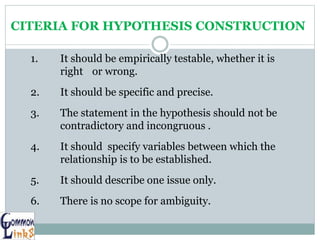
CITERIA FOR HYPOTHESIS CONSTRUCTION
1. It should be empirically testable, whether it is
right or wrong.
2. It should be specific and precise.
3. The statement in the hypothesis should not be
contradictory and incongruous .
4. It should specify variables between which the
relationship is to be established.
5. It should describe one issue only.
6. There is no scope for ambiguity.
NATURE OF HYPOTHESIS
 It must accurately affect the revelevant sociological
fact.
 It must not be in contradiction with approved relevant
statements of other scientific disciplines.
 It must consider the experience of other researchers.
THEORY SAYS…….
Hypothesis is a set of assumptions considering
two main purposes- to understand and to predict
(Theordorson and Theordorson) .
TYPES OF HYPOTHESIS
Broadly the hypothesis can be classified into six
categories.
1) Working hypothesis: Working hypothesis is a
preliminary researcher’s assumption on the research
topic.
1) Scientific hypothesis: Scientific hypothesis
contains statement based on sufficient theoretical
and empirical data.
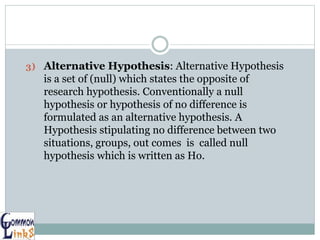
3) Alternative Hypothesis: Alternative Hypothesis
is a set of (null) which states the opposite of
research hypothesis. Conventionally a null
hypothesis or hypothesis of no difference is
formulated as an alternative hypothesis. A
Hypothesis stipulating no difference between two
situations, groups, out comes is called null
hypothesis which is written as Ho.
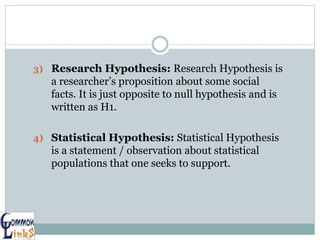
3) Research Hypothesis: Research Hypothesis is
a researcher’s proposition about some social
facts. It is just opposite to null hypothesis and is
written as H1.
4) Statistical Hypothesis: Statistical Hypothesis
is a statement / observation about statistical
populations that one seeks to support.
DIFFICULTIES IN FORMULATING HYPOTHESIS
 Inability to assume properly the out come of the
research.
 Inability to phrase and frame it to fulfil the
requirement
 Absence of theoretical framework
 Lack of ability to utilise theoretical framework
logically
CHARACTERISTICS OF HYPOTHESIS
 It must be conceptually clear
 It should be empirically referents
 It should be specific, brief and to the point
 It should be related to available techniques
 It should be related to a body of theory
 It should maintain the balance with the objectives
 It should be testable
 It should be very much comprehensive
SOURCES OF DERIVING HYPOTHESIS
 Cultural values of society
 Past Research
 Folk wisdom
 Discussions and conversations
 Personal Experiences
 Institution
 Literature Review of the prefixed research topic
 Relevant research journal, dissertation, thesis
FUNCTIONS OF HYPOTHESIS
 To guide social research by offering direction to the
structure.
 To offer temporary answer to the research question
 To facilitate statistical analysis of variables in the
context of hypothesis testing.
 To frame the research design.
 To decide the research methodology.
FARTHER READING
 Ahuja.R (2014), Research Method, Rawat
Publication, New Delhi

Hypothesis

  • 1.
    Hypothesis By Dr. Anamika Ray AssistantProfessor in Mass Communication Gauhati University, Assam, India
  • 2.
    CONCEPT OF HYPOTHESIS A hypothesis is an postulation about relations between variables.  It is tentative elucidation of the research problem or a speculation about the research upshot.  According to Theodorson and Theodorson “a hypothesis is a tentative statement asserting a relationship between certain facts”
  • 3.
    CITERIA FOR HYPOTHESISCONSTRUCTION 1. It should be empirically testable, whether it is right or wrong. 2. It should be specific and precise. 3. The statement in the hypothesis should not be contradictory and incongruous . 4. It should specify variables between which the relationship is to be established. 5. It should describe one issue only. 6. There is no scope for ambiguity.
  • 4.
    NATURE OF HYPOTHESIS It must accurately affect the revelevant sociological fact.  It must not be in contradiction with approved relevant statements of other scientific disciplines.  It must consider the experience of other researchers.
  • 5.
    THEORY SAYS……. Hypothesis isa set of assumptions considering two main purposes- to understand and to predict (Theordorson and Theordorson) .
  • 6.
    TYPES OF HYPOTHESIS Broadlythe hypothesis can be classified into six categories. 1) Working hypothesis: Working hypothesis is a preliminary researcher’s assumption on the research topic. 1) Scientific hypothesis: Scientific hypothesis contains statement based on sufficient theoretical and empirical data.
  • 7.
    3) Alternative Hypothesis:Alternative Hypothesis is a set of (null) which states the opposite of research hypothesis. Conventionally a null hypothesis or hypothesis of no difference is formulated as an alternative hypothesis. A Hypothesis stipulating no difference between two situations, groups, out comes is called null hypothesis which is written as Ho.
  • 8.
    3) Research Hypothesis:Research Hypothesis is a researcher’s proposition about some social facts. It is just opposite to null hypothesis and is written as H1. 4) Statistical Hypothesis: Statistical Hypothesis is a statement / observation about statistical populations that one seeks to support.
  • 9.
    DIFFICULTIES IN FORMULATINGHYPOTHESIS  Inability to assume properly the out come of the research.  Inability to phrase and frame it to fulfil the requirement  Absence of theoretical framework  Lack of ability to utilise theoretical framework logically
  • 10.
    CHARACTERISTICS OF HYPOTHESIS It must be conceptually clear  It should be empirically referents  It should be specific, brief and to the point  It should be related to available techniques  It should be related to a body of theory  It should maintain the balance with the objectives  It should be testable  It should be very much comprehensive
  • 11.
    SOURCES OF DERIVINGHYPOTHESIS  Cultural values of society  Past Research  Folk wisdom  Discussions and conversations  Personal Experiences  Institution  Literature Review of the prefixed research topic  Relevant research journal, dissertation, thesis
  • 12.
    FUNCTIONS OF HYPOTHESIS To guide social research by offering direction to the structure.  To offer temporary answer to the research question  To facilitate statistical analysis of variables in the context of hypothesis testing.  To frame the research design.  To decide the research methodology.
  • 13.
    FARTHER READING  Ahuja.R(2014), Research Method, Rawat Publication, New Delhi