Module 1
Business Research Methods
Research Meaning
• According to Clifford Woody research comprises defining and
redefining problems, formulating hypothesis or suggested
solutions; collecting, organising and evaluating data; making
deductions and reaching conclusions; and at last carefully
testing the conclusions to determine whether they fit the
formulating hypothesis.
• D. Slesinger and M. Stephenson in the Encyclopaedia of
Social Sciences define research as “the manipulation of
things, concepts or symbols for the purpose of generalising
to extend, correct or verify knowledge, whether that
knowledge aids in construction of theory or in the practice of
an art.”
• Research is, thus, an original contribution to the existing
stock of knowledge making for its advancement.
OBJECTIVES OF RESEARCH
• 1. To gain familiarity with a phenomenon or to achieve new
insights into it (studies with this object in view are termed as
exploratory or formulative research studies);
• 2. To portray accurately the characteristics of a particular
individual, situation or a group (studies with this object in
view are known as descriptive research studies);
• 3. To determine the frequency with which something occurs
or with which it is associated with something else (studies
with this object in view are known as diagnostic research
studies);
• 4. To test a hypothesis of a causal relationship between
variables (such studies are known as hypothesis-testing
research studies).
TYPES OF RESEARCH
• Descriptive vs Analytical
• Applied Vs Fundamental
• Quantitative Vs Qualitative
• Conceptual Vs Empirical
• Some other types:
Longitudinal research, historical research, clinical
research, field research and laboratory research
Research Approaches
• Inductive Approach
• Deductive Approach
• Quantitative Approach
• Qualitative Approach
• Experimental Approach
• Simulation Approach
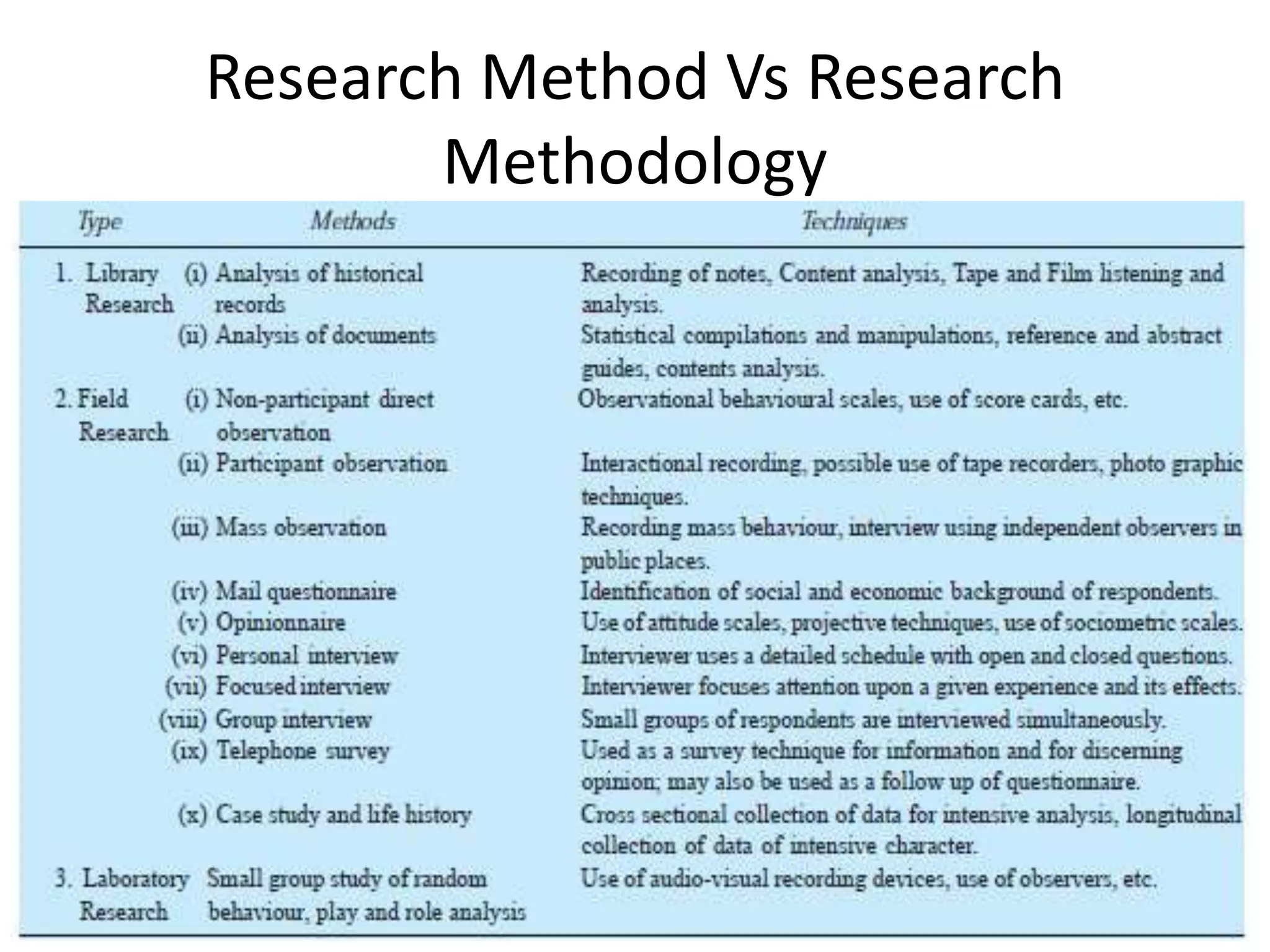
Research Method Vs Research
Methodology
Scale
• Ordinal (likert scale
• Strongly agree…… strongly disagree)
• Nominal
• Ratio
• Interval
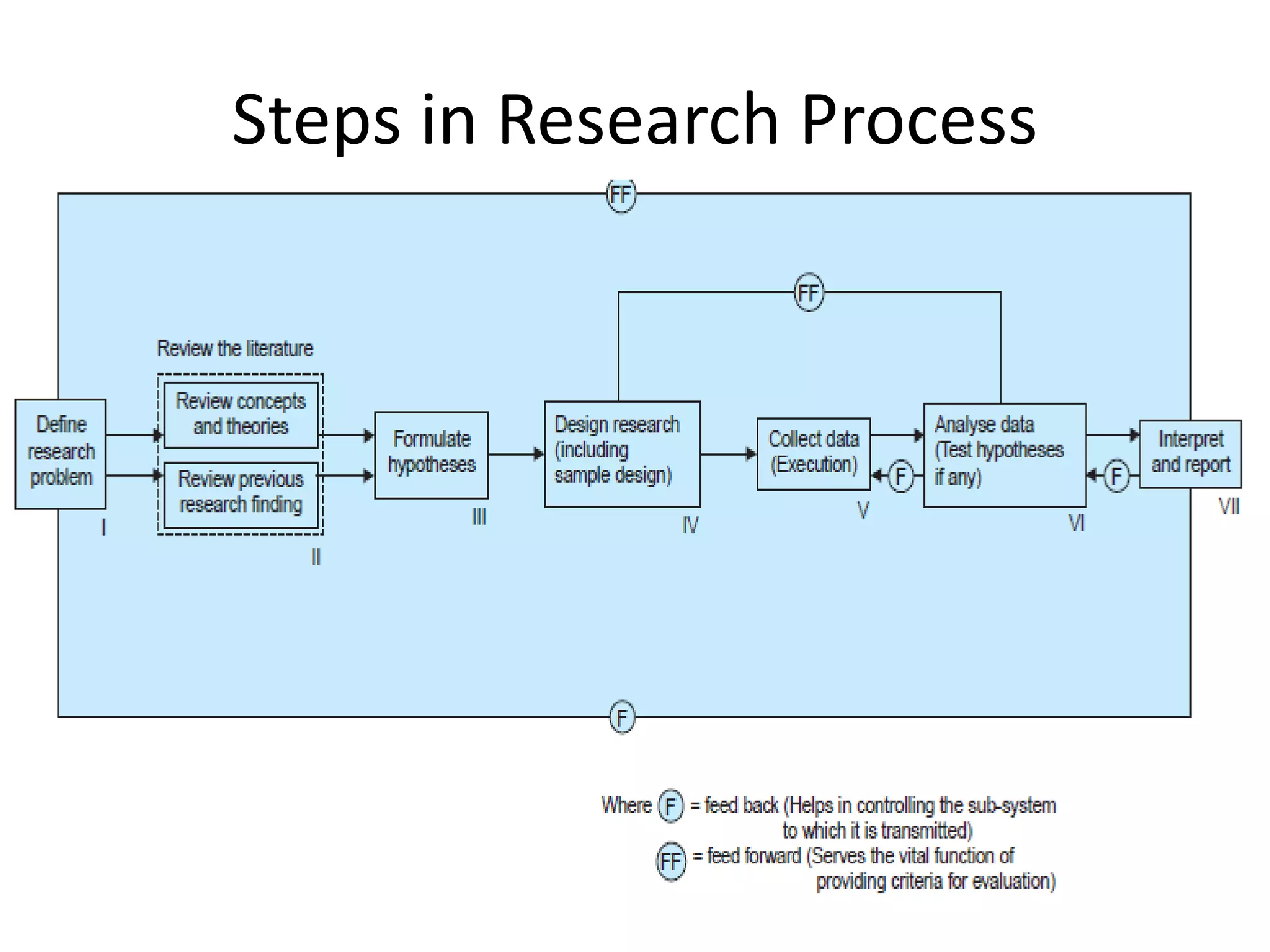
Steps in Research Process
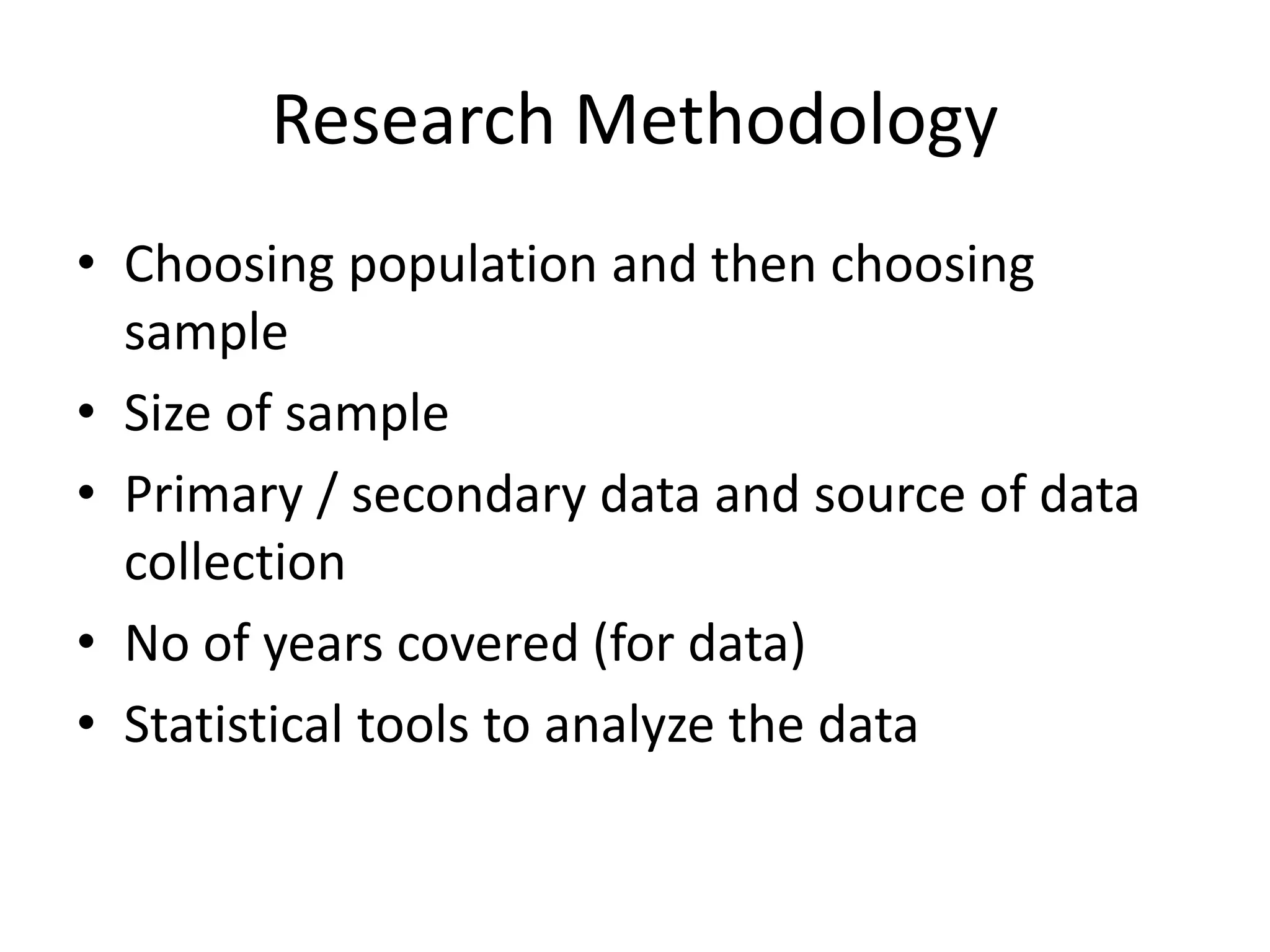
Research Methodology
• Choosing population and then choosing
sample
• Size of sample
• Primary / secondary data and source of data
collection
• No of years covered (for data)
• Statistical tools to analyze the data
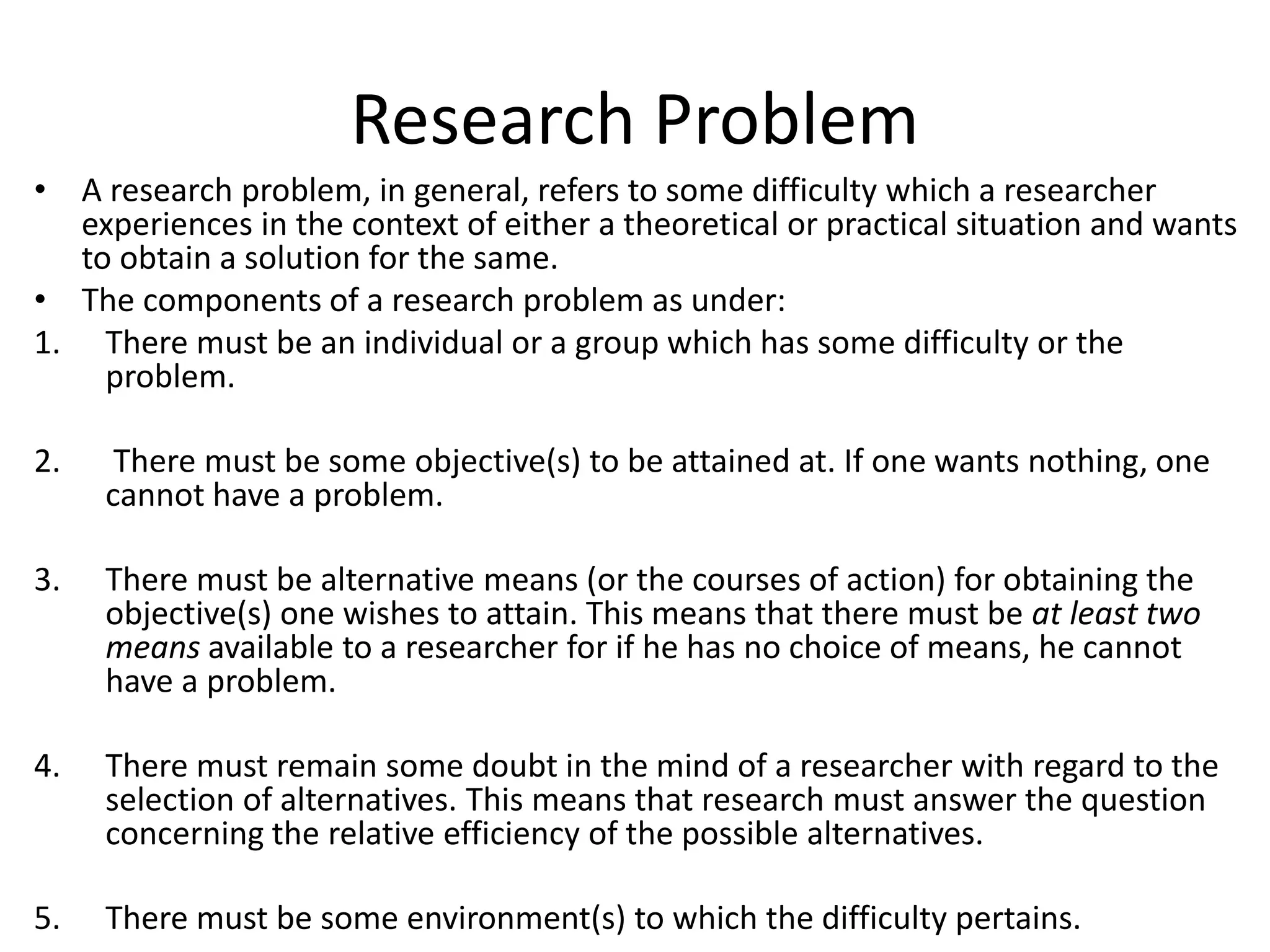
Research Problem
• A research problem, in general, refers to some difficulty which a researcher
experiences in the context of either a theoretical or practical situation and wants
to obtain a solution for the same.
• The components of a research problem as under:
1. There must be an individual or a group which has some difficulty or the
problem.
2. There must be some objective(s) to be attained at. If one wants nothing, one
cannot have a problem.
3. There must be alternative means (or the courses of action) for obtaining the
objective(s) one wishes to attain. This means that there must be at least two
means available to a researcher for if he has no choice of means, he cannot
have a problem.
4. There must remain some doubt in the mind of a researcher with regard to the
selection of alternatives. This means that research must answer the question
concerning the relative efficiency of the possible alternatives.
5. There must be some environment(s) to which the difficulty pertains.
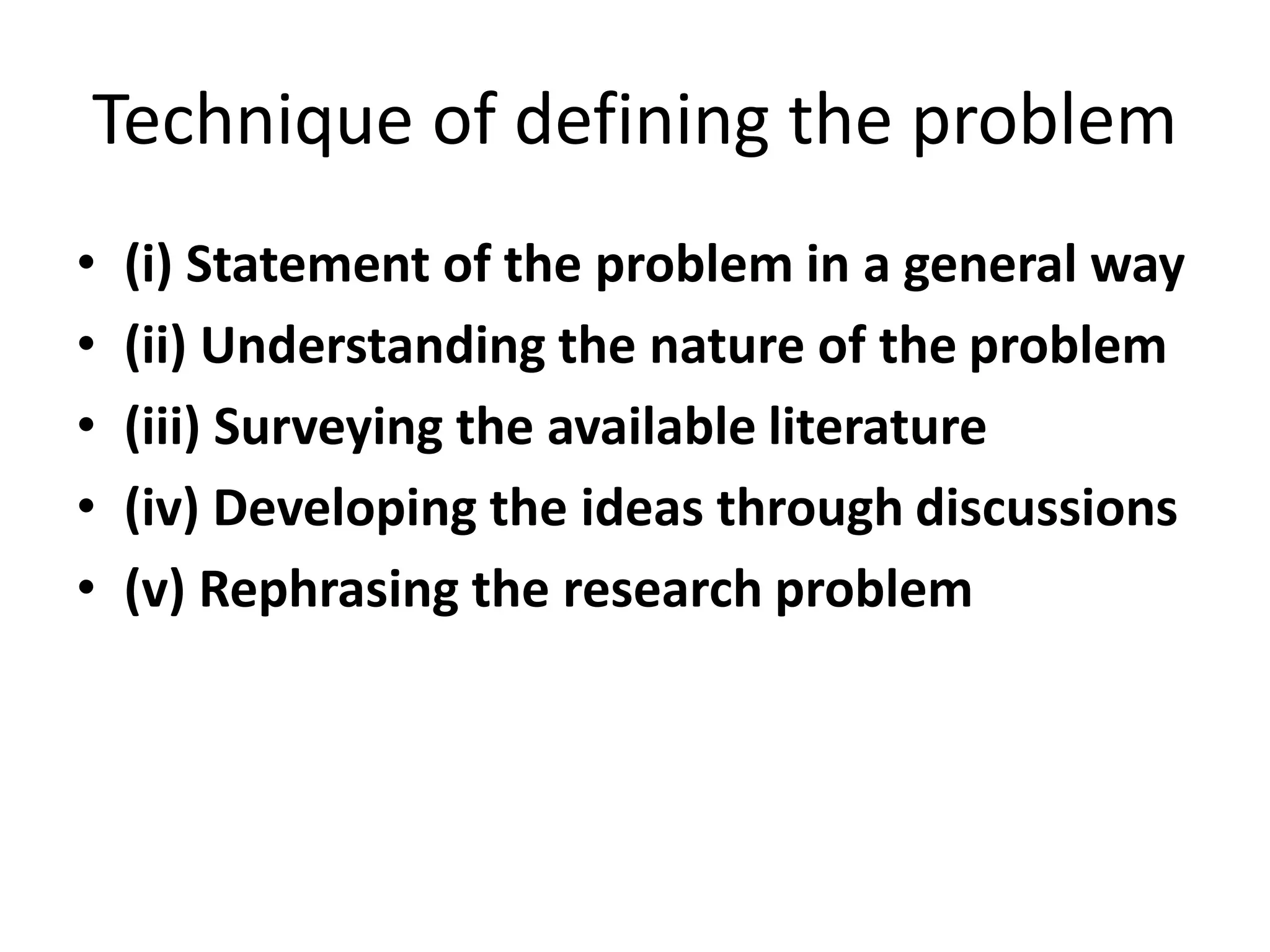
Technique of defining the problem
• (i) Statement of the problem in a general way
• (ii) Understanding the nature of the problem
• (iii) Surveying the available literature
• (iv) Developing the ideas through discussions
• (v) Rephrasing the research problem
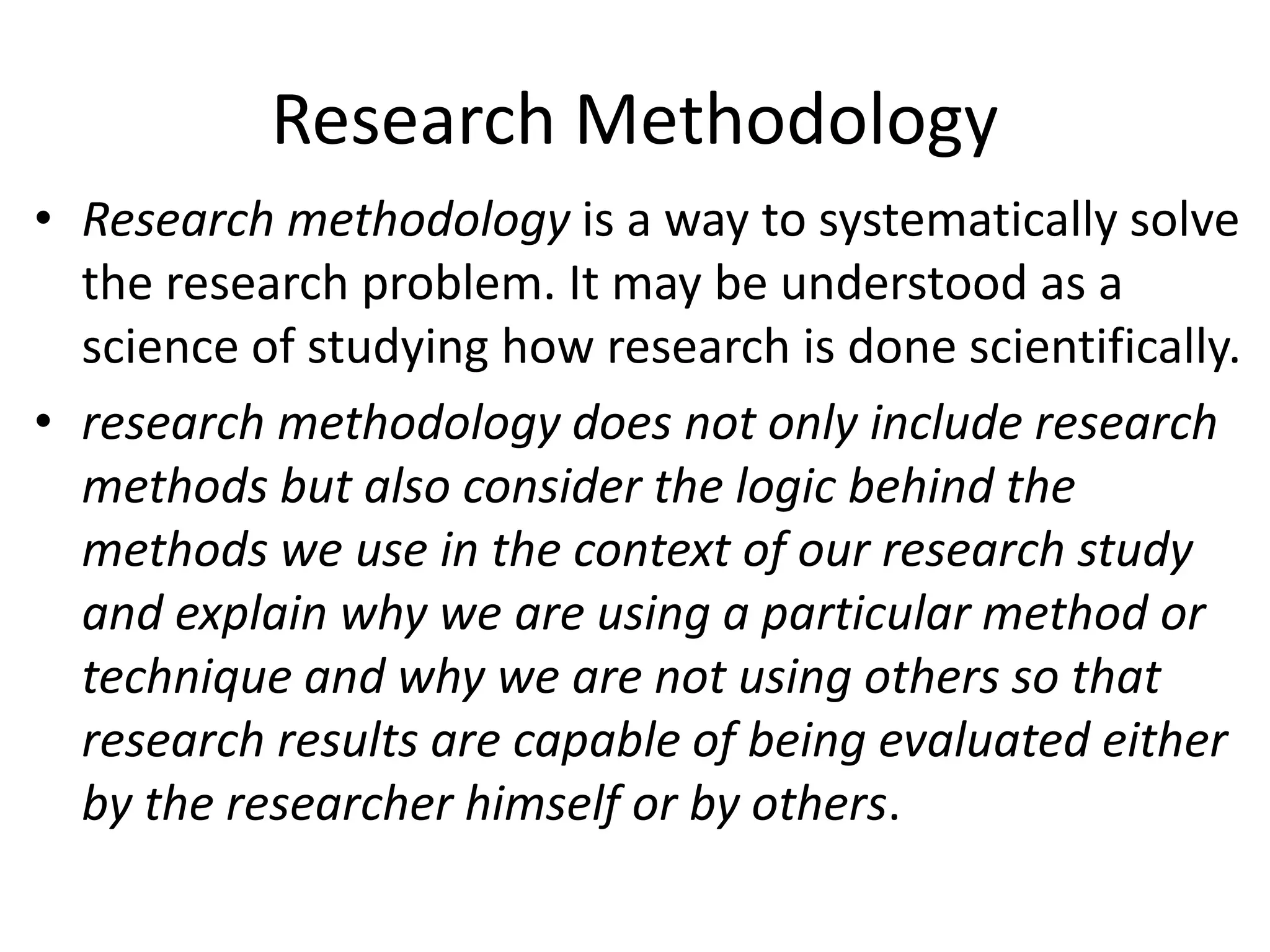
Research Methodology
• Research methodology is a way to systematically solve
the research problem. It may be understood as a
science of studying how research is done scientifically.
• research methodology does not only include research
methods but also consider the logic behind the
methods we use in the context of our research study
and explain why we are using a particular method or
technique and why we are not using others so that
research results are capable of being evaluated either
by the researcher himself or by others.
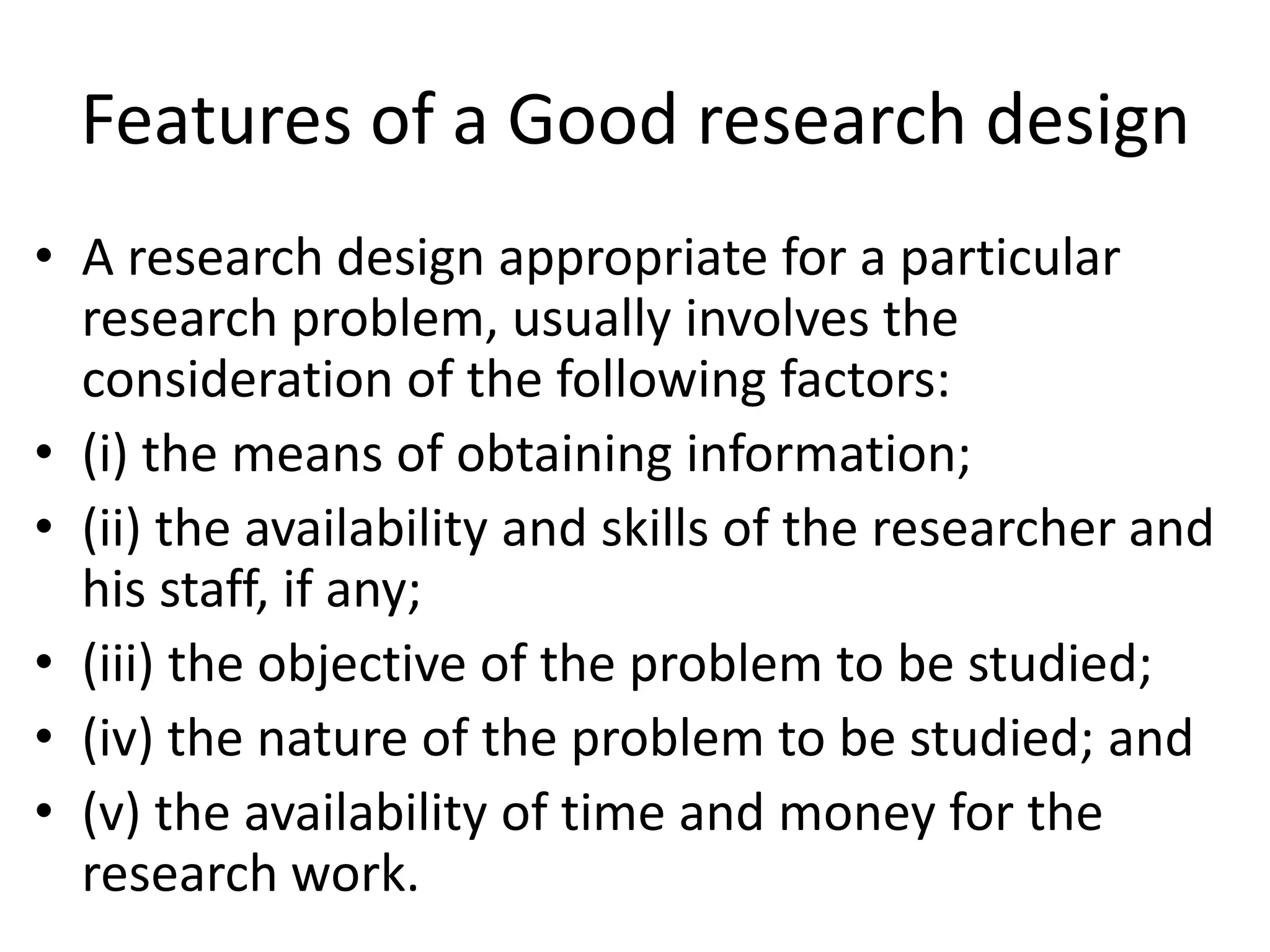
Features of a Good research design
• A research design appropriate for a particular
research problem, usually involves the
consideration of the following factors:
• (i) the means of obtaining information;
• (ii) the availability and skills of the researcher and
his staff, if any;
• (iii) the objective of the problem to be studied;
• (iv) the nature of the problem to be studied; and
• (v) the availability of time and money for the
research work.
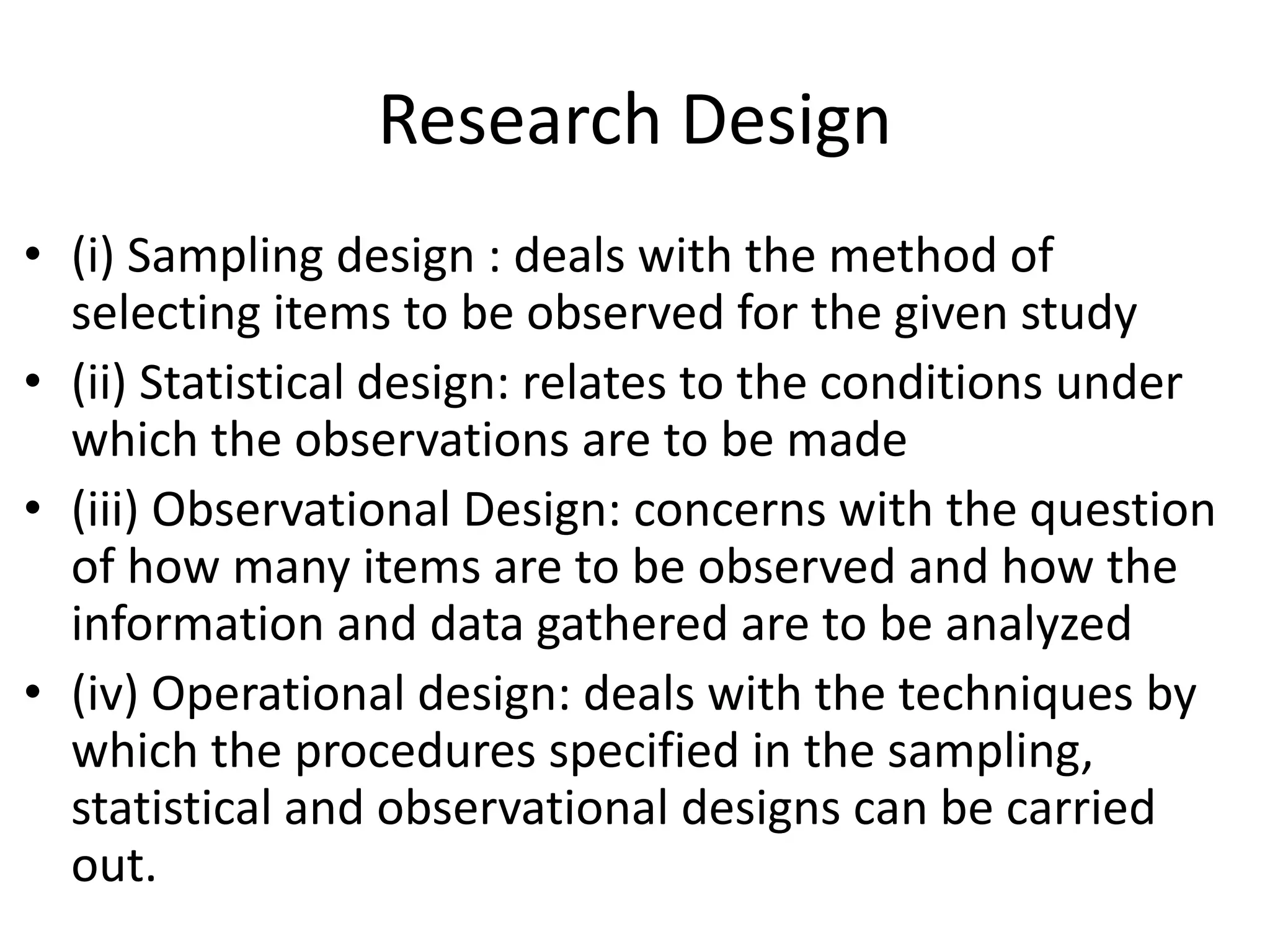
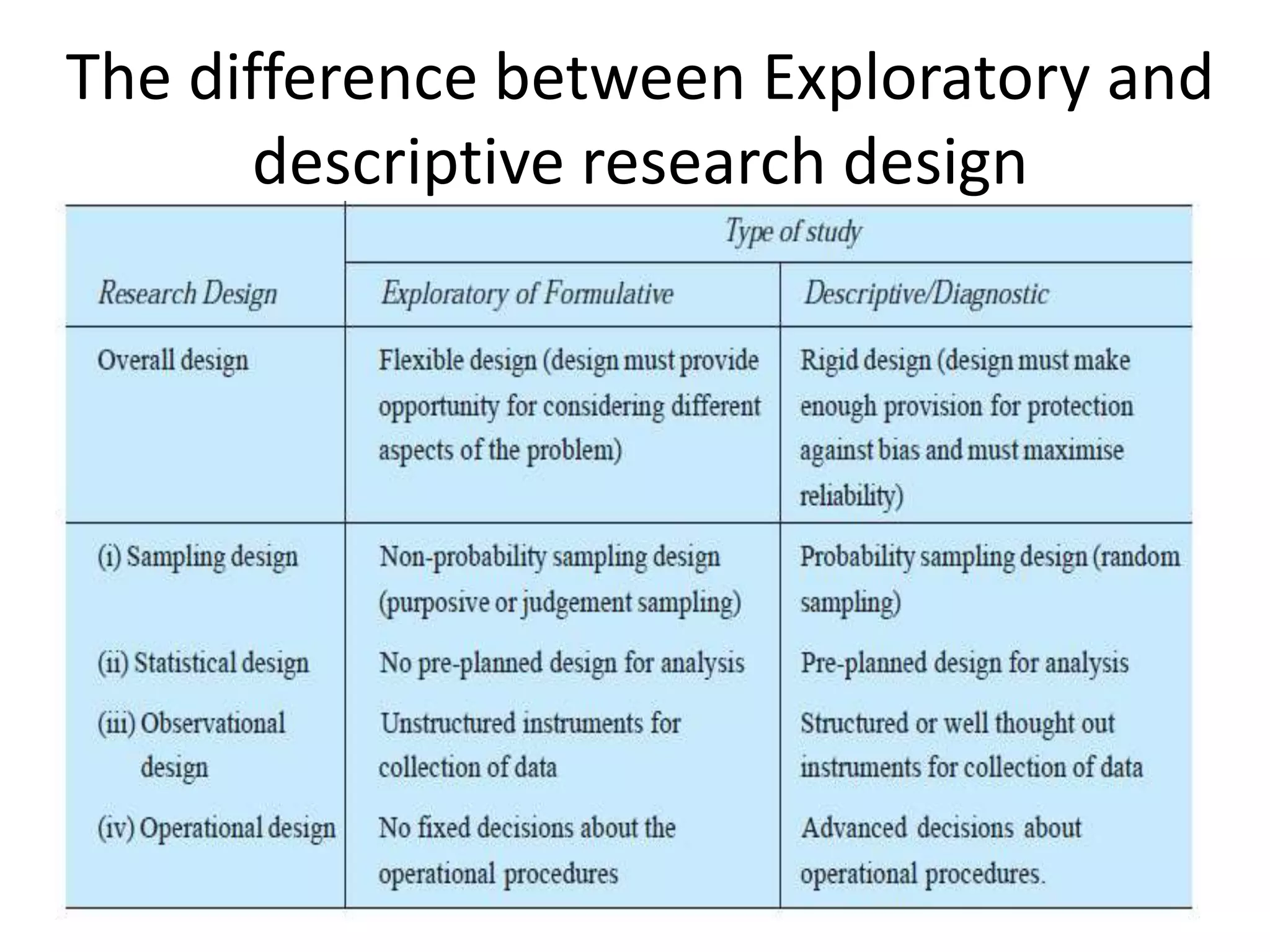
Research Design
• (i) Sampling design : deals with the method of
selecting items to be observed for the given study
• (ii) Statistical design: relates to the conditions under
which the observations are to be made
• (iii) Observational Design: concerns with the question
of how many items are to be observed and how the
information and data gathered are to be analyzed
• (iv) Operational design: deals with the techniques by
which the procedures specified in the sampling,
statistical and observational designs can be carried
out.
Observational design
• Motivational factor for students to do MBA
• 1. SA to S disagree
• 2.
• 3.
• 4.
• 30
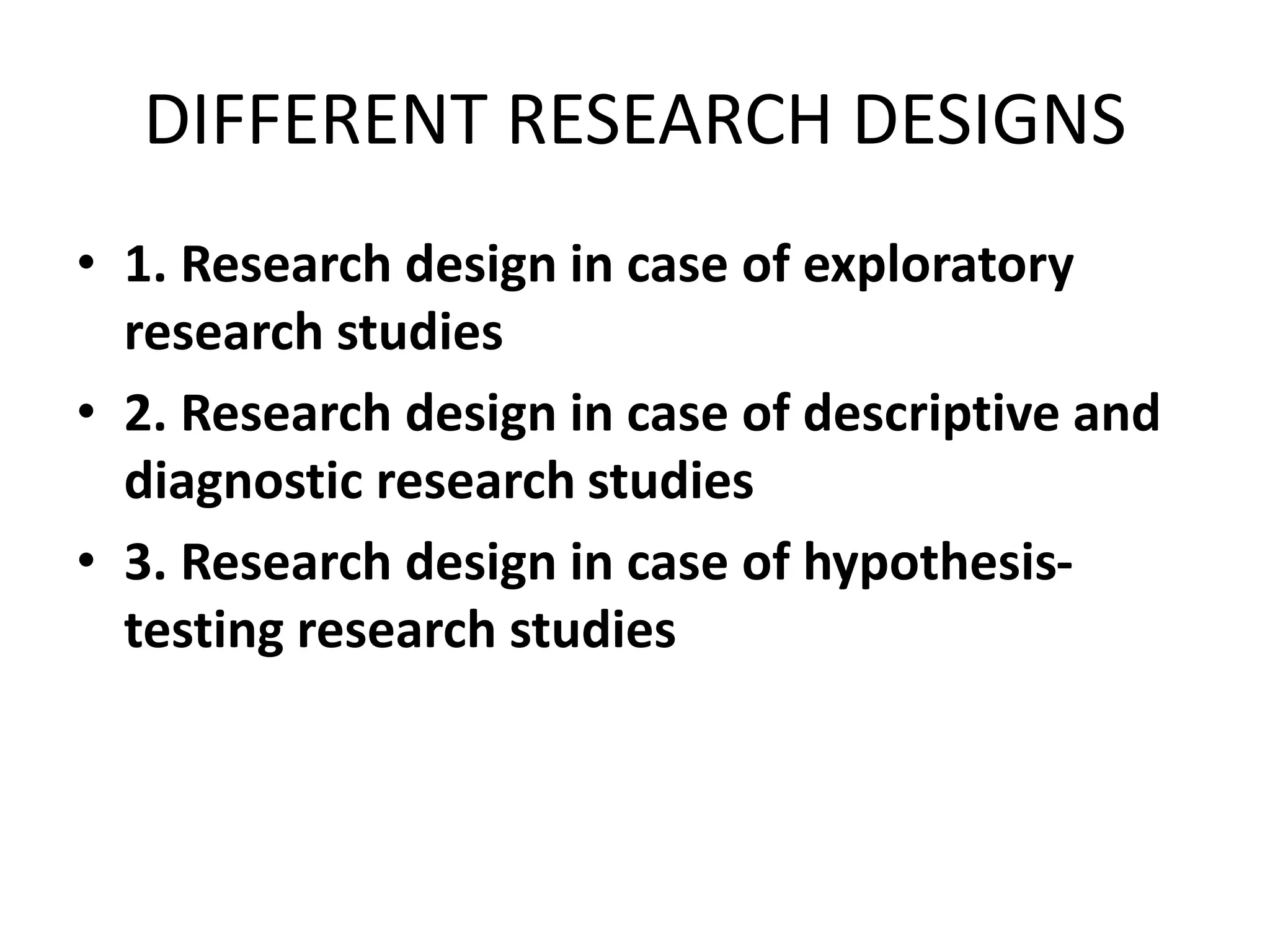
DIFFERENT RESEARCH DESIGNS
• 1. Research design in case of exploratory
research studies
• 2. Research design in case of descriptive and
diagnostic research studies
• 3. Research design in case of hypothesis-
testing research studies
Research design of Exploratory Studies
• Exploratory research studies are also termed as
formulative research studies.
• The main purpose of such studies is that of
formulating a problem for more precise
investigation or of developing the working
hypotheses from an operational point of view.
Research design of Descriptive Studies
• Descriptive research studies are those studies which are
concerned with describing the characteristics of a particular
individual, or of a group,
• whereas diagnostic research studies determine the frequency
with which something occurs or its association with something
else.
• (a) Formulating the objective of the study (what the study is
about and why is it being made?)
• (b) Designing the methods of data collection (what techniques of
gathering data will be adopted?)
• (c) Selecting the sample (how much material will be needed?)
• (d) Collecting the data (where can the required data be found and
with what time period should the data be related?)
• (e) Processing and analyzing the data.
• (f) Reporting the findings.
The difference between Exploratory and
descriptive research design
Research Design of Hypothesis testing
• Hypothesis-testing research studies (generally
known as experimental studies) are those where
the researcher tests the hypotheses of causal
relationships between variables.
• Such studies require procedures that will not only
reduce bias and increase reliability, but will permit
drawing inferences about causality.
• Usually experiments meet this requirement.
Hence, when we talk of research design in such
studies, we often mean the design of
experiments.

Module 1.pptx

  • 1.
  • 2.
    Research Meaning • Accordingto Clifford Woody research comprises defining and redefining problems, formulating hypothesis or suggested solutions; collecting, organising and evaluating data; making deductions and reaching conclusions; and at last carefully testing the conclusions to determine whether they fit the formulating hypothesis. • D. Slesinger and M. Stephenson in the Encyclopaedia of Social Sciences define research as “the manipulation of things, concepts or symbols for the purpose of generalising to extend, correct or verify knowledge, whether that knowledge aids in construction of theory or in the practice of an art.” • Research is, thus, an original contribution to the existing stock of knowledge making for its advancement.
  • 3.
    OBJECTIVES OF RESEARCH •1. To gain familiarity with a phenomenon or to achieve new insights into it (studies with this object in view are termed as exploratory or formulative research studies); • 2. To portray accurately the characteristics of a particular individual, situation or a group (studies with this object in view are known as descriptive research studies); • 3. To determine the frequency with which something occurs or with which it is associated with something else (studies with this object in view are known as diagnostic research studies); • 4. To test a hypothesis of a causal relationship between variables (such studies are known as hypothesis-testing research studies).
  • 4.
    TYPES OF RESEARCH •Descriptive vs Analytical • Applied Vs Fundamental • Quantitative Vs Qualitative • Conceptual Vs Empirical • Some other types: Longitudinal research, historical research, clinical research, field research and laboratory research
  • 5.
    Research Approaches • InductiveApproach • Deductive Approach • Quantitative Approach • Qualitative Approach • Experimental Approach • Simulation Approach
  • 6.
    Research Method VsResearch Methodology
  • 7.
    Scale • Ordinal (likertscale • Strongly agree…… strongly disagree) • Nominal • Ratio • Interval
  • 8.
  • 9.
    Research Methodology • Choosingpopulation and then choosing sample • Size of sample • Primary / secondary data and source of data collection • No of years covered (for data) • Statistical tools to analyze the data
  • 10.
    Research Problem • Aresearch problem, in general, refers to some difficulty which a researcher experiences in the context of either a theoretical or practical situation and wants to obtain a solution for the same. • The components of a research problem as under: 1. There must be an individual or a group which has some difficulty or the problem. 2. There must be some objective(s) to be attained at. If one wants nothing, one cannot have a problem. 3. There must be alternative means (or the courses of action) for obtaining the objective(s) one wishes to attain. This means that there must be at least two means available to a researcher for if he has no choice of means, he cannot have a problem. 4. There must remain some doubt in the mind of a researcher with regard to the selection of alternatives. This means that research must answer the question concerning the relative efficiency of the possible alternatives. 5. There must be some environment(s) to which the difficulty pertains.
  • 11.
    Technique of definingthe problem • (i) Statement of the problem in a general way • (ii) Understanding the nature of the problem • (iii) Surveying the available literature • (iv) Developing the ideas through discussions • (v) Rephrasing the research problem
  • 12.
    Research Methodology • Researchmethodology is a way to systematically solve the research problem. It may be understood as a science of studying how research is done scientifically. • research methodology does not only include research methods but also consider the logic behind the methods we use in the context of our research study and explain why we are using a particular method or technique and why we are not using others so that research results are capable of being evaluated either by the researcher himself or by others.
  • 13.
    Features of aGood research design • A research design appropriate for a particular research problem, usually involves the consideration of the following factors: • (i) the means of obtaining information; • (ii) the availability and skills of the researcher and his staff, if any; • (iii) the objective of the problem to be studied; • (iv) the nature of the problem to be studied; and • (v) the availability of time and money for the research work.
  • 14.
    Research Design • (i)Sampling design : deals with the method of selecting items to be observed for the given study • (ii) Statistical design: relates to the conditions under which the observations are to be made • (iii) Observational Design: concerns with the question of how many items are to be observed and how the information and data gathered are to be analyzed • (iv) Operational design: deals with the techniques by which the procedures specified in the sampling, statistical and observational designs can be carried out.
  • 15.
    Observational design • Motivationalfactor for students to do MBA • 1. SA to S disagree • 2. • 3. • 4. • 30
  • 16.
    DIFFERENT RESEARCH DESIGNS •1. Research design in case of exploratory research studies • 2. Research design in case of descriptive and diagnostic research studies • 3. Research design in case of hypothesis- testing research studies
  • 17.
    Research design ofExploratory Studies • Exploratory research studies are also termed as formulative research studies. • The main purpose of such studies is that of formulating a problem for more precise investigation or of developing the working hypotheses from an operational point of view.
  • 18.
    Research design ofDescriptive Studies • Descriptive research studies are those studies which are concerned with describing the characteristics of a particular individual, or of a group, • whereas diagnostic research studies determine the frequency with which something occurs or its association with something else. • (a) Formulating the objective of the study (what the study is about and why is it being made?) • (b) Designing the methods of data collection (what techniques of gathering data will be adopted?) • (c) Selecting the sample (how much material will be needed?) • (d) Collecting the data (where can the required data be found and with what time period should the data be related?) • (e) Processing and analyzing the data. • (f) Reporting the findings.
  • 19.
    The difference betweenExploratory and descriptive research design
  • 20.
    Research Design ofHypothesis testing • Hypothesis-testing research studies (generally known as experimental studies) are those where the researcher tests the hypotheses of causal relationships between variables. • Such studies require procedures that will not only reduce bias and increase reliability, but will permit drawing inferences about causality. • Usually experiments meet this requirement. Hence, when we talk of research design in such studies, we often mean the design of experiments.

Editor's Notes