





Introducti
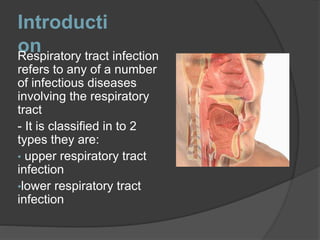
onRespiratory tract infection
refers to any of a number
of infectious diseases
involving the respiratory
tract
- It is classified in to 2
types they are:
• upper respiratory tract
infection
•lower respiratory tract
infection
Definition
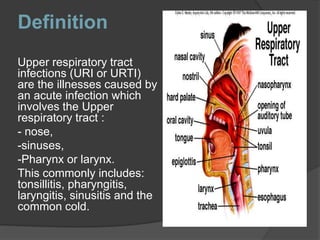
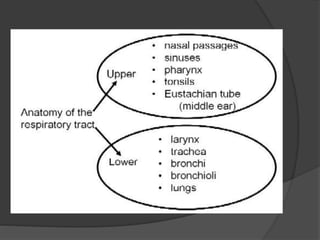
Upper respiratory tract
infections (URI or URTI)
are the illnesses caused by
an acute infection which
involves the Upper
respiratory tract :
- nose,
-sinuses,
-Pharynx or larynx.
This commonly includes:
tonsillitis, pharyngitis,
laryngitis, sinusitis and the
common cold.
Etiology
 Upper respiratory tract infections occurs when a
micro organisms either virus or bacteria are inhaled.
 Examples of viruses that causes URTIs includes;
rhinovirus, coronavirus, coxsackie virus, Influenza
virus and Adenovirus
 Examples of bacteria which causes URTIs includes:
 Haemophilus influenza
 S. pneumoniae
 S. pyogenes and
 C. diphtheriae
Classification
 The upper respiratory tract infections are
classified according to the part they
affect
Rhinitis
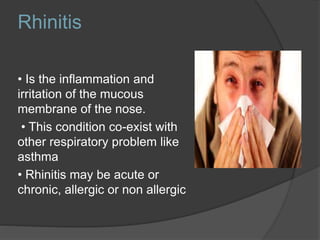
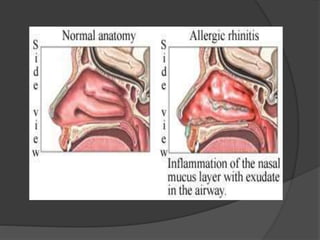
• Is the inflammation and
irritation of the mucous
membrane of the nose.
• This condition co-exist with
other respiratory problem like
asthma
• Rhinitis may be acute or
chronic, allergic or non allergic
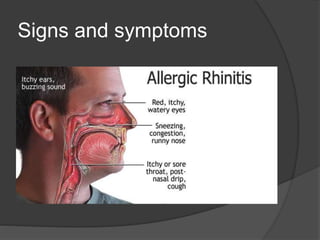
Signs and symptoms
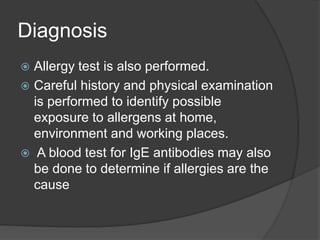
Diagnosis
 Allergy test is also performed.
 Careful history and physical examination
is performed to identify possible
exposure to allergens at home,
environment and working places.
 A blood test for IgE antibodies may also
be done to determine if allergies are the
cause
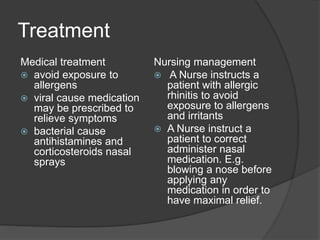
Treatment
Medical treatment
 avoid exposure to
allergens
 viral cause medication
may be prescribed to
relieve symptoms
 bacterial cause
antihistamines and
corticosteroids nasal
sprays
Nursing management
 A Nurse instructs a
patient with allergic
rhinitis to avoid
exposure to allergens
and irritants
 A Nurse instruct a
patient to correct
administer nasal
medication. E.g.
blowing a nose before
applying any
medication in order to
have maximal relief.
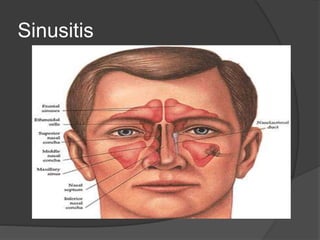
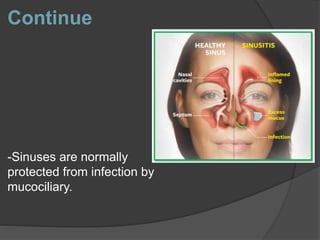
Sinusitis
Continue
-Sinuses are normally
protected from infection by
mucociliary.
Sign and symptoms
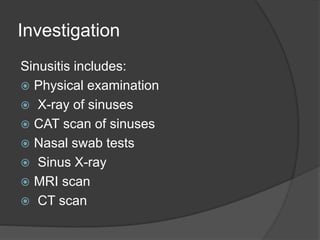
Investigation
Sinusitis includes:
 Physical examination
 X-ray of sinuses
 CAT scan of sinuses
 Nasal swab tests
 Sinus X-ray
 MRI scan
 CT scan
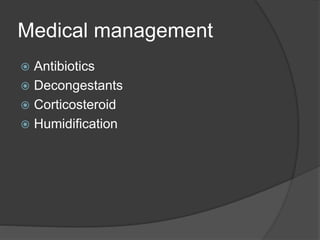
Medical management
 Antibiotics
 Decongestants
 Corticosteroid
 Humidification
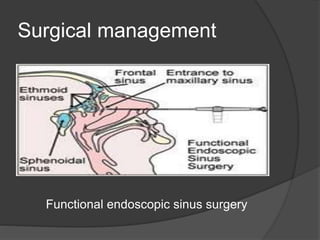
Surgical management
Functional endoscopic sinus surgery
Endoscopic
sphenoethmoidectomy
 An operation to remove diseased tissue
from the sphenoid and ethmoid sinuses.
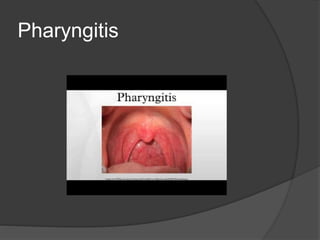
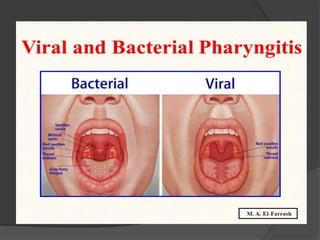
Pharyngitis
Continue
This is the inflammation and irritation of
the pharynx. This condition may be acute
or Chronic.
Etiology
 viral pharyngitis includes; adenovirus,
influenza virus.
 bacterial pharyngitis is streptococcus
pyogenes
Signs and symptoms
 sore throat
 dysphagia
 fever
 malaise
 cough
 and elevated wbc count
Diagnosis
 examining the throat
 swab throat
Medical management
 Viral pharyngitis is treated with
supportive measures
 bacterial pharyngitis is treated with
antimicrobial agents like penicillin and
erythromycin.
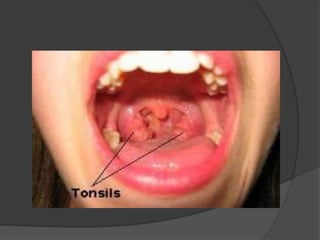
Tonsillitis
 Tonsillitis is inflammation of the tonsils,
typically of rapid onset. It is a type of
pharyngitis.
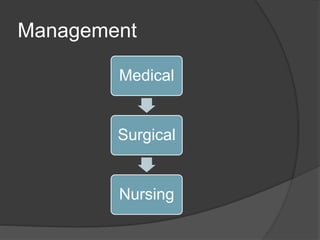
Management
Medical management
Surgical management
Nursing management
Continue
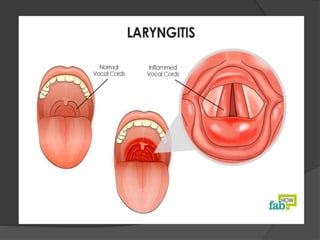
 This is the inflammation and irritation of
the voice box/larynx. The inflammation
causes narrowing of the upper airways
which leads to a hoarseness of the
voice, in some circumstance aphonia (
complete loss of voice)
Diagnostic evaluation
Management
Medical
Surgical
Nursing
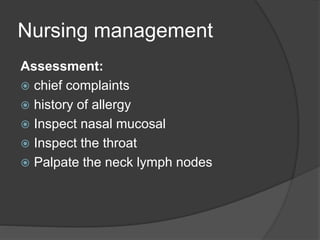
Nursing management
Assessment:
 chief complaints
 history of allergy
 Inspect nasal mucosal
 Inspect the throat
 Palpate the neck lymph nodes
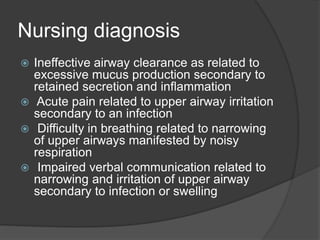
Nursing diagnosis
 Ineffective airway clearance as related to
excessive mucus production secondary to
retained secretion and inflammation
 Acute pain related to upper airway irritation
secondary to an infection
 Difficulty in breathing related to narrowing
of upper airways manifested by noisy
respiration
 Impaired verbal communication related to
narrowing and irritation of upper airway
secondary to infection or swelling
Recaptulization
 Topic: Nursing interventions for patient
with URTIS
 Date : 27-11-2017
 Venue: room no-204
upper respiratory tract infection

upper respiratory tract infection