RESEARCH APPROACHES AND DESIGNS
JANNET MARIA ELIAS
LECTURER
CON,NMC
MUVATTUPUZHA
INTRODUCTION
• Research design is a boarder plan to conduct a study, and research
approach is an element of the research design.
• It is a systemic plan of what is to be done, how it will be done, and
how the data will be analyzed.
• It includes the descriptions of the research approaches, dependent
and independent variables, sampling design, and a planned format
for data collection, analysis and presentation.
DEFINITIONS
• Research design is the master plan specifying the
methods and procedures for collecting and analyzing
the needed information in a research study.
DEFINITIONS
• The research design is the researcher’s overall plan for
answering the research questions or testing the research
hypothesis.
• It can be defined as a blue print to conduct a research study,
which involves the description of research approach, study
setting, sampling size, sampling technique, tools and
method of data collection and analysis to answer a specific
research questions or for testing research hypotheses.
ELEMENTS
• The approach
• Population, sample and sampling technique
• The time, place, and sources of data collection
• Tools and methods of data collection
• Methods of data analysis
FACTORS AFFECTING SELECTION OF RESEARCH DESIGN
• Nature of the research problem
• Purpose of the study
• Researcher’s knowledge and experience
• Researcher’s interest and motivation
• Research ethics and principles
FACTORS AFFECTING SELECTION OF RESEARCH DESIGN
• Subjects/Participants
• Resources
• Time
• Possible control on extraneous variables
• Users of the study findings
VALIDITY OF RESEARCH DESIGNS
• Internal Validity
• External Validity
INTERNAL VALIDITY
•Extent to which it is possible to make an inference that the
independent variable is truly influencing over the dependent
variable
Campbell and Stanley(1963)
EXTERNAL VALIDITY
• It refers to the extent to which the results can be
generalized to a larger population.
FACTORS THAT AFFECT EXTERNAL VALIDITY
• Hawthorne effect
• Experimenter effect
• Reactive effect of pretest
• Novelty effect (effect of introducing new elements
on some activity or behavior)
• People
• Place
• Time
TYPES OF RESEARCH DESIGN
• Quantitative Research Designs
• Qualitative Research Designs
TYPES OF QUANTITATIVE RESEARCH
DESIGN
I. Experimental research designs
II. Nonexperimental research designs
III. Other additional research designs
TYPES OF QUALITATIVE RESEARCH
DESIGN
I. Phenomenological research
II. Ethnographic research
III. Grounded theory
IV. Case studies
V. Historical research
VI. Action research
TYPES OF QUANTITATIVE RESEARCH
DESIGN
•I. EXPERIMENTAL RESEARCH DESIGNS
• It is a design in which the researcher controls(manipulates)the
independent variable by randomly assigning subjects to different
treatment conditions.
EXPERIMENTAL RESEARCH DESIGNS
• Experimental research design are concerned with examination of
the effect of independent variable on the dependent variable, where
the independent variable is manipulated through treatment or
intervention(s), and the effect of these interventions is observed on
the dependent variable.
EXPERIMENTAL RESEARCH DESIGNS -
TYPES
1. True Experimental designs
2. Quasi - experimental designs
3. Pre - experimental designs
1. TRUE EXPERIMENTAL DESIGNS
True experimental research designs are those where
researchers have complete control over the extraneous
variables and can predict confidently that the observed
effect on the dependable variable is only due to the
manipulation of the independent variable.
ESSENTIAL CHARACTERISTICS OF
TRUE EXPERIMENTAL
RESEARCH DESIGNS
• Manipulation
• Control
• Randomization
MANIPULATION
• An intervention or treatment introduced by the researcher in an
experimental or quasi experimental study to assess its impact on
the dependent variable.
• It is a conscious act by the researcher, where he or she varies the
independent variable and observes the effect that manipulation has
on the dependant variable of interest.
EXAMPLE FOR MANIPULATION
• Study on efficacy of chlorhexidine mouthwash on the prevention of
ventilator-associated pneumonia (VAP) among patients admitted in
ICUs.
• chlorhexidine mouthwash - the independent variable, which
is manipulated by the researcher
• while the control group is kept deprived of it to observe its effect
on the incidence of VAP.
CONTROL
• Control refers to the use of control group and controlling the effects of
extraneous variables on the dependent variable in which the researcher
is interested.
• The subject in the control and experimental groups are similar in number
and characteristics, but the subject in the control group
receive no experimental treatment or any intervention at all.
RANDOMIZATION
• Randomization means that every subject has an equal chance
of being assigned to experimental or control group.
METHODS OF RANDOMIZATION
• Flip of a coin
• Draw Lots
• Random Table
• Computer assisted Randomization
TYPES OF TRUE EXPERIMENTAL DESIGNS
1. Post test only control design
2. Pretest - post test control group design
3. Solomon four - group design
4. Factorial design
5. Randomized block design
6. Cross over design
7. Latin square design
POST TEST ONLY CONTROL DESIGN
• For example: to study the effect of an educational
intervention related to urinary incontinence on the
subsequent help-seeking behavior of older adults.
POST TEST ONLY CONTROL DESIGN
PRETEST - POST TEST CONTROL GROUP DESIGN
• For example: An experimental study to assess the
effectiveness of cognitive behavioral therapy
interventions for patients with breast cancer.
PRETEST - POST TEST CONTROL GROUP DESIGN
SOLOMON FOUR - GROUP DESIGN
FACTORIAL DESIGN
Frequency of
Mouth care
Protocols of the mouth care
Chlorhexidin
e (α1)
Saline (α2)
4 hourly(β1) α1…β1 α2…β1
6 hourly(β2) α1…β2 α2…β2
8 hourly(β3) α1…β3 α2…β3
• For example: a researcher
wants to observe
the effects of two
different protocols of mouth
care on
prevention of VAP when
performed at
different frequencies
in a day.
RANDOMIZED BLOCK DESIGN
• For example: a researcher wants to examine the effects of three
different antihypertensive drugs on patients with hypertension.
• In this example, to ensure the homogeneity among the
subjects under treatment, researcher randomly places the
subjects in homogenous groups(blocks) like patients with
primary hypertension, diabetic patients with hypertension, and
renal patients with hypertension.
RANDOMIZED BLOCK DESIGN…
•This design looks similar to a factorial designin
structure, but out of two factors, one factor is not
experimentally manipulated, like inthe given example there are
two factors: type of anti hypertensive drugs and type of patients
with hypertension, where only the type of drug is manipulated and
type of patients with hypertension are simply grouped in different
blocks with similar characteristics to ensure homogeneity.
RANDOMIZED BLOCK DESIGN
Type of
antihypertensive
drugs
BLOCKS
Patients with primary
hypertension(I)
Diabetic patients with
hypertension(II)
Renal patients with
hypertension(III)
A A, I A, II A, III
B B, I B, II B, III
C C, I C, II C, III
CROSS OVER DESIGN
• For example: when we are comparing the effectiveness
of the chlorhexidine and saline mouth care protocol, first we
administer the chlorhexidine mouth care protocol on group I
and saline mouth care protocol on the subjects of group II.
Later, the treatment is swapped, where group I receives the
saline mouth care and group II receives chlorhexidine.
CROSS OVER DESIGN(REPEAT
MEASURE DESIGN)
Groups Protocols of the mouth care
Group I Chlorhexidine (α1) Saline (α2)
Group II Saline (α2) Chlorhexidine (α1)
2. QUASI-EXPERIMENTAL DESIGN
Quasi-experimental design involves the manipulation of
independent variable to observe the effect on dependent
variable, but it lacks at least one of the two
characteristics of the true experimental design:
randomization or a control group
Types
1. Non-randomized control group design
2. Time-series design
NON-RANDOMIZED CONTROL GROUP DESIGN
• For example: the effects of
integrated care on quality of work in
nursing homes: a quasi-
experiment.
TIME-SERIES
DESIGN
• For example: Measuring a
child’s school performance on
a weekly
and then introducing
a teaching technique.
Then measuring on a
weekly
basis,
new
again
basis
.
3. PRE-EXPERIMENTAL DESIGNS
SUHANYARAJ V,LECTURER,KUHS
contro
l
ove
r
• Manipulation of independent variables, but
limited extraneous variables, no randomization and
control group.
Types
1. One-shot case design
2. One-group pretest-posttest
design
ONE-SHOT CASE DESIGN
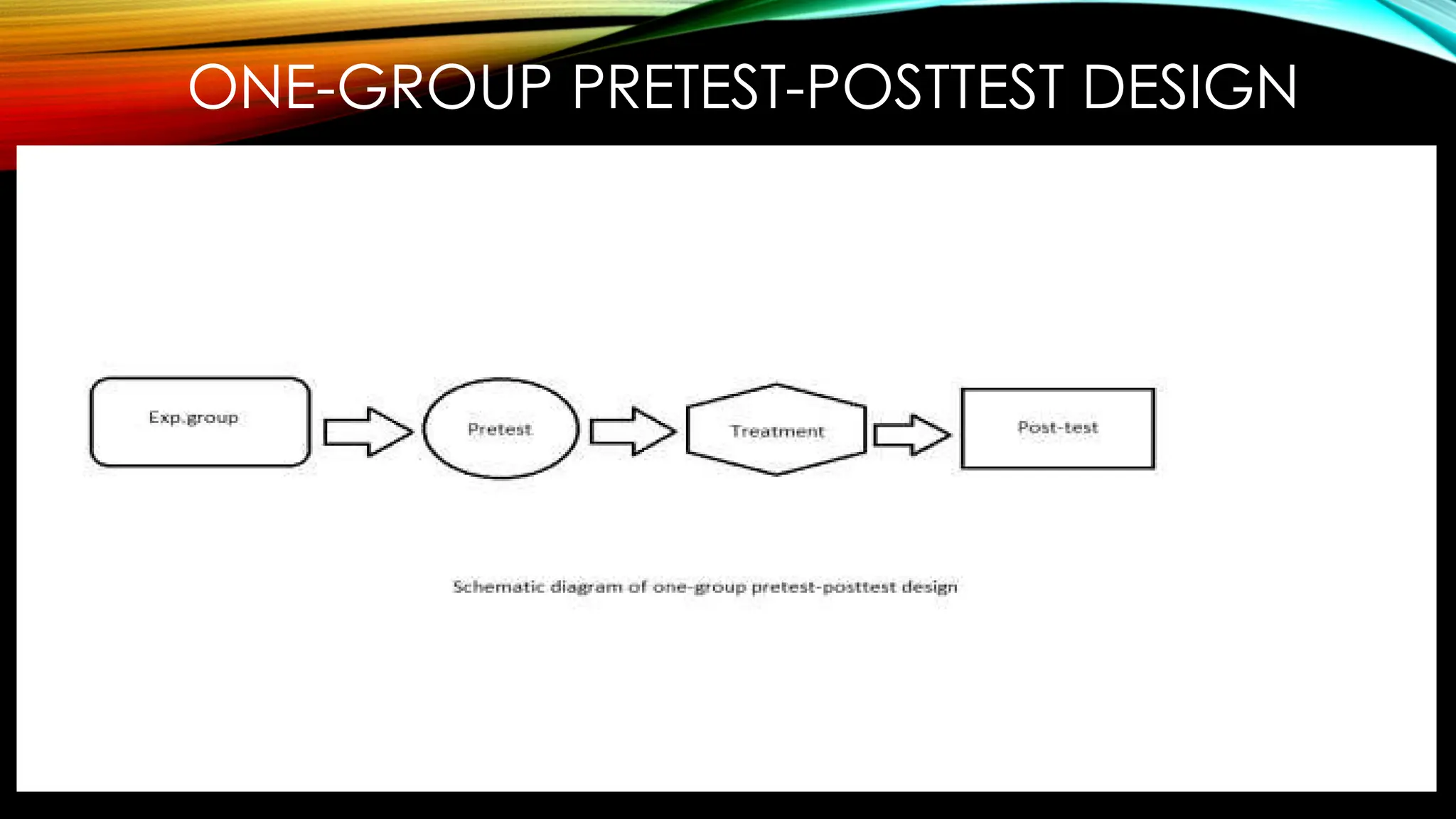
ONE-GROUP PRETEST-POSTTEST DESIGN
II. NONEXPERIMENTAL RESEARCH DESIGNS
1.Descriptive design
2.Correlational/Ex post facto design
3.Developmental research design
4.Epidemiological designs
5.Survey design
1. DESCRIPTIVE DESIGN
• Accurate description of characteristics of individual
situation, or group , and the frequency with which a
certain phenomenon occurs in natural setting without
imposing any control or manipulation.
Types
• Univariant descriptive design
• Exploratory descriptive design
• Comparative descriptive design
UNIVARIANT DESCRIPTIVE
• Studies undertaken to describe the frequency of occurrence
Of a phenomenon rather than to study relationship.
• For example: a descriptive study on prevalence of
backache among nurses working in critical units of
Christian Medical College (CMCH), Vellore, Tamilnadu.
EXPLORATORY
• Investigating the phenomenon and its related factors about
which very little is known.
• For example: an exploratory study on the contributing factors of
sleep disturbance among patients admitted in Emergency Unit of
Nehru Hospital, Post-Graduate Institute of Medical Education and
Research, Chandigarh.
COMPARATIVE
• Comparing occurrences of a phenomenon in two or more groups.
• For example: A comparative study on backache among nurses
working in critical care units and general wards of the
Victoria Hospital, Bangalore, Karnataka.
2. CORRELATIONAL/EX POST FACTO
DESIGN
SUHANYARAJ V,LECTURER,KUHS
• Examining the relationship between two or more variables in a
natural setting without manipulation or control(cause and effect
relationship)
Types
• Prospective design
• Retrospective design
2. CORRELATIONAL/EX POST FACTO DESIGN
•Prospective design : Examining relationship from cause to effect
•For example: A prospective correlational study on effect of maternal
infection during pregnancy outcome
•Retrospective design : Examining relationship from effect to cause
•For example: A retrospective correlational study on substance-abuse-
related high-risk factors among traumatic head injury patients admitted in
neurosurgery ICU of Dayanand Medical College and Hospital(DMCH),
Ludhiana.
3. DEVELOPMENTAL RESEARCH DESIGN
• Examining the phenomenon in respect to the
time
Types
• Cross-sectional design
• Longitudinal design
3. DEVELOPMENTAL RESEARCH DESIGN
•Cross-sectional design : Examining the phenomenon only at one point in
time.
•For example: a researcher is interested in assessing the awareness on
swine flu among people of an area. Here the researcher interacts only
once to collect awareness-related data from respondents.
3. DEVELOPMENTAL RESEARCH DESIGN
Longitudinal design : Examiningthe
phenomenon at more than one point
in time.
For example: a researcher is interested in the perception
of nursing students towards nursing profession from the
beginning of the nursing program to its end.
4. EPIDEMIOLOGICAL DESIGNS
• The investigation of the distribution and causes of diseases in a
population is known as epidemiology.
•Types
• Case-control studies
• Cohort studies
4. EPIDEMIOLOGICAL DESIGNS
• Case-control studies - A case-control study is
an experimental design that compares a group of
participants possessing a condition of interest to a very
similar group lacking that condition
• Cohort studies - A cohort study is a type of observational
study that follows a group of participants over a period of
time, examining how certain factors (like exposure to a
given risk factor) affect their health outcomes.
SURVEY RESEARCH DESIGN
• Survey studies are investigation in which self-reported data
are collected from sample with the purpose of describing
population on some variables of interest.
TYPES OF SURVEY RESEARCH DESIGN
1. Depending on the nature of phenomenon under
study
2. Based on the methods of data collection
TYPES OF SURVEY RESEARCH DESIGN
1. Depending on the nature of phenomenon under
study
• Descriptive survey
• Exploratory survey
• Comparative survey
• Correlational survey
TYPES OF SURVEY RESEARCH DESIGN
2. Based on the methods of data
collection
• Written survey
• Oral survey
• Electronic survey
III. OTHER ADDITIONAL RESEARCH
DESIGNS
1. Methodological studies
2. Meta-analysis
3. Secondary data
analysis
4. Outcome research
5. Evaluation studies
6. Operational research
1. METHODOLOGICAL STUDIES
• Research conducted to develop, test, and evaluate the research
instruments and methods
• Steps:
• Defining the behavior or construct to measure
• Formulating the items for tool
• Developing instruments for users and respondents
• Testing the reliability and validity of research tool.
• Eg:- a methodological study to develop a pressure sore risk assessment
tool for patients admitted in orthopaedic wards.
2.META-ANALYSIS
• Quantitatively combining and integrating the findings of the multiple research
studies on a particular topic.
Steps:
• Define hypothesis
• Locate the studies
• Input data
• Calculate effect sizes
• Analyse variables
Eg:- a meta-analysis study on the coping behaviour of the people with cancer
diagnoses.
3. SECONDARY DATA ANALYSIS
• A research design in which the data collected in one research
is reanalyzed by another researcher, usually to test new
hypotheses.
• A secondary analysis can be performedwith both quantitative
and
qualitative data.
3. SECONDARY DATA ANALYSIS
• Example of quantitative study:
A researcher used data from a previous study of patients with COPD to
test an explanatory model of factors affecting functional status in this
disorder.
• Example of qualitative study:
A researcher carried out a secondary analysis of data from a qualitative
study of clients with end-stage renal disease. The original study was
designed to examine how and by whom were the decisions about
treatment modality made; the secondary study examined factors that
influenced those decisions.
4. OUTCOME RESEARCH
• Outcome research involves the evaluation of care practices
and systems in place. It is used in nursing to develop
evidence-based practice and improve nursing actions.
• Eg:- An outcome research on the effectiveness of Quality
Assurance Program (QAP) implemented in Nehru Hospital,
PGIMER, Chandigarh and Safdarjung Hospital New Delhi.
5. EVALUATION STUDIES
• It is research design which involves the judgement about success of a
programs, practices, procedures, or policies.
• Eg:- A evaluation study on the implementation
of the National Rural Health Mission program in selected
districts of Rajasthan.
5. EVALUATION STUDIES
formative evaluation or
summative
• Evaluation research could either
be
evaluation research.
• Formative evaluation research: it refers to the assessment of a program
as it is being implemented; the focus is on evaluation process of a
program rather than the outcome.
• Summative evaluation research: it refers to the assessment of the
outcome of a program that is conducted after the completion of the
program.
6. OPERATIONAL RESEARCH
• It involves the study of complex human organizations and
services to develop new knowledge about institutions, programs,
use of facilities, and personnel in order to improve working
efficiency of an organization.
• Eg:- An operational research study on the patients’ perception
about different patient assignment methods for providing
nursing care in selected hospitals of Hyderabad.
QUALITATIVE RESEARCH DESIGN
• Qualitative research approaches have somewhat short and less
well- defined plans.
• In this study design, elements typically evolve over the course of
the project.
• As one study unfolds, decisions are made in the field about how
best to obtain information, and from whom; how to schedule
data collection; how long each data collection session should last.
CHARACTERISTICS OF QUALITATIVE
RESEARCH DESIGN
• Emerge as study advances
• Flexible and elastic
• Multiple strategies of data
collection(triangulation)
• Holistic ( treating the whole)
• Intense researcher’s involvement
• Ongoing data analysis
PHASES OF THE QUALITATIVE RESEARCH
DESIGN
• Orientation and overview
phase
• Focused exploration
• Confirmation and closure
TYPES OF QUALITATIVE RESEARCH
DESIGN
I. Phenomenological research
II. Ethnographic research
III. Grounded theory
IV. Case studies
V. Historical research
VI. Action research
PHENOMENOLOGICAL RESEARCH
• phenomenological research is a qualitative
research approach that aims to learn more about
people’s lived experiences. It is used to gain a
better understanding of people’s beliefs, behaviors,
attitudes, and experiences.
PHENOMENOLOGICAL RESEARCH
• Example:
• A phenomenological study on lived experiences of tsunami victims in
selected
villages of Tamilnadu
ETHNOGRAPHIC RESEARCH
• Focuses on the sociology of meaning through close field
observation of socio- cultural phenomena.Typically, the
ethnographer focuses on a community
•For Example:
• A ethnographic study on socio-cultural beliefs of the
people about antenatal,natal, and postnatal care of
women in selected tribal communities of Rajasthan.
GROUNDED
THEORY
• Theory is developed inductivelyfrom a corpus of data acquired
by a participant-observer.
For example:
• A grounded theory research on the adaptationlevels of people
with
postinjury permanent physical disabilities at AIIMS, New Delhi.
SOURCES OF DATA COLLECTION IN
GROUNDED THEORY
• Formal/Informal
interviews
• Audio/Video tape
recording
• Diaries
• Case studies
• Artwork
• Participant Observation
• Documents
CASE STUDIES
• Attempts to focus on a phenomenon by studying in depth a
single case example. The case can be an individual, an event, a group,
or an institution.
• It is usually collected by observation/personal interview method.
• For example:
• A case study on the availability and utilization of the emergency services in
Civil Hospital, Ludhiana.
HISTORICAL RESEARCH
• Systematic collection and objective evaluation of
data related to past occurrences in order to test
hypotheses concerning causes, effects, or trends
of these events that may help to explain present
events and anticipate future events.
STEPS OF HISTORICAL RESEARCH
• Data collection: Using Primary and Secondary
sources
• Criticism of the data: by External and Internal
criticism
• Presentation of the facts
ACTION RESEARCH
Action research is a form of applied research that tries to
empower people through a process that constructs and uses
knowledge. It tries to find practical solutions to problems existing
in the frame work of an organization. It increases understanding
of how change in one’s actions or practices can mutually benefit
nurses within an organization.
DATA COLLECTION METHODS OF ACTION
RESEARCH
• Interview
• Observation
• Story telling
• Socio-drama
• Drawing and Painting
• Play and skits
• Other creative ways like explore lives, tell stories, and recognize own
strength etc.
T H A N K Y O
U

Approaches and Designs.pptx for nursing students

  • 1.
    RESEARCH APPROACHES ANDDESIGNS JANNET MARIA ELIAS LECTURER CON,NMC MUVATTUPUZHA
  • 2.
    INTRODUCTION • Research designis a boarder plan to conduct a study, and research approach is an element of the research design. • It is a systemic plan of what is to be done, how it will be done, and how the data will be analyzed. • It includes the descriptions of the research approaches, dependent and independent variables, sampling design, and a planned format for data collection, analysis and presentation.
  • 3.
    DEFINITIONS • Research designis the master plan specifying the methods and procedures for collecting and analyzing the needed information in a research study.
  • 4.
    DEFINITIONS • The researchdesign is the researcher’s overall plan for answering the research questions or testing the research hypothesis. • It can be defined as a blue print to conduct a research study, which involves the description of research approach, study setting, sampling size, sampling technique, tools and method of data collection and analysis to answer a specific research questions or for testing research hypotheses.
  • 5.
    ELEMENTS • The approach •Population, sample and sampling technique • The time, place, and sources of data collection • Tools and methods of data collection • Methods of data analysis
  • 6.
    FACTORS AFFECTING SELECTIONOF RESEARCH DESIGN • Nature of the research problem • Purpose of the study • Researcher’s knowledge and experience • Researcher’s interest and motivation • Research ethics and principles
  • 7.
    FACTORS AFFECTING SELECTIONOF RESEARCH DESIGN • Subjects/Participants • Resources • Time • Possible control on extraneous variables • Users of the study findings
  • 8.
    VALIDITY OF RESEARCHDESIGNS • Internal Validity • External Validity
  • 9.
    INTERNAL VALIDITY •Extent towhich it is possible to make an inference that the independent variable is truly influencing over the dependent variable Campbell and Stanley(1963)
  • 10.
    EXTERNAL VALIDITY • Itrefers to the extent to which the results can be generalized to a larger population.
  • 11.
    FACTORS THAT AFFECTEXTERNAL VALIDITY • Hawthorne effect • Experimenter effect • Reactive effect of pretest • Novelty effect (effect of introducing new elements on some activity or behavior) • People • Place • Time
  • 12.
    TYPES OF RESEARCHDESIGN • Quantitative Research Designs • Qualitative Research Designs
  • 13.
    TYPES OF QUANTITATIVERESEARCH DESIGN I. Experimental research designs II. Nonexperimental research designs III. Other additional research designs
  • 14.
    TYPES OF QUALITATIVERESEARCH DESIGN I. Phenomenological research II. Ethnographic research III. Grounded theory IV. Case studies V. Historical research VI. Action research
  • 15.
    TYPES OF QUANTITATIVERESEARCH DESIGN •I. EXPERIMENTAL RESEARCH DESIGNS • It is a design in which the researcher controls(manipulates)the independent variable by randomly assigning subjects to different treatment conditions.
  • 16.
    EXPERIMENTAL RESEARCH DESIGNS •Experimental research design are concerned with examination of the effect of independent variable on the dependent variable, where the independent variable is manipulated through treatment or intervention(s), and the effect of these interventions is observed on the dependent variable.
  • 17.
    EXPERIMENTAL RESEARCH DESIGNS- TYPES 1. True Experimental designs 2. Quasi - experimental designs 3. Pre - experimental designs
  • 18.
    1. TRUE EXPERIMENTALDESIGNS True experimental research designs are those where researchers have complete control over the extraneous variables and can predict confidently that the observed effect on the dependable variable is only due to the manipulation of the independent variable.
  • 19.
    ESSENTIAL CHARACTERISTICS OF TRUEEXPERIMENTAL RESEARCH DESIGNS • Manipulation • Control • Randomization
  • 20.
    MANIPULATION • An interventionor treatment introduced by the researcher in an experimental or quasi experimental study to assess its impact on the dependent variable. • It is a conscious act by the researcher, where he or she varies the independent variable and observes the effect that manipulation has on the dependant variable of interest.
  • 21.
    EXAMPLE FOR MANIPULATION •Study on efficacy of chlorhexidine mouthwash on the prevention of ventilator-associated pneumonia (VAP) among patients admitted in ICUs. • chlorhexidine mouthwash - the independent variable, which is manipulated by the researcher • while the control group is kept deprived of it to observe its effect on the incidence of VAP.
  • 22.
    CONTROL • Control refersto the use of control group and controlling the effects of extraneous variables on the dependent variable in which the researcher is interested. • The subject in the control and experimental groups are similar in number and characteristics, but the subject in the control group receive no experimental treatment or any intervention at all.
  • 23.
    RANDOMIZATION • Randomization meansthat every subject has an equal chance of being assigned to experimental or control group.
  • 24.
    METHODS OF RANDOMIZATION •Flip of a coin • Draw Lots • Random Table • Computer assisted Randomization
  • 25.
    TYPES OF TRUEEXPERIMENTAL DESIGNS 1. Post test only control design 2. Pretest - post test control group design 3. Solomon four - group design 4. Factorial design 5. Randomized block design 6. Cross over design 7. Latin square design
  • 26.
    POST TEST ONLYCONTROL DESIGN • For example: to study the effect of an educational intervention related to urinary incontinence on the subsequent help-seeking behavior of older adults.
  • 27.
    POST TEST ONLYCONTROL DESIGN
  • 28.
    PRETEST - POSTTEST CONTROL GROUP DESIGN • For example: An experimental study to assess the effectiveness of cognitive behavioral therapy interventions for patients with breast cancer.
  • 29.
    PRETEST - POSTTEST CONTROL GROUP DESIGN
  • 30.
    SOLOMON FOUR -GROUP DESIGN
  • 31.
    FACTORIAL DESIGN Frequency of Mouthcare Protocols of the mouth care Chlorhexidin e (α1) Saline (α2) 4 hourly(β1) α1…β1 α2…β1 6 hourly(β2) α1…β2 α2…β2 8 hourly(β3) α1…β3 α2…β3 • For example: a researcher wants to observe the effects of two different protocols of mouth care on prevention of VAP when performed at different frequencies in a day.
  • 32.
    RANDOMIZED BLOCK DESIGN •For example: a researcher wants to examine the effects of three different antihypertensive drugs on patients with hypertension. • In this example, to ensure the homogeneity among the subjects under treatment, researcher randomly places the subjects in homogenous groups(blocks) like patients with primary hypertension, diabetic patients with hypertension, and renal patients with hypertension.
  • 33.
    RANDOMIZED BLOCK DESIGN… •Thisdesign looks similar to a factorial designin structure, but out of two factors, one factor is not experimentally manipulated, like inthe given example there are two factors: type of anti hypertensive drugs and type of patients with hypertension, where only the type of drug is manipulated and type of patients with hypertension are simply grouped in different blocks with similar characteristics to ensure homogeneity.
  • 34.
    RANDOMIZED BLOCK DESIGN Typeof antihypertensive drugs BLOCKS Patients with primary hypertension(I) Diabetic patients with hypertension(II) Renal patients with hypertension(III) A A, I A, II A, III B B, I B, II B, III C C, I C, II C, III
  • 35.
    CROSS OVER DESIGN •For example: when we are comparing the effectiveness of the chlorhexidine and saline mouth care protocol, first we administer the chlorhexidine mouth care protocol on group I and saline mouth care protocol on the subjects of group II. Later, the treatment is swapped, where group I receives the saline mouth care and group II receives chlorhexidine.
  • 36.
    CROSS OVER DESIGN(REPEAT MEASUREDESIGN) Groups Protocols of the mouth care Group I Chlorhexidine (α1) Saline (α2) Group II Saline (α2) Chlorhexidine (α1)
  • 37.
    2. QUASI-EXPERIMENTAL DESIGN Quasi-experimentaldesign involves the manipulation of independent variable to observe the effect on dependent variable, but it lacks at least one of the two characteristics of the true experimental design: randomization or a control group Types 1. Non-randomized control group design 2. Time-series design
  • 38.
    NON-RANDOMIZED CONTROL GROUPDESIGN • For example: the effects of integrated care on quality of work in nursing homes: a quasi- experiment.
  • 39.
    TIME-SERIES DESIGN • For example:Measuring a child’s school performance on a weekly and then introducing a teaching technique. Then measuring on a weekly basis, new again basis .
  • 40.
    3. PRE-EXPERIMENTAL DESIGNS SUHANYARAJV,LECTURER,KUHS contro l ove r • Manipulation of independent variables, but limited extraneous variables, no randomization and control group. Types 1. One-shot case design 2. One-group pretest-posttest design
  • 41.
  • 42.
  • 43.
    II. NONEXPERIMENTAL RESEARCHDESIGNS 1.Descriptive design 2.Correlational/Ex post facto design 3.Developmental research design 4.Epidemiological designs 5.Survey design
  • 44.
    1. DESCRIPTIVE DESIGN •Accurate description of characteristics of individual situation, or group , and the frequency with which a certain phenomenon occurs in natural setting without imposing any control or manipulation. Types • Univariant descriptive design • Exploratory descriptive design • Comparative descriptive design
  • 45.
    UNIVARIANT DESCRIPTIVE • Studiesundertaken to describe the frequency of occurrence Of a phenomenon rather than to study relationship. • For example: a descriptive study on prevalence of backache among nurses working in critical units of Christian Medical College (CMCH), Vellore, Tamilnadu.
  • 46.
    EXPLORATORY • Investigating thephenomenon and its related factors about which very little is known. • For example: an exploratory study on the contributing factors of sleep disturbance among patients admitted in Emergency Unit of Nehru Hospital, Post-Graduate Institute of Medical Education and Research, Chandigarh.
  • 47.
    COMPARATIVE • Comparing occurrencesof a phenomenon in two or more groups. • For example: A comparative study on backache among nurses working in critical care units and general wards of the Victoria Hospital, Bangalore, Karnataka.
  • 48.
    2. CORRELATIONAL/EX POSTFACTO DESIGN SUHANYARAJ V,LECTURER,KUHS • Examining the relationship between two or more variables in a natural setting without manipulation or control(cause and effect relationship) Types • Prospective design • Retrospective design
  • 49.
    2. CORRELATIONAL/EX POSTFACTO DESIGN •Prospective design : Examining relationship from cause to effect •For example: A prospective correlational study on effect of maternal infection during pregnancy outcome •Retrospective design : Examining relationship from effect to cause •For example: A retrospective correlational study on substance-abuse- related high-risk factors among traumatic head injury patients admitted in neurosurgery ICU of Dayanand Medical College and Hospital(DMCH), Ludhiana.
  • 50.
    3. DEVELOPMENTAL RESEARCHDESIGN • Examining the phenomenon in respect to the time Types • Cross-sectional design • Longitudinal design
  • 51.
    3. DEVELOPMENTAL RESEARCHDESIGN •Cross-sectional design : Examining the phenomenon only at one point in time. •For example: a researcher is interested in assessing the awareness on swine flu among people of an area. Here the researcher interacts only once to collect awareness-related data from respondents.
  • 52.
    3. DEVELOPMENTAL RESEARCHDESIGN Longitudinal design : Examiningthe phenomenon at more than one point in time. For example: a researcher is interested in the perception of nursing students towards nursing profession from the beginning of the nursing program to its end.
  • 53.
    4. EPIDEMIOLOGICAL DESIGNS •The investigation of the distribution and causes of diseases in a population is known as epidemiology. •Types • Case-control studies • Cohort studies
  • 54.
    4. EPIDEMIOLOGICAL DESIGNS •Case-control studies - A case-control study is an experimental design that compares a group of participants possessing a condition of interest to a very similar group lacking that condition • Cohort studies - A cohort study is a type of observational study that follows a group of participants over a period of time, examining how certain factors (like exposure to a given risk factor) affect their health outcomes.
  • 55.
    SURVEY RESEARCH DESIGN •Survey studies are investigation in which self-reported data are collected from sample with the purpose of describing population on some variables of interest.
  • 56.
    TYPES OF SURVEYRESEARCH DESIGN 1. Depending on the nature of phenomenon under study 2. Based on the methods of data collection
  • 57.
    TYPES OF SURVEYRESEARCH DESIGN 1. Depending on the nature of phenomenon under study • Descriptive survey • Exploratory survey • Comparative survey • Correlational survey
  • 58.
    TYPES OF SURVEYRESEARCH DESIGN 2. Based on the methods of data collection • Written survey • Oral survey • Electronic survey
  • 59.
    III. OTHER ADDITIONALRESEARCH DESIGNS 1. Methodological studies 2. Meta-analysis 3. Secondary data analysis 4. Outcome research 5. Evaluation studies 6. Operational research
  • 60.
    1. METHODOLOGICAL STUDIES •Research conducted to develop, test, and evaluate the research instruments and methods • Steps: • Defining the behavior or construct to measure • Formulating the items for tool • Developing instruments for users and respondents • Testing the reliability and validity of research tool. • Eg:- a methodological study to develop a pressure sore risk assessment tool for patients admitted in orthopaedic wards.
  • 61.
    2.META-ANALYSIS • Quantitatively combiningand integrating the findings of the multiple research studies on a particular topic. Steps: • Define hypothesis • Locate the studies • Input data • Calculate effect sizes • Analyse variables Eg:- a meta-analysis study on the coping behaviour of the people with cancer diagnoses.
  • 62.
    3. SECONDARY DATAANALYSIS • A research design in which the data collected in one research is reanalyzed by another researcher, usually to test new hypotheses. • A secondary analysis can be performedwith both quantitative and qualitative data.
  • 63.
    3. SECONDARY DATAANALYSIS • Example of quantitative study: A researcher used data from a previous study of patients with COPD to test an explanatory model of factors affecting functional status in this disorder. • Example of qualitative study: A researcher carried out a secondary analysis of data from a qualitative study of clients with end-stage renal disease. The original study was designed to examine how and by whom were the decisions about treatment modality made; the secondary study examined factors that influenced those decisions.
  • 64.
    4. OUTCOME RESEARCH •Outcome research involves the evaluation of care practices and systems in place. It is used in nursing to develop evidence-based practice and improve nursing actions. • Eg:- An outcome research on the effectiveness of Quality Assurance Program (QAP) implemented in Nehru Hospital, PGIMER, Chandigarh and Safdarjung Hospital New Delhi.
  • 65.
    5. EVALUATION STUDIES •It is research design which involves the judgement about success of a programs, practices, procedures, or policies. • Eg:- A evaluation study on the implementation of the National Rural Health Mission program in selected districts of Rajasthan.
  • 66.
    5. EVALUATION STUDIES formativeevaluation or summative • Evaluation research could either be evaluation research. • Formative evaluation research: it refers to the assessment of a program as it is being implemented; the focus is on evaluation process of a program rather than the outcome. • Summative evaluation research: it refers to the assessment of the outcome of a program that is conducted after the completion of the program.
  • 67.
    6. OPERATIONAL RESEARCH •It involves the study of complex human organizations and services to develop new knowledge about institutions, programs, use of facilities, and personnel in order to improve working efficiency of an organization. • Eg:- An operational research study on the patients’ perception about different patient assignment methods for providing nursing care in selected hospitals of Hyderabad.
  • 68.
    QUALITATIVE RESEARCH DESIGN •Qualitative research approaches have somewhat short and less well- defined plans. • In this study design, elements typically evolve over the course of the project. • As one study unfolds, decisions are made in the field about how best to obtain information, and from whom; how to schedule data collection; how long each data collection session should last.
  • 69.
    CHARACTERISTICS OF QUALITATIVE RESEARCHDESIGN • Emerge as study advances • Flexible and elastic • Multiple strategies of data collection(triangulation) • Holistic ( treating the whole) • Intense researcher’s involvement • Ongoing data analysis
  • 70.
    PHASES OF THEQUALITATIVE RESEARCH DESIGN • Orientation and overview phase • Focused exploration • Confirmation and closure
  • 71.
    TYPES OF QUALITATIVERESEARCH DESIGN I. Phenomenological research II. Ethnographic research III. Grounded theory IV. Case studies V. Historical research VI. Action research
  • 72.
    PHENOMENOLOGICAL RESEARCH • phenomenologicalresearch is a qualitative research approach that aims to learn more about people’s lived experiences. It is used to gain a better understanding of people’s beliefs, behaviors, attitudes, and experiences.
  • 73.
    PHENOMENOLOGICAL RESEARCH • Example: •A phenomenological study on lived experiences of tsunami victims in selected villages of Tamilnadu
  • 74.
    ETHNOGRAPHIC RESEARCH • Focuseson the sociology of meaning through close field observation of socio- cultural phenomena.Typically, the ethnographer focuses on a community •For Example: • A ethnographic study on socio-cultural beliefs of the people about antenatal,natal, and postnatal care of women in selected tribal communities of Rajasthan.
  • 75.
    GROUNDED THEORY • Theory isdeveloped inductivelyfrom a corpus of data acquired by a participant-observer. For example: • A grounded theory research on the adaptationlevels of people with postinjury permanent physical disabilities at AIIMS, New Delhi.
  • 76.
    SOURCES OF DATACOLLECTION IN GROUNDED THEORY • Formal/Informal interviews • Audio/Video tape recording • Diaries • Case studies • Artwork • Participant Observation • Documents
  • 77.
    CASE STUDIES • Attemptsto focus on a phenomenon by studying in depth a single case example. The case can be an individual, an event, a group, or an institution. • It is usually collected by observation/personal interview method. • For example: • A case study on the availability and utilization of the emergency services in Civil Hospital, Ludhiana.
  • 78.
    HISTORICAL RESEARCH • Systematiccollection and objective evaluation of data related to past occurrences in order to test hypotheses concerning causes, effects, or trends of these events that may help to explain present events and anticipate future events.
  • 79.
    STEPS OF HISTORICALRESEARCH • Data collection: Using Primary and Secondary sources • Criticism of the data: by External and Internal criticism • Presentation of the facts
  • 80.
    ACTION RESEARCH Action researchis a form of applied research that tries to empower people through a process that constructs and uses knowledge. It tries to find practical solutions to problems existing in the frame work of an organization. It increases understanding of how change in one’s actions or practices can mutually benefit nurses within an organization.
  • 81.
    DATA COLLECTION METHODSOF ACTION RESEARCH • Interview • Observation • Story telling • Socio-drama • Drawing and Painting • Play and skits • Other creative ways like explore lives, tell stories, and recognize own strength etc.
  • 82.
    T H AN K Y O U