INTRODUCTION
TO
NURSING RESEARCH
WHAT IS RESEARCH?
MEANING OF RESEARCH?
The word Research is derived from the French word
“recherche”, which means “to go about seeking”,
Old French term “recerchier” a compound word
from
“re-” + “cerchier”
The earliest recorded use of the term was in 1577.
RE – SEARCH
The prefix “re” means “again” and signifies
replication of the search.
One seeks new knowledge or to directly
utilize knowledge specific to life situations.
DEFINITIONS
RESEARCH
Webster (1971), “research is a studious inquiry or
examination, investigation, or experimentation
aimed at the discovery and interpretation of facts,
revision of accepted theories or laws in the light
of new facts or practical applications of such new
or revised theories or laws.”
RESEARCH
Treece and Treece (1973) stated: “Research is an
attempt to gain solutions to problems. It is the
collection of data in a rigorously controlled
situation for the purpose of prediction or
explanation.”
DEFINITIONS
NURSING RESEARCH
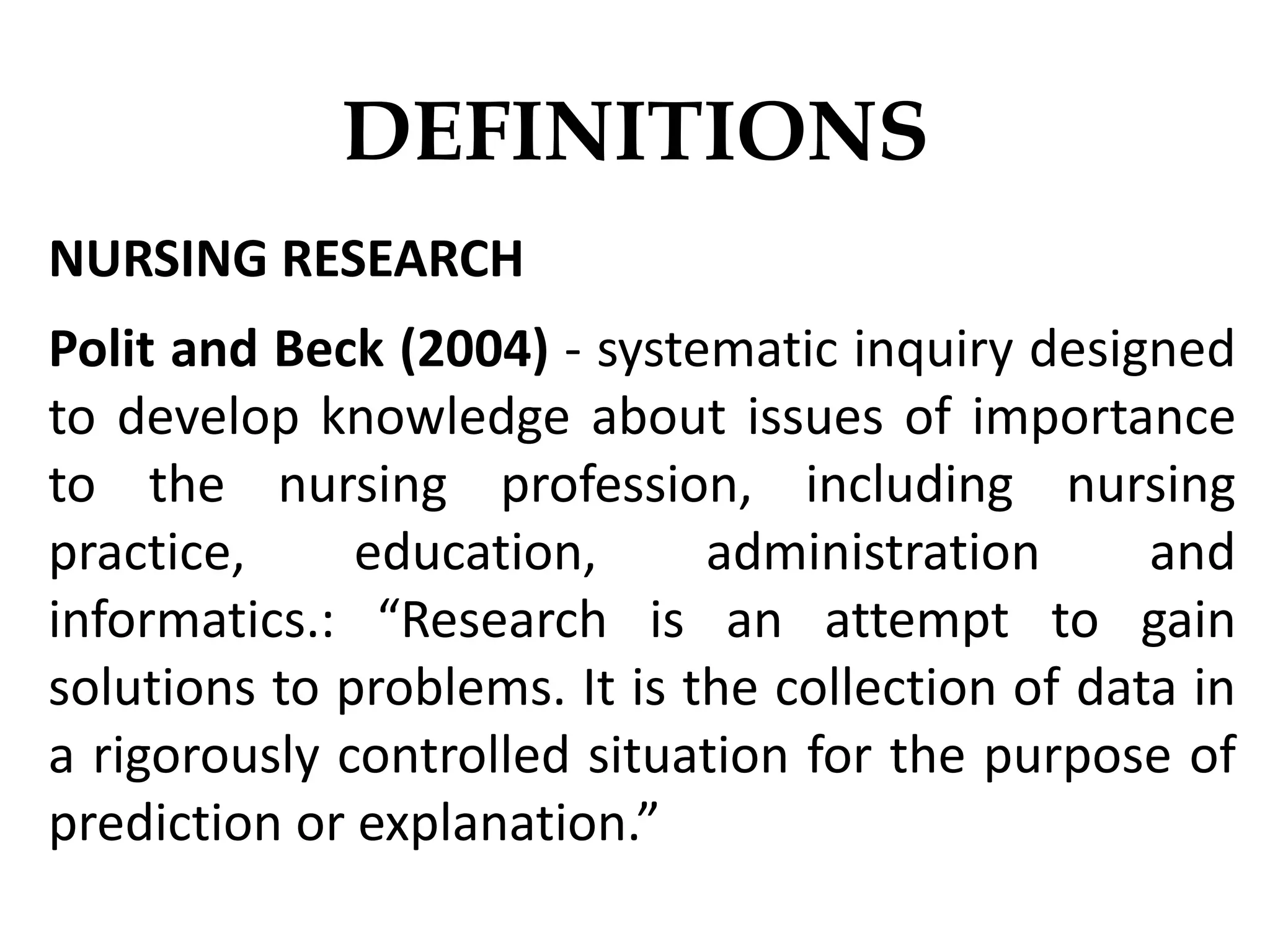
Polit and Beck (2004) - systematic inquiry designed
to develop knowledge about issues of importance
to the nursing profession, including nursing
practice, education, administration and
informatics.: “Research is an attempt to gain
solutions to problems. It is the collection of data in
a rigorously controlled situation for the purpose of
prediction or explanation.”
DEFINITIONS
NURSING RESEARCH
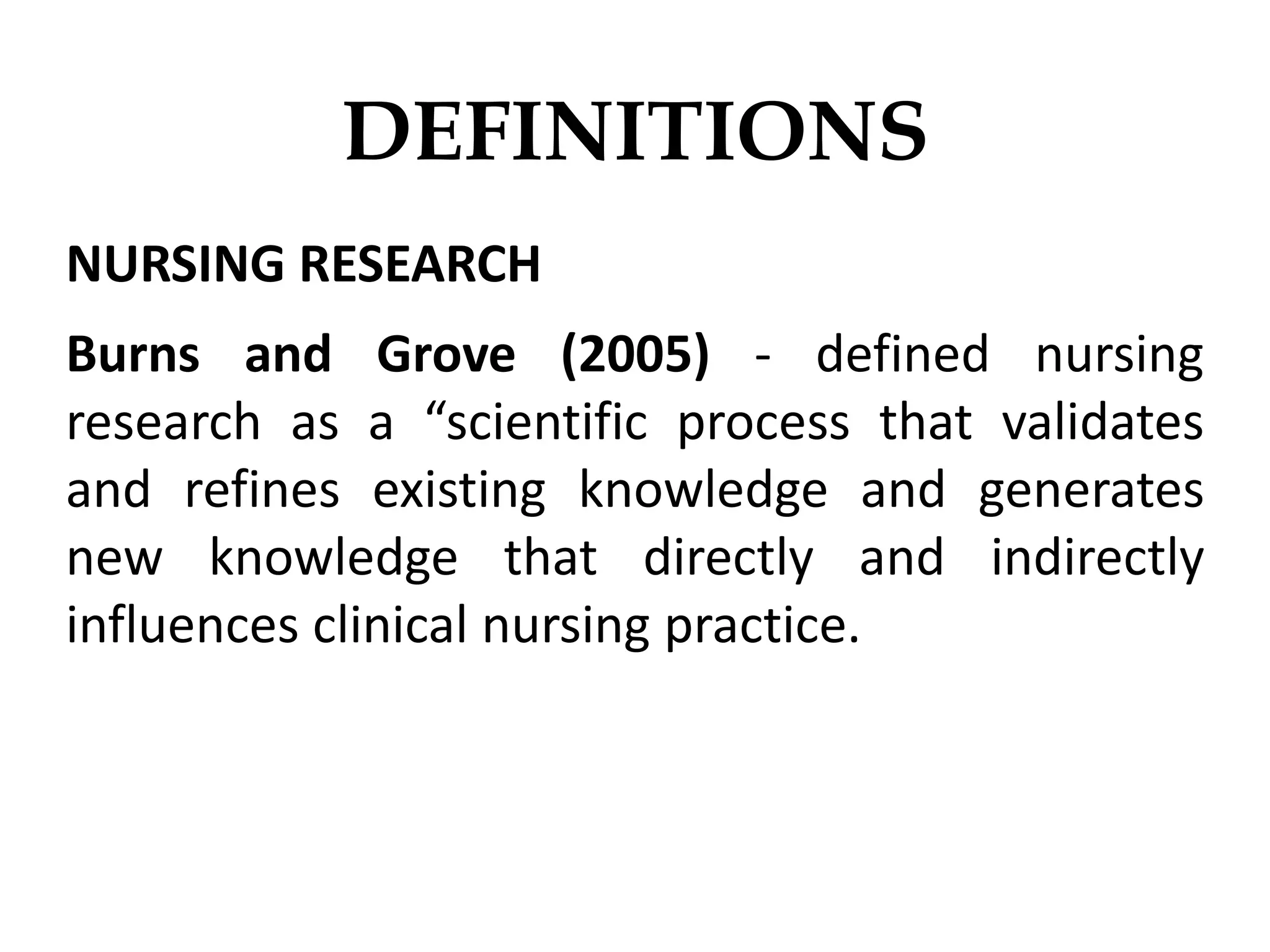
Burns and Grove (2005) - defined nursing
research as a “scientific process that validates
and refines existing knowledge and generates
new knowledge that directly and indirectly
influences clinical nursing practice.
DEFINITIONS
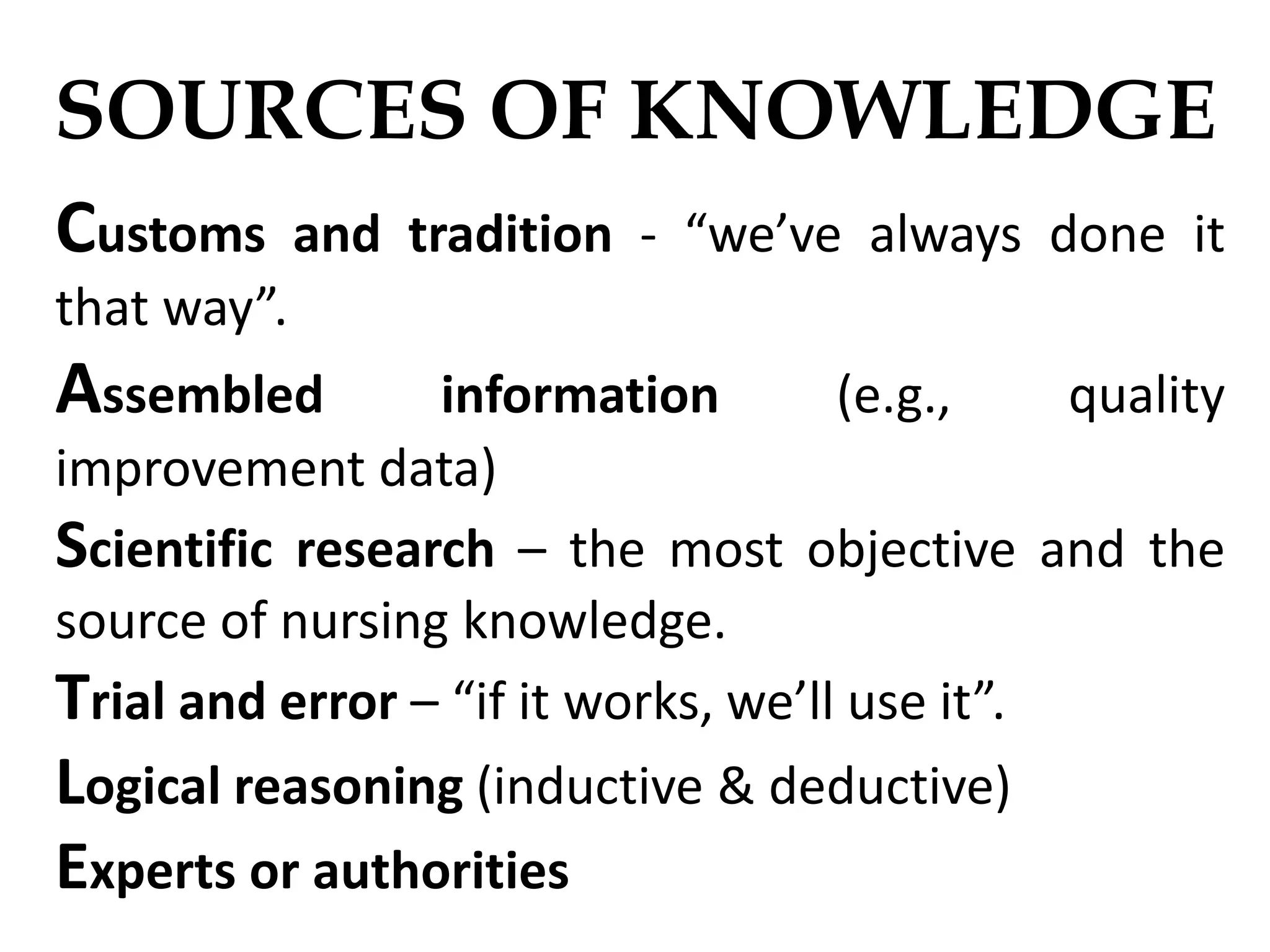
SOURCES OF KNOWLEDGE
Customs and tradition - “we’ve always done it
that way”.
Assembled information (e.g., quality
improvement data)
Scientific research – the most objective and the
source of nursing knowledge.
Trial and error – “if it works, we’ll use it”.
Logical reasoning (inductive & deductive)
Experts or authorities
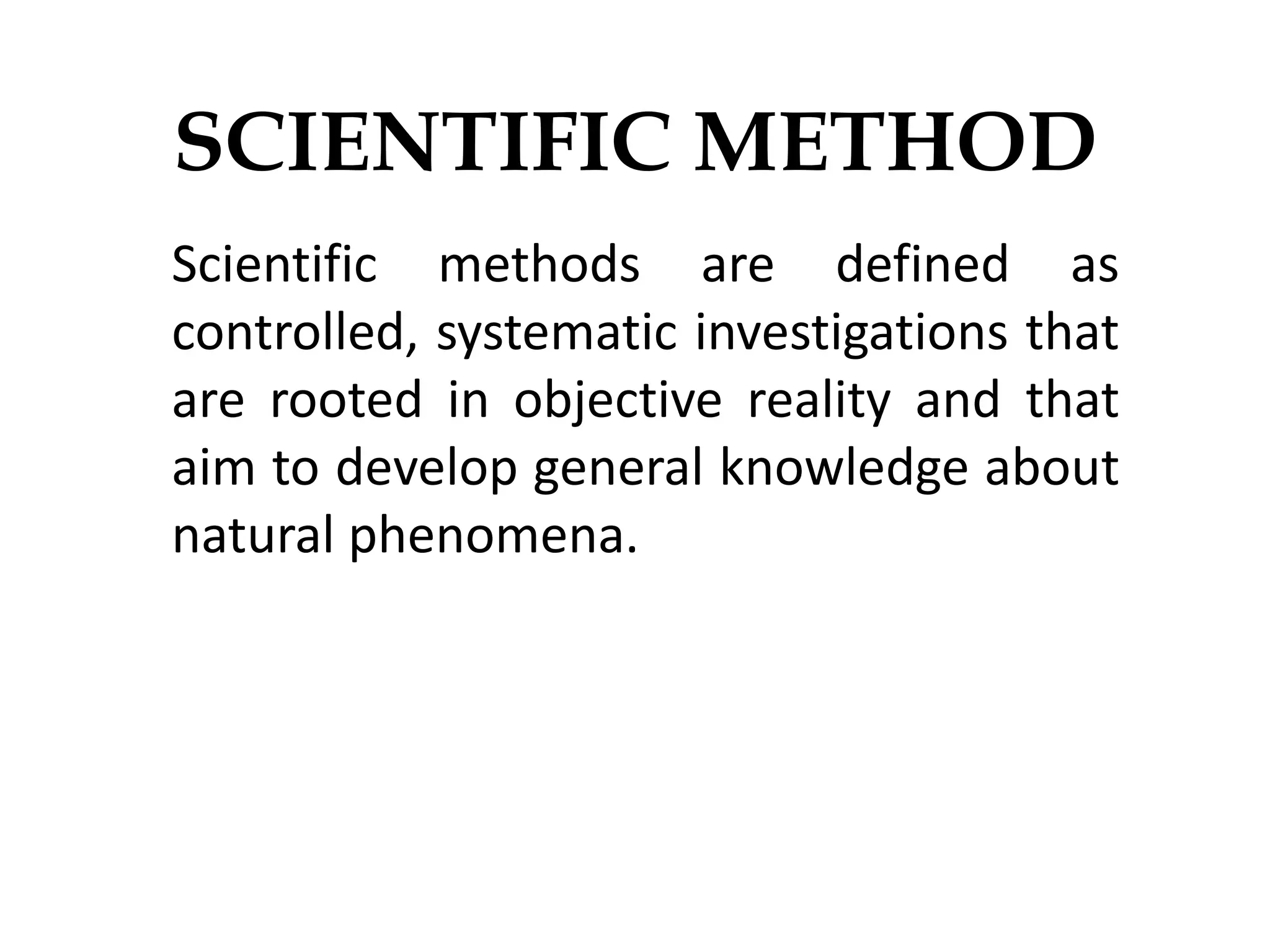
SCIENTIFIC METHOD
Scientific methods are defined as
controlled, systematic investigations that
are rooted in objective reality and that
aim to develop general knowledge about
natural phenomena.
CHARACTERISTICS OF
SCIENTIFIC METHODS
Based on the above definition, the characteristics of
scientific methods are as follows:
•They are orderly and systematic processes.
•Scientists attempt to control external factors that are
not under direct investigation.
•Their findings are based on the empirical evidences.
•Findings of scientific methods can be generalized, which
means that they can be used in situations other than the
one under study.
•They are based on assumptions or hypotheses.
•They are basically conducted to develop or test
theories.
STEPS OF SCIENTIFIC METHOD
The steps of scientific methods depend on the
type of the study, which follows either a
qualitative or a quantitative approach.
However, the main steps used in any scientific
method or approach are as follows:
•Selecting the topic and identifying the problem.
•Defining the objectives of the study.
•Reviewing the literature from theory and other
related studies.
•Defining concepts and variables to be studied.
CONT…
•Stating hypothesis about expected observations
or phenomenon to be studied.
•Identifying assumptions and implications.
•Determining the ethical implication of the
proposed study.
•Describing the research design and methods for
data collection.
•Defining study population and sample.
•Planning the data analysis and discussion.
•Collecting data from subjects.
•Analysing and interpreting data.
•Communicating findings of the study.
NEED FOR NURSING RESEARCH
Nursing Research helps to:
•Build and expand the body of nursing
knowledge,
•Validate and refine the existing nursing practice,
•Make health care efficient and cost-effective.
NEED FOR NURSING RESEARCH
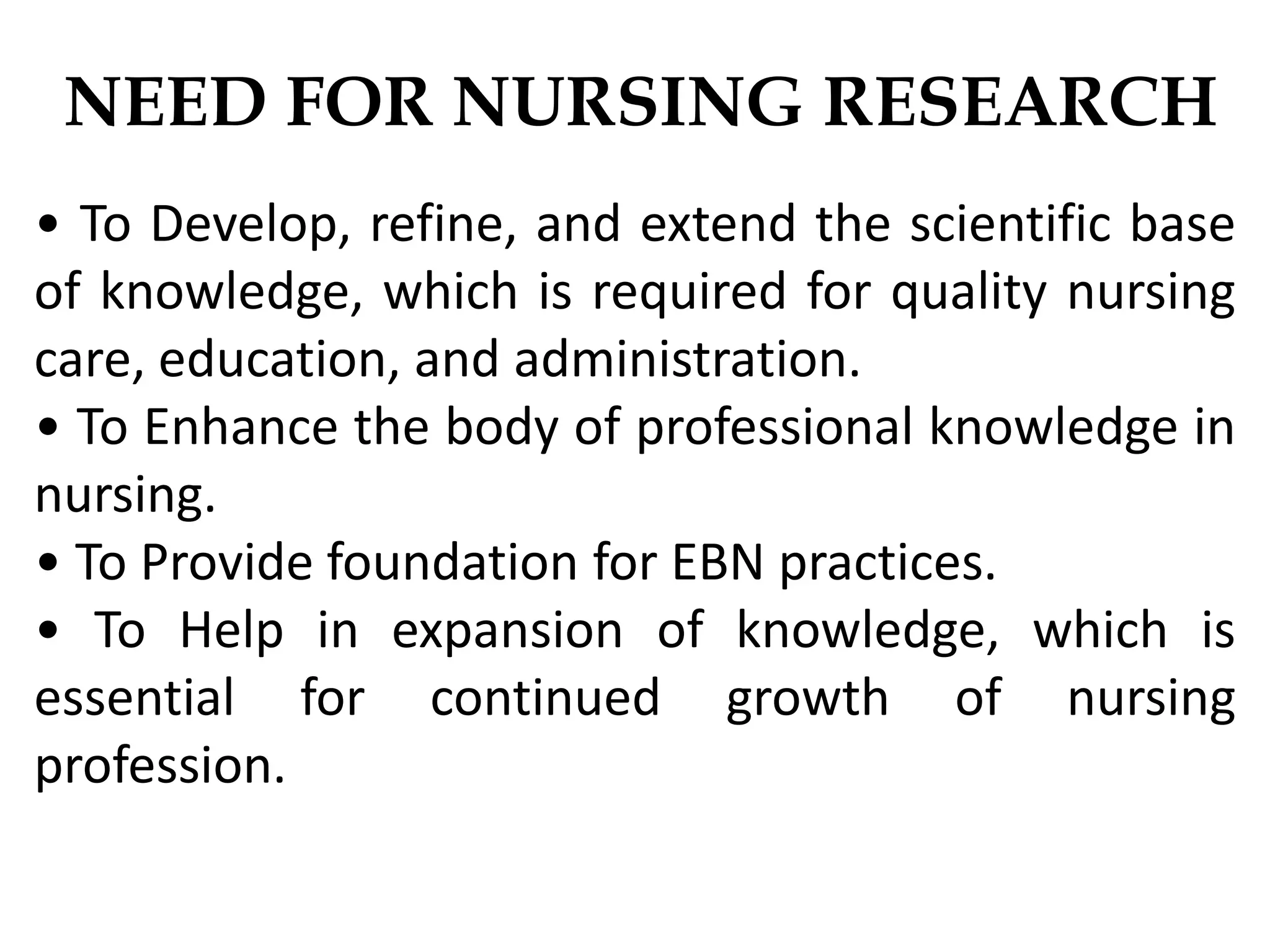
• To Develop, refine, and extend the scientific base
of knowledge, which is required for quality nursing
care, education, and administration.
• To Enhance the body of professional knowledge in
nursing.
• To Provide foundation for EBN practices.
• To Help in expansion of knowledge, which is
essential for continued growth of nursing
profession.
NEED FOR NURSING RESEARCH
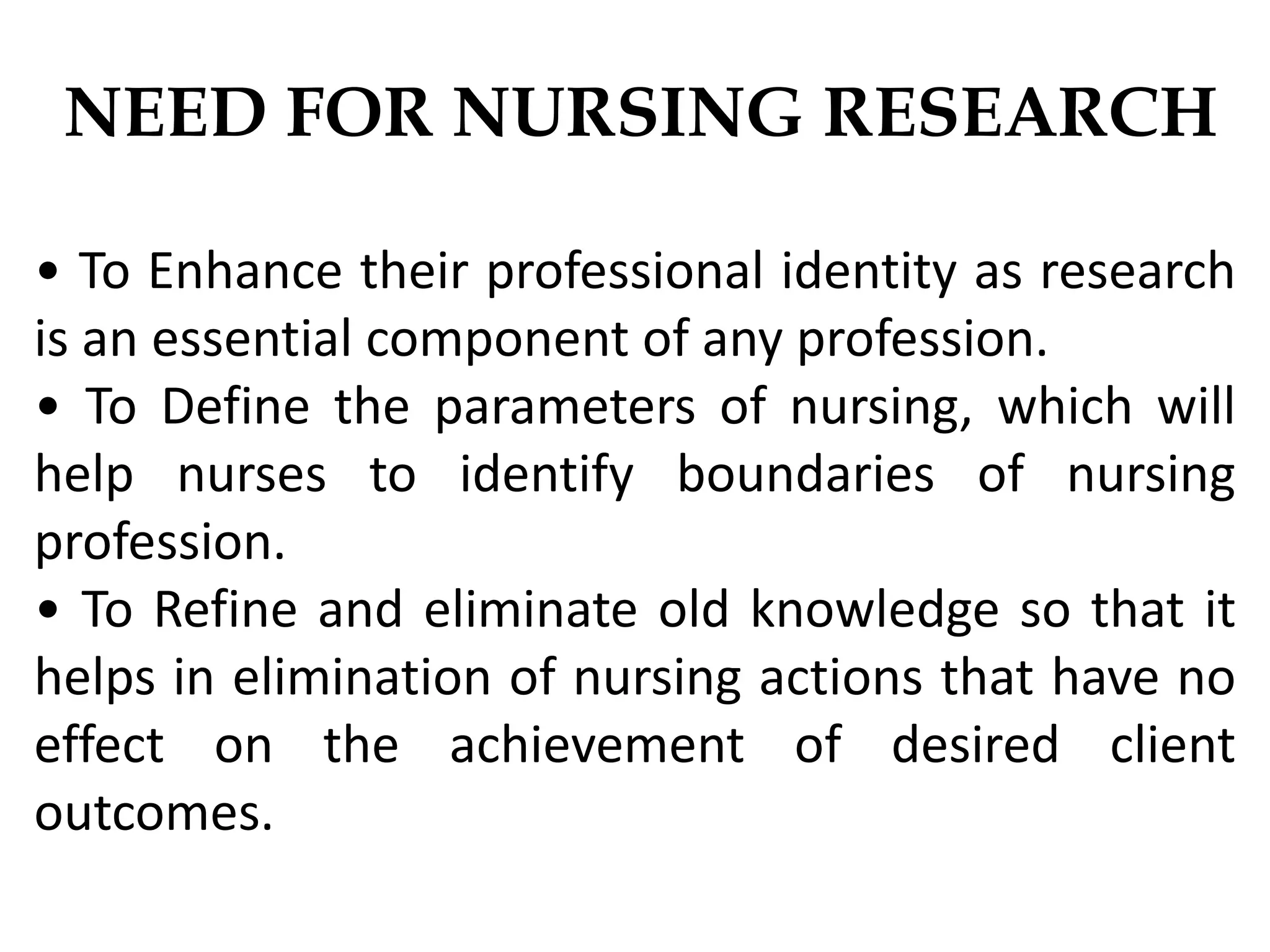
• To Enhance their professional identity as research
is an essential component of any profession.
• To Define the parameters of nursing, which will
help nurses to identify boundaries of nursing
profession.
• To Refine and eliminate old knowledge so that it
helps in elimination of nursing actions that have no
effect on the achievement of desired client
outcomes.
NURSES ROLE IN RESEARCH
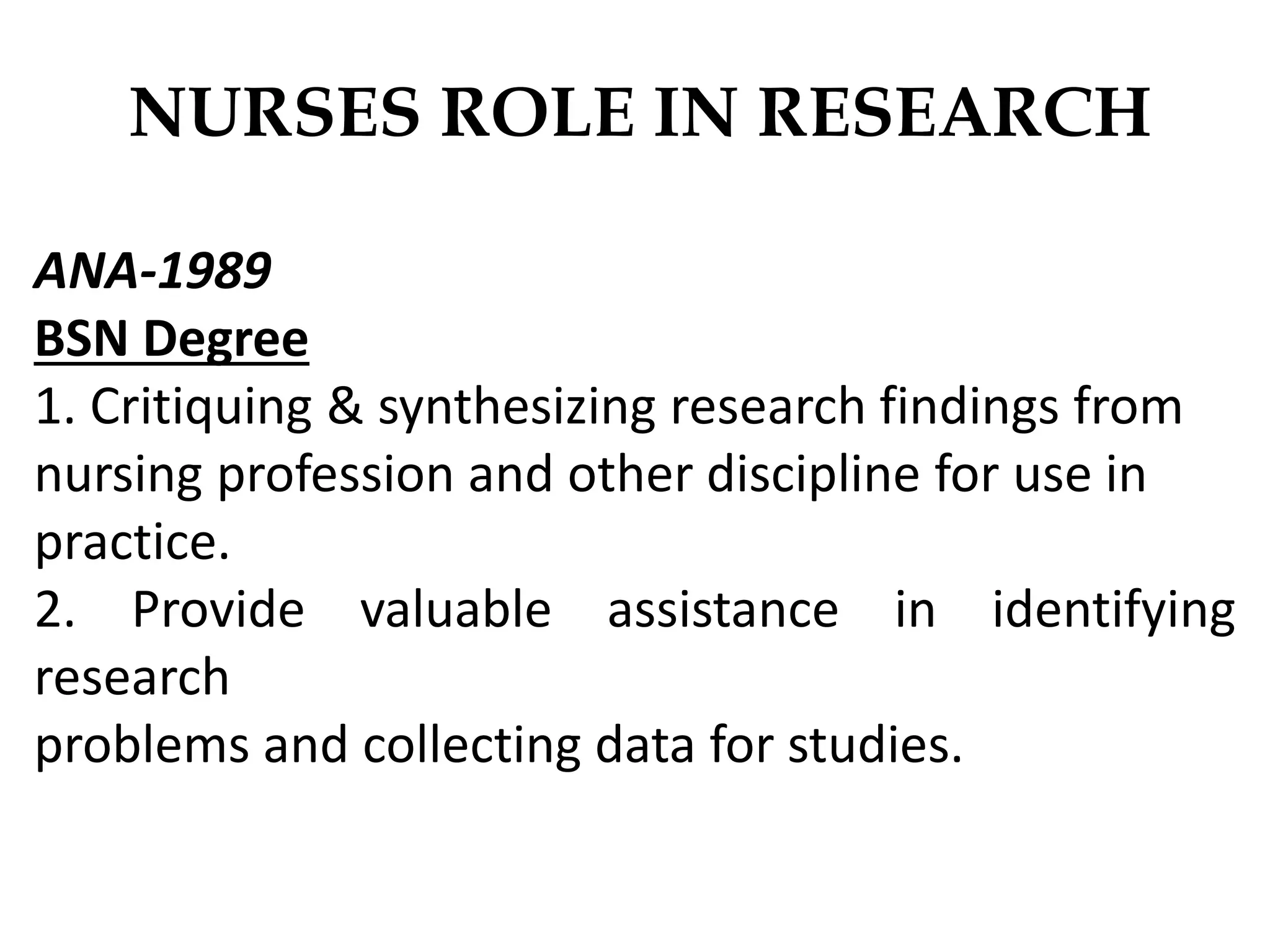
ANA-1989
BSN Degree
1. Critiquing & synthesizing research findings from
nursing profession and other discipline for use in
practice.
2. Provide valuable assistance in identifying
research
problems and collecting data for studies.
NURSES ROLE IN RESEARCH
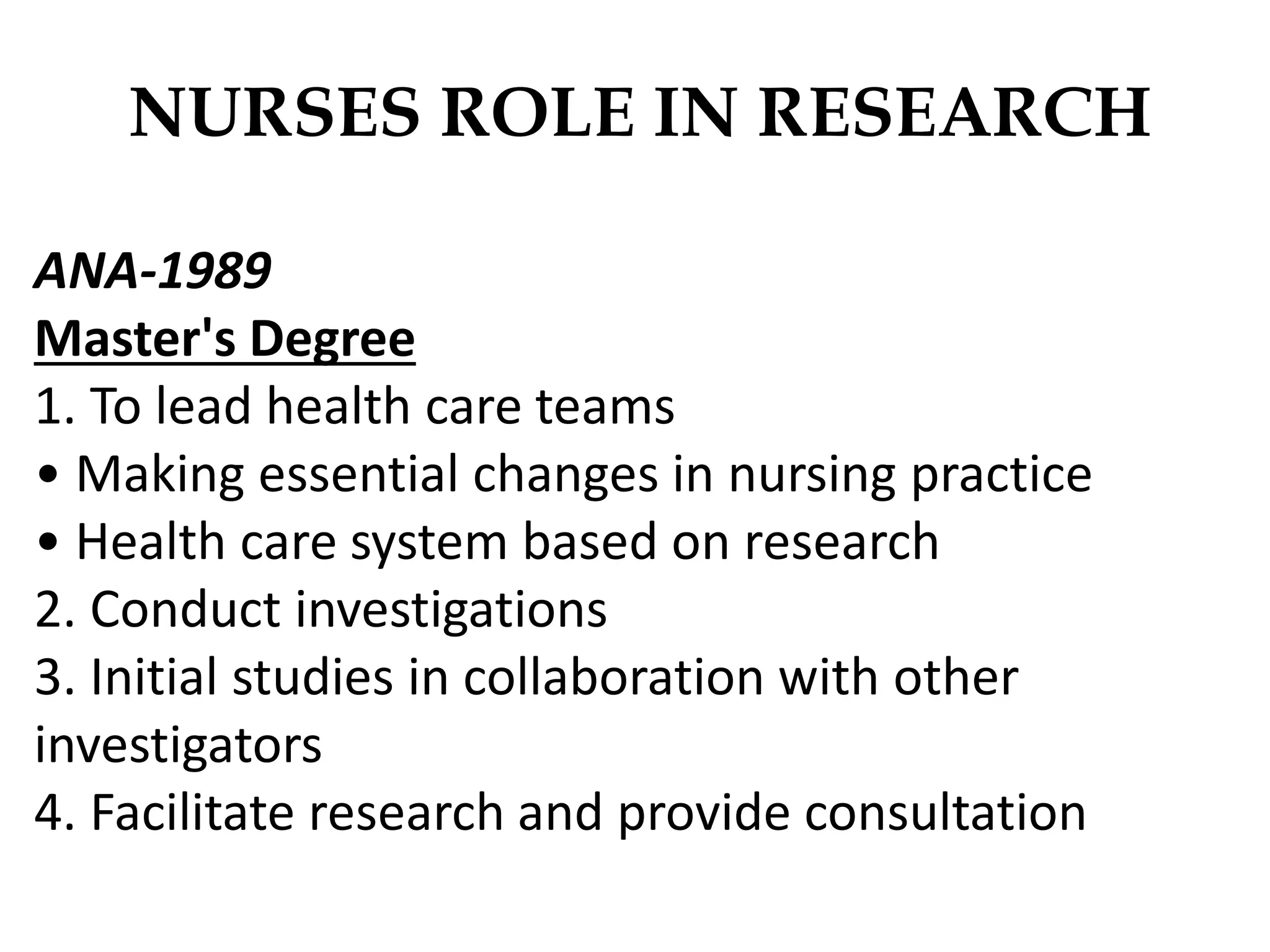
ANA-1989
Master's Degree
1. To lead health care teams
• Making essential changes in nursing practice
• Health care system based on research
2. Conduct investigations
3. Initial studies in collaboration with other
investigators
4. Facilitate research and provide consultation
NURSES ROLE IN RESEARCH
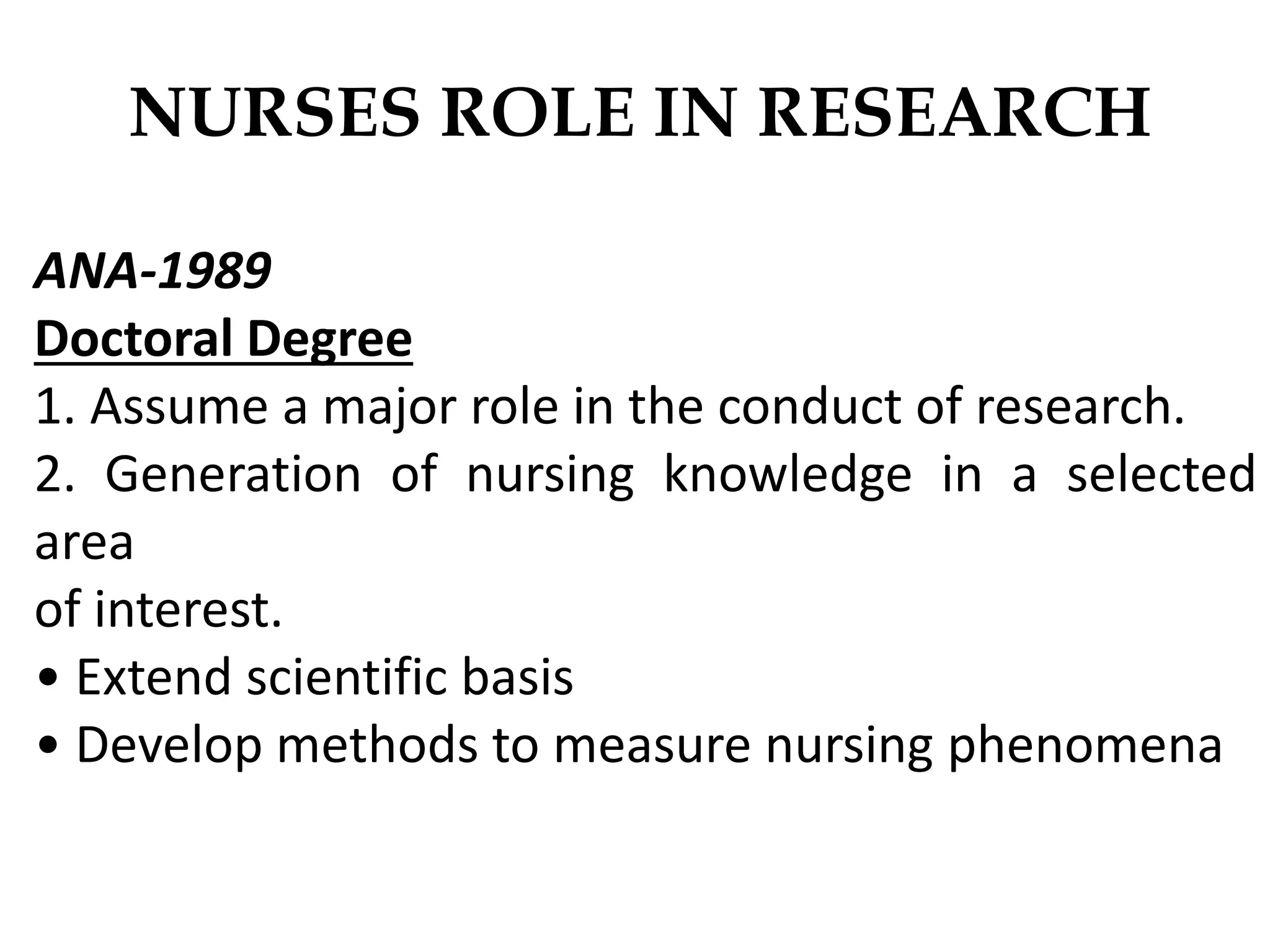
ANA-1989
Doctoral Degree
1. Assume a major role in the conduct of research.
2. Generation of nursing knowledge in a selected
area
of interest.
• Extend scientific basis
• Develop methods to measure nursing phenomena
NURSES ROLE IN RESEARCH
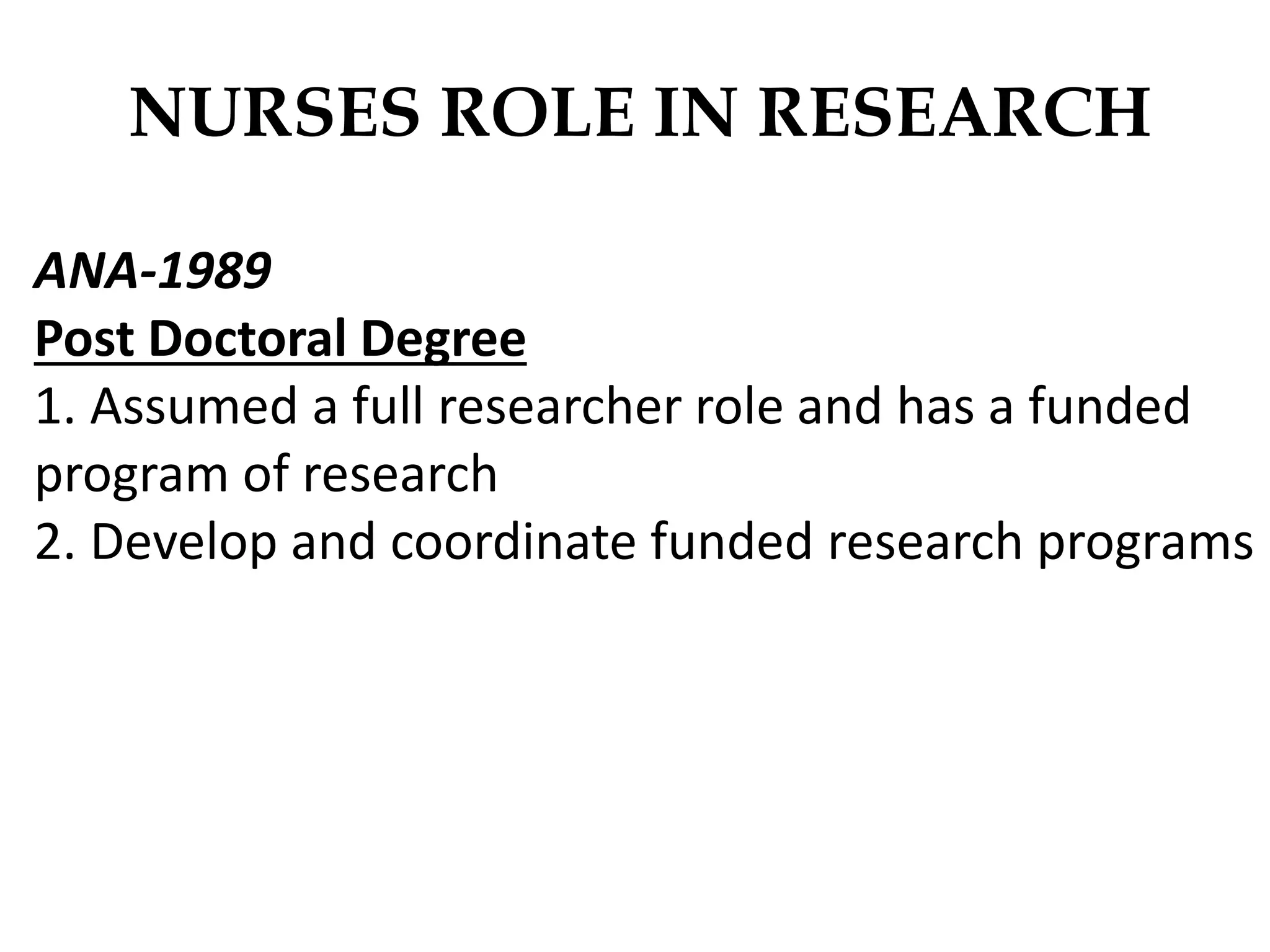
ANA-1989
Post Doctoral Degree
1. Assumed a full researcher role and has a funded
program of research
2. Develop and coordinate funded research programs
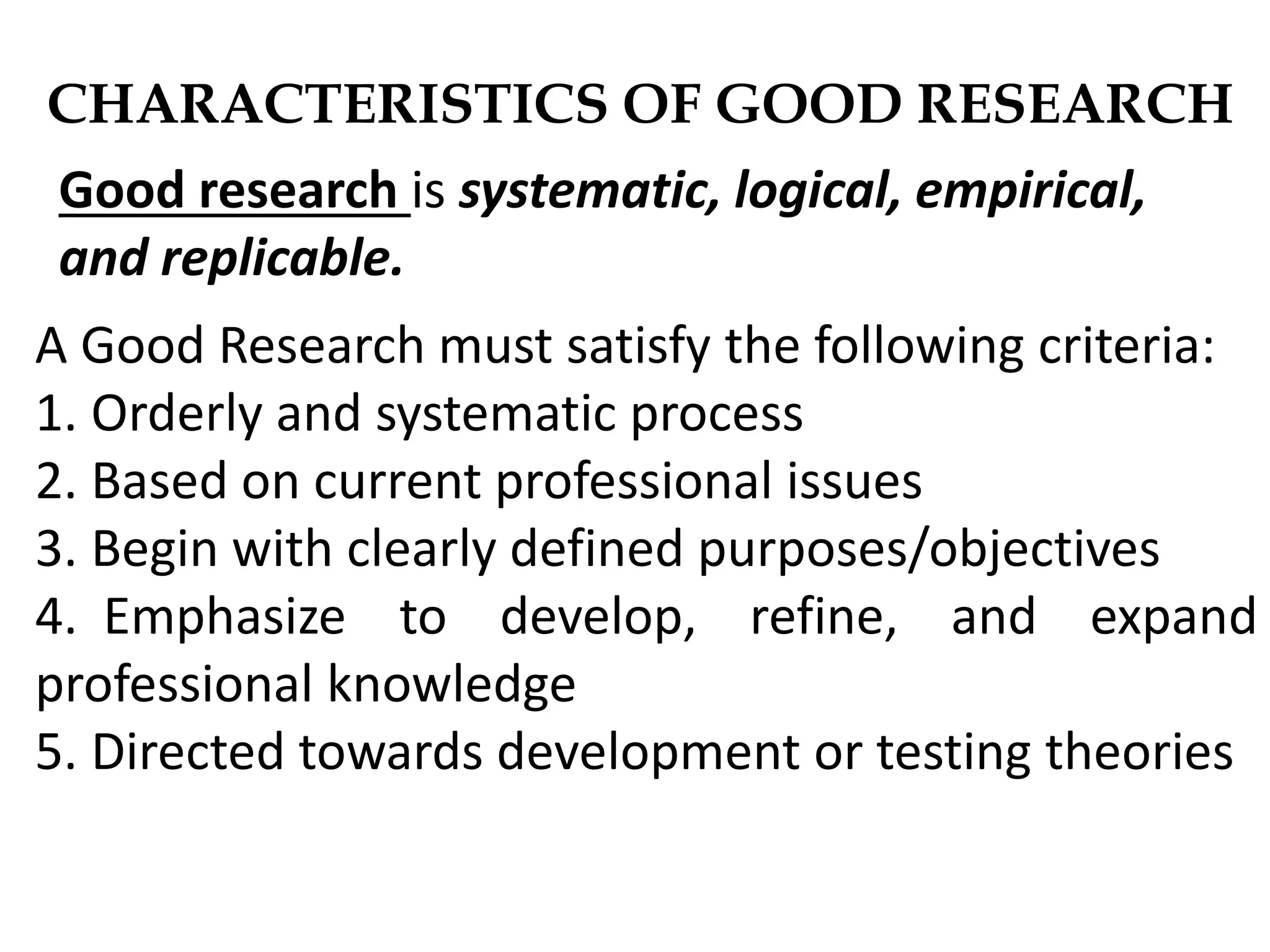
CHARACTERISTICS OF GOOD RESEARCH
A Good Research must satisfy the following criteria:
1. Orderly and systematic process
2. Based on current professional issues
3. Begin with clearly defined purposes/objectives
4. Emphasize to develop, refine, and expand
professional knowledge
5. Directed towards development or testing theories
Good research is systematic, logical, empirical,
and replicable.
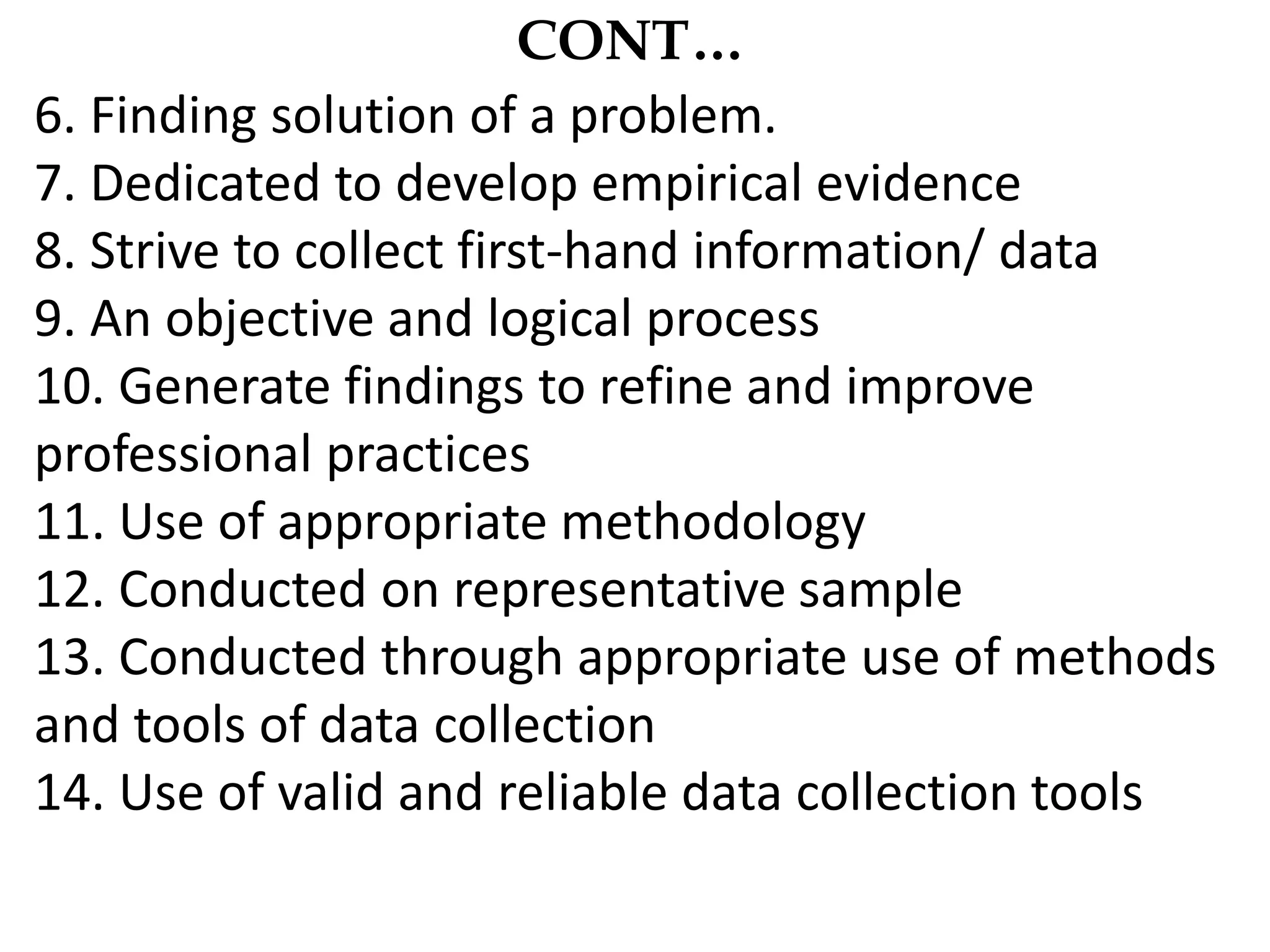
CONT…
6. Finding solution of a problem.
7. Dedicated to develop empirical evidence
8. Strive to collect first-hand information/ data
9. An objective and logical process
10. Generate findings to refine and improve
professional practices
11. Use of appropriate methodology
12. Conducted on representative sample
13. Conducted through appropriate use of methods
and tools of data collection
14. Use of valid and reliable data collection tools
CONT…
15. Carefully recorded and reported
16. Adequately and appropriately analysed research
17. Patiently carried out activity
18. Researcher’s expertise, interest, motivation, and
courage
19. Adequately communicated

Introduction to Nursing Research

  • 1.
  • 2.
  • 3.
    MEANING OF RESEARCH? Theword Research is derived from the French word “recherche”, which means “to go about seeking”, Old French term “recerchier” a compound word from “re-” + “cerchier” The earliest recorded use of the term was in 1577.
  • 4.
    RE – SEARCH Theprefix “re” means “again” and signifies replication of the search. One seeks new knowledge or to directly utilize knowledge specific to life situations.
  • 5.
    DEFINITIONS RESEARCH Webster (1971), “researchis a studious inquiry or examination, investigation, or experimentation aimed at the discovery and interpretation of facts, revision of accepted theories or laws in the light of new facts or practical applications of such new or revised theories or laws.”
  • 6.
    RESEARCH Treece and Treece(1973) stated: “Research is an attempt to gain solutions to problems. It is the collection of data in a rigorously controlled situation for the purpose of prediction or explanation.” DEFINITIONS
  • 7.
    NURSING RESEARCH Polit andBeck (2004) - systematic inquiry designed to develop knowledge about issues of importance to the nursing profession, including nursing practice, education, administration and informatics.: “Research is an attempt to gain solutions to problems. It is the collection of data in a rigorously controlled situation for the purpose of prediction or explanation.” DEFINITIONS
  • 8.
    NURSING RESEARCH Burns andGrove (2005) - defined nursing research as a “scientific process that validates and refines existing knowledge and generates new knowledge that directly and indirectly influences clinical nursing practice. DEFINITIONS
  • 9.
    SOURCES OF KNOWLEDGE Customsand tradition - “we’ve always done it that way”. Assembled information (e.g., quality improvement data) Scientific research – the most objective and the source of nursing knowledge. Trial and error – “if it works, we’ll use it”. Logical reasoning (inductive & deductive) Experts or authorities
  • 10.
    SCIENTIFIC METHOD Scientific methodsare defined as controlled, systematic investigations that are rooted in objective reality and that aim to develop general knowledge about natural phenomena.
  • 11.
    CHARACTERISTICS OF SCIENTIFIC METHODS Basedon the above definition, the characteristics of scientific methods are as follows: •They are orderly and systematic processes. •Scientists attempt to control external factors that are not under direct investigation. •Their findings are based on the empirical evidences. •Findings of scientific methods can be generalized, which means that they can be used in situations other than the one under study. •They are based on assumptions or hypotheses. •They are basically conducted to develop or test theories.
  • 12.
    STEPS OF SCIENTIFICMETHOD The steps of scientific methods depend on the type of the study, which follows either a qualitative or a quantitative approach. However, the main steps used in any scientific method or approach are as follows: •Selecting the topic and identifying the problem. •Defining the objectives of the study. •Reviewing the literature from theory and other related studies. •Defining concepts and variables to be studied.
  • 13.
    CONT… •Stating hypothesis aboutexpected observations or phenomenon to be studied. •Identifying assumptions and implications. •Determining the ethical implication of the proposed study. •Describing the research design and methods for data collection. •Defining study population and sample. •Planning the data analysis and discussion. •Collecting data from subjects. •Analysing and interpreting data. •Communicating findings of the study.
  • 14.
    NEED FOR NURSINGRESEARCH Nursing Research helps to: •Build and expand the body of nursing knowledge, •Validate and refine the existing nursing practice, •Make health care efficient and cost-effective.
  • 15.
    NEED FOR NURSINGRESEARCH • To Develop, refine, and extend the scientific base of knowledge, which is required for quality nursing care, education, and administration. • To Enhance the body of professional knowledge in nursing. • To Provide foundation for EBN practices. • To Help in expansion of knowledge, which is essential for continued growth of nursing profession.
  • 16.
    NEED FOR NURSINGRESEARCH • To Enhance their professional identity as research is an essential component of any profession. • To Define the parameters of nursing, which will help nurses to identify boundaries of nursing profession. • To Refine and eliminate old knowledge so that it helps in elimination of nursing actions that have no effect on the achievement of desired client outcomes.
  • 17.
    NURSES ROLE INRESEARCH ANA-1989 BSN Degree 1. Critiquing & synthesizing research findings from nursing profession and other discipline for use in practice. 2. Provide valuable assistance in identifying research problems and collecting data for studies.
  • 18.
    NURSES ROLE INRESEARCH ANA-1989 Master's Degree 1. To lead health care teams • Making essential changes in nursing practice • Health care system based on research 2. Conduct investigations 3. Initial studies in collaboration with other investigators 4. Facilitate research and provide consultation
  • 19.
    NURSES ROLE INRESEARCH ANA-1989 Doctoral Degree 1. Assume a major role in the conduct of research. 2. Generation of nursing knowledge in a selected area of interest. • Extend scientific basis • Develop methods to measure nursing phenomena
  • 20.
    NURSES ROLE INRESEARCH ANA-1989 Post Doctoral Degree 1. Assumed a full researcher role and has a funded program of research 2. Develop and coordinate funded research programs
  • 21.
    CHARACTERISTICS OF GOODRESEARCH A Good Research must satisfy the following criteria: 1. Orderly and systematic process 2. Based on current professional issues 3. Begin with clearly defined purposes/objectives 4. Emphasize to develop, refine, and expand professional knowledge 5. Directed towards development or testing theories Good research is systematic, logical, empirical, and replicable.
  • 22.
    CONT… 6. Finding solutionof a problem. 7. Dedicated to develop empirical evidence 8. Strive to collect first-hand information/ data 9. An objective and logical process 10. Generate findings to refine and improve professional practices 11. Use of appropriate methodology 12. Conducted on representative sample 13. Conducted through appropriate use of methods and tools of data collection 14. Use of valid and reliable data collection tools
  • 23.
    CONT… 15. Carefully recordedand reported 16. Adequately and appropriately analysed research 17. Patiently carried out activity 18. Researcher’s expertise, interest, motivation, and courage 19. Adequately communicated