Mr. Hildebrandt, Fall Semester 2011-12
                                   Course Summary
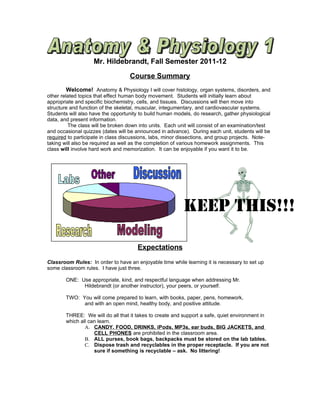
         Welcome! Anatomy & Physiology I will cover histology, organ systems, disorders, and
other related topics that effect human body movement. Students will initially learn about
appropriate and specific biochemistry, cells, and tissues. Discussions will then move into
structure and function of the skeletal, muscular, integumentary, and cardiovascular systems.
Students will also have the opportunity to build human models, do research, gather physiological
data, and present information.
         The class will be broken down into units. Each unit will consist of an examination/test
and occasional quizzes (dates will be announced in advance). During each unit, students will be
required to participate in class discussions, labs, minor dissections, and group projects. Note-
taking will also be required as well as the completion of various homework assignments. This
class will involve hard work and memorization. It can be enjoyable if you want it to be.


                                      Expectations
Classroom Rules: In order to have an enjoyable time while learning it is necessary to set up
some classroom rules. I have just three.

        ONE: Use appropriate, kind, and respectful language when addressing Mr.
              Hildebrandt (or another instructor), your peers, or yourself.

        TWO: You will come prepared to learn, with books, paper, pens, homework,
              and with an open mind, healthy body, and positive attitude.

        THREE: We will do all that it takes to create and support a safe, quiet environment in
        which all can learn.
                A. CANDY. FOOD, DRINKS, iPods, MP3s, ear buds, BIG JACKETS, and
                    CELL PHONES are prohibited in the classroom area.
                B. ALL purses, book bags, backpacks must be stored on the lab tables.
                C. Dispose trash and recyclables in the proper receptacle. If you are not
                    sure if something is recyclable – ask. No littering!
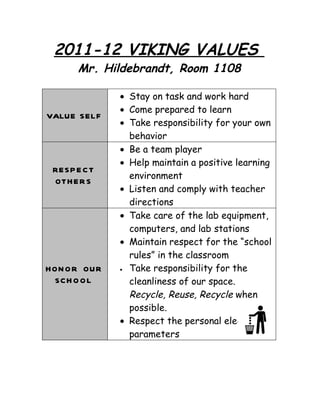
2011-12 VIKING VALUES
       Mr. Hildebrandt, Room 1108

              • Stay on task and work hard
              • Come prepared to learn
VALUE SELF
              • Take responsibility for your own
                behavior
              • Be a team player
              • Help maintain a positive learning
 RESP E C T
                environment
 OTH E R S
              • Listen and comply with teacher
                directions
              • Take care of the lab equipment,
                computers, and lab stations
              • Maintain respect for the “school
                rules” in the classroom
HON O R OUR   • Take responsibility for the

 SCH O O L      cleanliness of our space.
                Recycle, Reuse, Recycle when
                possible.
              • Respect the personal electronics
                parameters
...Rules continued - If a student chooses not to follow these rules, there will be appropriate
consequences (i.e., contacting a parent, confiscation, etc.). As a result, I always invite students
to create any other “rules” that might be needed in order to enforce the three just mentioned.


Tardiness: Students must be quiet and in their assigned desks when the bell rings. At this
point, students will get ready to learn while roll is taken, passes signed, etc. Any other behavior
will be considered a tardy.


Walking Around or Leaving the classroom: Unless the activity involves moving
around the classroom, students are to remain seated a ready to learn. I will try my hardest to
plan many active activities whenever possible. “Wander” into the lab area without permission is
prohibited.

Students will not be allowed to leave the room during class time discussions unless it is an
absolute emergency. If it is an emergency -- just go. I will send someone to check on you or
check on you myself.

During other parts of class (lab, group work, etc.) a student can ask to visit the washroom, water
fountain, etc. They MUST have a school ID and carry the classroom clipboard. Students
MUST also sign out on the student log. Remember: Using hall passes is a privilege and if a
student abuses this privilege he or she will not be allowed to use the pass at all.


Dismissal/Clean-Up: Students will be dismissed by Mr. Hildebrandt - NOT by the bell.
Until then, stay in your assigned seats! Closing books early and walking towards or standing
around the door is prohibited. When modeling or dissecting, the last few minutes of the period
will be set aside as clean-up time. Mr. Hildebrandt will announce to the class when it is time to
start the clean-up.


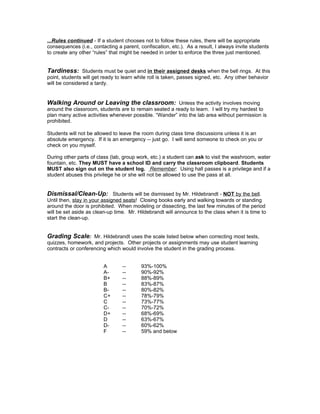
Grading Scale: Mr. Hildebrandt uses the scale listed below when correcting most tests,
quizzes, homework, and projects. Other projects or assignments may use student learning
contracts or conferencing which would involve the student in the grading process.


                         A       --       93%-100%
                         A-      --       90%-92%
                         B+      --       88%-89%
                         B       --       83%-87%
                         B-      --       80%-82%
                         C+      --       78%-79%
                         C       --       73%-77%
                         C-      --       70%-72%
                         D+      --       68%-69%
                         D       --       63%-67%
                         D-      --       60%-62%
                         F       --       59% and below
Classroom Participation Grade: All students are expected to regularly: follow
instructions, attend class, try their best, volunteer in class, and actively engage in dissections and
modeling. Students will receive a grade each quarter for their level of participation. This
participation grade holds substantial weight and can greatly influence the grade at the end of
each quarter. See participation criteria at the end of this packet.


Turning in assignments/Returning assignments: Each class will have a “Return”
folder in which corrected/inputted assignments are placed. Assignments in this folder can be
taken out at any time.


Late Work/Make-up work: Students will be given two days to make-up missed work
ONLY when Mr. Hildebrandt receives a pre-excuse slip or notice from the office that the absence
is excused.
    Students are always expected to hand in their assignments on time. Late work will be
corrected and returned BUT it will be recorded as a “one”.


Extra Credit: There are two types of “extra” points available to students:
  Improvement Bonus Points - A student can receive up to 10 bonus points if he or she
       improves two entire letter grades from one test to the next (i.e. a student gets a “B-” on a
       major test after getting a “D-” on the previous one). It is the student’s responsibility to
       make the teacher aware of the improvement.

  Extra Credit Projects may be available at times. The student’s project idea MUST be
                   cleared by Mr. Hildebrandt before you begin work. All regular assignments
  must be                  completed before extra credit projects will be allowed.


I understand the above classroom rules and will honor them.


Signature                                                                            date
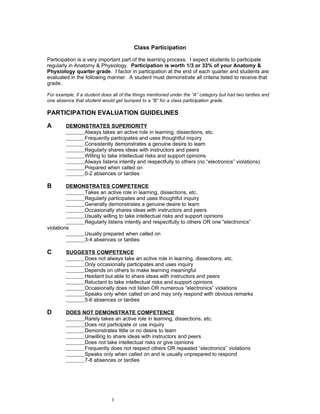
Class Participation

Participation is a very important part of the learning process. I expect students to participate
regularly in Anatomy & Physiology. Participation is worth 1/3 or 33% of your Anatomy &
Physiology quarter grade. I factor in participation at the end of each quarter and students are
evaluated in the following manner. A student must demonstrate all criteria listed to receive that
grade.

For example, if a student does all of the things mentioned under the “A” category but had two tardIes and
one absence that student would get bumped to a “B” for a class participation grade.

PARTICIPATION EVALUATION GUIDELINES

A       DEMONSTRATES SUPERIORITY
             Always takes an active role in learning, dissections, etc.
             Frequently participates and uses thoughtful inquiry
             Consistently demonstrates a genuine desire to learn
             Regularly shares ideas with instructors and peers
             Willing to take intellectual risks and support opinions
             Always listens intently and respectfully to others (no “electronics” violations)
             Prepared when called on
             0-2 absences or tardies

B        DEMONSTRATES COMPETENCE
              Takes an active role in learning, dissections, etc.
              Regularly participates and uses thoughtful inquiry
              Generally demonstrates a genuine desire to learn
              Occasionally shares ideas with instructors and peers
              Usually willing to take intellectual risks and support opinions
              Regularly listens intently and respectfully to others OR one “electronics”
violations
              Usually prepared when called on
              3-4 absences or tardies

C       SUGGESTS COMPETENCE
             Does not always take an active role in learning, dissections, etc.
             Only occasionally participates and uses inquiry
             Depends on others to make learning meaningful
             Hesitant but able to share ideas with instructors and peers
             Reluctant to take intellectual risks and support opinions
             Occasionally does not listen OR numerous “electronics” violations
             Speaks only when called on and may only respond with obvious remarks
             5-6 absences or tardies

D       DOES NOT DEMONSTRATE COMPETENCE
              Rarely takes an active role in learning, dissections, etc.
              Does not participate or use inquiry
              Demonstrates little or no desire to learn
              Unwilling to share ideas with instructors and peers
              Does not take intellectual risks or give opinions
              Frequently does not respect others OR repeated “electronics” violations
              Speaks only when called on and is usually unprepared to respond
              7-8 absences or tardies

A&P Classroom Expectations

  • 1.
    Mr. Hildebrandt, FallSemester 2011-12 Course Summary Welcome! Anatomy & Physiology I will cover histology, organ systems, disorders, and other related topics that effect human body movement. Students will initially learn about appropriate and specific biochemistry, cells, and tissues. Discussions will then move into structure and function of the skeletal, muscular, integumentary, and cardiovascular systems. Students will also have the opportunity to build human models, do research, gather physiological data, and present information. The class will be broken down into units. Each unit will consist of an examination/test and occasional quizzes (dates will be announced in advance). During each unit, students will be required to participate in class discussions, labs, minor dissections, and group projects. Note- taking will also be required as well as the completion of various homework assignments. This class will involve hard work and memorization. It can be enjoyable if you want it to be. Expectations Classroom Rules: In order to have an enjoyable time while learning it is necessary to set up some classroom rules. I have just three. ONE: Use appropriate, kind, and respectful language when addressing Mr. Hildebrandt (or another instructor), your peers, or yourself. TWO: You will come prepared to learn, with books, paper, pens, homework, and with an open mind, healthy body, and positive attitude. THREE: We will do all that it takes to create and support a safe, quiet environment in which all can learn. A. CANDY. FOOD, DRINKS, iPods, MP3s, ear buds, BIG JACKETS, and CELL PHONES are prohibited in the classroom area. B. ALL purses, book bags, backpacks must be stored on the lab tables. C. Dispose trash and recyclables in the proper receptacle. If you are not sure if something is recyclable – ask. No littering!
  • 2.
    2011-12 VIKING VALUES Mr. Hildebrandt, Room 1108 • Stay on task and work hard • Come prepared to learn VALUE SELF • Take responsibility for your own behavior • Be a team player • Help maintain a positive learning RESP E C T environment OTH E R S • Listen and comply with teacher directions • Take care of the lab equipment, computers, and lab stations • Maintain respect for the “school rules” in the classroom HON O R OUR • Take responsibility for the SCH O O L cleanliness of our space. Recycle, Reuse, Recycle when possible. • Respect the personal electronics parameters
  • 3.
    ...Rules continued -If a student chooses not to follow these rules, there will be appropriate consequences (i.e., contacting a parent, confiscation, etc.). As a result, I always invite students to create any other “rules” that might be needed in order to enforce the three just mentioned. Tardiness: Students must be quiet and in their assigned desks when the bell rings. At this point, students will get ready to learn while roll is taken, passes signed, etc. Any other behavior will be considered a tardy. Walking Around or Leaving the classroom: Unless the activity involves moving around the classroom, students are to remain seated a ready to learn. I will try my hardest to plan many active activities whenever possible. “Wander” into the lab area without permission is prohibited. Students will not be allowed to leave the room during class time discussions unless it is an absolute emergency. If it is an emergency -- just go. I will send someone to check on you or check on you myself. During other parts of class (lab, group work, etc.) a student can ask to visit the washroom, water fountain, etc. They MUST have a school ID and carry the classroom clipboard. Students MUST also sign out on the student log. Remember: Using hall passes is a privilege and if a student abuses this privilege he or she will not be allowed to use the pass at all. Dismissal/Clean-Up: Students will be dismissed by Mr. Hildebrandt - NOT by the bell. Until then, stay in your assigned seats! Closing books early and walking towards or standing around the door is prohibited. When modeling or dissecting, the last few minutes of the period will be set aside as clean-up time. Mr. Hildebrandt will announce to the class when it is time to start the clean-up. Grading Scale: Mr. Hildebrandt uses the scale listed below when correcting most tests, quizzes, homework, and projects. Other projects or assignments may use student learning contracts or conferencing which would involve the student in the grading process. A -- 93%-100% A- -- 90%-92% B+ -- 88%-89% B -- 83%-87% B- -- 80%-82% C+ -- 78%-79% C -- 73%-77% C- -- 70%-72% D+ -- 68%-69% D -- 63%-67% D- -- 60%-62% F -- 59% and below
  • 4.
    Classroom Participation Grade:All students are expected to regularly: follow instructions, attend class, try their best, volunteer in class, and actively engage in dissections and modeling. Students will receive a grade each quarter for their level of participation. This participation grade holds substantial weight and can greatly influence the grade at the end of each quarter. See participation criteria at the end of this packet. Turning in assignments/Returning assignments: Each class will have a “Return” folder in which corrected/inputted assignments are placed. Assignments in this folder can be taken out at any time. Late Work/Make-up work: Students will be given two days to make-up missed work ONLY when Mr. Hildebrandt receives a pre-excuse slip or notice from the office that the absence is excused. Students are always expected to hand in their assignments on time. Late work will be corrected and returned BUT it will be recorded as a “one”. Extra Credit: There are two types of “extra” points available to students: Improvement Bonus Points - A student can receive up to 10 bonus points if he or she improves two entire letter grades from one test to the next (i.e. a student gets a “B-” on a major test after getting a “D-” on the previous one). It is the student’s responsibility to make the teacher aware of the improvement. Extra Credit Projects may be available at times. The student’s project idea MUST be cleared by Mr. Hildebrandt before you begin work. All regular assignments must be completed before extra credit projects will be allowed. I understand the above classroom rules and will honor them. Signature date
  • 5.
    Class Participation Participation isa very important part of the learning process. I expect students to participate regularly in Anatomy & Physiology. Participation is worth 1/3 or 33% of your Anatomy & Physiology quarter grade. I factor in participation at the end of each quarter and students are evaluated in the following manner. A student must demonstrate all criteria listed to receive that grade. For example, if a student does all of the things mentioned under the “A” category but had two tardIes and one absence that student would get bumped to a “B” for a class participation grade. PARTICIPATION EVALUATION GUIDELINES A DEMONSTRATES SUPERIORITY Always takes an active role in learning, dissections, etc. Frequently participates and uses thoughtful inquiry Consistently demonstrates a genuine desire to learn Regularly shares ideas with instructors and peers Willing to take intellectual risks and support opinions Always listens intently and respectfully to others (no “electronics” violations) Prepared when called on 0-2 absences or tardies B DEMONSTRATES COMPETENCE Takes an active role in learning, dissections, etc. Regularly participates and uses thoughtful inquiry Generally demonstrates a genuine desire to learn Occasionally shares ideas with instructors and peers Usually willing to take intellectual risks and support opinions Regularly listens intently and respectfully to others OR one “electronics” violations Usually prepared when called on 3-4 absences or tardies C SUGGESTS COMPETENCE Does not always take an active role in learning, dissections, etc. Only occasionally participates and uses inquiry Depends on others to make learning meaningful Hesitant but able to share ideas with instructors and peers Reluctant to take intellectual risks and support opinions Occasionally does not listen OR numerous “electronics” violations Speaks only when called on and may only respond with obvious remarks 5-6 absences or tardies D DOES NOT DEMONSTRATE COMPETENCE Rarely takes an active role in learning, dissections, etc. Does not participate or use inquiry Demonstrates little or no desire to learn Unwilling to share ideas with instructors and peers Does not take intellectual risks or give opinions Frequently does not respect others OR repeated “electronics” violations Speaks only when called on and is usually unprepared to respond 7-8 absences or tardies