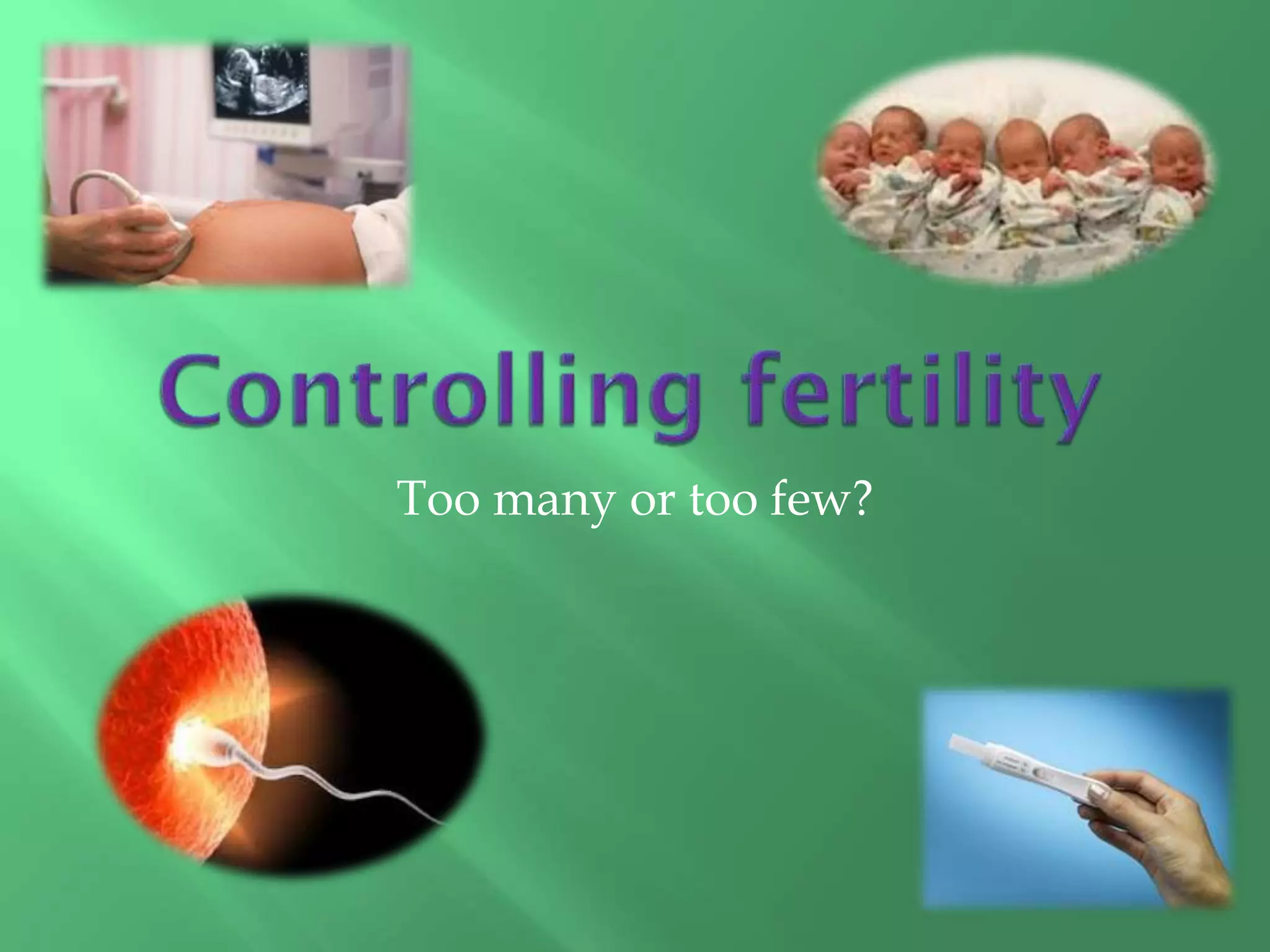
Too many or too few?
contraceptives
Natural
(rhythm
method)
chemical Mechanical surgical
 The couple abstain from sexual intercourse
around the time of ovulation.
 This is a more reliable method when the lady
has regular cycles and when she keeps record
of her menstrual cycle.
 It is the most accepted method by most
cultures and religions worldwide.
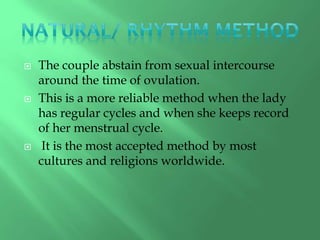
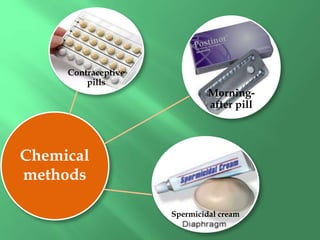
 chemicals that prevent fertilization/implantation.
 1. contraceptive pill. The woman takes one pill everyday for 3
weeks and stops for one week then repeats the pattern. The pills
contain estrogen & /or progesterone in a concentration that
prevents ovulation.
 Some women do not prefer the pill as may cause some weight
gain. It also increases the risk of getting breast cancer if used for
many years.
 2. The morning-after pill contains hormones that prevent the
implantation of the fertilized egg. It is taken by the woman after
she has intercourse. This is usually used as an emergency method.
 3. The spermicidal cream is placed inside the woman’s vagina
before sexual intercourse. It is not very effective on its own and
may be used in conjunction with a mechanical method.
Contraceptive
pills
Morning-
after pill
Spermicidal cream
Chemical
methods
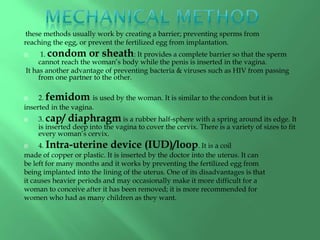
these methods usually work by creating a barrier; preventing sperms from
reaching the egg, or prevent the fertilized egg from implantation.
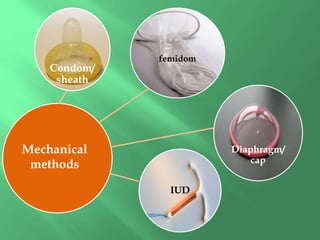
 1. condom or sheath: It provides a complete barrier so that the sperm
cannot reach the woman’s body while the penis is inserted in the vagina.
It has another advantage of preventing bacteria & viruses such as HIV from passing
from one partner to the other.
 2. femidom is used by the woman. It is similar to the condom but it is
inserted in the vagina.
 3. cap/ diaphragm is a rubber half-sphere with a spring around its edge. It
is inserted deep into the vagina to cover the cervix. There is a variety of sizes to fit
every woman’s cervix.
 4. Intra-uterine device (IUD)/loop. It is a coil
made of copper or plastic. It is inserted by the doctor into the uterus. It can
be left for many months and it works by preventing the fertilized egg from
being implanted into the lining of the uterus. One of its disadvantages is that
it causes heavier periods and may occasionally make it more difficult for a
woman to conceive after it has been removed; it is more recommended for
women who had as many children as they want.
Condom/
sheath
femidom
IUD
Diaphragm/
cap
Mechanical
methods
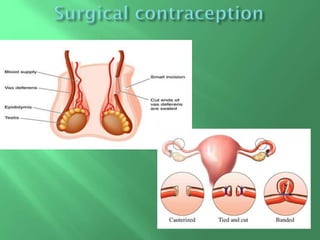
 a couple having as many children as they want
may choose this very effective but final method.
This type if surgery is called sterilisation.
 In a woman the oviducts are cut and tied so that
the sperms cannot reach the released egg. In a man
the sperm ducts are cut and sealed so that the
sperms cannot pass. This method can ensure a
couple can forget about having more babies, but at
the same time it cannot be reversed.
 Some people may find it difficult to have babies normally. This
may be due to many different reasons:
 A woman may not be able to produce “eggs”, in that case she is
given fertility drugs (FSH hormone)
 A woman may have blocked oviducts; preventing the sperm from
reaching the egg. In vitro fertilisation (IVF) provides a solution
where the egg is withdrawn with a fine needle from the ovary;
placed along with the father’s sperm in a Petri dish where
fertilisation takes place. The procedure is sometimes called the
“test tube baby” as a reference to fertilisation taking place in the
lab. The zygote is incubated for a couple of days to make sure it
starts dividing into a healthy embryo before being implanted into
the woman’s uterus.
 In the case where the male’s sperm are inactive, the couple may
choose to take sperm from a donor. The sperm is inserted into the
woman’s vagina. This is called artificial insemination.
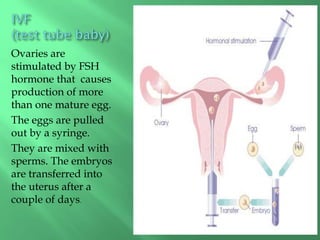
Ovaries are
stimulated by FSH
hormone that causes
production of more
than one mature egg.
The eggs are pulled
out by a syringe.
They are mixed with
sperms. The embryos
are transferred into
the uterus after a
couple of days.
 The body fluids such as those in the male or female reproductive
organs are a good medium for some bacteria and viruses. If a person is
not careful he or she might be infected through his or her partner. We
will discuss three of these diseases.
 Gonorrhoea: this disease is caused by a bacterium that cannot survive
outside the body; which means it cannot survive on toilet seats. The
bacteria causes a discharge from the urethra in males and a sore could
develop on the penis along with pain during urination. In females only
a discharge is released through the vagina.
 Gonorrhoea: this disease is caused by a bacterium that cannot
survive outside the body; which means it cannot survive on
toilet seats. The bacteria causes a discharge from the urethra in
males and a sore could develop on the penis along with pain
during urination. In females only a discharge is released
through the vagina
 Gonorrhoea symptoms are more noticeable in males than
females as the discharge could be confused with the normal
vaginal discharge. Gonorrhoea can be treated by a course of
antibiotics, but if left untreated it may cause blockage of the
sperm ducts or the oviducts resulting in sterility.
 To reduce the spread of gonorrhoea:
 People should reduce their sexual partners, ideally remaining
faithful to one person.
 People should use condoms to reduce infection during sexual
intercourse.
 Both partners must be treated as soon as possible with
antibiotics.
 AIDS (Acquired immune deficiency syndrome)
 caused by HIV, human immunodeficiency virus.
This virus lives in body fluids such as blood and
fluids of the reproductive tract. It can only be
passed by direct contact between blood and
fluids of two persons.
 The virus lives in white blood cells, making the
body’s defence system weaker. A person with
AIDS is more vulnerable to diseases.
Unfortunately, this virus has no cure. Scientists
all over the world are searching for a vaccine to
prevent the spread of the disease.

Reproduction in humans 2

  • 1.
    Too many ortoo few?
  • 2.
  • 3.
     The coupleabstain from sexual intercourse around the time of ovulation.  This is a more reliable method when the lady has regular cycles and when she keeps record of her menstrual cycle.  It is the most accepted method by most cultures and religions worldwide.
  • 4.
     chemicals thatprevent fertilization/implantation.  1. contraceptive pill. The woman takes one pill everyday for 3 weeks and stops for one week then repeats the pattern. The pills contain estrogen & /or progesterone in a concentration that prevents ovulation.  Some women do not prefer the pill as may cause some weight gain. It also increases the risk of getting breast cancer if used for many years.  2. The morning-after pill contains hormones that prevent the implantation of the fertilized egg. It is taken by the woman after she has intercourse. This is usually used as an emergency method.  3. The spermicidal cream is placed inside the woman’s vagina before sexual intercourse. It is not very effective on its own and may be used in conjunction with a mechanical method.
  • 5.
  • 6.
    these methods usuallywork by creating a barrier; preventing sperms from reaching the egg, or prevent the fertilized egg from implantation.  1. condom or sheath: It provides a complete barrier so that the sperm cannot reach the woman’s body while the penis is inserted in the vagina. It has another advantage of preventing bacteria & viruses such as HIV from passing from one partner to the other.  2. femidom is used by the woman. It is similar to the condom but it is inserted in the vagina.  3. cap/ diaphragm is a rubber half-sphere with a spring around its edge. It is inserted deep into the vagina to cover the cervix. There is a variety of sizes to fit every woman’s cervix.  4. Intra-uterine device (IUD)/loop. It is a coil made of copper or plastic. It is inserted by the doctor into the uterus. It can be left for many months and it works by preventing the fertilized egg from being implanted into the lining of the uterus. One of its disadvantages is that it causes heavier periods and may occasionally make it more difficult for a woman to conceive after it has been removed; it is more recommended for women who had as many children as they want.
  • 7.
  • 8.
     a couplehaving as many children as they want may choose this very effective but final method. This type if surgery is called sterilisation.  In a woman the oviducts are cut and tied so that the sperms cannot reach the released egg. In a man the sperm ducts are cut and sealed so that the sperms cannot pass. This method can ensure a couple can forget about having more babies, but at the same time it cannot be reversed.
  • 10.
     Some peoplemay find it difficult to have babies normally. This may be due to many different reasons:  A woman may not be able to produce “eggs”, in that case she is given fertility drugs (FSH hormone)  A woman may have blocked oviducts; preventing the sperm from reaching the egg. In vitro fertilisation (IVF) provides a solution where the egg is withdrawn with a fine needle from the ovary; placed along with the father’s sperm in a Petri dish where fertilisation takes place. The procedure is sometimes called the “test tube baby” as a reference to fertilisation taking place in the lab. The zygote is incubated for a couple of days to make sure it starts dividing into a healthy embryo before being implanted into the woman’s uterus.  In the case where the male’s sperm are inactive, the couple may choose to take sperm from a donor. The sperm is inserted into the woman’s vagina. This is called artificial insemination.
  • 11.
    Ovaries are stimulated byFSH hormone that causes production of more than one mature egg. The eggs are pulled out by a syringe. They are mixed with sperms. The embryos are transferred into the uterus after a couple of days.
  • 12.
     The bodyfluids such as those in the male or female reproductive organs are a good medium for some bacteria and viruses. If a person is not careful he or she might be infected through his or her partner. We will discuss three of these diseases.  Gonorrhoea: this disease is caused by a bacterium that cannot survive outside the body; which means it cannot survive on toilet seats. The bacteria causes a discharge from the urethra in males and a sore could develop on the penis along with pain during urination. In females only a discharge is released through the vagina.
  • 13.
     Gonorrhoea: thisdisease is caused by a bacterium that cannot survive outside the body; which means it cannot survive on toilet seats. The bacteria causes a discharge from the urethra in males and a sore could develop on the penis along with pain during urination. In females only a discharge is released through the vagina  Gonorrhoea symptoms are more noticeable in males than females as the discharge could be confused with the normal vaginal discharge. Gonorrhoea can be treated by a course of antibiotics, but if left untreated it may cause blockage of the sperm ducts or the oviducts resulting in sterility.  To reduce the spread of gonorrhoea:  People should reduce their sexual partners, ideally remaining faithful to one person.  People should use condoms to reduce infection during sexual intercourse.  Both partners must be treated as soon as possible with antibiotics.
  • 14.
     AIDS (Acquiredimmune deficiency syndrome)  caused by HIV, human immunodeficiency virus. This virus lives in body fluids such as blood and fluids of the reproductive tract. It can only be passed by direct contact between blood and fluids of two persons.  The virus lives in white blood cells, making the body’s defence system weaker. A person with AIDS is more vulnerable to diseases. Unfortunately, this virus has no cure. Scientists all over the world are searching for a vaccine to prevent the spread of the disease.