V . S . R A S H M I P R I Y E M
U L T R A ’ S B E S T D E N T A L S C I E N C E C O L L E G E
FERTILITY CONTROL
FERTILITY CONTROL
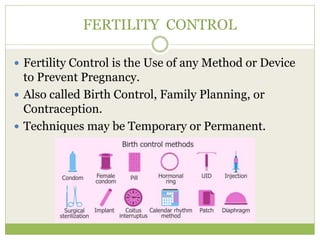
 Fertility Control is the Use of any Method or Device
to Prevent Pregnancy.
 Also called Birth Control, Family Planning, or
Contraception.
 Techniques may be Temporary or Permanent.
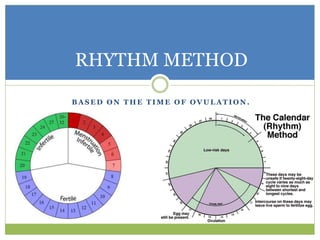
B A S E D O N T H E T I M E O F O V U L A T I O N .
RHYTHM METHOD
RHYTHM METHOD (SAFE PERIOD)
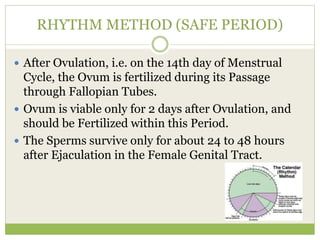
 After Ovulation, i.e. on the 14th day of Menstrual
Cycle, the Ovum is fertilized during its Passage
through Fallopian Tubes.
 Ovum is viable only for 2 days after Ovulation, and
should be Fertilized within this Period.
 The Sperms survive only for about 24 to 48 hours
after Ejaculation in the Female Genital Tract.
RHYTHM METHOD (SAFE PERIOD)
 If Sexual Intercourse occurs Few Days Before and
After Ovulation, there is Chance of Pregnancy.
 This Period is called the Dangerous Period.
 Pregnancy can be Avoided if there is No Sexual
Intercourse during this Period.
 The Prevention of Pregnancy by Avoiding Sexual
Mating during this Period is called Rhythm Method.
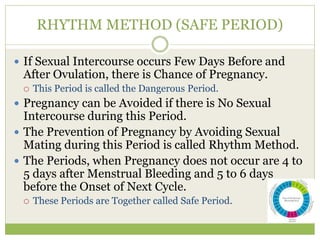
 The Periods, when Pregnancy does not occur are 4 to
5 days after Menstrual Bleeding and 5 to 6 days
before the Onset of Next Cycle.
 These Periods are Together called Safe Period.
Advantages and Disadvantages
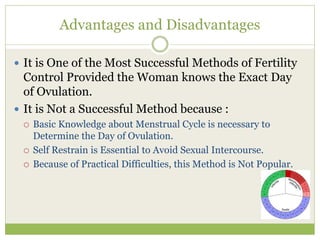
 It is One of the Most Successful Methods of Fertility
Control Provided the Woman knows the Exact Day
of Ovulation.
 It is Not a Successful Method because :
 Basic Knowledge about Menstrual Cycle is necessary to
Determine the Day of Ovulation.
 Self Restrain is Essential to Avoid Sexual Intercourse.
 Because of Practical Difficulties, this Method is Not Popular.
P R E V E N T I O N O F E N T R Y O F S P E R M I N T O
U T E R U S .
MECHANICAL BARRIERS
MECHANICAL BARRIERS
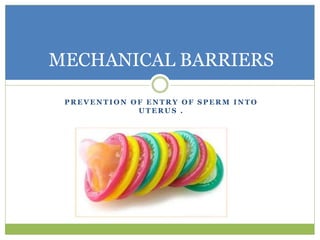
 Used to Prevent the Entry of Sperm into Uterine
Cavity.
 These Barriers are called Condoms.
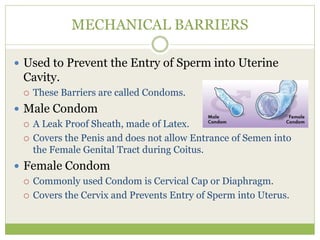
 Male Condom
 A Leak Proof Sheath, made of Latex.
 Covers the Penis and does not allow Entrance of Semen into
the Female Genital Tract during Coitus.
 Female Condom
 Commonly used Condom is Cervical Cap or Diaphragm.
 Covers the Cervix and Prevents Entry of Sperm into Uterus.
CHEMICAL METHODS
CHEMICAL METHODS
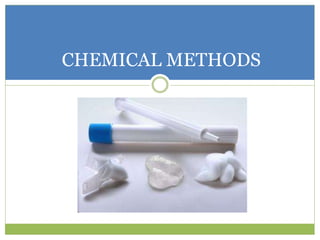
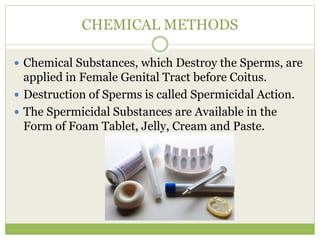
 Chemical Substances, which Destroy the Sperms, are
applied in Female Genital Tract before Coitus.
 Destruction of Sperms is called Spermicidal Action.
 The Spermicidal Substances are Available in the
Form of Foam Tablet, Jelly, Cream and Paste.
P I L L M E T H O D
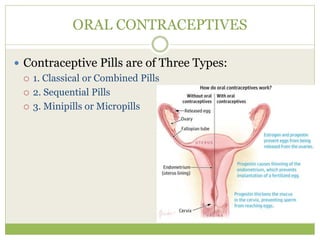
ORAL CONTRACEPTIVES
ORAL CONTRACEPTIVES
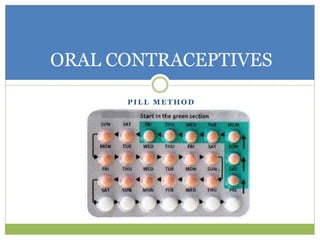
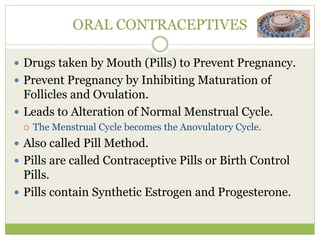
 Drugs taken by Mouth (Pills) to Prevent Pregnancy.
 Prevent Pregnancy by Inhibiting Maturation of
Follicles and Ovulation.
 Leads to Alteration of Normal Menstrual Cycle.
 The Menstrual Cycle becomes the Anovulatory Cycle.
 Also called Pill Method.
 Pills are called Contraceptive Pills or Birth Control
Pills.
 Pills contain Synthetic Estrogen and Progesterone.
ORAL CONTRACEPTIVES
 Contraceptive Pills are of Three Types:
 1. Classical or Combined Pills
 2. Sequential Pills
 3. Minipills or Micropills
1. CLASSICAL OR COMBINED PILLS
 Contain a Moderate Dose of Synthetic Estrogen like
Ethinyl Estradiol or Mestranol and a Mild Dose of
Synthetic Progesterone like Norethindrone or
Norgestral.
 Pills are taken Daily from 5 to 25th day of Menstrual
Cycle.
 Withdrawal of the Pills after 25th day causes
Menstrual Bleeding.
 Intake of Pills is Resumed Again after 5th day of the
Next Cycle.
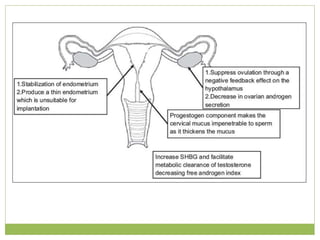
1. CLASSICAL OR COMBINED PILLS
 Mechanism of Action
 During the Continuous Intake of the Pills, there is Relatively
Large Amount of Estrogen and Progesterone in the Blood.
 It Suppresses the Release of Gonadotropins, FSH and LH from
Pituitary by Feedback Mechanism.
 Lack of FSH and LH prevents the Maturation of Follicle, and
Ovulation.
 Progesterone Increases the Thickness of Mucosa in Cervix,
which is Not Favorable for Transport of Sperm.
 When the Pills are withdrawn after 21 days the Menstrual Flow
Starts.
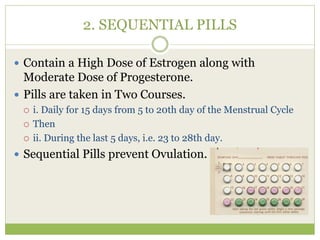
2. SEQUENTIAL PILLS
 Contain a High Dose of Estrogen along with
Moderate Dose of Progesterone.
 Pills are taken in Two Courses.
 i. Daily for 15 days from 5 to 20th day of the Menstrual Cycle
 Then
 ii. During the last 5 days, i.e. 23 to 28th day.
 Sequential Pills prevent Ovulation.
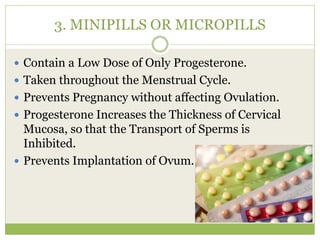
3. MINIPILLS OR MICROPILLS
 Contain a Low Dose of Only Progesterone.
 Taken throughout the Menstrual Cycle.
 Prevents Pregnancy without affecting Ovulation.
 Progesterone Increases the Thickness of Cervical
Mucosa, so that the Transport of Sperms is
Inhibited.
 Prevents Implantation of Ovum.
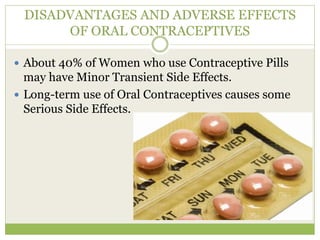
DISADVANTAGES AND ADVERSE EFFECTS
OF ORAL CONTRACEPTIVES
 About 40% of Women who use Contraceptive Pills
may have Minor Transient Side Effects.
 Long-term use of Oral Contraceptives causes some
Serious Side Effects.
LONG-TERM CONTRACEPTIVES
 To Avoid taking Pills Daily, the Long-Term
Contraceptives are used.
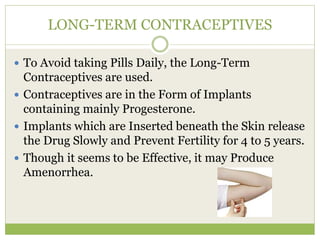
 Contraceptives are in the Form of Implants
containing mainly Progesterone.
 Implants which are Inserted beneath the Skin release
the Drug Slowly and Prevent Fertility for 4 to 5 years.
 Though it seems to be Effective, it may Produce
Amenorrhea.
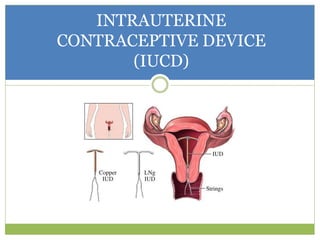
INTRAUTERINE
CONTRACEPTIVE DEVICE
(IUCD)
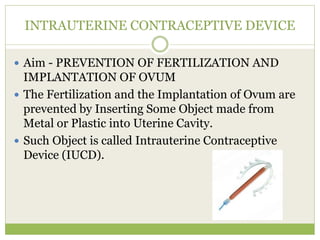
INTRAUTERINE CONTRACEPTIVE DEVICE
 Aim - PREVENTION OF FERTILIZATION AND
IMPLANTATION OF OVUM
 The Fertilization and the Implantation of Ovum are
prevented by Inserting Some Object made from
Metal or Plastic into Uterine Cavity.
 Such Object is called Intrauterine Contraceptive
Device (IUCD).
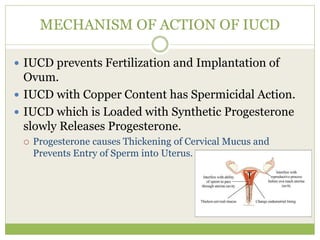
MECHANISM OF ACTION OF IUCD
 IUCD prevents Fertilization and Implantation of
Ovum.
 IUCD with Copper Content has Spermicidal Action.
 IUCD which is Loaded with Synthetic Progesterone
slowly Releases Progesterone.
 Progesterone causes Thickening of Cervical Mucus and
Prevents Entry of Sperm into Uterus.
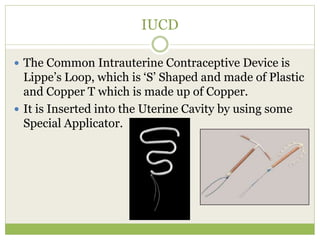
IUCD
 The Common Intrauterine Contraceptive Device is
Lippe’s Loop, which is ‘S’ Shaped and made of Plastic
and Copper T which is made up of Copper.
 It is Inserted into the Uterine Cavity by using some
Special Applicator.
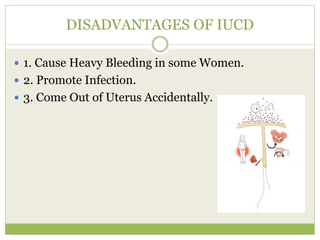
DISADVANTAGES OF IUCD
 1. Cause Heavy Bleeding in some Women.
 2. Promote Infection.
 3. Come Out of Uterus Accidentally.
MEDICAL TERMINATION OF
PREGNANCY
MEDICAL TERMINATION OF PREGNANCY
 Also known as ABORTION.
 The Abortion is done during First Few Months of
Pregnancy.
 This Method is called Medical Termination of
Pregnancy (MTP).
 There are Three Ways of doing MTP.
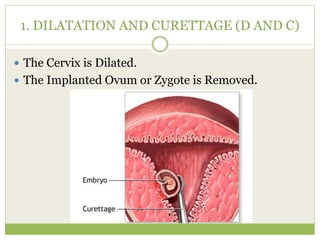
1. DILATATION AND CURETTAGE (D AND C)
 The Cervix is Dilated.
 The Implanted Ovum or Zygote is Removed.
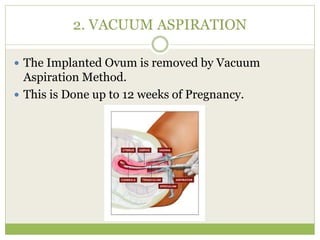
2. VACUUM ASPIRATION
 The Implanted Ovum is removed by Vacuum
Aspiration Method.
 This is Done up to 12 weeks of Pregnancy.
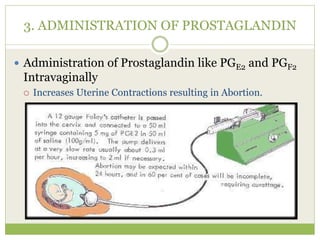
3. ADMINISTRATION OF PROSTAGLANDIN
 Administration of Prostaglandin like PGE2 and PGF2
Intravaginally
 Increases Uterine Contractions resulting in Abortion.
P E R M A N E N T S T E R I L I T Y I S O B T A I N E D B Y
S U R G I C A L M E T H O D S . I T I S A L S O C A L L E D
S T E R I L I Z A T I O N .
SURGICAL METHOD
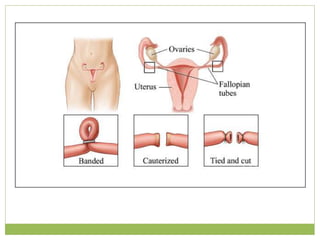
TUBECTOMY
 The Fallopian Tubes are Cut and both the Cut Ends are
Ligated.
 Prevents Entry of Ovum into Uterus.
 The Operation is done through Vaginal Orifice in the
Postpartum Period.
 During other Periods, it is done by Abdominal Incision.
 Tubectomy is done Quickly (in few minutes) by using a
Laparoscope.
 Tubectomy causes Permanent Sterility, if Necessary
Recanalization of Fallopian Tube can be Done using
Plastic Tube by another Surgical Procedure.
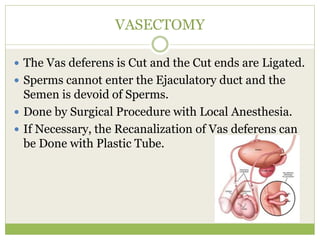
VASECTOMY
 The Vas deferens is Cut and the Cut ends are Ligated.
 Sperms cannot enter the Ejaculatory duct and the
Semen is devoid of Sperms.
 Done by Surgical Procedure with Local Anesthesia.
 If Necessary, the Recanalization of Vas deferens can
be Done with Plastic Tube.

Fertility Control

  • 1.
    V . S. R A S H M I P R I Y E M U L T R A ’ S B E S T D E N T A L S C I E N C E C O L L E G E FERTILITY CONTROL
  • 2.
    FERTILITY CONTROL  FertilityControl is the Use of any Method or Device to Prevent Pregnancy.  Also called Birth Control, Family Planning, or Contraception.  Techniques may be Temporary or Permanent.
  • 3.
    B A SE D O N T H E T I M E O F O V U L A T I O N . RHYTHM METHOD
  • 4.
    RHYTHM METHOD (SAFEPERIOD)  After Ovulation, i.e. on the 14th day of Menstrual Cycle, the Ovum is fertilized during its Passage through Fallopian Tubes.  Ovum is viable only for 2 days after Ovulation, and should be Fertilized within this Period.  The Sperms survive only for about 24 to 48 hours after Ejaculation in the Female Genital Tract.
  • 5.
    RHYTHM METHOD (SAFEPERIOD)  If Sexual Intercourse occurs Few Days Before and After Ovulation, there is Chance of Pregnancy.  This Period is called the Dangerous Period.  Pregnancy can be Avoided if there is No Sexual Intercourse during this Period.  The Prevention of Pregnancy by Avoiding Sexual Mating during this Period is called Rhythm Method.  The Periods, when Pregnancy does not occur are 4 to 5 days after Menstrual Bleeding and 5 to 6 days before the Onset of Next Cycle.  These Periods are Together called Safe Period.
  • 6.
    Advantages and Disadvantages It is One of the Most Successful Methods of Fertility Control Provided the Woman knows the Exact Day of Ovulation.  It is Not a Successful Method because :  Basic Knowledge about Menstrual Cycle is necessary to Determine the Day of Ovulation.  Self Restrain is Essential to Avoid Sexual Intercourse.  Because of Practical Difficulties, this Method is Not Popular.
  • 7.
    P R EV E N T I O N O F E N T R Y O F S P E R M I N T O U T E R U S . MECHANICAL BARRIERS
  • 8.
    MECHANICAL BARRIERS  Usedto Prevent the Entry of Sperm into Uterine Cavity.  These Barriers are called Condoms.  Male Condom  A Leak Proof Sheath, made of Latex.  Covers the Penis and does not allow Entrance of Semen into the Female Genital Tract during Coitus.  Female Condom  Commonly used Condom is Cervical Cap or Diaphragm.  Covers the Cervix and Prevents Entry of Sperm into Uterus.
  • 9.
  • 10.
    CHEMICAL METHODS  ChemicalSubstances, which Destroy the Sperms, are applied in Female Genital Tract before Coitus.  Destruction of Sperms is called Spermicidal Action.  The Spermicidal Substances are Available in the Form of Foam Tablet, Jelly, Cream and Paste.
  • 11.
    P I LL M E T H O D ORAL CONTRACEPTIVES
  • 12.
    ORAL CONTRACEPTIVES  Drugstaken by Mouth (Pills) to Prevent Pregnancy.  Prevent Pregnancy by Inhibiting Maturation of Follicles and Ovulation.  Leads to Alteration of Normal Menstrual Cycle.  The Menstrual Cycle becomes the Anovulatory Cycle.  Also called Pill Method.  Pills are called Contraceptive Pills or Birth Control Pills.  Pills contain Synthetic Estrogen and Progesterone.
  • 13.
    ORAL CONTRACEPTIVES  ContraceptivePills are of Three Types:  1. Classical or Combined Pills  2. Sequential Pills  3. Minipills or Micropills
  • 14.
    1. CLASSICAL ORCOMBINED PILLS  Contain a Moderate Dose of Synthetic Estrogen like Ethinyl Estradiol or Mestranol and a Mild Dose of Synthetic Progesterone like Norethindrone or Norgestral.  Pills are taken Daily from 5 to 25th day of Menstrual Cycle.  Withdrawal of the Pills after 25th day causes Menstrual Bleeding.  Intake of Pills is Resumed Again after 5th day of the Next Cycle.
  • 15.
    1. CLASSICAL ORCOMBINED PILLS  Mechanism of Action  During the Continuous Intake of the Pills, there is Relatively Large Amount of Estrogen and Progesterone in the Blood.  It Suppresses the Release of Gonadotropins, FSH and LH from Pituitary by Feedback Mechanism.  Lack of FSH and LH prevents the Maturation of Follicle, and Ovulation.  Progesterone Increases the Thickness of Mucosa in Cervix, which is Not Favorable for Transport of Sperm.  When the Pills are withdrawn after 21 days the Menstrual Flow Starts.
  • 17.
    2. SEQUENTIAL PILLS Contain a High Dose of Estrogen along with Moderate Dose of Progesterone.  Pills are taken in Two Courses.  i. Daily for 15 days from 5 to 20th day of the Menstrual Cycle  Then  ii. During the last 5 days, i.e. 23 to 28th day.  Sequential Pills prevent Ovulation.
  • 18.
    3. MINIPILLS ORMICROPILLS  Contain a Low Dose of Only Progesterone.  Taken throughout the Menstrual Cycle.  Prevents Pregnancy without affecting Ovulation.  Progesterone Increases the Thickness of Cervical Mucosa, so that the Transport of Sperms is Inhibited.  Prevents Implantation of Ovum.
  • 19.
    DISADVANTAGES AND ADVERSEEFFECTS OF ORAL CONTRACEPTIVES  About 40% of Women who use Contraceptive Pills may have Minor Transient Side Effects.  Long-term use of Oral Contraceptives causes some Serious Side Effects.
  • 20.
    LONG-TERM CONTRACEPTIVES  ToAvoid taking Pills Daily, the Long-Term Contraceptives are used.  Contraceptives are in the Form of Implants containing mainly Progesterone.  Implants which are Inserted beneath the Skin release the Drug Slowly and Prevent Fertility for 4 to 5 years.  Though it seems to be Effective, it may Produce Amenorrhea.
  • 21.
  • 22.
    INTRAUTERINE CONTRACEPTIVE DEVICE Aim - PREVENTION OF FERTILIZATION AND IMPLANTATION OF OVUM  The Fertilization and the Implantation of Ovum are prevented by Inserting Some Object made from Metal or Plastic into Uterine Cavity.  Such Object is called Intrauterine Contraceptive Device (IUCD).
  • 23.
    MECHANISM OF ACTIONOF IUCD  IUCD prevents Fertilization and Implantation of Ovum.  IUCD with Copper Content has Spermicidal Action.  IUCD which is Loaded with Synthetic Progesterone slowly Releases Progesterone.  Progesterone causes Thickening of Cervical Mucus and Prevents Entry of Sperm into Uterus.
  • 24.
    IUCD  The CommonIntrauterine Contraceptive Device is Lippe’s Loop, which is ‘S’ Shaped and made of Plastic and Copper T which is made up of Copper.  It is Inserted into the Uterine Cavity by using some Special Applicator.
  • 25.
    DISADVANTAGES OF IUCD 1. Cause Heavy Bleeding in some Women.  2. Promote Infection.  3. Come Out of Uterus Accidentally.
  • 26.
  • 27.
    MEDICAL TERMINATION OFPREGNANCY  Also known as ABORTION.  The Abortion is done during First Few Months of Pregnancy.  This Method is called Medical Termination of Pregnancy (MTP).  There are Three Ways of doing MTP.
  • 28.
    1. DILATATION ANDCURETTAGE (D AND C)  The Cervix is Dilated.  The Implanted Ovum or Zygote is Removed.
  • 29.
    2. VACUUM ASPIRATION The Implanted Ovum is removed by Vacuum Aspiration Method.  This is Done up to 12 weeks of Pregnancy.
  • 30.
    3. ADMINISTRATION OFPROSTAGLANDIN  Administration of Prostaglandin like PGE2 and PGF2 Intravaginally  Increases Uterine Contractions resulting in Abortion.
  • 31.
    P E RM A N E N T S T E R I L I T Y I S O B T A I N E D B Y S U R G I C A L M E T H O D S . I T I S A L S O C A L L E D S T E R I L I Z A T I O N . SURGICAL METHOD
  • 32.
    TUBECTOMY  The FallopianTubes are Cut and both the Cut Ends are Ligated.  Prevents Entry of Ovum into Uterus.  The Operation is done through Vaginal Orifice in the Postpartum Period.  During other Periods, it is done by Abdominal Incision.  Tubectomy is done Quickly (in few minutes) by using a Laparoscope.  Tubectomy causes Permanent Sterility, if Necessary Recanalization of Fallopian Tube can be Done using Plastic Tube by another Surgical Procedure.
  • 34.
    VASECTOMY  The Vasdeferens is Cut and the Cut ends are Ligated.  Sperms cannot enter the Ejaculatory duct and the Semen is devoid of Sperms.  Done by Surgical Procedure with Local Anesthesia.  If Necessary, the Recanalization of Vas deferens can be Done with Plastic Tube.