
Choosing the number of children in a
family and the length of time between
their births.
TYPES OF FAMILY PLANNING

Nat ur al   Family Planning
 Met hod
Ar t if icial Family

 Planning Met hod
NATURAL FAMILY
     PLANNING
Method
 Natural Family Planning, also
 called fertility awareness
 or the Rhythm method,
 relies on abstinence from
 sexual intercourse during
 the most fertile phase of a
 woman’s menstrual cycle.
3 Methods used to predict
ovulation:
   1. Basal Body Temperature
    method: A woman’s resting
    temperature rises between
    0.4 F and 0.8 F on the day of
    ovulation and stays elevated
    until the next menstrual
    period. Using a special (Basal
    body) thermometer, a woman
    needs to take her
    temperature every morning
    before getting out of bed.
    When she sees her
   2. Cervical Mucus Method:
    Right before ovulation, the
    mucus from the cervix
    changes from being cloudy and
    scanty to being clear and
    slippery. The consistency of
    ovulation mucus is like that of
    an egg white and it can be
    stretched between the
    fingers. After the ovulation,
    the mucus tends to dry up
    again.
   3. Calendar Method: Woman with
    regular menstrual periods can
    guess when ovulation occurs by
    looking at a record of their cycles.
    If a reasonable estimates can be
    made of when the next menstrual
    cycle will begin, subtracting 14
    days from the estimated date will
    give the approximate day of
    ovulation.
ARTIFICIAL METHOD of
Family Planning
   In this method, the live sperm is
    prevented from entering the
    uterus either by killing them with
    spermicidal or by obstructing
    them through the use of condom
    and diaphragms.
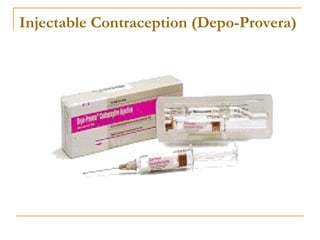
Injectable Contraception (Depo-Provera)
   Injectable Contraception (Depo-Provera)
   Depot medroxyprogesterone acetate (Depo-
    Provera or DMPA) is an injectable synthetic
    hormone that prevents pregnancy for 13
    weeks at a time. The hormone is like the one
    produced by the body (progesterone) to
    regulate the menstrual cycle. DMPA works
    mainly by preventing ovulation - the process
    by which an egg is released from the ovary. It
    also thickens the cervical mucus which may
    keep sperm from joining with an egg.
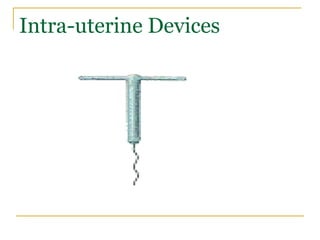
Intra-uterine Devices
   IUD (Intrauterine Device)
   The IUD (intrauterine device) is a small
    device placed inside the uterus for birth
    control. It is thought to primarily prevent
    fertilization by creating an intense
    inflammatory reaction inside the uterus
    that is harmful for sperm, either destroying
    sperm or making it nearly impossible for
    sperm to reach the fallopian tubes.
    Secondarily, the IUD also makes the
    uterus unsuitable for implantation.
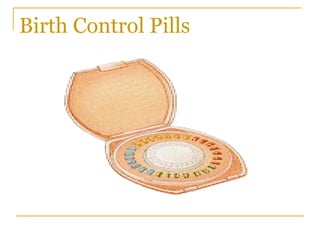
Birth Control Pills
   Birth Control Pills
   Birth control pills (oral contraceptives) are pills which
    are taken by mouth everyday to prevent pregnancy.
    Combined birth control pills are the most common
    type and contain both female sex hormones -
    estrogen and progesterone (in the form of
    progestin). The pill works mainly by preventing the
    ovaries from releasing eggs (ovulation).
    Secondarily, it may also prevent fertilization from
    occurring by thickening the cervical mucus which
    impedes the sperm.
Diaphragm
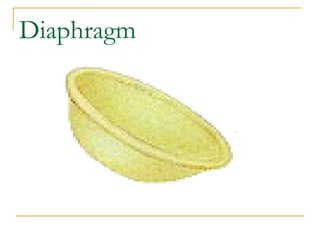
   Diaphragm
   The diaphragm is a dome-shaped latex
    cap that is first coated with a spermicidal
    gel or cream and then placed high in the
    vagina before intercourse. It is a physical
    barrier to sperm entering the cervix but,
    more importantly, it holds the spermicidal
    cream or gel against the cervix and thus
    immobilizes sperm near the cervical canal.
Condoms
 The condoms or sheath was
 known in Europe as early as
 the 16 century. It was then
       th

 made of animal gut or linen.
 Modern condoms are made
 of rubber
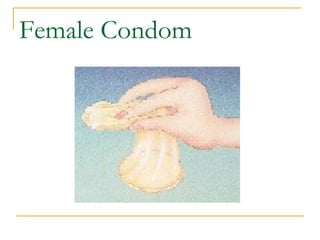
Female Condom
   Female Condoms
 The    female condom is a thin
    polyurethane sheath which lines
    the vagina and some of the
    external genitalia. It is a barrier
    method of birth control and does
    not contain a spermicide.
Cervical Cap
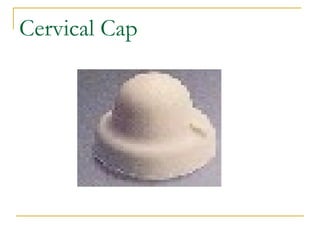
   Cervical Cap
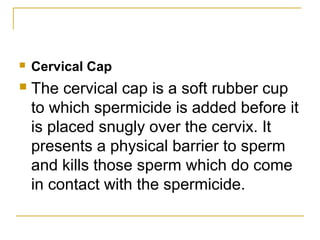
   The cervical cap is a soft rubber cup
    to which spermicide is added before it
    is placed snugly over the cervix. It
    presents a physical barrier to sperm
    and kills those sperm which do come
    in contact with the spermicide.
Spermicides
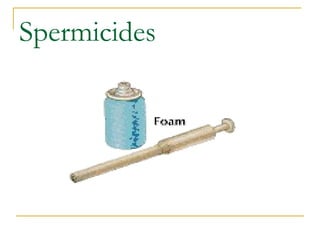
   Spermicides
   Spermicides are chemicals which kill
    sperm. They are available in many
    different forms: suppository, foam, cream,
    gel, film and tablets. The active ingredient
    in most spermicidal is nonoxynol-9, which
    may also offer protection against sexually
    transmitted diseases.
Sterilization
 Sterilization
              is a simple operation
 for both men and women. It is a
 one-time method of birth control
 which is permanent and requires
 no effort other than getting the
 procedure done.
2 Kinds of Sterilization

Vasectomy   for men
Tubal Ligation for women
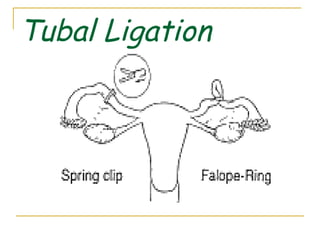
Tubal Ligation
   FEMALE STERILIZATION

    Female sterilization is a permanent method of birth
    control which requires surgery. The surgery involves
    blocking the fallopian tubes by cutting them, electrically
    sealing them, or putting clips/rings (spring clip/Falope
    ring) on them. Pregnancy does not occur because the
    sperm cannot reach the egg (fertilization). The procedure
    is done under local or general anesthesia, usually using
    a laparoscope. The laparoscope makes it possible to do
    the surgery with an incision of only about 1/2". It has
    therefore been called the band-aid operation because of
    the minimal amount of disruption to the skin. Most
    women do not need to stay overnight.
Vasectomy
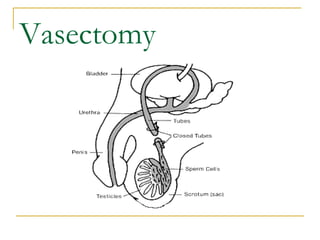
   Vasectomy
   Vasectomy is a permanent method of birth control
    for men. It is a surgicial procedure which is done
    under local anesthesia. The vas deferens is blocked
    - the tube that carries the sperm from the testicle to
    the opening of the penis. After a vasectomy, sperm
    will not be present in the semen and pregnancy
    cannot occur. The procedure is done under local
    anesthesia and takes only 15-20 minutes. There is
    no need of any overnight stay.
Wit hdr awal
   Withdrawal
 Withdrawal    refers to a
    pregnancy prevention
    method where the man
    pulls the penis out of the
    vagina before ejaculation
    into the vagina.

Familyplanning

  • 1.
    Choosing the numberof children in a family and the length of time between their births.
  • 2.
    TYPES OF FAMILYPLANNING Nat ur al Family Planning Met hod Ar t if icial Family Planning Met hod
  • 3.
    NATURAL FAMILY PLANNING Method  Natural Family Planning, also called fertility awareness or the Rhythm method, relies on abstinence from sexual intercourse during the most fertile phase of a woman’s menstrual cycle.
  • 4.
    3 Methods usedto predict ovulation:  1. Basal Body Temperature method: A woman’s resting temperature rises between 0.4 F and 0.8 F on the day of ovulation and stays elevated until the next menstrual period. Using a special (Basal body) thermometer, a woman needs to take her temperature every morning before getting out of bed. When she sees her
  • 5.
    2. Cervical Mucus Method: Right before ovulation, the mucus from the cervix changes from being cloudy and scanty to being clear and slippery. The consistency of ovulation mucus is like that of an egg white and it can be stretched between the fingers. After the ovulation, the mucus tends to dry up again.
  • 6.
    3. Calendar Method: Woman with regular menstrual periods can guess when ovulation occurs by looking at a record of their cycles. If a reasonable estimates can be made of when the next menstrual cycle will begin, subtracting 14 days from the estimated date will give the approximate day of ovulation.
  • 7.
    ARTIFICIAL METHOD of FamilyPlanning  In this method, the live sperm is prevented from entering the uterus either by killing them with spermicidal or by obstructing them through the use of condom and diaphragms.
  • 8.
  • 9.
    Injectable Contraception (Depo-Provera)  Depot medroxyprogesterone acetate (Depo- Provera or DMPA) is an injectable synthetic hormone that prevents pregnancy for 13 weeks at a time. The hormone is like the one produced by the body (progesterone) to regulate the menstrual cycle. DMPA works mainly by preventing ovulation - the process by which an egg is released from the ovary. It also thickens the cervical mucus which may keep sperm from joining with an egg.
  • 10.
  • 11.
    IUD (Intrauterine Device)  The IUD (intrauterine device) is a small device placed inside the uterus for birth control. It is thought to primarily prevent fertilization by creating an intense inflammatory reaction inside the uterus that is harmful for sperm, either destroying sperm or making it nearly impossible for sperm to reach the fallopian tubes. Secondarily, the IUD also makes the uterus unsuitable for implantation.
  • 12.
  • 13.
    Birth Control Pills  Birth control pills (oral contraceptives) are pills which are taken by mouth everyday to prevent pregnancy. Combined birth control pills are the most common type and contain both female sex hormones - estrogen and progesterone (in the form of progestin). The pill works mainly by preventing the ovaries from releasing eggs (ovulation). Secondarily, it may also prevent fertilization from occurring by thickening the cervical mucus which impedes the sperm.
  • 14.
  • 15.
    Diaphragm  The diaphragm is a dome-shaped latex cap that is first coated with a spermicidal gel or cream and then placed high in the vagina before intercourse. It is a physical barrier to sperm entering the cervix but, more importantly, it holds the spermicidal cream or gel against the cervix and thus immobilizes sperm near the cervical canal.
  • 16.
    Condoms  The condomsor sheath was known in Europe as early as the 16 century. It was then th made of animal gut or linen. Modern condoms are made of rubber
  • 17.
  • 18.
    Female Condoms  The female condom is a thin polyurethane sheath which lines the vagina and some of the external genitalia. It is a barrier method of birth control and does not contain a spermicide.
  • 19.
  • 20.
    Cervical Cap  The cervical cap is a soft rubber cup to which spermicide is added before it is placed snugly over the cervix. It presents a physical barrier to sperm and kills those sperm which do come in contact with the spermicide.
  • 21.
  • 22.
    Spermicides  Spermicides are chemicals which kill sperm. They are available in many different forms: suppository, foam, cream, gel, film and tablets. The active ingredient in most spermicidal is nonoxynol-9, which may also offer protection against sexually transmitted diseases.
  • 23.
    Sterilization  Sterilization is a simple operation for both men and women. It is a one-time method of birth control which is permanent and requires no effort other than getting the procedure done.
  • 24.
    2 Kinds ofSterilization Vasectomy for men Tubal Ligation for women
  • 25.
  • 26.
    FEMALE STERILIZATION Female sterilization is a permanent method of birth control which requires surgery. The surgery involves blocking the fallopian tubes by cutting them, electrically sealing them, or putting clips/rings (spring clip/Falope ring) on them. Pregnancy does not occur because the sperm cannot reach the egg (fertilization). The procedure is done under local or general anesthesia, usually using a laparoscope. The laparoscope makes it possible to do the surgery with an incision of only about 1/2". It has therefore been called the band-aid operation because of the minimal amount of disruption to the skin. Most women do not need to stay overnight.
  • 27.
  • 28.
    Vasectomy  Vasectomy is a permanent method of birth control for men. It is a surgicial procedure which is done under local anesthesia. The vas deferens is blocked - the tube that carries the sperm from the testicle to the opening of the penis. After a vasectomy, sperm will not be present in the semen and pregnancy cannot occur. The procedure is done under local anesthesia and takes only 15-20 minutes. There is no need of any overnight stay.
  • 29.
    Wit hdr awal  Withdrawal  Withdrawal refers to a pregnancy prevention method where the man pulls the penis out of the vagina before ejaculation into the vagina.