In Vitro Fertilization
What is In Vitro Fertilization (IVF)? Process by which egg cells are fertilized by sperm outside of the womb Major treatment for infertility Process involves hormonally controlling ovulation, removing eggs from the ovaries and letting sperm fertilize the eggs in a fluid medium    fertilized egg (zygote) is transferred to woman’s uterus
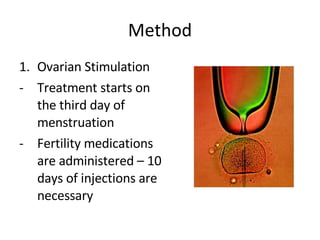
Method Ovarian Stimulation Treatment starts on the third day of menstruation Fertility medications are administered – 10 days of injections are necessary
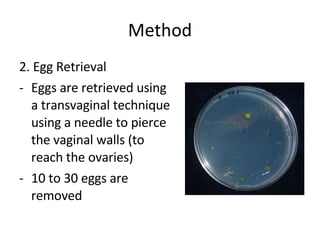
Method 2. Egg Retrieval Eggs are retrieved using a transvaginal technique using a needle to pierce the vaginal walls (to reach the ovaries) 10 to 30 eggs are removed
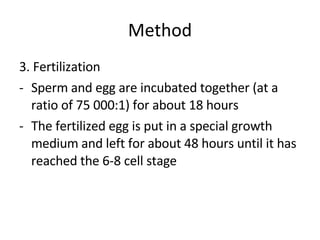
Method 3. Fertilization Sperm and egg are incubated together (at a ratio of 75 000:1) for about 18 hours The fertilized egg is put in a special growth medium and left for about 48 hours until it has reached the 6-8 cell stage
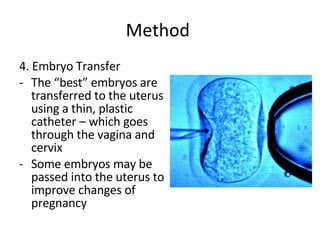
Method  4. Embryo Transfer The “best” embryos are transferred to the uterus using a thin, plastic catheter – which goes through the vagina and cervix Some embryos may be passed into the uterus to improve changes of pregnancy
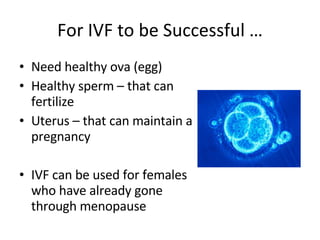
For IVF to be Successful … Need healthy ova (egg) Healthy sperm – that can fertilize  Uterus – that can maintain a pregnancy  IVF can be used for females who have already gone through menopause
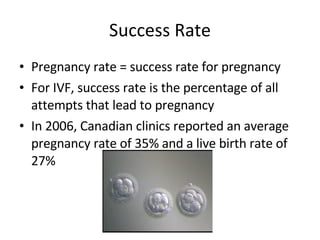
Success Rate Pregnancy rate = success rate for pregnancy  For IVF, success rate is the percentage of all attempts that lead to pregnancy In 2006, Canadian clinics reported an average pregnancy rate of 35% and a live birth rate of 27%
Complications Major complication is risk of multiple births – related to the practice of transferring multiple embryos at embryo transfer Multiple births – related to increased risk of pregnancy loss, obstetrical complications, prematurity, and death

In Vitro Fertilization

  • 1.
  • 2.
    What is InVitro Fertilization (IVF)? Process by which egg cells are fertilized by sperm outside of the womb Major treatment for infertility Process involves hormonally controlling ovulation, removing eggs from the ovaries and letting sperm fertilize the eggs in a fluid medium  fertilized egg (zygote) is transferred to woman’s uterus
  • 3.
    Method Ovarian StimulationTreatment starts on the third day of menstruation Fertility medications are administered – 10 days of injections are necessary
  • 4.
    Method 2. EggRetrieval Eggs are retrieved using a transvaginal technique using a needle to pierce the vaginal walls (to reach the ovaries) 10 to 30 eggs are removed
  • 5.
    Method 3. FertilizationSperm and egg are incubated together (at a ratio of 75 000:1) for about 18 hours The fertilized egg is put in a special growth medium and left for about 48 hours until it has reached the 6-8 cell stage
  • 6.
    Method 4.Embryo Transfer The “best” embryos are transferred to the uterus using a thin, plastic catheter – which goes through the vagina and cervix Some embryos may be passed into the uterus to improve changes of pregnancy
  • 7.
    For IVF tobe Successful … Need healthy ova (egg) Healthy sperm – that can fertilize Uterus – that can maintain a pregnancy IVF can be used for females who have already gone through menopause
  • 8.
    Success Rate Pregnancyrate = success rate for pregnancy For IVF, success rate is the percentage of all attempts that lead to pregnancy In 2006, Canadian clinics reported an average pregnancy rate of 35% and a live birth rate of 27%
  • 9.
    Complications Major complicationis risk of multiple births – related to the practice of transferring multiple embryos at embryo transfer Multiple births – related to increased risk of pregnancy loss, obstetrical complications, prematurity, and death