



FAMILY PLANNING METHODS
-MR.J.C.FRANK, ASST. PROFESSOR
DEFINITION
• “A way of thinking and living that is
adopted voluntarily, upon the basis of
knowledge, attitudes and responsible
decisions by individuals and couples,
in order to promote the health and
welfare of the family group and thus
contribute effectively to the social
development of a country”
- W.H.O
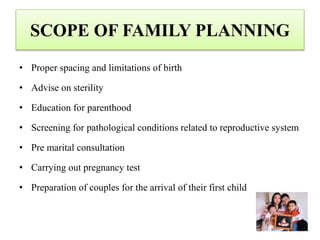
SCOPE OF FAMILY PLANNING
• Proper spacing and limitations of birth
• Advise on sterility
• Education for parenthood
• Screening for pathological conditions related to reproductive system
• Pre marital consultation
• Carrying out pregnancy test
• Preparation of couples for the arrival of their first child
OBJECTIVES
• To avoid unwanted births
• To bring about wanted births
• To regulate the intervals between pregnancies
• To control the time at which births occur in relation to the ages
of the parent
• To determine the number of children in the family
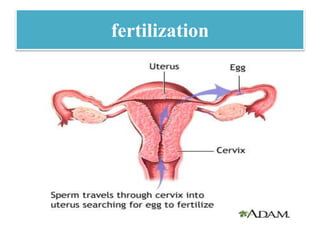
REVIEW OF FERTILIZATION
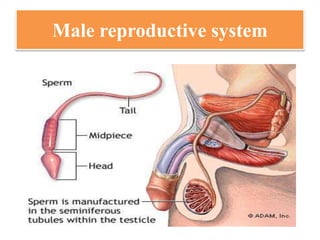
Male reproductive system
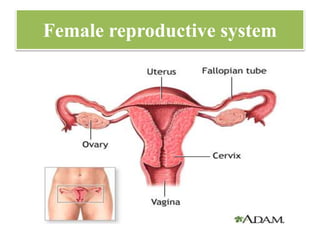
Female reproductive system
fertilization
Family planning methods
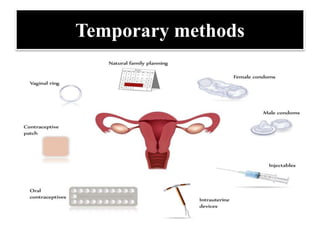
Temporary methods
condom
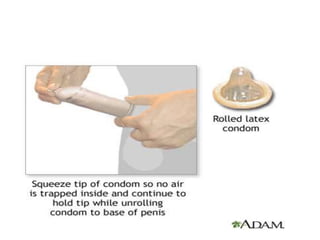
• The male condom is a barrier contraceptive made of latex or
polyurethane.
• The condom must be fitted over the erect penis.
• The condom is sold over-the-counter and when used
properly is an inexpensive, effective barrier to pregnancy
and sexually-transmitted disease.
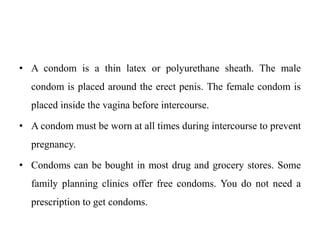
• A condom is a thin latex or polyurethane sheath. The male
condom is placed around the erect penis. The female condom is
placed inside the vagina before intercourse.
• A condom must be worn at all times during intercourse to prevent
pregnancy.
• Condoms can be bought in most drug and grocery stores. Some
family planning clinics offer free condoms. You do not need a
prescription to get condoms.
Female condom
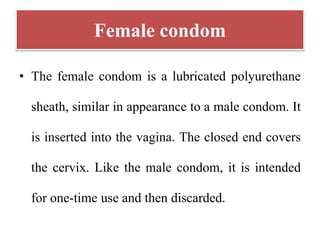
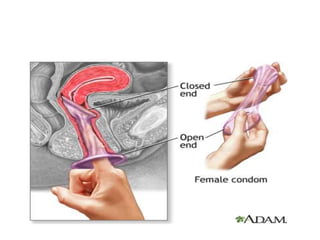
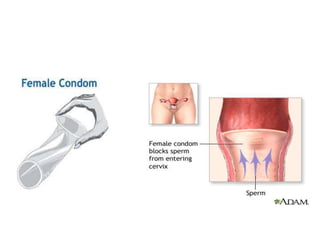
• The female condom is a lubricated polyurethane
sheath, similar in appearance to a male condom. It
is inserted into the vagina. The closed end covers
the cervix. Like the male condom, it is intended
for one-time use and then discarded.
Cervical cap
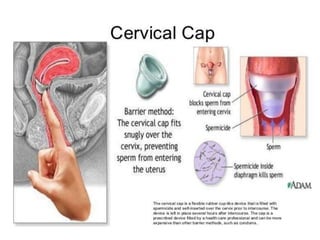
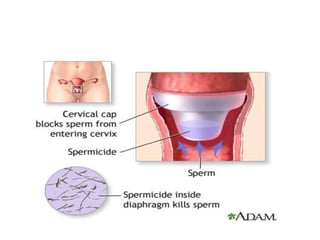
• The cervical cap is made of soft rubber and is designed
to fit completely over the cervix. Spermicide is placed
on the outer rim of the cap and in the portion of the cap
facing the vagina. The cervical cap prevents pregnancy
by blocking the sperm from entering the uterus.
• A similar, smaller device is called a cervical cap.
• Risks include irritation and allergic reactions to the
diaphragm or spermicide, and increased frequency of
urinary tract infection and vaginal yeast infection.
• In rare cases, toxic shock syndrome may develop in
women who leave the diaphragm in too long.
• A cervical cap may cause an abnormal Pap test.
diaphragm
• The diaphragm is available by prescription only and must be fitted by a physician.
• Once the diaphragm is fitted, a woman can insert and remove it by herself.
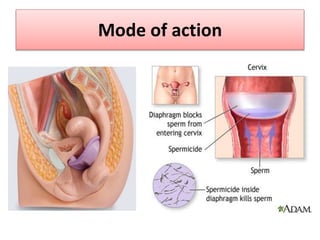
• This dome-shaped rubber disk protects from pregnancy in two ways. The
diaphragm blocks sperm from entering the cervix. Spermicide jelly placed inside
the rubber dome before insertion will kill any sperm it comes in contact with.
• Once inserted, the diaphragm is effective for up to six hours.
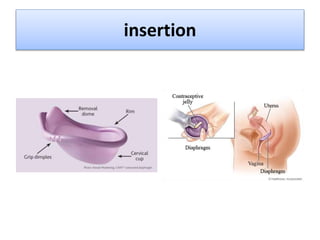
• A diaphragm is a flexible rubber cup that is filled with spermicidal cream or
jelly.
• It is placed into the vagina over the cervix before intercourse, to prevent sperm
from reaching the uterus.
• It should be left in place for 6 to 8 hours after intercourse.
• Diaphragms must be prescribed by a woman's health care provider. The
provider will determine the correct type and size of diaphragm for the woman.
• About 5 to 20 pregnancies occur over 1 year in 100 women using this method,
depending on proper use.
insertion
Mode of action
Vaginal sponge
• Vaginal contraceptive sponges are soft, and contain a
chemical that kills or "disables "sperm.
• The sponge is moistened and inserted into the vagina,
to cover over the cervix before intercourse.
• The vaginal sponge can be bought at your pharmacy
without a prescription.
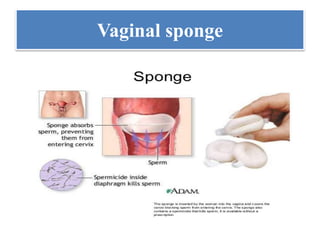
• The sponge is inserted by the woman into the
vagina and covers the cervix blocking sperm
from entering the cervix. The sponge also
contains a spermicide that kills sperm. It is
available without a prescription.
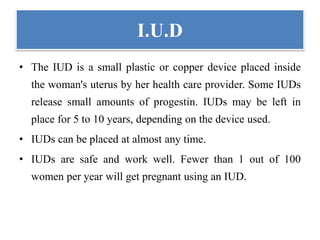
I.U.D
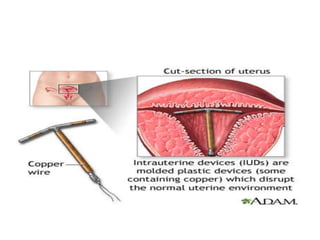
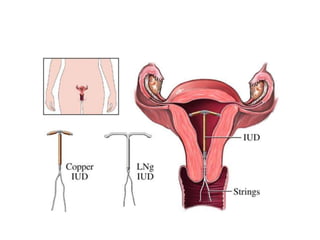
• The IUD is a small plastic or copper device placed inside
the woman's uterus by her health care provider. Some IUDs
release small amounts of progestin. IUDs may be left in
place for 5 to 10 years, depending on the device used.
• IUDs can be placed at almost any time.
• IUDs are safe and work well. Fewer than 1 out of 100
women per year will get pregnant using an IUD.
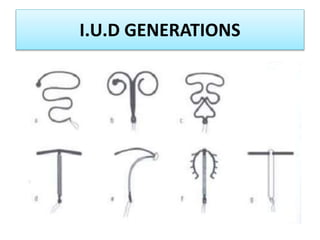
I.U.D GENERATIONS
Birth control pills
• Some birth control methods use hormones. They will have either
both an estrogen and a progestin, or a progestin alone. You need a
prescription for most hormonal birth control methods.
• Both hormones prevent a woman's ovary from releasing an egg
during her cycle. They do this by affecting the levels of other
hormones the body makes.
• Progestin help prevent sperm from making their way to the egg by
making mucus around a woman's cervix thick and sticky.
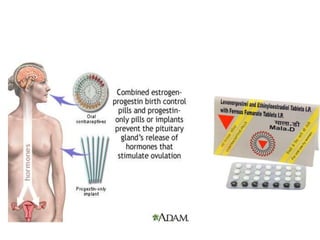
Combine pills
• The pill works in several ways to prevent pregnancy. The pill
suppresses ovulation so that an egg is not released from the ovaries,
and changes the cervical mucus, causing it to become thicker and
making it more difficult for sperm to swim into the womb. The pill
also does not allow the lining of the womb to develop enough to
receive and nurture a fertilized egg.
• This method of birth control offers no protection against sexually-
transmitted diseases.
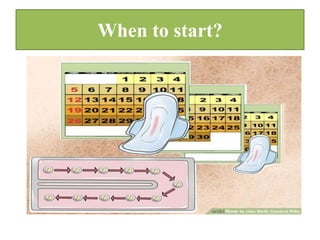
When to start?
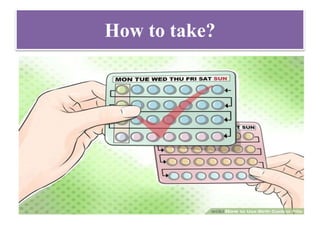
How to take?
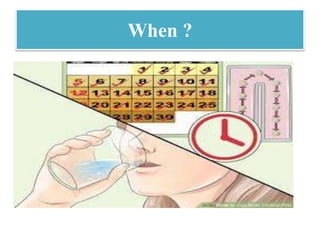
When ?
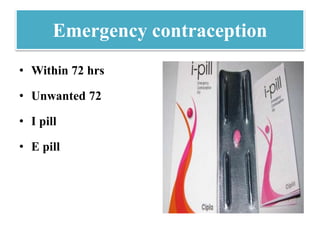
Emergency contraception
• Within 72 hrs
• Unwanted 72
• I pill
• E pill
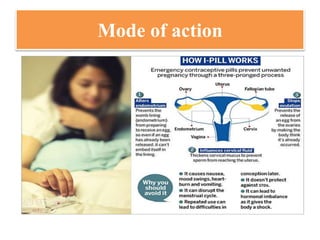
Mode of action
HORMONAL INJECTIONS
• Progesterone only injectables
– DMPA(Depot medroxy progesterone acetate) 150 mg/ I.M/
3 Months
– NET – EN (Norethisterone enanate) 200 mg/ IM/ 60 days
– DMPA – SC 104 mg / sc / 3 months
• Combined injectable contraceptives (progesterone
and estrogen / monthly once)
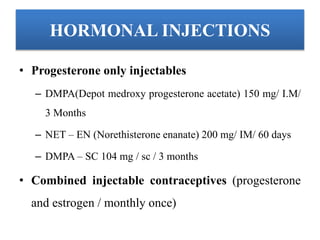
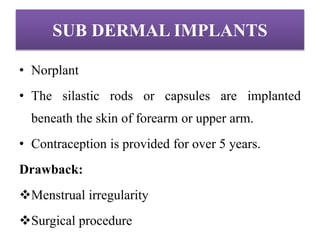
SUB DERMAL IMPLANTS
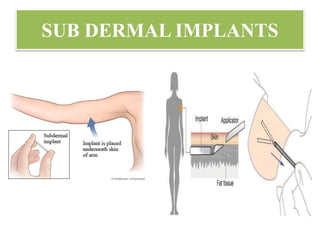
• Norplant
• The silastic rods or capsules are implanted
beneath the skin of forearm or upper arm.
• Contraception is provided for over 5 years.
Drawback:
Menstrual irregularity
Surgical procedure
SUB DERMAL IMPLANTS
VAGINAL RINGS
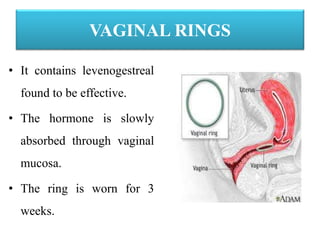
• It contains levenogestreal
found to be effective.
• The hormone is slowly
absorbed through vaginal
mucosa.
• The ring is worn for 3
weeks.
POST CONCEPTIONAL METHODS
• MENSTRUAL REGULATION
• MENSTRUAL INDUCTION
• ORAL ABORTIFACIENT
• MTP
MENSTRUAL REGULATION
• Aspiration of uterus contents 6 to 14 days of a
missed period.
• Pregnancy should be confirmed priorly
MENSTRUAL INDUCTION
• Disturbing the normal progeterone and prostaglandin
balance by intra uterine application of 1-5 mg of
solution of prostaglandin.
• It should be performed under sedation.
• Bleeding starts and continued for 7-8 days.
ORALABORTIFACIENT
• Mifepristone 200 mg orally
• Misoprostol 800 mcg vaginally
• Follow up
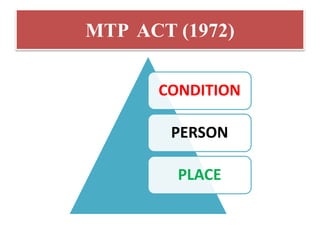
MTP ACT (1972)
CONDITION
PERSON
PLACE
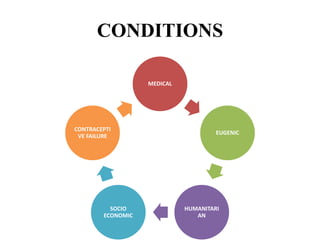
CONDITIONS
MEDICAL
EUGENIC
HUMANITARI
AN
SOCIO
ECONOMIC
CONTRACEPTI
VE FAILURE
NATURAL METHODS OF FAMILY
PLANNING
• CERVICAL MUCUS METHOD
• BODY TEMPERATURE METHOD
• BREASTFEEDING AMENORRHOEA
OTHERS
• Abstinence
• Coitus interrupts
• Birth control vaccine
• Safe period method
– Short cycle minus 18 days
– Long cycle minus 10 days
PERMANENT METHOD
OF
FAMILY PLANNING
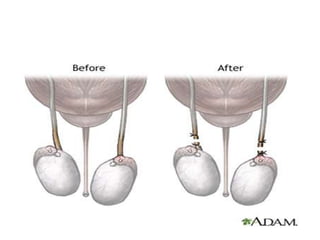
vasectomy
• A vasectomy is a procedure to cause permanent sterility in a
man by preventing the transport of sperm out of the testes. A
small incision is made in the scrotum and each vas deferens is
tied off and cut apart preventing sperm from being released
within the ejaculate. The small skin incision is stitched closed
and the surgery does not affect a man's sexual function.
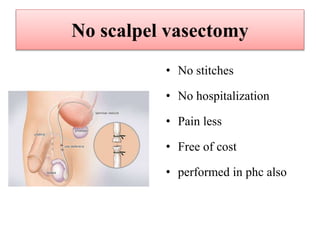
No scalpel vasectomy
• No stitches
• No hospitalization
• Pain less
• Free of cost
• performed in phc also
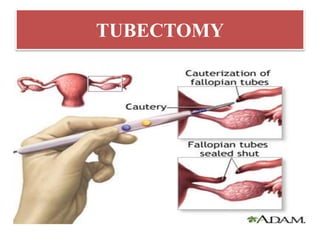
TUBECTOMY
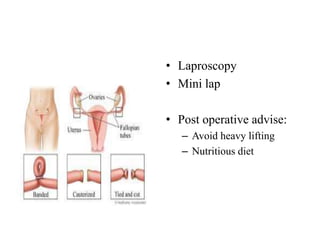
• Laproscopy
• Mini lap
• Post operative advise:
– Avoid heavy lifting
– Nutritious diet
Family planning methods new

Family planning methods new

  • 1.
  • 2.
    DEFINITION • “A wayof thinking and living that is adopted voluntarily, upon the basis of knowledge, attitudes and responsible decisions by individuals and couples, in order to promote the health and welfare of the family group and thus contribute effectively to the social development of a country” - W.H.O
  • 3.
    SCOPE OF FAMILYPLANNING • Proper spacing and limitations of birth • Advise on sterility • Education for parenthood • Screening for pathological conditions related to reproductive system • Pre marital consultation • Carrying out pregnancy test • Preparation of couples for the arrival of their first child
  • 4.
    OBJECTIVES • To avoidunwanted births • To bring about wanted births • To regulate the intervals between pregnancies • To control the time at which births occur in relation to the ages of the parent • To determine the number of children in the family
  • 5.
  • 6.
  • 7.
  • 8.
  • 9.
  • 10.
  • 11.
    condom • The malecondom is a barrier contraceptive made of latex or polyurethane. • The condom must be fitted over the erect penis. • The condom is sold over-the-counter and when used properly is an inexpensive, effective barrier to pregnancy and sexually-transmitted disease.
  • 12.
    • A condomis a thin latex or polyurethane sheath. The male condom is placed around the erect penis. The female condom is placed inside the vagina before intercourse. • A condom must be worn at all times during intercourse to prevent pregnancy. • Condoms can be bought in most drug and grocery stores. Some family planning clinics offer free condoms. You do not need a prescription to get condoms.
  • 14.
    Female condom • Thefemale condom is a lubricated polyurethane sheath, similar in appearance to a male condom. It is inserted into the vagina. The closed end covers the cervix. Like the male condom, it is intended for one-time use and then discarded.
  • 17.
    Cervical cap • Thecervical cap is made of soft rubber and is designed to fit completely over the cervix. Spermicide is placed on the outer rim of the cap and in the portion of the cap facing the vagina. The cervical cap prevents pregnancy by blocking the sperm from entering the uterus.
  • 18.
    • A similar,smaller device is called a cervical cap. • Risks include irritation and allergic reactions to the diaphragm or spermicide, and increased frequency of urinary tract infection and vaginal yeast infection. • In rare cases, toxic shock syndrome may develop in women who leave the diaphragm in too long. • A cervical cap may cause an abnormal Pap test.
  • 21.
    diaphragm • The diaphragmis available by prescription only and must be fitted by a physician. • Once the diaphragm is fitted, a woman can insert and remove it by herself. • This dome-shaped rubber disk protects from pregnancy in two ways. The diaphragm blocks sperm from entering the cervix. Spermicide jelly placed inside the rubber dome before insertion will kill any sperm it comes in contact with. • Once inserted, the diaphragm is effective for up to six hours.
  • 22.
    • A diaphragmis a flexible rubber cup that is filled with spermicidal cream or jelly. • It is placed into the vagina over the cervix before intercourse, to prevent sperm from reaching the uterus. • It should be left in place for 6 to 8 hours after intercourse. • Diaphragms must be prescribed by a woman's health care provider. The provider will determine the correct type and size of diaphragm for the woman. • About 5 to 20 pregnancies occur over 1 year in 100 women using this method, depending on proper use.
  • 23.
  • 24.
  • 25.
  • 26.
    • Vaginal contraceptivesponges are soft, and contain a chemical that kills or "disables "sperm. • The sponge is moistened and inserted into the vagina, to cover over the cervix before intercourse. • The vaginal sponge can be bought at your pharmacy without a prescription.
  • 27.
    • The spongeis inserted by the woman into the vagina and covers the cervix blocking sperm from entering the cervix. The sponge also contains a spermicide that kills sperm. It is available without a prescription.
  • 28.
    I.U.D • The IUDis a small plastic or copper device placed inside the woman's uterus by her health care provider. Some IUDs release small amounts of progestin. IUDs may be left in place for 5 to 10 years, depending on the device used. • IUDs can be placed at almost any time. • IUDs are safe and work well. Fewer than 1 out of 100 women per year will get pregnant using an IUD.
  • 29.
  • 32.
    Birth control pills •Some birth control methods use hormones. They will have either both an estrogen and a progestin, or a progestin alone. You need a prescription for most hormonal birth control methods. • Both hormones prevent a woman's ovary from releasing an egg during her cycle. They do this by affecting the levels of other hormones the body makes. • Progestin help prevent sperm from making their way to the egg by making mucus around a woman's cervix thick and sticky.
  • 33.
    Combine pills • Thepill works in several ways to prevent pregnancy. The pill suppresses ovulation so that an egg is not released from the ovaries, and changes the cervical mucus, causing it to become thicker and making it more difficult for sperm to swim into the womb. The pill also does not allow the lining of the womb to develop enough to receive and nurture a fertilized egg. • This method of birth control offers no protection against sexually- transmitted diseases.
  • 35.
  • 36.
  • 37.
  • 38.
    Emergency contraception • Within72 hrs • Unwanted 72 • I pill • E pill
  • 39.
  • 40.
    HORMONAL INJECTIONS • Progesteroneonly injectables – DMPA(Depot medroxy progesterone acetate) 150 mg/ I.M/ 3 Months – NET – EN (Norethisterone enanate) 200 mg/ IM/ 60 days – DMPA – SC 104 mg / sc / 3 months • Combined injectable contraceptives (progesterone and estrogen / monthly once)
  • 41.
    SUB DERMAL IMPLANTS •Norplant • The silastic rods or capsules are implanted beneath the skin of forearm or upper arm. • Contraception is provided for over 5 years. Drawback: Menstrual irregularity Surgical procedure
  • 42.
  • 43.
    VAGINAL RINGS • Itcontains levenogestreal found to be effective. • The hormone is slowly absorbed through vaginal mucosa. • The ring is worn for 3 weeks.
  • 44.
    POST CONCEPTIONAL METHODS •MENSTRUAL REGULATION • MENSTRUAL INDUCTION • ORAL ABORTIFACIENT • MTP
  • 45.
    MENSTRUAL REGULATION • Aspirationof uterus contents 6 to 14 days of a missed period. • Pregnancy should be confirmed priorly
  • 46.
    MENSTRUAL INDUCTION • Disturbingthe normal progeterone and prostaglandin balance by intra uterine application of 1-5 mg of solution of prostaglandin. • It should be performed under sedation. • Bleeding starts and continued for 7-8 days.
  • 47.
    ORALABORTIFACIENT • Mifepristone 200mg orally • Misoprostol 800 mcg vaginally • Follow up
  • 48.
  • 49.
  • 50.
    NATURAL METHODS OFFAMILY PLANNING • CERVICAL MUCUS METHOD • BODY TEMPERATURE METHOD • BREASTFEEDING AMENORRHOEA
  • 51.
    OTHERS • Abstinence • Coitusinterrupts • Birth control vaccine • Safe period method – Short cycle minus 18 days – Long cycle minus 10 days
  • 52.
  • 53.
    vasectomy • A vasectomyis a procedure to cause permanent sterility in a man by preventing the transport of sperm out of the testes. A small incision is made in the scrotum and each vas deferens is tied off and cut apart preventing sperm from being released within the ejaculate. The small skin incision is stitched closed and the surgery does not affect a man's sexual function.
  • 54.
    No scalpel vasectomy •No stitches • No hospitalization • Pain less • Free of cost • performed in phc also
  • 56.
  • 57.
    • Laproscopy • Minilap • Post operative advise: – Avoid heavy lifting – Nutritious diet