

IN VITRO FERTILIZATION (IVF)
PREPARED BY: SAADO KHADER
&
JAMAL KHRMSH
OBJECTES:
• What is IVF?
• History of IVF.
• How IVF is done?
• What are indications of IVF?
• What are the factors that affect IVF?
• What are side affect and risk factors of IVF?
In vitro: in glass
Fertilization: Ova + Sperm
IN VITRO FERTILIZATION(IVF ):-
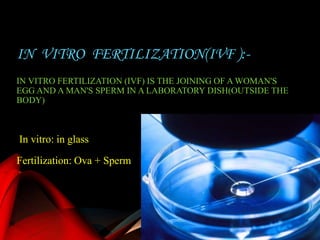
IN VITRO FERTILIZATION (IVF) IS THE JOINING OF A WOMAN'S
EGG AND A MAN'S SPERM IN A LABORATORY DISH(OUTSIDE THE
BODY)
HISTORY
 In 1972 pre implantation mammalian embryos were
first cryopreserved .
 The first successful birth from IVF in 1978 by Robert
G. Edwards the physiologist who developed the
treatment by this method .
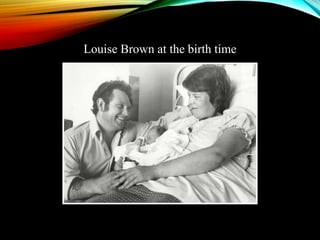
 Louise Brown was the first IVF baby in the world. She
was born in July of 1978 in England.
Louise Brown at the birth time
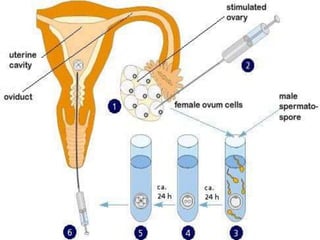
Hormonal
treatment
Female
Harvest
the ovum
Mix in a test tube
Natural
ejaculation
Collect semen
Mature Ova
Motile sperms
Keep to
develop
embryo
Transfer
to mother
Male
Basic Principle of IVF
STEP 1:
CONTROL OVARIAN
HYPERSTIMULATION
(COH)
• COH is done using different protocols. The most
common one is a long GnRH-Agonist (Lupron)
protocol where the secretion of gonadotropin
hormones is suppressed in order to prevent premature
ovulation. Once optimal suppression is achieved, the
next step is the recruitment of multiple follicles by
daily injections of gonadotropins.
Drugs currently in use include:
• clomiphene citrate (Clomidâ, Seropheneâ)
• human menopausal gonadotropin (hCG)
• gonodotropin releasing hormone (GnRH) analog called
leuprolide (Lupron)
Most of these drugs may be used alone or in a combination
with others.
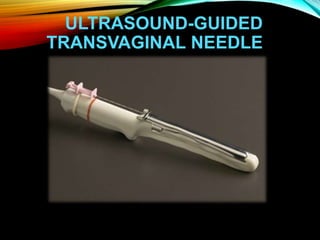
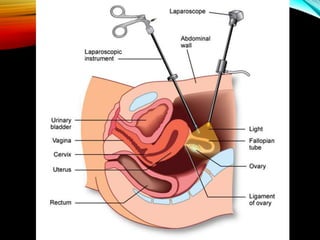
STEP 2: EGG RETRIEVAL
• Egg retrieval is performed in a surgical suite under
intravenous sedation. Ovarian follicles are aspirated
using a needle guided by trans-vaginal
ultrasonography(Ultrasound-guided transvaginal needle
aspiration) or Laparoscopy
STEP 3: FERTILIZATION AND
EMBRYO CULTURE
• If sperm parameters are normal, approximately
50,000 to 100,000 motile sperm are transferred to the
dish containing the eggs. This is called standard
insemination.
• The ICSI technique is utilized to fertilize mature eggs
if sperm parameters are abnormal
• Fertilization is assessed 16-18 hours after insemination or
ICSI. The fertilized eggs are called zygotes and are cultured in
a specially formulated culture medium that supports their
growth.
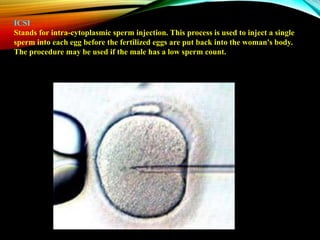
ICSI
Stands for intra-cytoplasmic sperm injection. This process is used to inject a single
sperm into each egg before the fertilized eggs are put back into the woman's body.
The procedure may be used if the male has a low sperm count.
STEP 4: EMBRYO
TRANSFER
• Embryos are transferred on day 3 when they
are at the cleavage stage (6-8 cells) or on day 5
when they have reached the blastocyst stage.
Embryo transfer is a simple procedure that
does not require any anesthesia. Embryos are
loaded in a soft catheter and are placed in the
uterine cavity to be implanted through the
cervix.
ULTRASOUND-GUIDED
TRANSVAGINAL NEEDLE
INDICATIONS OF IVF
• 1) Tubal disease: In women with blocked fallopian tubes, IVF
has largely replaced surgery as the treatment of choice. In
patients with hydrosalpinx, the tubes may have to be
surgically removed (or interrupted) to maximize IVF success
rates.
• 2) Male factor: In cases with male infertility, where there is a
defect in sperm quality, sperm have difficulty penetrating the
egg. IVF with intracytoplasmic sperm injection (ICSI) may
be used in such cases.
• 3) Endometriosis
• 4) Ovulatory dysfunction: In patients with
polycystic ovarian disease (PCOS) and other
ovulatory problems, IVF can be used when other
methods have failed.
• 5) Unexplained infertility
FACTORS THAT AFFECT IVF
1- Maternal age .
2- Causes of infertility .
3-Reproductive history.
4- Lifestyle factors .
THE MATERNAL AGE IS THE MOST
IMPORTANT FACTOR THAT EFFECT THE RATE
OF SUCCESS OF PREGNANCY .
THE YOUNGER CANDIDATES OF IVF ARE
MORE LIKELY TO GET PREGNANCY . WOMEN
OLDER THAN 41 YEARS OLD ARE MORE
LIKELY TO GET PREGNANCY WITH A DONOR
EGG .
SIDE EFFECT AND RISKS
OF IVF
• 1-Drug reaction:
• A mild reaction to fertility drugs may involve hot flushes, feeling down or
irritable, headaches and restlessness. Symptoms usually disappear after a short
time but if they do not, you should see a doctor as soon as possible.
• 2-Ovarian hyper-stimulation syndrome (OHSS):
• OHSS can be a dangerous over-reaction to fertility drugs used to stimulate
egg production. It can cause symptoms such as a swollen stomach, stomach
pains, nausea and vomiting.
• 3-Miscarriage
• 4-Ectopic pregnancy
• 5-Multiple births
• Having a multiple birth (twins, triplets or more) is the single greatest health
risk associated with fertility treatment.
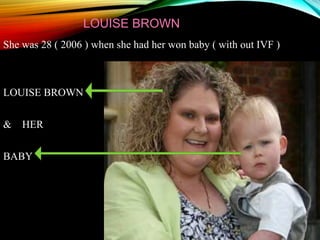
LOUISE BROWN
She was 28 ( 2006 ) when she had her won baby ( with out IVF )
LOUISE BROWN
& HER
BABY
In vitro fertilization (ivf)

In vitro fertilization (ivf)

  • 1.
    IN VITRO FERTILIZATION(IVF) PREPARED BY: SAADO KHADER & JAMAL KHRMSH
  • 2.
    OBJECTES: • What isIVF? • History of IVF. • How IVF is done? • What are indications of IVF? • What are the factors that affect IVF? • What are side affect and risk factors of IVF?
  • 3.
    In vitro: inglass Fertilization: Ova + Sperm IN VITRO FERTILIZATION(IVF ):- IN VITRO FERTILIZATION (IVF) IS THE JOINING OF A WOMAN'S EGG AND A MAN'S SPERM IN A LABORATORY DISH(OUTSIDE THE BODY)
  • 4.
    HISTORY  In 1972pre implantation mammalian embryos were first cryopreserved .  The first successful birth from IVF in 1978 by Robert G. Edwards the physiologist who developed the treatment by this method .  Louise Brown was the first IVF baby in the world. She was born in July of 1978 in England.
  • 5.
    Louise Brown atthe birth time
  • 6.
    Hormonal treatment Female Harvest the ovum Mix ina test tube Natural ejaculation Collect semen Mature Ova Motile sperms Keep to develop embryo Transfer to mother Male Basic Principle of IVF
  • 7.
    STEP 1: CONTROL OVARIAN HYPERSTIMULATION (COH) •COH is done using different protocols. The most common one is a long GnRH-Agonist (Lupron) protocol where the secretion of gonadotropin hormones is suppressed in order to prevent premature ovulation. Once optimal suppression is achieved, the next step is the recruitment of multiple follicles by daily injections of gonadotropins.
  • 8.
    Drugs currently inuse include: • clomiphene citrate (Clomidâ, Seropheneâ) • human menopausal gonadotropin (hCG) • gonodotropin releasing hormone (GnRH) analog called leuprolide (Lupron) Most of these drugs may be used alone or in a combination with others.
  • 9.
    STEP 2: EGGRETRIEVAL • Egg retrieval is performed in a surgical suite under intravenous sedation. Ovarian follicles are aspirated using a needle guided by trans-vaginal ultrasonography(Ultrasound-guided transvaginal needle aspiration) or Laparoscopy
  • 10.
    STEP 3: FERTILIZATIONAND EMBRYO CULTURE • If sperm parameters are normal, approximately 50,000 to 100,000 motile sperm are transferred to the dish containing the eggs. This is called standard insemination. • The ICSI technique is utilized to fertilize mature eggs if sperm parameters are abnormal • Fertilization is assessed 16-18 hours after insemination or ICSI. The fertilized eggs are called zygotes and are cultured in a specially formulated culture medium that supports their growth.
  • 11.
    ICSI Stands for intra-cytoplasmicsperm injection. This process is used to inject a single sperm into each egg before the fertilized eggs are put back into the woman's body. The procedure may be used if the male has a low sperm count.
  • 12.
    STEP 4: EMBRYO TRANSFER •Embryos are transferred on day 3 when they are at the cleavage stage (6-8 cells) or on day 5 when they have reached the blastocyst stage. Embryo transfer is a simple procedure that does not require any anesthesia. Embryos are loaded in a soft catheter and are placed in the uterine cavity to be implanted through the cervix.
  • 14.
  • 16.
    INDICATIONS OF IVF •1) Tubal disease: In women with blocked fallopian tubes, IVF has largely replaced surgery as the treatment of choice. In patients with hydrosalpinx, the tubes may have to be surgically removed (or interrupted) to maximize IVF success rates. • 2) Male factor: In cases with male infertility, where there is a defect in sperm quality, sperm have difficulty penetrating the egg. IVF with intracytoplasmic sperm injection (ICSI) may be used in such cases.
  • 17.
    • 3) Endometriosis •4) Ovulatory dysfunction: In patients with polycystic ovarian disease (PCOS) and other ovulatory problems, IVF can be used when other methods have failed. • 5) Unexplained infertility
  • 18.
    FACTORS THAT AFFECTIVF 1- Maternal age . 2- Causes of infertility . 3-Reproductive history. 4- Lifestyle factors .
  • 19.
    THE MATERNAL AGEIS THE MOST IMPORTANT FACTOR THAT EFFECT THE RATE OF SUCCESS OF PREGNANCY . THE YOUNGER CANDIDATES OF IVF ARE MORE LIKELY TO GET PREGNANCY . WOMEN OLDER THAN 41 YEARS OLD ARE MORE LIKELY TO GET PREGNANCY WITH A DONOR EGG .
  • 20.
    SIDE EFFECT ANDRISKS OF IVF • 1-Drug reaction: • A mild reaction to fertility drugs may involve hot flushes, feeling down or irritable, headaches and restlessness. Symptoms usually disappear after a short time but if they do not, you should see a doctor as soon as possible. • 2-Ovarian hyper-stimulation syndrome (OHSS): • OHSS can be a dangerous over-reaction to fertility drugs used to stimulate egg production. It can cause symptoms such as a swollen stomach, stomach pains, nausea and vomiting. • 3-Miscarriage • 4-Ectopic pregnancy • 5-Multiple births • Having a multiple birth (twins, triplets or more) is the single greatest health risk associated with fertility treatment.
  • 21.
    LOUISE BROWN She was28 ( 2006 ) when she had her won baby ( with out IVF ) LOUISE BROWN & HER BABY