



• Population growth is steadily increasing in a
geometric proportion.
• The population can be controlled either by
decreasing the number of births or increasing
the number of deaths.
• Developing medical sciences and human law
do not permit the increased death-rate.
• Only way to control the growth of population
is reduced the number of births.
• Best way to reduce birth is preventing fusion
of sperms and eggs(fertilization) that refers
the prevention of pregnancies or birth control.
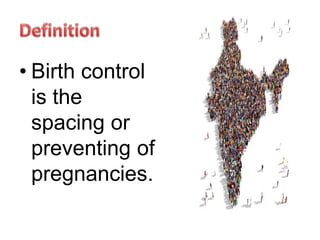
• Birth control
is the
spacing or
preventing of
pregnancies.
• To maintain an economic standard
• To maintain healthy family
• To avoid lack of accommodation
• For better care and education of children.
• To avoid lack of food
• In some cases pregnancy may be a thread to
the health of the mother
• Temporary postponement may be advisable
after an operation or debilitating illness.
• Intra Uterine Contraceptive Devices(IUCD)
• Hormonal control
• Surgical method
• Physical barriers
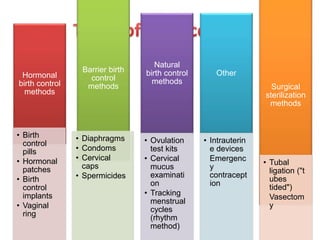
Hormonal
birth control
methods
• Birth
control
pills
• Hormonal
patches
• Birth
control
implants
• Vaginal
ring
Barrier birth
control
methods
• Diaphragms
• Condoms
• Cervical
caps
• Spermicides
Natural
birth control
methods
• Ovulation
test kits
• Cervical
mucus
examinati
on
• Tracking
menstrual
cycles
(rhythm
method)
Other
• Intrauterin
e devices
Emergenc
y
contracept
ion
Surgical
sterilization
methods
• Tubal
ligation ("t
ubes
tided")
Vasectom
y
• Inserted inside the uterus that prevent
fertilization and conception
• Recommended by national Family Welfare
programme(NFWP) in India.
1. Copper-T
2.Lippes loop
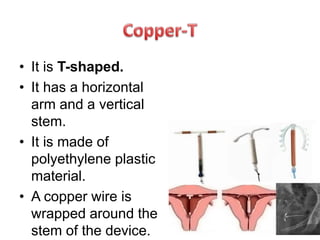
• It is T-shaped.
• It has a horizontal
arm and a vertical
stem.
• It is made of
polyethylene plastic
material.
• A copper wire is
wrapped around the
stem of the device.
• Before insertion, the women are subjected
to carefully, thorough, general and pelvic
medical examination.
• Inserted into the uterus through the vagina
with the help of syringe.
• Since copper can dissolve slowly, the
copper-T device may be replaced every 3
to 5 years.
Advantages of Copper-T:
• Smaller in size and therefore easier for
insertion
• Low expulsion rate
• Less pain and bleeding
• Greater effectiveness
• Prevents fertilization and implantation
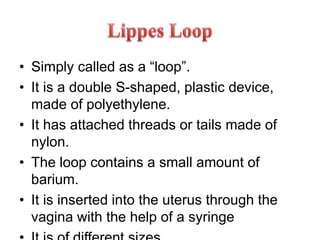
• Simply called as a “loop”.
• It is a double S-shaped, plastic device,
made of polyethylene.
• It has attached threads or tails made of
nylon.
• The loop contains a small amount of
barium.
• It is inserted into the uterus through the
vagina with the help of a syringe
Time of insertion of IUCD
• Best time-3 and 7 days of the menstrual
cycle.
Side effects:
• Backache
• Lower abdominal pain
• Inter-rmenstrual bleeding
• Spotting
Advantages
• Low failure rate
• Inexpensive
• Suitable for women who are breast-feeding
• One time method, and it requires on attention
after insertion
• Reversible
• It is esthetic
• No hospitalization is required
• Reliable method for spacing child births.
Disadvantages:
• May be painful when inserted or removed
• Most IUCD are associated either with
inter- menstrual bleeding or spotting in the
first 3 months.
• Pregnancy can be prevented by
suppressing ovulation.
• Contains concentrations of progesterone
and low concentrations of oestrogen.
• They prevent ovulation.
The hormones may be taken by the
following routes:
• Oral taken by mouth
• Injected under the skin
• Implanted into the body tissue
• Absorbed from a patch on the skin
• Placed in the vagina
Hormonal methods of birth control:
1. Pills
2. Injections
3. Implants
4. Patch
5. Vaginal ring
Taken by orally.
Two types:
1.Combination pills
2.Mini pills
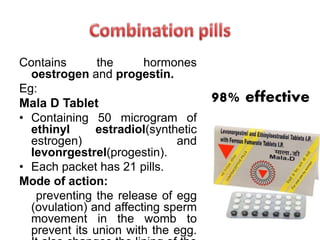
Contains the hormones
oestrogen and progestin.
Eg:
Mala D Tablet
• Containing 50 microgram of
ethinyl estradiol(synthetic
estrogen) and
levonrgestrel(progestin).
• Each packet has 21 pills.
Mode of action:
preventing the release of egg
(ovulation) and affecting sperm
movement in the womb to
prevent its union with the egg.
98% effective
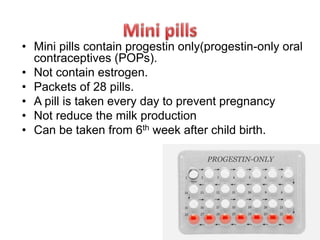
• Mini pills contain progestin only(progestin-only oral
contraceptives (POPs).
• Not contain estrogen.
• Packets of 28 pills.
• A pill is taken every day to prevent pregnancy
• Not reduce the milk production
• Can be taken from 6th week after child birth.
• Two types of contraceptive injections or
hormones.
1.Depo-provera
2.Lunelle
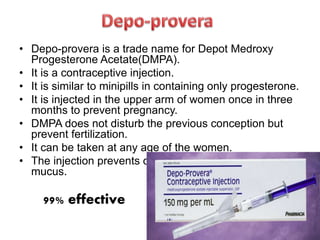
• Depo-provera is a trade name for Depot Medroxy
Progesterone Acetate(DMPA).
• It is a contraceptive injection.
• It is similar to minipills in containing only progesterone.
• It is injected in the upper arm of women once in three
months to prevent pregnancy.
• DMPA does not disturb the previous conception but
prevent fertilization.
• It can be taken at any age of the women.
• The injection prevents ovulation and thickens cervical
mucus.
99% effective
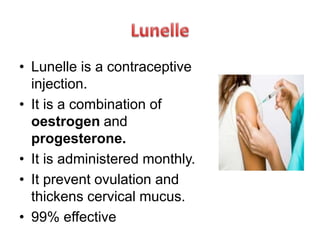
• Lunelle is a contraceptive
injection.
• It is a combination of
oestrogen and
progesterone.
• It is administered monthly.
• It prevent ovulation and
thickens cervical mucus.
• 99% effective
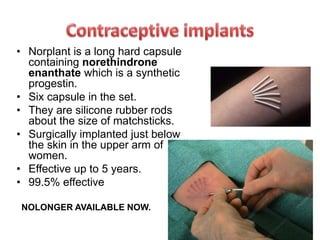
• Norplant is a long hard capsule
containing norethindrone
enanthate which is a synthetic
progestin.
• Six capsule in the set.
• They are silicone rubber rods
about the size of matchsticks.
• Surgically implanted just below
the skin in the upper arm of
women.
• Effective up to 5 years.
• 99.5% effective
NOLONGER AVAILABLE NOW.
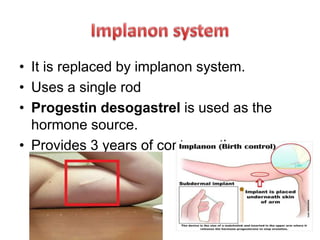
• It is replaced by implanon system.
• Uses a single rod
• Progestin desogastrel is used as the
hormone source.
• Provides 3 years of contraception.
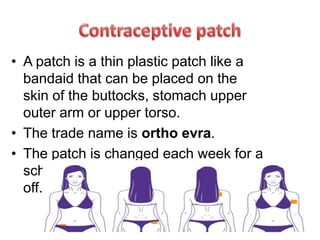
• A patch is a thin plastic patch like a
bandaid that can be placed on the
skin of the buttocks, stomach upper
outer arm or upper torso.
• The trade name is ortho evra.
• The patch is changed each week for a
schedule of 3 weeks on and 1 week
off.
• It is slowly releasing a combination of
hormones estrogen and progestin through
the skin.
• These hormones prevent ovulation and
thicken the cervical mucous and creating a
barrier to prevent the sperm from entering
the uterus.
• It is some sort of operation done in the
reproductive system of male and female,
to prevent fertilizations.
• It includes
• Female sterilization(Tubectomy)
• Male sterilization (Vasectomy)
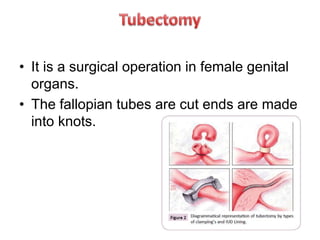
• It is a surgical operation in female genital
organs.
• The fallopian tubes are cut ends are made
into knots.
• Female sterilization involves cutting and
tying off the fallopian tube.
• When sterilization is performed 1-3mdays
after delivery, it is known as post-partum
sterilization
• A) Traditional tubectomy
• B)Mini-lap operation
• C) Laparoscopy
• A) Traditional tubectomy
• An abdominal operation in which a small
piece of each fallopian tube is removed
and ligated.
• The operation is done under general or
spinal anesthesia.
• Hospitalization is required for 5 to 7 days.
• B)Mini-lap operation
• It is a modification of the traditional
tubectomy.
• It is a simpler procedure.
• It requires a small supra-pubic incision of
2.5 to 3cm just above the pubic hair.
• The fallopian tubes are cut and the ends
are blocked. Then the incision is closed.
C) Laparoscopy
• This is more sophisticated operation.
• The abdomen is first inflated with gas(carbon
momoxide, nitrogen or air) to push away the
intestine from the site of operation.
Advantages:
• The short operation time
• Shorter stay in the hospital
• The formation of small scar’s
• It is a surgical operation done in the male.
• The vasadeferens is cut on the sides of
testis.
• The cut ends are made into knots.
Advantages:
• Very effective mothod of contraception
• A very safe procedure
• No long-term side effects
• Does not interrupt sexual behavior
• Does not require hospitalization
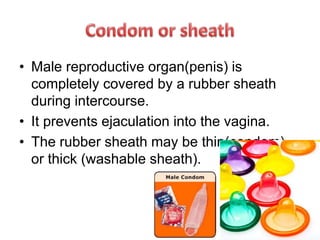
• Male reproductive organ(penis) is
completely covered by a rubber sheath
during intercourse.
• It prevents ejaculation into the vagina.
• The rubber sheath may be thin(condom)
or thick (washable sheath).
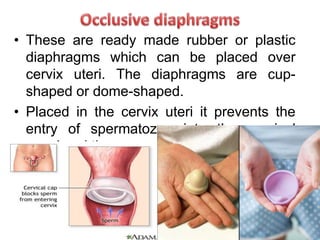
• These are ready made rubber or plastic
diaphragms which can be placed over
cervix uteri. The diaphragms are cup-
shaped or dome-shaped.
• Placed in the cervix uteri it prevents the
entry of spermatozoa into the cervical
canal and thus prevents fertilization.
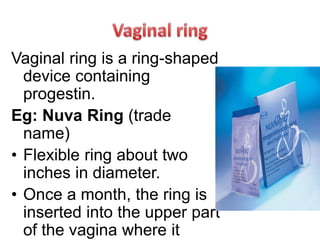
Vaginal ring is a ring-shaped
device containing
progestin.
Eg: Nuva Ring (trade
name)
• Flexible ring about two
inches in diameter.
• Once a month, the ring is
inserted into the upper part
of the vagina where it
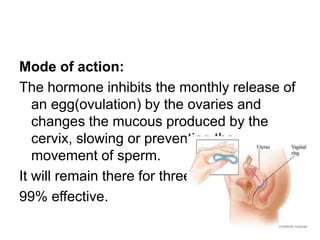
Mode of action:
The hormone inhibits the monthly release of
an egg(ovulation) by the ovaries and
changes the mucous produced by the
cervix, slowing or preventing the
movement of sperm.
It will remain there for three weeks.
99% effective.
• Conception is prevented when the couple
abstains from inter course.
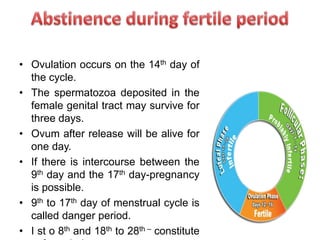
• Ovulation occurs on the 14th day of
the cycle.
• The spermatozoa deposited in the
female genital tract may survive for
three days.
• Ovum after release will be alive for
one day.
• If there is intercourse between the
9th day and the 17th day-pregnancy
is possible.
• 9th to 17th day of menstrual cycle is
called danger period.
• I st o 8th and 18th to 28th – constitute
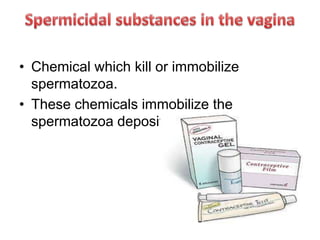
• Chemical which kill or immobilize
spermatozoa.
• These chemicals immobilize the
spermatozoa deposited into the vagina.
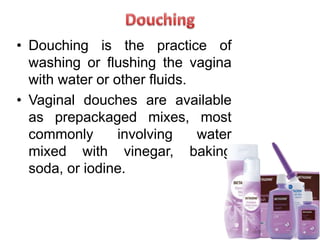
• Douching is the practice of
washing or flushing the vagina
with water or other fluids.
• Vaginal douches are available
as prepackaged mixes, most
commonly involving water
mixed with vinegar, baking
soda, or iodine.
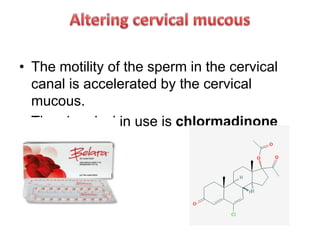
• The motility of the sperm in the cervical
canal is accelerated by the cervical
mucous.
• The chemical in use is chlormadinone
acetate.
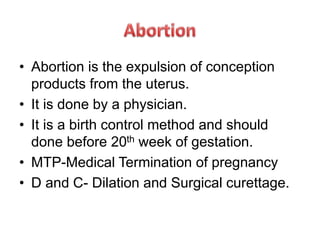
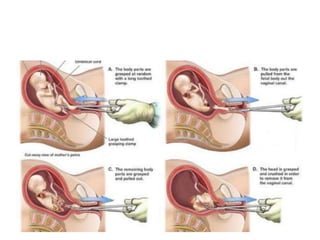
• Abortion is the expulsion of conception
products from the uterus.
• It is done by a physician.
• It is a birth control method and should
done before 20th week of gestation.
• MTP-Medical Termination of pregnancy
• D and C- Dilation and Surgical curettage.
• Department of Biotechnology(DBT) and
Indian Council of Medical Research
(ICMR) developed anti-fertility vaccines for
men and women.
• BCG(Beta Chorionic Gonadotrophin)-
female anti fertility vaccine(in 2nd phase of
clinical trial in India).
• OFSH vaccine(Ovine follicle stimulating
hormone)-to control sperm development
in man.(1st phase of clinical trial)
Birth control methods

Birth control methods

  • 2.
    • Population growthis steadily increasing in a geometric proportion. • The population can be controlled either by decreasing the number of births or increasing the number of deaths. • Developing medical sciences and human law do not permit the increased death-rate. • Only way to control the growth of population is reduced the number of births. • Best way to reduce birth is preventing fusion of sperms and eggs(fertilization) that refers the prevention of pregnancies or birth control.
  • 3.
    • Birth control isthe spacing or preventing of pregnancies.
  • 4.
    • To maintainan economic standard • To maintain healthy family • To avoid lack of accommodation • For better care and education of children. • To avoid lack of food • In some cases pregnancy may be a thread to the health of the mother • Temporary postponement may be advisable after an operation or debilitating illness.
  • 5.
    • Intra UterineContraceptive Devices(IUCD) • Hormonal control • Surgical method • Physical barriers
  • 6.
    Hormonal birth control methods • Birth control pills •Hormonal patches • Birth control implants • Vaginal ring Barrier birth control methods • Diaphragms • Condoms • Cervical caps • Spermicides Natural birth control methods • Ovulation test kits • Cervical mucus examinati on • Tracking menstrual cycles (rhythm method) Other • Intrauterin e devices Emergenc y contracept ion Surgical sterilization methods • Tubal ligation ("t ubes tided") Vasectom y
  • 7.
    • Inserted insidethe uterus that prevent fertilization and conception • Recommended by national Family Welfare programme(NFWP) in India. 1. Copper-T 2.Lippes loop
  • 8.
    • It isT-shaped. • It has a horizontal arm and a vertical stem. • It is made of polyethylene plastic material. • A copper wire is wrapped around the stem of the device.
  • 9.
    • Before insertion,the women are subjected to carefully, thorough, general and pelvic medical examination. • Inserted into the uterus through the vagina with the help of syringe. • Since copper can dissolve slowly, the copper-T device may be replaced every 3 to 5 years.
  • 10.
    Advantages of Copper-T: •Smaller in size and therefore easier for insertion • Low expulsion rate • Less pain and bleeding • Greater effectiveness • Prevents fertilization and implantation
  • 11.
    • Simply calledas a “loop”. • It is a double S-shaped, plastic device, made of polyethylene. • It has attached threads or tails made of nylon. • The loop contains a small amount of barium. • It is inserted into the uterus through the vagina with the help of a syringe
  • 12.
    Time of insertionof IUCD • Best time-3 and 7 days of the menstrual cycle. Side effects: • Backache • Lower abdominal pain • Inter-rmenstrual bleeding • Spotting
  • 13.
    Advantages • Low failurerate • Inexpensive • Suitable for women who are breast-feeding • One time method, and it requires on attention after insertion • Reversible • It is esthetic • No hospitalization is required • Reliable method for spacing child births.
  • 14.
    Disadvantages: • May bepainful when inserted or removed • Most IUCD are associated either with inter- menstrual bleeding or spotting in the first 3 months.
  • 16.
    • Pregnancy canbe prevented by suppressing ovulation. • Contains concentrations of progesterone and low concentrations of oestrogen. • They prevent ovulation.
  • 17.
    The hormones maybe taken by the following routes: • Oral taken by mouth • Injected under the skin • Implanted into the body tissue • Absorbed from a patch on the skin • Placed in the vagina
  • 18.
    Hormonal methods ofbirth control: 1. Pills 2. Injections 3. Implants 4. Patch 5. Vaginal ring
  • 19.
    Taken by orally. Twotypes: 1.Combination pills 2.Mini pills
  • 20.
    Contains the hormones oestrogenand progestin. Eg: Mala D Tablet • Containing 50 microgram of ethinyl estradiol(synthetic estrogen) and levonrgestrel(progestin). • Each packet has 21 pills. Mode of action: preventing the release of egg (ovulation) and affecting sperm movement in the womb to prevent its union with the egg. 98% effective
  • 21.
    • Mini pillscontain progestin only(progestin-only oral contraceptives (POPs). • Not contain estrogen. • Packets of 28 pills. • A pill is taken every day to prevent pregnancy • Not reduce the milk production • Can be taken from 6th week after child birth.
  • 22.
    • Two typesof contraceptive injections or hormones. 1.Depo-provera 2.Lunelle
  • 23.
    • Depo-provera isa trade name for Depot Medroxy Progesterone Acetate(DMPA). • It is a contraceptive injection. • It is similar to minipills in containing only progesterone. • It is injected in the upper arm of women once in three months to prevent pregnancy. • DMPA does not disturb the previous conception but prevent fertilization. • It can be taken at any age of the women. • The injection prevents ovulation and thickens cervical mucus. 99% effective
  • 24.
    • Lunelle isa contraceptive injection. • It is a combination of oestrogen and progesterone. • It is administered monthly. • It prevent ovulation and thickens cervical mucus. • 99% effective
  • 25.
    • Norplant isa long hard capsule containing norethindrone enanthate which is a synthetic progestin. • Six capsule in the set. • They are silicone rubber rods about the size of matchsticks. • Surgically implanted just below the skin in the upper arm of women. • Effective up to 5 years. • 99.5% effective NOLONGER AVAILABLE NOW.
  • 26.
    • It isreplaced by implanon system. • Uses a single rod • Progestin desogastrel is used as the hormone source. • Provides 3 years of contraception.
  • 27.
    • A patchis a thin plastic patch like a bandaid that can be placed on the skin of the buttocks, stomach upper outer arm or upper torso. • The trade name is ortho evra. • The patch is changed each week for a schedule of 3 weeks on and 1 week off.
  • 28.
    • It isslowly releasing a combination of hormones estrogen and progestin through the skin. • These hormones prevent ovulation and thicken the cervical mucous and creating a barrier to prevent the sperm from entering the uterus.
  • 30.
    • It issome sort of operation done in the reproductive system of male and female, to prevent fertilizations. • It includes • Female sterilization(Tubectomy) • Male sterilization (Vasectomy)
  • 31.
    • It isa surgical operation in female genital organs. • The fallopian tubes are cut ends are made into knots.
  • 32.
    • Female sterilizationinvolves cutting and tying off the fallopian tube. • When sterilization is performed 1-3mdays after delivery, it is known as post-partum sterilization • A) Traditional tubectomy • B)Mini-lap operation • C) Laparoscopy
  • 33.
    • A) Traditionaltubectomy • An abdominal operation in which a small piece of each fallopian tube is removed and ligated. • The operation is done under general or spinal anesthesia. • Hospitalization is required for 5 to 7 days.
  • 34.
    • B)Mini-lap operation •It is a modification of the traditional tubectomy. • It is a simpler procedure. • It requires a small supra-pubic incision of 2.5 to 3cm just above the pubic hair. • The fallopian tubes are cut and the ends are blocked. Then the incision is closed.
  • 35.
    C) Laparoscopy • Thisis more sophisticated operation. • The abdomen is first inflated with gas(carbon momoxide, nitrogen or air) to push away the intestine from the site of operation. Advantages: • The short operation time • Shorter stay in the hospital • The formation of small scar’s
  • 36.
    • It isa surgical operation done in the male. • The vasadeferens is cut on the sides of testis. • The cut ends are made into knots. Advantages: • Very effective mothod of contraception • A very safe procedure • No long-term side effects • Does not interrupt sexual behavior • Does not require hospitalization
  • 38.
    • Male reproductiveorgan(penis) is completely covered by a rubber sheath during intercourse. • It prevents ejaculation into the vagina. • The rubber sheath may be thin(condom) or thick (washable sheath).
  • 39.
    • These areready made rubber or plastic diaphragms which can be placed over cervix uteri. The diaphragms are cup- shaped or dome-shaped. • Placed in the cervix uteri it prevents the entry of spermatozoa into the cervical canal and thus prevents fertilization.
  • 40.
    Vaginal ring isa ring-shaped device containing progestin. Eg: Nuva Ring (trade name) • Flexible ring about two inches in diameter. • Once a month, the ring is inserted into the upper part of the vagina where it
  • 41.
    Mode of action: Thehormone inhibits the monthly release of an egg(ovulation) by the ovaries and changes the mucous produced by the cervix, slowing or preventing the movement of sperm. It will remain there for three weeks. 99% effective.
  • 42.
    • Conception isprevented when the couple abstains from inter course.
  • 43.
    • Ovulation occurson the 14th day of the cycle. • The spermatozoa deposited in the female genital tract may survive for three days. • Ovum after release will be alive for one day. • If there is intercourse between the 9th day and the 17th day-pregnancy is possible. • 9th to 17th day of menstrual cycle is called danger period. • I st o 8th and 18th to 28th – constitute
  • 44.
    • Chemical whichkill or immobilize spermatozoa. • These chemicals immobilize the spermatozoa deposited into the vagina.
  • 45.
    • Douching isthe practice of washing or flushing the vagina with water or other fluids. • Vaginal douches are available as prepackaged mixes, most commonly involving water mixed with vinegar, baking soda, or iodine.
  • 46.
    • The motilityof the sperm in the cervical canal is accelerated by the cervical mucous. • The chemical in use is chlormadinone acetate.
  • 47.
    • Abortion isthe expulsion of conception products from the uterus. • It is done by a physician. • It is a birth control method and should done before 20th week of gestation. • MTP-Medical Termination of pregnancy • D and C- Dilation and Surgical curettage.
  • 49.
    • Department ofBiotechnology(DBT) and Indian Council of Medical Research (ICMR) developed anti-fertility vaccines for men and women. • BCG(Beta Chorionic Gonadotrophin)- female anti fertility vaccine(in 2nd phase of clinical trial in India). • OFSH vaccine(Ovine follicle stimulating hormone)-to control sperm development in man.(1st phase of clinical trial)