21st Century
Literature
FromthePhilippinesandtheW
orld
GAME
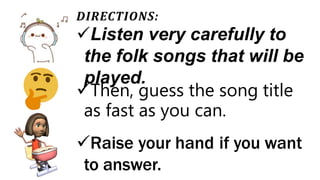
DIRECTIONS:
Listen very carefully to
the folk songs that will be
played.
Then, guess the song title
as fast as you can.
Raise your hand if you want
to answer.
GROUP
ACTIVITY
21stCenturyliterature
DIRECTIONS:
The class will be divided into five (5)
groups.
Each group will be given a task in a form
of 4 Pics 1 Word that needs to be
answered.
The answer on the task shall be the name
to be written on each group’s sash.
DIRECTIONS:
 Each group have
representatives
must
that will represent
assigned region to them as Mr
. and
two (2)
the
Ms.
(the answer on their task).
Each
“hugot”
representative
introduction
must compose their
about their assigned
region to be presented in front of the class.
The group with the loudest applause from
the audience wins the pageant.
DIRECTIONS:
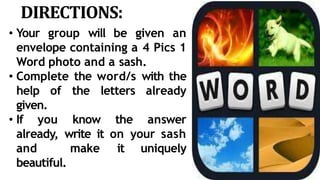
• Your group will be given an
envelope containing a 4 Pics 1
Word photo and a sash.
• Complete the word/s with the
help of the letters already
given.
• If you know the answer
already, write it on your sash
and make it uniquely
beautiful.
21stCenturyliterature
RepresentativeTexts
andAuthorsfrom
DifferentRegionsofthe
Country
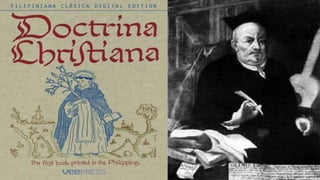
Doctrina Christiana
 was an early book of
Roman Catholic
Catechism, written in
1593 by Fray Juan de
Plasencia, and is believed
to be one of the earliest
books printed in
the Philippines.
REGIONI
ILOCOSREGION
FRANCISCO LOPEZ
In fact, the earliest known written
Iloko poems were the romances he
translated from Spanish
 an Augustinian friar who in 1621,
published his own Iloko
translation of the Doctrina
Cristiana, the first book to be
printed in Iloko.
LEONA FLORENTINO
has since been considered by some as the
"National Poetess of the Philippines”
a Filipino poet in
the Spanish and Ilocano languages. She is
considered as the "mother of Philippine
women's literature" and the "bridge from
oral to literary tradition".
She wrote Nalpay a Namnama o
Naunsyaming Pag-asa (Blasted Hope)
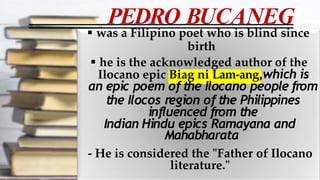
PEDRO BUCANEG
 was a Filipino poet who is blind since
birth
 he is the acknowledged author of the
Ilocano epic Biag ni Lam-ang,which is
an epic poem of the Ilocano people from
the Ilocos region of the Philippines
influenced from the
Indian Hindu epics Ramayana and
Mahabharata
- He is considered the "Father of Ilocano
literature."
REGIONII
CAGAYANVALLEY
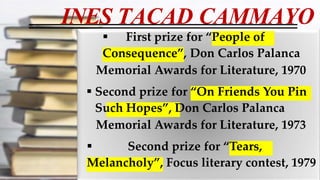
INES TACAD CAMMAYO
 First prize for “People of
Consequence”, Don Carlos Palanca
Memorial Awards for Literature, 1970
 Second prize for “On Friends You Pin
Such Hopes”, Don Carlos Palanca
Memorial Awards for Literature, 1973
 Second prize for “Tears,
Melancholy”, Focus literary contest, 1979
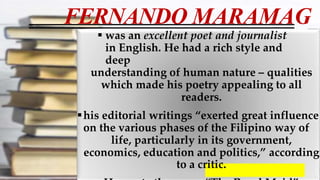
FERNANDO MARAMAG
 was an excellent poet and journalist
in English. He had a rich style and
deep
understanding of human nature – qualities
which made his poetry appealing to all
readers.
his editorial writings “exerted great influence
on the various phases of the Filipino way of

life, particularly in its government,
economics, education and politics,” according
to a critic.
REGIONIII
CENTRALLUZON
ANICIO PASCUAL
 He wrote
“Juan
Manalaksan”
 He is from Arayat,
Pampanga, who heard the
story from an old
MACARIA GARCIA
 She narrated
“Suan, the Good
Guesser”
and
“Suan's Good Luck”.
REGIONIV
SOUTHERNT
AGALOG
MANUEL REYES
a Tagalog from
Rizal province.
narrated
“Suan Eket”
JOSE RIZAL
 wrote “Legend of
Maria Makiling”
also Noli Me
Tangere and El
Filibusterismo
REGIONV
BICOLREGION
MARIANO PERFECTO
 Father of
Bikol
Literature
 He published the first
Bikol newspaper,
Ang Parabareta
IBALON
narrated by Cadregong,
translated by
Fr. Jose Castaño
The story talks
about three stories
of Bicol
APPLICATION
Let’s watch a video clip! 
Select and share to
the class one
literary piece from
region 1 to 5.
REFERENCES:
www.slideshare.net; www.edocsite.com; www.youtube.com

representativetxts-200501155548.pptx