The Nature
Jovy D. Elimanao – Mihm, MAEd
Oral Communication Process
of the
“Brain Starter”
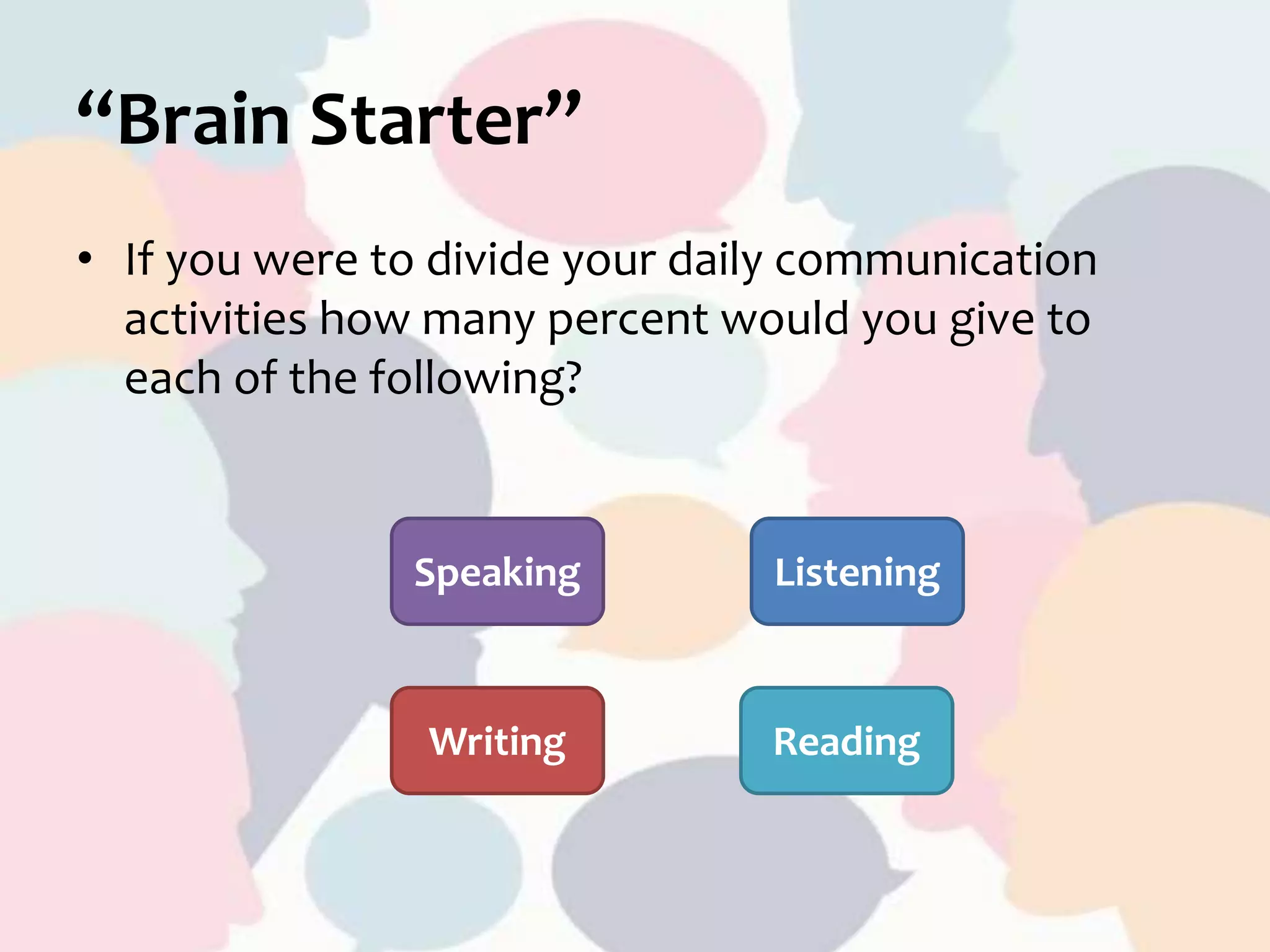
• If you were to divide your daily communication
activities how many percent would you give to
each of the following?
Speaking Listening
Writing Reading
“Brain Starter”
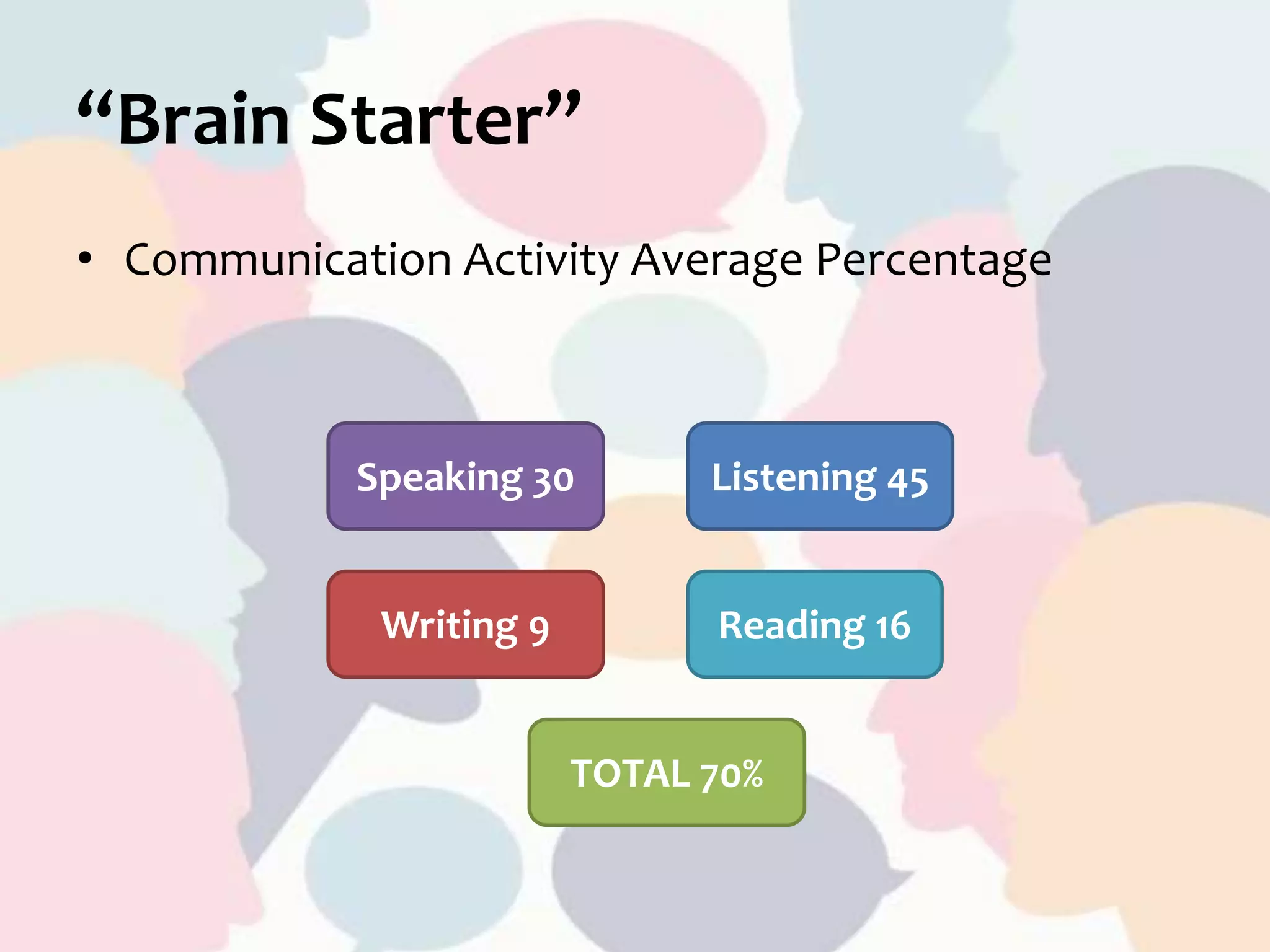
• Communication Activity Average Percentage
Speaking 30 Listening 45
Writing 9 Reading 16
TOTAL 70%
Activity 1: Pass the Message
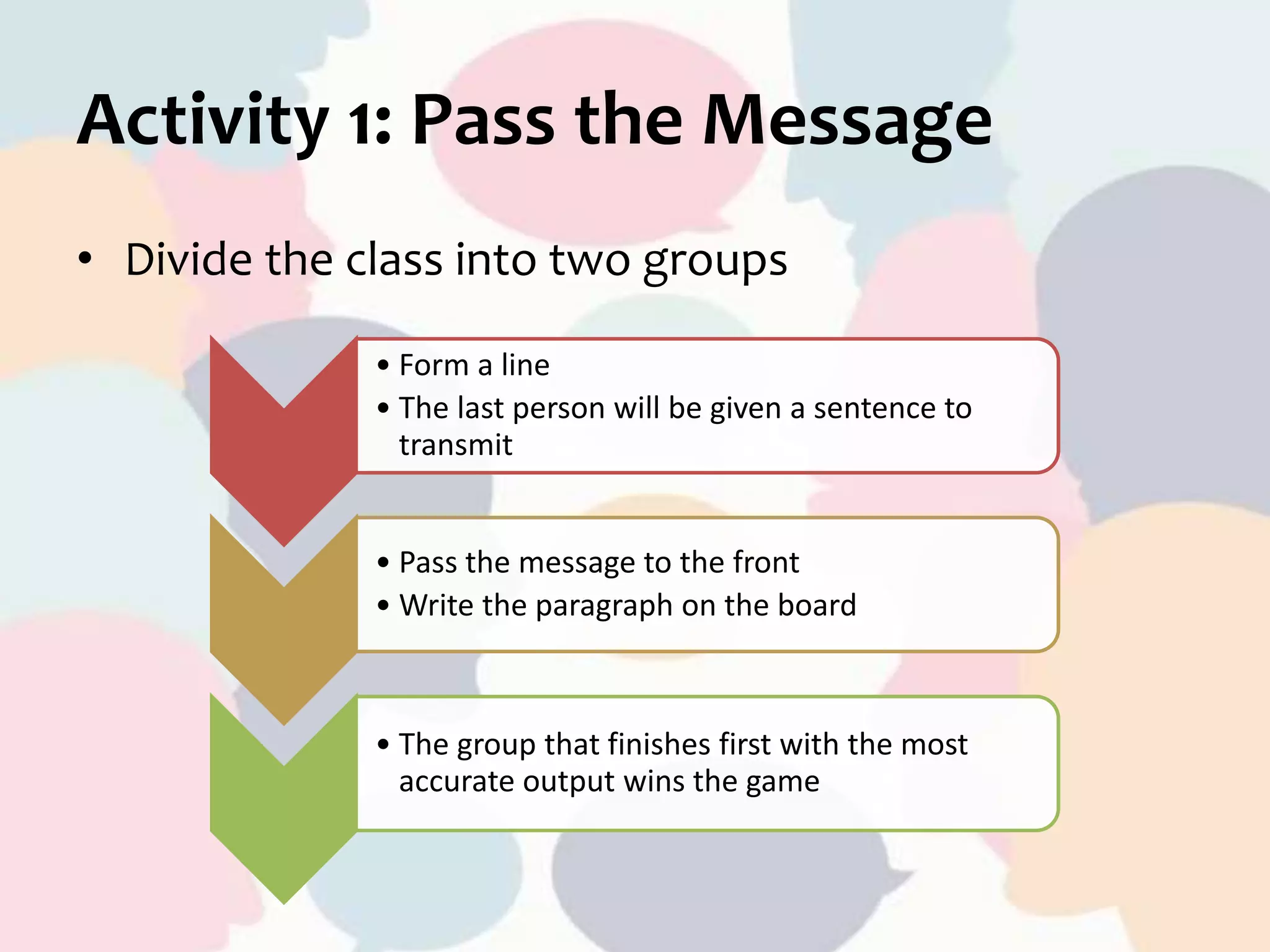
• Divide the class into two groups
• Form a line
• The last person will be given a sentence to
transmit
• Pass the message to the front
• Write the paragraph on the board
• The group that finishes first with the most
accurate output wins the game
• Love is the most beautiful feeling in the world.
It has the power to create miracles.
Activity: Pass the Message
• Was the paragraph accurately transmitted? Why or
why not?
• What helped you accomplish the task well?
• What hindered you from doing it well?
• If you were to repeat the process, how would you
improve it?
• How did you deliver the message from one person to
the other?
• What was the process you have undergone to transfer
information?
• What did you use to deliver messages?
Defining COMMUNICATION
• is a process of sharing and conveying messages or
information from one person to another within and
across channels, contexts, media, and cultures.
• sending and receiving messages to achieve
understanding.
• It is the act or process of using words, signs, or
behaviors to express or exchange information or
to express your ideas, thoughts, feelings to
someone else.
Defining COMMUNICATION
• is the exchange of thoughts, feelings, expressions
and observations among people.
• Derived from the Latin word “COMMUNIS” which
means to impart, to transmit, to convey and to
share.
Elements of COMMUNICATION
• Speaker – the source of information or message
• Message – the information, ideas, or thoughts
conveyed by the speaker in words or in actions
• Encoding – the process of converting the message into
words, actions, or other forms that the speaker
understands
• Channel – the medium or the means, such as personal
or non-personal, verbal or nonverbal, in which the
encoded message is conveyed
• Decoding – the process of interpreting the encoded
message of the speaker by the receiver
Elements of COMMUNICATION
• Receiver – the recipient of the message, or
someone who decodes the message
• Feedback – the reactions, responses, or
information provided by the receiver
• Context / Situation – the environment where
communication takes place
• Barrier/ Noise – the factors that affect the flow of
communication
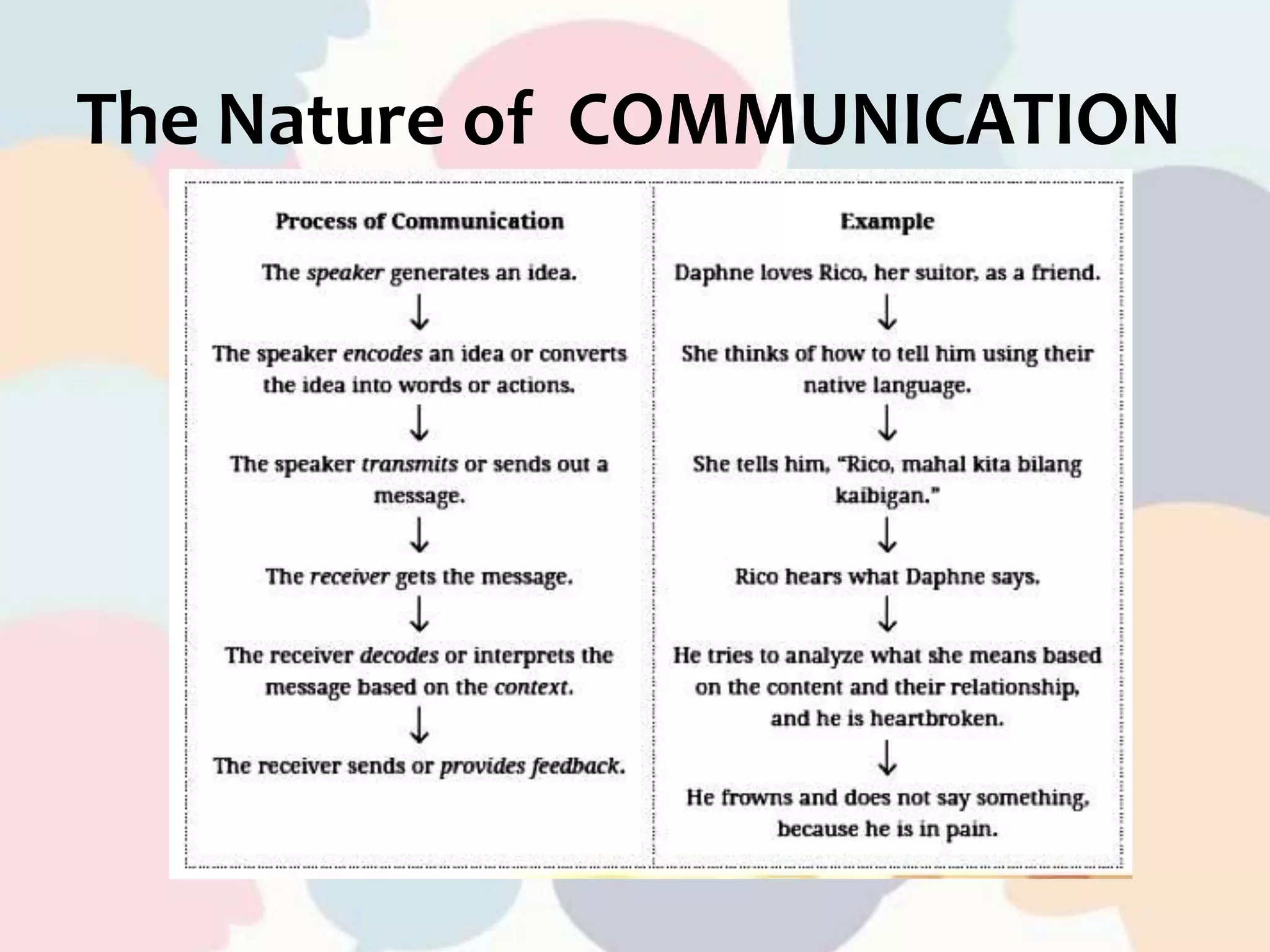
The Nature of COMMUNICATION
• Communication is a process
• Communication is an Interaction
• Communication can be expressed through written
or spoken words, actions (nonverbal), or both
spoken words and nonverbal actions at the same
time.
The Nature of COMMUNICATION
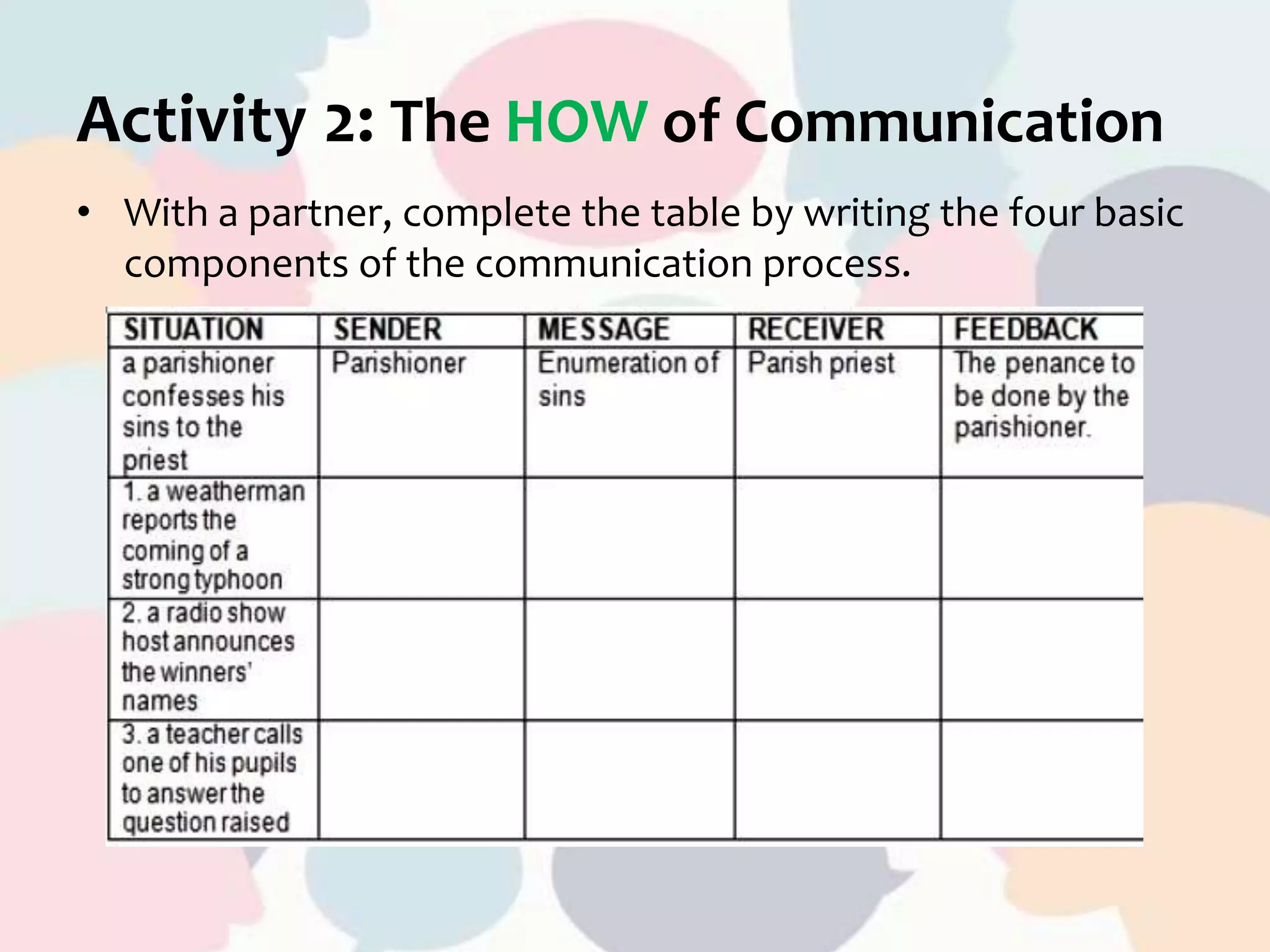
Activity 2: The HOW of Communication
• With a partner, complete the table by writing the four basic
components of the communication process.
Activity 3: What’s with the Conversation?
• With the same partner, write a conversation
chunks and identify the sender, message, receiver,
and feedback.
• These chunks should be taken from one of the
following settings:
• home
• school
• Office

The Nature of the Communication Process

  • 1.
    The Nature Jovy D.Elimanao – Mihm, MAEd Oral Communication Process of the
  • 2.
    “Brain Starter” • Ifyou were to divide your daily communication activities how many percent would you give to each of the following? Speaking Listening Writing Reading
  • 3.
    “Brain Starter” • CommunicationActivity Average Percentage Speaking 30 Listening 45 Writing 9 Reading 16 TOTAL 70%
  • 4.
    Activity 1: Passthe Message • Divide the class into two groups • Form a line • The last person will be given a sentence to transmit • Pass the message to the front • Write the paragraph on the board • The group that finishes first with the most accurate output wins the game
  • 5.
    • Love isthe most beautiful feeling in the world. It has the power to create miracles.
  • 6.
    Activity: Pass theMessage • Was the paragraph accurately transmitted? Why or why not? • What helped you accomplish the task well? • What hindered you from doing it well? • If you were to repeat the process, how would you improve it? • How did you deliver the message from one person to the other? • What was the process you have undergone to transfer information? • What did you use to deliver messages?
  • 7.
    Defining COMMUNICATION • isa process of sharing and conveying messages or information from one person to another within and across channels, contexts, media, and cultures. • sending and receiving messages to achieve understanding. • It is the act or process of using words, signs, or behaviors to express or exchange information or to express your ideas, thoughts, feelings to someone else.
  • 8.
    Defining COMMUNICATION • isthe exchange of thoughts, feelings, expressions and observations among people. • Derived from the Latin word “COMMUNIS” which means to impart, to transmit, to convey and to share.
  • 9.
    Elements of COMMUNICATION •Speaker – the source of information or message • Message – the information, ideas, or thoughts conveyed by the speaker in words or in actions • Encoding – the process of converting the message into words, actions, or other forms that the speaker understands • Channel – the medium or the means, such as personal or non-personal, verbal or nonverbal, in which the encoded message is conveyed • Decoding – the process of interpreting the encoded message of the speaker by the receiver
  • 10.
    Elements of COMMUNICATION •Receiver – the recipient of the message, or someone who decodes the message • Feedback – the reactions, responses, or information provided by the receiver • Context / Situation – the environment where communication takes place • Barrier/ Noise – the factors that affect the flow of communication
  • 11.
    The Nature ofCOMMUNICATION • Communication is a process • Communication is an Interaction • Communication can be expressed through written or spoken words, actions (nonverbal), or both spoken words and nonverbal actions at the same time.
  • 12.
    The Nature ofCOMMUNICATION
  • 13.
    Activity 2: TheHOW of Communication • With a partner, complete the table by writing the four basic components of the communication process.
  • 14.
    Activity 3: What’swith the Conversation? • With the same partner, write a conversation chunks and identify the sender, message, receiver, and feedback. • These chunks should be taken from one of the following settings: • home • school • Office