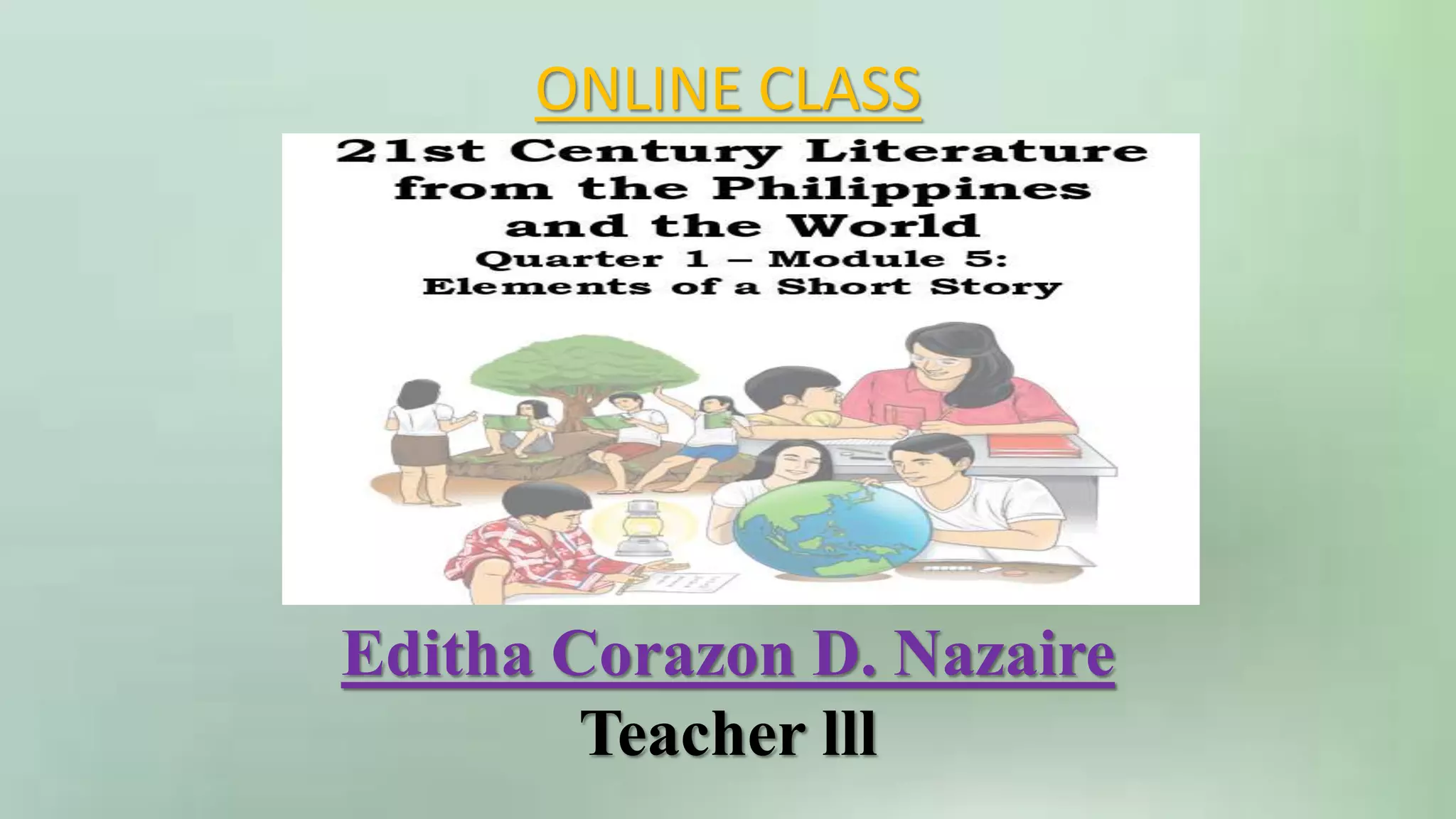
Editha Corazon D. Nazaire
Teacher lll
ONLINE CLASS
A short story has six basic elements that you as a reader should look for when analyzing one.
Every story begins with a seed of an idea. Hence, the author should think of these basic elements
when writing a story. Although not all stories put equal importance on every aspect, each of
these elements must be expected in the story.
At the end of this lesson, you are expected to do a self- and/or peer assessment of the creative
adaptation of a literary text,
based on rationalized criteria.
Studying literature can be very easy with the right amount of
knowledge gained from your studies in the past. Can you recall module
4? How do you define anecdote? What are the purposes of an
anecdote? What lesson does the anecdote in
“Home of the Ashfall” convey? For this next lesson, you will be guided in
will be guided in gathering more literary tools that will surely make
learning more exciting.
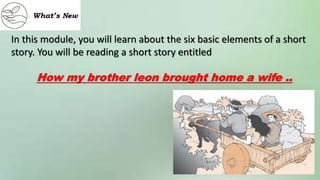
In this module, you will learn about the six basic elements of a short
story. You will be reading a short story entitled
How my brother leon brought home a wife ..
Objectives:
At the end of the lesson, learners are able to:
1.Identify the Elements of a Short Story
2.Differentiate life in the barrio and the city.
3. Enumerate the characters in the story.
4. Analyze the elements found in the story “How My Brother Leon
Brought Home A Wife”
BASIC ELEMENTS OF A SHORT STORY
1. Character– A character in a short story is a person, in some stories an animal,
who takes part in the action of the story or other literary work.
The way an author develops the character in a story is very important in making
the story appeal to the readers. It is said that the heart of the story are the
characters. The two most important characters in a short story are the
protagonist and the antagonist.
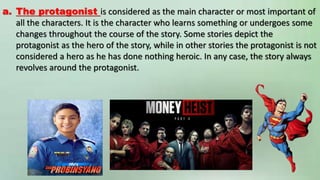
a. The protagonist is considered as the main character or most important of
all the characters. It is the character who learns something or undergoes some
changes throughout the course of the story. Some stories depict the
protagonist as the hero of the story, while in other stories the protagonist is not
considered a hero as he has done nothing heroic. In any case, the story always
revolves around the protagonist.
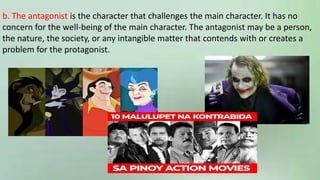
b. The antagonist is the character that challenges the main character. It has no
concern for the well-being of the main character. The antagonist may be a person,
the nature, the society, or any intangible matter that contends with or creates a
problem for the protagonist.
2. Setting– The place (locale) and time (period) when the story happens is called
the setting. The setting may be based on real place and real time or it may also be
based on the author’s imagination. When analyzing the setting of the story,
consider where the action is taking place. Most authors use descriptive words to
describe the landscape, scenery, buildings, season, or weather to provide a strong
sense of setting which will help the reader visualize the story and connect to the
story’s plot.
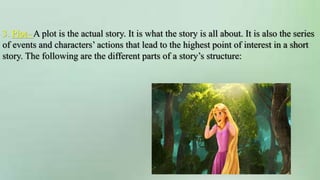
3. Plot– A plot is the actual story. It is what the story is all about. It is also the series
of events and characters’ actions that lead to the highest point of interest in a short
story. The following are the different parts of a story’s structure:
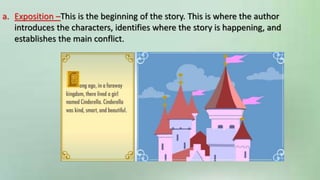
a. Exposition –This is the beginning of the story. This is where the author
introduces the characters, identifies where the story is happening, and
establishes the main conflict.
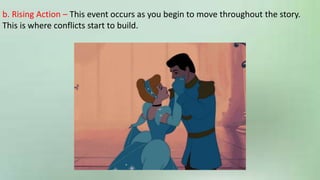
b. Rising Action – This event occurs as you begin to move throughout the story.
This is where conflicts start to build.
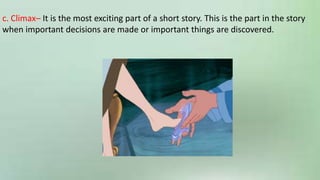
c. Climax– It is the most exciting part of a short story. This is the part in the story
when important decisions are made or important things are discovered.
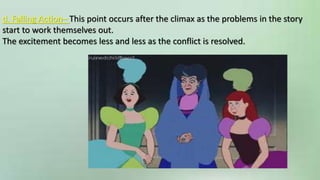
d. Falling Action– This point occurs after the climax as the problems in the story
start to work themselves out.
The excitement becomes less and less as the conflict is resolved.
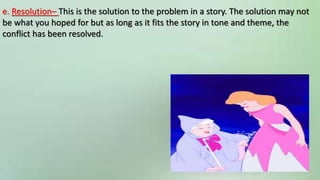
e. Resolution– This is the solution to the problem in a story. The solution may not
be what you hoped for but as long as it fits the story in tone and theme, the
conflict has been resolved.
5. Theme- This is the central idea in a short story and a general truth. This is
considered as the author’s message to the readers.
6. Point of View – This is the way the story is told or narrated. It is also known as
the vantage point that a writer uses to narrate the story. The following are the
types of point of view in a short story:
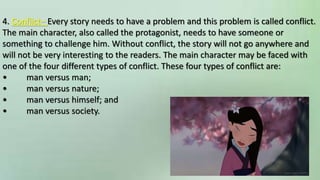
4. Conflict– Every story needs to have a problem and this problem is called conflict.
The main character, also called the protagonist, needs to have someone or
something to challenge him. Without conflict, the story will not go anywhere and
will not be very interesting to the readers. The main character may be faced with
one of the four different types of conflict. These four types of conflict are:
• man versus man;
• man versus nature;
• man versus himself; and
• man versus society.
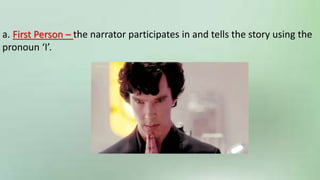
a. First Person – the narrator participates in and tells the story using the
pronoun ‘I’.
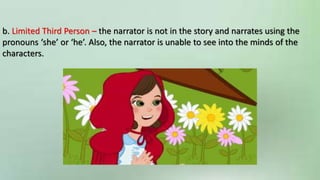
b. Limited Third Person – the narrator is not in the story and narrates using the
pronouns ‘she’ or ‘he’. Also, the narrator is unable to see into the minds of the
characters.
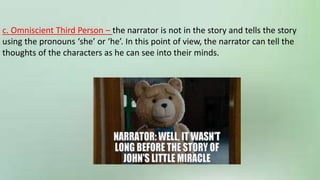
c. Omniscient Third Person – the narrator is not in the story and tells the story
using the pronouns ‘she’ or ‘he’. In this point of view, the narrator can tell the
thoughts of the characters as he can see into their minds.
Life in the City…
Life in the Barrio…
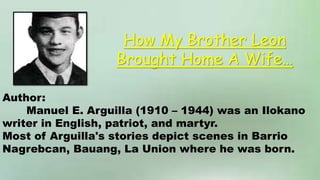
Author:
Manuel E. Arguilla (1910 – 1944) was an Ilokano
writer in English, patriot, and martyr.
Most of Arguilla's stories depict scenes in Barrio
Nagrebcan, Bauang, La Union where he was born.
How My Brother Leon
Brought Home A Wife…
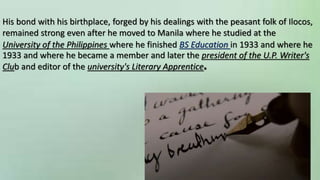
His bond with his birthplace, forged by his dealings with the peasant folk of Ilocos,
remained strong even after he moved to Manila where he studied at the
University of the Philippines where he finished BS Education in 1933 and where he
1933 and where he became a member and later the president of the U.P. Writer's
Club and editor of the university's Literary Apprentice.
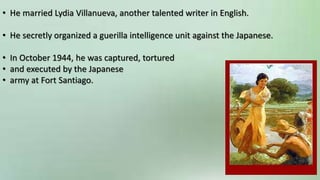
• He married Lydia Villanueva, another talented writer in English.
• He secretly organized a guerilla intelligence unit against the Japanese.
• In October 1944, he was captured, tortured
• and executed by the Japanese
• army at Fort Santiago.
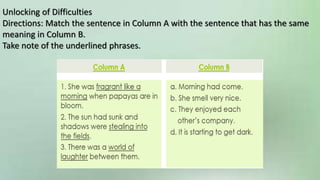
Unlocking of Difficulties
Directions: Match the sentence in Column A with the sentence that has the same
meaning in Column B.
Take note of the underlined phrases.
Assignment:
• Read the story “How My Brother Leon Brought Home A Wife” by
Manuel E. Arguilla
• Identify the Elements of the story
• Answer the following questions:
References
Lacia, Ferdilyn C., Lydia L. Libunao, Mark G. Fabella and Vivian I. Buhain. The
Literatures of the Philippines. Quezon City Metro Manila: Rex Book Store, Inc.: 2016.
Marcos, Lucivilla,Wilfredo Bantados and Suzette Valdez. Introduction to Literature
with Special Glimpse of Philippine Literature. City of Manila, Metro Manila: Purely
Books Trading & Publishing Corp., 2012.
The Best Philippine Short Stories. “How My Brother Leon Brought Home A Wife: by
Manuel E. Arguilla” Last modified September 2015.
Thank
you &
Yahweh
Bless 

21st Century Literature Module 5.pptx

  • 1.
    Editha Corazon D.Nazaire Teacher lll ONLINE CLASS
  • 3.
    A short storyhas six basic elements that you as a reader should look for when analyzing one. Every story begins with a seed of an idea. Hence, the author should think of these basic elements when writing a story. Although not all stories put equal importance on every aspect, each of these elements must be expected in the story. At the end of this lesson, you are expected to do a self- and/or peer assessment of the creative adaptation of a literary text, based on rationalized criteria.
  • 4.
    Studying literature canbe very easy with the right amount of knowledge gained from your studies in the past. Can you recall module 4? How do you define anecdote? What are the purposes of an anecdote? What lesson does the anecdote in “Home of the Ashfall” convey? For this next lesson, you will be guided in will be guided in gathering more literary tools that will surely make learning more exciting.
  • 5.
    In this module,you will learn about the six basic elements of a short story. You will be reading a short story entitled How my brother leon brought home a wife ..
  • 6.
    Objectives: At the endof the lesson, learners are able to: 1.Identify the Elements of a Short Story 2.Differentiate life in the barrio and the city. 3. Enumerate the characters in the story. 4. Analyze the elements found in the story “How My Brother Leon Brought Home A Wife”
  • 8.
    BASIC ELEMENTS OFA SHORT STORY 1. Character– A character in a short story is a person, in some stories an animal, who takes part in the action of the story or other literary work. The way an author develops the character in a story is very important in making the story appeal to the readers. It is said that the heart of the story are the characters. The two most important characters in a short story are the protagonist and the antagonist.
  • 9.
    a. The protagonistis considered as the main character or most important of all the characters. It is the character who learns something or undergoes some changes throughout the course of the story. Some stories depict the protagonist as the hero of the story, while in other stories the protagonist is not considered a hero as he has done nothing heroic. In any case, the story always revolves around the protagonist.
  • 10.
    b. The antagonistis the character that challenges the main character. It has no concern for the well-being of the main character. The antagonist may be a person, the nature, the society, or any intangible matter that contends with or creates a problem for the protagonist.
  • 11.
    2. Setting– Theplace (locale) and time (period) when the story happens is called the setting. The setting may be based on real place and real time or it may also be based on the author’s imagination. When analyzing the setting of the story, consider where the action is taking place. Most authors use descriptive words to describe the landscape, scenery, buildings, season, or weather to provide a strong sense of setting which will help the reader visualize the story and connect to the story’s plot.
  • 12.
    3. Plot– Aplot is the actual story. It is what the story is all about. It is also the series of events and characters’ actions that lead to the highest point of interest in a short story. The following are the different parts of a story’s structure:
  • 13.
    a. Exposition –Thisis the beginning of the story. This is where the author introduces the characters, identifies where the story is happening, and establishes the main conflict.
  • 14.
    b. Rising Action– This event occurs as you begin to move throughout the story. This is where conflicts start to build.
  • 15.
    c. Climax– Itis the most exciting part of a short story. This is the part in the story when important decisions are made or important things are discovered.
  • 16.
    d. Falling Action–This point occurs after the climax as the problems in the story start to work themselves out. The excitement becomes less and less as the conflict is resolved.
  • 17.
    e. Resolution– Thisis the solution to the problem in a story. The solution may not be what you hoped for but as long as it fits the story in tone and theme, the conflict has been resolved.
  • 18.
    5. Theme- Thisis the central idea in a short story and a general truth. This is considered as the author’s message to the readers.
  • 19.
    6. Point ofView – This is the way the story is told or narrated. It is also known as the vantage point that a writer uses to narrate the story. The following are the types of point of view in a short story:
  • 20.
    4. Conflict– Everystory needs to have a problem and this problem is called conflict. The main character, also called the protagonist, needs to have someone or something to challenge him. Without conflict, the story will not go anywhere and will not be very interesting to the readers. The main character may be faced with one of the four different types of conflict. These four types of conflict are: • man versus man; • man versus nature; • man versus himself; and • man versus society.
  • 21.
    a. First Person– the narrator participates in and tells the story using the pronoun ‘I’.
  • 22.
    b. Limited ThirdPerson – the narrator is not in the story and narrates using the pronouns ‘she’ or ‘he’. Also, the narrator is unable to see into the minds of the characters.
  • 23.
    c. Omniscient ThirdPerson – the narrator is not in the story and tells the story using the pronouns ‘she’ or ‘he’. In this point of view, the narrator can tell the thoughts of the characters as he can see into their minds.
  • 24.
    Life in theCity…
  • 25.
    Life in theBarrio…
  • 26.
    Author: Manuel E. Arguilla(1910 – 1944) was an Ilokano writer in English, patriot, and martyr. Most of Arguilla's stories depict scenes in Barrio Nagrebcan, Bauang, La Union where he was born. How My Brother Leon Brought Home A Wife…
  • 27.
    His bond withhis birthplace, forged by his dealings with the peasant folk of Ilocos, remained strong even after he moved to Manila where he studied at the University of the Philippines where he finished BS Education in 1933 and where he 1933 and where he became a member and later the president of the U.P. Writer's Club and editor of the university's Literary Apprentice.
  • 28.
    • He marriedLydia Villanueva, another talented writer in English. • He secretly organized a guerilla intelligence unit against the Japanese. • In October 1944, he was captured, tortured • and executed by the Japanese • army at Fort Santiago.
  • 29.
    Unlocking of Difficulties Directions:Match the sentence in Column A with the sentence that has the same meaning in Column B. Take note of the underlined phrases.
  • 30.
    Assignment: • Read thestory “How My Brother Leon Brought Home A Wife” by Manuel E. Arguilla • Identify the Elements of the story • Answer the following questions:
  • 31.
    References Lacia, Ferdilyn C.,Lydia L. Libunao, Mark G. Fabella and Vivian I. Buhain. The Literatures of the Philippines. Quezon City Metro Manila: Rex Book Store, Inc.: 2016. Marcos, Lucivilla,Wilfredo Bantados and Suzette Valdez. Introduction to Literature with Special Glimpse of Philippine Literature. City of Manila, Metro Manila: Purely Books Trading & Publishing Corp., 2012. The Best Philippine Short Stories. “How My Brother Leon Brought Home A Wife: by Manuel E. Arguilla” Last modified September 2015.
  • 32.