LESSON 3-
SYMBOLIC
INTERACTIONISM
LEARNING COMPETENCY:
The learners appraise the
meanings that people attach
to everyday forms of
interaction in order to
explain social behavior.
(HUMSS_DIS11-IIIh-3)
LEARNING OBJECTIVE:
The learners define
symbolic
interactionism.
REVIEW (2 MINS.)
MOTIVATION
(10 MINS.)
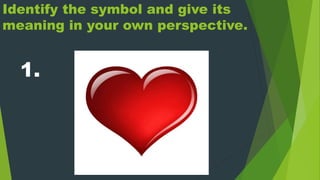
Identify the symbol and give its
meaning in your own perspective.
1.
Identify the symbol and give its
meaning in your own perspective.
2.
Identify the symbol and give its
meaning in your own perspective.
3.
Identify the symbol and give its
meaning in your own perspective.
4.
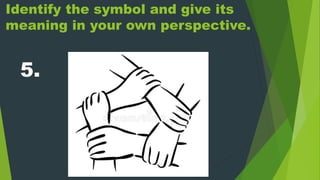
Identify the symbol and give its
meaning in your own perspective.
5.
Exchange your
notebook to your
seatmate and compare
your answers. Do you
have the same answers
with your classmates?
GUIDE QUESTIONS: (10 minutes)
 The following guide questions will be answered:
1. What images did you see?
2. What were your observations on the pictures?
3. What is /are the meanings of those symbols in
your life?
4. What do you think will be the lesson for this day?
(The teacher reveals the lesson)
All trees are source of
shade
All trees are source of
fresh air
All trees are source of
income (e.g. paper
production)
All trees are infested with
ants
THREE CENTRAL IDEAS OF
SYMBOLIC INTERACTIONISM
1.We act based on the meaning we
have given to something.
2.We give meaning to things based on
social interactions. We can get
different meaning from the different
person we associate to through
socialization .
3.The meaning we give to something
can change.
SYMBOLIC INTERACTIONISM
a sociological framework that
focuses on the different
meanings individual attach to
objects, people, and
interaction as well as the
corresponding behaviors that
reflect those meanings and/or
presentations.
It is a framework that
actualizes the nature of
humans to make sense of
their actions and
interactions through
external cues from their
everyday life and
environment. (Vejar 2015)
A theory analyzes society by
addressing the subjective
meanings that people impose on
objects, events, and behaviors.
Subjective meanings are given
primacy because it is believe that
people behave based on what they
believe and not just on what is
objectively true.
Subjective meaning – meaning
given to an object, event, or
behavior based on personal
opinion, feelings, and tastes.
Objective meaning – meaning
given to an object based on
what is generally true and is not
influenced by personal feelings
or opinions.
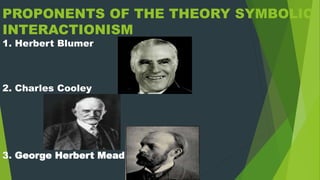
PROPONENTS OF THE THEORY SYMBOLIC
INTERACTIONISM
1. Herbert Blumer
2. Charles Cooley
3. George Herbert Mead
Basic premises of symbolic interactionism:
(Herbert Blumer)
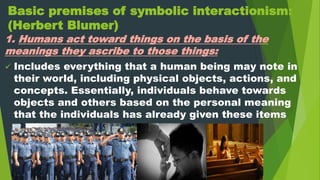
1. Humans act toward things on the basis of the
meanings they ascribe to those things:
 Includes everything that a human being may note in
their world, including physical objects, actions, and
concepts. Essentially, individuals behave towards
objects and others based on the personal meaning
that the individuals has already given these items
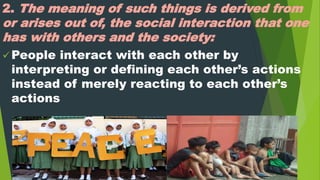
2. The meaning of such things is derived from
or arises out of, the social interaction that one
has with others and the society:
 People interact with each other by
interpreting or defining each other’s actions
instead of merely reacting to each other’s
actions
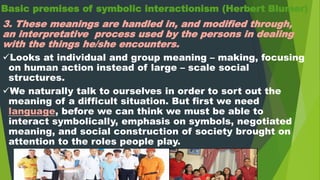
Basic premises of symbolic interactionism (Herbert Blumer)
3. These meanings are handled in, and modified through,
an interpretative process used by the persons in dealing
with the things he/she encounters.
Looks at individual and group meaning – making, focusing
on human action instead of large – scale social
structures.
We naturally talk to ourselves in order to sort out the
meaning of a difficult situation. But first we need
language, before we can think we must be able to
interact symbolically, emphasis on symbols, negotiated
meaning, and social construction of society brought on
attention to the roles people play.
 Our view of ourselves comes from not only our
contemplation of personal qualities, but also
from our impressions of how others perceive
us.
 We based our perception of who we are on how
we think other people see us and on whether
this opinion seems good or bad to us.
 We learn who we are by interacting with others
 Cooley argued that during interaction humans
serve as mirrors for one another
Looking-Glass Self by Charles Cooley
 Self, I, and Me (George Herbert Mead )
Gestures, according to Mead are important
in communication. When we interact with
others, our posture, tone of voice, voice
inflections, as well as hand and facial
movements convey significance.
Actors reflect on themselves as objects (able
to be object and subjects)
It has a development and is not initially there
at birth
A product of interaction, selfhood is develop
and acquired in a social context
 3 Stages of Self Development (George
Herbert Mead )
1)Play stage is when young children identify with
key figures in their environments, such as the
mother or father, as well as occupational or
gender-specific roles to which they have been
exposed (e.g. police officer, nurse) and
replicate the behavioral norms that correspond
with such roles. For example, a young boy
might sit on the edge of the bathroom counter,
attentive to the way in which his father goes
about shaving, and emulate his action by
scraping the edge of a blunt object across his
own face.
 3 Stages of Self Development (George
Herbert Mead )
2)Game stage – children extrapolate from
the vantage point of the roles they have
simulated by assuming the roles that
their counterparts concurrently
undertake. While engaging in the team
sport, for example, it behooves a child to
conceptualize the roles of his
teammates and opponents in order to
successfully maneuver throughout the
game within his own particular position.
 3 Stages of Self Development (George
Herbert Mead )
3) Generalized other – this is the stage
wherein it helps them construct
morally sound and appropriate
behavior, such as an employee who
arrives promptly to work in order to
avoid scrutiny from his colleagues. Self
identity continuously fluctuates and the
actions are socially refined by adopting
to social standards.
Lesson 3- Symbolic Interactionism .pptx

Lesson 3- Symbolic Interactionism .pptx

  • 1.
  • 2.
    LEARNING COMPETENCY: The learnersappraise the meanings that people attach to everyday forms of interaction in order to explain social behavior. (HUMSS_DIS11-IIIh-3)
  • 3.
    LEARNING OBJECTIVE: The learnersdefine symbolic interactionism.
  • 4.
  • 5.
  • 6.
    Identify the symboland give its meaning in your own perspective. 1.
  • 7.
    Identify the symboland give its meaning in your own perspective. 2.
  • 8.
    Identify the symboland give its meaning in your own perspective. 3.
  • 9.
    Identify the symboland give its meaning in your own perspective. 4.
  • 10.
    Identify the symboland give its meaning in your own perspective. 5.
  • 11.
    Exchange your notebook toyour seatmate and compare your answers. Do you have the same answers with your classmates?
  • 12.
    GUIDE QUESTIONS: (10minutes)  The following guide questions will be answered: 1. What images did you see? 2. What were your observations on the pictures? 3. What is /are the meanings of those symbols in your life? 4. What do you think will be the lesson for this day? (The teacher reveals the lesson)
  • 14.
    All trees aresource of shade All trees are source of fresh air All trees are source of income (e.g. paper production) All trees are infested with ants
  • 15.
    THREE CENTRAL IDEASOF SYMBOLIC INTERACTIONISM 1.We act based on the meaning we have given to something. 2.We give meaning to things based on social interactions. We can get different meaning from the different person we associate to through socialization . 3.The meaning we give to something can change.
  • 16.
    SYMBOLIC INTERACTIONISM a sociologicalframework that focuses on the different meanings individual attach to objects, people, and interaction as well as the corresponding behaviors that reflect those meanings and/or presentations.
  • 17.
    It is aframework that actualizes the nature of humans to make sense of their actions and interactions through external cues from their everyday life and environment. (Vejar 2015)
  • 18.
    A theory analyzessociety by addressing the subjective meanings that people impose on objects, events, and behaviors. Subjective meanings are given primacy because it is believe that people behave based on what they believe and not just on what is objectively true.
  • 19.
    Subjective meaning –meaning given to an object, event, or behavior based on personal opinion, feelings, and tastes. Objective meaning – meaning given to an object based on what is generally true and is not influenced by personal feelings or opinions.
  • 20.
    PROPONENTS OF THETHEORY SYMBOLIC INTERACTIONISM 1. Herbert Blumer 2. Charles Cooley 3. George Herbert Mead
  • 21.
    Basic premises ofsymbolic interactionism: (Herbert Blumer) 1. Humans act toward things on the basis of the meanings they ascribe to those things:  Includes everything that a human being may note in their world, including physical objects, actions, and concepts. Essentially, individuals behave towards objects and others based on the personal meaning that the individuals has already given these items
  • 22.
    2. The meaningof such things is derived from or arises out of, the social interaction that one has with others and the society:  People interact with each other by interpreting or defining each other’s actions instead of merely reacting to each other’s actions
  • 23.
    Basic premises ofsymbolic interactionism (Herbert Blumer) 3. These meanings are handled in, and modified through, an interpretative process used by the persons in dealing with the things he/she encounters. Looks at individual and group meaning – making, focusing on human action instead of large – scale social structures. We naturally talk to ourselves in order to sort out the meaning of a difficult situation. But first we need language, before we can think we must be able to interact symbolically, emphasis on symbols, negotiated meaning, and social construction of society brought on attention to the roles people play.
  • 24.
     Our viewof ourselves comes from not only our contemplation of personal qualities, but also from our impressions of how others perceive us.  We based our perception of who we are on how we think other people see us and on whether this opinion seems good or bad to us.  We learn who we are by interacting with others  Cooley argued that during interaction humans serve as mirrors for one another Looking-Glass Self by Charles Cooley
  • 27.
     Self, I,and Me (George Herbert Mead ) Gestures, according to Mead are important in communication. When we interact with others, our posture, tone of voice, voice inflections, as well as hand and facial movements convey significance. Actors reflect on themselves as objects (able to be object and subjects) It has a development and is not initially there at birth A product of interaction, selfhood is develop and acquired in a social context
  • 28.
     3 Stagesof Self Development (George Herbert Mead ) 1)Play stage is when young children identify with key figures in their environments, such as the mother or father, as well as occupational or gender-specific roles to which they have been exposed (e.g. police officer, nurse) and replicate the behavioral norms that correspond with such roles. For example, a young boy might sit on the edge of the bathroom counter, attentive to the way in which his father goes about shaving, and emulate his action by scraping the edge of a blunt object across his own face.
  • 29.
     3 Stagesof Self Development (George Herbert Mead ) 2)Game stage – children extrapolate from the vantage point of the roles they have simulated by assuming the roles that their counterparts concurrently undertake. While engaging in the team sport, for example, it behooves a child to conceptualize the roles of his teammates and opponents in order to successfully maneuver throughout the game within his own particular position.
  • 30.
     3 Stagesof Self Development (George Herbert Mead ) 3) Generalized other – this is the stage wherein it helps them construct morally sound and appropriate behavior, such as an employee who arrives promptly to work in order to avoid scrutiny from his colleagues. Self identity continuously fluctuates and the actions are socially refined by adopting to social standards.

Editor's Notes

  • #29 Emulate - immitate
  • #30 Extrapolate- estimate or conclude Vantage – a place or position affording a good view of something. Behooves – appropriate or suitable , fits