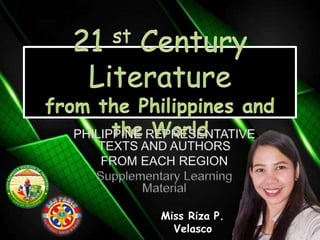
Miss Riza P.
Velasco
REGION I (ILOCOS
REGION)
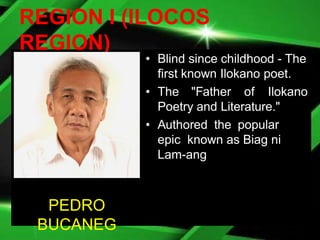
• Blind since childhood - The
first known Ilokano poet.
• The "Father of Ilokano
Poetry and Literature."
• Authored the popular
epic known as Biag ni
Lam-ang
PEDRO
BUCANEG
REGION I (ILOCOS
REGION)
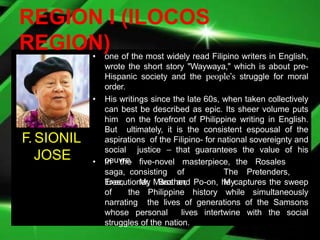
• one of the most widely read Filipino writers in English,
wrote the short story "Waywaya," which is about pre-
Hispanic society and the people’s struggle for moral
order.
• His writings since the late 60s, when taken collectively
can best be described as epic. Its sheer volume puts
him on the forefront of Philippine writing in English.
But ultimately, it is the consistent espousal of the
aspirations of the Filipino- for national sovereignty and
social justice – that guarantees the value of his
oeuvre.
• In the five-novel masterpiece, the Rosales
saga, consisting of The Pretenders,
Tree, My Brother, My
Executioner, Mass and Po-on, he captures the sweep
of the Philippine history while simultaneously
narrating the lives of generations of the Samsons
whose personal lives intertwine with the social
struggles of the nation.
F. SIONIL
JOSE
REGION II (CAGAYAN
VALLEY)
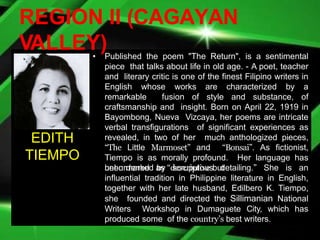
• Published the poem "The Return", is a sentimental
piece that talks about life in old age. - A poet, teacher
and literary critic is one of the finest Filipino writers in
English whose works are characterized by a
remarkable fusion of style and substance, of
craftsmanship and insight. Born on April 22, 1919 in
Bayombong, Nueva Vizcaya, her poems are intricate
verbal transfigurations of significant experiences as
revealed, in two of her much anthologized pieces,
“The Little Marmoset” and “Bonsai”. As fictionist,
Tiempo is as morally profound. Her language has
been marked as “descriptive but
unburdened by scrupulous detailing.” She is an
influential tradition in Philippine literature in English,
together with her late husband, Edilbero K. Tiempo,
she founded and directed the Sillimanian National
Writers Workshop in Dumaguete City, which has
produced some of the country’s best writers.
EDITH
TIEMPO
REGION II (CAGAYAN
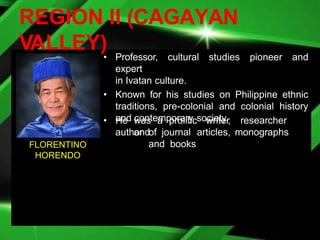
VALLEY)• Professor, cultural studies pioneer and
expert
in Ivatan culture.
• Known for his studies on Philippine ethnic
traditions, pre-colonial and colonial history
and contemporary society.
• He was a prolific writer, researcher
and
author of journal articles, monographs
and books
FLORENTINO
HORENDO
REGION III (CENTRAL
LUZON)
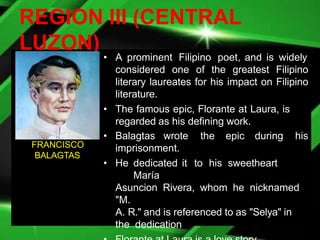
• A prominent Filipino poet, and is widely
considered one of the greatest Filipino
literary laureates for his impact on Filipino
literature.
• The famous epic, Florante at Laura, is
regarded as his defining work.
• Balagtas wrote the epic during his
imprisonment.
• He dedicated it to his sweetheart
María
Asuncion Rivera, whom he nicknamed
"M.
A. R." and is referenced to as "Selya" in
the dedication
FRANCISCO
BALAGTAS
REGION IV-A
(CALABARZON)
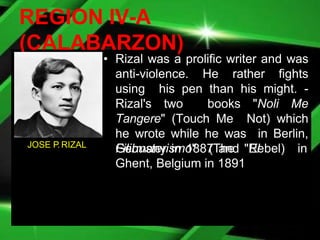
• Rizal was a prolific writer and was
anti-violence. He rather fights
using his pen than his might. -
Rizal's two books "Noli Me
Tangere" (Touch Me Not) which
he wrote while he was in Berlin,
Germany in 1887 and "El
Filibusterismo" (The Rebel) in
Ghent, Belgium in 1891
JOSE P. RIZAL
REGION IV-B (MIMAROPA)
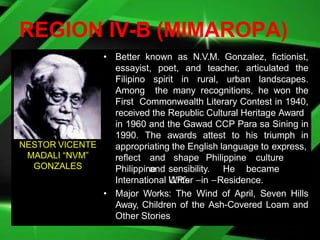
• Better known as N.V.M. Gonzalez, fictionist,
essayist, poet, and teacher, articulated the
Filipino spirit in rural, urban landscapes.
Among the many recognitions, he won the
First Commonwealth Literary Contest in 1940,
received the Republic Cultural Heritage Award
in 1960 and the Gawad CCP Para sa Sining in
1990. The awards attest to his triumph in
appropriating the English language to express,
reflect and shape Philippine culture
and
Philippine sensibility. He became
U.P.’s
International Writer –in –Residence.
• Major Works: The Wind of April, Seven Hills
Away, Children of the Ash-Covered Loam and
Other Stories
NESTOR VICENTE
MADALI “NVM”
GONZALES
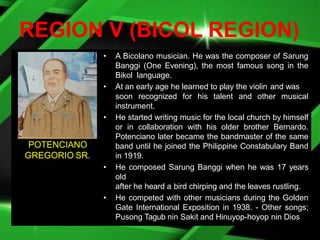
REGION V (BICOL REGION)
• A Bicolano musician. He was the composer of Sarung
Banggi (One Evening), the most famous song in the
Bikol language.
• At an early age he learned to play the violin and was
soon recognized for his talent and other musical
instrument.
• He started writing music for the local church by himself
or in collaboration with his older brother Bernardo.
Potenciano later became the bandmaster of the same
band until he joined the Philippine Constabulary Band
in 1919.
• He composed Sarung Banggi when he was 17 years
old
after he heard a bird chirping and the leaves rustling.
• He competed with other musicians during the Golden
Gate International Exposition in 1938. - Other songs;
Pusong Tagub nin Sakit and Hinuyop-hoyop nin Dios
POTENCIANO
GREGORIO SR.
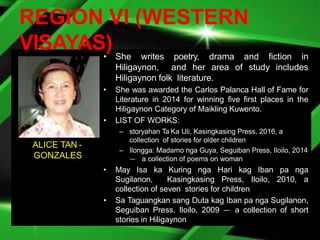
REGION VI (WESTERN
VISAYAS)
• She writes poetry, drama and fiction in
Hiligaynon, and her area of study includes
Hiligaynon folk literature.
• She was awarded the Carlos Palanca Hall of Fame for
Literature in 2014 for winning five first places in the
Hiligaynon Category of Maikling Kuwento.
• LIST OF WORKS:
– storyahan Ta Ka Uli, Kasingkasing Press, 2016, a
collection of stories for older children
– Ilongga: Madamo nga Guya, Seguiban Press, Iloilo, 2014
— a collection of poems on woman
• May Isa ka Kuring nga Hari kag Iban pa nga
Sugilanon, Kasingkasing Press, Iloilo, 2010, a
collection of seven stories for children
• Sa Taguangkan sang Duta kag Iban pa nga Sugilanon,
Seguiban Press, Iloilo, 2009 — a collection of short
stories in Hiligaynon
ALICE TAN -
GONZALES
REGION VII (CENTRAL
VISAYAS)
• Known as “The Father of Modern Cebuano
Literature.” He was born in Tuyom, Carcar. He spent
most of his life writing almost 80 short stories which
were published in Cebuano magazines; namely,
Bisaya, Alimyon and Bulak.
• His first story, Tungod sa Kayagang, was published in
Nasud in 1931. His best-known story is Ug Gianod
Ako, a Bisaya prizewinner.
• Marcel Navarra also became editor of two of the most
popular Cebuano magazine – Bisaya and Bag-ong
Suga.
• Other known stories are “Paingon sa Bag-
ong Kalibutan” (1947, Tungo sa Bagong Mundo) and
“Ang
Hunsoy Sunsungan Usab” (1954, Ang Hungkag
na
Hunsoy) which was translated in English, Clay Pipe.
• Marcel Navarra stopped writing after he wrote his last
work entitled Si Zosimo in 1955.
MARCEL M.
NAVARRA
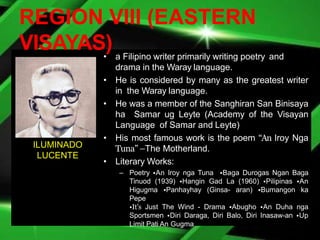
REGION VIII (EASTERN
VISAYAS)
• a Filipino writer primarily writing poetry and
drama in the Waray language.
• He is considered by many as the greatest writer
in the Waray language.
• He was a member of the Sanghiran San Binisaya
ha Samar ug Leyte (Academy of the Visayan
Language of Samar and Leyte)
• His most famous work is the poem “An Iroy Nga
Tuna” –The Motherland.
• Literary Works:
– Poetry •An Iroy nga Tuna •Baga Durogas Ngan Baga
Tinuod (1939) •Hangin Gad La (1960) •Pilipinas •An
Higugma •Panhayhay (Ginsa- aran) •Bumangon ka
Pepe
•It’s Just The Wind - Drama •Abugho •An Duha nga
Sportsmen •Diri Daraga, Diri Balo, Diri Inasaw-an •Up
Limit Pati An Gugma
ILUMINADO
LUCENTE
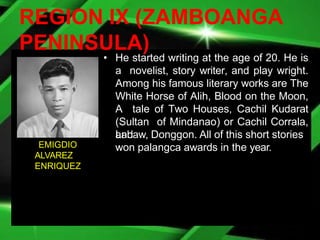
REGION IX (ZAMBOANGA
PENINSULA)
• He started writing at the age of 20. He is
a novelist, story writer, and play wright.
Among his famous literary works are The
White Horse of Alih, Blood on the Moon,
A tale of Two Houses, Cachil Kudarat
(Sultan of Mindanao) or Cachil Corrala,
and
Labaw, Donggon. All of this short stories
won palangca awards in the year.
EMIGDIO
ALVAREZ
ENRIQUEZ
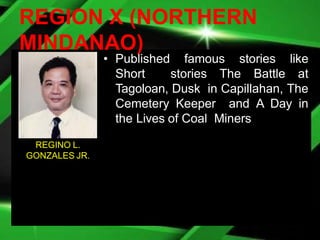
REGION X (NORTHERN
MINDANAO)
• Published famous stories like
Short stories The Battle at
Tagoloan, Dusk in Capillahan, The
Cemetery Keeper and A Day in
the Lives of Coal Miners
REGINO L.
GONZALES JR.
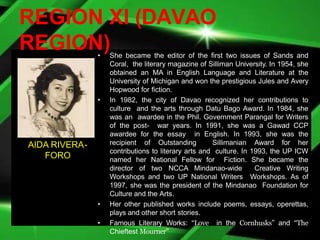
REGION XI (DAVAO
REGION)
• She became the editor of the first two issues of Sands and
Coral, the literary magazine of Silliman University. In 1954, she
obtained an MA in English Language and Literature at the
University of Michigan and won the prestigious Jules and Avery
Hopwood for fiction.
• In 1982, the city of Davao recognized her contributions to
culture and the arts through Datu Bago Award. In 1984, she
was an awardee in the Phil. Government Parangal for Writers
of the post- war years. In 1991, she was a Gawad CCP
awardee for the essay in English. In 1993, she was the
recipient of Outstanding Sillimanian Award for her
contributions to literary arts and culture. In 1993, the UP ICW
named her National Fellow for Fiction. She became the
director of two NCCA Mindanao-wide Creative Writing
Workshops and two UP National Writers Workshops. As of
1997, she was the president of the Mindanao Foundation for
Culture and the Arts.
• Her other published works include poems, essays, operettas,
plays and other short stories.
• Famous Literary Works: “Love in the Cornhusks” and “The
Chieftest Mourner”
AIDA RIVERA-
FORO
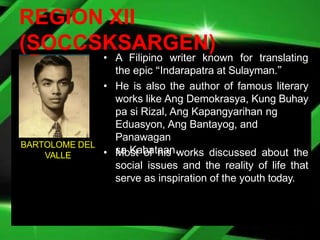
REGION XII
(SOCCSKSARGEN)
• A Filipino writer known for translating
the epic “Indarapatra at Sulayman.”
• He is also the author of famous literary
works like Ang Demokrasya, Kung Buhay
pa si Rizal, Ang Kapangyarihan ng
Eduasyon, Ang Bantayog, and
Panawagan
sa Kabataan.
• Most of his works discussed about the
social issues and the reality of life that
serve as inspiration of the youth today.
BARTOLOME DEL
VALLE
CARAGA REGION
• a Philippine academic, historian, and
anthropologist best known for his contributions to
Philippine anthropology, history, literature, and
linguistics. During a three-decade academic
career at the University of the Philippines, he
wrote a seminal survey of Philippine folk epics,
and was responsible for discovering and
publishing folk epics from the Manuvu,
Matigsalug, and Ilianon peoples.
• He introduced the epic, Tuwaang at Agyu.
• Contributions:
– Dictionary of Philippine Biography (1955-1970), Tayabas
Tagalog Fragments from Quezon Province (1958), A
Survey of Philippine Folk Epics (1963), A Lexicographic
Study of Tayabas Tagalog in Quezon Province (1971),
Documenting Philippinesian: An Inquiry into the Ancestry
of the Filipino People (1994)
E.ARSENIO
MANUEL
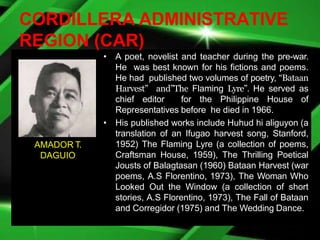
CORDILLERA ADMINISTRATIVE
REGION (CAR)
• A poet, novelist and teacher during the pre-war.
He was best known for his fictions and poems.
He had published two volumes of poetry, “Bataan
Harvest” and”The Flaming Lyre”. He served as
chief editor for the Philippine House of
Representatives before he died in 1966.
• His published works include Huhud hi aliguyon (a
translation of an Ifugao harvest song, Stanford,
1952) The Flaming Lyre (a collection of poems,
Craftsman House, 1959), The Thrilling Poetical
Jousts of Balagtasan (1960) Bataan Harvest (war
poems, A.S Florentino, 1973), The Woman Who
Looked Out the Window (a collection of short
stories, A.S Florentino, 1973), The Fall of Bataan
and Corregidor (1975) and The Wedding Dance.
AMADOR T.
DAGUIO
CORDILLERA ADMINISTRATIVE
REGION (CAR)
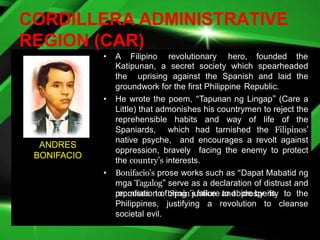
• A Filipino revolutionary hero, founded the
Katipunan, a secret society which spearheaded
the uprising against the Spanish and laid the
groundwork for the first Philippine Republic.
• He wrote the poem, “Tapunan ng Lingap” (Care a
Little) that admonishes his countrymen to reject the
reprehensible habits and way of life of the
Spaniards, which had tarnished the Filipinos’
native psyche, and encourages a revolt against
oppression, bravely facing the enemy to protect
the country’s interests.
• Bonifacio’s prose works such as “Dapat Mabatid ng
mga Tagalog” serve as a declaration of distrust and
repudiation of Spain’s failure to abide by its
promises to bring justice and prosperity to the
Philippines, justifying a revolution to cleanse
societal evil.
ANDRES
BONIFACIO
week1no-200908043150.pptx

week1no-200908043150.pptx

  • 1.
  • 3.
    REGION I (ILOCOS REGION) •Blind since childhood - The first known Ilokano poet. • The "Father of Ilokano Poetry and Literature." • Authored the popular epic known as Biag ni Lam-ang PEDRO BUCANEG
  • 4.
    REGION I (ILOCOS REGION) •one of the most widely read Filipino writers in English, wrote the short story "Waywaya," which is about pre- Hispanic society and the people’s struggle for moral order. • His writings since the late 60s, when taken collectively can best be described as epic. Its sheer volume puts him on the forefront of Philippine writing in English. But ultimately, it is the consistent espousal of the aspirations of the Filipino- for national sovereignty and social justice – that guarantees the value of his oeuvre. • In the five-novel masterpiece, the Rosales saga, consisting of The Pretenders, Tree, My Brother, My Executioner, Mass and Po-on, he captures the sweep of the Philippine history while simultaneously narrating the lives of generations of the Samsons whose personal lives intertwine with the social struggles of the nation. F. SIONIL JOSE
  • 5.
    REGION II (CAGAYAN VALLEY) •Published the poem "The Return", is a sentimental piece that talks about life in old age. - A poet, teacher and literary critic is one of the finest Filipino writers in English whose works are characterized by a remarkable fusion of style and substance, of craftsmanship and insight. Born on April 22, 1919 in Bayombong, Nueva Vizcaya, her poems are intricate verbal transfigurations of significant experiences as revealed, in two of her much anthologized pieces, “The Little Marmoset” and “Bonsai”. As fictionist, Tiempo is as morally profound. Her language has been marked as “descriptive but unburdened by scrupulous detailing.” She is an influential tradition in Philippine literature in English, together with her late husband, Edilbero K. Tiempo, she founded and directed the Sillimanian National Writers Workshop in Dumaguete City, which has produced some of the country’s best writers. EDITH TIEMPO
  • 6.
    REGION II (CAGAYAN VALLEY)•Professor, cultural studies pioneer and expert in Ivatan culture. • Known for his studies on Philippine ethnic traditions, pre-colonial and colonial history and contemporary society. • He was a prolific writer, researcher and author of journal articles, monographs and books FLORENTINO HORENDO
  • 7.
    REGION III (CENTRAL LUZON) •A prominent Filipino poet, and is widely considered one of the greatest Filipino literary laureates for his impact on Filipino literature. • The famous epic, Florante at Laura, is regarded as his defining work. • Balagtas wrote the epic during his imprisonment. • He dedicated it to his sweetheart María Asuncion Rivera, whom he nicknamed "M. A. R." and is referenced to as "Selya" in the dedication FRANCISCO BALAGTAS
  • 8.
    REGION IV-A (CALABARZON) • Rizalwas a prolific writer and was anti-violence. He rather fights using his pen than his might. - Rizal's two books "Noli Me Tangere" (Touch Me Not) which he wrote while he was in Berlin, Germany in 1887 and "El Filibusterismo" (The Rebel) in Ghent, Belgium in 1891 JOSE P. RIZAL
  • 9.
    REGION IV-B (MIMAROPA) •Better known as N.V.M. Gonzalez, fictionist, essayist, poet, and teacher, articulated the Filipino spirit in rural, urban landscapes. Among the many recognitions, he won the First Commonwealth Literary Contest in 1940, received the Republic Cultural Heritage Award in 1960 and the Gawad CCP Para sa Sining in 1990. The awards attest to his triumph in appropriating the English language to express, reflect and shape Philippine culture and Philippine sensibility. He became U.P.’s International Writer –in –Residence. • Major Works: The Wind of April, Seven Hills Away, Children of the Ash-Covered Loam and Other Stories NESTOR VICENTE MADALI “NVM” GONZALES
  • 10.
    REGION V (BICOLREGION) • A Bicolano musician. He was the composer of Sarung Banggi (One Evening), the most famous song in the Bikol language. • At an early age he learned to play the violin and was soon recognized for his talent and other musical instrument. • He started writing music for the local church by himself or in collaboration with his older brother Bernardo. Potenciano later became the bandmaster of the same band until he joined the Philippine Constabulary Band in 1919. • He composed Sarung Banggi when he was 17 years old after he heard a bird chirping and the leaves rustling. • He competed with other musicians during the Golden Gate International Exposition in 1938. - Other songs; Pusong Tagub nin Sakit and Hinuyop-hoyop nin Dios POTENCIANO GREGORIO SR.
  • 11.
    REGION VI (WESTERN VISAYAS) •She writes poetry, drama and fiction in Hiligaynon, and her area of study includes Hiligaynon folk literature. • She was awarded the Carlos Palanca Hall of Fame for Literature in 2014 for winning five first places in the Hiligaynon Category of Maikling Kuwento. • LIST OF WORKS: – storyahan Ta Ka Uli, Kasingkasing Press, 2016, a collection of stories for older children – Ilongga: Madamo nga Guya, Seguiban Press, Iloilo, 2014 — a collection of poems on woman • May Isa ka Kuring nga Hari kag Iban pa nga Sugilanon, Kasingkasing Press, Iloilo, 2010, a collection of seven stories for children • Sa Taguangkan sang Duta kag Iban pa nga Sugilanon, Seguiban Press, Iloilo, 2009 — a collection of short stories in Hiligaynon ALICE TAN - GONZALES
  • 12.
    REGION VII (CENTRAL VISAYAS) •Known as “The Father of Modern Cebuano Literature.” He was born in Tuyom, Carcar. He spent most of his life writing almost 80 short stories which were published in Cebuano magazines; namely, Bisaya, Alimyon and Bulak. • His first story, Tungod sa Kayagang, was published in Nasud in 1931. His best-known story is Ug Gianod Ako, a Bisaya prizewinner. • Marcel Navarra also became editor of two of the most popular Cebuano magazine – Bisaya and Bag-ong Suga. • Other known stories are “Paingon sa Bag- ong Kalibutan” (1947, Tungo sa Bagong Mundo) and “Ang Hunsoy Sunsungan Usab” (1954, Ang Hungkag na Hunsoy) which was translated in English, Clay Pipe. • Marcel Navarra stopped writing after he wrote his last work entitled Si Zosimo in 1955. MARCEL M. NAVARRA
  • 13.
    REGION VIII (EASTERN VISAYAS) •a Filipino writer primarily writing poetry and drama in the Waray language. • He is considered by many as the greatest writer in the Waray language. • He was a member of the Sanghiran San Binisaya ha Samar ug Leyte (Academy of the Visayan Language of Samar and Leyte) • His most famous work is the poem “An Iroy Nga Tuna” –The Motherland. • Literary Works: – Poetry •An Iroy nga Tuna •Baga Durogas Ngan Baga Tinuod (1939) •Hangin Gad La (1960) •Pilipinas •An Higugma •Panhayhay (Ginsa- aran) •Bumangon ka Pepe •It’s Just The Wind - Drama •Abugho •An Duha nga Sportsmen •Diri Daraga, Diri Balo, Diri Inasaw-an •Up Limit Pati An Gugma ILUMINADO LUCENTE
  • 14.
    REGION IX (ZAMBOANGA PENINSULA) •He started writing at the age of 20. He is a novelist, story writer, and play wright. Among his famous literary works are The White Horse of Alih, Blood on the Moon, A tale of Two Houses, Cachil Kudarat (Sultan of Mindanao) or Cachil Corrala, and Labaw, Donggon. All of this short stories won palangca awards in the year. EMIGDIO ALVAREZ ENRIQUEZ
  • 15.
    REGION X (NORTHERN MINDANAO) •Published famous stories like Short stories The Battle at Tagoloan, Dusk in Capillahan, The Cemetery Keeper and A Day in the Lives of Coal Miners REGINO L. GONZALES JR.
  • 16.
    REGION XI (DAVAO REGION) •She became the editor of the first two issues of Sands and Coral, the literary magazine of Silliman University. In 1954, she obtained an MA in English Language and Literature at the University of Michigan and won the prestigious Jules and Avery Hopwood for fiction. • In 1982, the city of Davao recognized her contributions to culture and the arts through Datu Bago Award. In 1984, she was an awardee in the Phil. Government Parangal for Writers of the post- war years. In 1991, she was a Gawad CCP awardee for the essay in English. In 1993, she was the recipient of Outstanding Sillimanian Award for her contributions to literary arts and culture. In 1993, the UP ICW named her National Fellow for Fiction. She became the director of two NCCA Mindanao-wide Creative Writing Workshops and two UP National Writers Workshops. As of 1997, she was the president of the Mindanao Foundation for Culture and the Arts. • Her other published works include poems, essays, operettas, plays and other short stories. • Famous Literary Works: “Love in the Cornhusks” and “The Chieftest Mourner” AIDA RIVERA- FORO
  • 17.
    REGION XII (SOCCSKSARGEN) • AFilipino writer known for translating the epic “Indarapatra at Sulayman.” • He is also the author of famous literary works like Ang Demokrasya, Kung Buhay pa si Rizal, Ang Kapangyarihan ng Eduasyon, Ang Bantayog, and Panawagan sa Kabataan. • Most of his works discussed about the social issues and the reality of life that serve as inspiration of the youth today. BARTOLOME DEL VALLE
  • 18.
    CARAGA REGION • aPhilippine academic, historian, and anthropologist best known for his contributions to Philippine anthropology, history, literature, and linguistics. During a three-decade academic career at the University of the Philippines, he wrote a seminal survey of Philippine folk epics, and was responsible for discovering and publishing folk epics from the Manuvu, Matigsalug, and Ilianon peoples. • He introduced the epic, Tuwaang at Agyu. • Contributions: – Dictionary of Philippine Biography (1955-1970), Tayabas Tagalog Fragments from Quezon Province (1958), A Survey of Philippine Folk Epics (1963), A Lexicographic Study of Tayabas Tagalog in Quezon Province (1971), Documenting Philippinesian: An Inquiry into the Ancestry of the Filipino People (1994) E.ARSENIO MANUEL
  • 19.
    CORDILLERA ADMINISTRATIVE REGION (CAR) •A poet, novelist and teacher during the pre-war. He was best known for his fictions and poems. He had published two volumes of poetry, “Bataan Harvest” and”The Flaming Lyre”. He served as chief editor for the Philippine House of Representatives before he died in 1966. • His published works include Huhud hi aliguyon (a translation of an Ifugao harvest song, Stanford, 1952) The Flaming Lyre (a collection of poems, Craftsman House, 1959), The Thrilling Poetical Jousts of Balagtasan (1960) Bataan Harvest (war poems, A.S Florentino, 1973), The Woman Who Looked Out the Window (a collection of short stories, A.S Florentino, 1973), The Fall of Bataan and Corregidor (1975) and The Wedding Dance. AMADOR T. DAGUIO
  • 20.
    CORDILLERA ADMINISTRATIVE REGION (CAR) •A Filipino revolutionary hero, founded the Katipunan, a secret society which spearheaded the uprising against the Spanish and laid the groundwork for the first Philippine Republic. • He wrote the poem, “Tapunan ng Lingap” (Care a Little) that admonishes his countrymen to reject the reprehensible habits and way of life of the Spaniards, which had tarnished the Filipinos’ native psyche, and encourages a revolt against oppression, bravely facing the enemy to protect the country’s interests. • Bonifacio’s prose works such as “Dapat Mabatid ng mga Tagalog” serve as a declaration of distrust and repudiation of Spain’s failure to abide by its promises to bring justice and prosperity to the Philippines, justifying a revolution to cleanse societal evil. ANDRES BONIFACIO