DIASS 11
GO!
PROCESSING OF SDL
• Analyze the Case of Mary Jane Veloso
https://youtu.be/jM_ilO1UjZs and assess how
communication takes place in different clienteles and
audiences.
• Juvin (individual as a client); Lei (group or community
as a client)
• You may also read related articles about the topic.
THE INDIVIDUAL AS CLIENT
• Barriers need to be managed
• One has to have a way to overcome
them to achieve effective
communication
GROUP AND ORGANIZATION
AS CLIENT
• They have communication needs that
are specific to them
COMMUNITY AS CLIENT
• Message has to be responsive to the
need and the channel has to be
appropriate, and the subject to be
communicated has to be relevant to the
community
Life Performance Outcome
I am a conscientious, adept
performer and achiever,
competently pursuing my
mission in life.
Essential Performance Outcome
Devote focused time to developing
the competencies required for sound
achievement in a chosen field and for
functioning effectively in the face of
life’s diverse challenges.
Intended Learning Outcome
Devote focused time to
describe and discuss the
processes and methods of
communication by analyzing
the different settings.
Lesson 15
The Settings,
Processes, and
Tools in
Communication
01
02
03
Engage
What is your
preferred method of
sending
communication or
expressing your
opinions?
What is your
preferred method
of receiving
communication?
If you were to lead,
how would you
want others to
communicate with
you?
The physical surrounding of a communication
event which may be made up of the location
where the communication occurs,
environmental conditions, time of the day, or
day of the week, as well as the proximity of the
communicators.
Setting of Communication
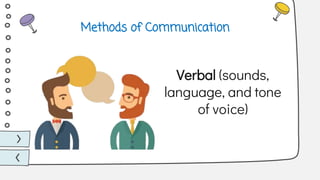
Verbal (sounds,
language, and tone
of voice)
Methods of Communication
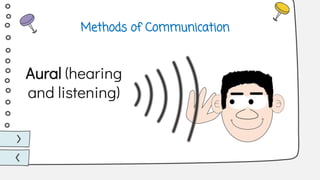
Aural (hearing
and listening)
Methods of Communication
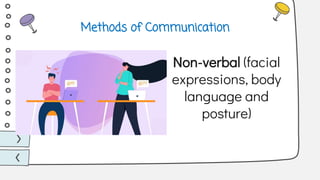
Non-verbal (facial
expressions, body
language and
posture)
Methods of Communication
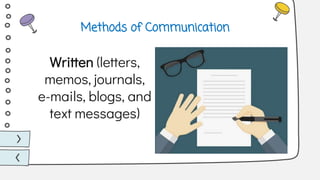
Written (letters,
memos, journals,
e-mails, blogs, and
text messages)
Methods of Communication
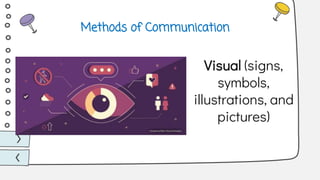
Visual (signs,
symbols,
illustrations, and
pictures)
Methods of Communication
● Include all that we use in both
communicating with others and
interpreting the information received
from others.
Tools in Communication
● They range from language in all its forms from
the tone of voice to performing, reenacting,
television, storytelling, telephone, cell phones,
movie, radio, photographs, cartoon,
cyberspace, digital and social platforms, and
the internet.
Tools in Communication
Government Setting
• Deals with citizens and particularly
delivers social and public services that
ensure peaceful and orderly living
• More of public to government and
government to public
Government Setting
• The government communicates to
inform the public about national plans,
public services, security situation,
opportunities, and give general direction
to people as a nation
Government Setting
• Varied communication tools and
methods depending on the subject and
intent
• Transition from mass media to new
technological tools
Private Sectors Setting
• Business community; job creation and
employment provision but not part of the
government
• Communication for them is largely
advertisement to inform the audience
about available goods and services
Private Sectors Setting
• They need information from the public to
understand the demand they have to
supply
• Corporate social responsibility is
important to foster the goal of
maintaining a positive public perception
Civil Society Setting
• Third force
• It comes to complement government
and business action
• Communication is defined by the
mission and actions chosen by the civil
society
Civil Society Setting
• They can draw all forms of tools
available in communication
• They are using new and social media to
bring their case to a wide audience
possible and effectively
School Setting
• Schools are educational and social
institution
• Communication in this setting tends to
be very formal and academic
• Learning beyond confines of physical
schools
School Setting
• Exchange of information and documents
among students; from traditional to
virtual
• Teaching and learning pedagogies are
affected to fever a highly personalized
and learner-centered style
Community Setting
• It is where all sectors interact
• Communication in this setting has
tended to favor a one-directional pattern
of mass media
Community Setting
• Sectors of community announce their
offering to the wider community, and
government agencies inform community
in this fashion regarding what they want
the community to know
Community Setting
• Various tools and methods are
appropriately drawn to achieve
community setting communication goals
• Face-to-face, tarpaulins, graffiti
● If you were a professional communicator,
what setting would you choose? Why?
● Describe the processes, methods, and
tools you expect to be in your chosen
setting.
SDL
Create an advocacy
campaign poster or
infographic on the
importance of
effective
communication.

Lesson 15 The Settings, Processes, and Tools in Communication.pptx

  • 1.
  • 2.
    PROCESSING OF SDL •Analyze the Case of Mary Jane Veloso https://youtu.be/jM_ilO1UjZs and assess how communication takes place in different clienteles and audiences. • Juvin (individual as a client); Lei (group or community as a client) • You may also read related articles about the topic.
  • 3.
    THE INDIVIDUAL ASCLIENT • Barriers need to be managed • One has to have a way to overcome them to achieve effective communication
  • 4.
    GROUP AND ORGANIZATION ASCLIENT • They have communication needs that are specific to them
  • 5.
    COMMUNITY AS CLIENT •Message has to be responsive to the need and the channel has to be appropriate, and the subject to be communicated has to be relevant to the community
  • 6.
    Life Performance Outcome Iam a conscientious, adept performer and achiever, competently pursuing my mission in life.
  • 7.
    Essential Performance Outcome Devotefocused time to developing the competencies required for sound achievement in a chosen field and for functioning effectively in the face of life’s diverse challenges.
  • 8.
    Intended Learning Outcome Devotefocused time to describe and discuss the processes and methods of communication by analyzing the different settings.
  • 9.
    Lesson 15 The Settings, Processes,and Tools in Communication 01 02 03
  • 10.
    Engage What is your preferredmethod of sending communication or expressing your opinions? What is your preferred method of receiving communication? If you were to lead, how would you want others to communicate with you?
  • 11.
    The physical surroundingof a communication event which may be made up of the location where the communication occurs, environmental conditions, time of the day, or day of the week, as well as the proximity of the communicators. Setting of Communication
  • 12.
    Verbal (sounds, language, andtone of voice) Methods of Communication
  • 13.
  • 14.
    Non-verbal (facial expressions, body languageand posture) Methods of Communication
  • 15.
    Written (letters, memos, journals, e-mails,blogs, and text messages) Methods of Communication
  • 16.
  • 17.
    ● Include allthat we use in both communicating with others and interpreting the information received from others. Tools in Communication
  • 18.
    ● They rangefrom language in all its forms from the tone of voice to performing, reenacting, television, storytelling, telephone, cell phones, movie, radio, photographs, cartoon, cyberspace, digital and social platforms, and the internet. Tools in Communication
  • 19.
    Government Setting • Dealswith citizens and particularly delivers social and public services that ensure peaceful and orderly living • More of public to government and government to public
  • 20.
    Government Setting • Thegovernment communicates to inform the public about national plans, public services, security situation, opportunities, and give general direction to people as a nation
  • 21.
    Government Setting • Variedcommunication tools and methods depending on the subject and intent • Transition from mass media to new technological tools
  • 22.
    Private Sectors Setting •Business community; job creation and employment provision but not part of the government • Communication for them is largely advertisement to inform the audience about available goods and services
  • 23.
    Private Sectors Setting •They need information from the public to understand the demand they have to supply • Corporate social responsibility is important to foster the goal of maintaining a positive public perception
  • 24.
    Civil Society Setting •Third force • It comes to complement government and business action • Communication is defined by the mission and actions chosen by the civil society
  • 25.
    Civil Society Setting •They can draw all forms of tools available in communication • They are using new and social media to bring their case to a wide audience possible and effectively
  • 26.
    School Setting • Schoolsare educational and social institution • Communication in this setting tends to be very formal and academic • Learning beyond confines of physical schools
  • 27.
    School Setting • Exchangeof information and documents among students; from traditional to virtual • Teaching and learning pedagogies are affected to fever a highly personalized and learner-centered style
  • 28.
    Community Setting • Itis where all sectors interact • Communication in this setting has tended to favor a one-directional pattern of mass media
  • 29.
    Community Setting • Sectorsof community announce their offering to the wider community, and government agencies inform community in this fashion regarding what they want the community to know
  • 30.
    Community Setting • Varioustools and methods are appropriately drawn to achieve community setting communication goals • Face-to-face, tarpaulins, graffiti
  • 31.
    ● If youwere a professional communicator, what setting would you choose? Why? ● Describe the processes, methods, and tools you expect to be in your chosen setting.
  • 32.
    SDL Create an advocacy campaignposter or infographic on the importance of effective communication.