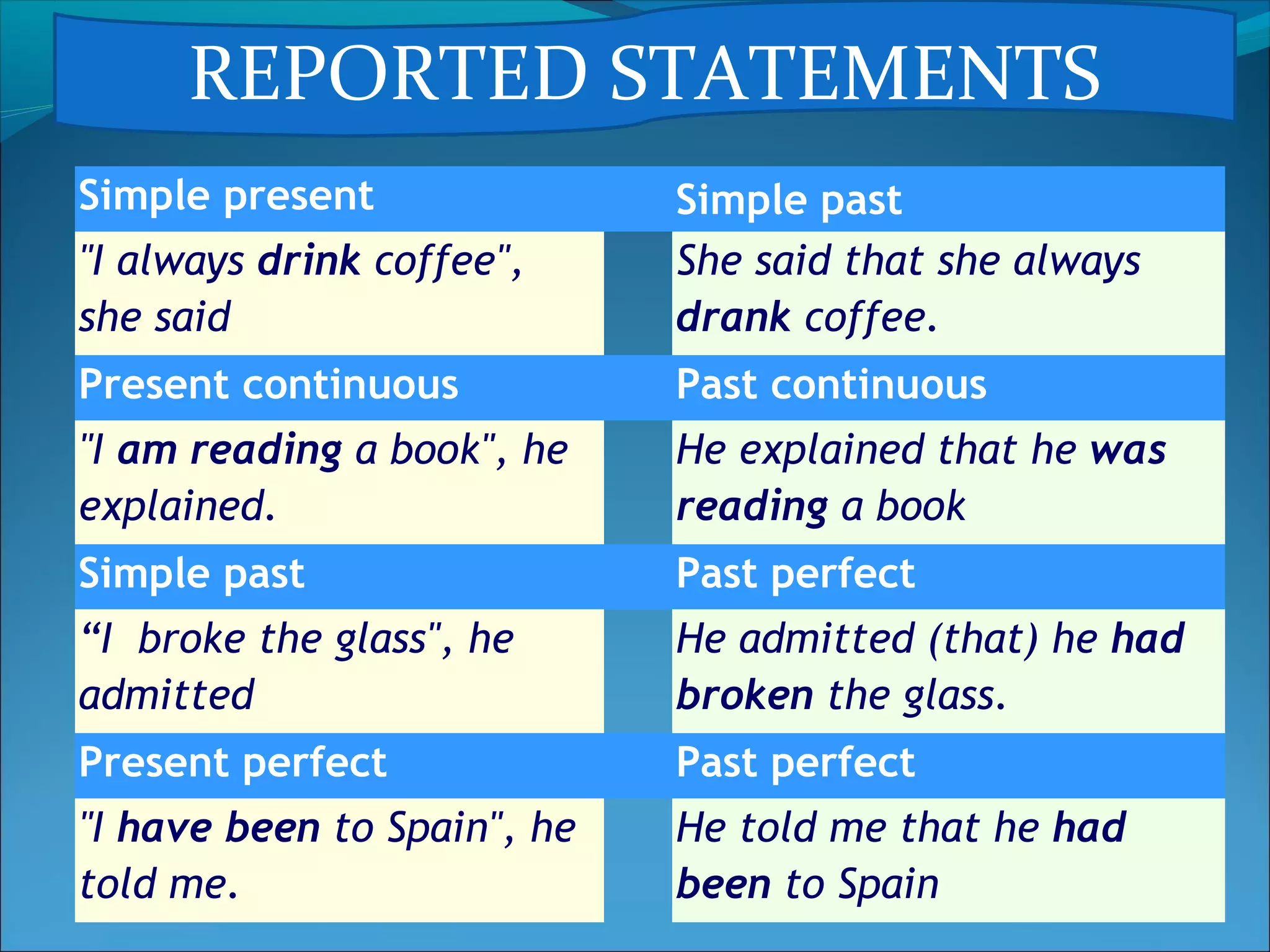
Simple present Simple past
"I always drink coffee",
she said
She said that she always
drank coffee.
Present continuous Past continuous
"I am reading a book", he
explained.
He explained that he was
reading a book
Simple past Past perfect
“I broke the glass", he
admitted
He admitted (that) he had
broken the glass.
Present perfect Past perfect
"I have been to Spain", he
told me.
He told me that he had
been to Spain
REPORTED STATEMENTS
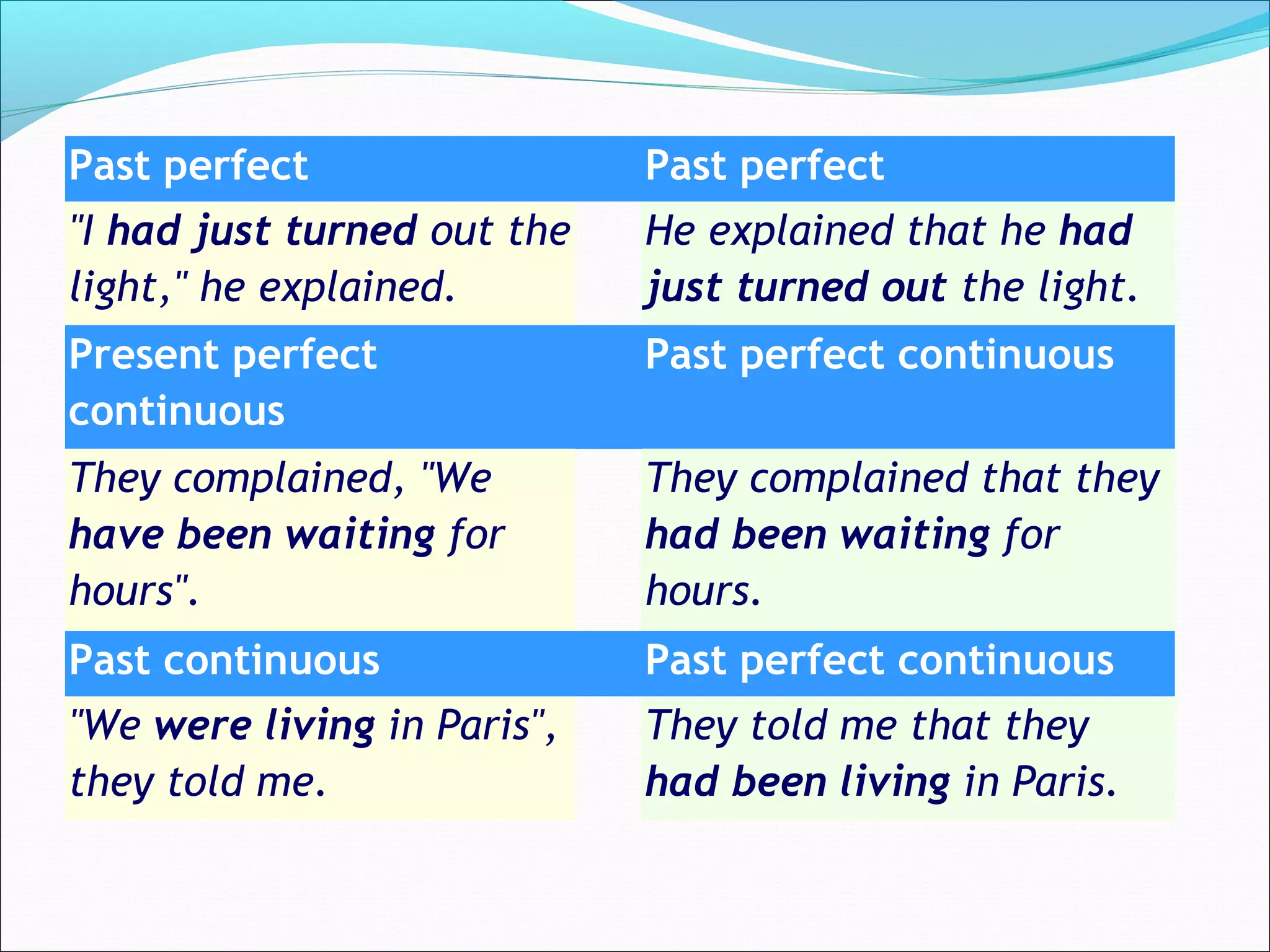
Past perfect Past perfect
"I had just turned out the
light," he explained.
He explained that he had
just turned out the light.
Present perfect
continuous
Past perfect continuous
They complained, "We
have been waiting for
hours".
They complained that they
had been waiting for
hours.
Past continuous Past perfect continuous
"We were living in Paris",
they told me.
They told me that they
had been living in Paris.
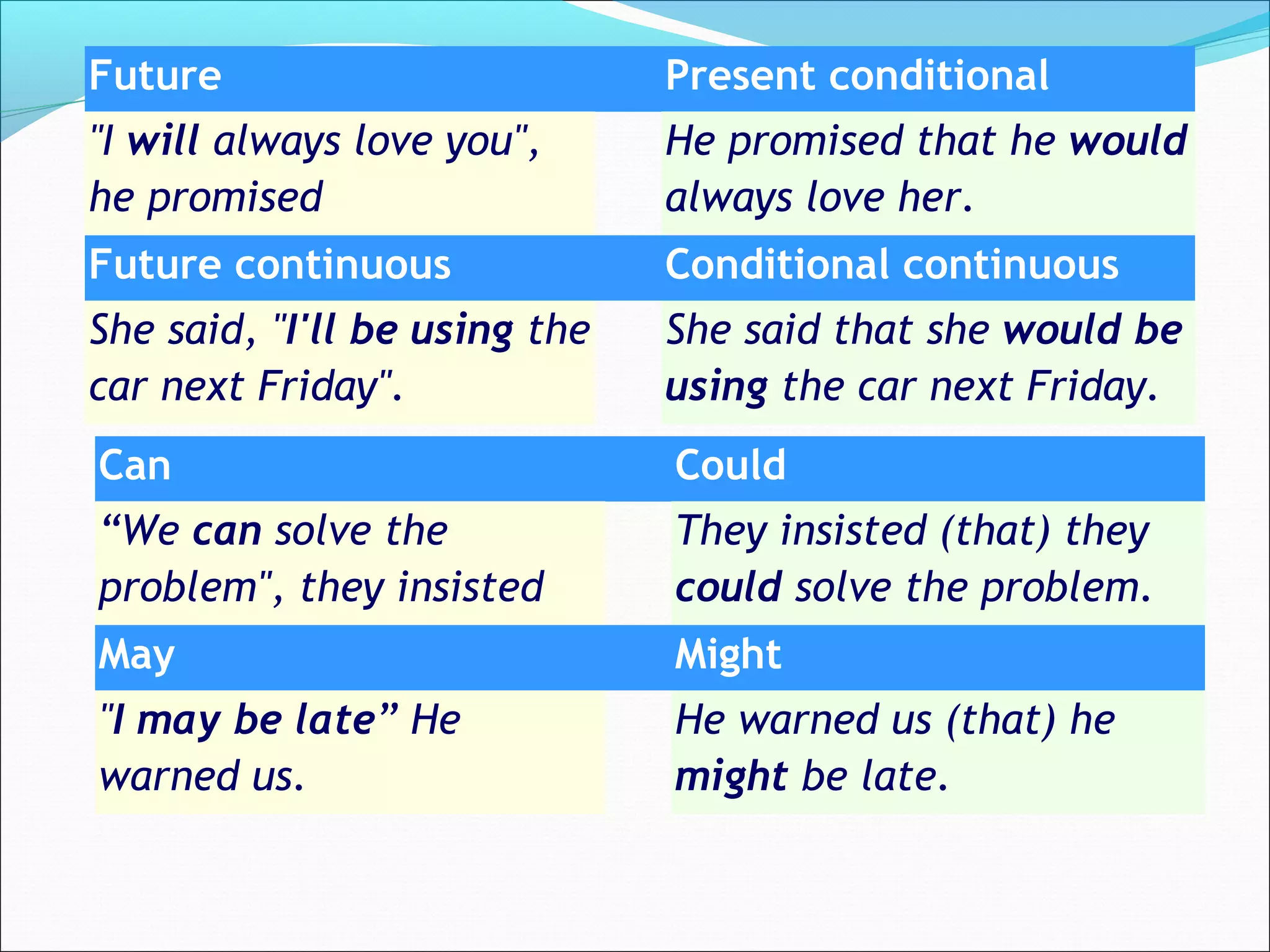
Future Present conditional
"I will always love you",
he promised
He promised that he would
always love her.
Future continuous Conditional continuous
She said, "I'll be using the
car next Friday".
She said that she would be
using the car next Friday.
Can Could
“We can solve the
problem", they insisted
They insisted (that) they
could solve the problem.
May Might
"I may be late” He
warned us.
He warned us (that) he
might be late.
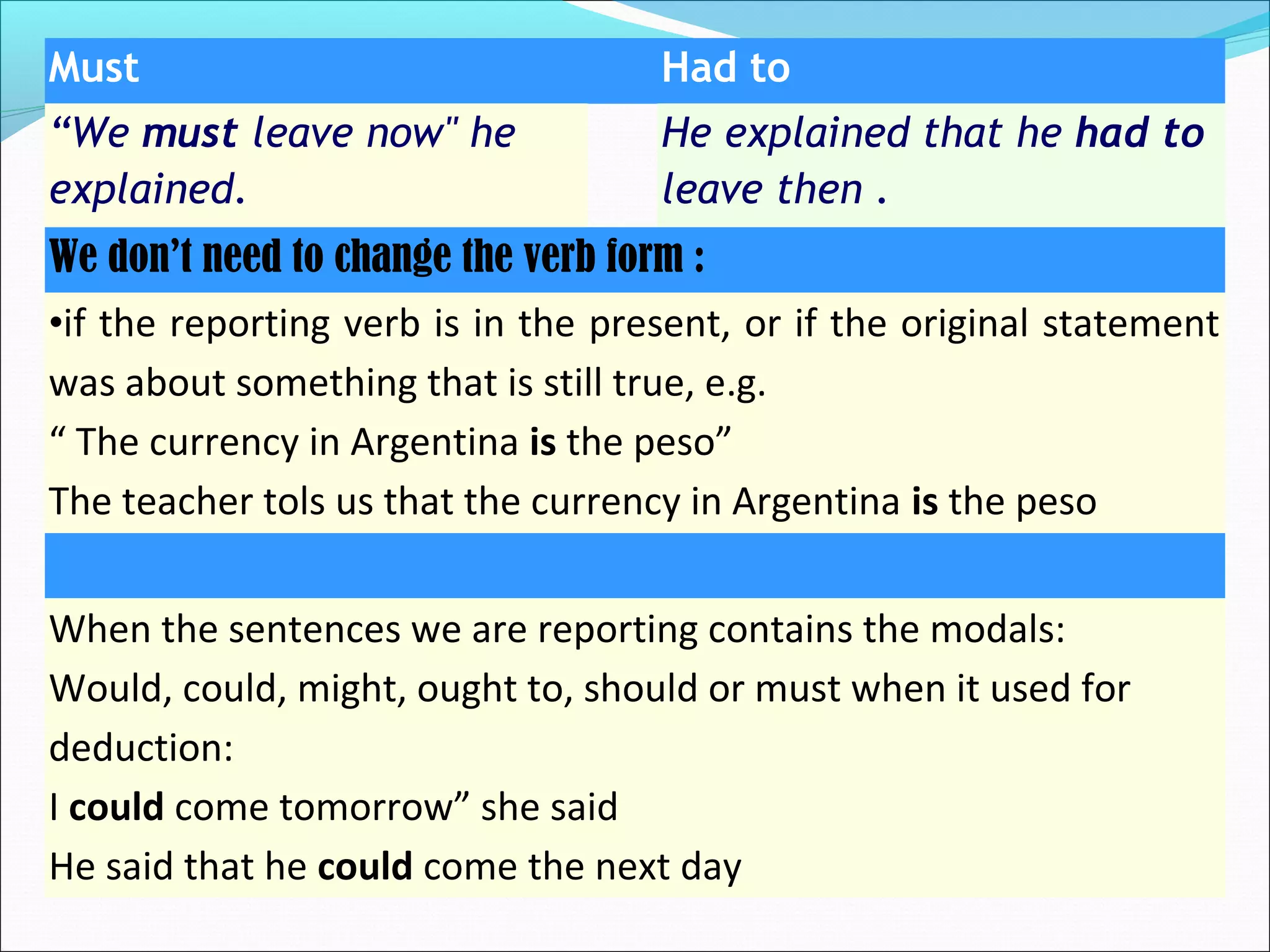
Must Had to
“We must leave now" he
explained.
He explained that he had to
leave then .
We don’t need to change the verb form :
•if the reporting verb is in the present, or if the original statement
was about something that is still true, e.g.
“ The currency in Argentina is the peso”
The teacher tols us that the currency in Argentina is the peso
When the sentences we are reporting contains the modals:
Would, could, might, ought to, should or must when it used for
deduction:
I could come tomorrow” she said
He said that he could come the next day
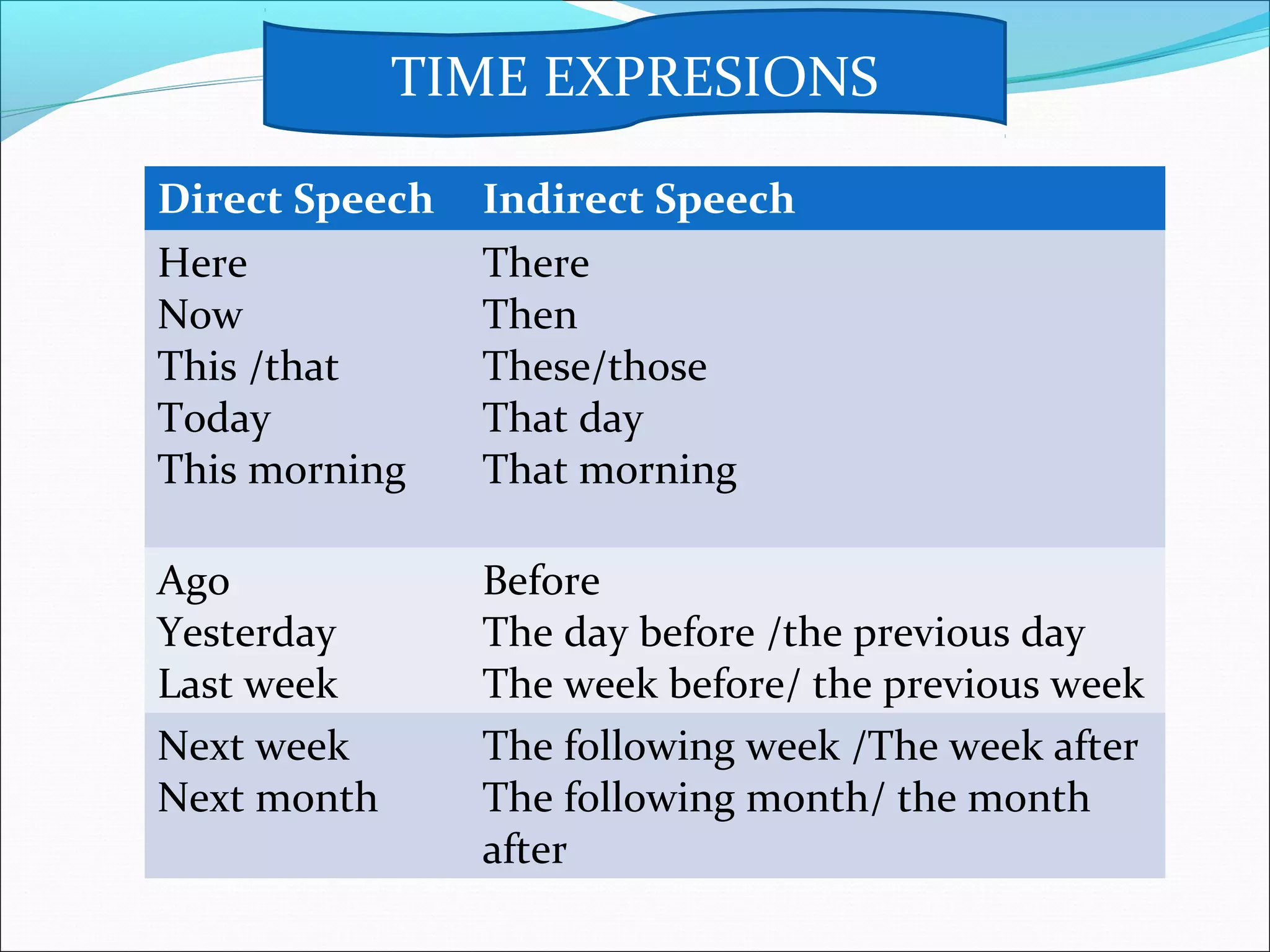
Direct Speech Indirect Speech
Here
Now
This /that
Today
This morning
There
Then
These/those
That day
That morning
Ago
Yesterday
Last week
Before
The day before /the previous day
The week before/ the previous week
Next week
Next month
The following week /The week after
The following month/ the month
after
TIME EXPRESIONS
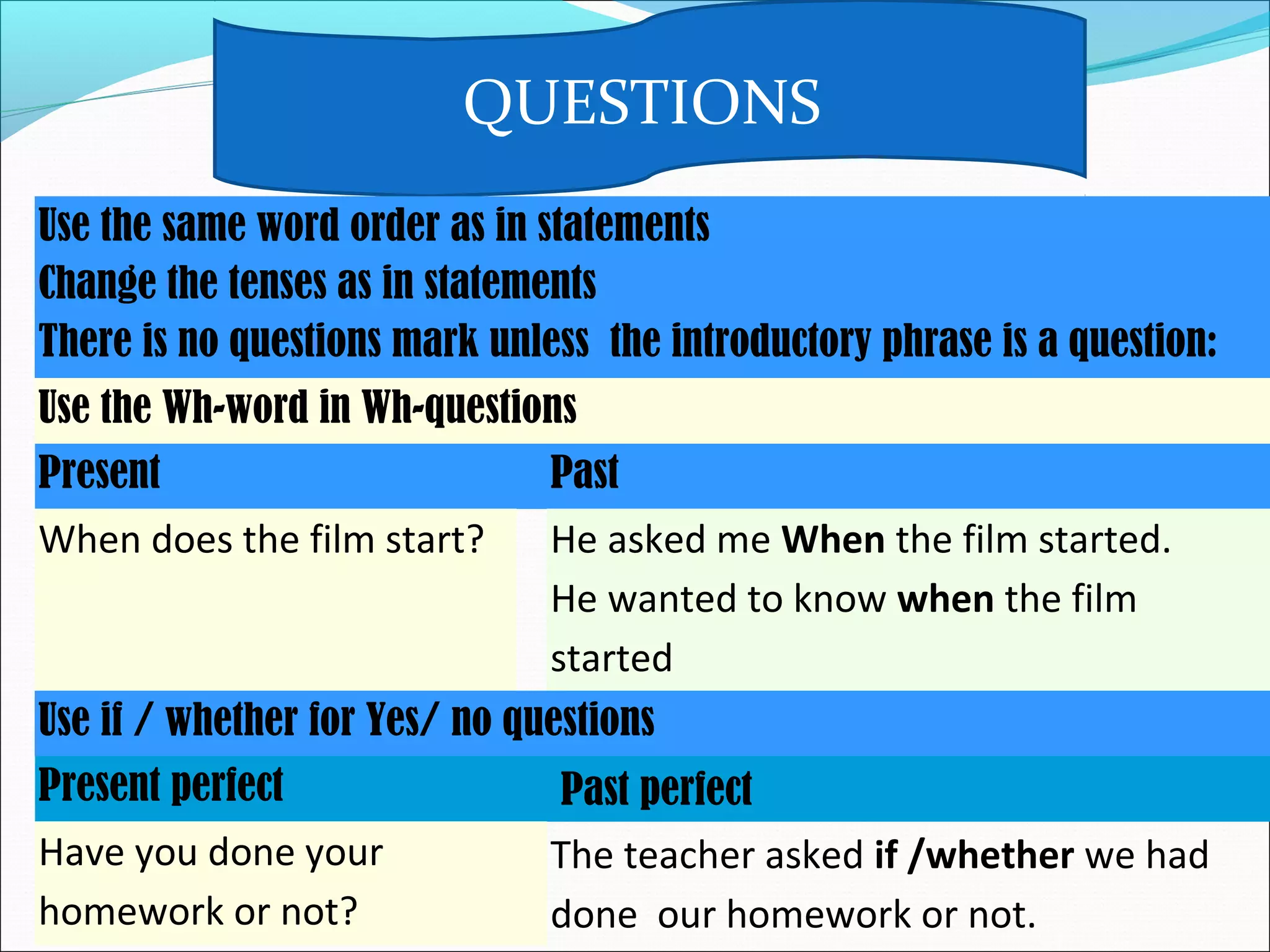
QUESTIONS
Use the same word order as in statements
Change the tenses as in statements
There is no questions mark unless the introductory phrase is a question:
Use the Wh-word in Wh-questions 
Present Past
When does the film start?
 
He asked me When the film started.
He wanted to know when the film
started
Use if / whether for Yes/ no questions
Present perfect  Past perfect
Have you done your
homework or not?
The teacher asked if /whether we had
done our homework or not.
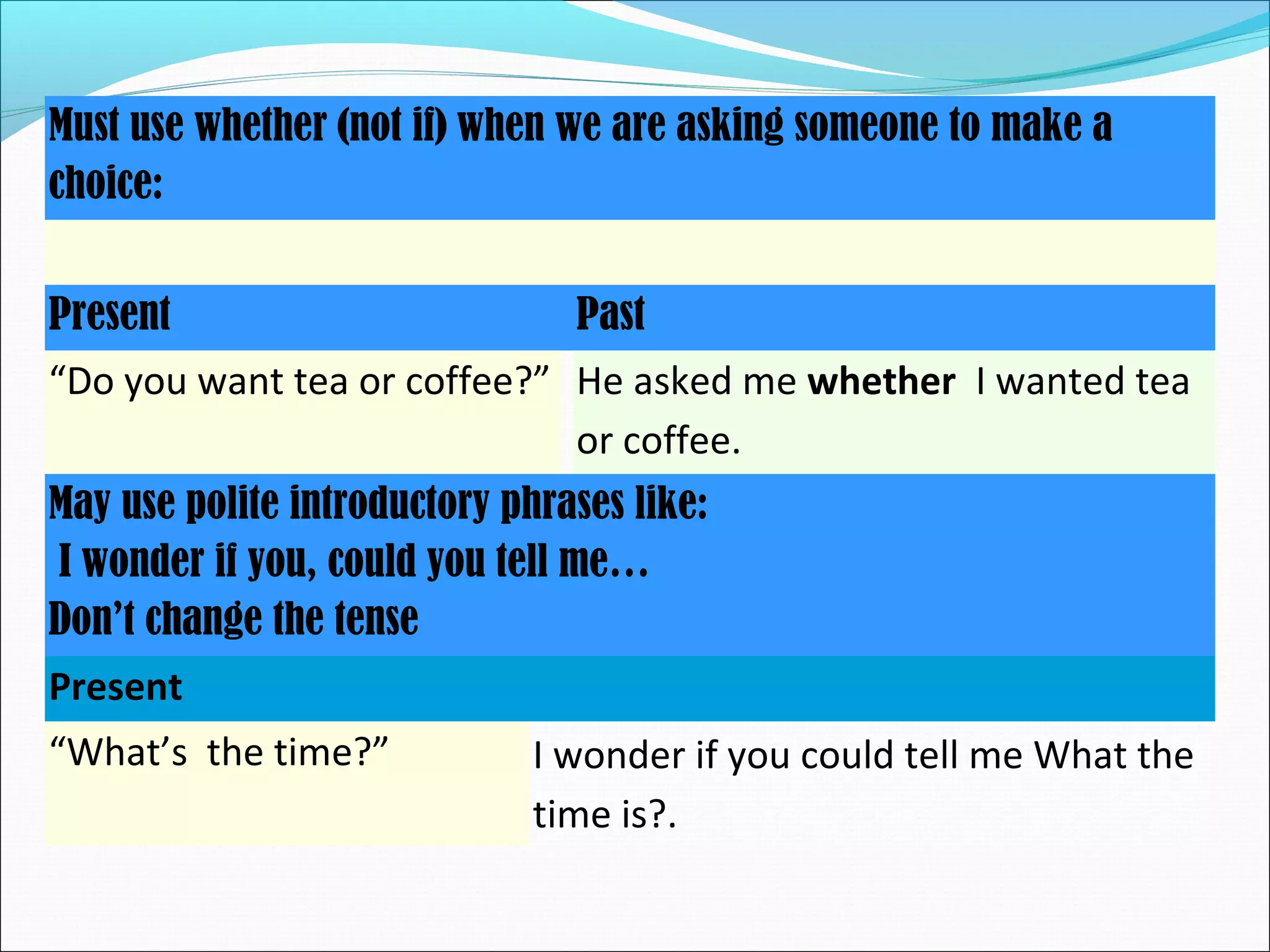
Must use whether (not if) when we are asking someone to make a
choice:
Present Past
“Do you want tea or coffee?”
 
He asked me whether I wanted tea
or coffee.
May use polite introductory phrases like:
I wonder if you, could you tell me…
Don’t change the tense
Present
“What’s the time?” I wonder if you could tell me What the
time is?.
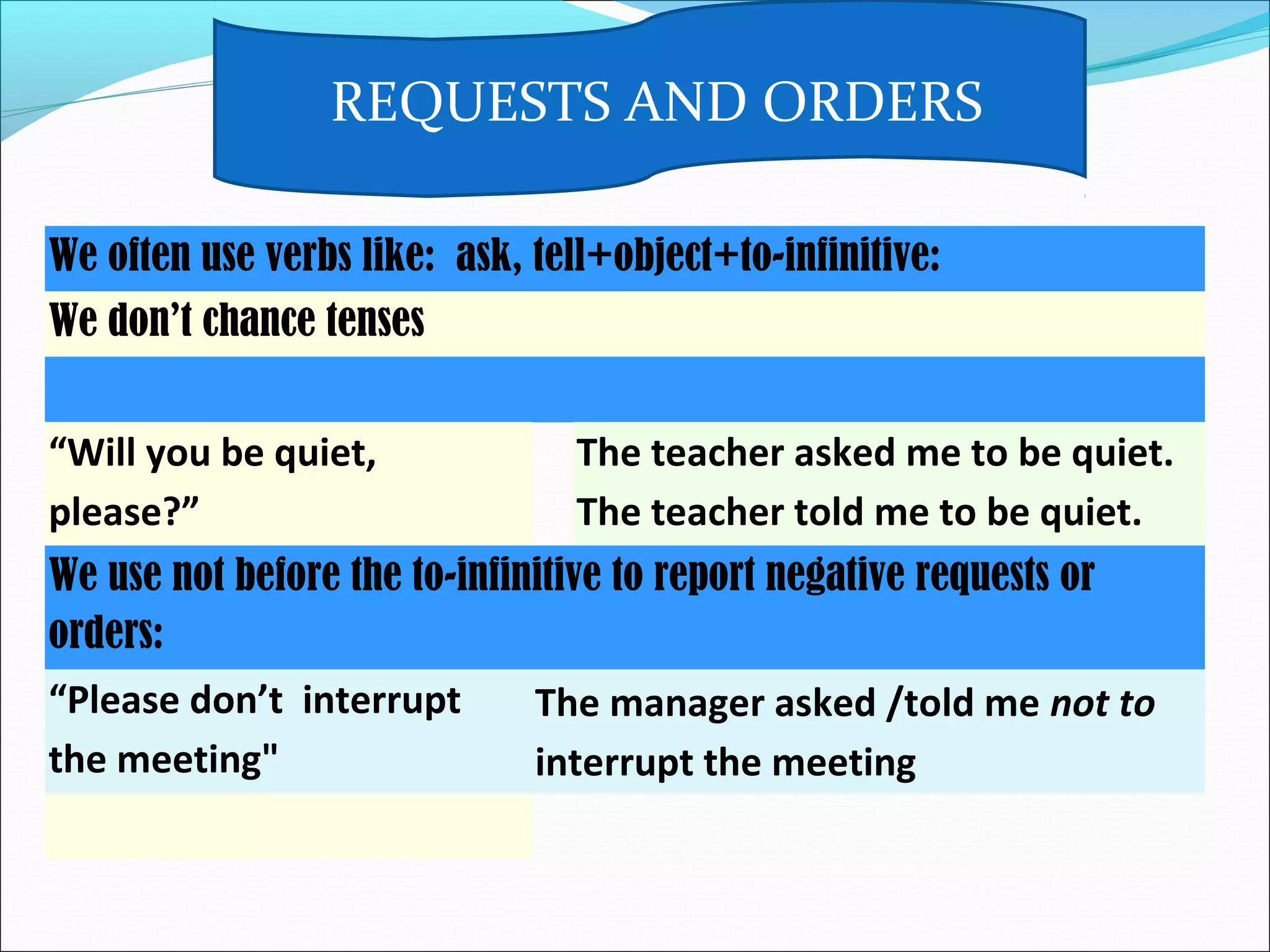
REQUESTS AND ORDERS
We often use verbs like: ask, tell+object+to-infinitive:
We don’t chance tenses
“Will you be quiet,
please?”
The teacher asked me to be quiet.
The teacher told me to be quiet.
We use not before the to-infinitive to report negative requests or
orders:
“Please don’t interrupt
the meeting"
The manager asked /told me not to
interrupt the meeting
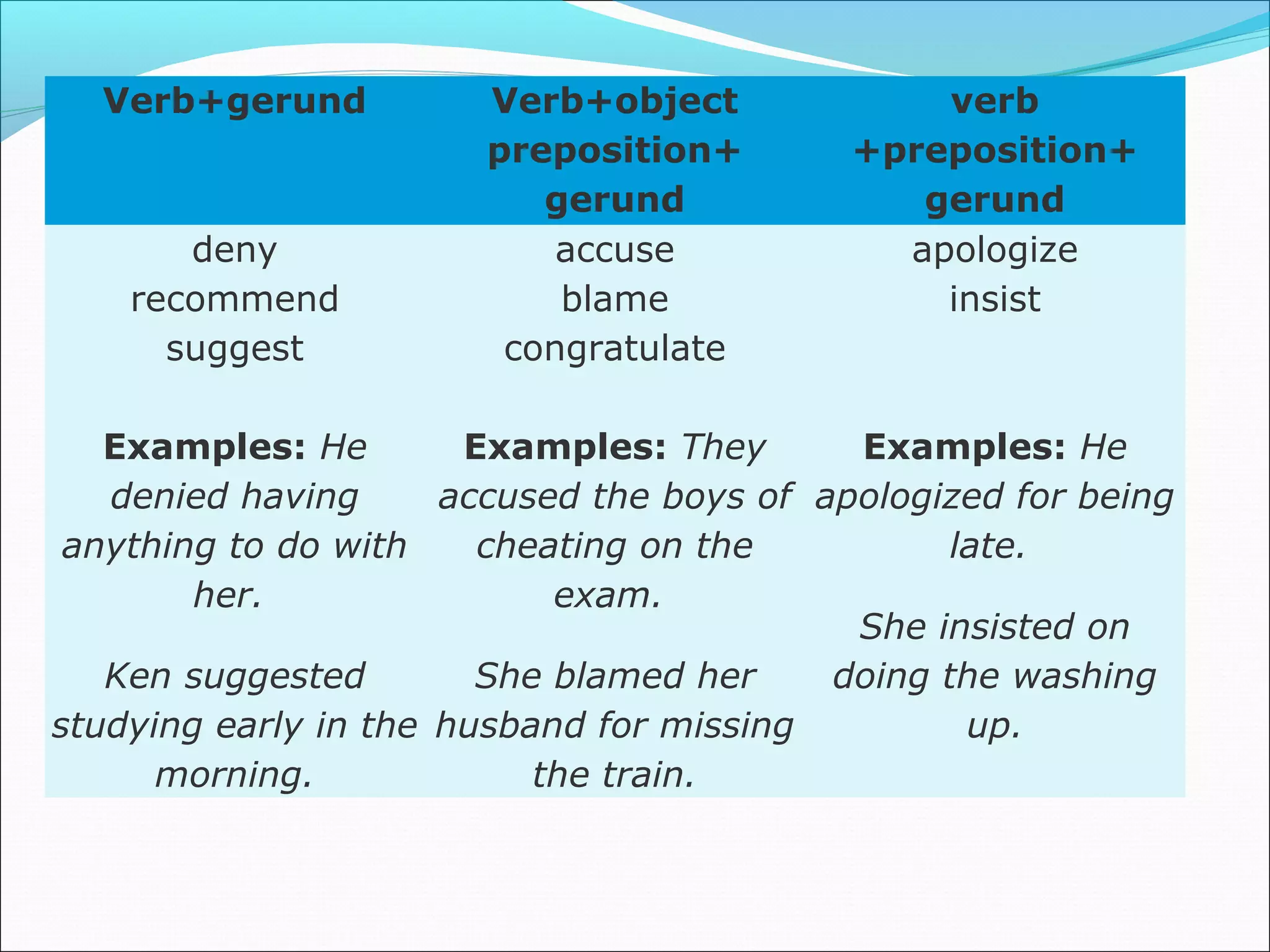
Verb+gerund Verb+object
preposition+
gerund
verb
+preposition+
gerund
deny
recommend
suggest
accuse
blame
congratulate
apologize
insist
Examples: He
denied having
anything to do with
her.
Ken suggested
studying early in the
morning.
Examples: They
accused the boys of
cheating on the
exam.
She blamed her
husband for missing
the train.
Examples: He
apologized for being
late.
She insisted on
doing the washing
up.
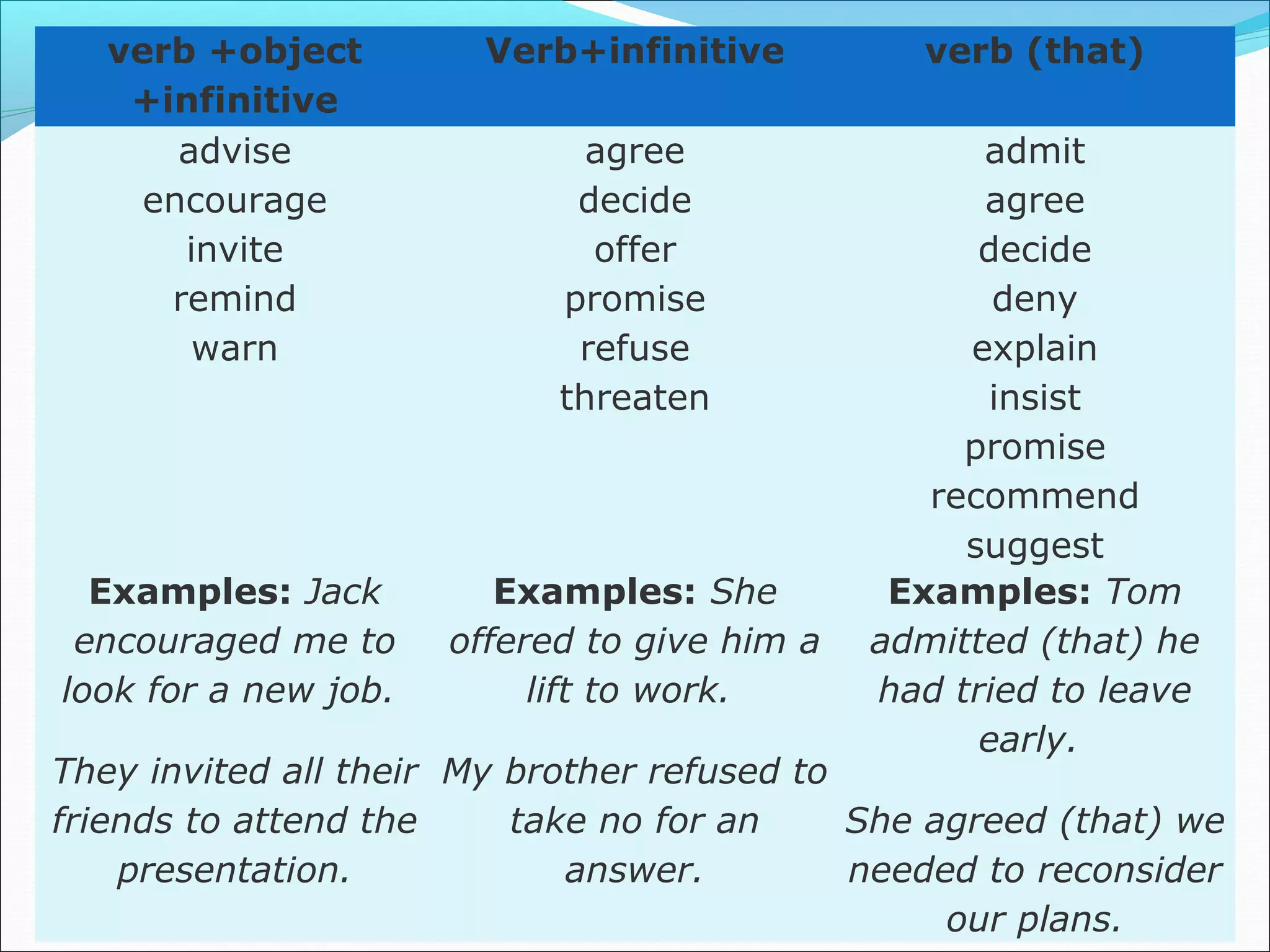
verb +object
+infinitive
Verb+infinitive verb (that)
advise
encourage
invite
remind
warn
agree
decide
offer
promise
refuse
threaten
admit
agree
decide
deny
explain
insist
promise
recommend
suggest
Examples: Jack
encouraged me to
look for a new job.
They invited all their
friends to attend the
presentation.
Examples: She
offered to give him a
lift to work.
My brother refused to
take no for an
answer.
Examples: Tom
admitted (that) he
had tried to leave
early.
She agreed (that) we
needed to reconsider
our plans.
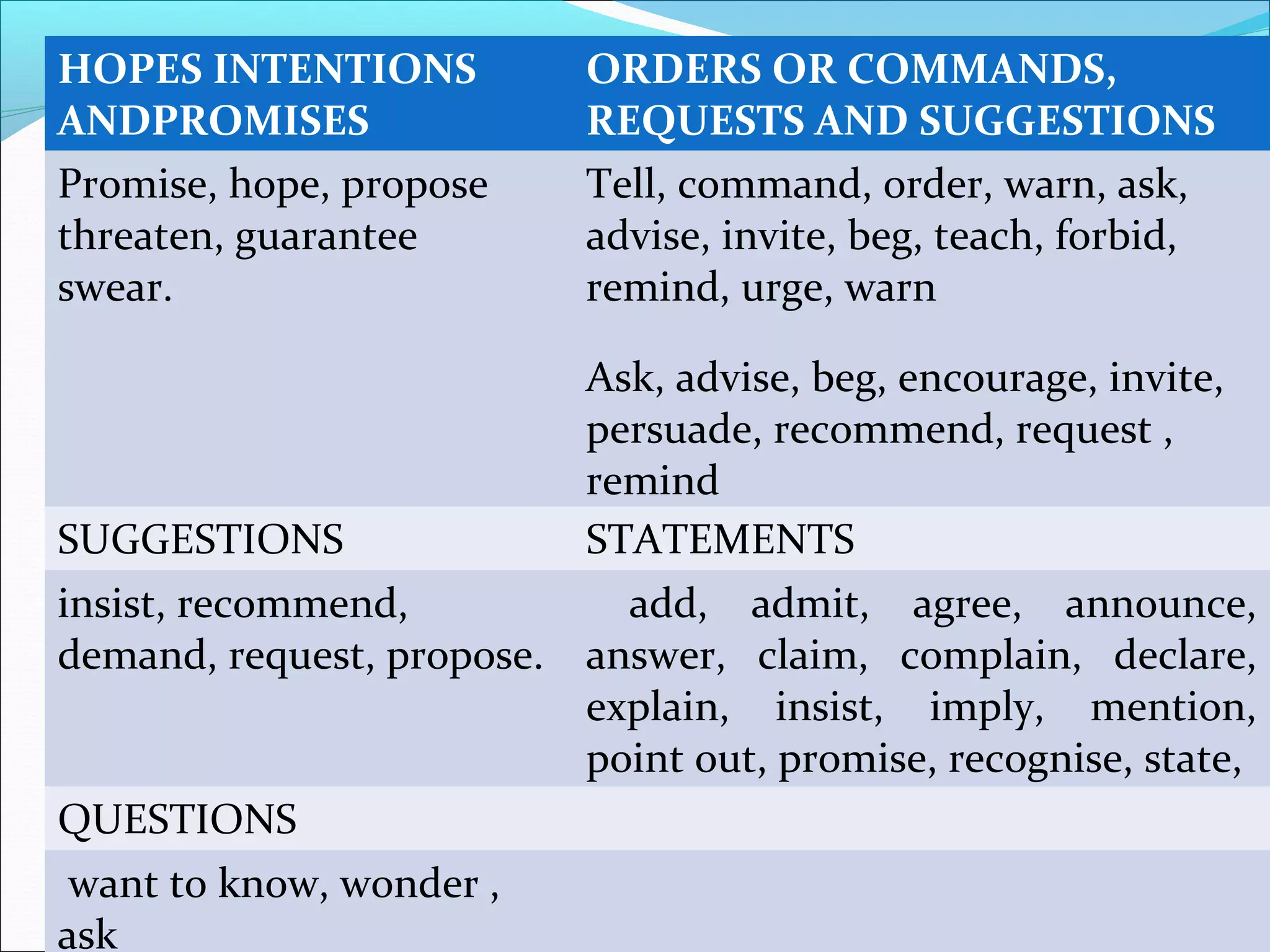
HOPES INTENTIONS
ANDPROMISES
ORDERS OR COMMANDS,
REQUESTS AND SUGGESTIONS
Promise, hope, propose
threaten, guarantee
swear.
Tell, command, order, warn, ask,
advise, invite, beg, teach, forbid,
remind, urge, warn
Ask, advise, beg, encourage, invite,
persuade, recommend, request ,
remind
SUGGESTIONS STATEMENTS
insist, recommend,
demand, request, propose.
add, admit, agree, announce,
answer, claim, complain, declare,
explain, insist, imply, mention,
point out, promise, recognise, state,
QUESTIONS
want to know, wonder ,
ask
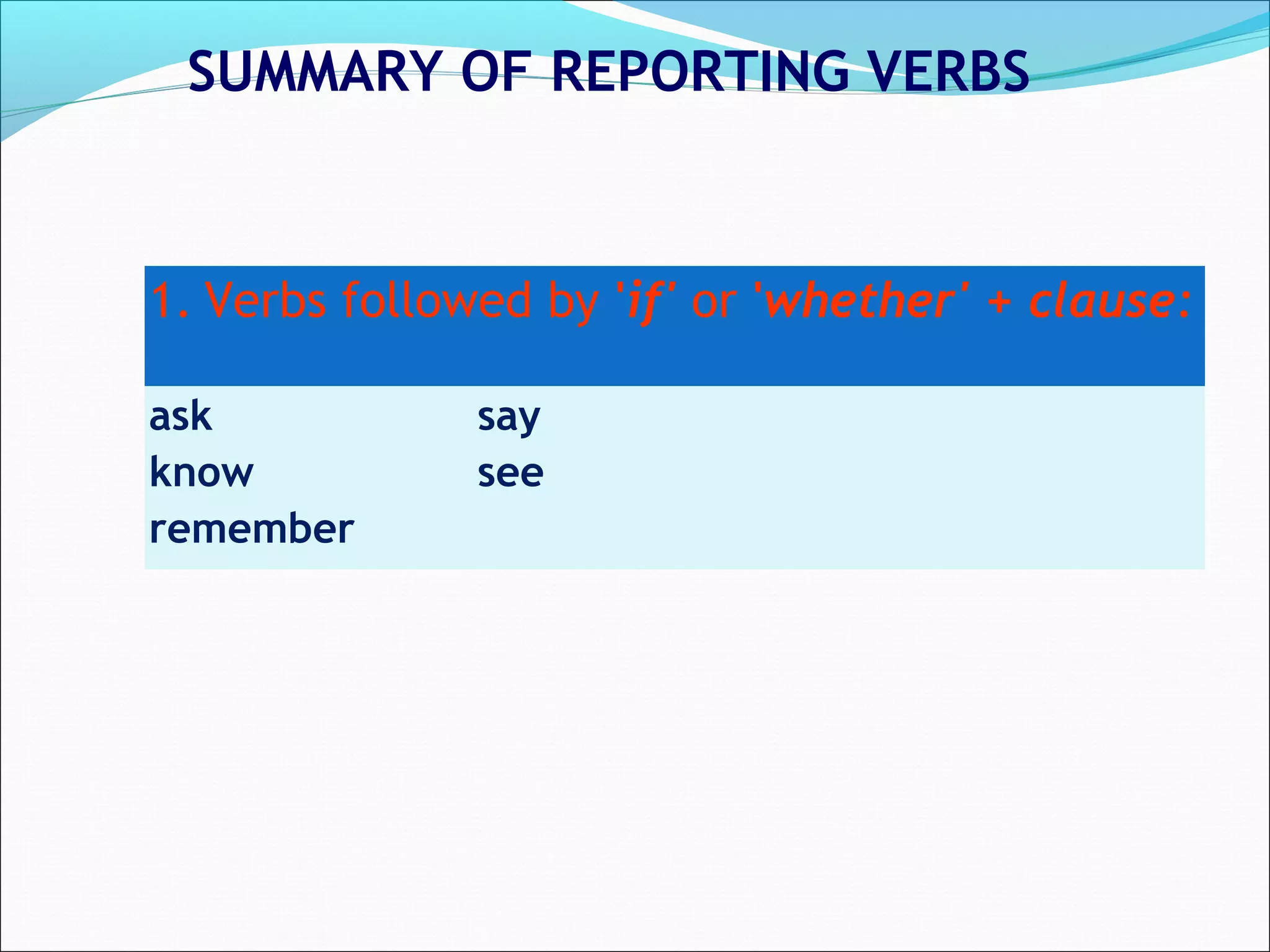
1. Verbs followed by 'if' or 'whether' + clause:
ask
know
remember
say
see
SUMMARY OF REPORTING VERBS
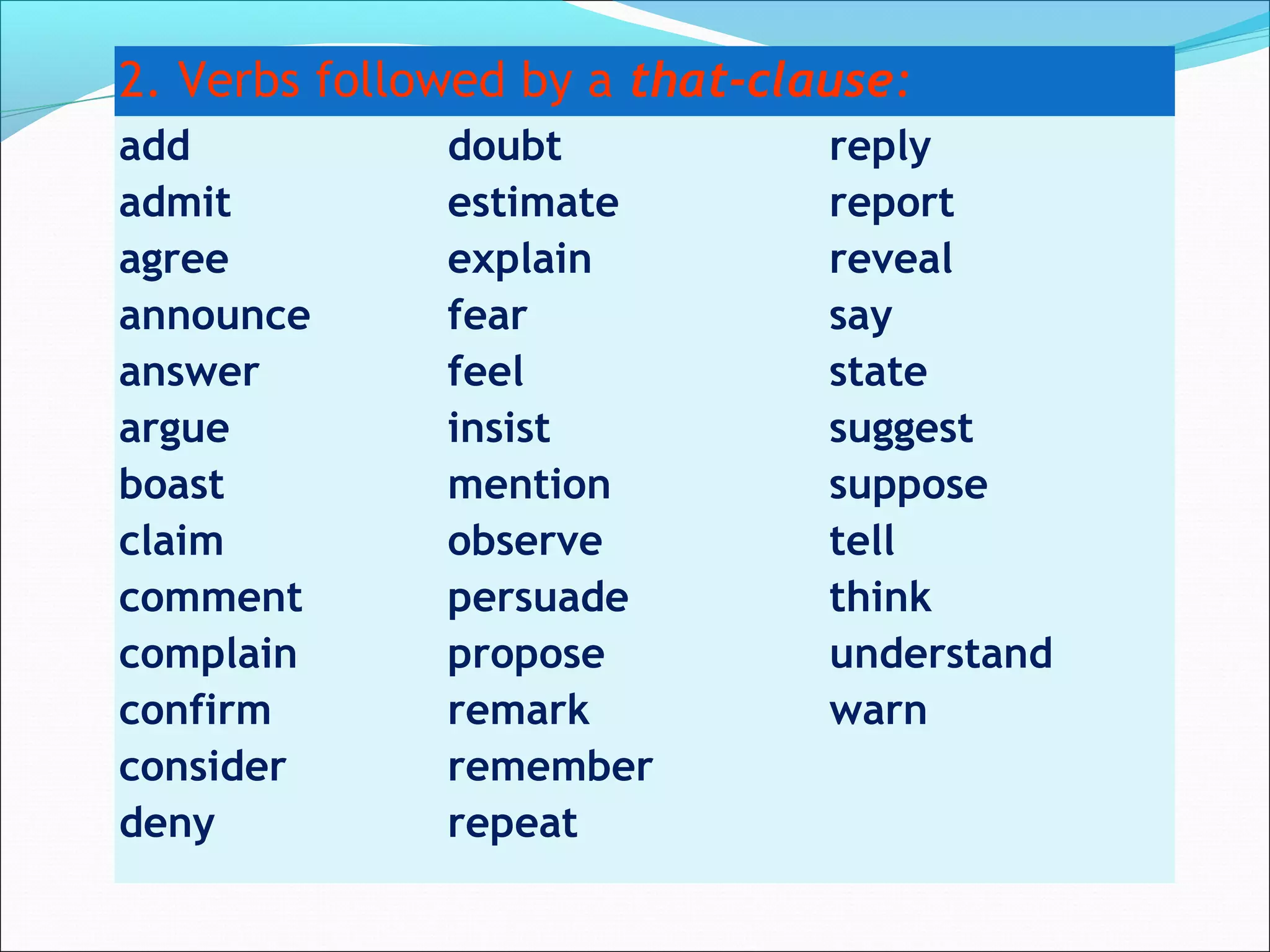
2. Verbs followed by a that-clause:
add
admit
agree
announce
answer
argue
boast
claim
comment
complain
confirm
consider
deny
doubt
estimate
explain
fear
feel
insist
mention
observe
persuade
propose
remark
remember
repeat
reply
report
reveal
say
state
suggest
suppose
tell
think
understand
warn
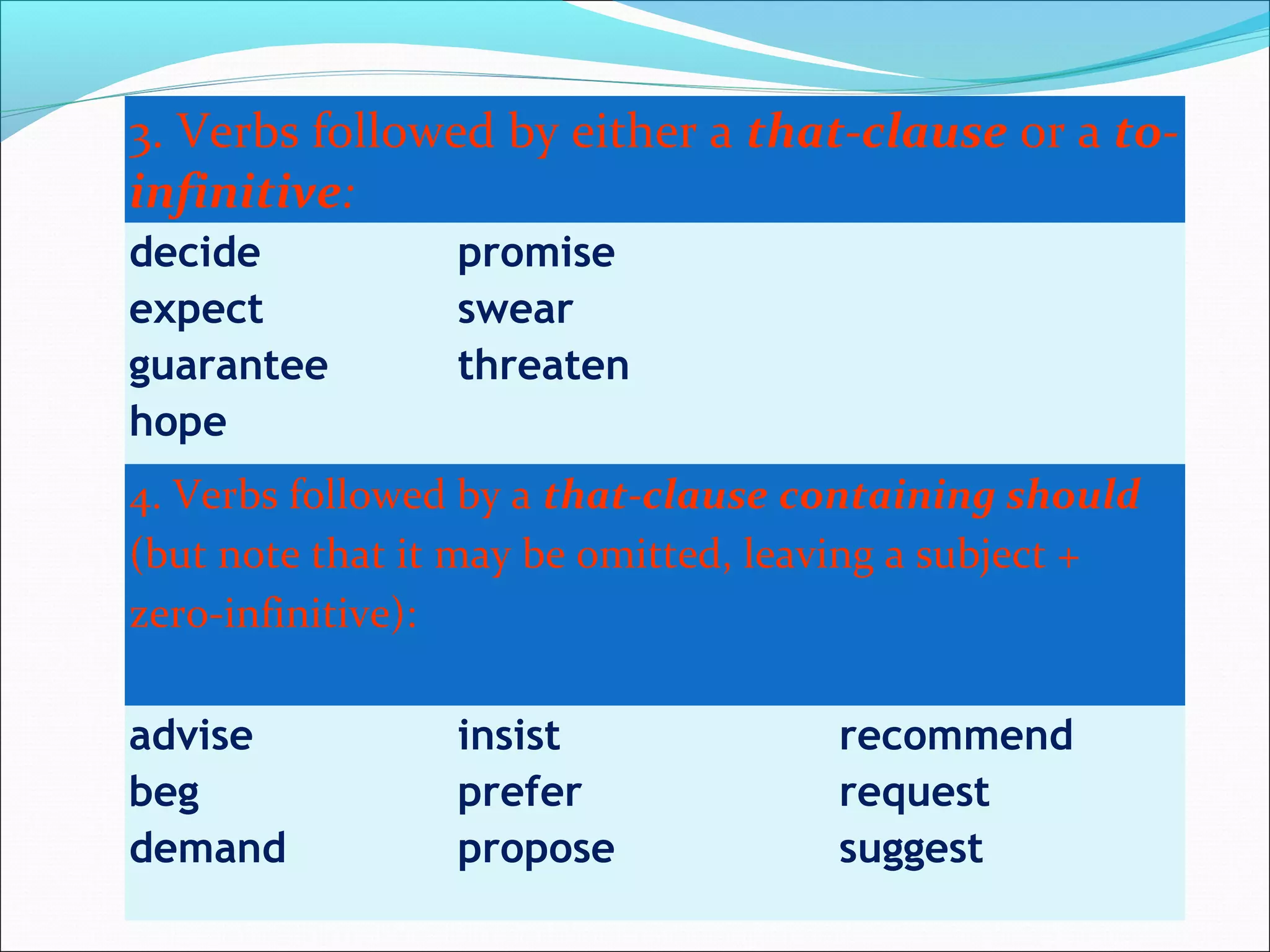
3. Verbs followed by either a that-clause or a to-
infinitive:
decide
expect
guarantee
hope
promise
swear
threaten
4. Verbs followed by a that-clause containing should
(but note that it may be omitted, leaving a subject +
zero-infinitive):
advise
beg
demand
insist
prefer
propose
recommend
request
suggest
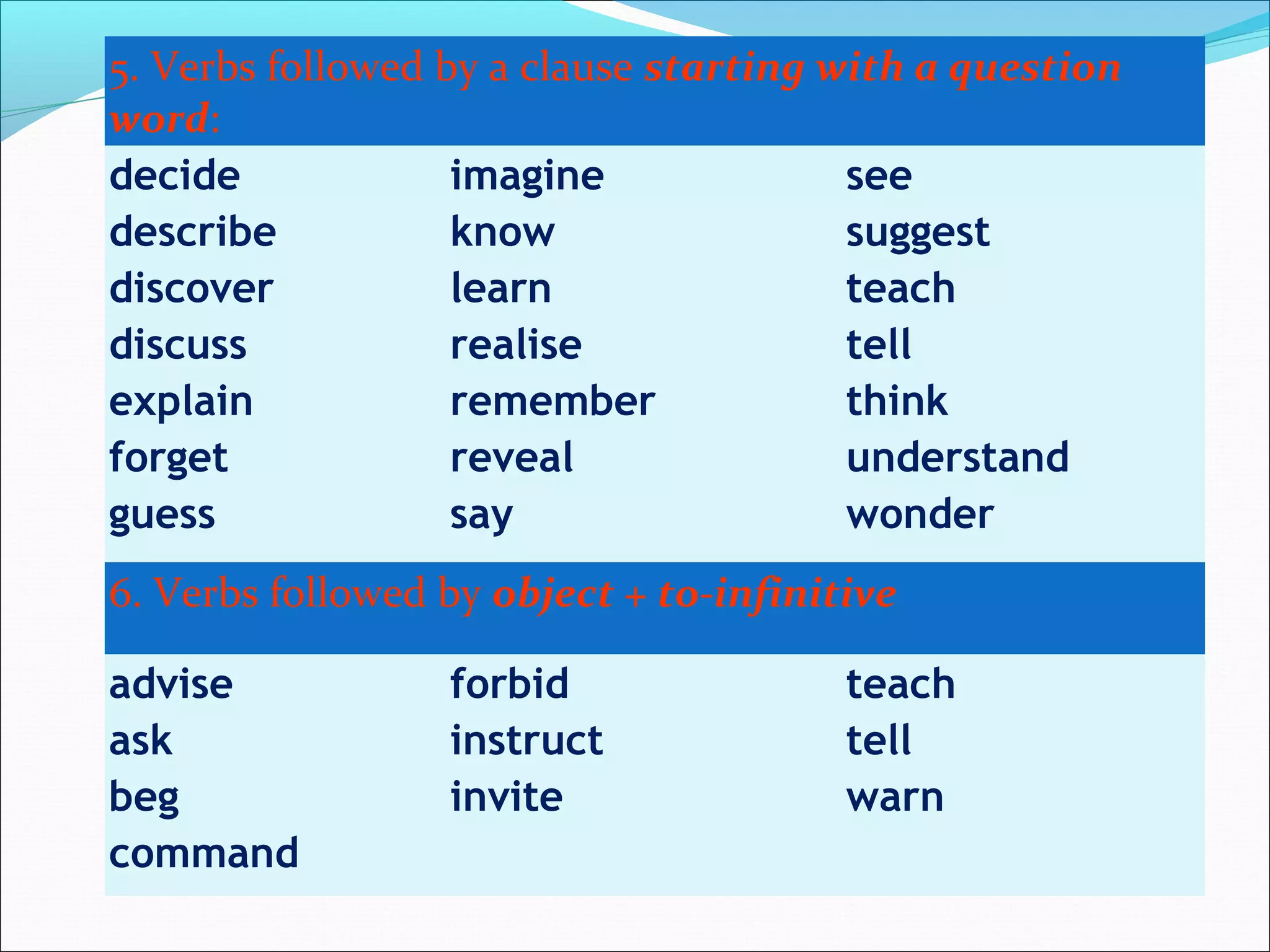
5. Verbs followed by a clause starting with a question
word:
decide
describe
discover
discuss
explain
forget
guess
imagine
know
learn
realise
remember
reveal
say
see
suggest
teach
tell
think
understand
wonder
6. Verbs followed by object + to-infinitive
advise
ask
beg
command
forbid
instruct
invite
teach
tell
warn

Reportedspeech

  • 1.
    Simple present Simplepast "I always drink coffee", she said She said that she always drank coffee. Present continuous Past continuous "I am reading a book", he explained. He explained that he was reading a book Simple past Past perfect “I broke the glass", he admitted He admitted (that) he had broken the glass. Present perfect Past perfect "I have been to Spain", he told me. He told me that he had been to Spain REPORTED STATEMENTS
  • 2.
    Past perfect Pastperfect "I had just turned out the light," he explained. He explained that he had just turned out the light. Present perfect continuous Past perfect continuous They complained, "We have been waiting for hours". They complained that they had been waiting for hours. Past continuous Past perfect continuous "We were living in Paris", they told me. They told me that they had been living in Paris.
  • 3.
    Future Present conditional "Iwill always love you", he promised He promised that he would always love her. Future continuous Conditional continuous She said, "I'll be using the car next Friday". She said that she would be using the car next Friday. Can Could “We can solve the problem", they insisted They insisted (that) they could solve the problem. May Might "I may be late” He warned us. He warned us (that) he might be late.
  • 4.
    Must Had to “Wemust leave now" he explained. He explained that he had to leave then . We don’t need to change the verb form : •if the reporting verb is in the present, or if the original statement was about something that is still true, e.g. “ The currency in Argentina is the peso” The teacher tols us that the currency in Argentina is the peso When the sentences we are reporting contains the modals: Would, could, might, ought to, should or must when it used for deduction: I could come tomorrow” she said He said that he could come the next day
  • 5.
    Direct Speech IndirectSpeech Here Now This /that Today This morning There Then These/those That day That morning Ago Yesterday Last week Before The day before /the previous day The week before/ the previous week Next week Next month The following week /The week after The following month/ the month after TIME EXPRESIONS
  • 6.
    QUESTIONS Use the sameword order as in statements Change the tenses as in statements There is no questions mark unless the introductory phrase is a question: Use the Wh-word in Wh-questions  Present Past When does the film start?   He asked me When the film started. He wanted to know when the film started Use if / whether for Yes/ no questions Present perfect  Past perfect Have you done your homework or not? The teacher asked if /whether we had done our homework or not.
  • 7.
    Must use whether(not if) when we are asking someone to make a choice: Present Past “Do you want tea or coffee?”   He asked me whether I wanted tea or coffee. May use polite introductory phrases like: I wonder if you, could you tell me… Don’t change the tense Present “What’s the time?” I wonder if you could tell me What the time is?.
  • 8.
    REQUESTS AND ORDERS Weoften use verbs like: ask, tell+object+to-infinitive: We don’t chance tenses “Will you be quiet, please?” The teacher asked me to be quiet. The teacher told me to be quiet. We use not before the to-infinitive to report negative requests or orders: “Please don’t interrupt the meeting" The manager asked /told me not to interrupt the meeting
  • 9.
    Verb+gerund Verb+object preposition+ gerund verb +preposition+ gerund deny recommend suggest accuse blame congratulate apologize insist Examples: He deniedhaving anything to do with her. Ken suggested studying early in the morning. Examples: They accused the boys of cheating on the exam. She blamed her husband for missing the train. Examples: He apologized for being late. She insisted on doing the washing up.
  • 10.
    verb +object +infinitive Verb+infinitive verb(that) advise encourage invite remind warn agree decide offer promise refuse threaten admit agree decide deny explain insist promise recommend suggest Examples: Jack encouraged me to look for a new job. They invited all their friends to attend the presentation. Examples: She offered to give him a lift to work. My brother refused to take no for an answer. Examples: Tom admitted (that) he had tried to leave early. She agreed (that) we needed to reconsider our plans.
  • 11.
    HOPES INTENTIONS ANDPROMISES ORDERS ORCOMMANDS, REQUESTS AND SUGGESTIONS Promise, hope, propose threaten, guarantee swear. Tell, command, order, warn, ask, advise, invite, beg, teach, forbid, remind, urge, warn Ask, advise, beg, encourage, invite, persuade, recommend, request , remind SUGGESTIONS STATEMENTS insist, recommend, demand, request, propose. add, admit, agree, announce, answer, claim, complain, declare, explain, insist, imply, mention, point out, promise, recognise, state, QUESTIONS want to know, wonder , ask
  • 12.
    1. Verbs followedby 'if' or 'whether' + clause: ask know remember say see SUMMARY OF REPORTING VERBS
  • 13.
    2. Verbs followedby a that-clause: add admit agree announce answer argue boast claim comment complain confirm consider deny doubt estimate explain fear feel insist mention observe persuade propose remark remember repeat reply report reveal say state suggest suppose tell think understand warn
  • 14.
    3. Verbs followedby either a that-clause or a to- infinitive: decide expect guarantee hope promise swear threaten 4. Verbs followed by a that-clause containing should (but note that it may be omitted, leaving a subject + zero-infinitive): advise beg demand insist prefer propose recommend request suggest
  • 15.
    5. Verbs followedby a clause starting with a question word: decide describe discover discuss explain forget guess imagine know learn realise remember reveal say see suggest teach tell think understand wonder 6. Verbs followed by object + to-infinitive advise ask beg command forbid instruct invite teach tell warn