Reported Speech by Yolanda Giménez
DIRECT SPEECH ‘ This building will be open to the public tomorrow’, said the official. How many different ways can we use to say what someone has said?
We can give the speaker exact words in  quotation marks.””  + Direct speech We can report what the speaker said using our own words.  + Reported or indirect speech
REPORTED SPEECH The official said that the building would be open to the public the following day. What changes can you see?
Verbs Time Place words Why?
Because  time has gone by  since the words were spoken and the  people , the  place  and  the moment  have also changed. *IMPORTANT When we are reporting someone’s words, we must pay attention to the type of sentence you are reporting. How many different types  of sentences can you remember?
Statements Questions Orders Suggestions
CHANGES (1) ‘ Get out  of the way!’ The warden asked me  to get  out of the way. “ Don’t smoke  in  this   compartment’. The inspector asked me  not to smoke  in  that  compartment.  COMMANDS ‘ What time  does   the train for Fleet  leave ? He asked the porter   what   time the train for Fleet  left. INFORMATION QUESTIONS CHANGES (1) ‘ Are   you the person who   won   the prize?’ They asked me  if/whether   I was the person who  had won  the prize. YES/NO QUESTIONS CHANGES (1) “ I  spent   all my money   last week ” He told me (that) he  had spent  all his money  the week  before .   STATEMENTS REPORTED SPEECH
Statements : say, tell, shout, agree, exclaim, answer, reply, advise promise…. Questions : ask, wonder, want to know,  Commands : ask,order, command,  REPORTING VERBS the previous week / the week before the week before that those there last week a week ago this these here go then that day the day before the next/following day come Now today  yesterday  tomorrow   INDIRECT SPEECH DIRECT SPEECH INDIRECT SPEECH DIRECT SPEECH Other changes could go might go must go / had to go 4.  didn’t need to go 5.They don’t  change 1. can go  2. may go/might go 3. must go/have to go  4. needn’t go/ don’t need  to go  5. ought to go/ should go /  used to go/ could/ might  1. went 2. had gone 3. was/were going 4. had been going 5. would go 1. go  2. went/have gone/ had gone 3. am/is/are going  4. was/were going/  have been / going /had been going 5. will/shall go  INDIRECT SPEECH DIRECT SPEECH INDIRECT SPEECH DIRECT SPEECH (1) TENSE CHANGES
SAY / TELL / TALK / SPEAK Now, listen what I’m going to  say : I’m going to  tell  you what to do next: I’m  talking   about four verbs which are often confused. You should learn to  speak   better English. SPEAK   to somebody SPEAK   well/badly SPEAK   French / Japanese… TALK  to somebody TALK  about something TELL   somebody that… TELL   somebody to do something… TELL  the truth, lies, a story, the time, fortunes … TELL   somebody how to do something SAY  a word, a name, a sentence SAY   that… SAY  something to somebody He  SAID , ‘………………..’
SAY / TELL / ASK (  They just introduce the  message, they don’t add more information ) Often introduced by   SAY   and  TELL .   TELL   is often  followed by a  name or an object pronoun :   He  told  me   he was a police officer.   When the reporting verb is in the present tense, there   is no change in the tense: ‘ I don’t want to come.’ He   says ( that) he doesn’t want to come. 4.   THAT   is always optional after verbs of speaking. 5. In  REPORTED QUESTIONS  the word order of the original question is changed: ‘ What  is  your name ?’ She asked   WHAT   my name  was.
Suggestions “ Let’s go to the theatre!” Beth said. Beth  suggested going  to the theatre. This means that the person who suggested going to the theatre is included. “ Paul had better stay in bed,”  the doctor  said. The doctor  recommended that  Paul (should) stay in bed. This means that the suggestion is about other people. *  The use of should is a bit old-fasioned nowadays.
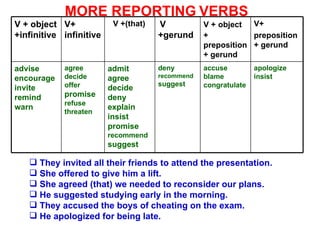
MORE REPORTING   VERBS They invited all their friends to attend the presentation. She offered to give him a lift. She agreed (that) we needed to reconsider our plans. He suggested studying early in the morning. They accused the boys of cheating on the exam. He apologized for being late. apologize insist accuse blame congratulate deny recommend suggest admit agree decide deny explain insist promise recommend suggest agree decide offer promise refuse threaten advise encourage invite remind warn V+ preposition + gerund V +   object +   preposition + gerund V +gerund V +(that) V+ infinitive V + object +infinitive

Reported1

  • 1.
    Reported Speech byYolanda Giménez
  • 2.
    DIRECT SPEECH ‘This building will be open to the public tomorrow’, said the official. How many different ways can we use to say what someone has said?
  • 3.
    We can givethe speaker exact words in quotation marks.”” + Direct speech We can report what the speaker said using our own words. + Reported or indirect speech
  • 4.
    REPORTED SPEECH Theofficial said that the building would be open to the public the following day. What changes can you see?
  • 5.
    Verbs Time Placewords Why?
  • 6.
    Because timehas gone by since the words were spoken and the people , the place and the moment have also changed. *IMPORTANT When we are reporting someone’s words, we must pay attention to the type of sentence you are reporting. How many different types of sentences can you remember?
  • 7.
  • 8.
    CHANGES (1) ‘Get out of the way!’ The warden asked me to get out of the way. “ Don’t smoke in this compartment’. The inspector asked me not to smoke in that compartment. COMMANDS ‘ What time does the train for Fleet leave ? He asked the porter what time the train for Fleet left. INFORMATION QUESTIONS CHANGES (1) ‘ Are you the person who won the prize?’ They asked me if/whether I was the person who had won the prize. YES/NO QUESTIONS CHANGES (1) “ I spent all my money last week ” He told me (that) he had spent all his money the week before . STATEMENTS REPORTED SPEECH
  • 9.
    Statements : say,tell, shout, agree, exclaim, answer, reply, advise promise…. Questions : ask, wonder, want to know, Commands : ask,order, command, REPORTING VERBS the previous week / the week before the week before that those there last week a week ago this these here go then that day the day before the next/following day come Now today yesterday tomorrow INDIRECT SPEECH DIRECT SPEECH INDIRECT SPEECH DIRECT SPEECH Other changes could go might go must go / had to go 4. didn’t need to go 5.They don’t change 1. can go 2. may go/might go 3. must go/have to go 4. needn’t go/ don’t need to go 5. ought to go/ should go / used to go/ could/ might 1. went 2. had gone 3. was/were going 4. had been going 5. would go 1. go 2. went/have gone/ had gone 3. am/is/are going 4. was/were going/ have been / going /had been going 5. will/shall go INDIRECT SPEECH DIRECT SPEECH INDIRECT SPEECH DIRECT SPEECH (1) TENSE CHANGES
  • 10.
    SAY / TELL/ TALK / SPEAK Now, listen what I’m going to say : I’m going to tell you what to do next: I’m talking about four verbs which are often confused. You should learn to speak better English. SPEAK to somebody SPEAK well/badly SPEAK French / Japanese… TALK to somebody TALK about something TELL somebody that… TELL somebody to do something… TELL the truth, lies, a story, the time, fortunes … TELL somebody how to do something SAY a word, a name, a sentence SAY that… SAY something to somebody He SAID , ‘………………..’
  • 11.
    SAY / TELL/ ASK ( They just introduce the message, they don’t add more information ) Often introduced by SAY and TELL . TELL is often followed by a name or an object pronoun : He told me he was a police officer. When the reporting verb is in the present tense, there is no change in the tense: ‘ I don’t want to come.’ He says ( that) he doesn’t want to come. 4. THAT is always optional after verbs of speaking. 5. In REPORTED QUESTIONS the word order of the original question is changed: ‘ What is your name ?’ She asked WHAT my name was.
  • 12.
    Suggestions “ Let’sgo to the theatre!” Beth said. Beth suggested going to the theatre. This means that the person who suggested going to the theatre is included. “ Paul had better stay in bed,” the doctor said. The doctor recommended that Paul (should) stay in bed. This means that the suggestion is about other people. * The use of should is a bit old-fasioned nowadays.
  • 13.
    MORE REPORTING VERBS They invited all their friends to attend the presentation. She offered to give him a lift. She agreed (that) we needed to reconsider our plans. He suggested studying early in the morning. They accused the boys of cheating on the exam. He apologized for being late. apologize insist accuse blame congratulate deny recommend suggest admit agree decide deny explain insist promise recommend suggest agree decide offer promise refuse threaten advise encourage invite remind warn V+ preposition + gerund V + object + preposition + gerund V +gerund V +(that) V+ infinitive V + object +infinitive