Verb Tenses
Simple Past
•Occurs at 1 past time
• Began & ended in the past
• often ends in –ed (but irregular
verbs too)
• did/didn’t + base form
(do/open…etc)
normally used with have
not used with be (was/were)
Used to (+base form)
“I used to smoke.”
“I used to live.”
Present Simple
Generalities,habits
“He drives a bus.”
Do/Does (?’s and neg. sentences)
“Do you smoke?”
“I don’t smoke.”
How often things are done
“I go out daily.”
“Where do you come from?”
“He comes from Japan.”
Permanent Situations
“The earth is big.”
Timetables/Schedules
“The game starts at 2pm.”
All present tenses are linked to the present,
all the past tenses aren’t.
Simple Future
• Occurs at 1 future time
• Begins & ends in the future
• “He will play next week.”
Past simple and Present Perfect (USA vs UK)
UK USA
I haven’t done it. I didn’t do it.
I’ve just done it. I just did it.
I’ve already done it. I already did it.
Past Continuous
• In the process of happening in the
past (may or may not be finished).
“I was playing when you called.”
• PC + Simple Past to say happened
in middle of something else.
“It was raining as I woke up.
Present Continuous
At/close to the time of speaking/present
“He is playing at the park.”
“He’s building his own house.”
“He’s playing today.”
Temporary/changing Situations
“I’m renting this summer.”
“The world is changing.”
Future Arrangements
“She is going out tomorrow.”
Future Continuous
• In progress in the future
“He will be playing in April”
2.
Past Perfect
2 pastactions at diff times
He had already
arrived,
when I came in.
(can also use simple past
+ before/after)
Verb Tenses (con´t)
Present Perfect (result is focus)
• Result (a finish) of a past action in effect now.
“It has rained 2 hours.”
• A long time/always situation(past til’ the present).
“He has lived there a long time.”
• “just” or “already” (simple past can use too)
• Difference between have gone to and have been to
• ever and never
• superlatives “ …the best I have tasted.”
• This is/It’s the first time…..
• To say never done something (or recent past til now.)
• yet (simple past can use too)
• this week, today...(if time isn’t finished when speaking)
• To say how much, how many things, how many times
Future Perfect
Future action looked back on
as completed from the future
“I will have made a lot of $.”
2 future actions at diff times
“He will have arrived,
when I come home.”
(can also use simple future +
before/after)
Present Perfect and Present Perfect
Continuous often used interchangeably
Past Perfect Continuous
1 before another & cont. to it
It had been raining when the
sun appeared
Present Perfect Continuous (action is focus)
• Past til’ present w/emphasis on duration
and incompletion.
“It has been raining for 2 hours.”
• Recent continuous activity (possibly not
completed) with a result in the present.
“I look a mess. I’ve been painting.”
Some verbs don’t use this tense (ex. know)
Future Perfect Continuous
1 event will be in progress when
another occurs
“He will have been playing for
2 hours when you arrive.”
3.
Modals
Will (Won’t)
Decision todo at time of speaking
“I’ll go and shut it.”
“I think I’ll take a nap.”
Offering, agree/refuse, promising, asking someone to
do something, predictions (not tied to present
situation)
Going to
Going to (do) -> decided/intended for future
“I told him I’m going to play tomorrow.”
I am doing -> arranged to do
“I’m meeting her on Monday”
“I’m (going to) meet her on Monday”
Was/were – intended but didn’t do
“He was going to buy it.”
Predictions based on the present situation.
“Look at the sky. I think it’s going to rain.”
When I do (simple present)….
If I do (simple present)….
• Can’t use “will” or “going to” in the when (while,
after, before, until/till, as soon as) part of the
sentence
• Can also use present perfect
“When I’ve arrived, call me.”
will be doing
• to say will be in middle of doing something at a
certain time in the future
• to talk about things already planned or
decided (similar to am doing)
• Will (you) be –ing?
will have done
• to say something will already have happened
before a certain time in the future
Can (present), could (past), and be able to
• Can has no present perfect or infinitive (use be
able to)
• Could(n’t) used with see, hear, smell, taste,
feel, remember, understand. Also used with
general ability.
Could (do) and could have (done)
• Possible future actions (espe. Suggestions)
• Used as would(n’t) be able to
Must (have) and can’t (have)
• Must to say we are sure something is true
• Can’t to say we think something is impossible
“You can’t be hungry already.”
• past is must have and can’t have
May (have) and might (have)
• To say that something is possible
• Negative is might not and may not
• Past forms may have and might have
• “Could” the possibility is smaller
May and might (future)
• Possible events/actions in the future
• Continuous form may/might be doing
continuous also used for possible plans
• May/might as well - to say we should do because
there is no reason not to do it and nothing better to do
Can, could, may, and would
requests, permission, offers, and invitations
• Don’t use could to give permission
Have to and must
• to say it’s necessary to do
• Sometimes a difference:
must – speaker expressing personal feelings (what
he or she thinks is necessary)
have to – just giving facts
• Must is only used in present/future, but have to can be
used in all forms
• Mustn’t = it’s necessary to not do it
don’t have to = it’s not necessary to do it
4.
Should(n’t)
• To saywe think it’s a good thing or right thing to do
• When we ask for or give an opinion about something
(often used with I (don’t) think, do you think?)
• should have (past) = someone did the wrong thing
• should be (future) = something will probably happen
• Can also use ought to instead of should
Subjunctive (I suggest you do)
• is always same as base form (I buy, he buy, …etc)
“I suggest he take a vacation.”
• Used after these verbs:
suggest propose recommend
insist demand
• Can use for past, present, future
• Other structures are possible after insist and suggest:
“They insisted on my having dinner.”
“I suggested going for a walk.”
Can’t use infinitive after suggest:
“What do you suggest I do?” (not suggest me to
do)
• Should is sometimes used instead of the subjunctive
“He suggested that I should rest a few days.”
Modals (Con´t)
5.
Conditionals
If sentences (present/future)
•Real possibility
“If I find it, I will call you.”
• Imaginary situation
“If I found $100, I would keep it.”
• Also can use could, might
If and wish sentences (present)
• Sometimes these forms are used:
“If I knew her #, I would call her.”
“I wish I knew her #.”
(past tense used but meaning is present)
• Use were instead of was
• Do not use would in the if part of the
sentence or after wish
If and wish sentences (past)
• If I had known her #, I would have
called her.
• I wish I had known her #. I would have
called her. (do not use would have
after wish.)
(might have and could have are possible
instead of would have)
Would
• can use would(n’t) after I wish when
we want something to change or
somebody else to do something
• Would(n’t) is sometimes the past of
will/won’t
“He said he would be there.”
“The car wouldn’t start.”
• When you want to remember things
that often happened (also can use
“used to”)
In case (preparation because it is possible)
• Do not use will (future) after in case
• Isn’t the same as if, because if isn’t
used when you are preparing to do
something anyway
• Can use in case to say why someone
did something in the past
• “In case of….” is different from in case.
Unless
• Unless means except if, and is often used in
warnings
• Can also use if…not
“We’ll be late if we don’t hurry.”
As long as, provided/providing (that)
• Mean but only if
• For future, DO NOT use will with them
“I’ll be late unless we hurry.”
(not unless we will hurry)
6.
Passive
be done /have been done
• Often used when it is not so important who or what did the action
Passive -> “This house was built in 1920.” (Active -> “Someone built this house in 1920.”)
• Use “by” if you want to say who or what caused the action
• Be (is/are/was/were/has been, etc) + the past participle:
(be) done (be) cleaned (be) damaged (be) built (be) seen
• Use the base form (…be done, be cleaned, be built, etc) after modal verbs (will, can,…etc) and some other verbs (example: have to, be going
to, want to)
Passive -> “This problem can be solved.” (Active -> “We can solve this problem.”)
(past form of modal verbs too: “This problem should have been solved.”
present and past tenses
• Simple present This room is cleaned every day.
• Simple past This room was cleaned yesterday.
• Present Continuous The room is being cleaned right now.
• Past Continuous The room was being cleaned when I arrived.
• Present Perfect The room has been cleaned.
• Past Perfect The room had been cleaned.
7.
Passive (con´t)
Passive -More notes
• Some verbs can have 2 objects
“They didn’t offer Ann the job.” (the 2 objects are Ann and the job)
Other verbs like offer that can have 2 objects are: ask tell give send shoe teach
pay
• be born is a passive verb and is usually past
• The passive –ing form is being done / being cleaned, etc.
Active: I don’t like people telling me what to do.
Passive: I don’t like being told what to do.
• Sometimes can use get instead of be
“Nobody got hurt.” “Did she get fired?”
(get is mainly used in informal spoken English)
It is said that…./He is said to…, etc., and supposed to
“It is said that she is 108 years old.” “She is said to be 108 years old.”
• Can also use these structures with:
thought believed reported understood known expected alleged considered
• Sometimes (be) supposed to means “said to”
• Sometimes (be) supposed to means what is planned or arranged
• Not supposed to = what is not allowed or not advisable
Have something done
• To say we arrange for someone else to do something for us
• The word order is important: He had the roof (object) repaired (past participle).
• “get something done” is possible instead of have something done
8.
Verb Tenses
Simple
P Heplayed the violin when he was 10. Particular point in the past. Began and ended in the past.
P He plays the violin. Regular, like habits. Exist now, in past, and probably in future.
Facts (and known facts about future),
thoughts/feelings
F He will play the violin next Saturday. This event will happen at one particular point of time in future.
Progressive (be + -ing) ongoing event
P I was playing when you called. Action continuing at particular past time
P I am playing. Action continuing now
things true now but not always, present plans for the future
F I will be playing when you call. Continuing action in particular future time
Perfect (have + past participle) completed action focus: results
P I had completed my homework at 10pm. 2 events happened (usually at different times).
P I have completed my homework. Past action with present connection
Often used with ‘ever, ‘never’, and ‘since’
9.
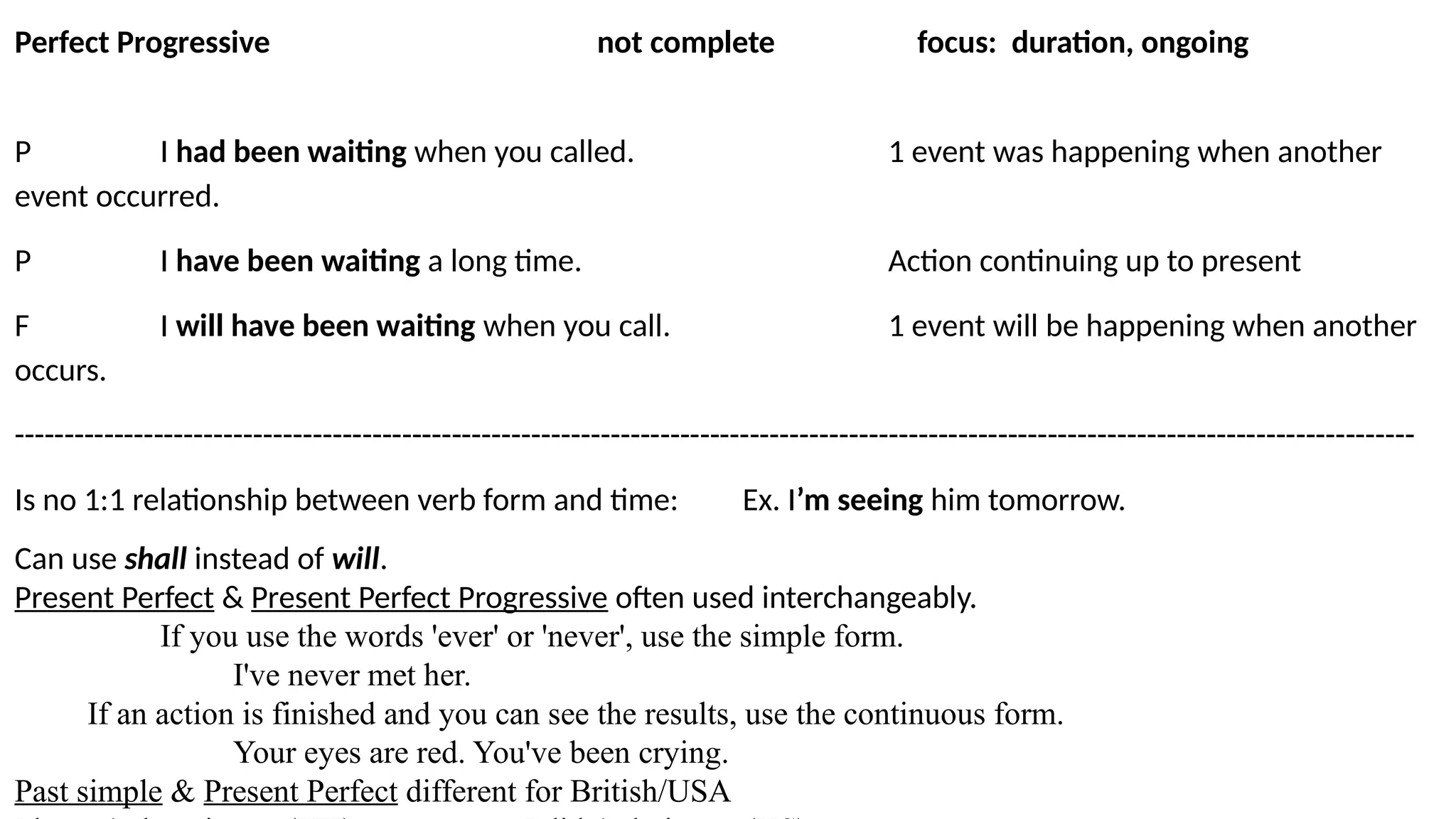
Perfect Progressive notcomplete focus: duration, ongoing
P I had been waiting when you called. 1 event was happening when another
event occurred.
P I have been waiting a long time. Action continuing up to present
F I will have been waiting when you call. 1 event will be happening when another
occurs.
---------------------------------------------------------------------------------------------------------------------------------------------
Is no 1:1 relationship between verb form and time: Ex. I’m seeing him tomorrow.
Can use shall instead of will.
Present Perfect & Present Perfect Progressive often used interchangeably.
If you use the words 'ever' or 'never', use the simple form.
I've never met her.
If an action is finished and you can see the results, use the continuous form.
Your eyes are red. You've been crying.
Past simple & Present Perfect different for British/USA