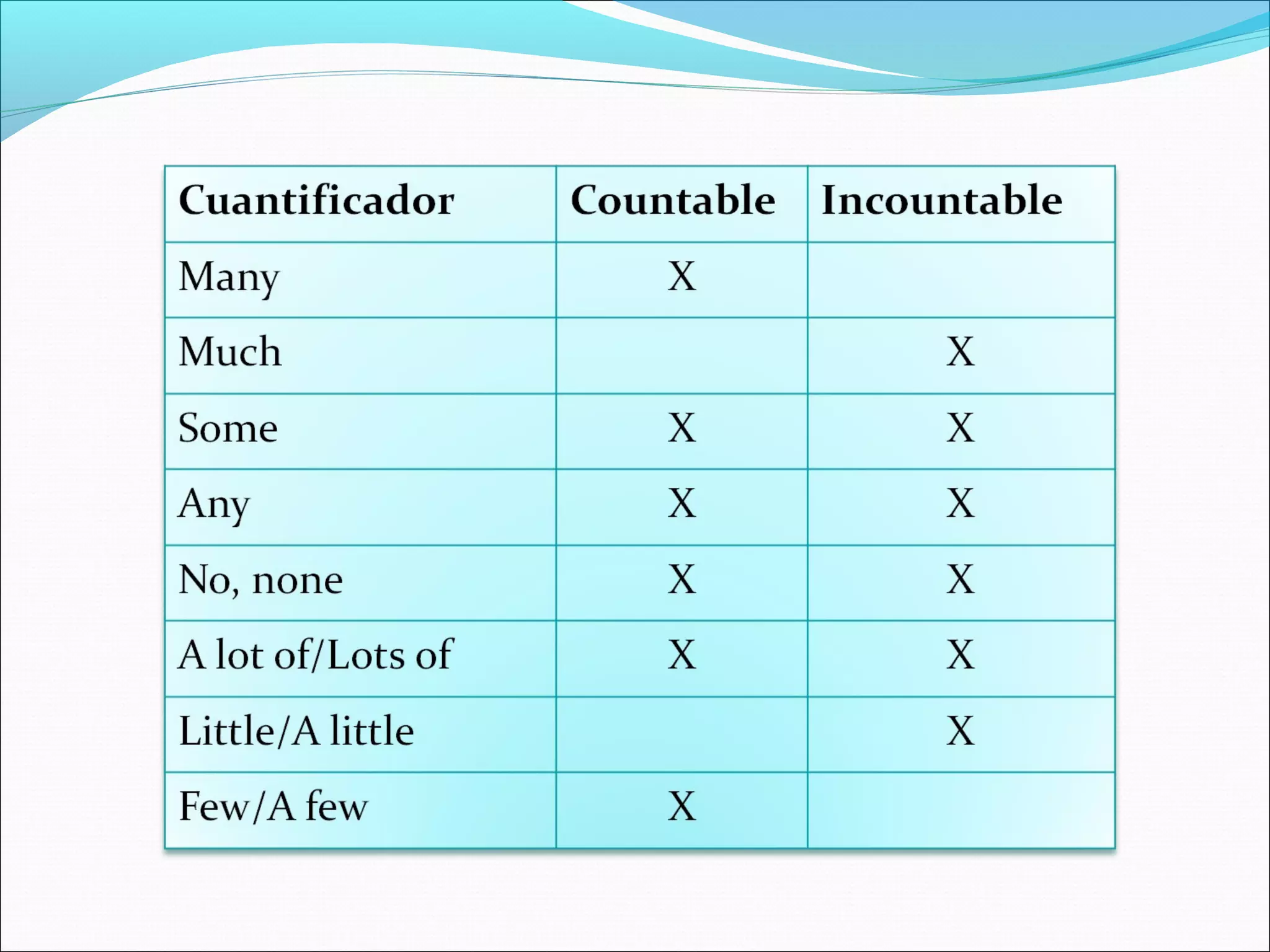
Quantifiers indicate the amount of a
name. Are responses to the question "How many?"
Like articles, quantifiers define a name and are always
situated in front of the name. You can use some only
with countable nouns, other nouns only and some
with both.
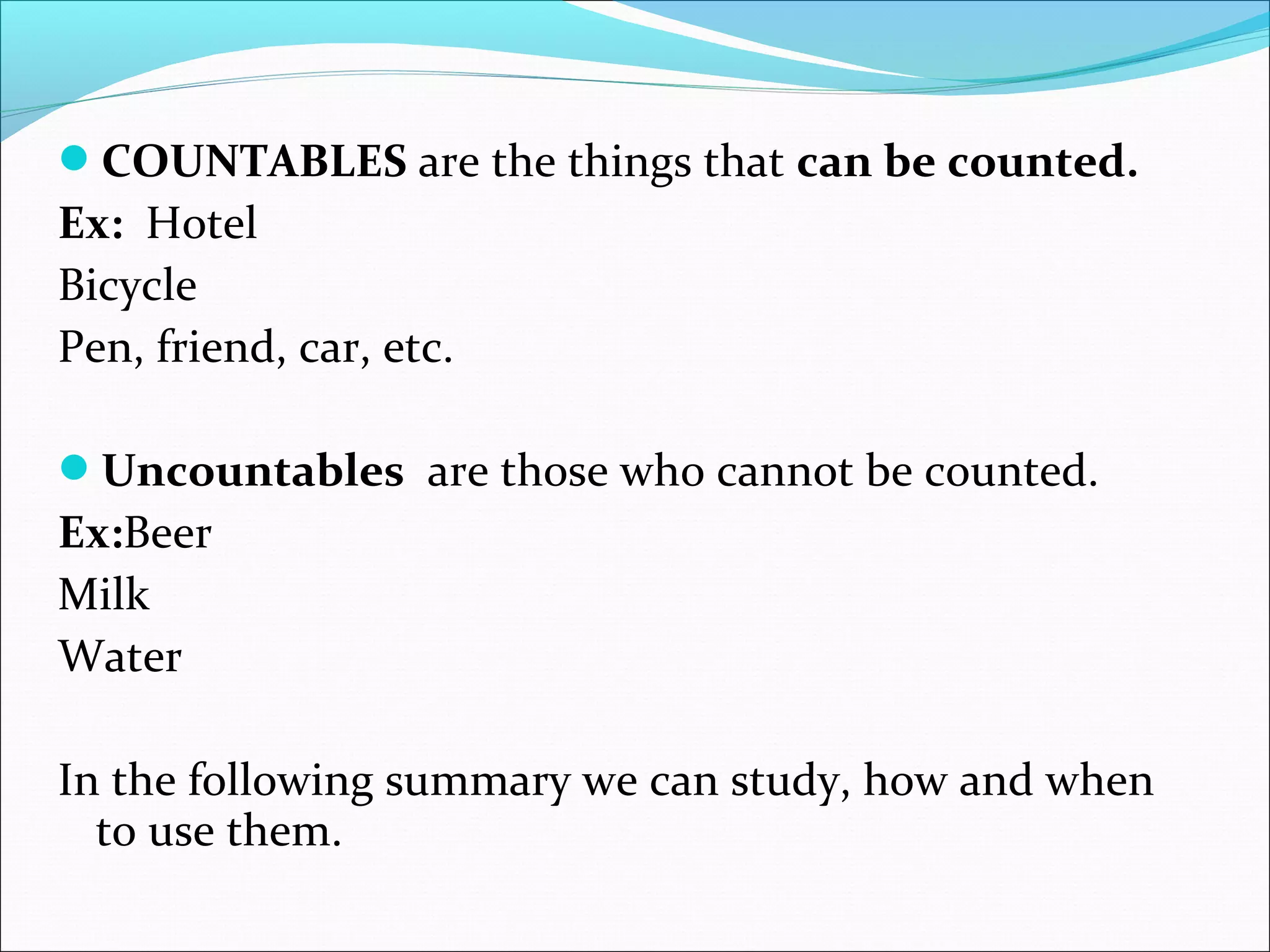
COUNTABLES are the things that can be counted.
Ex:  Hotel
Bicycle
Pen, friend, car, etc.
Uncountables  are those who cannot be counted.
Ex:Beer
Milk
Water
In the following summary we can study, how and when
to use them.
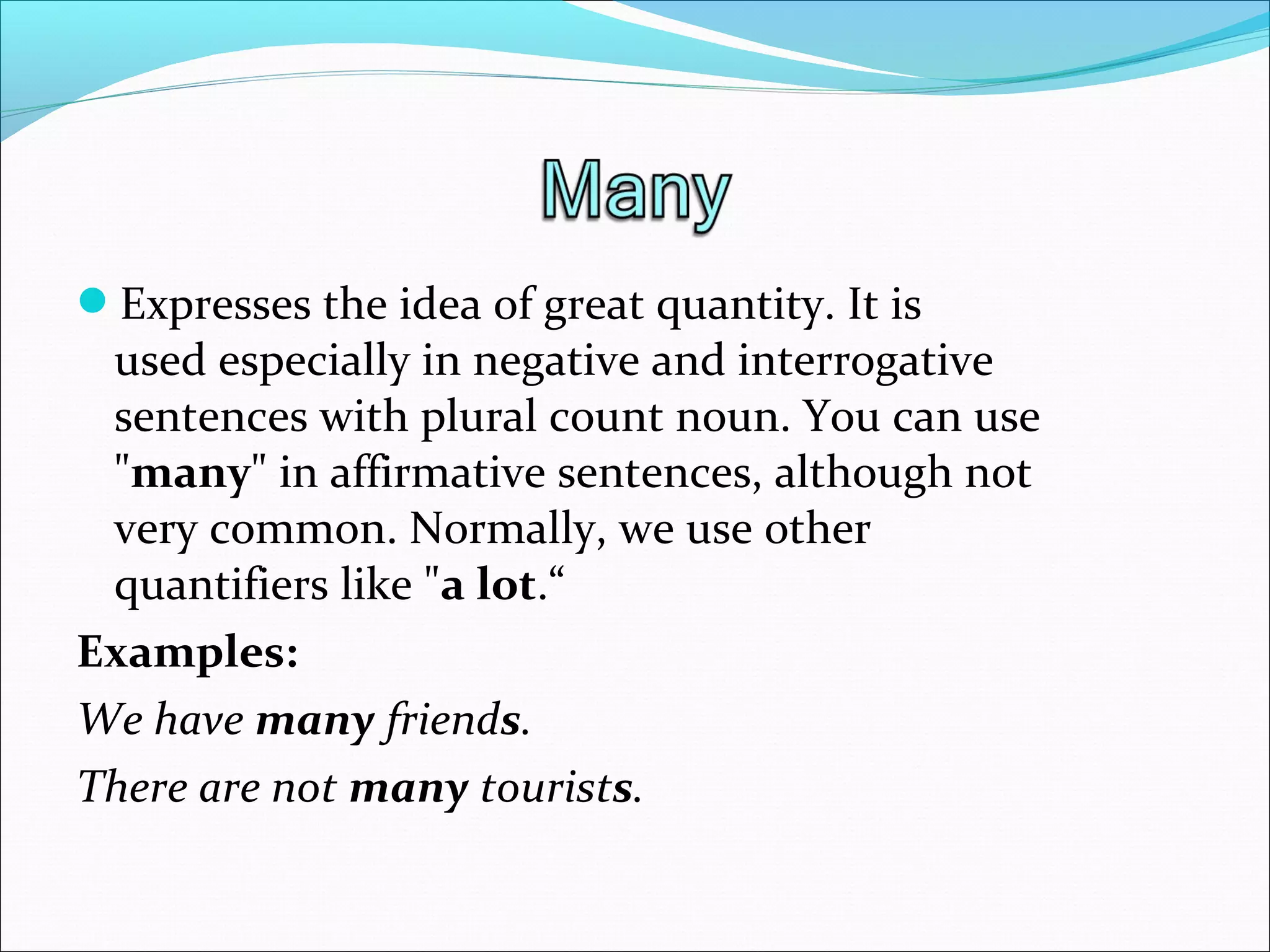
Expresses the idea of great quantity. It is​​
used especially in negative and interrogative
sentences with plural count noun. You can use
"many" in affirmative sentences, although not
very common. Normally, we use other
quantifiers like "a lot.“
Examples:
We have many friends.
There are not many tourists.
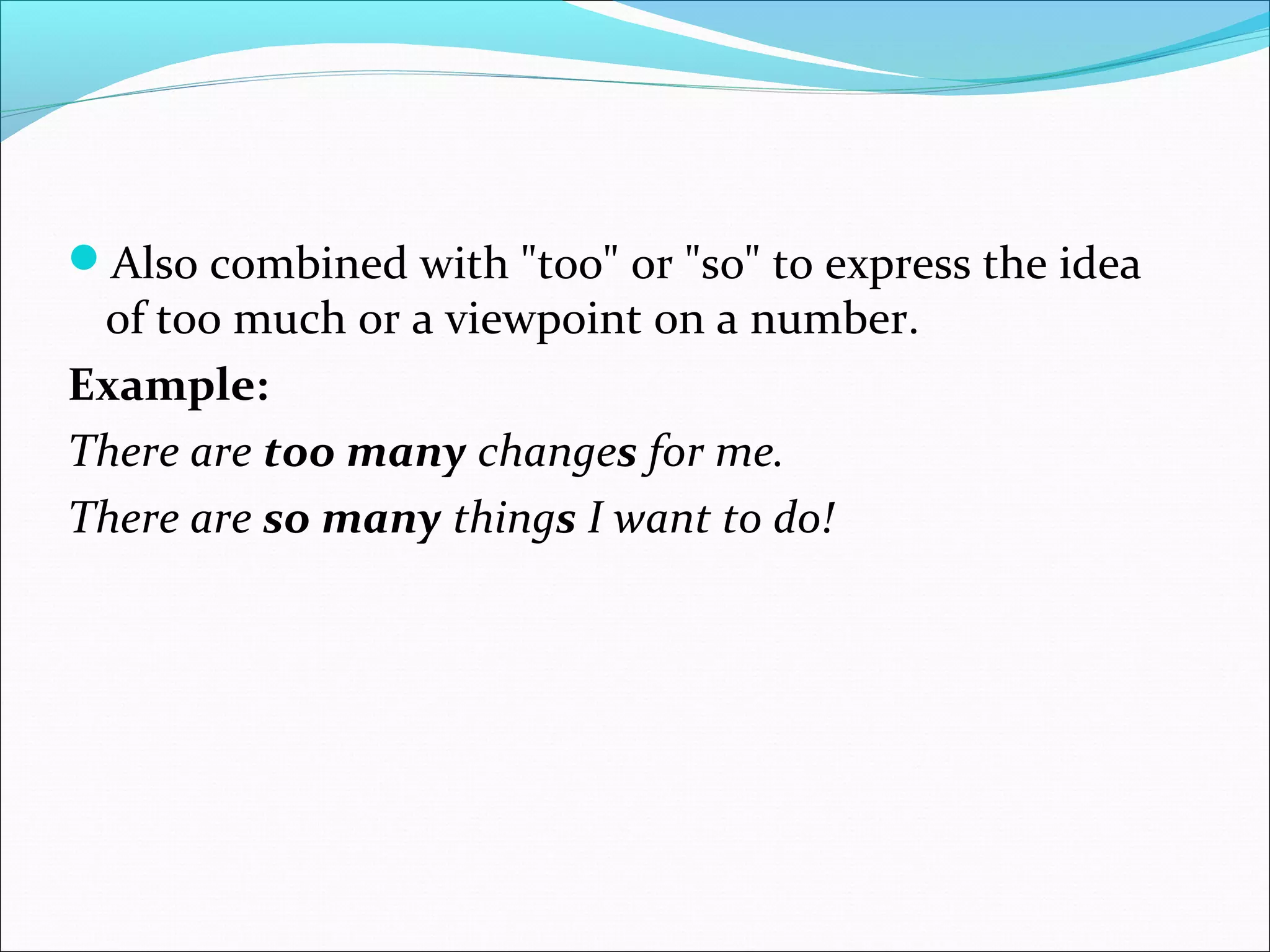
Also combined with "too" or "so" to express the idea 
of too much or a viewpoint on a number.​​
Example:
There are too many changes for me.
There are so many things I want to do!
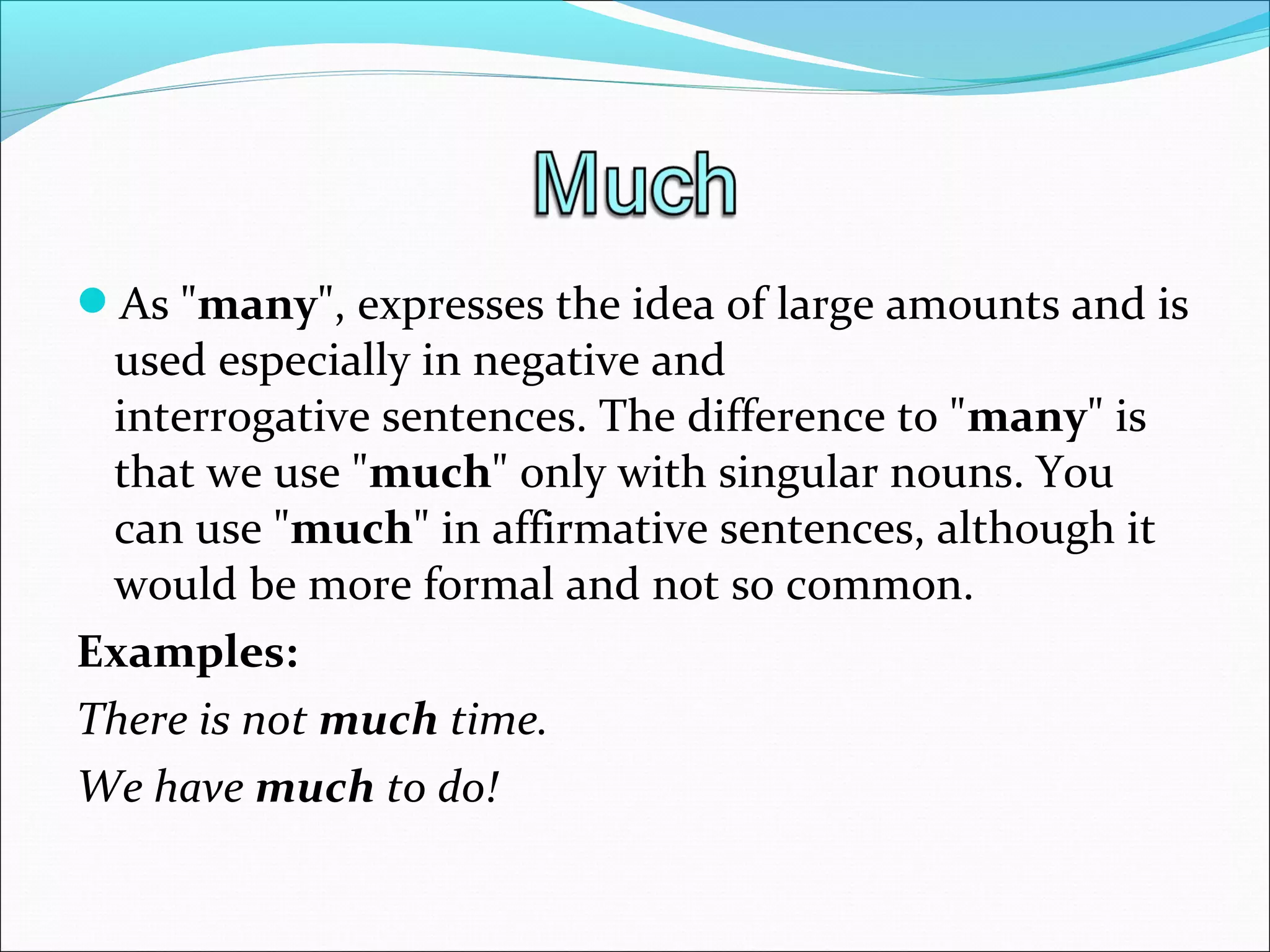
As "many", expresses the idea of large amounts and is 
used especially in negative and 
interrogative sentences. The difference to "many" is 
that we use "much" only with singular nouns. You 
can use "much" in affirmative sentences, although it 
would be more formal and not so common.
Examples:
There is not much time. 
We have much to do!
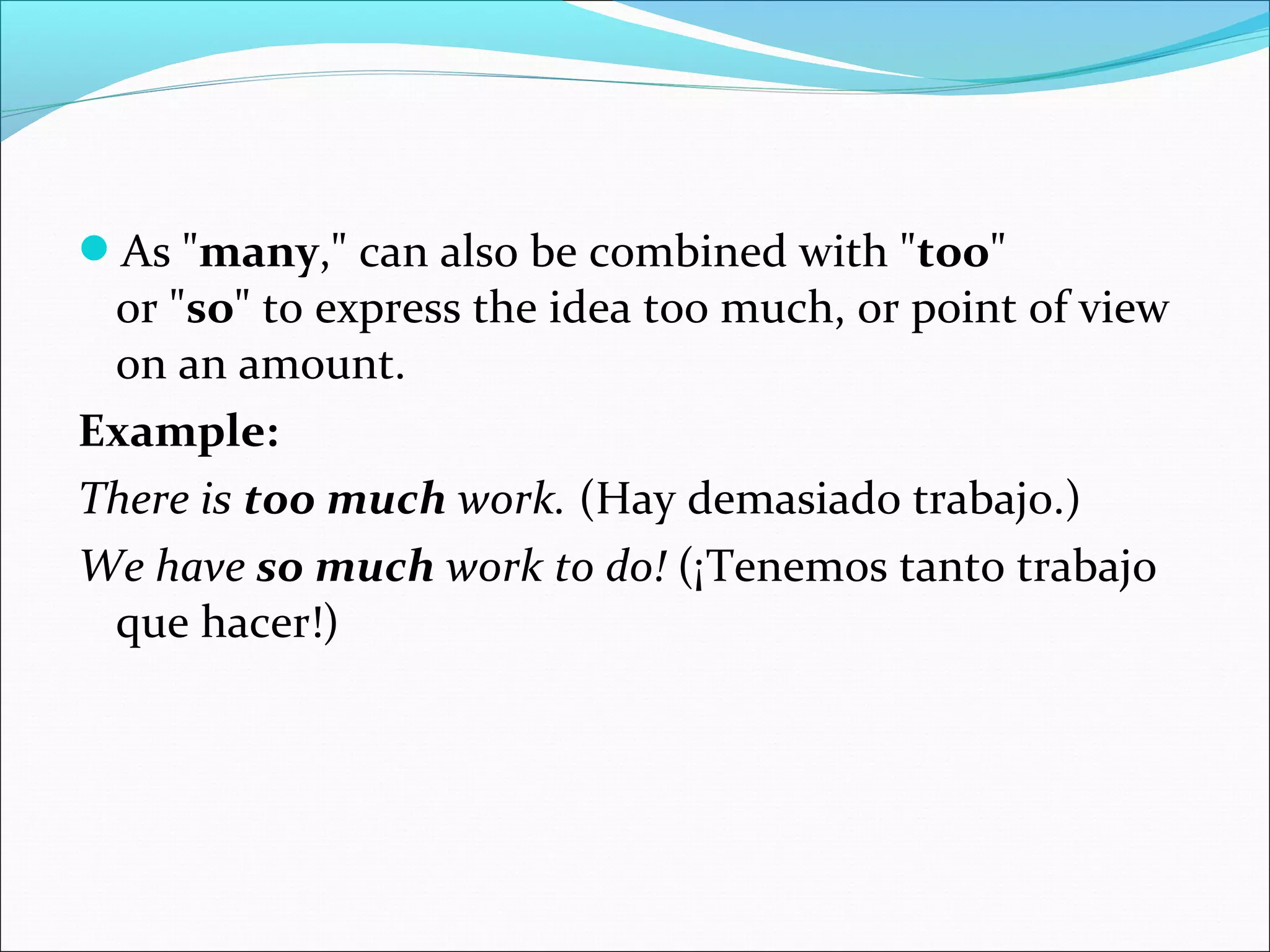
As "many," can also be combined with "too" 
or "so" to express the idea too much, or point of view 
on an amount.
Example:
There is too much work. (Hay demasiado trabajo.)
We have so much work to do! (¡Tenemos tanto trabajo 
que hacer!)
It is used both for names or singular countable nouns, 
such  as for  names  or plural  countable  nouns. It  is 
used  in affirmative sentences and questions 
(to say something), is  substituted "any" in negative 
or interrogative sentences. Means an  indefinite 
quantity, but limited.
Examples:
She has some apples.
There is some milk in the kitchen. (
Are there some tourists?
Is there some sugar?
It is used in the same contexts as "some", but
in negative or interrogative sentences.
Examples:
I do not have any cats. (No tengo ninguno gato.)
Frase negativa/nombre incontable:
He does not have any money. (No tiene dinero.)
Frase interrogativa/nombre contable:
Are there any changes? (¿Hay algunos cambios?)
Frase interrogativa/nombre incontable:
Is there any milk? (¿Hay leche?)
Unlike the particle "no," "none" can be used unless
accompanied by a name, accounting
or uncountable. Therefore used to go to the end
of sentence and the only answer to a question that
refers to quantities
Examples:
How many pencils are there? None.
There are no pencils.
How much money do you have? None.
I have no money.
Idea expressing large quantities. It can be used with
nouns or uncountable nouns and accounting. Unlike
"many" and "much", do not use them in interrogative
sentences. In general, "lots of" is more informal.
Examples:
Countable noun:
He has a lot of books.
Countable noun
He does not have a lot of books.
Uncountable noun:
I have lots of money.
Uncountable noun:
I do not have a lot of money.
Express a small amount and are used only
with uncountable nouns. The decision to use"little"
or "a little" reflects an opinion on the amount. If you
are using "a little" means a positive opinion on the
quantity, and if you use "little" implies a negative
opinion.
Examples:
questions
Do you have a little money?
Positive sentences:
We have little time.
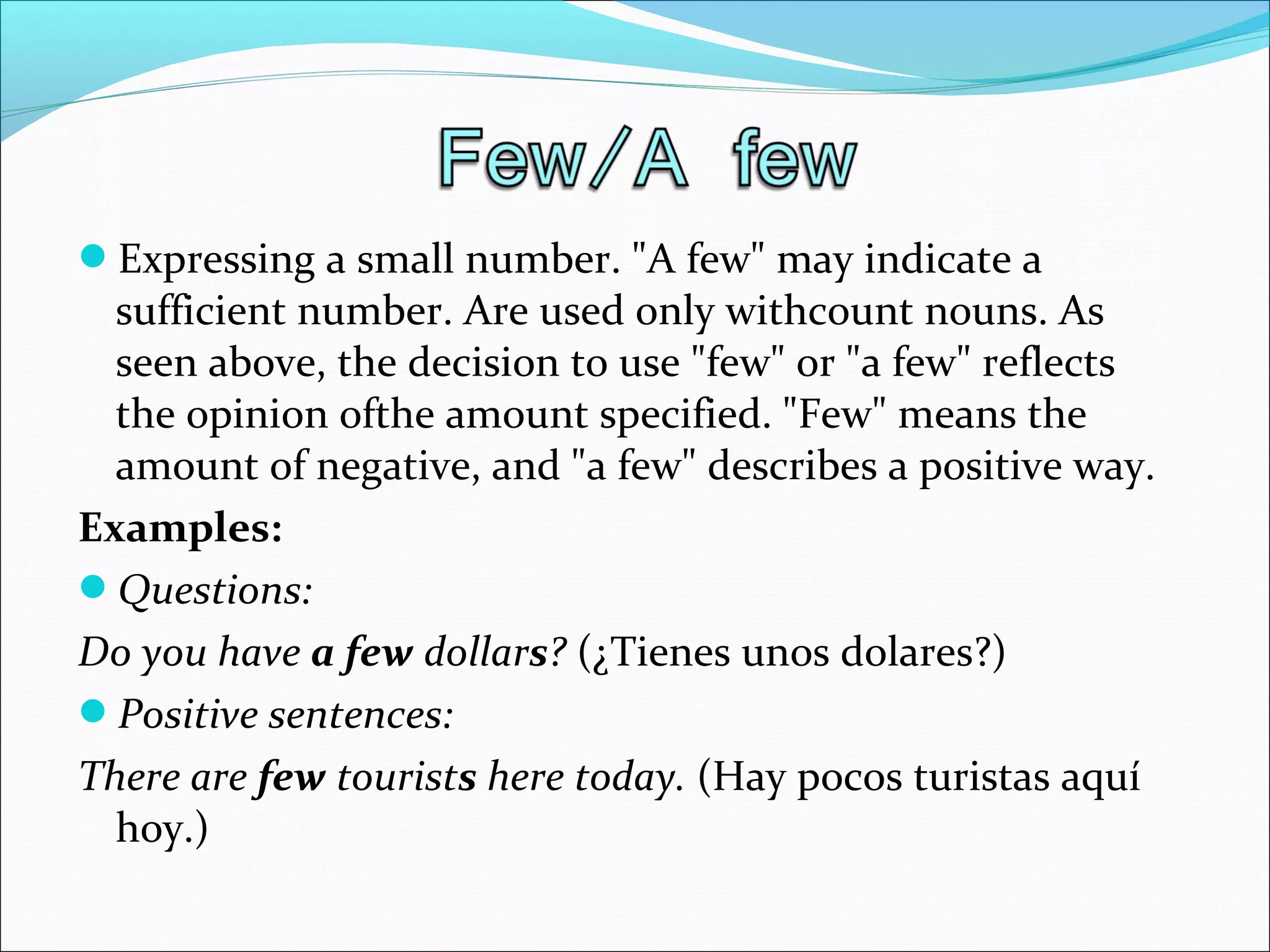
Expressing a small number. "A few" may indicate a
sufficient number. Are used only withcount nouns. As
seen above, the decision to use "few" or "a few" reflects
the opinion ofthe amount specified. "Few" means the
amount of negative, and "a few" describes a positive way.
Examples:
Questions:
Do you have a few dollars? (¿Tienes unos dolares?)
Positive sentences:
There are few tourists here today. (Hay pocos turistas aquí
hoy.)

Quantifiers 121029221514-phpapp01