There are two ways of reporting what somebody
says;
                   direct speech
           indirect (or reported) speech.
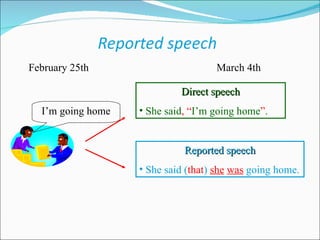
February 25th                       March 4th

                            Direct speech
  I’m going home   • She said, “I’m going home”.


                             Reported speech
                   • She said (that) she was going home.
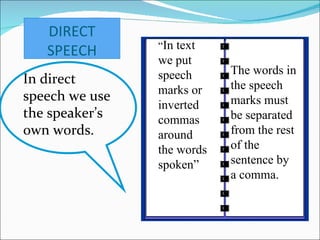
DIRECT
                “In text
   SPEECH
                we put
                speech      The words in
In direct                   the speech
                marks or
speech we use               marks must
                inverted
the speaker’s   commas      be separated
own words.      around      from the rest
                the words   of the
                spoken”     sentence by
                            a comma.
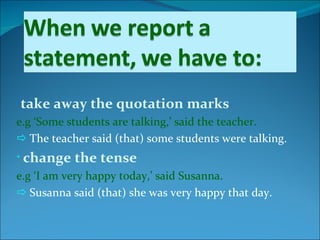
•take away the quotation marks
e.g ‘Some students are talking,’ said the teacher.
 The teacher said (that) some students were talking.
• change   the tense
e.g ‘I am very happy today,’ said Susanna.
 Susanna said (that) she was very happy that day.
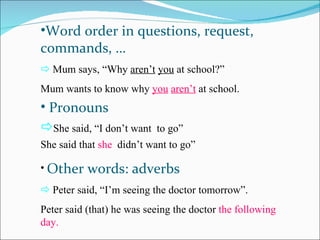
•Word order in questions, request,
commands, …
 Mum says, “Why aren’t you at school?”
Mum wants to know why you aren’t at school.
• Pronouns
She said, “I don’t want   to go”
She said that she didn’t want to go”

• Other    words: adverbs
 Peter said, “I’m seeing the doctor tomorrow”.
Peter said (that) he was seeing the doctor the following
day.
Changes: verb tenses
Direct speech                          Reported speech
 Present simple                       Past simple
  ‘I like peaches’.                    He said he liked peaches.
 Present continuous                   Past continuous
  ‘Is it raining?’                     He asked if it was raining.
 Past simple                          Past simple / Past Perfect
  ‘I didn’t recognize you’.            She explained that she
                               hadn’t recognized /didn’t
                               recognize me.
 Past continuous                      Past continuous or past
                                       perfect continuous
  ‘I was joking about the price.’              He said he was
  joking (Or:                                  had been joking)
  about the                                    price.
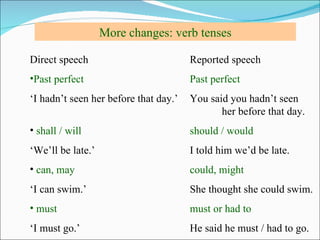
More changes: verb tenses

Direct speech                          Reported speech
•Past perfect                          Past perfect
‘I hadn’t seen her before that day.’   You said you hadn’t seen
                                              her before that day.
• shall / will                         should / would
‘We’ll be late.’                       I told him we’d be late.
• can, may                             could, might
‘I can swim.’                          She thought she could swim.
• must                                 must or had to
‘I must go.’                           He said he must / had to go.
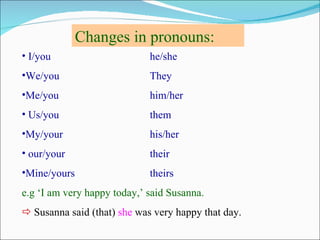
Changes in pronouns:
• I/you                      he/she
•We/you                      They
•Me/you                      him/her
• Us/you                     them
•My/your                     his/her
• our/your                   their
•Mine/yours                  theirs
e.g ‘I am very happy today,’ said Susanna.
 Susanna said (that) she was very happy that day.
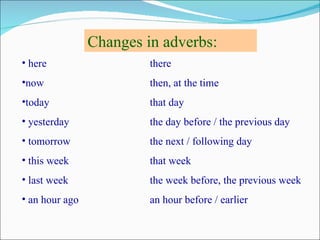
Changes in adverbs:
• here                   there
•now                     then, at the time
•today                   that day
• yesterday              the day before / the previous day
• tomorrow               the next / following day
• this week              that week
• last week              the week before, the previous week
• an hour ago            an hour before / earlier
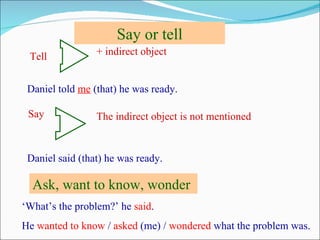
Say or tell
 Tell            + indirect object


 Daniel told me (that) he was ready.

 Say             The indirect object is not mentioned


 Daniel said (that) he was ready.

  Ask, want to know, wonder
‘What’s the problem?’ he said.
He wanted to know / asked (me) / wondered what the problem was.
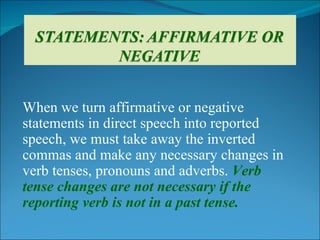
When we turn affirmative or negative
statements in direct speech into reported
speech, we must take away the inverted
commas and make any necessary changes in
verb tenses, pronouns and adverbs. Verb
tense changes are not necessary if the
reporting verb is not in a past tense.
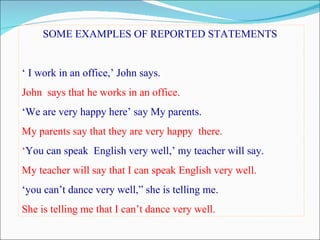
SOME EXAMPLES OF REPORTED STATEMENTS


‘ I work in an office,’ John says.
John says that he works in an office.
‘We are very happy here’ say My parents.
My parents say that they are very happy there.
‘You can speak English very well,’ my teacher will say.
My teacher will say that I can speak English very well.
‘you can’t dance very well,” she is telling me.
She is telling me that I can’t dance very well.
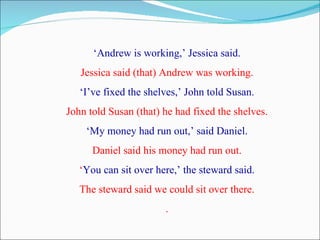
‘Andrew is working,’ Jessica said.
   Jessica said (that) Andrew was working.
   ‘I’ve fixed the shelves,’ John told Susan.
John told Susan (that) he had fixed the shelves.
    ‘My money had run out,’ said Daniel.
      Daniel said his money had run out.
   ‘You can sit over here,’ the steward said.
   The steward said we could sit over there.
                       .
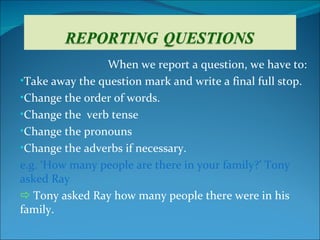
When we report a question, we have to:
•Take away the question mark and write a final full stop.
•Change the order of words.
•Change the verb tense
•Change the pronouns
•Change the adverbs if necessary.
e.g. ‘How many people are there in your family?’ Tony
asked Ray
 Tony asked Ray how many people there were in his
family.
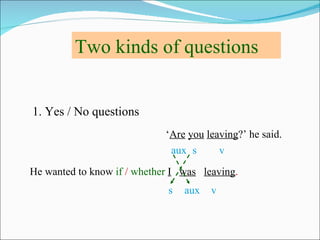
Two kinds of questions


1. Yes / No questions
                             ‘Are you leaving?’ he said.
                              aux s      v

He wanted to know if / whether I was leaving.
                             s   aux   v
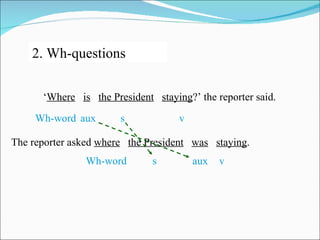
2. Wh-questions

      ‘Where is the President staying?’ the reporter said.
     Wh-word aux       s            v

The reporter asked where the President was staying.
               Wh-word        s         aux   v
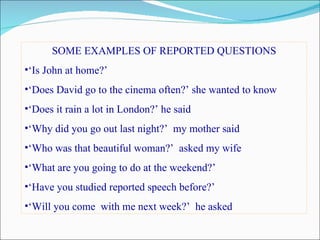
SOME EXAMPLES OF REPORTED QUESTIONS
•‘Is John at home?’
•‘Does David go to the cinema often?’ she wanted to know
•‘Does it rain a lot in London?’ he said
•‘Why did you go out last night?’ my mother said
•‘Who was that beautiful woman?’ asked my wife
•‘What are you going to do at the weekend?’
•‘Have you studied reported speech before?’
•‘Will you come with me next week?’ he asked
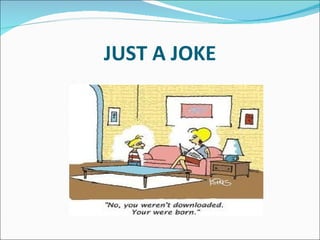
JUST A JOKE

Reported speech carmen

  • 1.
    There are twoways of reporting what somebody says; direct speech indirect (or reported) speech.
  • 2.
    February 25th March 4th Direct speech I’m going home • She said, “I’m going home”. Reported speech • She said (that) she was going home.
  • 3.
    DIRECT “In text SPEECH we put speech The words in In direct the speech marks or speech we use marks must inverted the speaker’s commas be separated own words. around from the rest the words of the spoken” sentence by a comma.
  • 4.
    •take away thequotation marks e.g ‘Some students are talking,’ said the teacher.  The teacher said (that) some students were talking. • change the tense e.g ‘I am very happy today,’ said Susanna.  Susanna said (that) she was very happy that day.
  • 5.
    •Word order inquestions, request, commands, …  Mum says, “Why aren’t you at school?” Mum wants to know why you aren’t at school. • Pronouns She said, “I don’t want to go” She said that she didn’t want to go” • Other words: adverbs  Peter said, “I’m seeing the doctor tomorrow”. Peter said (that) he was seeing the doctor the following day.
  • 6.
    Changes: verb tenses Directspeech Reported speech  Present simple Past simple ‘I like peaches’. He said he liked peaches.  Present continuous Past continuous ‘Is it raining?’ He asked if it was raining.  Past simple Past simple / Past Perfect ‘I didn’t recognize you’. She explained that she hadn’t recognized /didn’t recognize me.  Past continuous Past continuous or past perfect continuous ‘I was joking about the price.’ He said he was joking (Or: had been joking) about the price.
  • 7.
    More changes: verbtenses Direct speech Reported speech •Past perfect Past perfect ‘I hadn’t seen her before that day.’ You said you hadn’t seen her before that day. • shall / will should / would ‘We’ll be late.’ I told him we’d be late. • can, may could, might ‘I can swim.’ She thought she could swim. • must must or had to ‘I must go.’ He said he must / had to go.
  • 8.
    Changes in pronouns: •I/you he/she •We/you They •Me/you him/her • Us/you them •My/your his/her • our/your their •Mine/yours theirs e.g ‘I am very happy today,’ said Susanna.  Susanna said (that) she was very happy that day.
  • 9.
    Changes in adverbs: •here there •now then, at the time •today that day • yesterday the day before / the previous day • tomorrow the next / following day • this week that week • last week the week before, the previous week • an hour ago an hour before / earlier
  • 10.
    Say or tell Tell + indirect object Daniel told me (that) he was ready. Say The indirect object is not mentioned Daniel said (that) he was ready. Ask, want to know, wonder ‘What’s the problem?’ he said. He wanted to know / asked (me) / wondered what the problem was.
  • 11.
    When we turnaffirmative or negative statements in direct speech into reported speech, we must take away the inverted commas and make any necessary changes in verb tenses, pronouns and adverbs. Verb tense changes are not necessary if the reporting verb is not in a past tense.
  • 12.
    SOME EXAMPLES OFREPORTED STATEMENTS ‘ I work in an office,’ John says. John says that he works in an office. ‘We are very happy here’ say My parents. My parents say that they are very happy there. ‘You can speak English very well,’ my teacher will say. My teacher will say that I can speak English very well. ‘you can’t dance very well,” she is telling me. She is telling me that I can’t dance very well.
  • 13.
    ‘Andrew is working,’Jessica said. Jessica said (that) Andrew was working. ‘I’ve fixed the shelves,’ John told Susan. John told Susan (that) he had fixed the shelves. ‘My money had run out,’ said Daniel. Daniel said his money had run out. ‘You can sit over here,’ the steward said. The steward said we could sit over there. .
  • 14.
    When we reporta question, we have to: •Take away the question mark and write a final full stop. •Change the order of words. •Change the verb tense •Change the pronouns •Change the adverbs if necessary. e.g. ‘How many people are there in your family?’ Tony asked Ray  Tony asked Ray how many people there were in his family.
  • 15.
    Two kinds ofquestions 1. Yes / No questions ‘Are you leaving?’ he said. aux s v He wanted to know if / whether I was leaving. s aux v
  • 16.
    2. Wh-questions ‘Where is the President staying?’ the reporter said. Wh-word aux s v The reporter asked where the President was staying. Wh-word s aux v
  • 17.
    SOME EXAMPLES OFREPORTED QUESTIONS •‘Is John at home?’ •‘Does David go to the cinema often?’ she wanted to know •‘Does it rain a lot in London?’ he said •‘Why did you go out last night?’ my mother said •‘Who was that beautiful woman?’ asked my wife •‘What are you going to do at the weekend?’ •‘Have you studied reported speech before?’ •‘Will you come with me next week?’ he asked
  • 18.