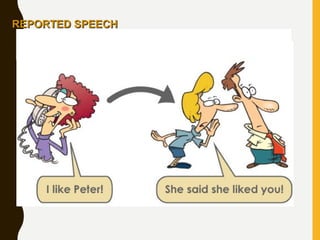
REPORTED SPEECH
(& REPORTING
VERBS)
Silvia López Mas
REPORTED SPEECHREPORTED SPEECH
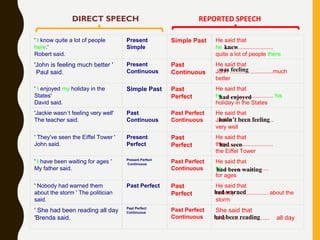
' I know quite a lot of people
here.'
Robert said.
Present
Simple
Simple Past He said that
he ...............................
quite a lot of people there
'John is feeling much better '
Paul said.
Present
Continuous
Past
Continuous
He said that
John ...........................much
better
' I enjoyed my holiday in the
States'
David said.
Simple Past Past
Perfect
He said that
he ............................... his
holiday in the States
'Jackie wasn´t feeling very well'
The teacher said.
Past
Continuous
Past Perfect
Continuous
He said that
Jackie .........................
very well
' They've seen the Eiffel Tower '
John said.
Present
Perfect
Past
Perfect
He said that
they ............................
the Eiffel Tower
' I have been waiting for ages '
My father said.
Present Perfect
Continuous
Past Perfect
Continuous
He said that
he ............................
for ages
' Nobody had warned them
about the storm ' The politician
said.
Past Perfect Past
Perfect
He said that
nobody .................... about the
storm
' She had been reading all day
'Brenda said.
Past Perfect
Continuous
Past Perfect
Continuous
She said that
she ........................ all day
knew
was feeling
had enjoyed
hadn’t been feeling
had seen
had been waiting
had warned
had been reading
DIRECT SPEECH REPORTED SPEECH
' I will be here with you.'
Robert promised me.
Future
Simple
Conditional
Present
Robert promised that
he ...............................
there with me
'John is going to study French '
Paul said.
Be going to Was/Were
going to
Paul said that
John ...........................
to study French
' We can start the lesson'
David said.
Can Could David said that
we ............................... start
the lesson
' They may come home '
My husband said.
May Might My husband said that
they .........................
come home
' You must be quiet in class '
The teacher said.
Must Had to The teacher said that
we ............................
be quiet in class
would be there
was going
could
might
had to
DIRECT SPEECH REPORTED SPEECH
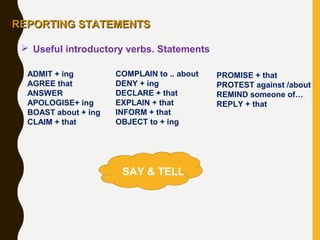
ADMIT + ing
AGREE that
ANSWER
APOLOGISE+ ing
BOAST about + ing
CLAIM + that
COMPLAIN to .. about
DENY + ing
DECLARE + that
EXPLAIN + that
INFORM + that
OBJECT to + ing
PROMISE + that
PROTEST against /about
REMIND someone of…
REPLY + that
SAY & TELL
REPORTING STATEMENTSREPORTING STATEMENTS
 Useful introductory verbs. Statements
 agree, refuse, offer, promise, threaten + infinitive
 accuse of, admit, apologize for, deny, insist on + gerund
REPORTING STATEMENTSREPORTING STATEMENTS
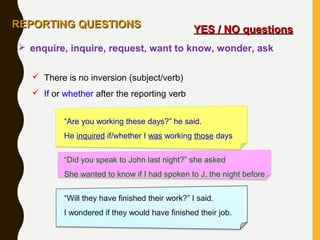
YES / NO questionsYES / NO questions
 There is no inversion (subject/verb)
 If or whether after the reporting verb
“Are you working these days?” he said.
He inquired if/whether I was working those days
“Did you speak to John last night?” she asked
She wanted to know if I had spoken to J, the night before
“Will they have finished their work?” I said.
I wondered if they would have finished their job.
 enquire, inquire, request, want to know, wonder, ask
REPORTING QUESTIONSREPORTING QUESTIONS
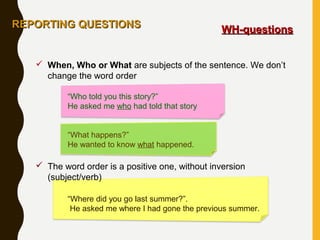
 When, Who or What are subjects of the sentence. We don’t
change the word order
“Who told you this story?”
He asked me who had told that story
“What happens?”
He wanted to know what happened.
 The word order is a positive one, without inversion
(subject/verb)
“Where did you go last summer?”.
He asked me where I had gone the previous summer.
REPORTING QUESTIONSREPORTING QUESTIONS
WH-questionsWH-questions
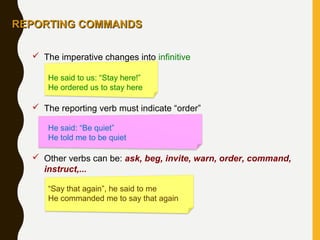
 The imperative changes into infinitive
He said to us: “Stay here!”
He ordered us to stay here
 The reporting verb must indicate “order”
He said: “Be quiet”
He told me to be quiet
 Other verbs can be: ask, beg, invite, warn, order, command,
instruct,...
“Say that again”, he said to me
He commanded me to say that again
REPORTING COMMANDSREPORTING COMMANDS
 The verbs used are: beg, ask, demand & request and they are
situated before the requested person.
 The word “please” is omitted
“John, don’t open the window, please” I said
I asked /requested/begged John not to open the window.
 When let is used in direct speech it must appear in the reported
too but omitting the modal verb.
 When let is not used the modal is not omitted.
“Can you let me use your phone, please?” I asked my neighbour
I asked my neighbour to let me use her phone.
“Can I use your phone?” I asked my neighbour
I asked my neighbour if I could use her phone.
REPORTING REQUESTSREPORTING REQUESTS
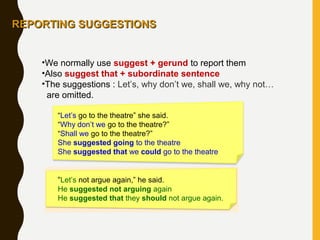
•We normally use suggest + gerund to report them
•Also suggest that + subordinate sentence
•The suggestions : Let’s, why don’t we, shall we, why not…
are omitted.
“Let’s go to the theatre” she said.
“Why don’t we go to the theatre?”
“Shall we go to the theatre?”
She suggested going to the theatre
She suggested that we could go to the theatre
“Let’s not argue again,” he said.
He suggested not arguing again
He suggested that they should not argue again.
REPORTING SUGGESTIONSREPORTING SUGGESTIONS
Silvia López Mas

Reported speech

  • 1.
  • 2.
  • 3.
    ' I knowquite a lot of people here.' Robert said. Present Simple Simple Past He said that he ............................... quite a lot of people there 'John is feeling much better ' Paul said. Present Continuous Past Continuous He said that John ...........................much better ' I enjoyed my holiday in the States' David said. Simple Past Past Perfect He said that he ............................... his holiday in the States 'Jackie wasn´t feeling very well' The teacher said. Past Continuous Past Perfect Continuous He said that Jackie ......................... very well ' They've seen the Eiffel Tower ' John said. Present Perfect Past Perfect He said that they ............................ the Eiffel Tower ' I have been waiting for ages ' My father said. Present Perfect Continuous Past Perfect Continuous He said that he ............................ for ages ' Nobody had warned them about the storm ' The politician said. Past Perfect Past Perfect He said that nobody .................... about the storm ' She had been reading all day 'Brenda said. Past Perfect Continuous Past Perfect Continuous She said that she ........................ all day knew was feeling had enjoyed hadn’t been feeling had seen had been waiting had warned had been reading DIRECT SPEECH REPORTED SPEECH
  • 4.
    ' I willbe here with you.' Robert promised me. Future Simple Conditional Present Robert promised that he ............................... there with me 'John is going to study French ' Paul said. Be going to Was/Were going to Paul said that John ........................... to study French ' We can start the lesson' David said. Can Could David said that we ............................... start the lesson ' They may come home ' My husband said. May Might My husband said that they ......................... come home ' You must be quiet in class ' The teacher said. Must Had to The teacher said that we ............................ be quiet in class would be there was going could might had to DIRECT SPEECH REPORTED SPEECH
  • 5.
    ADMIT + ing AGREEthat ANSWER APOLOGISE+ ing BOAST about + ing CLAIM + that COMPLAIN to .. about DENY + ing DECLARE + that EXPLAIN + that INFORM + that OBJECT to + ing PROMISE + that PROTEST against /about REMIND someone of… REPLY + that SAY & TELL REPORTING STATEMENTSREPORTING STATEMENTS  Useful introductory verbs. Statements
  • 6.
     agree, refuse,offer, promise, threaten + infinitive  accuse of, admit, apologize for, deny, insist on + gerund REPORTING STATEMENTSREPORTING STATEMENTS
  • 7.
    YES / NOquestionsYES / NO questions  There is no inversion (subject/verb)  If or whether after the reporting verb “Are you working these days?” he said. He inquired if/whether I was working those days “Did you speak to John last night?” she asked She wanted to know if I had spoken to J, the night before “Will they have finished their work?” I said. I wondered if they would have finished their job.  enquire, inquire, request, want to know, wonder, ask REPORTING QUESTIONSREPORTING QUESTIONS
  • 8.
     When, Whoor What are subjects of the sentence. We don’t change the word order “Who told you this story?” He asked me who had told that story “What happens?” He wanted to know what happened.  The word order is a positive one, without inversion (subject/verb) “Where did you go last summer?”. He asked me where I had gone the previous summer. REPORTING QUESTIONSREPORTING QUESTIONS WH-questionsWH-questions
  • 9.
     The imperativechanges into infinitive He said to us: “Stay here!” He ordered us to stay here  The reporting verb must indicate “order” He said: “Be quiet” He told me to be quiet  Other verbs can be: ask, beg, invite, warn, order, command, instruct,... “Say that again”, he said to me He commanded me to say that again REPORTING COMMANDSREPORTING COMMANDS
  • 10.
     The verbsused are: beg, ask, demand & request and they are situated before the requested person.  The word “please” is omitted “John, don’t open the window, please” I said I asked /requested/begged John not to open the window.  When let is used in direct speech it must appear in the reported too but omitting the modal verb.  When let is not used the modal is not omitted. “Can you let me use your phone, please?” I asked my neighbour I asked my neighbour to let me use her phone. “Can I use your phone?” I asked my neighbour I asked my neighbour if I could use her phone. REPORTING REQUESTSREPORTING REQUESTS
  • 11.
    •We normally usesuggest + gerund to report them •Also suggest that + subordinate sentence •The suggestions : Let’s, why don’t we, shall we, why not… are omitted. “Let’s go to the theatre” she said. “Why don’t we go to the theatre?” “Shall we go to the theatre?” She suggested going to the theatre She suggested that we could go to the theatre “Let’s not argue again,” he said. He suggested not arguing again He suggested that they should not argue again. REPORTING SUGGESTIONSREPORTING SUGGESTIONS
  • 12.