Intermediate Level
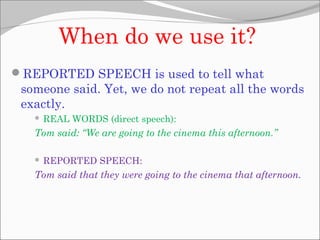
When do we use it?
REPORTED SPEECH is used to tell what

someone said. Yet, we do not repeat all the words
exactly.


REAL WORDS (direct speech):

Tom said: “We are going to the cinema this afternoon.”


REPORTED SPEECH:

Tom said that they were going to the cinema that afternoon.
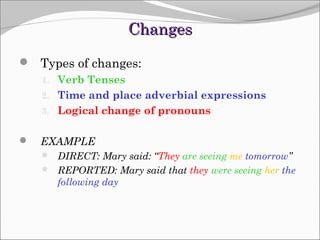
Changes
 Types of changes:
1. Verb Tenses
2. Time and place adverbial expressions
3. Logical change of pronouns



EXAMPLE
 DIRECT: Mary said: “They are seeing me tomorrow”
 REPORTED: Mary said that they were seeing her the

following day
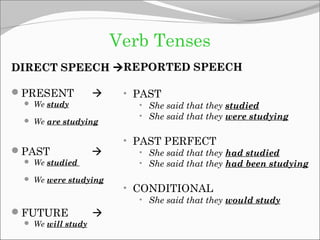
Verb Tenses
DIRECT SPEECH REPORTED SPEECH
PRESENT



 We study
 We are studying

PAST



 We studied
 We were studying

• PAST
• She said that they studied
• She said that they were studying

• PAST PERFECT
• She said that they had studied
• She said that they had been studying

• CONDITIONAL
• She said that they would study

FUTURE
 We will study


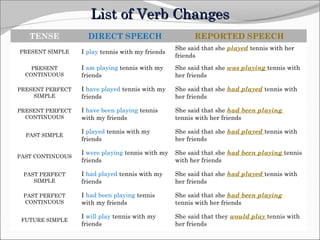
List of Verb Changes
TENSE

DIRECT SPEECH

REPORTED SPEECH

PRESENT SIMPLE

I play tennis with my friends

She said that she played tennis with her
friends

PRESENT
CONTINUOUS

I am playing tennis with my
friends

She said that she was playing tennis with
her friends

PRESENT PERFECT
SIMPLE

I have played tennis with my
friends

She said that she had played tennis with
her friends

PRESENT PERFECT
CONTINUOUS

I have been playing tennis
with my friends

She said that she had been playing
tennis with her friends

I played tennis with my
friends

She said that she had played tennis with
her friends

I were playing tennis with my
friends

She said that she had been playing tennis
with her friends

PAST PERFECT
SIMPLE

I had played tennis with my
friends

She said that she had played tennis with
her friends

PAST PERFECT
CONTINUOUS

I had been playing tennis
with my friends

She said that she had been playing
tennis with her friends

FUTURE SIMPLE

I will play tennis with my
friends

She said that they would play tennis with
her friends

PAST SIMPLE

PAST CONTINUOUS
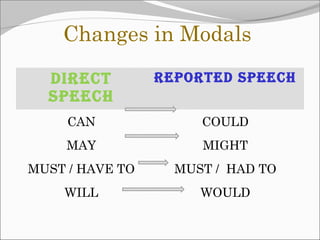
Changes in Modals
DIRECT
SPEECH

REPORTED SPEECH

CAN

COULD

MAY

MIGHT

MUST / HAVE TO

MUST / HAD TO

WILL

WOULD
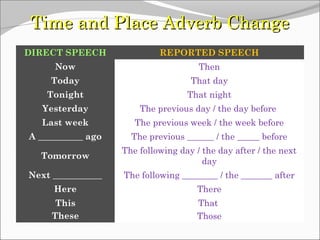
Time and Place Adverb Change
DIRECT SPEECH

REPORTED SPEECH

Now

Then

Today

That day

Tonight

That night

Yesterday

The previous day / the day before

Last week

The previous week / the week before

A __________ ago

The previous ______ / the _____ before

Tomorrow

The following day / the day after / the next
day

Next ___________

The following ________ / the _______ after

Here

There

This
These

That
Those
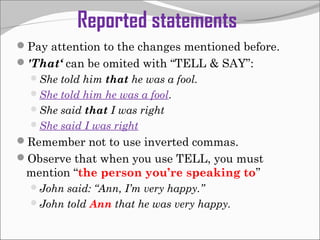
Reported statements
Pay attention to the changes mentioned before.
'That‘ can be omited with “TELL & SAY”:
She told him that he was a fool.
She told him he was a fool.
She said that I was right
She said I was right

Remember not to use inverted commas.
Observe that when you use TELL, you must

mention “the person you’re speaking to”
John said: “Ann, I’m very happy.”
John told Ann that he was very happy.
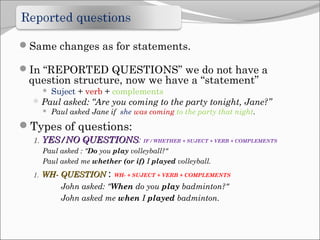
Same changes as for statements.
In “REPORTED QUESTIONS” we do not have a

question structure, now we have a “statement”


Suject + verb + complements

 Paul asked: “Are you coming to the party tonight, Jane?”
 Paul asked Jane if she was coming to the party that night.

Types of questions:
1. YES/NO QUESTIONS:
QUESTIONS

IF / WHETHER + SUJECT + VERB + COMPLEMENTS

Paul asked : "Do you play volleyball?"
Paul asked me whether (or if) I played volleyball.
1. WH- QUESTION :

WH- + SUJECT + VERB + COMPLEMENTS

John asked: "When do you play badminton?"
John asked me when I played badminton.
Reported commands
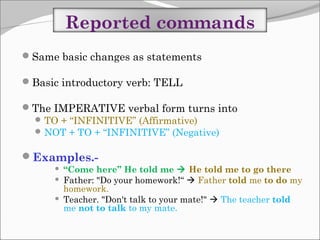
Same basic changes as statements
Basic introductory verb: TELL
The IMPERATIVE verbal form turns into
 TO + “INFINITIVE” (Affirmative)
 NOT + TO + “INFINITIVE” (Negative)

Examples.



“Come here” He told me  He told me to go there
Father: "Do your homework!“  Father told me to do my
homework.
Teacher. "Don't talk to your mate!"  The teacher told
me not to talk to my mate.
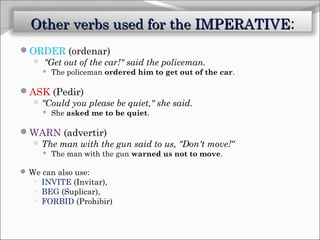
Other verbs used for the IMPERATIVE:
ORDER (ordenar)
 "Get out of the car!" said the policeman.


The policeman ordered him to get out of the car.

ASK (Pedir)
 "Could you please be quiet," she said.


She asked me to be quiet.

WARN (advertir)
 The man with the gun said to us, "Don't move!“


The man with the gun warned us not to move.

 We can also use:
 INVITE (Invitar),
 BEG (Suplicar),
 FORBID (Prohibir)
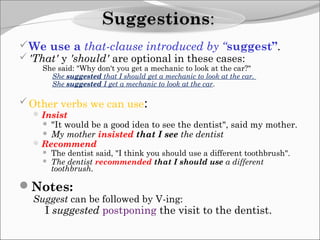
 We use a that-clause introduced by “suggest”.
 'That' y 'should' are optional in these cases:
She said: "Why don't you get a mechanic to look at the car?"

She suggested that I should get a mechanic to look at the car.
She suggested I get a mechanic to look at the car.

 Other verbs we can use:
 Insist

"It would be a good idea to see the dentist", said my mother.
 My mother insisted that I see the dentist
 Recommend





The dentist said, "I think you should use a different toothbrush".
The dentist recommended that I should use a different
toothbrush.

Notes:

Suggest can be followed by V-ing:

I suggested postponing the visit to the dentist.
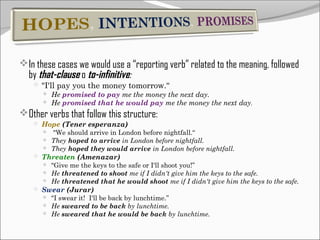
In these cases we would use a “reporting verb” related to the meaning, followed

by that-clause o to-infinitive:

 "I'll pay you the money tomorrow.“
 He promised to pay me the money the next day.
 He promised that he would pay me the money the next day.

Other verbs that follow this structure:
 Hope (Tener esperanza)




"We should arrive in London before nightfall.“
They hoped to arrive in London before nightfall.
They hoped they would arrive in London before nightfall.

 Threaten (Amenazar)




"Give me the keys to the safe or I'll shoot you!”
He threatened to shoot me if I didn't give him the keys to the safe.
He threatened that he would shoot me if I didn't give him the keys to the safe.

 Swear (Jurar)




"I swear it! I'll be back by lunchtime.”
He sweared to be back by lunchtime.
He sweared that he would be back by lunchtime.
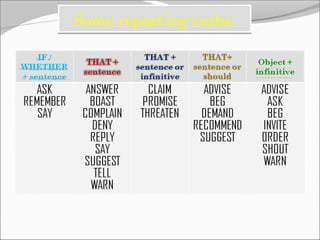
Some reporting verbs.

Reportedspeech. Upper intermediate level .

  • 1.
  • 2.
    When do weuse it? REPORTED SPEECH is used to tell what someone said. Yet, we do not repeat all the words exactly.  REAL WORDS (direct speech): Tom said: “We are going to the cinema this afternoon.”  REPORTED SPEECH: Tom said that they were going to the cinema that afternoon.
  • 3.
    Changes  Types ofchanges: 1. Verb Tenses 2. Time and place adverbial expressions 3. Logical change of pronouns  EXAMPLE  DIRECT: Mary said: “They are seeing me tomorrow”  REPORTED: Mary said that they were seeing her the following day
  • 4.
    Verb Tenses DIRECT SPEECHREPORTED SPEECH PRESENT   We study  We are studying PAST   We studied  We were studying • PAST • She said that they studied • She said that they were studying • PAST PERFECT • She said that they had studied • She said that they had been studying • CONDITIONAL • She said that they would study FUTURE  We will study 
  • 5.
    List of VerbChanges TENSE DIRECT SPEECH REPORTED SPEECH PRESENT SIMPLE I play tennis with my friends She said that she played tennis with her friends PRESENT CONTINUOUS I am playing tennis with my friends She said that she was playing tennis with her friends PRESENT PERFECT SIMPLE I have played tennis with my friends She said that she had played tennis with her friends PRESENT PERFECT CONTINUOUS I have been playing tennis with my friends She said that she had been playing tennis with her friends I played tennis with my friends She said that she had played tennis with her friends I were playing tennis with my friends She said that she had been playing tennis with her friends PAST PERFECT SIMPLE I had played tennis with my friends She said that she had played tennis with her friends PAST PERFECT CONTINUOUS I had been playing tennis with my friends She said that she had been playing tennis with her friends FUTURE SIMPLE I will play tennis with my friends She said that they would play tennis with her friends PAST SIMPLE PAST CONTINUOUS
  • 6.
    Changes in Modals DIRECT SPEECH REPORTEDSPEECH CAN COULD MAY MIGHT MUST / HAVE TO MUST / HAD TO WILL WOULD
  • 7.
    Time and PlaceAdverb Change DIRECT SPEECH REPORTED SPEECH Now Then Today That day Tonight That night Yesterday The previous day / the day before Last week The previous week / the week before A __________ ago The previous ______ / the _____ before Tomorrow The following day / the day after / the next day Next ___________ The following ________ / the _______ after Here There This These That Those
  • 8.
    Reported statements Pay attentionto the changes mentioned before. 'That‘ can be omited with “TELL & SAY”: She told him that he was a fool. She told him he was a fool. She said that I was right She said I was right Remember not to use inverted commas. Observe that when you use TELL, you must mention “the person you’re speaking to” John said: “Ann, I’m very happy.” John told Ann that he was very happy.
  • 9.
    Same changes asfor statements. In “REPORTED QUESTIONS” we do not have a question structure, now we have a “statement”  Suject + verb + complements  Paul asked: “Are you coming to the party tonight, Jane?”  Paul asked Jane if she was coming to the party that night. Types of questions: 1. YES/NO QUESTIONS: QUESTIONS IF / WHETHER + SUJECT + VERB + COMPLEMENTS Paul asked : "Do you play volleyball?" Paul asked me whether (or if) I played volleyball. 1. WH- QUESTION : WH- + SUJECT + VERB + COMPLEMENTS John asked: "When do you play badminton?" John asked me when I played badminton.
  • 10.
    Reported commands Same basicchanges as statements Basic introductory verb: TELL The IMPERATIVE verbal form turns into  TO + “INFINITIVE” (Affirmative)  NOT + TO + “INFINITIVE” (Negative) Examples.   “Come here” He told me  He told me to go there Father: "Do your homework!“  Father told me to do my homework. Teacher. "Don't talk to your mate!"  The teacher told me not to talk to my mate.
  • 11.
    Other verbs usedfor the IMPERATIVE: ORDER (ordenar)  "Get out of the car!" said the policeman.  The policeman ordered him to get out of the car. ASK (Pedir)  "Could you please be quiet," she said.  She asked me to be quiet. WARN (advertir)  The man with the gun said to us, "Don't move!“  The man with the gun warned us not to move.  We can also use:  INVITE (Invitar),  BEG (Suplicar),  FORBID (Prohibir)
  • 12.
     We usea that-clause introduced by “suggest”.  'That' y 'should' are optional in these cases: She said: "Why don't you get a mechanic to look at the car?" She suggested that I should get a mechanic to look at the car. She suggested I get a mechanic to look at the car.  Other verbs we can use:  Insist "It would be a good idea to see the dentist", said my mother.  My mother insisted that I see the dentist  Recommend    The dentist said, "I think you should use a different toothbrush". The dentist recommended that I should use a different toothbrush. Notes: Suggest can be followed by V-ing: I suggested postponing the visit to the dentist.
  • 13.
    In these caseswe would use a “reporting verb” related to the meaning, followed by that-clause o to-infinitive:  "I'll pay you the money tomorrow.“  He promised to pay me the money the next day.  He promised that he would pay me the money the next day. Other verbs that follow this structure:  Hope (Tener esperanza)    "We should arrive in London before nightfall.“ They hoped to arrive in London before nightfall. They hoped they would arrive in London before nightfall.  Threaten (Amenazar)    "Give me the keys to the safe or I'll shoot you!” He threatened to shoot me if I didn't give him the keys to the safe. He threatened that he would shoot me if I didn't give him the keys to the safe.  Swear (Jurar)    "I swear it! I'll be back by lunchtime.” He sweared to be back by lunchtime. He sweared that he would be back by lunchtime.
  • 14.