REPORTED SPEECH
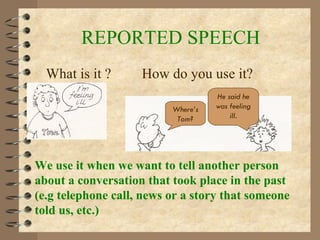
REPORTED SPEECH What is it ?  How do you use it? We use it when we want to tell another person about a conversation that took place in the past (e.g telephone call, news or a story that someone told us, etc.) Where’s Tom? He said he was feeling ill .
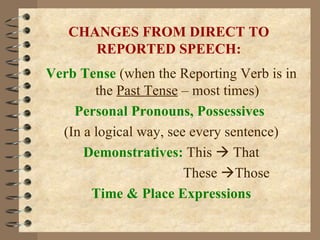
CHANGES FROM DIRECT TO REPORTED SPEECH: Verb Tense  (when the Reporting Verb is in the  Past Tense  – most times) Personal Pronouns, Possessives   (In a logical way, see every sentence) Demonstratives:   This    That   These   Those Time & Place Expressions
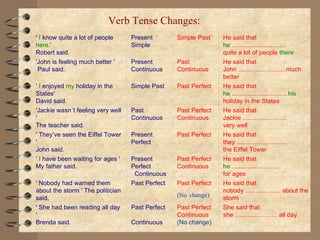
DIRECT SPEECH  REPORTED SPEECH   Verb Tense Changes: '   I  know quite a lot of people   here .' Robert said. Present Simple  Simple Past He said that  he  ............................... quite a lot of people  there 'John is feeling much better ' Paul said. Present Continuous  Past Continuous He said that John ...........................much better '  I   enjoyed  my  holiday in the States' David said.  Simple Past  Past Perfect He said that  he  ...............................  his  holiday in the States 'Jackie wasn´t feeling very well ' The teacher said. Past Continuous  Past Perfect Continuous He said that Jackie ......................... very well ' They‘ve seen the Eiffel Tower ' John said. Present Perfect  Past Perfect He said that they ............................ the Eiffel Tower '  I   have been waiting for ages ' My father said. Present Perfect  Continuous  Past Perfect Continuous He said that  he  ............................ for ages ' Nobody had warned them about the storm ' The politician said. Past Perfect  Past Perfect (No   change) He said that nobody .................... about the storm ' She had been reading all day ' Brenda said. Past Perfect  Continuous  Past Perfect Continuous (No change) She said that she ........................ all day
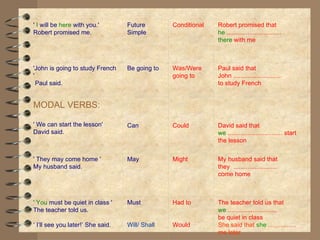
'   I  will be   here  with you.' Robert promised me. Future Simple  Conditional Robert promised that  he  ............................... there   with me 'John is going to study French ' Paul said. Be going to  Was/Were going to Paul said that John ........................... to study French MODAL VERBS:  ' We can start the lesson' David said.  Can  Could David said that  we  ............................... start the lesson ' They may come home ' My husband said. May  Might My husband said that they  ......................... come home ' You  must be quiet in class ' The teacher told us. ‘  I’ll see you later!’ She said. Must  Will/ Shall Had to Would The teacher told us that  we  ............................ be quiet in class She said that  she  ………..… me later.
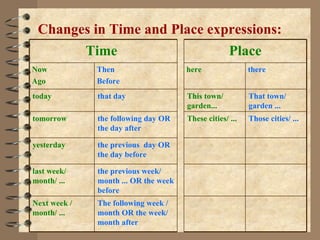
Changes in Time and Place expressions: the previous week/ month ... OR the week before  last week/ month/ ... The following week / month OR the week/ month after Next week / month/ ... the previous  day OR the day before yesterday Those cities/ ... These cities/ ... the following day OR the day after tomorrow That town/ garden ... This town/ garden... that day today there here Then Before Now Ago Place Time
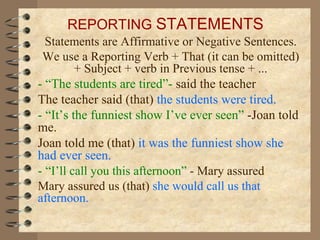
Statements are Affirmative or Negative Sentences. We use a Reporting Verb + That (it can be omitted) + Subject + verb in Previous tense + ... - “The students are tired”-  said the teacher The teacher said   (that)  the students were tired. - “It’s the funniest show I’ve ever seen”  -Joan told me. Joan told me (that)  it was the funniest show she had ever seen. -   “ I’ll call you this afternoon”  - Mary assured Mary assured us (that)  she would call us that afternoon. REPORTING  STATEMENTS
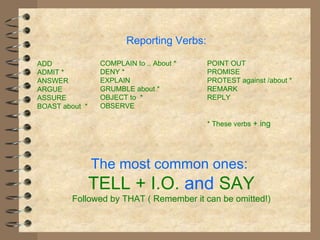
Reporting Verbs: ADD ADMIT * ANSWER ARGUE ASSURE BOAST about  * COMPLAIN to .. About * DENY * EXPLAIN GRUMBLE about * OBJECT to  * OBSERVE POINT OUT PROMISE PROTEST against /about * REMARK REPLY * These verbs  + ing The most common ones:  TELL + I.O.  and  SAY Followed by THAT ( Remember it can be omitted!)
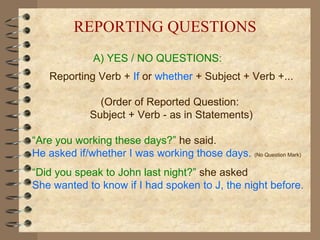
A) YES / NO QUESTIONS: Reporting Verb +  If   or   whether  + Subject + Verb +... (Order of Reported Question:  Subject + Verb - as in Statements) “ Are you working these days?”   he said. He asked if/whether I was working those days.  (No Question Mark) “ Did you speak to John last night?”   she asked She wanted to know if I had spoken to J, the night before. REPORTING QUESTIONS
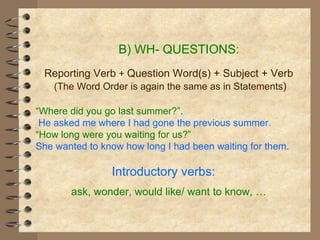
B) WH- QUESTIONS: Reporting Verb  +  Question Word(s) + Subject + Verb (The Word Order is again the same as in Statements ) “ Where did you go last summer?”. He asked me where I had gone the previous summer. “ How long were you waiting for us?” She wanted to know how long I had been waiting for them. Introductory verbs:  ask, wonder, would like/ want to know,  …
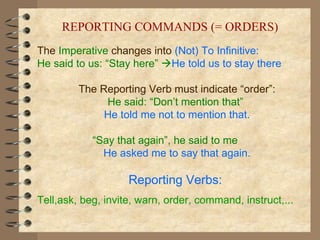
The  Imperative  changes into  (Not) To   Infinitive: He said to us: “Stay here”   He told us to stay there The Reporting Verb must indicate “order”: He said: “Don’t mention that”  He told me not to mention that. “ Say that again”, he said to me  He asked me to say that again. Reporting Verbs:  Tell,ask, beg, invite, warn, order, command, instruct,... REPORTING COMMANDS (= ORDERS)
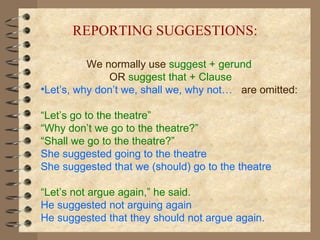
We normally use  suggest + gerund   OR  suggest that + Clause Let’s, why don’t we, shall we, why not…   are omitted: “ Let’s go to the theatre”   “ Why don’t we go to the theatre?” “ Shall we go to the theatre?” She suggested going to the theatre She suggested that we (should) go to the theatre “ Let’s not argue again,” he said. He suggested not arguing again He suggested that they should not argue again. REPORTING SUGGESTIONS:
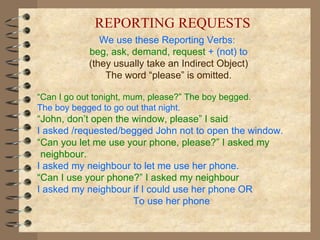
We use these Reporting Verbs:  beg, ask, demand, request  + (not) to (they usually take an Indirect Object) The word “please” is omitted. “ Can I go out tonight, mum, please?” The boy begged. The boy begged to go out that night. “ John, don’t open the window, please” I said I asked /requested/begged John not to open the window. “ Can you let me use your phone, please?” I asked my neighbour. I asked my neighbour to let me use her phone. “ Can I use your phone?” I asked my neighbour I asked my neighbour if I could use her phone OR  To use her phone REPORTING REQUESTS
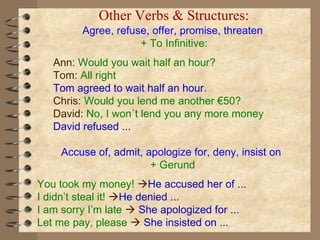
Agree, refuse, offer, promise, threaten + To Infinitive: Ann:  Would you wait half an hour? Tom:  All right Tom agreed to wait half an hour. Chris:  Would you lend me another €50? David:  No, I won´t lend you any more money David refused ... Accuse of, admit, apologize for, deny, insist on  + Gerund You took my money!   He accused her of ... I didn’t steal it!   He denied ... I am sorry I’m late     She apologized for ... Let me pay, please     She insisted on ... Other Verbs & Structures:

Reportedspeech 1

  • 1.
  • 2.
    REPORTED SPEECH Whatis it ? How do you use it? We use it when we want to tell another person about a conversation that took place in the past (e.g telephone call, news or a story that someone told us, etc.) Where’s Tom? He said he was feeling ill .
  • 3.
    CHANGES FROM DIRECTTO REPORTED SPEECH: Verb Tense (when the Reporting Verb is in the Past Tense – most times) Personal Pronouns, Possessives (In a logical way, see every sentence) Demonstratives: This  That These  Those Time & Place Expressions
  • 4.
    DIRECT SPEECH REPORTED SPEECH   Verb Tense Changes: ' I know quite a lot of people here .' Robert said. Present Simple Simple Past He said that he ............................... quite a lot of people there 'John is feeling much better ' Paul said. Present Continuous Past Continuous He said that John ...........................much better ' I enjoyed my holiday in the States' David said. Simple Past Past Perfect He said that he ............................... his holiday in the States 'Jackie wasn´t feeling very well ' The teacher said. Past Continuous Past Perfect Continuous He said that Jackie ......................... very well ' They‘ve seen the Eiffel Tower ' John said. Present Perfect Past Perfect He said that they ............................ the Eiffel Tower ' I have been waiting for ages ' My father said. Present Perfect Continuous Past Perfect Continuous He said that he ............................ for ages ' Nobody had warned them about the storm ' The politician said. Past Perfect Past Perfect (No change) He said that nobody .................... about the storm ' She had been reading all day ' Brenda said. Past Perfect Continuous Past Perfect Continuous (No change) She said that she ........................ all day
  • 5.
    ' I will be here with you.' Robert promised me. Future Simple Conditional Robert promised that he ............................... there with me 'John is going to study French ' Paul said. Be going to Was/Were going to Paul said that John ........................... to study French MODAL VERBS: ' We can start the lesson' David said. Can Could David said that we ............................... start the lesson ' They may come home ' My husband said. May Might My husband said that they ......................... come home ' You must be quiet in class ' The teacher told us. ‘ I’ll see you later!’ She said. Must Will/ Shall Had to Would The teacher told us that we ............................ be quiet in class She said that she ………..… me later.
  • 6.
    Changes in Timeand Place expressions: the previous week/ month ... OR the week before last week/ month/ ... The following week / month OR the week/ month after Next week / month/ ... the previous day OR the day before yesterday Those cities/ ... These cities/ ... the following day OR the day after tomorrow That town/ garden ... This town/ garden... that day today there here Then Before Now Ago Place Time
  • 7.
    Statements are Affirmativeor Negative Sentences. We use a Reporting Verb + That (it can be omitted) + Subject + verb in Previous tense + ... - “The students are tired”- said the teacher The teacher said (that) the students were tired. - “It’s the funniest show I’ve ever seen” -Joan told me. Joan told me (that) it was the funniest show she had ever seen. - “ I’ll call you this afternoon” - Mary assured Mary assured us (that) she would call us that afternoon. REPORTING STATEMENTS
  • 8.
    Reporting Verbs: ADDADMIT * ANSWER ARGUE ASSURE BOAST about * COMPLAIN to .. About * DENY * EXPLAIN GRUMBLE about * OBJECT to * OBSERVE POINT OUT PROMISE PROTEST against /about * REMARK REPLY * These verbs + ing The most common ones: TELL + I.O. and SAY Followed by THAT ( Remember it can be omitted!)
  • 9.
    A) YES /NO QUESTIONS: Reporting Verb + If or whether + Subject + Verb +... (Order of Reported Question: Subject + Verb - as in Statements) “ Are you working these days?” he said. He asked if/whether I was working those days. (No Question Mark) “ Did you speak to John last night?” she asked She wanted to know if I had spoken to J, the night before. REPORTING QUESTIONS
  • 10.
    B) WH- QUESTIONS:Reporting Verb + Question Word(s) + Subject + Verb (The Word Order is again the same as in Statements ) “ Where did you go last summer?”. He asked me where I had gone the previous summer. “ How long were you waiting for us?” She wanted to know how long I had been waiting for them. Introductory verbs: ask, wonder, would like/ want to know, …
  • 11.
    The Imperative changes into (Not) To Infinitive: He said to us: “Stay here”  He told us to stay there The Reporting Verb must indicate “order”: He said: “Don’t mention that” He told me not to mention that. “ Say that again”, he said to me He asked me to say that again. Reporting Verbs: Tell,ask, beg, invite, warn, order, command, instruct,... REPORTING COMMANDS (= ORDERS)
  • 12.
    We normally use suggest + gerund OR suggest that + Clause Let’s, why don’t we, shall we, why not… are omitted: “ Let’s go to the theatre” “ Why don’t we go to the theatre?” “ Shall we go to the theatre?” She suggested going to the theatre She suggested that we (should) go to the theatre “ Let’s not argue again,” he said. He suggested not arguing again He suggested that they should not argue again. REPORTING SUGGESTIONS:
  • 13.
    We use theseReporting Verbs: beg, ask, demand, request + (not) to (they usually take an Indirect Object) The word “please” is omitted. “ Can I go out tonight, mum, please?” The boy begged. The boy begged to go out that night. “ John, don’t open the window, please” I said I asked /requested/begged John not to open the window. “ Can you let me use your phone, please?” I asked my neighbour. I asked my neighbour to let me use her phone. “ Can I use your phone?” I asked my neighbour I asked my neighbour if I could use her phone OR To use her phone REPORTING REQUESTS
  • 14.
    Agree, refuse, offer,promise, threaten + To Infinitive: Ann: Would you wait half an hour? Tom: All right Tom agreed to wait half an hour. Chris: Would you lend me another €50? David: No, I won´t lend you any more money David refused ... Accuse of, admit, apologize for, deny, insist on + Gerund You took my money!  He accused her of ... I didn’t steal it!  He denied ... I am sorry I’m late  She apologized for ... Let me pay, please  She insisted on ... Other Verbs & Structures: