REPORTED SPEECH
DIRECT SPEECH  vs REPORTED SPEECH We often have to give information about what people say or think.  In order to do this you can use: DIRECT SPEECH Saying exactly what someone has said is called direct speech (sometimes called quoted speech). Here what a person says appears within quotation marks (“…”) and should be word for word.  For example: “Today’s lesson is on presentations,” she said. INDIRECT/ REPORTED SPEECH It doesn’t use quotation marks to enclose what the person said and it doesn’t have to be word for word.
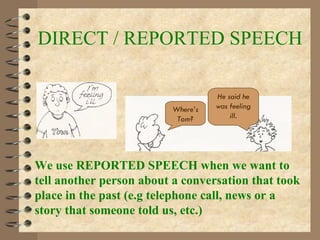
DIRECT / REPORTED SPEECH We use REPORTED SPEECH when we want to tell another person about a conversation that took place in the past (e.g telephone call, news or a story that someone told us, etc.) Where’s Tom? He said he was feeling ill .
CHANGES FROM DIRECT TO REPORTED SPEECH: Verb Tense Personal Pronouns, Possessives   Demonstratives Time & Place Expressions Special cases
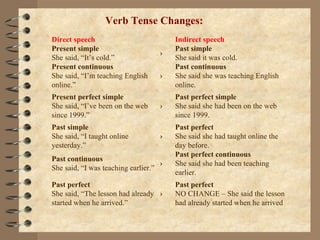
DIRECT SPEECH  REPORTED SPEECH   Verb Tense Changes: Direct speech  Indirect speech  Present simple  She said, “It’s cold.” › Past simple  She said it was cold. Present continuous  She said, “I’m teaching English online.” › Past continuous  She said she was teaching English online. Present perfect simple  She said, “I’ve been on the web since 1999.” › Past perfect simple She said she had been on the web since 1999. Past simple  She said, “I taught online yesterday.” › Past perfect  She said she had taught online the day before. Past continuous  She said, “I was teaching earlier.” › Past perfect continuous  She said she had been teaching earlier. Past perfect  She said, “The lesson had already started when he arrived.” › Past perfect  NO CHANGE – She said the lesson had already started when he arrived
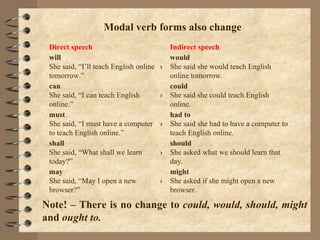
Note! – There is no change to  could, would, should, might  and  ought to. Modal verb forms also change Direct speech  Indirect speech  will She said, “I’ll teach English online tomorrow.” › would She said she would teach English online tomorrow. can She said, “I can teach English online.” › could She said she could teach English online. must She said, “I must have a computer to teach English online.” › had to  She said she had to have a computer to teach English online. shall She said, “What shall we learn today?” › should She asked what we should learn that day. may She said, “May I open a new browser?” › might She asked if she might open a new browser.
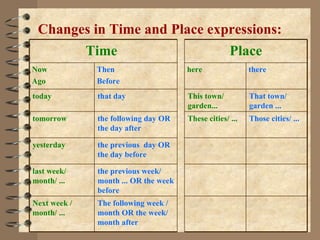
Changes in Time and Place expressions: Time  Place Now Ago Then Before here there today that day This town/ garden... That town/ garden ... tomorrow the following day OR the day after These cities/ ... Those cities/ ... yesterday the previous  day OR the day before last week/ month/ ... the previous week/ month ... OR the week before  Next week / month/ ... The following week / month OR the week/ month after
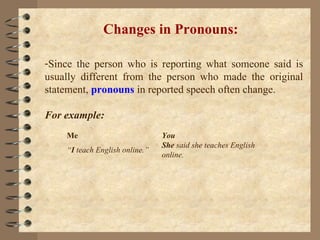
Changes in Pronouns: Since the person who is reporting what someone said is usually different from the person who made the original statement,  pronouns  in reported speech often change. For example:  Me  You  “ I  teach English online.”  She  said she teaches English online.
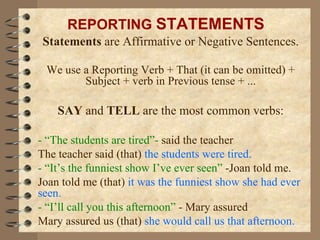
Statements  are Affirmative or Negative Sentences. We use a Reporting Verb + That (it can be omitted) + Subject + verb in Previous tense + ... SAY  and  TELL  are the most common verbs: - “The students are tired”-  said the teacher The teacher said   (that)  the students were tired. - “It’s the funniest show I’ve ever seen”  -Joan told me. Joan told me (that)  it was the funniest show she had ever seen. -   “I’ll call you this afternoon”  - Mary assured Mary assured us (that)  she would call us that afternoon. REPORTING  STATEMENTS
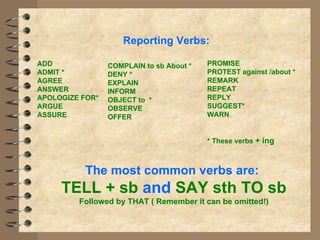
Reporting Verbs: ADD ADMIT * AGREE ANSWER APOLOGIZE FOR* ARGUE ASSURE COMPLAIN to sb About * DENY * EXPLAIN INFORM OBJECT to  * OBSERVE OFFER PROMISE PROTEST against /about * REMARK REPEAT REPLY SUGGEST* WARN * These verbs  + ing The most common verbs are:  TELL + sb  and  SAY sth TO sb Followed by THAT ( Remember it can be omitted!)
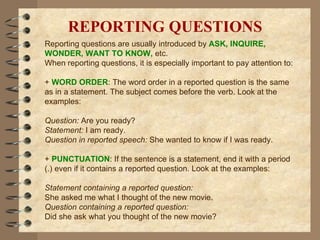
REPORTING QUESTIONS Reporting questions are usually introduced by  ASK, INQUIRE, WONDER, WANT TO KNOW,  etc.  When reporting questions, it is especially important to pay attention to: +  WORD ORDER : The word order in a reported question is the same as in a statement. The subject comes before the verb. Look at the examples: Question:  Are you ready? Statement:  I am ready. Question in reported speech:  She wanted to know if I was ready. +  PUNCTUATION : If the sentence is a statement, end it with a period (.) even if it contains a reported question. Look at the examples: Statement containing a reported question: She asked me what I thought of the new movie. Question containing a reported question: Did she ask what you thought of the new movie?
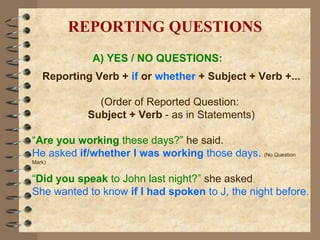
A) YES / NO QUESTIONS: Reporting Verb +  if   or   whether  + Subject + Verb +... (Order of Reported Question:  Subject + Verb  - as in Statements) “ Are you working  these days?”   he said. He asked  if/whether I was working  those days.  (No Question Mark) “ Did you speak  to John last night?”   she asked She wanted to know  if I had spoken  to J, the night before. REPORTING QUESTIONS
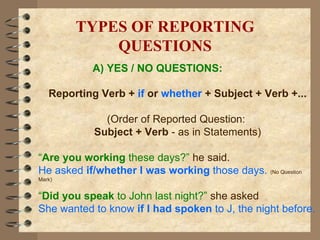
A) YES / NO QUESTIONS: Reporting Verb +  if   or   whether  + Subject + Verb +... (Order of Reported Question:  Subject + Verb  - as in Statements) “ Are you working  these days?”   he said. He asked  if/whether I was working  those days.  (No Question Mark) “ Did you speak  to John last night?”   she asked She wanted to know  if I had spoken  to J, the night before. TYPES OF REPORTING QUESTIONS
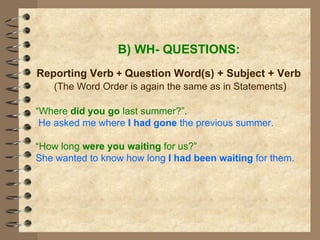
B) WH- QUESTIONS: Reporting Verb  +   Question Word(s) + Subject + Verb (The Word Order is again the same as in Statements ) “ Where  did you go  last summer?”. He asked me where  I had gone  the previous summer. “ How long  were you waiting  for us?” She wanted to know how long  I had been waiting  for them.
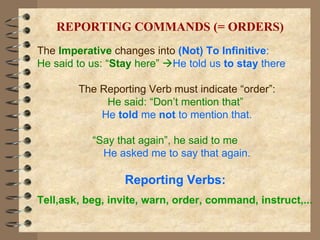
The  Imperative  changes into  (Not) To   Infinitive : He said to us: “ Stay  here”   He told us  to stay  there The Reporting Verb must indicate “order”: He said: “Don’t mention that”  He  told  me  not  to mention that. “ Say that again”, he said to me  He asked me to say that again. Reporting Verbs:  Tell,ask, beg, invite, warn, order, command, instruct,... REPORTING COMMANDS (= ORDERS)
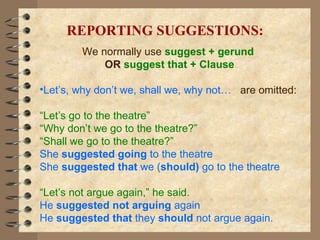
We normally use  suggest + gerund   OR   suggest that + Clause Let’s, why don’t we, shall we, why not…   are omitted: “ Let’s   go to the theatre”   “ Why don’t we go to the theatre?” “ Shall we go to the theatre?” She  suggested going  to the theatre She  suggested that  we ( should)  go to the theatre “ Let’s not argue again,” he said. He  suggested not arguing  again He  suggested that  they  should  not argue again. REPORTING SUGGESTIONS:

Reportedspeech

  • 1.
  • 2.
    DIRECT SPEECH vs REPORTED SPEECH We often have to give information about what people say or think. In order to do this you can use: DIRECT SPEECH Saying exactly what someone has said is called direct speech (sometimes called quoted speech). Here what a person says appears within quotation marks (“…”) and should be word for word. For example: “Today’s lesson is on presentations,” she said. INDIRECT/ REPORTED SPEECH It doesn’t use quotation marks to enclose what the person said and it doesn’t have to be word for word.
  • 3.
    DIRECT / REPORTEDSPEECH We use REPORTED SPEECH when we want to tell another person about a conversation that took place in the past (e.g telephone call, news or a story that someone told us, etc.) Where’s Tom? He said he was feeling ill .
  • 4.
    CHANGES FROM DIRECTTO REPORTED SPEECH: Verb Tense Personal Pronouns, Possessives Demonstratives Time & Place Expressions Special cases
  • 5.
    DIRECT SPEECH REPORTED SPEECH   Verb Tense Changes: Direct speech Indirect speech Present simple She said, “It’s cold.” › Past simple She said it was cold. Present continuous She said, “I’m teaching English online.” › Past continuous She said she was teaching English online. Present perfect simple She said, “I’ve been on the web since 1999.” › Past perfect simple She said she had been on the web since 1999. Past simple She said, “I taught online yesterday.” › Past perfect She said she had taught online the day before. Past continuous She said, “I was teaching earlier.” › Past perfect continuous She said she had been teaching earlier. Past perfect She said, “The lesson had already started when he arrived.” › Past perfect NO CHANGE – She said the lesson had already started when he arrived
  • 6.
    Note! – Thereis no change to could, would, should, might and ought to. Modal verb forms also change Direct speech Indirect speech will She said, “I’ll teach English online tomorrow.” › would She said she would teach English online tomorrow. can She said, “I can teach English online.” › could She said she could teach English online. must She said, “I must have a computer to teach English online.” › had to She said she had to have a computer to teach English online. shall She said, “What shall we learn today?” › should She asked what we should learn that day. may She said, “May I open a new browser?” › might She asked if she might open a new browser.
  • 7.
    Changes in Timeand Place expressions: Time Place Now Ago Then Before here there today that day This town/ garden... That town/ garden ... tomorrow the following day OR the day after These cities/ ... Those cities/ ... yesterday the previous day OR the day before last week/ month/ ... the previous week/ month ... OR the week before Next week / month/ ... The following week / month OR the week/ month after
  • 8.
    Changes in Pronouns:Since the person who is reporting what someone said is usually different from the person who made the original statement, pronouns in reported speech often change. For example: Me You “ I teach English online.” She said she teaches English online.
  • 9.
    Statements areAffirmative or Negative Sentences. We use a Reporting Verb + That (it can be omitted) + Subject + verb in Previous tense + ... SAY and TELL are the most common verbs: - “The students are tired”- said the teacher The teacher said (that) the students were tired. - “It’s the funniest show I’ve ever seen” -Joan told me. Joan told me (that) it was the funniest show she had ever seen. - “I’ll call you this afternoon” - Mary assured Mary assured us (that) she would call us that afternoon. REPORTING STATEMENTS
  • 10.
    Reporting Verbs: ADDADMIT * AGREE ANSWER APOLOGIZE FOR* ARGUE ASSURE COMPLAIN to sb About * DENY * EXPLAIN INFORM OBJECT to * OBSERVE OFFER PROMISE PROTEST against /about * REMARK REPEAT REPLY SUGGEST* WARN * These verbs + ing The most common verbs are: TELL + sb and SAY sth TO sb Followed by THAT ( Remember it can be omitted!)
  • 11.
    REPORTING QUESTIONS Reportingquestions are usually introduced by ASK, INQUIRE, WONDER, WANT TO KNOW, etc. When reporting questions, it is especially important to pay attention to: + WORD ORDER : The word order in a reported question is the same as in a statement. The subject comes before the verb. Look at the examples: Question: Are you ready? Statement: I am ready. Question in reported speech: She wanted to know if I was ready. + PUNCTUATION : If the sentence is a statement, end it with a period (.) even if it contains a reported question. Look at the examples: Statement containing a reported question: She asked me what I thought of the new movie. Question containing a reported question: Did she ask what you thought of the new movie?
  • 12.
    A) YES /NO QUESTIONS: Reporting Verb + if or whether + Subject + Verb +... (Order of Reported Question: Subject + Verb - as in Statements) “ Are you working these days?” he said. He asked if/whether I was working those days. (No Question Mark) “ Did you speak to John last night?” she asked She wanted to know if I had spoken to J, the night before. REPORTING QUESTIONS
  • 13.
    A) YES /NO QUESTIONS: Reporting Verb + if or whether + Subject + Verb +... (Order of Reported Question: Subject + Verb - as in Statements) “ Are you working these days?” he said. He asked if/whether I was working those days. (No Question Mark) “ Did you speak to John last night?” she asked She wanted to know if I had spoken to J, the night before. TYPES OF REPORTING QUESTIONS
  • 14.
    B) WH- QUESTIONS:Reporting Verb + Question Word(s) + Subject + Verb (The Word Order is again the same as in Statements ) “ Where did you go last summer?”. He asked me where I had gone the previous summer. “ How long were you waiting for us?” She wanted to know how long I had been waiting for them.
  • 15.
    The Imperative changes into (Not) To Infinitive : He said to us: “ Stay here”  He told us to stay there The Reporting Verb must indicate “order”: He said: “Don’t mention that” He told me not to mention that. “ Say that again”, he said to me He asked me to say that again. Reporting Verbs: Tell,ask, beg, invite, warn, order, command, instruct,... REPORTING COMMANDS (= ORDERS)
  • 16.
    We normally use suggest + gerund OR suggest that + Clause Let’s, why don’t we, shall we, why not… are omitted: “ Let’s go to the theatre” “ Why don’t we go to the theatre?” “ Shall we go to the theatre?” She suggested going to the theatre She suggested that we ( should) go to the theatre “ Let’s not argue again,” he said. He suggested not arguing again He suggested that they should not argue again. REPORTING SUGGESTIONS: