• Changing verb tenses:
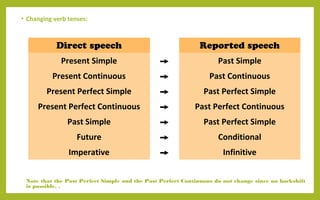
Note that the Past Perfect Simple and the Past Perfect Continuous do not change since no backshift
is possible. .
Direct speech Reported speech
Present Simple ➙ Past Simple
Present Continuous ➙ Past Continuous
Present Perfect Simple ➙ Past Perfect Simple
Present Perfect Continuous ➙ Past Perfect Continuous
Past Simple ➙ Past Perfect Simple
Future ➙ Conditional
Imperative ➙ Infinitive
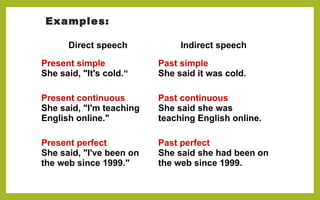
Direct speech Indirect speech
Present simple
She said, "It's cold.“
Present continuous
She said, "I'm teaching
English online."
Present perfect
She said, "I've been on
the web since 1999."
Past simple
She said it was cold.
Past continuous
She said she was
teaching English online.
Past perfect
She said she had been on
the web since 1999.
Examples:
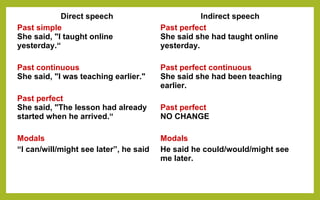
Direct speech Indirect speech
Past simple
She said, "I taught online
yesterday.“
Past continuous
She said, "I was teaching earlier."
Past perfect
She said, "The lesson had already
started when he arrived.“
Modals
“I can/will/might see later”, he said
Past perfect
She said she had taught online
yesterday.
Past perfect continuous
She said she had been teaching
earlier.
Past perfect
NO CHANGE
Modals
He said he could/would/might see
me later.
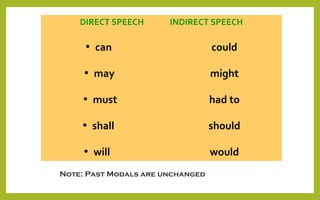
DIRECT SPEECH INDIRECT SPEECH
• can could
• may might
• must had to
• shall should
• will would
Note: Past Modals are unchanged
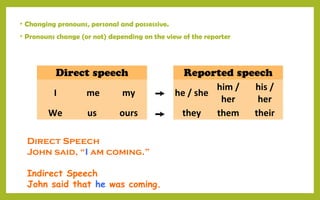
• Changing pronouns, personal and possessive.
• Pronouns change (or not) depending on the view of the reporter
Direct speech Reported speech
I me my ➙ he / she
him /
her
his /
her
We us ours ➙ they them their
Direct Speech
John said, “I am coming.”
Indirect Speech
John said that he was coming.
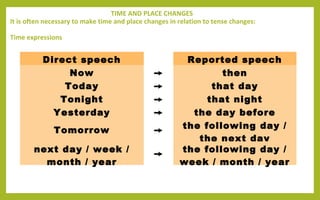
TIME AND PLACE CHANGES
It is often necessary to make time and place changes in relation to tense changes:
Time expressions
Direct speech Reported speech
Now ➙ then
Today ➙ that day
Tonight ➙ that night
Yesterday ➙ the day before
Tomorrow ➙ the following day /
the next day
next day / week /
month / year
➙ the following day /
week / month / year
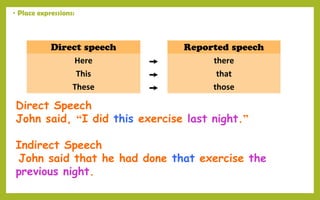
• Place expressions:
Direct speech Reported speech
Here ➙ there
This ➙ that
These ➙ those
Direct Speech
John said, “I did this exercise last night.”
Indirect Speech
 John said that he had done that exercise the
previous night.
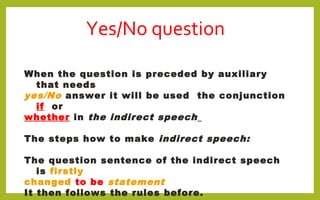
Yes/No question
When the question is preceded by auxiliary
that needs
yes/No answer it will be used the conjunction
if or
whether in the indirect speech
The steps how to make indirect speech:
The question sentence of the indirect speech
is firstly
changed to be statement
It then follows the rules before.
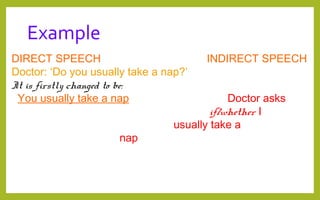
Example
DIRECT SPEECH INDIRECT SPEECH
Doctor: ‘Do you usually take a nap?’
It is firstly changed to be:
You usually take a nap Doctor asks
if/whether I
usually take a
nap
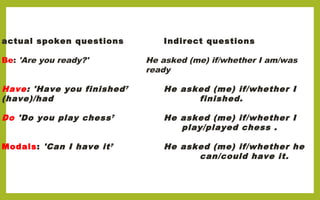
actual spoken questions Indirect questions
Be: 'Are you ready?' He asked (me) if/whether I am/was
ready
Have: 'Have you finished? He asked (me) if/whether I
(have)/had finished.
Do 'Do you play chess? He asked (me) if/whether I
play/played chess .
Modals: 'Can I have it? He asked (me) if/whether he
can/could have it.
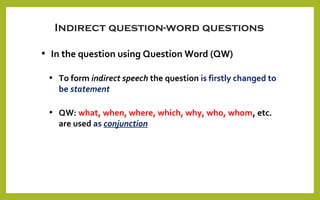
Indirect question-word questions
• In the question using Question Word (QW)
• To form indirect speech the question is firstly changed to
be statement
• QW: what, when, where, which, why, who, whom, etc.
are used as conjunction
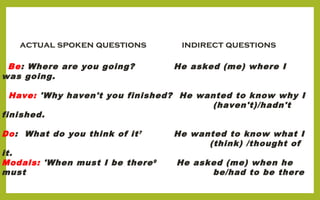
actual spoken questions indirect questions
Be: Where are you going? He asked (me) where I
was going.
Have: 'Why haven't you finished? He wanted to know why I
(haven't)/hadn't
finished.
Do: What do you think of it? He wanted to know what I
(think) /thought of
it.
Modals: 'When must I be there9 He asked (me) when he
must be/had to be there
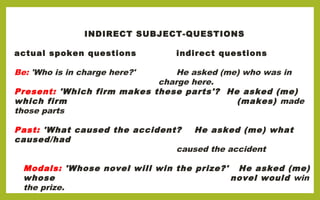
INDIRECT SUBJECT-QUESTIONS
actual spoken questions indirect questions
Be: 'Who is in charge here?' He asked (me) who was in
charge here.
Present: 'Which firm makes these parts'? He asked (me)
which firm (makes) made
those parts
Past: 'What caused the accident? He asked (me) what
caused/had
caused the accident
Modals: 'Whose novel will win the prize?' He asked (me)
whose novel would win
the prize.
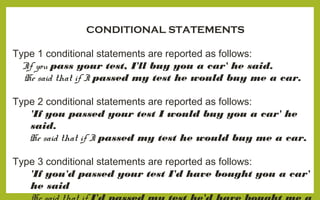
CONDITIONAL STATEMENTS
Type 1 conditional statements are reported as follows:
'If you pass your test, I'll buy you a car' he said.
He said that if I passed my test he would buy me a car.
Type 2 conditional statements are reported as follows:
'If you passed your test I would buy you a car' he
said.
He said that if I passed my test he would buy me a car.
Type 3 conditional statements are reported as follows:
'If you'd passed your test I'd have bought you a car'
he said
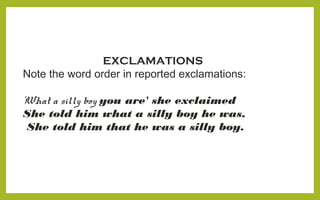
EXCLAMATIONS
Note the word order in reported exclamations:
'What a silly boy you are' she exclaimed
She told him what a silly boy he was.
She told him that he was a silly boy.
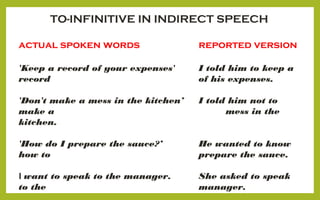
TO-INFINITIVE IN INDIRECT SPEECH
actual spoken words reported version
'Keep a record of your expenses' I told him to keep a
record of his expenses.
'Don't make a mess in the kitchen’ I told him not to
make a mess in the
kitchen.
'How do I prepare the sauce?’ He wanted to know
how to prepare the sauce.
I want to speak to the manager. She asked to speak
to the manager.
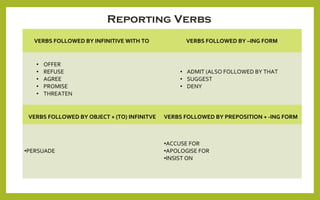
Reporting Verbs
VERBS FOLLOWED BY INFINITIVE WITH TO VERBS FOLLOWED BY –ING FORM
• OFFER
• REFUSE
• AGREE
• PROMISE
• THREATEN
• ADMIT (ALSO FOLLOWED BY THAT
• SUGGEST
• DENY
VERBS FOLLOWED BY OBJECT + (TO) INFINITVE VERBS FOLLOWED BY PREPOSITION + -ING FORM
•PERSUADE
•ACCUSE FOR
•APOLOGISE FOR
•INSIST ON
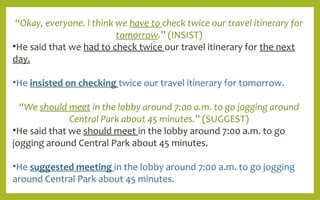
“Okay, everyone. I think we have to check twice our travel itinerary for
tomorrow.” (INSIST)
•He said that we had to check twice our travel itinerary for the next
day.
•He insisted on checking twice our travel itinerary for tomorrow.
“We should meet in the lobby around 7:00 a.m. to go jogging around
Central Park about 45 minutes.” (SUGGEST)
•He said that we should meet in the lobby around 7:00 a.m. to go
jogging around Central Park about 45 minutes.
•He suggested meeting in the lobby around 7:00 a.m. to go jogging
around Central Park about 45 minutes.
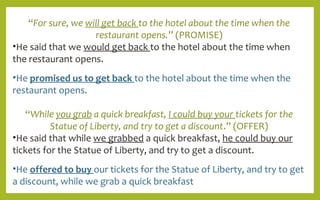
“For sure, we will get back to the hotel about the time when the
restaurant opens.” (PROMISE)
•He said that we would get back to the hotel about the time when
the restaurant opens.
•He promised us to get back to the hotel about the time when the
restaurant opens.
“While you grab a quick breakfast, I could buy your tickets for the
Statue of Liberty, and try to get a discount.” (OFFER)
•He said that while we grabbed a quick breakfast, he could buy our
tickets for the Statue of Liberty, and try to get a discount.
•He offered to buy our tickets for the Statue of Liberty, and try to get
a discount, while we grab a quick breakfast
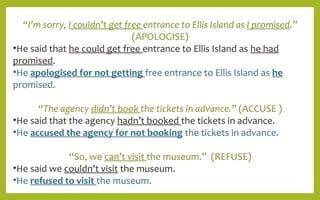
“I’m sorry, I couldn’t get free entrance to Ellis Island as I promised.”
(APOLOGISE)
•He said that he could get free entrance to Ellis Island as he had
promised.
•He apologised for not getting free entrance to Ellis Island as he
promised.
“The agency didn’t book the tickets in advance.” (ACCUSE )
•He said that the agency hadn’t booked the tickets in advance.
•He accused the agency for not booking the tickets in advance.
“So, we can’t visit the museum.” (REFUSE)
•He said we couldn’t visit the museum.
•He refused to visit the museum.
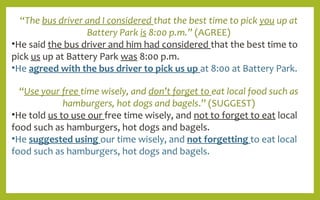
“The bus driver and I considered that the best time to pick you up at
Battery Park is 8:00 p.m.” (AGREE)
•He said the bus driver and him had considered that the best time to
pick us up at Battery Park was 8:00 p.m.
•He agreed with the bus driver to pick us up at 8:00 at Battery Park.
“Use your free time wisely, and don’t forget to eat local food such as
hamburgers, hot dogs and bagels.” (SUGGEST)
•He told us to use our free time wisely, and not to forget to eat local
food such as hamburgers, hot dogs and bagels.
•He suggested using our time wisely, and not forgetting to eat local
food such as hamburgers, hot dogs and bagels.
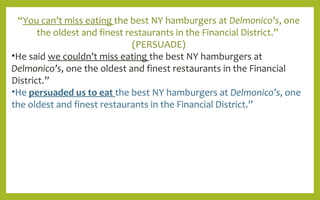
“You can’t miss eating the best NY hamburgers at Delmonico’s, one
the oldest and finest restaurants in the Financial District.”
(PERSUADE)
•He said we couldn’t miss eating the best NY hamburgers at
Delmonico’s, one the oldest and finest restaurants in the Financial
District.”
•He persuaded us to eat the best NY hamburgers at Delmonico’s, one
the oldest and finest restaurants in the Financial District.”

Reported speech and reporting verbs for Upper-Intermediate levels

  • 2.
    • Changing verbtenses: Note that the Past Perfect Simple and the Past Perfect Continuous do not change since no backshift is possible. . Direct speech Reported speech Present Simple ➙ Past Simple Present Continuous ➙ Past Continuous Present Perfect Simple ➙ Past Perfect Simple Present Perfect Continuous ➙ Past Perfect Continuous Past Simple ➙ Past Perfect Simple Future ➙ Conditional Imperative ➙ Infinitive
  • 3.
    Direct speech Indirectspeech Present simple She said, "It's cold.“ Present continuous She said, "I'm teaching English online." Present perfect She said, "I've been on the web since 1999." Past simple She said it was cold. Past continuous She said she was teaching English online. Past perfect She said she had been on the web since 1999. Examples:
  • 4.
    Direct speech Indirectspeech Past simple She said, "I taught online yesterday.“ Past continuous She said, "I was teaching earlier." Past perfect She said, "The lesson had already started when he arrived.“ Modals “I can/will/might see later”, he said Past perfect She said she had taught online yesterday. Past perfect continuous She said she had been teaching earlier. Past perfect NO CHANGE Modals He said he could/would/might see me later.
  • 5.
    DIRECT SPEECH INDIRECTSPEECH • can could • may might • must had to • shall should • will would Note: Past Modals are unchanged
  • 6.
    • Changing pronouns,personal and possessive. • Pronouns change (or not) depending on the view of the reporter Direct speech Reported speech I me my ➙ he / she him / her his / her We us ours ➙ they them their Direct Speech John said, “I am coming.” Indirect Speech John said that he was coming.
  • 7.
    TIME AND PLACECHANGES It is often necessary to make time and place changes in relation to tense changes: Time expressions Direct speech Reported speech Now ➙ then Today ➙ that day Tonight ➙ that night Yesterday ➙ the day before Tomorrow ➙ the following day / the next day next day / week / month / year ➙ the following day / week / month / year
  • 8.
    • Place expressions: Directspeech Reported speech Here ➙ there This ➙ that These ➙ those Direct Speech John said, “I did this exercise last night.” Indirect Speech  John said that he had done that exercise the previous night.
  • 9.
    Yes/No question When thequestion is preceded by auxiliary that needs yes/No answer it will be used the conjunction if or whether in the indirect speech The steps how to make indirect speech: The question sentence of the indirect speech is firstly changed to be statement It then follows the rules before.
  • 10.
    Example DIRECT SPEECH INDIRECTSPEECH Doctor: ‘Do you usually take a nap?’ It is firstly changed to be: You usually take a nap Doctor asks if/whether I usually take a nap
  • 11.
    actual spoken questionsIndirect questions Be: 'Are you ready?' He asked (me) if/whether I am/was ready Have: 'Have you finished? He asked (me) if/whether I (have)/had finished. Do 'Do you play chess? He asked (me) if/whether I play/played chess . Modals: 'Can I have it? He asked (me) if/whether he can/could have it.
  • 12.
    Indirect question-word questions •In the question using Question Word (QW) • To form indirect speech the question is firstly changed to be statement • QW: what, when, where, which, why, who, whom, etc. are used as conjunction
  • 13.
    actual spoken questionsindirect questions Be: Where are you going? He asked (me) where I was going. Have: 'Why haven't you finished? He wanted to know why I (haven't)/hadn't finished. Do: What do you think of it? He wanted to know what I (think) /thought of it. Modals: 'When must I be there9 He asked (me) when he must be/had to be there
  • 14.
    INDIRECT SUBJECT-QUESTIONS actual spokenquestions indirect questions Be: 'Who is in charge here?' He asked (me) who was in charge here. Present: 'Which firm makes these parts'? He asked (me) which firm (makes) made those parts Past: 'What caused the accident? He asked (me) what caused/had caused the accident Modals: 'Whose novel will win the prize?' He asked (me) whose novel would win the prize.
  • 15.
    CONDITIONAL STATEMENTS Type 1conditional statements are reported as follows: 'If you pass your test, I'll buy you a car' he said. He said that if I passed my test he would buy me a car. Type 2 conditional statements are reported as follows: 'If you passed your test I would buy you a car' he said. He said that if I passed my test he would buy me a car. Type 3 conditional statements are reported as follows: 'If you'd passed your test I'd have bought you a car' he said
  • 16.
    EXCLAMATIONS Note the wordorder in reported exclamations: 'What a silly boy you are' she exclaimed She told him what a silly boy he was. She told him that he was a silly boy.
  • 17.
    TO-INFINITIVE IN INDIRECTSPEECH actual spoken words reported version 'Keep a record of your expenses' I told him to keep a record of his expenses. 'Don't make a mess in the kitchen’ I told him not to make a mess in the kitchen. 'How do I prepare the sauce?’ He wanted to know how to prepare the sauce. I want to speak to the manager. She asked to speak to the manager.
  • 18.
    Reporting Verbs VERBS FOLLOWEDBY INFINITIVE WITH TO VERBS FOLLOWED BY –ING FORM • OFFER • REFUSE • AGREE • PROMISE • THREATEN • ADMIT (ALSO FOLLOWED BY THAT • SUGGEST • DENY VERBS FOLLOWED BY OBJECT + (TO) INFINITVE VERBS FOLLOWED BY PREPOSITION + -ING FORM •PERSUADE •ACCUSE FOR •APOLOGISE FOR •INSIST ON
  • 20.
    “Okay, everyone. Ithink we have to check twice our travel itinerary for tomorrow.” (INSIST) •He said that we had to check twice our travel itinerary for the next day. •He insisted on checking twice our travel itinerary for tomorrow. “We should meet in the lobby around 7:00 a.m. to go jogging around Central Park about 45 minutes.” (SUGGEST) •He said that we should meet in the lobby around 7:00 a.m. to go jogging around Central Park about 45 minutes. •He suggested meeting in the lobby around 7:00 a.m. to go jogging around Central Park about 45 minutes.
  • 21.
    “For sure, wewill get back to the hotel about the time when the restaurant opens.” (PROMISE) •He said that we would get back to the hotel about the time when the restaurant opens. •He promised us to get back to the hotel about the time when the restaurant opens. “While you grab a quick breakfast, I could buy your tickets for the Statue of Liberty, and try to get a discount.” (OFFER) •He said that while we grabbed a quick breakfast, he could buy our tickets for the Statue of Liberty, and try to get a discount. •He offered to buy our tickets for the Statue of Liberty, and try to get a discount, while we grab a quick breakfast
  • 22.
    “I’m sorry, Icouldn’t get free entrance to Ellis Island as I promised.” (APOLOGISE) •He said that he could get free entrance to Ellis Island as he had promised. •He apologised for not getting free entrance to Ellis Island as he promised. “The agency didn’t book the tickets in advance.” (ACCUSE ) •He said that the agency hadn’t booked the tickets in advance. •He accused the agency for not booking the tickets in advance. “So, we can’t visit the museum.” (REFUSE) •He said we couldn’t visit the museum. •He refused to visit the museum.
  • 23.
    “The bus driverand I considered that the best time to pick you up at Battery Park is 8:00 p.m.” (AGREE) •He said the bus driver and him had considered that the best time to pick us up at Battery Park was 8:00 p.m. •He agreed with the bus driver to pick us up at 8:00 at Battery Park. “Use your free time wisely, and don’t forget to eat local food such as hamburgers, hot dogs and bagels.” (SUGGEST) •He told us to use our free time wisely, and not to forget to eat local food such as hamburgers, hot dogs and bagels. •He suggested using our time wisely, and not forgetting to eat local food such as hamburgers, hot dogs and bagels.
  • 24.
    “You can’t misseating the best NY hamburgers at Delmonico’s, one the oldest and finest restaurants in the Financial District.” (PERSUADE) •He said we couldn’t miss eating the best NY hamburgers at Delmonico’s, one the oldest and finest restaurants in the Financial District.” •He persuaded us to eat the best NY hamburgers at Delmonico’s, one the oldest and finest restaurants in the Financial District.”